The Youth’s Instructor, Vol. LIII, No. 38

Faith Cometh
Earlier text: Faith Cometh

Little Bob Stood the Test

The “Blue Line” stopped at the corner, and an anxious-looking young woman put a small boy inside.
“Now, Bob,” said his mother, “don’t lose that note I gave you, don’t take it out of your pocket at all.”
“No’m,” said the little man, looking wistfully after his mother as the conductor pulled the strap, the driver unscrewed the brake, and the horses, shaking their bells, trotted off with the car.
“What’s your name, Bob?” asked a mischievous-looking young man sitting beside him.
“Robert Cullen Deeme,” he answered.
“Where are you going?”
“To my grandma’s.”
“Let me see that note in your pocket.”
The look of innocent surprise on the round face ought to have shamed the baby’s tormentor, but he only said again, “Let me see it.”
“I tan’t,” said Robert Cullen Deeme.
“See here, if you don’t, I’ll scare the horses and make them run away.”
The little boy cast an apprehensive look at the horses, but shook his head.
“Here, Bob, I’ll give you this peach if you’ll pull that note half-way out of your pocket.”
The boy did not reply, but some of the older people looked angry.
“I say, chum, I’ll give you this whole bag of peaches if you will just show me the corner of your note,” said the tempter. The child turned away, as if he did not want to hear any more, but the young man opened the bag and held it just where he could see and smell the luscious fruit.
A look of distress came into the sweet little face; I believe Bob was afraid to trust himself, and when a man left his seat at the other end to get off the car, the little boy slid quickly down, left the temptation behind, and crept quickly into the vacant place.
A pair of prettily gloved hands began almost unconsciously to clap, and then everybody clapped and applauded until it might have alarmed Bob, if a young lady sitting by had not slipped her arm around him, and said, with a sweet glow on her face: “Tell your mama that we all congratulate her upon having a little man strong enough to resist temptation, and wise enough to run away from it.”
I doubt if that long message ever reached Bob’s mother, but no matter, the note got to his grandmother without ever coming out of his pocket.— Young Pilgrim.

The Boy in Grandpa

GRANDPA LANGLEY had had his hair cut. From their own pew the Sutherlands could see the close-cropped silver head and the bent shoulders of the old man as he sat in the very front seat, almost under the pulpit, listening, with his ear-trumpet, to the minister’s sermon.
A tender smile played around the corners of Mama Sutherland’s mouth each time she looked at him. There was something so boyish in his appearance. She lost some parts of the sermon, for her memory kept bringing pictures to her mind of their old home and her father, Grandpa Langley, in years gone by.
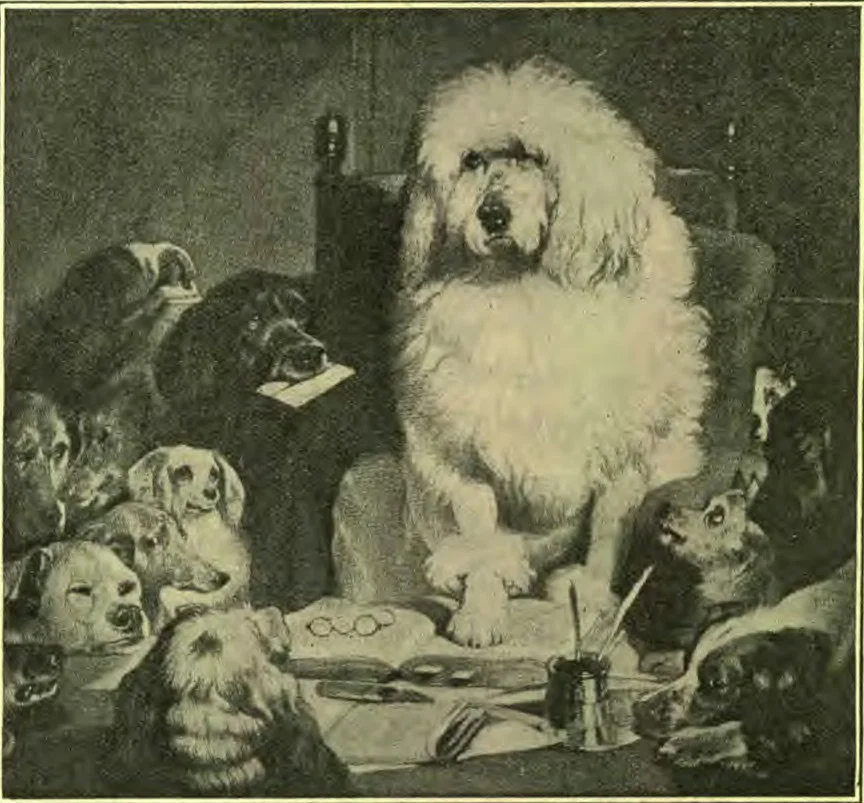
LANDSEER'S FAMOUS PAINTING, “LAYING DOWN THE LAW”
He usually waited at the door to help Grandpa Langley down the steps, but this time, when the service was over, he slipped along up the thronged aisle to the front seat, and helped him get his muffler and overcoat on, and slid his hand into the old man’s as they walked up the aisle together.
Grandpa did not talk much to people because he could not hear if they answered, but his kindly old face beamed as he shook hands and nodded at folks. There was something so “cute” about him this morning that Everett laughed outright with pleasure.
“Hey?” said the old man, turning to Everett. He had heard a sound, and thought the boy spoke. But Everett only smiled back into the twinkling eyes and shook his head.
That afternoon he was reading in the library. Grandpa Langley had fallen asleep in the Morris chair, and Mama Sutherland sat near by. Kathie had gone to the hospital with the flowers and papers. Everett looked over at the peaceful face and closed eyes, then at mama, and their eyes met.
“Isn’t he just like a boy to-day, mama!” he exclaimed.
“It’s the boy in him that you see, Everett,” said mama, laying down her book.
Everett looked puzzled.
“Don’t you know what stories he tells of the jolly times he had when he was a boy?” she asked. “He was a boy once, just like you.”
“Of course,” said Everett.
“Well, he is a boy yet. Has he ever forgotten how to flip marbles? It is all in him; he didn’t change into a young man and lose the boy; the boy was all there, and more, too. Then when he was a strong young man, and worked and earned the bread and butter for grandma and the babies at home on the little farm, he was still a boy, but a man, too. Then by and by, when he was middle-aged, and we children were all big, he still worked hard to send us away to school, one after the other. His hair began to get gray, but still he was a boy, and a young man, too, and, most of all, the older man. He hadn’t lost any of it; he had had all the experience and all the knowledge, and he kept growing and adding; but the boy is still there, and the young man, and the middle-aged man.”
Everett’s eyes were big and wondering. “How much there is to him!” he said, softly, turning his own brown head to look at the silver one. “Didn’t he keep adding, though?”
“How much of reverence we owe to him, and how loving and patient we should be,” said mama, dreamily. “I hope you will keep adding, dearie, so that when you grow to be old, there will be in you such a splendid boy and such a splendid young man as there is in grandpa.”
Everett hoped so, too, and made up his mind that, with the dear Lord to help him, he would do it.
Grandpa woke suddenly, and looked up at the two. “Hey?” he said. He always thought some one had spoken to him.
Everett slid his hassock over to the Morris chair, and laid his hand on the wrinkled one. Grandpa’s face was all wrinkled, too,—wrinkled with smiles as he turned toward Everett. “Sonnie,” he began, “when I was a boy,”—
Everett looked swiftly toward mama, as she looked at him, in loving appreciation of the boy in grandpa.—Sunday School Times.

What Would You Like to Do?

IRMA STONE’S aunt, Elsie Milton, had just returned from abroad; and Irma was delighted with the souvenirs she had brought home, and the accounts she gave of what she had seen during her travels, and at knowing that her aunt had received high honors abroad.
Irma’s mama had much work to do; and Miss Milton, too, was busy in her own room. But Irma, instead of helping either of them, hindered her aunt by asking her questions.
“Aunt Elsie, don’t you wish you could go back to those places again?” Irma asked; but her aunt replied, “Oh, no, I am glad to stay at home now.”
Soon the little girl inquired, “Aunt Elsie, wouldn’t you like to go somewhere else now, where you have not been?” and Miss Milton answered, “No, my dear, I’m tired of strange places and strange people and everything strange, and am happy to be in this old familiar place again.”
After a time Irma questioned, “Auntie, didn’t you feel proud when you received such high honors?”
Miss Milton surprised her little niece by replying, “Not so proud as sometimes, when I was a child, when I had a new dress or hat, or even a new hair ribbon.”
Irma was silent a few minutes. Then she asked, “Aunt Elsie, which did you enjoy most, the beautiful things you saw, or the fine music you heard, or the nice presents you received, or the praise that was given you, or the grand gatherings you attended, or what?”
Miss Milton declared it would be difficult to decide what had given her most happiness; for some things that she had much enjoyed for a time had been a sorrow to her afterward, and other things, which she had not at first regarded as a source of pleasure, afterward gave her much satisfaction.
Still Irma urged, “Which would you rather have occur again?”
When Aunt Elsie replied, very gravely: “My dear, there is one thing that I wish I had done oftener. If I had done so, I would be happier now. But I used often to think it a task rather than a privilege.”
“What was it, auntie?” Irma inquired.
Her aunt replied: “Helping my mother. Many of the things I used to do instead are not worth remembering, and such as were worth doing I may yet have opportunity for. But I can never again help my mother.”
Irma stood thinking for a few moments, then she went quietly from the room, and soon, in another part of the house, she was saying, “Mama, I want to do something to help you.”
— Mrs. A. D. Wellman.

Insects and Their Habits, and What Harold Learned About Them
“O! JUST let me see these specimens that I have fixed, will you please, uncle? I’m so anxious to see how they look through the glass.”
Uncle Frank turned his head, and there stood his young nephew, with two or three small pieces of glass in his hands, upon each of which was some substance almost too small to be seen by the unaided eye.
“I found a mosquito down by the river; I haven’t seen one before this summer; the rascal bit me, and I killed him for his pains,—see uncle, it is quite swollen. But I want to see how his head looks, and his bill, and—”
“I hope you saved the wing,” said Uncle Frank; “if you have, you will be surprised at its beauty.”
“I think I did, uncle, I meant to; but I want to see his bill,—the thing he bit me with.”
Uncle Frank put the tiny head under the glass at once, and smiled. “You have a fine specimen here, only your mosquito is a gnat, very much like the mosquito, however; in fact, we may call them cousins. You may see the proboscis which stung you; now you don’t wonder the wound has swollen a little, do you?”
“Why! can it be that this is the head of that little chap? Well, his bite hurt, but not so much as the sting of those bees. But what is that great thing beside the head? O, I see! that’s the wing. I stuck that down on the glass because I wanted to know all about it. The head is as pretty as a plant, and looks a little bit like one, too; and the wing—O my! that looks like anything in the world but a gnat’s wing, doesn’t it, uncle?”
“It looks much like a mosquito’s wing, only the embroidery, or trimming, as we might call it, around the edge, is not quite so elaborate. A great many years ago, when the country was newer than it now is, mosquitoes were not quite so much of a curiosity as they are now in this section of the country. I can remember sleeping in the barn many a summer to get rid of them.”
“Didn’t they creep through the cracks, uncle?”
“O, no! the smell of the clover and hay drove them away. O how I used to enjoy those nights in the old barn, sleeping on the fragrant hay! When we would shut up the house for the night, ready to go to our sleeping quarters, the hm-m, hm-m of the disappointed insects left behind was loud and fierce,—for there were myriads of them,—and right glad we were to escape them.”
“But how did you manage in the daytime? You couldn’t stay in the barn all the time.”
“They were not so troublesome days; though I can remember standing by my mother’s side, when a child, and fanning the blood-thirsty insects away from her while she sewed.”
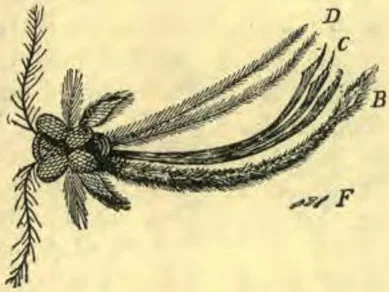
All this time, Uncle Frank was busy adjusting another lens to his instrument. “I have an idea there is something else here worth looking at, but it is too small to see plainly through the first lens. Ah, here we are,—I thought so: you noticed maybe that the proboscis looked rough and strange through the first lens. The fact is that it is completely covered with tiny feathers, which this stronger lens reveals.”
“Feathers! O uncle, there’s something strange and new all the time. Think of feathers on the bill of a little gnat! I wonder what they are for. How strange they look.”
“I can not tell you their use, but you may be sure they act some part in the physical make-up of the little creature. We can not understand all the ways of the great Creator; they are past finding out,” said Uncle Frank, reverently. “But,” continued he, “this little instrument called a sting, or proboscis, is really composed of six tiny lancets, covered over by the feathery sheath. The wings of the gnat are also most wonderful pieces of mechanism. They are estimated to vibrate three thousand times a minute when the insect is flying. Think of a joint so delicate as that which must connect this wing to the body, and yet so elastic and smooth that it will allow of such tremendous speed and motion as this!”
“I should think the joints would need oiling pretty often,” said Harold.
“And yet the little insect is almost constantly using his wings. So delicate, and yet such perfect mechanism! It is wonderful, and the more we study these things, the more astonished we feel. The earth and the sea are filled with tiny creatures, some of them too small to be seen by the unaided eye, and yet when we place just one of them under the magnifying-glass, we find enough to keep the wisest philosopher studying almost for a life-time; and then he will not find out all there is to know.”
“It makes a little boy like me feel pretty small and ignorant, Uncle Frank,” sighed Harold.
“That is the way the wisest feel,—small and ignorant. But here is something else I would like you to examine. I was at considerable trouble to mount and prepare the specimen, for I am not very skilful in the business. Now what do you suppose this is?”
“I haven’t the least idea, uncle; it is very pretty; it looks almost like a piece of lace.”
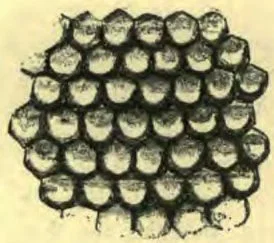
“You would never guess it to be the eye of a common fly, would you?”
“A fly’s eye! O uncle! what are those little six-sided blocks?”
“They are single, separate eyes, and it has been computed by adepts that there are at least seven thousand such little eyes in one single large eye of the fly.”
“Well, I don’t wonder that I never can surprise a fly. They always see me, no matter on which side of them I come.”
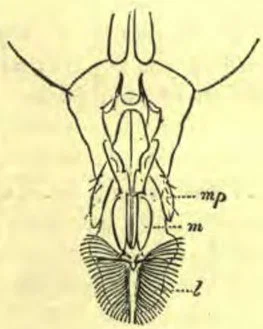
“Yes; you may surprise a person if you approach him from behind, for he can not see you; but a tiny insect can not be caught off its guard for a moment. And here,” continued Uncle Frank, “is the mouth and tongue, or proboscis, of the fly. Isn’t it wonderful? You see it is particularly adapted for sucking juices. Flies, as you know, are great eaters.”
“That’s what mama thinks, I am sure; she is always hiding things from them; they are filthy fellows, aren’t they, uncle?”
“Yes, they are not at all particular about their food; indeed, they seem to be a trifle fonder of carrion than anything else. One great naturalist declared that three flies would consume the dead body of a horse as quickly as a lion could do the same; that is, the flies and their offspring. They begin to eat at once, and never cease. And when we remember that one single blow fly can become the parent of twenty thousand others, the statement of the naturalist does not seem unreasonable. And so we find that even these ugly creatures that are shunned and detested by mankind are really useful scavengers, ridding the world of an enormous quantity of deadly, poisonous matter. But now, my dear Harold, we must close our studies for the present, because, you know, I must start on my homeward voyage to-morrow. But I am sure you have become sufficiently interested in the things you have seen and heard about insects, to continue your studies, which you can do even without a teacher; and, my dear boy, if you and I are so happy as to be numbered among the blessed company of the saved, we shall have an eternity in which to learn more and more of the wonderful works of the God whose name is Love.”
The next week when Harold’s birthday came, he received a beautiful microscope, a present from his Uncle Frank.
MRS. L. D. AVERY-STUTTLE.
(Concluded)

A Word About the Illustrations

THE illustration at the top of the page shows the mosquito’s bill instead of that of a gnat. The figure marked F shows the actual size, while B, C, and D show the parts much enlarged. The second figure, as you recognize, represents the parts of a fly’s eye, while the third shows the proboscis of the fly. When a fly settles upon a lump of sugar or other sweet object, or even upon the back of our hand when covered with perspiration, it unbends its proboscis, extends it, and the broad knob-like end divides into two flat, muscular leaves (marked 1), which thus form a broad sucker-like surface, with which the fly laps up liquid sweets, or any matter which seems good to its mind. The two flaps at the end are supported upon a framework of strong but delicate rods which act as a set of springs to open and shut the broad flaps. The inside of this broad, fleshy expansion is rough, like a rasp.

(September 30)

XIV—Review

(September 30)

MEMORY VERSE: “Bring ye all the tithes into the storehouse, that there may be meat in mine house, and prove me now herewith, saith the Lord of hosts, if I will not open you the windows of heaven, and pour you out a blessing, that there shall not be room enough to receive it.” Mal. 3:10.

Questions

1. What indictment is brought against the church by the prophet Malachi? Mal. 3:8, 9.
2. What great blessing is promised if they repent? Mal. 3:10.
3. How much did Christ give up to redeem man? How complete was his sacrifice? 2 Cor. 8:9.
4. How much must we give up to secure the pearl of eternal life? Matt. 19:29.
5. How extensively has the Lord said that the gospel shall be preached? Matt. 24:14.
6. What plan has the Lord laid for the support of those who preach the gospel? 1 Cor. 9:13, 14.
7. With what ancient priesthood was the tithing system connected? Heb. 7:1, 2.
8. In what besides the tithe have God’s people robbed him? Mal. 3:8.
9. According to what measure are they to give? 2 Cor. 8:12.
10. How is the offering to be estimated? 1 Cor. 16:1, 2.
11. How willing is the Lord to bestow his Holy Spirit? Luke 11:13.
12. What promise for the last days is made through the prophet Joel concerning the Holy Spirit? Joel 2:28.
13. For what should we especially pray at this time? Zech. 10:1.
14. Tell one way in which we may bring the showers of the latter rain. Mal. 3:10.

INTERMEDIATE LESSON

XIV—The Good Samaritan

(September 30)
LESSON SCRIPTURE: Luke 10:25-42.
MEMORY VERSE: “But the stranger that dwelleth with you shall be unto you as one born among you, and thou shalt love him as thyself; for ye were strangers in the land of Egypt: I am the Lord your God.” Lev. 19:34.
“And, behold, a certain lawyer stood up, and tempted him, saying, Master, what shall I do to inherit eternal life? He said unto him, What is written in the law? how readest thou? And he answering said, Thou shalt love the Lord thy God with all thy heart, and with all thy soul, and with all thy strength, and with all thy mind; and thy neighbor as thyself. And he said unto him, Thou hast answered right: this do, and thou shalt live.
“But he, willing to justify himself, said unto Jesus, And who is my neighbor? And Jesus answering said, A certain man went down from Jerusalem to Jericho, and fell among thieves, which stripped him of his raiment, and wounded him, and departed, leaving him half dead. And by chance there came down a certain priest that way: and when he saw him, he passed by on the other side. And likewise a Levite, when he was at the place, came and looked on him, and passed by on the other side. But a certain Samaritan, as he journeyed, came where he was: and when he saw him, he had compassion on him, and went to him, and bound up his wounds, pouring in oil and wine, and set him on his own beast, and brought him to an inn, and took care of him. And on the morrow when he departed, he took out two pence, and gave them to the host, and said unto him, Take care of him; and whatsoever thou spendest more, when I come again, I will repay thee. Which now of these three, thinkest thou, was neighbor unto him that fell among the thieves? And he said, He that showed mercy on him. Then said Jesus unto him, Go, and do thou likewise.
“Now it came to pass, as they went, that he entered into a certain village: and a certain woman named Martha received him into her house. And she had a sister called Mary, which also sat at Jesus’ feet, and heard his word. But Martha was cumbered about much serving, and came to him, and said, Lord, dost thou not care that my sister hath left me to serve alone? bid her therefore that she help me. And Jesus answered and said unto her, Martha, Martha, thou art careful and troubled about many things: but one thing is needful: and Mary hath chosen that good part, which shall not be taken away from her.”

Questions

  1. Who came to Jesus one day? What question did he ask the Master? How did Jesus avoid being drawn into a controversy with this man?
  2. What question did Jesus ask the lawyer? Repeat his reply. How much does God require of men, in order that they may inherit eternal life? Then in answering the question of Jesus, what other question was the lawyer really answering?
  3. What did Jesus say to the lawyer about his answer? What question did the man now ask? Why?
  4. How did Jesus answer this question? What had happened to a certain man who went from Jerusalem to Jericho? In what condition was he left by the roadside?
  1. Who passed that way a little later? Why would one have expected this man to go to the aid of the traveler? What special command had the Lord given the Jews concerning strangers? Memory verse. Instead of helping the wounded stranger, what did the priest do? A little later, what other man passed by? What did he also do?
  2. After this who passed that way? How were the Samaritans regarded by the Jews? Read John 4:9, last clause. How did the Samaritan feel when he saw the wounded man? What did he do? When he had dressed his wounds, what did he do?
  3. When the Samaritan had carried the wounded man to an inn, how did he further provide for him? When Jesus had told this story to the lawyer, and the people gathered about, what question did he ask? How did the lawyer answer? Then what did Jesus bid the lawyer do?
  4. From the story of the good Samaritan, what do we learn about our duty to minister to others? Who are our neighbors? How much should we be willing to do for them?
  5. After this, to what little village did Jesus go?—Bethany. Whose home did he visit in Bethany? As Jesus was resting, what did Martha do? Where was Mary at this time? What did Martha ask Jesus to have Mary do?
  6. Tell how Jesus answered Martha. Upon whom has he taught us to cast all care? 1 Peter 5:7. For what has he told us to take no anxious thought? Matt. 6:31. What promise is made to all who seek first the kingdom of God and his righteousness? Verse 33.

Is the Key in Your Pocket?

Did you ever hear a man remind the Lord of his promise in Mal. 3:10? I have many a time. I have heard men really demand the Lord to open the windows of heaven and pour out a blessing. It would seem as if they would actually force them open; but the windows did not open, the blessing did not come, and they felt a little hard toward the Lord for the failure. But all the time they had the key in their pockets, and did not use it.
How does the promise read? Look sharp: “Bring ye all the tithes [tenth of your income] into the storehouse, that there may be meat in mine house, and prove me now herewith [that is, with the tenth] saith the Lord of hosts, if I will not open you the windows of heaven, and pour you out a blessing, that there shall not be room enough to receive it.” The tenth is the key to the windows. Apply the key. Bring that tenth into the storehouse. Take it out of your pocket, and give it to the Lord. Then what will happen? Why, he says he will open the windows and pour out a blessing. You can’t keep the key in your pocket and get the blessing. How much noise is wasted over this text, and it is called prayer. Fulfil the condition, and God will fulfil the promise.—Selected.

A Valuable Experience

A FEW weeks ago while studying the Sabbath-school lesson, I was impressed by the Spirit of the Lord that I should pay a tithe on my board and room, for which I worked while attending school last winter.
I prayed earnestly over the matter, and promised the Lord that on condition he would give me success in my work, I would be honest with him, and would pay up all tithes due while working for my board. But in this promise there was no exercise of faith, and it did not please God, “for without faith it is impossible to please him.” I started to work earnestly on a promise based on the old covenant, with little or no success.
The impression to pay my back tithe deepened day by day. On the 16th inst., after paying twenty dollars on my book account, I found I had nine dollars and some cents left in my pocket-book. But I purposed in my heart to pay up my tithe as far as I could. As near as I could reckon, I owed ten dollars tithes in arrears, and two dollars which was then due. I sent the nine dollars to Brother Wilcox and twenty dollars to Brother Tucker. After registering my letter, I had remaining in my pocket eighteen cents, and an expense of more than seven dollars to meet by Wednesday morning.
Monday morning I started out with full assurance that the Lord would bless me according to his word. I had a blessed experience. The angel of the Lord was with me all the week, and as a result the footing up of my report this week reached the grand total of fifty-eight dollars. I received cash enough to settle up every penny of my liabilities, and pay my board bill.
Surely this experience verifies the promise of the Lord in Mal. 3:10: “Bring ye all the tithes into the storehouse [treasury], that there may be meat in mine house, and prove me now herewith, saith the Lord of hosts, if I will not open you the windows of heaven, and pour you out a blessing, that there shall not be room enough to receive it.”
May the study of this quarter’s lessons work out similar results for those who are robbing God and emptying the treasury of that which should fill it to overflowing, and are thus withholding the blessing from themselves, and the light of the precious gospel of Jesus Christ from those who are daily dying in heathen darkness.—A. G. Peart, in Atlantic Union Gleaner.

Japanese Teaching Russian to Russians

ONE of the most unexpected things that has ever occurred in connection with any war is now being successfully done at Himeji, Japan. At this town are confined the seventy thousand Russian prisoners of war, mostly from Port Arthur, nine tenths of whom are illiterate. With a desire to improve their minds, the Japanese government has established in the prison a school to teach the illiterate Russians their own language. The Japan Daily Times says: “Thanks to the teaching, those soldiers who were totally illiterate are now able to write letters to their homes. It is stated that the authorities of the quarters are receiving inquiries from Russia asking if the letters were really written by the senders.”
This certainly is one of the most unusual events ever produced by any war, and is as creditable to the Japanese as it is valuable to the Russians. The Kobe Daily News now issues an illustrated weekly called Japan and Russia for the prisoners. “The magazine is to keep the seventy thousand Russian prisoners now in this country informed about the general situation at the front, and the attitude of the various powers in connection with the war, as well as to acquaint the prisoners with the characteristics of our people, thus preparing the way for mutual friendship and confidence between the two nations after the restoration of peace. The first number contains nearly twenty beautiful illustrations in half-tone.”
No wonder the Russians are not overanxious about being released.—Selected.

The War in a Nutshell

Began Feb. 1904. Peace agreed to on Aug. 29, 1905. Duration, 570 days.

Cost in Life and Money

Russian casualties in battle ............ 420,000
Japanese casualties .................... 200,000
Prisoners — Russians in Japan, 72,000; Japanese in Russia, 7,000.
Cost in money — Russia (treasury funds), $615,000,000; Japan, $5,000,000 a week, or $410,000,000.

Cost in Ships and Territory

Russia lost 73 ships, worth $150,000,000; Japan lost 12, worth $15,000,000.
Russia’s loss of material at Port Arthur, Dalny, and of the Manchurian railway is to be added, making at least $100,000,000.

Territory Gained and Lost

Territory gained by Japan in Korea, Sakhalin, and Liao-Tung Peninsula, 196,000 square miles, with a population of 20,000,000.
Territory lost by Russia, half island of Sakhalin.

Treaty Provisions

The treaty will provide that:—
Russia recognizes Japanese preponderating influence in Korea.
Russia agrees to respect the administrative entity of Manchuria.
Both nations agree to evacuate Manchuria.
Japan ratifies Russia’s lease of the trunk line railway across Manchuria to Vladivostok.
Russia surrenders the Chinese Eastern railway from Kwan-cheng-tse pass to Port Arthur to Japan.
Russia acknowledges Japan’s title to Port Arthur and Dalny.
Russia acknowledges Japan’s title to that portion of Sakhalin south of the fiftieth parallel of latitude.
Each belligerent shall reimburse the other for the care of her imprisoned soldiers, sailors, and citizens.—Washington Evening Star.

Death of Mary Mapes Dodge, Editor of St. Nicholas

THE editor of St. Nicholas, Mary Mapes Dodge, died August twenty-first.
Continue reading: Peace Concluded Between Russia and Japan