THE month of July would seem to be fated for revolutions. On the fourth, the people of the United States celebrate the signing of the Declaration of Independence. The fourteenth is the great national holiday in the republic of France, when young and old take part in gladsome pageant and parade, in commemoration of the fall of the hated Bastile. To the revolutionary calendar of this month there was last year added another birthday of liberty—the twenty-third, when Sultan Abdul Hamid of Turkey drained to the dregs the cup of bitterness, and proclaimed the restoration of Mithat Pasha's constitution.
It is said on good authority that Abdul spent the previous night in unceasing telegraphic communication with the German emperor, hoping that at the eleventh hour the Wilhelmstrasse would lend him substantial support for the perpetuation of his absolutism. In the small hours of the morning, however, fresh despatches from many parts of his dominions convinced this past master in crafty statesmanship that the disaffection was general, and resistance useless. Then, and not till then, with the advice and consent of his “great and good friend” in Berlin, did he yield to the inevitable.
The most extraordinary thing in connection with the Turkish revolution was the suddenness and unexpectedness with which it came. For fully one hundred years the world has been watching for the dissolution of the Turkish empire.
On Jan. 9, 1853, the Archduchess Helen gave a party in her palace at St. Petersburg. There Czar Nicholas I met Sir G. Hamilton Seymour, the British minister, whom he drew aside, entering into conversation with him relative to the future of Turkey, and the arrangements which it might be necessary to make regarding it. Few conversations have enjoyed a greater degree of fame than this one. As long as the Ottoman empire shall stand, so long will there cling to it the name of “the sick man.” And that name was to that conversation born. “We have on our hands,” said the czar, “a sick man—a very sick man. It will be a great misfortune if one of these days he should slip away from us before the necessary arrangements have been made.”—'History of Our Own Times,' Justin McCarthy, Vol. I, chap. 25, par. 10.
But Turkey—the sick man—has not slipped away. Many argue that he has not only recovered from his sickness, but that he has become rejuvenated. On the face of it, this would almost appear to be so; for who would ever have dreamed during the early months of 1907 that by midsummer the empire of the sultan would receive a constitution?
“Yesterday Turkey was ruled by a medieval despotism. The sultan was emperor and pope, the head of the state and the head of the church. The law of the prophet contained in the Koran and in the Multeka was the law of the land. To-day Turkey is a free, modern democracy, ruled by the great principles which were enunciated by the French philosophers of the eighteenth century. The words liberty, equality, fraternity, are on everybody's lips, and they may be seen emblazoned in the towns and villages all over Turkey. The people are rejoicing. Happiness and harmony have taken the place of strife. The races, nationalities, religions, and sects which were at war are fraternizing. The sultan is ruler only in name. . . . Never in the world's history has there been so complete and so rapid a revolution, or one so bloodless. Youthful enthusiasts have hastened to tell us that the decrepit Turkey which we knew so well has disappeared forever, and that a rejuvenated and progressive Turkish empire is being created, which will be an empire indeed.”—'The Future of Turkey,' J. Ellis Barker, in the London Fortnightly Review, October, 1908.
It is difficult to discover how there could occur a much more totally unlooked-for event in the history of the world than the Turkish revolution. Of literature, both lay and official, on the “Turkish question,” there is literally heaps. “There have been blue books, yellow books, green books, and other books, an unending succession of volumes in all colors of the spectrum. Not a single word can apparently be found in these compilations which could be taken as foreshadowing the possibility of what has occurred. No ambassador warned his government. Baron Marschall, in Constantinople, is one of the ablest and most experienced figures in the diplomatic service of any nation. But it is clear that the Wilhelmstrasse was as much surprised as the foreign office of any other nation. There were consuls everywhere, but they gave no hint. All the most important journals in Europe have correspondents in Constantinople, and in the Balkans. Many of them are men of long experience and keen observation. Even they did not foresee what was coming, though to follow political events and tendencies is the chief part of their profession. It need not be said that earnest tourists who produced large volumes after a six-weeks' tour, were quite certain that they had missed nothing, though no syllable to suggest the possibility of a Turkish revolution will be found in their pages. One specimen production of this order, published in the last two years, and written from the point of view of the Macedonian Committee, describes the Young Turkish Movement, in a casual sentence, as ‘ineffective and innocuous.’”—The Turkish Revolution, Viator, London Fortnightly Review, September, 1908.
Even the brilliant and able Sir Charles Elliott, who is one of the most keen observers of events Turkish, failed utterly to estimate the spirit which gave birth to the revolution. Hear him, in his latest and most admirable work:—
“Of all those Liberals and Young Turks, there is not one who, when the time for talking is over, and the time for action comes, will not submit to his [the sultan's] will. Though much has been talked and written about revolution by the so-called Liberal party, nothing has ever been done. . . .
“One can not help wondering why the Turks themselves let so strange a government continue. The majority of them are, in their own way, honest, patriotic, God-fearing men; some of them are intelligent and energetic. Why will they not reform? One answer is that no changes seem to make the Turkish11government any better. Perhaps the greatest reform ever introduced into Turkey was the abolition of the janizaries. Yet it has not altered the general character of the administration, and probably no change which would alter it would be acceptable to the Turkish people. Many, particularly of the younger men, profess to be anxious for ‘reforms,’ and are commonly known as Young Turks, or la jeune Turquie. Their ideal is some form of constitutional government, such as the parliament of 1877; but I do not know that any section of them are sufficiently definite, or practical in their organization to have any detailed program. They and their literature are the objects of the special suspicion and severity of the Ottoman government, and a Christian rising creates less alarm than a conspiracy among Ottoman schoolboys.”—'Turkey in Europe,' by Sir Charles Elliott, pages 112, 152, 153.
But leave foreign observers and critics out of the count. It would seem as if the Bulgars, Greeks, Serbs, and Rumanians, whose contributions to the bibliography of the “Eastern question” have been almost countless, would have been able to give us some hint as to what was coming. But they failed as completely as the foreign ambassadors at Constantinople and the consuls at Salonika. Evidently they did not apprehend the slightest possibility of so stupendous and mighty a revolution.
Again: it looks strange that Sultan Abdul Hamid himself was not better informed of what was taking place in his empire. He possessed a most numerous corps of spies. A terrible system of espionage was in unceasing operation all over his dominions. His secret emissaries were everywhere; in the public offices, in homes and in harems, in bathhouses and on the street, in bedrooms and in kitchens, these fawning satellites were ever ready to report.
And to the art and science of espionage and surveillance Abdul Hamid had devoted the strongest powers of his intellect. In that realm he justly considered himself without a peer. He had used his private fortune for the organization of this terrible piece of machinery. “Through it no father could trust his sons, nor a master his servants, for Abdul Hamid had proved that there was no one above suspicion or beyond temptation.”
And all of this conspired in making people timid in the matter of inaugurating new movements of any kind. It produced a feeling of constraint. It engendered a constant terror. The hearts of men and women were impregnated with fear and horror. Many men had disappeared. Their kinsmen could only vaguely guess what had become of them. The cold waters of the Bosporus undoubtedly have closed over many. Perhaps the word oubliette sums up their fate better than any other.
And yet in spite of all this, the work of revolution went on. It went on and on, till millions of people were party to it, and no man gave away the secret till, when the morning of the event dawned, the sultan and the camarilla were taken completely by surprise.
The preceding political facts have deeply impressed one thought upon the cabinets and chancelleries of the world; viz., the utter “inability of human intelligence to predict what a day may bring forth.” One noted writer tersely states the case, when he says: “There never could have been a stranger instance of the fallacy of judging present affairs too much by past experience, and of the matchless absurdity of prophecy in politics.”—The Fortnightly Review, London, September, 1908; Art., “Turkish Revolution,” by Viator.
The importance of the impression which these things have made upon the minds of statesmen can not be overestimated. Noel Buxton, the chairman of the Balkan Commission, tells us that “no one is entitled, since the revolution of the twenty-third of July, to speak of more than facts. . . . The world is watching a new phenomenon.”
But while men feel that they are powerless longer to prophesy relative to the “Eastern question,” there is One who sitteth in the circle of the heavens, who is able to prophesy as to the ultimate outcome of the “Turkish question.” And that One has prophesied and has written it all down in his Book. To that Book statesmen, as well as men of low degree, must turn, if they would understand. The study of those divine pages makes clear the otherwise dark phenomenon of the suddenness of the Turkish revolution. Four brief chapters in the Bible not only light up with brilliant revelation the events of the recent past, but they illuminate the shadowy path of the future of the “Turkish question.”
Madison, Tenn.
An Impressive Lesson
By A. Allen John
A. ALLEN JOHN
A BEVY of doves were in the habit of feeding in our garden, and seemed to understand the purpose of the domestic cat as it passed to and fro apparently without noticing them. One morning the doves were peacefully picking up their food; and as Miss Pussy, at a safe distance, was sleeping in the sunshine, there seemed to be no cause for alarm.
Presently a dispute arose between two doves, and they began to fight. In an instant the cat, unnoticed by them, was well on its way across the garden, and behind a tuft of grass was preparing for the fatal spring. The first round of the fight ended, and as the birds strutted around retaliating in language most unbecoming to doves, the cat sprang, and the poor doves barely escaped by seeking protection in flight.
This scene occurred in my presence, and the lesson, so real, at once brought to my mind a picture of the scattered people of God, who, in little companies, are exposed to many temptations and dangers. Knowing this, they peacefully and watchfully pursue their vocations, keeping a “safe” distance from the enemy. This sense of safety should cause alarm; for differences may arise, leading to self-exaltation and adverse criticism of others; and when indulging in evil surmisings, the seeds are sown for unkind words and deeds; and while manifesting our unrighteous indignation, Satan will make a rapid, dangerously close approach, and take us captive, unless we have speedily sought safety above. Personal experience, to my sorrow, confirms all this.
Thinking evil, in logical sequence leads to evil speaking, evil doing, and evil being. Cause and effect, in natural and spiritual things, are inseparable; hence, in this sense, it may be said that thoughts are things. “As he thinketh in his heart, so is he.” “Whosoever hateth his brother is a murderer.” “When lust hath conceived, it bringeth forth sin.” See Matt. 5: 27, 28; 2 Cor. 3: 18. “Look and live!” On the tempest-tossed waves, the ardent, impetuous Peter for one instant lost sight of the Master, and sank, crying, “Lord, save me.” Again when questioned as to discipleship, he cursed and three times denied his Lord, after only a few hours’ separation from him. And three days apart from Jesus, found the disciples in an upper room, with closed doors, trembling with fear, disconcerted by division, and hesitating because of doubt. In the midst of this despised, persecuted, and perplexed company the Saviour’s presence was made known by the gracious benediction, “Peace be unto you.” And that blessing of peace, a pledge of the divine presence, changed hatred to love, strife to fellowship, and doubt to assurance, preparing them for pentecostal baptism and obedience to the requirements of the great commission.
With such antecedents, without making them a subterfuge, it would not be strange if the remnant people, who “keep the commandments of God, and the faith of Jesus,” should be similarly tried amid the distress and perplexity of nations. The facts are that hearts, homes, churches, institutions, and conferences, to our sorrow and dismay, have at times lost sight of the Captain of our salvation, and the enemy has brought doubt and confusion among us. True, the church must be awakened: “Cry aloud, spare not.” The world must be warned: “Go ye into all the world.” Personal wrongs must be pointed out: “Reprove, rebuke, exhort;” but all should be done in love and with the spirit and tenderness of the Master.
Let God set up and cast down kingdoms and men in his own way. The spirit of prophecy has ever voiced his counsels and reproofs; and its manifestation in the remnant church is evidence of its mission still. Let praise to men be given with modesty, and censure with faithfulness, the end being the salvation of the erring, and that oneness, faith, and love that will vouchsafe the peace and presence of him who said, “Lo, I am with you alway, even to the end of the world.”
Cuatla. Morelos, Mexico.
The Woman That Will Sing
I HAVE in mind a woman
Who never sings a song;
Her house is neat and tidy,
But she worries all day long.
She worries if the sun shines;
She worries if it rain;
She worries if she feels well,
And worries if in pain.
She worries ’bout her husband;
She worries ’bout her child;
She worries ’bout the chickens,
And drives all round her wild.
I know another woman,
Who, when at work will sing;
Her home is just as tidy,
And she’s happy as a king.
She’s happy if the sun shines;
She’s happy if it rain;
She’s happy if she feels well,
And happy if in pain.
She’s happy with her husband;
She’s happy with her child;
She’s happy with her chickens,
And her temper’s seldom riled.
What is it makes this difference?
Hath worry such a sting?
If so — O, give us music,
And the woman that will sing!
— Life.
Other Eyes Are on You
“THERE, that will do,” said John as he took a shovelful of ashes out of the stove. “The pan isn’t empty, but it is near enough; nobody will see it. If I can get the store swept in five minutes, I can finish that story before any one comes.”
The store was swept very much as the stove had been cleaned. The open spaces presented a good appearance, but out-of-the-way corners and the places underneath boxes and barrels told a different story. However, John thought it was “good enough.” The story was finished, and the paper hidden out of sight before the clerks arrived. Then Mr. Willis, the proprietor, came in, bade them all “good morning,” glanced around the store, and went into his private office. Presently he called John. “Take these letters to the office as soon as you can. They will be just in time for the nine-o’clock post. Come right back.”
John hurried to the office as he had been bidden, but having deposited the letters safely, saw no reason for haste. Indeed, he even indulged in a game of marbles before returning to his work. When he entered the store again, Mr. Willis made no comment on his tardiness, but remarked: “Well, John, I’ve almost learned my lesson.”
John stared. “What lesson, sir?” “Why, the one you’ve been teaching me.”
John was more puzzled than ever, and all day long he wondered what lesson he could possibly teach Mr. Willis. The next morning John’s work was done speedily, and no better than the day before. Mr. Willis came before the clerks, and sent John out on an errand. While he was gone, the gentleman, with a quiet smile, began to investigate the corners that John thought “nobody would see.” When he returned, Mr. Willis said: “John, I told you yesterday I had almost learned my lesson. To-day I know it thoroughly. Would you like to hear it?”
“Yes, sir.”
“You have been teaching me how well I can get along without you. I thought the stove needed cleaning and the store sweeping every morning, but it seems they do not. So I shall not need you any longer than this week.”—Oriental Watchman.
Practical Suggestions
GRASS stains are removed by rubbing the stain with molasses, then washing as usual. Blood stains should be saturated with coal-oil and left to stand a few minutes, then washed in cold water. Perspiration may be removed by rubbing soap on the stain, laying the garment in hot sunshine, and washing in a few hours. Colored garments should not be treated in this way, as it fades the color.
Silverware may be cleaned by lying in thick, sour buttermilk for half to three quarters of an hour. This is especially good for embossed ware, as no scrubbing is needed. The silver should be washed well, and polished with a chamois skin after the buttermilk bath, to remove the acid.
When washing bottles, cruets, and the like with small necks, put into them with the water a handful of crushed cow egg-shells, shake well, and the inside will be beautifully scoured. Dried beans, peas, or pop-corn may be used; but fine gravel is one of the best things if it can be had.
For the greasy sink pipes, dissolve a handful of potash in boiling water and pour down the pipes. Boiling water alone is good, but the potash forms a kind of emulsion with the grease, turning it into the nature of soap. The best way is to keep all greasy water out of the sink.
Do not make the mistake of getting up two or three hours earlier on the morning when hard work is to be done. It may save a little of the daylight, but it is an extravagance of health and strength, and will make the rest of the day harder to endure.
After a day of unusually hard work, do not attempt to do little jobs by lamplight. Be just to yourself, and do not overtax your powers. One hour of work when the system is overfatigued is harder than twice the amount when one is normally strong.
Try to do everything in its own regular time; if you do not, things will accumulate until nothing will set them aright but a regular overhauling and upheaval. Do not leave little things to be done later. There is no time like now.—The Commoner.
The Other Side
GEORGE MANSFIELD found many things that puzzled him. He went one evening, as he often did, to his best friend, Lyman Burton. Burton was thirty years older than George. His hair was a little gray, but his clear blue eyes were full of youth and peace.
“I have always been told and have often read that the Heavenly Father takes care of his children.”
“Yes.” Burton’s eyes were turned to a spot of sun that lingered on the hill east of the valley.
“Well, it does not look like it.”
“Why?” Burton still watched the sunlight.
“Well, it doesn’t. I have seen too many cases where the wicked prospered, and the righteous were poor; where the evil were happy, and the good wretched. It does not look as if religion helps very much in this line, after all. Of course, I know the arguments,” he hurried on, as Burton turned his eyes to him, “about our not knowing what really is prosperity, and that health and money and comfort are not what they seem. But that kind of argument does not satisfy.
“Take the case of old Mr. Monroe, who lives down the creek here. If there was ever a good man, Monroe is one. He surely is a faithful Christian. He has always wanted to have money enough to educate his children, but never has it. He has prayed every day for years that Charley might get well, but he has not; he gets worse all the time. Last year the lightning killed one of his horses—he had only two. This spring the wind blew down his barn, and his cow was drowned in a flood. The family has always lived on the ragged edge. I suppose they have enough to eat and wear, but that is all. How do you account for a case of that kind?”
“There was a time,” said Burton, gravely, “when they did not have enough to eat and wear. They were hungry and cold most of the time for ten winters—the neighbors had to give them food. That was in the days before Monroe became a Christian. He was a bad man then, and could not hold a job, and wasted what little he did make.
“It seems very good to them to have a dry roof, three rooms, and plenty of good food out here where the air is clean and the world at peace. I have heard13them thank God for it many times. Have you talked with him since the lightning killed his horse, and the wind blew down the barn?”
“Yes,” answered George.
“Did he complain?”
“No.”
“Was he out of heart?”
“No.”
“Did he speak bitterly of his fellow men? of luck? of Providence?”
“No.”
“Then you have your answer.”
“I don’t quite understand,” said the young man.
“You see, George,” Burton explained, gently, “you are looking in the wrong place. The Spirit works inside instead of outside. When a man is born again, it is his spirit that is changed.
“He has the same body and brain. It may be an inefficient body and an incapable brain; it may be a body cursed by heredity and weakened by habit, a brain undisciplined, untrained. The Spirit will help him make the best of that body and brain, but it will not make them over for him. He may still be as subject to disease and pain and failure as before.
“The world outside is not changed,—there will still be storms and pestilence and famine,—but his attitude toward it is changed.
“Instead of making his body and the world over so that these difficulties may be removed, the Spirit makes the real man—the inside man—over, so that he can face them and conquer them by getting good out of them. When pain and misfortune come, they bring, instead of bitterness and despondency, sweetness of spirit and renewed faith.
“And to know this, that the spirit has been quickened into life that evil can not quench nor disaster embitter, is to possess that peace ‘which passeth all understanding.’” — Youth’s Companion.
Basutoland, South Africa
By M. E. Emmerson
M. E. EMMERSON
WE are very busy at Kolo Mission nowadays, and our work is accomplishing something, I am glad to say. To our Leader be all the glory. Not only are people becoming interested in the truth, but our literature is being placed in the hands of the reading class. We have some books in the Sesuto language, and it rejoices my heart still more to have hopes of more being translated soon. During the month of February we sold one hundred thirty-one books. Our largest book is “Steps to Christ.” Booklets on “Christ’s Second Coming,” “The Sabbath Restored,” and “Bible Studies” have been written.
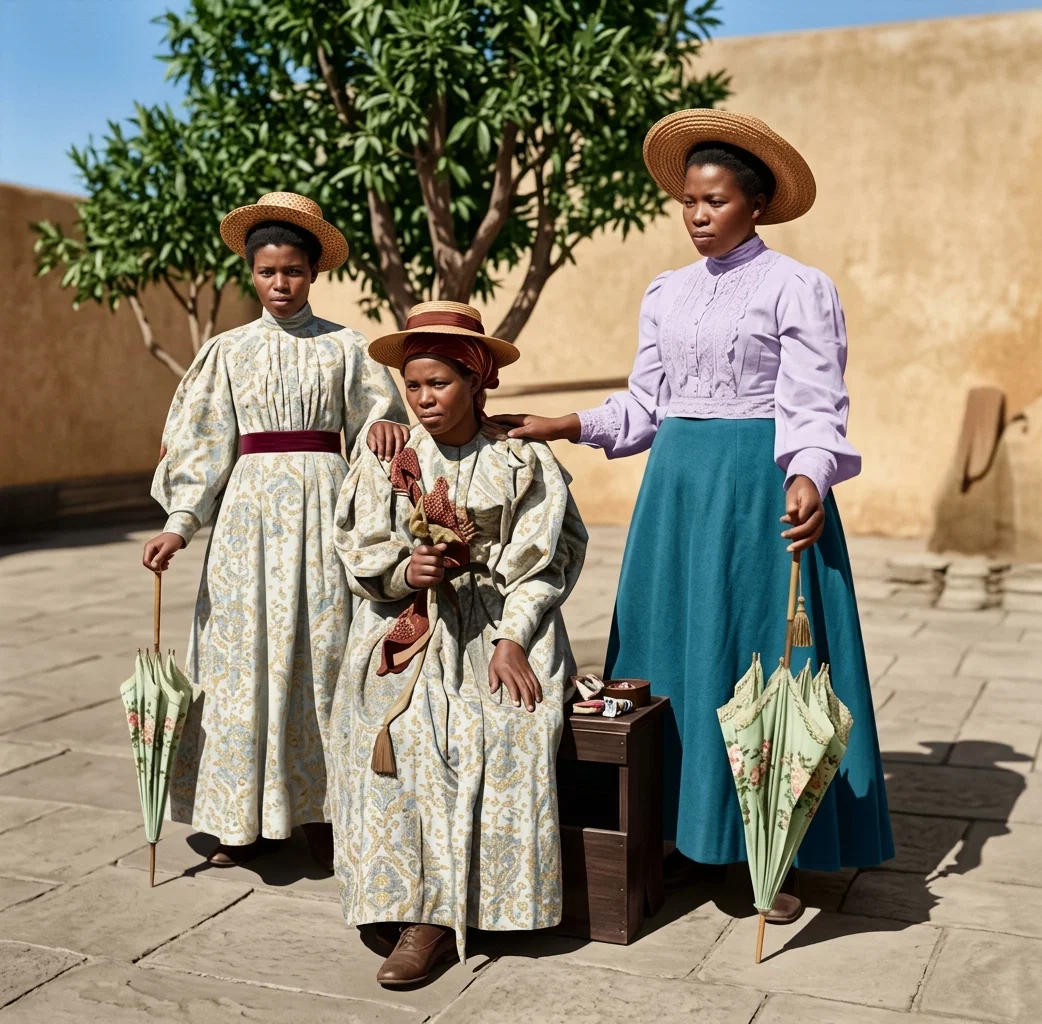
BASUTOLAND GIRLS OF BEST-EDUCATED CLASS
While we canvass, we have opportunity to relieve the sick and suffering. Sometimes we stop our work to make a coffin, and then the privilege is afforded us of speaking words of sympathy, and of telling many of Jesus’ love.
A few days ago, while canvassing a village close by, one native spied the small booklet entitled, “The Sabbath Restored,” and raised the question which day is the Sabbath. The answer, given by another man, was, “The seventh, of course.” “And which day is the seventh?” the first man continued. The second replied quickly, “Any man knows that Sunday is the seventh day of the week.” Then I was asked in regard to the day, and in a short time, by God’s help, was able to show all present that Sunday is not the seventh day, and, therefore, can not be the Sabbath. The result of our talk was that five of our books were sold. And we trust the light of truth found its way to one heart. Before we left, one native said, “What are we going to do?” The one who first raised the Sabbath question answered, “We can not afford to do any other way than to obey the light we have received.”
I could tell of many other interesting incidents like this. Sometimes women are come bringing the last chicken they have, and say, “This is all I have in the world. Please give me a book for this hen.” I am not much given to tears, but many times I find myself wiping moist eyes as I see the efforts put forth to get the books.
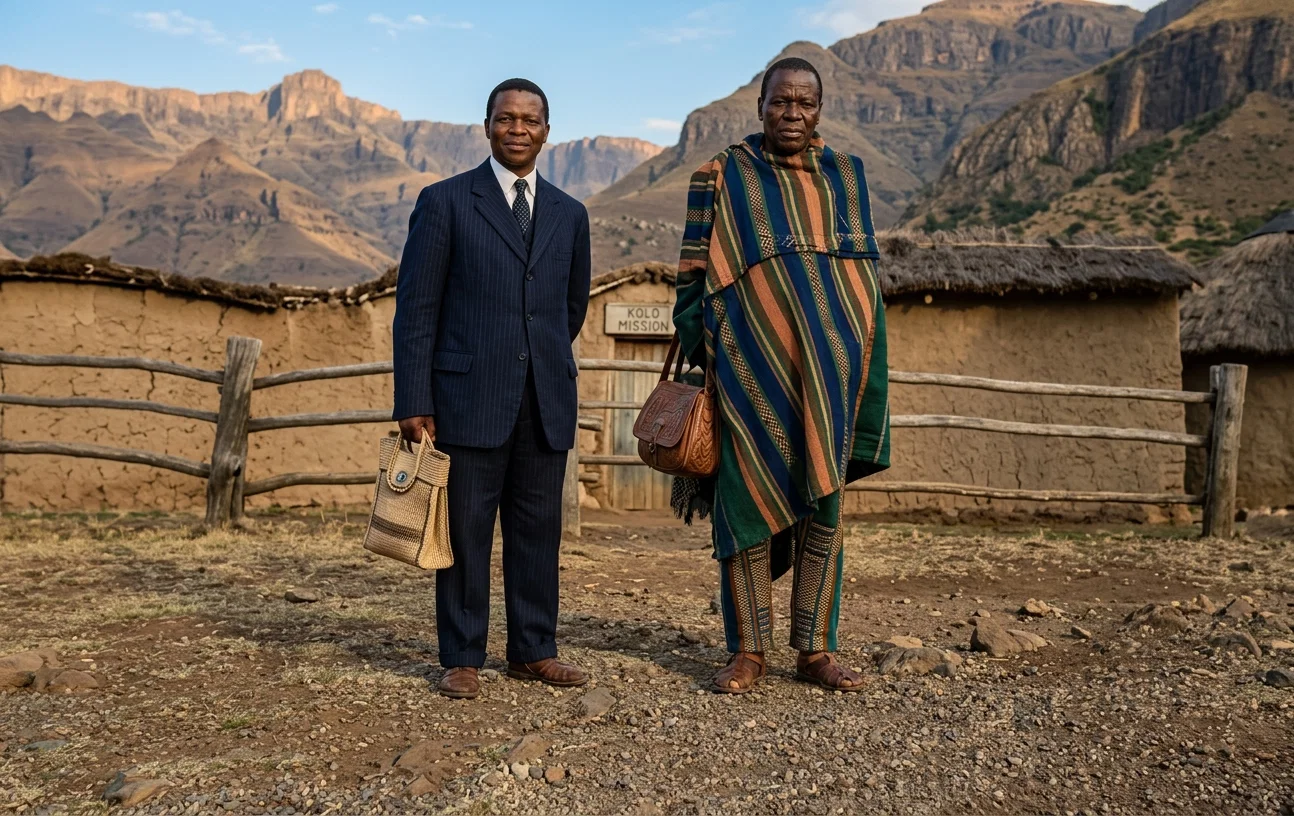
AT LEFT, MURRAY KALAKA, OUR NATIVE PREACHER; AT RIGHT, MOHOLE, CHIEF OF KOLO
The work is taking substantial root in Basutoland. I told my native helper a few weeks ago that in the next two years we must do our best to push our books into all corners of Basutoland, and then they could do as they liked with us, for the work would not stop.14
You will be interested in some photos I am sending. That of the three young women was taken near here, and is a fair sample of the educated class of Basutos. The picture of two men, one with a blanket on, and the other dressed like a black American preacher, shows our village chief, and Murray Kalaka, my native helper. Mohole is the chief’s name. While he is not a member of our church, he is a great friend of ours, and we trust he may be one of us before long. The illustration showing the front of a few huts gives a view of Chief Mohole’s place.
FRONT OF CHIEF MOHOLE'S RESIDENCE
Mrs. Emmerson and myself are of good courage, and feel it a privilege to work among a people who are so much in darkness.
Grandmother Did Know Something
A GENERATION ago it was somewhat common to burn sugar in sick-rooms as a disinfectant, or “to kill bad smells.” The doctors generally regarded the practise as useless but harmless, but encouraged the use of other substances.
Lately it has been shown, in a report from Professor Trilbert, of the Pasteur Institute of Paris, that burning sugar develops formic acetylene-hydrogen, one of the most powerful antiseptic gases known. Five grams of sugar (77.16 grains) were burned under a bell glass, holding ten quarts. After the vapor had cooled, bacilli of typhus, tuberculosis, cholera, smallpox, etc., were placed in the bell in open glass tubes, and within half an hour all the microbes were dead.
Some of the grandmothers’ remedies seem to be coming back again. Perhaps some of the higher critics, after a lapse of years and plenty of hard thinking, as Browning says, may come, after all, to believe again in the Bible their grandmothers knew.—The Christian.