LAST week we told how two of our brethren in Gainesville, Ga., were arrested, tried, and fined for Sunday work. The Eagle, of November 23, a secular paper of that town, expresses its opinion of the matter; and, though evidently believing in Sunday keeping, the editor expresses most forcibly, though indirectly, the true animus of Sunday laws, and all laws for the enforcement of religion. Underneath them all, though unseen by their advocates, is the very spirit which put Christ to death. By sabbath we take it that he means Sunday. The Eagle says:—
THE CRIME AND THE PUNISHMENT.
On Monday the pastor of the Seventh-day Adventist Church of this city, and the teacher of a school in the church, were each fined $50 and costs for the offense of disorderly conduct, which consisted in working on Sunday with saw and hammer in the new church building. They were also bound over to the city court for sabbath breaking, which is a State offense.
A fine of $50 and costs for disorderly conduct, in which life, limb, or property were not endangered, and in which the doer was in pursuit of a useful occupation, with an honest conviction that he was committing no sin, seems to be cutting the pants too big for the crime.
A few days ago several persons, male and female, were up before the mayor's court for raising the tallest kind of Cain at a house of the illest kind of fame. It was proved that they indulged in fighting, crying, cursing, and the firing of pistols. One neighbor testified that he was exceedingly disturbed, that he had gone to bed, and that his pillow was turned into a pillow of thorns while the carousal lasted. These persons were fined $5.00 and costs each, which seemed to satisfy the ends of justice.
The fact is, these Adventist gentlemen were not guilty of disorderly conduct. They were guilty of sabbath breaking, and were justly bound over to the city court. The fact of its being Sunday is not an element in creating a case of disorderly conduct. The act itself must be disorderly. The use of saw and hammer is not a source of disturbance on Monday, and when their use becomes so on Sunday, it is sabbath breaking. The public peace cannot be disturbed on Sunday by a thing that would not disturb it on Monday. A man's religious sensibilities might be shocked, but that is not the public peace. The thing which the sound of a saw and hammer on Sunday would be likely to disturb would be a man's heavenly meditations; but the city has no statute against that. When our city laws were enacted, men with heavenly meditations were so scarce that it was not thought worth while to go to the expense of protecting them.
We are opposed to all forms of sabbath breaking. We believe in keeping the commandment to the very letter. But who does it? Is it any worse to break the sabbath by conforming to a conscientious religious conviction than it is to break it through a laxity of morals? Is it any worse for the Adventists to saw lumber on Sunday than to run street cars with horses that have worked all week? Our livery stables stand open Sunday and do business. What for? to enable persons to go quickly on errands of mercy?—Oh, no! it is to hire horses to persons in pursuit of business or pleasure, in which the dumb brutes are robbed of their God-given right to rest.
It is commanded of God that our horses shall rest on the Sabbath. It is their right, and we cannot take that right away from them without breaking the Sabbath, except in cases of absolute necessity. The man who on Sunday morning hitches up his horses that have worked hard all week, and drives his family out on a jaunt to see his mother-in-law, or his aunt, or to camp meeting, commits a worse sin in the sight of God than he who takes his hoe and works in the field, for he not only breaks the sabbath himself, but compels the unwilling animals to do likewise, and robs them of their rights given them by their Creator.
Let us suppose a case: A good old gentleman emerges from his home on a beautiful Sunday morn, dressed in faultless linen and his best Sunday suit. Hymn book in hand, he starts toward the church, his mind absorbed in the contemplation of things divine. He passes the drug store and a crowd of gilded youths smoking cigars which the druggist has just sold. Then further on he has to stop and wait at the crossing for the dust to subside, for many carriages and buggies are passing, going hither and thither on pleasure bent. Then he sees the street cars pass with jingling bells and horses straining their muscles under the heavy load. His attention is not attracted in the least, for these things are usual; he has become accustomed to them. Then he passes the open door of the livery stable, around which a number of men and boys sit and chew tobacco, and talk horse. Inside he sees a number of men hard at work currying horses, washing vehicles, and hitching up teams. But this does not take his mind from the contemplation of divine things, for he has seen it so much, and it has become a matter of course. But he goes on. The birds are singing sweetly, the bees are buzzing in the Mayflowers. All nature is happy—
But hark! what is that? A saw—upon my soul! And that saw in the hands of the teacher of a strange religion!
"Crucify him!" "Release unto us BARABBAS!"
A GLANCE AT THE PARLIAMENT OF RELIGIONS.
By Editor
This is what an editorial writer of the World's Crisis, an eyewitness, has to say of the great religious exhibit at the World's Fair at Chicago. Some of the more striking expressions we have italicized:—
Among the speakers are prominent men from the following denominations: Baptists, Methodists, Congregationalists, Presbyterians, Buddhists, Brahmins, Hindus, Universalists, Roman Catholics, Theosophists, Swedenborgians, Episcopalians, Advent Christians, Jews, Lutherans, Christians, Unitarians, Seventh-day Baptists, Friends, Christian Scientists, Reformed Episcopal Church, King's Daughters, Christian Endeavor, Evangelical Church, Evolution Congress, Swedish Evangelical Mission Covenant, Welsh Church, New Jerusalem Church, Free Religious Association, The Ethical Congress, The Christian Association, The Young Men's Christian Association, The International Young Women's Christian Association, The Evangelical Alliance, United Norwegian Church, Jewish Women's Congress, Congress of the Disciples of Christ, The United Brethren Church Congress, Lutheran Women's Congress, African Methodist Episcopal Church Congress, Cumberland Presbyterian Church, World's Congress of Missions, and Congress of the International Board of Women's Christian Association.
Each denomination chose their representative men to present their peculiar views in the best possible manner. It is a World's Fair exhibition of religions. One remarkable feature in the speeches made in the Congress was the kind spirit manifested toward each other's views. While they differed as widely as possible, there was almost an entire absence of any effort to throw reproach on the opposite opinion. This was particularly true of those who represented foreign religions. On the Protestant side there seemed to be a lack of the deepened spirituality needed to carry conviction to the hearts of those who had not accepted the Christian religion. I did not hear one advocate the importance of holiness, of heart purity, and the means by which it might be secured. The importance, the necessity, of having the Holy Spirit in order to lead a holy life was scarcely noticed. This was the great failure on the Protestant side. Theirs, like the opposite, was an argumentative, an intellectual exhibition, lacking in the spiritual realm. It was a grand opportunity to show the wide contrast between the unchristian religions and the pure Bible religion imbued with the Holy Spirit. Without the Spirit of Christ all religions are powerless in their tendency to make men new creatures. The strength and reformatory power of the Christian religion is in proportion to the prevalence of the Holy Spirit in the heart of the believer. He who lacks the Spirit of Christ "is none of his," says the voice of inspiration. Rom. 8: 9.
The Roman Catholic Congress began Monday, September 4, and continued through the week, in the Hall of Columbus, where the "World's Religious Congresses" were held. The hall will hold some three thousand. The Washington Hall, in the same building, will hold the same number. The American Pope Satolli, Cardinal Gibbons, of Baltimore, Archbishop Corrigan, of New York, Archbishop Ireland, of St. Paul, and many other noted Papists, were present, who were able speakers in defense of their religion. But I did not hear a word of prayer or praise to God in any of their great meetings which crowded the hall. They also had a prominent part in the World's Religious Congresses, and, so far as I could judge, they exercised the leading influence, and occupied the most prominent positions. Cardinal Gibbons was called to lead the general prayer at the opening of the Congress, September 11. Said Mr. Seton, a Roman Catholic D.D.: "The Church [the Papal Church] also maintains that it belongs to her—and to her alone—to determine the true sense of the Scriptures, and that they cannot be rightly interpreted contrary to her decision, because she claims to be and is the living, unerring authority to whom . . . infallibility was promised and given." "According to our view, the Bible does not contain the whole of revealed truth, nor is it necessary for every Christian to read and understand it." [See report in Chicago Herald, September 17.]
THE PARLIAMENT OF RELIGIONS AT CHICAGO.
By Christian Alliance Weekly
WE are glad to hear that Dr. Pentecost has had the courage to call this absurd thing "an oriental humbug." We have been astounded all the year at the names of prominent ministers of the gospel who have allowed themselves to be drawn into this disgraceful compromise. But God wisely overruled the proceedings, so that the parliament brought its own retribution. Some of the Buddhists from India and Japan took advantage of the opportunity so unexpectedly offered, to pour a whole battery of hot shot into the Christian camp, and to denounce Christian missions in the most bold and misrepresenting manner. They could not be blamed for it. When we go on the devil's ground, the best thing that can happen to us is to get a good thrashing. There is absolutely no common meeting place between Christianity and the false religions of heathenism. They are wholly false and devilish. Christianity is wholly divine, and requires no argument to establish its claims.
It speaks to man with the authority of God, and there is no pathway for us to take out to the plain of Ono, to confer with Sanballat, Tobiah, and Geshem, the Arabian. Sanballat and his friends always get the best of Nehemiah when they meet him off his own ground. Such servants are not likely to be trusted long with the honor of Christ and the interest of his kingdom.—Christian Alliance Weekly.
The Peace of the Gospel
By Dyer
It is a great mercy to enjoy the gospel of peace, but a greater to enjoy the peace of the gospel.—Dyer.
Satan’s Hunting Ground
"THAT neutral border ground on the confines of the right and the wrong is Satan's chief hunting ground."
THE MIDWINTER FAIR.
By Editor
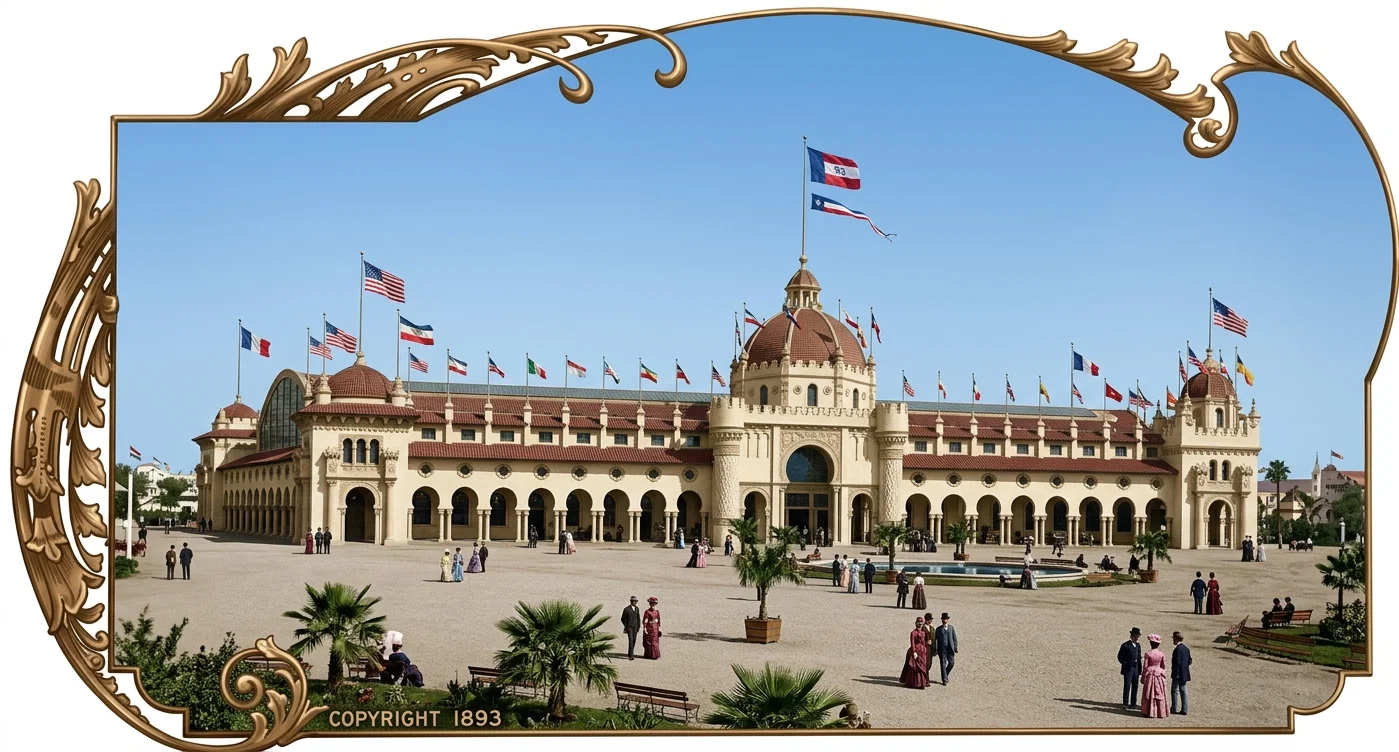
LAST week we presented to our readers some of the interesting facts about the California Midwinter International Exposition. It is safe to say that no other enterprise of its magnitude was ever developed and carried so far as to make its success a matter beyond question in so short a time as this. The World's Fair at Chicago was two years in building, and was then uncompleted when opened. But the prospects are that the Midwinter Fair in San Francisco will be ready to open six months after the first suggestion that it should be held.
We gave cuts last week of the Administration building and of the Horticultural and Agricultural Hall. This week we present another of the five great buildings, that of Manufactures and Liberal Arts. The size of this great fabric is 462x237 feet. The style of architecture is Moorish, reminding one strongly of the California mission buildings. Besides these three great buildings mentioned, there is the building for Mechanical Arts, 324x160 feet, East Indian in style, and well adapted for the accommodation of all such exhibits as are found in machinery halls. The fifth great building is the Fine Arts Palace. The style of architecture is Egyptian and it is constructed in brick. And yet these buildings have been found insufficient in size, and an annex is already being added to the Manufactures building, and the Fine Arts building has been increased by an additional 20 feet to its projected size. These enlargements have been caused by the constantly developing scope of the Exposition since its first inception. In fact, it will be much larger than many of the earlier World's Fairs. The floor space in the main exhibition buildings amounts to one-fourth of a million feet, and every inch of this space will be taken by the time the Fair opens, on January 1. In the Manufactures and Liberal Arts building, Russia alone will occupy 12,000 feet, Italy 10,000, and Austria nearly as much. There will be seen the dainty handiwork of the Japanese, a wonderful display of Bohemian glassware, the beautiful products of the looms of Asia and Central Europe, and some of the latest and finest curiosities of many lands. Some of the best displays made of American products seen at Chicago will be made here, with a large number of valuable exhibits which were not seen in Chicago, so that in many respects the Exposition at San Francisco will surpass that at Chicago. This will be especially true of Pacific Coast products.
The art department will have some fine displays of famous Russian and French paintings, with a large number of pieces of art which Chicago could not secure. The agricultural and horticultural display will probably surpass everything else. In this will be seen in their perfection the products of the glorious climate of the Pacific Coast, especially of California. Cut flowers and roses of every variety, great floral pyramids of daily fresh-cut flowers, in fact, almost every beautiful thing in the flora and fauna kingdoms, will be exhibited here, while the flower gardens of the East are buried in snow. The displays of fruit and vegetables will be equal to that of the flowers.
The best features of the Midway Plaisance at Chicago will be transported to San Francisco, with many new things added. The old Moorish and Egyptian customs shown at Chicago will also be reproduced at San Francisco. Hawaii will exhibit a cyclorama of the burning mountain; Germany, the old castle of Heidelberg; Santa Barbara, a great amphibion, where sea lions and sea tigers will disport themselves; Southern California, an ostrich farm; and various tribes of Indians will be represented from different parts of the great West. Already may be seen on the streets of San Francisco and about Golden Gate Park men with baggy trousers and Turkish fezzes on their heads. The place in sections is taking on quite a foreign air.
MANUFACTURES AND LIBERAL ARTS BUILDING.
The great high board fence around the grounds is rapidly being completed, and when that is finished a small charge will be made for admittance. Thousands and tens of thousands visit the grounds on Sundays and many during the week. The counties of California are already doing excellent work in preparing buildings and exhibits. The counties of Southern California will together put up a mammoth building, and to offset this the northern counties will do likewise. This sharp competition will doubtless bring out the finest products of both sections.
The mining exhibit will probably surpass that of anything which California or the world has ever seen. It will include not only the exhibit of California but of Colorado as well. There will be a quartz mill in full operation; ore will be crushed before the eyes of the people and turned into the precious metal while they wait. Two great pyramids will be erected, one of silver and the other of gold, representing the whole outputs from the mines of California.
Although the past week was very rainy indeed, the work has gone forward just the same. Three weeks ago the wind blew down the Hawaiian Cyclorama building, completely demolishing it, but already it has been erected again, and made sufficiently strong to withstand a hurricane. Arrangements have been made with the Southern Pacific Railroad Company so that transportation of exhibits from exhibitors on the coast to and from the Fair will cost nothing. The management has the following to say:—
The regulation made by the Southern Pacific Company is that shipments originating at stations on the Southern Pacific system west of and including Portland, Ogden, El Paso, Deming, Benson, and Mojave, for exhibitors at the Fair, shall be way-billed to San Francisco at regular rates, consigned to the Exposition, in care of the exhibitor, and the charges prepaid, and that after the Fair is over, by presenting a certificate from the officers of the Fair that the property has been on exhibition and has not changed hands, the first payment of freight to San Francisco will be refunded, and his property will be returned to his home station free of charge.
In the same connection, and in response to numerous communications on the subject, the public is respectfully informed that the Southern Pacific Company has arranged for three classes of tickets in connection with the Exposition, the rates of which are as follows:—
Class A—Half fare, or one-way rate for round trip, with $2.50 added, from all stations located over 300 miles from San Francisco.
Class B—One and one-fifth fare for round trip, with $2.00 added, from all stations located over 150 miles (not to exceed 300 miles) from San Francisco.
Class C—One and one-fifth fare for round trip, with $1.50 added, from all stations located within 150 miles from San Francisco.
The minimum special rate will be $1.00.
Entrance ticket coupons to the Fair grounds will be sold with the railroad special tickets as follows: For class A, five gate coupons; for class B, four gate coupons; for class C, three gate coupons.
The Southern Pacific Company has recently conceded a fifteen days' stop-over privilege on tickets from the East, so that visitors to California will have a little time to spend in other parts of the State than in the immediate vicinity of San Francisco. Other railways are doing their share in the matter of transportation. A $65 round trip rate has already been established west of the Missouri River, and the chance is good for a $100 rate from New York and return, while the big cut already made by the Canadian Pacific may result in a better rate all around.
LUCY'S BISCUITS.
"I LOVE you, Lucy; but I cannot eat these biscuits."
So said a young married man to his wife in the early days of their married life. Lucy was a fine pianist; she understood the arts of embroidery and crochet and knitting; she was quite skilled in water colors; and she took high honors when she graduated from college; but she could not cook. That part of her education had been neglected. When she married, because she loved him, a young physician just getting into practice, and undertook to do her own work, how she regretted that some of the hours she had spent over the embroidery frame or at the easel had not been given to a more thorough acquaintance with the culinary art! All day long after those words of her husband were spoken, she seemed to hear, "I love you, Lucy; but I cannot eat these biscuits."
So Lucy set herself diligently to work to "conquer biscuits," and then bread and meats. After many failures, she was happy in seeing the relish with which her husband ate the food she set before him, and she resolved106inwardly that no daughter of hers should ever undergo the pain of hearing her husband say, "I love you, my dear; but I cannot eat these biscuits."—Christian Advocate.
LITTLE THINGS.
By Union Signal
A GOOD-BY kiss is a little thing,
With your hand on the door to go,
But it takes the venom out of the sting
Of a thoughtless word or a cruel fling
That you made an hour ago.
A kiss of greeting is sweet and rare,
After the toil of the day,
But it smooths the furrows out of the care
And lines on the forehead you once called fair
In the years that have flown away.
'Tis a little thing to say, "You are kind,"
"I love you, my dear," each night,
But it sends a thrill through the heart, I find,
For love is tender, as love is blind,
As we climb life's rugged height.
We starve each other for love's caress;
We take, but do not give;
It seems so easy some soul to bless,
But we dole love grudgingly, less and less,
Till 'tis bitter and hard to live.
—Union Signal.
ECUADOR AND ITS CAPITAL.
By Hon. N. F. Graves
QUITO, the capital of Ecuador, has a population of about seventy thousand. It is near the equator, and is about two miles above the level of the sea, being one of the highest cities of the world. It has a climate that is nearly perfect. It is very difficult to reach it at any time, and it takes seven days to climb the mountain. The distance is about two hundred miles from Guayaquil. Between November and May is the rainy season, and then you cannot reach it at all, the roads being impassable.
The labor of the journey is very severe, but there is some compensation, for the views are ever changing and are surpassingly beautiful. The city is surrounded by volcanoes, which stand up as sentinels. Three of these volcanoes are active, twelve are extinguished, while others throw up smoke and sometimes ashes. The summits of eleven of them are continually covered with snow. Most of the summits of these great mountains have never been reached by any human being. Cotopaxi is the highest of all volcanoes. It is not now dangerous, but sends up clouds of smoke by day, and at night streams of fire. The rumblings of these volcanoes are heard hundreds of miles away. The people live in dread of them from day to day. It is a sad restraint to enterprise in building; most of the buildings are low, plain, and strong. The city looks grand and fair at the first view. The traveler is surprised to find such splendid houses and public buildings in this lofty top of the Andes.
There are twenty streets crossing each other at right angles, and two ravines coming down from the mountain and through the city. These ravines are covered with arches, on which rest the buildings, and over which the streets run. The streets are narrow, and the sidewalks very narrow. The drainage is very good. The streets are lighted by candles and are very dim, and in many places dark. There are three parks, all of which are very small, the largest being about three hundred feet square. It is finely adorned with trees, shrubs, and flowers, and is said to be the finest square in South America. These public grounds are abundantly supplied with pure water, that comes dashing down the mountain side. The Indians build their houses in the outskirts of the city, and they107are very small and low. They are generally mud hovels, very dirty inside and out.
The Grand Plaza is in the center of the city, and the buildings around it are much finer than in any other part of the town, but most of them are adobe. The adobe is cheap and resists earthquake shocks. Nearly all the floors are paved with large square brick. The roofs are of tile, and usually project over the sidewalk. The shops are very small. The public buildings surround the plaza, and are modeled after the old Spanish style. These public buildings are generally of brick, but some few are of a dark, volcanic stone. The government house fronts on the Grand Plaza, and is an imposing building, with a fine colonnade.
There are no bookstores in the city, and no place where magazines or papers are sold. There are a few drugstores, and all are kept by foreigners and are sources of wealth. The remains of the military roads and highways, aqueducts, temples, and other public works, awaken feelings of surprise. They were constructed by the Incas many hundred years ago. These royal roads extend across the empire. The remains are still noticed in many parts of the country. They extend south to Cuzco and on toward Chile, and north to Bogota. They were constructed over pathless Sierras, and often cut in the solid rock, sometimes in galleries.
Perhaps no other roads were ever made where so many serious obstacles stood in the way. Fortresses were constructed at several points along these grand highways, where a few military could command the passage. At every few miles small buildings were erected, where travelers could find accommodations and rest. The government dispatches were carried over these roads by trained runners. Each one had a route of about five miles, when he was relieved and another runner stood ready to rush on with the dispatches, and in that way they ran a hundred and fifty miles a day. The remains of these great roads speak of their former magnificence.
The roads on the level ground between the Andes and the ocean were very different. They were constructed mostly on low, sandy land. The beds of these roads were raised above the surface, and trees and shrubs were planted on each side. In wet places large piles were driven into the ground, forming a solid foundation for the road. The remains of these once grand roads is no greater surprise to the traveler than the fact that now there are hardly any roads at all. Humboldt said of these roads that they were "the most stupendous and useful works of man."
Quito ranks high among the South American cities as a place to acquire an education. It had two universities; now it has but one. Some of the professors were Europeans, and were celebrated for their learning. There are several colleges under the care and direction of the different religious orders. They have a department of philosophy, theology, and jurisprudence. They do well in the exact sciences, but only tolerably in political history and philosophy. The college of the Jesuits is the finest building in the city. The university occupies a part of this great and fine building. The justly celebrated William Jameson was a professor in the university. There is a public library here containing about twenty thousand books. While the library has not been replenished for many years, it contains very rich material on the history of the country. There is a polytechnical school that is well sustained and is very popular.
There are three hospitals, which seem to be ample for the wants of the city. There are more than four hundred priests, monks, and nuns in Quito, and a large number of bishops besides, and, as they pass, the poor Indians kneel and kiss their hands.
The Jesuits that come from Europe are the most intelligent and best educated, and are taking the lead. They work more than the natives, and have more influence with the people. They are the teachers and professors in the university and colleges and in all the schools. They mingle with the people and are popular. They insist that all the people shall worship, and promise them that they shall not lose heaven.
They blow the bugles and strike the bells every three hours night and day. The bells are struck, not rung. The great bell in the cathedral is struck at half past nine every morning at the elevation of the host, and in an instant all Quito are on their knees. Men and women, in the house or in the street, in the parlor or cathedral, go down on their knees; all business is suspended; they remain on their knees for one minute. The great bell is struck again, when the stream of business flows on as before. The established religion is the most intolerant of any in the world. The people, especially the women, go to church every day, and bow down before little images that, to say the least, are very rude, and worship with a devotion that surprises all who do not agree with them.
It is said that one-fourth of Quito is covered with churches and convents. The convents are very numerous and sometimes cover acres of land. Many of the native priests are ignorant and immoral. The people of Quito bury their dead at night. They carry lanterns and sing dirges as the procession winds through the streets. The dirges are very plaintive, and many very touching. If the corpse is a child, they carry it in a chair.
A Protestant cannot hold an office, nor vote, nor be a witness in a court of law. There are but few Protestants and no missionaries, and the people greatly need the gospel of Christ.—Gospel in All Lands.
THE SNAIL'S WONDERFUL MOUTH.
By New York Sun
It is a fortunate thing for man and the rest of the animal kingdom that no large wild animal has a mouth constructed with the devouring apparatus built on the plan of the insignificant looking snail's mouth, for that animal could out-devour anything that lives. The snail itself is such an entirely unpleasant, not to say loathsome, creature to handle that few amateur naturalists care to bother with it, but by neglecting the snail they miss studying one of the most interesting objects that come under their observation.
Anyone who has noticed a snail feeding on a leaf must have wondered how such a soft, flabby, slimy animal can make such a sharp and clean-cut incision in the leaf, having an edge as smooth and straight as if it had been cut with a knife. That is due to the peculiar and formidable mouth he has. The snail eats with his tongue and the roof of his mouth.
The tongue is a ribbon which the snail keeps in a coil in his mouth. This tongue is in reality a band saw, with the teeth on the surface instead of on the edge. The teeth are so small that as many as 30,000 of them have been found on one snail's tongue. They are exceeding sharp, and only a few of them are used at a time. Not exactly only a few of them, but a few of them comparatively, for the snail will probably have 4,000 or 5,000 of them in use at once. He does this by means of his coiled tongue. He can uncoil as much of this as he chooses, and the uncoiled part he brings into service. The roof of his mouth is as hard as bone. He grasps the leaf between his tongue and that hard substance, and, rasping away with his tongue, saws through the toughest leaf with ease, always leaving the edge smooth and straight.
By use the teeth wear off or become dull. When the snail finds that this tool is becoming blunted, he uncoils another section and works that out until he has come to the end of the coil. Then he coils the tongue up again and is ready to start in new, for while he has been using the latter portions of the ribbon, the teeth have grown in again in the idle portions—the saw has been filed and reset, so to speak—and while he is using them, the teeth in the back coil are renewed.—New York Sun.
THE TEETH.
By Family Doctor
A FREQUENT cause of indigestion is partially masticated food; this is often the result of bad teeth. Now, good or bad teeth are [often] an inheritance, undoubtedly, but it is equally true that teeth degenerate through improper food imperfectly masticated, and they can be nourished through proper aliments and thorough mastication. The enamel of a tooth is composed chiefly of lime, and is very hard. Hot or cold drinks are liable to injure it, and anything acid or sour corrodes or softens it, sometimes to the final destruction of the whole tooth. It is necessary that the teeth should be cleansed twice a day, the best times being after breakfast and after dinner, as then all foreign substances can be dislodged easily, and the interstices can be penetrated by the brushes, of which there ought always to be two—the bristle brush to use for the cleaning process, and an India rubber one for the polishing. First use the bristle brush with antiseptic (or charcoal) tooth powder, and thoroughly brush the teeth; then take the rubber brush and cold water, and brush lightly and briskly. This polishes the teeth like ivory, and sweetens the breath also.—Family Doctor.
THE COMMON WAY.
SCENE in a library; gentleman busy writing; child enters.
"Father, give me a penny."
"Haven't got any; don't bother me."
"But, father, I want it. Something particular."
"I tell you I haven't got one about me."
"I must have one; you promised me one."
"I did no such thing; I won't give you any more pennies; you spend too many. It's all wrong; I won't give it to you, so go away."
Child begins to whimper, "I think you might give me one; it's really mean."
"No; go away; I won't do it, so there's an end of it."
Child cries, teases, coaxes, father gets out of patience, puts his hand in his pocket, takes out a penny, and throws it at the child. "There, take it and don't come back again to-day."
Child smiles, looks shy, goes out conqueror, determined to renew the struggle in the afternoon, with the certainty of like results.
Scene in the street; two boys playing; mother opens the door, calls to one of them, "Joe, come into the house instantly."
Joe pays no attention.
"Joe, do you hear me? If you don't come, I'll give you a good beating."
Joe smiles and continues his play; his companion is alarmed for him, and advises him to obey. "You'll catch it if you don't go, Joe."
"Oh, no, I won't; she always says so, but never does! I ain't afraid."
Mother goes back into the house greatly put out, and thinking herself a martyr to bad children.
That's the way, parents; show your children by your example that you are weak, undecided, untruthful, and they learn aptly enough to despise your authority and regard your word as nothing. They soon graduate liars and mockers, and the reaping of your own sowing is but the natural consequence. —Phrenological Journal.
NOT LUCK, BUT WORK.
"TWENTY clerks in a store, twenty hands in a printing office, twenty apprentices in a shipyard, twenty young men in a town, all want to get on in the world, and expect to do so," says an old merchant.
"One of the clerks will become partner, and make a fortune; one of the compositors will own a newspaper and become an influential citizen; one of the apprentices will become a master builder; one of the villagers will get a handsome farm, and live like a patriarch, but which one is the lucky individual? Lucky?—There is no luck about it. The thing is almost as certain as the rule of three. The young fellow who will distance his competitors is he who masters in business, who preserves his integrity, who lives cleanly and purely, who devotes his leisure to the acquisition of knowledge, who gains friends by deserving them, and who saves his spare money. There are some ways to fortune shorter than this dusty old highway, but the staunch men all go this road."—Selected.
THREE KINDS.
THERE are many kinds of boys and girls in the world, but there are three kinds which deserve special mention. They have been called the "Wills," the "Won'ts," the "Can'ts." The "Wills" accomplish everything; the "Won'ts" oppose everything, and the "Can'ts" fail in everything. The "Wills" are the ones wanted in the army of the Lord. There is no room for the "Won'ts" or the "Can'ts" in that host.—Foreign Missionary.
GOD AND MAN.
By Rev. James Yeames
"What is man, that thou art mindful of him? and the son of man, that thou visitest him?" Ps. 8:4.
"THOU ART MINDFUL OF HIM."
MAN in the heart of God,
Thought of, remembered, beloved;
"Mindful of him"—thus thy care,
Constant and kind, we have proved.
"Mindful"—with lavish providing,
"Mindful"—with tenderness guiding,
"Mindful"—how blest our abiding,
Held in the heart of God!
"THOU VISITEST HIM."
God in the heart of man,
Welcomed, and worshiped, and loved,
Wonderful mercy divine
Which toward humanity moved!
"Visited"—Jesus descending,
"Visited"—angels defending,
"Visited"—Spirit attending,
God in the heart of man.
—Rev. James Yeames.
A REMARKABLE REVIVAL IN PERSIA.
Woman’s Work for Women gives some striking incidents connected with a revival last winter in a village of sixty houses, six miles from Oroomiah. There were only three families who did not attend the special services, and nearly every attendant became an inquirer for the way of life. A striking proof of the sincerity of the converts was seen in the fact that at the conclusion of the services, immediately after a farewell meeting, the whole company went out to spill the wine which they had previously made from the large grape crop. Drunkenness had prevailed through wine drinking, and in their zeal for reformation every house save one immediately poured out its wine, and soon the last man yielded.
A Mohammedan who was present said, "Please tell me what this means." And after he was told he exclaimed: "Blessed be God! Would that I were a sacrifice to the religion that teaches men such virtue!" The pastor of the village, when asked to what source he traced the revival, said, "One of our Sunday school classes of small boys."
It seems that during the week of prayer these boys, from eight to fifteen years of age, organized a systematic visitation of all the houses of the village. After their suppers they would go to a house, New Testament and hymn book in hand, and ask permission to sing some of their songs and read from the Bible, and then follow with several prayers. In this way during the winter they visited every house in the village, always receiving a warm welcome. One characteristic of these revivals was the conversion of the worst characters. A band of young men who had done much evil in different villages are now engaged in giving earnest testimony as to what God has done for them.—Missionary Herald.