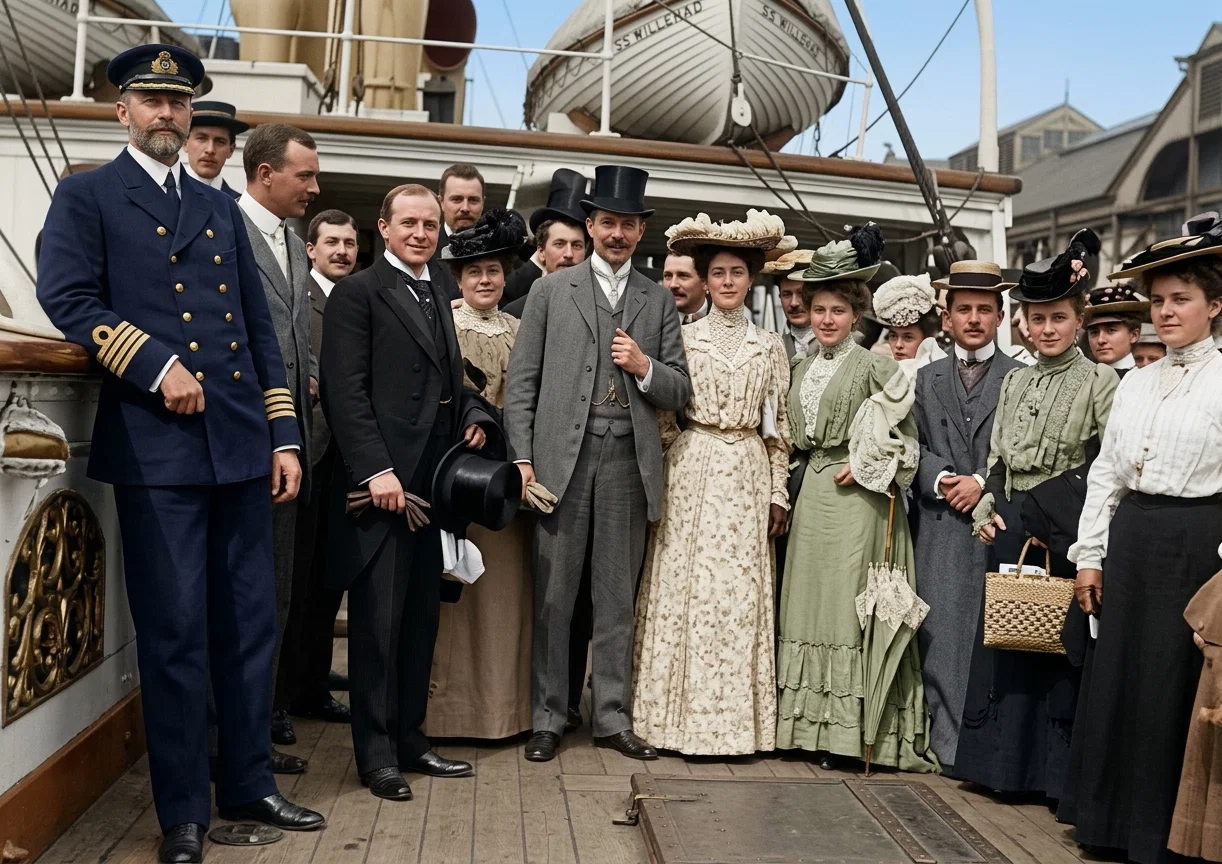
Knowing that the friends in America will be interested in the experiences we have passed through since we left the shores of Australia, we take this opportunity of telling you something of our trip. We left Sydney on April 15, and after a voyage of a week we arrived at New Britain. Here we spent two very pleasant days, during which time we were taken in the steamer’s launch on a ten-mile excursion down to Herbertshohe. On the way our motor engine broke down, and we were forced to hail another launch, which towed us to our destination. Among the passengers on the launch was the captain of the governor’s yacht, and he, seeing the disabled condition of our boat, invited us to return on his boat, saying that he would take us back to the ship in the afternoon. After spending a very enjoyable time wandering among the cocoanut palms, and seeing much of native life, we were taken on board the governor’s yacht just in time to escape a heavy downpour of rain. Later in the afternoon the governor came on board, and we had the honor of being introduced to his Excellency. We reached the “Willehad” in time for tea. The next day, in company with the doctor of the ship and two passengers, we went on the launch to an island just off New Britain, and from there five native boys rowed us over to the foot of a recently active volcano. The water for quite a considerable distance from the mountain was so hot that one could not bear his hand in it. We had a grand time climbing the mountain. From its summit we could look into the mouth of the crater, from which the steam was even then rising. As we looked into the crater’s mouth, we realized how easily this old earth could be burned up, and that even now the fires of destruction are kindled. We left New Britain at six o’clock the next morning, arriving at Fredrick Wilhelm’s Hafen the same time the following morning. These tropical islands are very beautiful, the hills being covered to the summit with luxuriant foliage.
During our stay in New Guinea we visited a Lutheran mission station. The missionaries were very kind to us, and took us through a number of native villages. Here we saw native life as it really is. It is hard to believe that human beings can exist under such conditions. The missionaries, however, seem to be doing some good. We were taken inside their church, and the missionaries had the children sing some hymns for us. These were sung in perfect time and tune.
In these islands, every one, almost without exception, uses tobacco; even the missionary himself offered cigars to our party. At the mission station we saw children between four and five years of age smoking cigarettes. New Guinea is at present unoccupied by us as a mission field; and we could not help feeling an intense longing to see the standard of present truth raised here.
A FAREWELL PARTY ON THE SHIP
Among the passengers on the “Willehad” was a Mr. Dannkohler, a well-known German explorer in these parts. He estimates the population of New Guinea to be from five to six millions, and probably he knows more about the interior than any other white man. Our boat left at 6:30 P. M. for Manila. Two days later we crossed the equator. The weather was intensely hot, and the nights were almost unbearable. After sailing for several days among the islands of the Philippine group, we entered the large bay upon which Manila is situated, on May 2. Here we spent two pleasant days with Pastor and Mrs. McElhany, who had been sent to open up work in this field just two weeks before we sailed. They kindly took us to every place of interest in the city. As a full description of Manila has recently been given by Brother Gates, and Brother McElhany will be writing from time to time, I will not take time to describe what we saw. We left Manila May 4, and reached Hongkong May 7, where we were met by Brother Robert Caldwell, and after a pleasant visit around Hongkong, we sailed that night for Canton, reaching there about ten o’clock the following morning. We were met by Brother13Anderson, and at the mission were greeted by all the Canton workers. We spent but six hours with these brethren, but during this time we saw many strange sights. We were taken by Brother Wilbur to a place called the “Chamber of Horrors.” In going to this place we had to pass through many streets that were no more than six feet wide. We also passed under an archway that is said to have been built in the days of Christ. At the “Chamber of Horrors” we gained a good knowledge of the Chinese idea of hell. In this place there were figures of human beings undergoing all kinds of torture that the gods were supposed to inflict. In one place, for instance, there was a man being slowly boiled to death in a huge pot of water. Another was being cut down through the middle with a cross-cut saw. As I looked at the figures, I thought it would be well if the people who believe in eternal punishment could pay this place a visit, for then they would be able to see the nature of the punishment they attribute to a God of mercy.
After this we went with Miss Thompson to her girls’ school. It was a sight to make one’s heart glad to see these Chinese girls being taught the gospel. We understand that several have already taken their stand for God, and are ready for baptism. We next visited the Anglo-Chinese school conducted by Brother Titbury. We were then obliged to leave our new-found friends, as our boat sailed at five o’clock. Brethren Wilbur and Caldwell and Sisters Law Keem and Vanscoy accompanied us to Hongkong, where we transshipped our luggage to the steamship “Roon.” We expected to reach Shanghai early on Sabbath, May 12, but our boat was stuck in the mud of the Yellow Sea for some six hours, so we did not reach Shanghai till six o’clock in the afternoon. Here we expected to meet Dr. Miller, but owing to a delay in the delivery of the telegram sent by Brother Anderson he was unable to meet us, and so we landed in a strange city with no one to meet us. However, we quickly found a missionary home mentioned to us by Brother Anderson. We waited at Shanghai several days before we received word from Dr. Miller. But it was a good experience, as we met quite a number of missionaries from different parts of China, and we trust some seeds of truth were sown which will spring up and bear fruit. During the time we spent at Shanghai we saw many new sights, such as Chinese marriage and burial processions. The music accompanying these processions is peculiar. It consists of several notes played over and over again in the same order. After we had waited a week for Dr. Miller, we thought it was time to make a move. As day after day went by and no news came, we began to grow anxious, and so we finally decided to sail alone for Hankow on Thursday. We felt that this would be quite an undertaking as we did not know much about traveling in China, but we knew that the Lord would be with us, and therefore all would be well.
Before deciding on this step, we prayed that if Dr. Miller was in Shanghai or on his way down, we might receive word that day. God heard this prayer, and although we had bought our tickets and had made arrangements for our baggage to be transshipped, a telegram came from Dr. Miller asking if we were still in Shanghai. We wired that we were waiting there, and soon received an answer telling us to stay at Shanghai till he came. You can not imagine the joy this gave us. I immediately went down to the shipping office and told them the circumstances, and they kindly refunded the entire amount of the fare. I did this because I knew we would travel first-class Chinese now that Dr. Miller would be with us. It was also a great saving in money, as the first-class Chinese cost but five dollars, whereas the European cost twenty dollars. On the fourth day from the receipt of the telegram Dr. Miller arrived. You can imagine how glad we were to receive him. We were very much pleased with his appearance, and the frank, manly way in which he greeted us showed me plainly that we could work together in perfect union. The next two days we spent in making quite a number of purchases, and we also visited the Presbyterian Mission Press, and gained some information regarding Chinese printing. In the evening I went through the somewhat painful process of being transformed into a Chinaman. I never knew until I lost my mustache and a ring of hair around my head how precious these were to me. In the forenoon we had bought a queue at the China Inland Mission Station for the modest sum of sixty cents. This was grown by a C. I. M. missionary. They have quite a number for sale, as their missionaries cut them off when they go home on furlough, some missionaries having two or three. It is impossible for me to describe how that Chinese barber pulled my hair in attaching that queue to my head, for my hair was rather short. C. I. M. missionaries when they first adopt the Chinese costume, generally pin the queue inside the round cap which is usually worn by missionaries. This plan, however, has its disadvantages, for if anything happens to knock the cap off, away goes the queue. On the contrary, there are some disadvantages in having your queue plaited into your own hair before you are used to wearing one, because if you are going through a doorway in a hurry, your queue is apt to catch on the door handle or some other obstruction, and you are suddenly jerked backward. Another difficulty a newly fledged missionary finds is that when he sits down, sometimes he sits on his queue, and so is unable to bend his head forward without almost parting company with his new appendage. But Paul became all things to all men, and we find it quite necessary in the interior of China to adopt the Chinese dress as far as consistent, in order not to arouse undue attention. It is also much cheaper to travel in Chinese clothes.
We left for Hankow at 12:30, traveling first-class Chinese. We found our cabins rather bare, but better than we expected. The food, however, was untouchable with the exception of the rice, which was very good. Dr. Miller had provided some foreign food, and so we fully expected to get along all right. Unfortunately, however, our captain seemed to think that his boat was so constructed that it could run along on dry land, and so he ran us into a mud bank in broad daylight. The bank was a long way out of the proper course, and there seemed to be no excuse for such a mistake. We stayed on that mud bank for two days and a half. During this time they tried various methods to get the boat out of the mud, but they were unsuccessful, and so we were finally transshipped to another boat. We were glad to get on a boat that could move, for we had grown weary of gazing upon the scenery in that part of the Yangtse. Furthermore, our food had run out, and we were getting hungry on a purely rice diet. It was Sabbath when the other boat arrived, and we had a busy time moving freight. These are some of the difficulties one meets when traveling in China. Satan no doubt had a hand in all this, for we know that he does not want us in China; and then when we are here, he wants to make the Sabbath as much like every other day as possible. The scenery along the Yangtse is most beautiful. There are mountains for a long way along either bank, and these are covered with verdure to the very top. China would make a splendid cattle country, but the Chinese do not raise cattle except in odd places. It is just impossible to describe the density of the population in this part of China. In a radius of about five miles there are over two hundred villages with from one hundred to four hundred people in each village. These farming people have very crude plows, etc., but they till the land very well, and avail themselves of every inch of ground. Two days’ sailing from the mud bank brought us to Hankow early on Tuesday morning, May 29. Hankow is destined to be the most important city of China because it can command the trade from almost every part of the country. Here is an important center that must soon be entered by the third angel’s message. Tuesday was an exceedingly busy day, for we had so many things to attend to, and our Chinese shoes did not help us very much, for they made our feet very sore. Now we are quite used to them, and do not mind them at all. It was late when we retired to rest on Tuesday night, and we would have been glad of a good night’s rest, but not a wink of sleep did we get. A Chinese inn is simply indescribable. The entire furniture in each room consists of five boards which form the bed, and this was pretty hard even when we had our Chinese bedding on it. The mosquitoes were14simply dreadful, and we could not sleep.
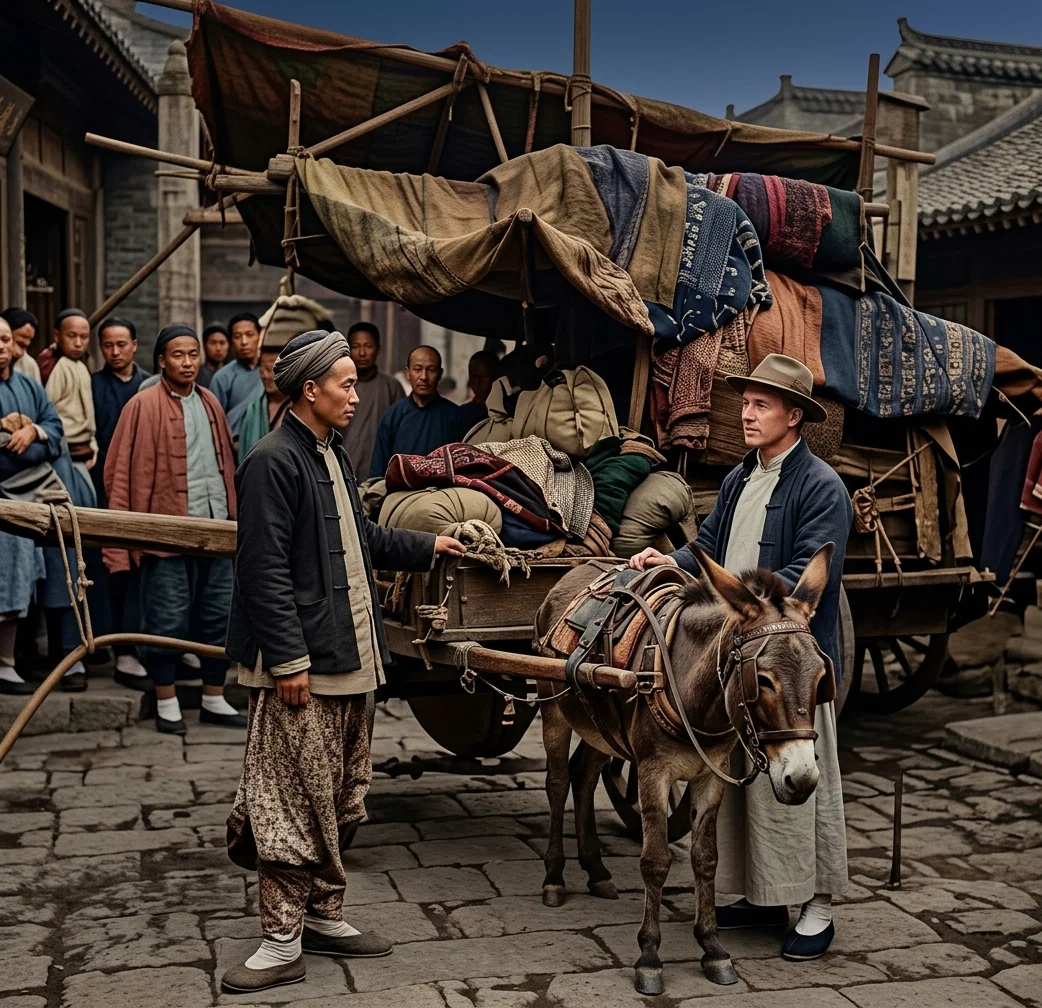
Seven o’clock Wednesday morning found us at the railway station waiting for our train. The trains on this railway are quite up-to-date, but there is a woeful lack of system in the way the road is worked. All the morning was spent in running through rice-fields, which were very pretty indeed. About midday the train stopped at a station, and soon engaged in shunting operations, with the result that our car was placed on a side line. We soon grasped the situation, and were successful in getting all our luggage removed to the train before it went on. If we had not noticed the fact that our car was uncoupled, we would have been left behind, and would have had to wait a whole day before the next train came along. Praise the Lord for all his love and tender watch-care. When we were a few stations from our destination, we were joined by the Misses Erickson and Simpson. We reached the end of our train journey at 6 P. M. We found Dr. Miller’s evangelist waiting for us, and soon we were all seated in donkey carts. In this manner we traveled all night. During the evening we passed through immense wheat-fields, and the scent from these was very refreshing after the noise and dirt of Hankow. It was the most pleasant experience we had had thus far in China, save for the fact that we were very sleepy, owing to the loss of sleep the previous night, and then, of course, the carts had no springs, and as the roads are full of ruts, they shook us up and down a great deal. It is harvest-time now, and even at the late hour we traveled, we could see the people out harvesting. They cut all the grain by hand, and you can imagine how long it would take, and the number of people that would be employed. As I thought about their inadequate methods for reaping their harvests, it made me think of another harvest that God’s people ought to be reaping, a harvest so precious that Christ would have come and lived and died on this earth rather than one grain should be lost. Yet in this country millions of grains are being lost every year because God’s husbandmen are so few and their facilities so inadequate. We wonder at the Chinese because of their antiquated methods, but let us not forget the lesson that there is in this for us, and let us be up and doing. Let us never cease to pray the Lord of the harvest that he will send more laborers into his harvest. You can not imagine the problems that we have before us continually. Think of this province alone with its twenty-two million people. China’s needs are many.
Since coming here, my work outside the language study, has been mainly in the pressroom and dispensary. It is in the latter place that you see China’s deep-seated misery. I wish that every one of our people could spend a day there. What a change it would make in their efforts to forward missionary work. This week has seen but three days pass by, and yet in that short time we have had three cases of opium poisoning. Two of these proved fatal. In each case the drug was given or taken with the idea of destroying life. One was that of an infant, whose mother had poisoned it, and it was already dying when brought to us. Another was the suicide of a husband. He was brought in the middle of the night. His was also a fatal case. The other was that of a young wife. Her life was saved. We also had a case of leprosy. The leg of the patient was a mass of rotten flesh and will soon drop off. Of course man can do little in such cases.
IN THE DONKEY CART
O, I tell you it is good to be in China and to be engaged in such work as this! We are constantly surrounded by disease, but I know the Lord will keep us, and if he wishes us to lay down our lives, then we shall not wish it otherwise.
We take this opportunity of publicly thanking those who were instrumental in raising the funds necessary for our transportation to China and our support here. We trust that in the great gathering day, when we shall know the result of every good deed, they will be able to see some souls saved as the result of their effort to propagate the kingdom of Christ in this dark land. We trust their prayers will still follow us that we may be kept faithful to the charge committed to our care.
A Hairbreadth Away
No man is ever abandoned and left to himself. Whether alone on a desert island, or in the greater loneliness of city life, there is with him a multitude of resources upon which, if he will, he can lay hold. “Heaven is only a hairbreadth away, and all its powers are with me,” writes Jowett in his wonderfully searching prayer-thoughts, “Yet Another Day.” How much better that is than if our bank account were unlimited, or our health perfect, or every temporal blessing for which we long were realized! For we can cross that hairbreadth and live in the kingdom of heaven now and here; and we can enjoy all its powers that we are willing to use. Heaven’s citizenship and heaven’s resources are given to us for immediate use in to-day’s struggle, and there can be only one outcome to the struggle for every one who claims his own.—Sunday School Times.
Be Not Like a Wheelbarrow
“BE not like a wheelbarrow that goes just as far as some one pushes it and stops when he stops.”
Mission Notes
BRETHREN, go! The world is waiting
For the coming of our King.
Be it yours to spread the story
Of his shame! and then his glory,
Till the whole creation sing.
“THE Lord God which gathereth the outcasts of Israel saith, Yet will I gather others to him.” Isa. 56:8.
“BEHOLD, these shall come from far: and, lo, these from the north and from the west; and these from the land of Sinim.” Isa. 49:12.
No countries surpass the South American continent, Central America, and Mexico in the excessive use of intoxicants.
THE Sabbath-keepers at Grand Rivière, Hayti, number between twenty-five and thirty. There are eight at Cape Haytien.
A RECENT letter from Elder J. N. Anderson, of Canton, China, tells of the baptism of five young men in the month of June.
WE have one Protestant Christian to each five persons; in the foreign field there is one Protestant Christian to each 1,566 persons.
SAID a Chinese convert, “You may take my house, you may take my land, you may take my life, if you will; but I will never give up Christ.”
THE demand for opium in China hardly existed one hundred and fifty years ago; to-day China consumes nearly five hundred thousand chests annually.
FROM San Luis Potosi, Mexico, Elder G. M. Brown reports: “Last Sabbath four were baptized at Mexico City, all of whom were Mexicans. Brother Harzman is now there, canvassing and helping. We expect that a good work will be done.”
ELDER C. A. HANSEN, of Bombay, India, has just recovered from a very severe attack of measles. Of the work in India, he says: “From all appearances, the message is fast closing up, and only a little while longer will they listen to our pleas. Pray for us, that we may prosper in spreading the truth.”
FROM Kulangsu, Amoy, China, Brother W. C. Hankins writes: “God is leading in the work here, and it is moving forward slowly but surely. I wish that every province in China had as much of a beginning as we have here. God has worked especially for us. Two of our young workers started for a trip into the country to-day. They will preach from village to village. Brother R. A. Caldwell is with us now for a few days. He has been doing very well with his canvassing.”
The Virginia Camp-Meeting
By E. W. FARNSWORTH
THIS meeting was held in the city of Petersburg, July 26 to August 5. The camp was situated in West End Park. The pavilion was surrounded by stately pine-trees, and the location was beautiful. Most of the family tents were pitched at some distance from the pavilion, with a little lake between them and the tent where meetings were held. The street-cars came to within a short distance of the park, so the meeting was accessible to the people of the city.
About two weeks before the camp-meeting Elders B. F. Purdham and H. W. Herrell began a tent-meeting, and considerable interest was awakened. The attendance of our brethren and sisters at the camp-meeting was quite good, considering the membership in the conference, though we would have been glad if a larger number could have shared the blessings of the meeting. The laborers present from without the conference were Elder W. A. Colcord, Prof. J. W. Lawhead, Brother F. E. Painter, and the writer.
The weather during the entire meeting was quite unfavorable, except the last Sabbath and Sunday. This prevented the people in the city from attending, as we were assured they would otherwise have been glad to do. The first heavy rain broke the dam which confined the lake, causing it to go out. The bed of mud that remained might have been a serious menace to the health of the campers, but the continuous rains washed the ground nearly every day, and there was scarcely any sickness. For this we felt very grateful.
The conference proceedings were pleasant and harmonious. The same officers were elected to serve another year, and we believe greater prosperity than ever before will attend the work in Virginia.
A number of recommendations were passed by the conference in reference to the carrying forward of aggressive work. One recommendation of special interest was in reference to the establishment of a school at Newmarket. The conference owns forty-two acres of good land not far from the village. This was given by a brother, now deceased, for school purposes. It is valued at three thousand dollars, and has no debt or encumbrance. It is estimated that the necessary buildings and improvements will cost between two and three thousand dollars. The largest churches in the conference are situated near Newmarket, and a school is greatly needed. At the camp-meeting pledges were made amounting to over eleven hundred dollars, and we believe the brethren and sisters of Virginia will rally to the support of this enterprise, so it can be established free of debt. They can surely make no safer investment.
The spiritual tone of the meeting was excellent throughout. Elder W. A. Colcord gave several Bible studies on the spirit of prophecy, which were much appreciated.
The last Sabbath we had a meeting which will long be remembered by those who were present. After a sermon on our work and the progress of the message, opportunity was given for all to speak. The Spirit of the Lord was present, and led quite a number who had not yet begun the observance of the Sabbath to express their sympathy with the truth, and their desire to obey it. Such meetings are truly refreshing. Our brethren and sisters united in giving expression to their feelings of thankfulness, praise, and confidence in the message, and their determination to remain with this people and to be faithful to the end.
The Petersburg papers were exceedingly kind in publishing reports of the meetings and sermons preached. The editor of the leading paper said he would publish all the matter we would furnish, and gave us to understand that we need not feel limited as to quantity; so we had from two to four columns each day. It is seldom that the press is so liberal.
Petersburg is the place where many battles were fought during the Civil War; but now those who fought one another then are bound together in brotherly love and union, and have united to war against the prince of darkness until the last great controversy shall close. Our hearts were knit in love with the brethren and sisters in Virginia; and if they are faithful and aggressive in their work, we look for real progress to be made during the coming year. Brethren Herrell and Purdham expect to remain and continue meetings as long as may be necessary.
E. W. FARNSWORTH.
J. S. WASHBURN
By J. S. Washburn
Tennessee
NASHVILLE.—The interest in our meetings here is still very encouraging. Last Sunday night we had a large audience. The special subject, no doubt, was one of the reasons for the increased attendance, being one in which many are interested, that is, the subject of the unpardonable sin. We feel that a deep and solemn impression was made upon the people present, who were an intelligent and excellent class, and who gave the best attention.
One week ago last Sabbath at least nine kept their first Sabbath, and more than twelve are now keeping the Sabbath as the result of these meetings and Bible work that has been recently done. Some are having a hard struggle to decide this matter. The ministers are opposing very earnestly, some of them having gone so far as to state publicly that their members would be expelled if they attended our meetings. Many opposition sermons have been preached. Several opposition articles in the papers have also appeared. The two daily papers still give us, as a rule, excellent reports each day. Sometimes there is an omission, but not often.
Several have responded to the appeal for means to help on the tent-meeting expenses. As stated in a previous report, Sister White sent thirty dollars for this purpose. Several others in the North and South have also sent in donations, for which we feel more thankful to God than we can tell. We ought to have a fund constantly in hand, not only for the present series of tent-meetings, but for the expenses of an active campaign in Nashville, and later on in Atlanta and other great Southern cities.
We are pleased with the climate and with the people of the South. The former is most healthful, the latter very cordial and hospitable. A great work must be done in this Southern field, and this work must be made self-supporting. The membership of the Nashville church is increasing, and their tithe is certainly very commendable. There are problems and difficulties here, dear brethren and sisters, but God has not spoken in vain through the spirit of prophecy, appealing earnestly that a great work should be done in the South.
One interesting and encouraging feature just at present is that it has been decided that the camp-meeting shall be held on the same ground where our tent-meeting has been conducted. Thus our tent-meetings will close with a large attendance, and, we believe, with good, spiritual meetings. We shall be very thankful for the help at this time of Elder K. C. Russell and other laborers from the General Conference Committee. I am hoping that it may be possible for Elder Daniells to be at this meeting for at least a day or two.
Dear brethren and sisters, pray for the work in the South, that God may give us wisdom that a great work may be accomplished here.
J. S. WASHBURN
South Africa
By M. J. Sturdevant
BULUWAYO.—I am glad to hear of the interest that is being felt by our people in America in regard to fields abroad. Elder Reaser and others have been writing, also, in regard to helping some of our native teachers, and have sent us help for four. And it is a help, too, you may be sure.
The four seasons I have been here have been so poor that we have not been able to raise sufficient crops to support our mission without help; neither can we this year, though we planted a large crop. The yield will compare with about half of what we would have in the States.
The work here is truly being blessed of God. The spiritual condition of our little flock has been very encouraging for months in the past. This is not to say we have no battles, for we do have, and some severe ones; but Christ is our16helper, and we are learning to trust him. I am teaching the children that we must not look to our weakness, but to the Source of our strength. We know his presence is with us.
As for the school work, all things considered, I do not see how we could expect more. I feel very much encouraged. I regret that I can not do more for the children. No little part of the time I am called away to look after the business matters of the mission, as my wife and I are the only workers here now; yet we are doing all we know how, feeling that the time is short in which to prepare a people for the coming of the Lord, and desiring to hasten the young teachers to the front. We now have a class of ten or twelve preparing for baptism. We expect the rite will be administered soon. There are as many others, but we thought best to have them wait a while until they grow a little older, and stronger in the faith.
Besides the mission school, we have four out-schools, which are doing good work, though the attendance is not what we could hope for.
M. J. STURDEVANT.
Visit to Muskoka Lake
By F. W. Morse; M. M. Morse
Ontario
MUSKOKA LAKE.—“A word spoken in season, how good it is.” So we thought during a recent visit from the Lord’s servant, Elder A. O. Burrill. More than four years ago we had a visit from Elder J. W. Collie, now deceased; and that was the last time we had heard the word preached by any minister, and we were hungry to hear.
We were also made glad as three of our dear young people followed their Lord in baptism. All the young in our church who have come to years of understanding, are now active in the Lord’s work.
F. W. MORSE,
M. M. MORSE.
Louisiana Camp-meeting
By R. M. Kilgore
LAKE ARTHUR, where this meeting was held, is situated on the beautiful lake of the same name, in the southwestern part of the State, surrounded by immense rice-fields, this staple being the principal land product.
Twenty well-filled family tents and two large ones provided homes for more than a hundred campers, and capacity for large and attentive congregations. This attendance and the marked interest in the word spoken were most encouraging to those in charge, it having been doubtful at one time whether ground could be secured for the camp. Prejudice gave place to real interest with many.
The grove of large live-oaks, whose spreading branches were thickly decorated with hanging Spanish air-plant moss, made the place an ideal one for the worship of nature's God. It is indeed one of God's own temples.
The laborers from outside the conference were Prof. J. E. Tenney, Elder E. H. Rees, Brother I. A. Ford, and the writer, Brother O. R. Staines and Elder K. C. Russell came later.
Elder S. B. Horton, the president of the conference, is laboring hard to build up the work in that field. He is encouraged by the success attending his efforts, though alone and single handed. He is the only minister in the conference. He needs and must have some help. His long, earnest plea for a good minister should be responded to at once.
The usual business session of the conference was held later, and the hours thus occupied were filled with a line of work after the order of the convention or Chautauqua, in connection with the Sabbath-school, the church, and educational and religious liberty work. Many excellent papers were read, and much good instruction was imparted in the discussions following each. This new feature here introduced afforded work for not a few, who otherwise would have had but little to do to make the occasion profitable.
A goodly number of youth and children were present, for whom earnest efforts were made. Several went forward for prayers. The Spirit was present in power, and the servants of God were free in his word. The spiritual atmosphere of the meeting was good throughout. Those who in brokenness of heart sought the Lord, found him.
Before the meeting closed, Elder Rees, Brother Ford, and the writer were obliged to leave in order to be at the opening of the Georgia camp-meeting at Marietta, August 2.
R. M. KILGORE.
A. W. GEORGE, M. D
By A. W. George
Turkey
In company with my wife and our native worker, Sister Asnive Inedjian, I recently enjoyed a visit to Brusa. This is the largest city in Asia Minor, except Smyrna, and is famous in history as the capital of the Turkish empire for one hundred and fifty years, also for its many mosques and tombs of the sultans. We had the opportunity of visiting several of these tombs, the most interesting to us being that of Othman, the first king of Turkey and founder of the Ottoman empire, doubtless the one referred to in Rev. 9:1. In one of these tombs we saw one of the horse's tails mentioned in Rev. 9:19. The tail was attached around the end of a round stick, in the end of which our attendant said was originally a spear-head. These curious things were carried as ensigns in the army. In Brusa we have a company of about fifteen Sabbath-keepers. We found it a pleasure to study with these earnest brethren and sisters the special truths for this time. Especially on Sabbath and Sunday the blessing of the Lord was with us. Five were baptized, and the ordinances were celebrated. To avoid being molested by the people, the baptism was performed at night. About midnight, under cover of the darkness, we scrambled down the deep gulch to the small stream that flows through the city. Although hidden from the gaze of the world, we believe that the angels were present to record our efforts to follow the command of the Lord. This city is an important place, and if it could be thoroughly worked, I feel confident that by God's blessing a strong church would be raised up.
From here we went a day's journey by carriage to Seuleus, an Armenian village not far from the ancient city of Nicea. It appears to be but a small village, yet there are crowded into it almost five thousand persons. It seems too bad that, while the surroundings are so beautiful and healthful, these people should crowd together and allow themselves to be practically buried in the accumulated filth. Fortunately, the living-rooms are kept clean. The farmers in this country do not live on their own farms or gardens, but crowd together as closely as possible into unkept villages. The fear of bandits and robbers has brought about this condition. Here we found a company of twelve or more of our people. I had not met this company before, and they were all very glad to see us and to lay aside their work and listen to what we had to give them. Here also five were baptized. On our return home we stopped at Nicea, famous as the place where assembled the Council of Nicea, A. D. 325. We visited the spot where the palace of Constantine stood in which the council was held. Some of the foundation-stones still remain.
At Ismid Brother Kapriel Perinian, elder of the church in Bardezag, boarded our train, and we were glad to learn from him of the good work that is going on in his church. The Spirit of God is working for both old and young, and a number who were backslidden have taken hold anew. The children and youth have united to seek the Lord and study the Word. Elder Conradi was at this place some weeks ago. He baptized one brother and eleven young persons. God's blessing has followed his visit. We have decided to start, as soon as possible, a school for training workers at this place. The brethren are giving liberally for it.
Our people in Turkey love the truth, and are willing to sacrifice for it; but they need some one to travel among them and teach them. We hope and pray that God will raise up workers for this field. There is now a spirit of moving forward, and I hope some one will come and help us, and that the call that Elder Conradi has made for ministers and workers for the Oriental Union will meet with an immediate response.