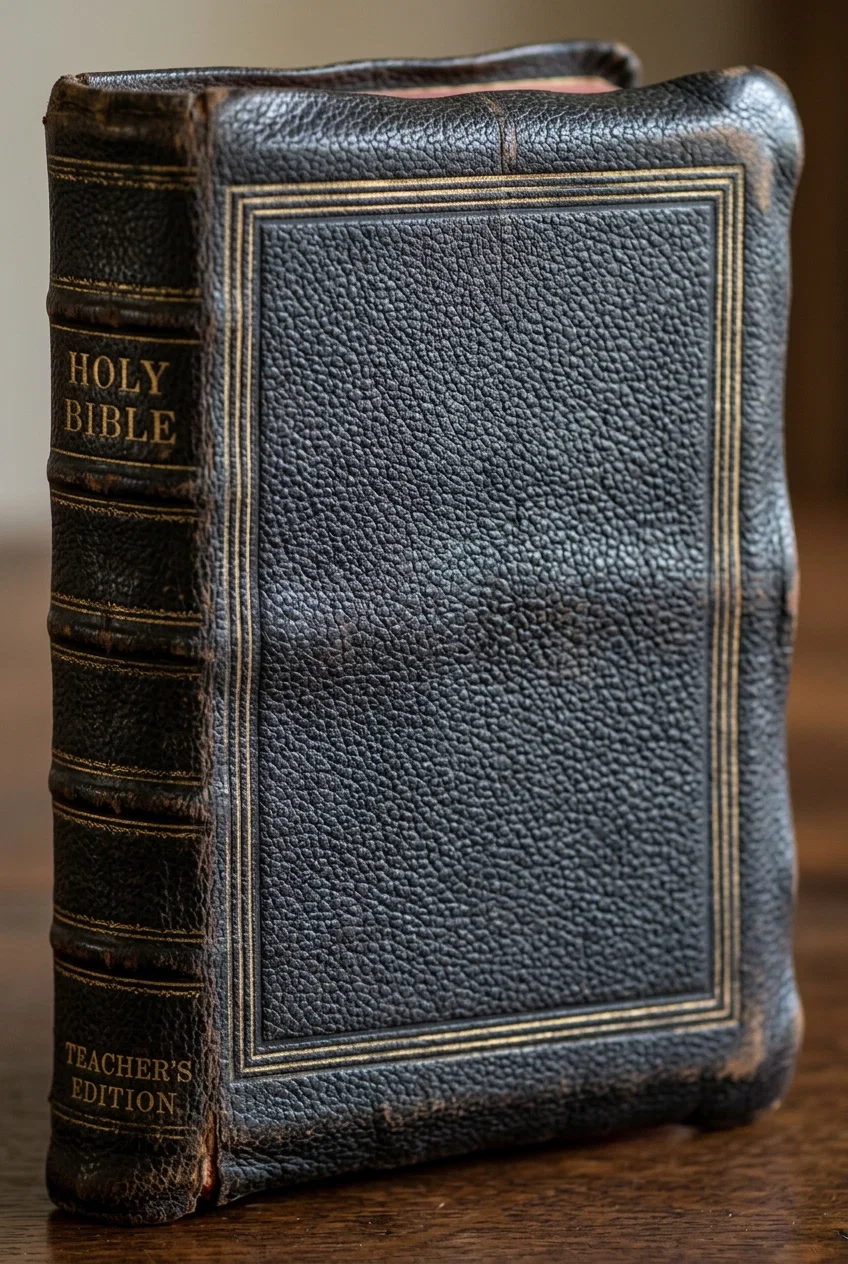
To ANY one, either old or new subscriber, sending us $3.00, we will send the SIGNS OF THE TIMES one year, and a Bible worth more than the price asked for both the SIGNS and the Bible. An opportunity, therefore, to get the paper free.
If you either need a Bible for yourself, or desire to invest in a handsome present for a friend, don't fail to remember that we have what you want.
The Bible is substantially bound in morocco, divinity circuit (see illustration), and is leather lined to edge; round corners, red under gold edges, minion type. Size of page, 5½ x 8 inches. Besides the Bible there are over 650 pages of valuable helps, containing more than 350 fine illustrations. Some of the special features are a Life of Jesus and Harmony of the Gospels, Parables and Miracles of Jesus, Life and Travels of Paul, Sacred Chronology, History of the Patriarchs, etc., etc.; in fact, the Bible Treasury contains a library of useful and valuable information concerning Bible customs, manners, history, geography, weights, measures, languages, etc., with side-lights from recent explorations, finely illustrated.
The book also contains a concordance of real merit; new design, combining a Concordance, Subject Index, and Pronouncing Dictionary of Scripture Proper Names, in very convenient form for ready reference.
Send $3.00 for our offer and be convinced; or $7.00 and seven new names will make you a possessor of one of these Bibles free.
Address, SIGNS OF THE TIMES, Oakland, Cal.
400 RECITATIONS AND READINGS.
A book designed for Parlor Readings, Sabbath-schools, Temperance Organizations, Debating Societies, Young People's Associations, Reading Clubs and Home Circles. This is a handsome book, bound in paper cover, and contains 400 of the best recitations ever issued, and other choice reading. Price, 40 cents, post-paid. Send order, with remittance, to Laconic Publishing Co., 123 Liberty St., New York.
When you write, please mention the SIGNS OF THE TIMES.
Nut Butter
NUT BUTTER easily and cheaply made by the use of our MILLS, Roasters and Blanchers. Valuable recipes free with each mill. Nuts of All Kinds, Nut Butter and Nut Products shipped to any address. Write for Circular and Price-List KNAPP BROS., 71 N. 11th St., E. Portland, Ore. General Agents for Mills in Wash., Ore., and Cal.
When you write, please mention the SIGNS OF THE TIMES.
The Kansas Worker
The Topeka missionary society has ordered one thousand of the tract “The Alarm of War.” Several societies have ordered one or two hundred of them. How many has your society ordered? Right now, while the war fever is so intense, is just the time to strike with these tracts. Price, 2 cents each.
The Kansas Worker
“The Alarm of War” contains an interesting table showing the recent increase in the land and naval forces of Europe. This table is a wonderful argument in itself.
At the present writing we have received orders for 10,842 copies of the new tract, “The Alarm of War,” and orders are still coming in every day. The demand for it has been so great that the publishers have been unable to keep up with their orders; hence there has been more or less delay in filling the orders we have received. We trust this has not been a source of discouragement to any. We are so glad to know that so many thousands of pages bearing the truth of God, have been scattered in our State. We trust that much more may yet be done with it. Some of the societies have found it necessary to increase their first order. Some are selling the tracts with good success.
Iowa Workers’ Bulletin.
Your neighbors are talking about the probability of a war with Spain. They will read a little tract called “The Alarm of War,” which may set them to thinking about something else. Will you not see that they have a copy?—Workers’ Bulletin.
1 “And after five days the high priest Ananias came down with certain elders, and with an orator, one Tertullus; and 2 they informed the governor against Paul. And when he was called, Tertullus began to accuse him, saying, 3 Seeing that by thee we enjoy much peace, and that by thy providence evils are corrected for this nation, we accept it in all ways and in all places, most excellent Felix, with all thankfulness. 4 But, that I be not further tedious unto thee, I entreat thee to hear us of thy clemency a few words. 5 For we have found this man a pestilent fellow, and a mover of insurrections among all the Jews throughout the world; and a 6 ringleader of the sect of the Nazarenes; who moreover assayed to profane the temple; on whom also we laid hold; and we 7 would have judged him according to our law. But the chief captain Lysias came, and with great violence took him 8 away out of our hands, commanding his accusers to come before thee; from whom thou wilt be able, by examining him thyself, to take knowledge of all these things, whereof we accuse him. And the Jews also joined in the charge, affirming that these things were so.”
10 “And when the governor had beckoned unto him to speak, Paul answered, Forasmuch as I know that thou hast been of many years a judge unto this nation, I do cheerfully make 11 my defense; seeing that thou canst take knowledge, that it is not more than twelve days since I went 12 up to worship at Jerusalem; and neither in the temple did they find me disputing with any man or stirring up a crowd, nor in the synagogs, nor in the 13 city. Neither can they prove to thee the things 14 whereof they now accuse me. But this I confess unto thee, that after the Way which they call a sect, so serve I the God of our fathers, believing all things which are according to the law, and which are 15 written in the prophets; having hope toward God, which these also themselves look for, that there shall be a resurrection both of the just and unjust. 16 Herein do I also exercise myself to have a conscience 17 void of offense toward God and men alway. Now after many years I came to bring alms to my 18 nation, and offerings; amidst which they found me purified in the temple, with no crowd, nor yet with 19 tumult; but there were certain Jews from Asia—who ought to have been here before thee, and to make 20 accusation, if they had aught against me. Or else let these men themselves say what wrong-doing they found, when I stood before the council, except it be for this one voice, that I cried standing among them, Touching the resurrection of the dead I am called in question before you this day. 22 “But Felix, having more exact knowledge concerning the Way, deferred them, saying, When Lysias the chief captain shall come down, I will determine your matter. And he gave order to the centurion that he should be kept in charge, and should have indulgence; and not to forbid any of his friends to minister unto him.”
QUESTIONS.
1. Tell how it came about that Paul was sent to Felix. Who was Felix?
2. For what was Paul kept waiting before his case was heard?
3. Who came down to appear against him after five days? Who was their spokesman? Verse 1.
4. With what flattering words to the governor did Tertullus begin his accusation against Paul? V. 2.
5. What charge did he bring against Paul? What did he say that would be most likely to injure Paul’s case with a Roman governor? In what contemptuous terms did he refer to Paul’s religious connections? Verse 5.
6. What did he say Paul was about to do when they took him? In what orderly manner did he say they had been about to proceed with him? Verse 6.
7. How did he represent that Lysias, the chief captain, had stopped the course of justice? Verse 7.
8. What did Tertullus assert that the governor would himself learn by examining Paul? Verse 8.
9. What did the Jews who were present also say? Verse 9.
10. Who then had permission to speak? How did Paul begin his defense? What did he say gave him the more confidence? Verse 10.
11. How long a time had elapsed since Paul arrived at Jerusalem? What did he say was his purpose in going to Jerusalem? Verse 11. How long was he there in all?
12. What did he say as to his conduct while there? Verse 12.
13. What about the charges against him? V. 13.
14. What confession did he make? Altho called a heretic, of whom was Paul a worshiper? What did he say as to his belief? How much Scripture did he accept? Verse 14.
15. What hope did he cherish? Verse 15.
16. What did he say was his constant endeavor? Verse 16.
17. After long absence from Jerusalem, what evidence of good-will to his people did Paul show? Verse 17.
18. Under what circumstances did the Jews from Asia find him in the temple? Verse 18.
19. What showed that those Jews had nothing to bring against him? Verse 19.
20. What did Paul demand of the Jews who were present? Verse 20.
21. What was the only thing that could by any possibility be charged against Paul as creating a disturbance? Verse 21.
22. What did Felix do when he heard these things? Was he deceived by the assertions of Tertullus and the Jews? What did he say he would do? When did he say the matter should be thoroughly investigated? Verse 22.
23. What order did he issue concerning Paul? What favors did he grant him? Verse 23.
NOTES AND QUESTIONS.
1. Point out the falsehoods in the charge of Tertullus against Paul.
2. Quote evidence showing that as Paul traveled about in missionary work, he always had the needs of the poor Jews in mind. Could there be any stronger proof that he was not a raiser of sedition?
The Marriage Feast
Lesson VI.—Sunday, May 8, 1898.
The Marriage Feast.
Note.—The incidents of to-day’s lesson occurred during the last week of the Saviour’s work upon earth. The importance of this work is well illustrated by the amount of space which is given to it in the sacred record. In Matthew there are seven chapters bearing upon this last week’s work of the Saviour; in Mark, five; in Luke, five; and in John, eight. The day upon which the parable of to-day’s lesson was spoken was one of the most busy days of the Saviour’s earthly ministry, as will be seen by the chapters which follow. The section includes the whole work of Christ on this last day of His public ministry, so far as it was done in the temple. Read Chapter 21:23 to 23:59.
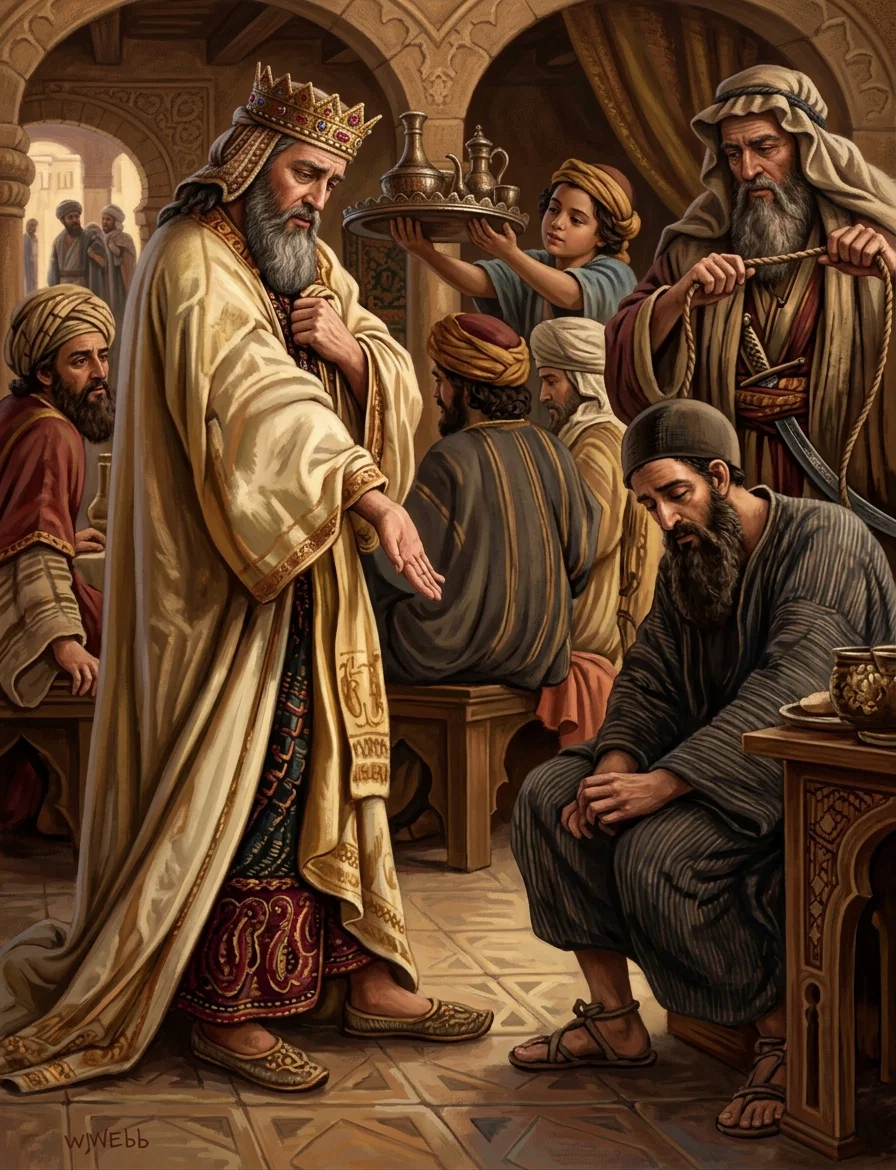
1 “And Jesus answered and spake again in parables unto 2 them, saying, The kingdom of heaven is likened unto a certain king, which made a marriage feast for his son, and sent forth his servants to call them that were bidden to the marriage feast; and they would not come. Again he sent forth other servants, saying, Tell them that are bidden, Behold, I have made ready my dinner; my oxen and my fatlings are killed, and all things are ready; come to the marriage feast. But they made light of it, and went their ways, one to his own farm, another to his merchandise; and the rest laid hold on his servants, and entreated them shamefully, and killed them. But the king was wroth; and he sent his armies, and destroyed those murderers, and burned their city. Then saith he to his servants, The wedding is ready, but they that were bidden were not worthy. Go ye therefore unto the partings of the highways, and as many as ye shall find, bid to the marriage feast. And those servants went out into the highways, and gathered together all as many as they found, both bad and good; and the wedding was filled with guests. But when the king came in to behold the guests, he saw there a man which had not on a wedding garment; and he saith unto him, Friend, how camest thou in hither not having a wedding garment? And he was speechless. Then the king said to the servants, Bind him hand and foot, and cast him out into the outer darkness; there shall be the weeping and gnashing of teeth. For many are called, but few are chosen.”
Golden Text: “Come; for all things are now ready.”Luke 14:17.
Suggestive Questions.
(1) What form of discourse did Jesus again adopt? Verse 1. (2) To what did He liken the kingdom of heaven? Verse 2. Note 1. (3) What invitation did this king send forth? Verse 3. Note 2. (4) How was the invitation received? Same verse. (5) Whom did he send forth to carry his second invitation? Verse 4. Note 3. (6) What was their message? Same verse. (7) How did a part of those who were invited receive the second invitation? Verse 5. (8) How did the remainder treat those who bore the invitation? Verse 6. Note 4. (9) How did the king feel when he learned what had been done? Verse 7. (10) How did he punish them for their wicked acts? Same verse. Note 5. (11) What statement did the king then make to his servants? Verse 8. (12) What did he command his servants to do? Verse 9. (13) Where did his servants go to find guests for the wedding feast? Verse 10. Note 6. (14) What class of people did they bring in to the feast? Same verse. (15) What was the result? Same verse. (16) When the king came in, whom did he find among the other guests? Verse 11. Note 7. (17) What question did he ask of this guest? Verse 12. Note 8. (18) What excuse did he have? Same verse. (19) What command did the king give his servants in regard to this guest? Verse 13. (20) In what way will the anguish of those who are cast out from the Lord’s presence be manifested? Same verse. (21) What truth is taught by this incident? Verse 14. Note 9.
Notes.
1. A certain king.—Representing God the Father. He was the King whom the Jewish people professed to serve; and the invitation to the marriage supper of the Lamb—His Son—is now going out into all the earth.
2. Them that were bidden.—“It is still customary in the East not only to give an invitation some time beforehand, but to send around servants at the proper time to inform the guests that all things are ready.”—Kitto. “The notification is not customary among common people; but in Lebanon it still prevails. If a Sheik, Beg, or Emir invites, he always sends a servant to call you at the proper time.”—Thompson. This invitation was given by the prophets and by John the Baptist.
3. Sent forth other servants.—The invitation of the first servants had been ignored. The invitation now comes from the lips of other servants, but it is the same invitation. God has set His hand to this work. It must be a success; the wedding must be furnished with guests; and this message given by others to the same people leaves them without excuse. The second invitation was what Christ and His disciples were giving at that time to the Jews.
4. Entreated them shamefully, and killed them.—Christ Himself is reckoned among those who were thus treated, and the Jews had again and again imbrued their hands in the blood of those who were seeking to turn them to God; and that they continued this work is shown in the persecution which the early Christians suffered at their hands, especially at the hands of Saul before his conversion.
5. Sent forth his armies, etc.—While this refers primarily to the destruction of Jerusalem at the hands of the Romans, when thousands upon thousands of the Jews were slain, and their city given to the flames, it is also a type of the destruction of all those who refuse the Gospel call.14
6. Went out into the highways.—This was fulfilled in the call to the Gentiles, to those outside the Jewish nation. It is typical of the last call to the marriage supper. Luke 14:23, 24. This antitypical call is now going to the world. Missions are being established in the lowest, wickedest parts of the large cities, and souls are being converted from the ranks of this class, who will have on the wedding garment of Christ’s righteousness, and be prepared when He comes in to inspect the guests. In this way, by raising up monuments to His glory from the slums of our cities, will God reveal the power of His grace and emphasize His victory over evil.
7. Came in to see the guests.—This will be in the judgment, when every case is examined in the great court of heaven.
8. Not having a wedding garment.—There was no excuse for it; for the king furnished the garment. It was customary in the East for this to be done. “At the royal wedding of Sultan Mahmoud, a few years ago, every guest invited to the wedding had made expressly for him, at the expense of the sultan, a wedding garment. No one, however dignified his station, was permitted to enter into the presence chamber of that sovereign without a change of raiment.” The wedding garment which Christ furnishes His followers is a garment which they can not make for themselves, nor purchase. It is the robe of His righteousness. Without it we can not see His face; with it we are guests at His marriage supper, and subjects of His kingdom forever.
9. Many are called, but few chosen.—The invitation is to every inhabitant of the earth. He is “not willing that any should perish.” 2 Peter 3:9. Few of the Jews became Christians and accepted of the sacrifice which was made for the world; and not all who have taken upon them the name of Christians will be accepted guests at the great marriage feast, for upon some will be found garments which the King has not prepared.
News and Notes
FOREIGN
—China has voluntarily declared Woo-sung a treaty port, and has given England formal notice of a desire for a revision of the tariff in accordance with the treaty of Tien-tsin.
—The strength of the rebellion in the Philippines grows with each week. There are now said to be 10,000 insurgents, armed and equipped, battling for freedom in those islands.
—A Peking correspondent of the London Times states that “the extension of British territory at Kau-lung, opposite Hongkong, will follow immediately after the French occupation of the new coaling station at Kwang-chau-wan.”
—The region around the city of Shun-king, China, is said to be in a state of open revolt. The local authorities are powerless to arrest the murderers of the American missionary, and a mob has sacked the French mission in that vicinity.
—It is reported that the English foreign office is making arrangements looking to the acquirement of Delagoa Bay, in Portuguese East Africa, either by purchase or seizure, as the first step in Secretary Chamberlain’s program of absorbing the Boer Republic.
—A despatch from Madrid, dated April 7, states that fifteen Spanish men-of-war are to leave Cadiz immediately for the Canary Islands, and several battalions of Spanish troops have been sent to reinforce the garrisons on the Balearic, in the Mediterranean.
—American citizens in Porto Rico have left that island and taken refuge at St. Thomas, fearing that their lives were endangered during the present strained relations between Spain and the United States. The American consul at that port has also taken his departure.
—A battle is reported to have taken place between the Chinese and Russian troops in the territory recently leased to Russia by China. The Russians now contend that this disturbance shows the necessity of Russia taking possession of the city of Kin-chow, which joins the territory she has recently acquired.
—The Anglo-Egyptian expedition in the region of the Upper Nile has met the forces of the Dervishes in a pitched battle and dispersed them, leaving 3,000 of the Dervishes on the field. Mahmoud Pasha, the leader, was captured, with 6,000 of his followers. This battle, which has been expected for a number of weeks, illustrates the superiority of the modern weapons of war over those of earlier date. The English and Egyptians lost only 61 killed, while the trenches of the Dervishes are heaped with their dead.
—Late advices from the Orient state that a severe attack has been made upon the missionaries in Chunchi, Shao-shing. An unsuccessful attempt was made to wreck the missionary chapel. The report states that some lives were lost, but the exact number is not known. A secret society, known as the Ko-lao-hui, has been organized at that place, and is being supplied with arms and ammunition, the society’s avowed object being to drive foreigners and Christianity out of China.
—J. P. Gibbins, an electrical engineer, of London, has written a letter to the New York World, in which he claims to have sold floating mines and ground mines to the Spanish Government for use in Havana harbor. He also claims to know that these mines were placed in the waters of Havana harbor, and that they are now in electrical connection with the shore. He also goes so far as to state that the blowing up of the Maine was the work of one of two men who are personally known to him.
—In St. Cuthbert’s Church, London, on April 8, during the ritual known as the “veneration of the cross,” in which the congregation prostrated themselves before the crucifix and kissed the figure of Christ, John Kenzil, who is leading an anti-ritualist crusade, seized the crucifix and rushed toward the door, denouncing “such idolatry and popery in the Church of England.” A panic ensued, in which Kenzil was roughly handled. Finally the congregation rescued the crucifix and the police rushed in and arrested Kenzil.
—Reports of terrible suffering from bush fires come from Victoria, Australia. The report states: “Farms and stations have been destroyed in every quarter, numbers of human beings, to say nothing of hundreds of thousands of sheep, cattle, and horses, meeting their death in the fire. The heat in this city at the time of writing is 105 in the shade and 154 in the sun, and ever since the outbreak the temperature has ranged from 96 to 108. The destitute settlers themselves are subsisting upon the roasted stock and potatoes which surround them so plentifully.”
—The abolishment of the order of reconcentration in Cuba has but opened the door for more atrocities. Many of the reconcentrados have taken advantage of the abolishment of the decree and gone into the country, only to be slaughtered at the hands of the Spanish guerrillas. Near Guanabacoa about forty women and boys were shot down by the Spanish volunteers while digging potatoes. Similar instances of unprovoked butchery are reported from Guines, Jaruco, and various Pinar del Rio towns. Near Santa Clara over 50 pacificos who had gone into the country in view of the rescinded decree, were slaughtered at night by Spanish guerrillas.
—Emperor William of Germany has signified his intention of making a trip to the heart of Palestine. While there he will officiate in the dedication of the German church at Jerusalem, and lay the cornerstone of a German school, parsonage, and hospital. The important task which the emperor has undertaken is to regain for the Roman Catholic Church the possession of the Coenaculum, the chamber of the last supper. The sultan has intimated his willingness to meet the wish of the emperor in this matter, and the pope has sent the emperor an autographic letter warmly thanking him for this new proof of his interest in the eternal welfare of the Christian church.
DOMESTIC
—The United States war ship Oregon has reported at Callao, and proceeded on her journey around the Horn.
—The United States Government has purchased of Brazil, for the sum of $550,000, the armored cruiser Nichteroy.
—The Legislature of Michigan has voted a war loan of $500,000, to become available on the breaking out of hostilities between the United States and Spain.
—The condition of the United States Treasury at the present time is as follows: Available cash balance, $226,347,786; gold reserve, $179,862,034.
—The Riverside County Hospital, at Bowers, California, was burned to the ground on April 12. All the inmates were rescued, but the loss is estimated at $40,000.
—The body of Miss Frances E. Willard was cremated at Chicago on April 9, and her ashes were deposited in Rose Hill Cemetery, all of which was in accordance with her expressed wish.
—The work of the Red Cross Society in Cuba has ceased, and Clara Barton has returned to the United States. The uncertainty of protection for the lives of those engaged in this work is the cause of this move.
—The Navy Department has purchased four of the Morgan line steamships, which will be at once fitted up as war vessels. These ships, now known as El Norte, El Sud, El Rio, and El Sol, will hereafter be known as Yankee, Dixie, Prairie, and Yosemite.
—The Navy Department has decided to buy the transatlantic liners St. Louis and St. Paul, and to fit them up for use in the expected war with Spain. These are both large, swift steamers, and it is stated will be under command of Captains Sigsbee and Goodrich.
—A fire occurred in the pattern warehouse of the Southern Pacific Railway Company at Sacramento on the night of April 8, resulting in a loss which is estimated at over $500,000. Many men are thrown out of employment by the loss of the company’s models and patterns.
—The United States war ship San Francisco, with the cruiser New Orleans, recently purchased in an English shipyard, arrived at Halifax on April 11, and left for New York on the following day. These vessels are bringing to America a heavy shipment of rapid-fire guns, explosives, and other war munitions.
—The prospect for war between the United States and Spain is causing considerable anxiety on the part of the American Board of Foreign Missions for the safety of its missionaries in Spain, both on account of the differences in religious belief between the missionaries and those among whom they labor, and the natural animosity of the people.
—On March 27 an avalanche of snow and ice swept down Chilkoot Pass, burying scores of the struggling miners. Sixty-three bodies have been exhumed, and it is stated that from 100 to 150 are still under the mass of snow and ice. United States soldiers and many miners are at work along the track of the avalanche, but the extent of this most terrible Alaskan disaster will not be known for several days.
—The Naval Appropriation Bill, which was reported to the House a few weeks ago, carrying a total of $35,686,058, has been reported to the Senate within the last week, with an increase of $8,263,500, making a total of $46,277,558. This increase is to provide for the construction of four harbor-defense vessels of the Monitor type, with their armor, armament, and equipment, and for four additional torpedo-boats.
—The representatives of the six European powers, Great Britain, France, Germany, Russia, Austria, and Italy, called upon President McKinley on April 7, and presented a “message of friendship and peace at the present critical juncture between the United States and Spain.” The message was delivered by Sir Julian Pauncefote, the British ambassador, and was replied to by President McKinley in a speech carefully prepared for the occasion.
—On April 12 there arrived at Edmonton, Alberta, British America, a messenger from the shut-in fleet of American whalers north of Alaska. He had traveled a distance of 3,000 miles with dog teams during the past five months, through such snow and ice and under such hardships as could only be experienced during a winter journey in such a land. This messenger reports that the whalers have provisions enough to last until help can reach them in the spring.
—On the afternoon of April 9 Consul-General Lee left Havana and sailed for Key West, arriving at Washington on April 12. General Lee received an ovation along his entire route from Florida to the capital, and a grand demonstration was made in his honor on his arrival there. All the Americans in Cuba were given an opportunity to leave the island, and nearly all availed themselves of the opportunity. The Spanish consul at Key West left his post on April 12, giving for his reason for doing so, that threats had been made against his life.
—On April 11, President McKinley sent to Congress his long-expected message on the America-Spanish-Cuban question. The message deals plainly with the horrors of the Cuban war, the inability of Spain to quell the insurrection or insure safety to life and property, the destruction of the Maine by a torpedo, and the duty of the United States to intervene. The President asks authority to use the forces of the army and navy to bring peace to Cuba, and recommends the distribution of food supplies to the starving inhabitants of the island; but is averse to the recognition of the Cuban Republic. In response to this, in both the Senate and House, on April 13 resolutions were introduced authorizing the President to intervene in Cuba, to put an end to the terrible conditions existing there, and establish a stable, independent form of government. In both Houses a minority report was presented declaring for the recognition of the independence of the Republic of Cuba. Neither of the resolutions was passed by the Senate; but the minority report was defeated in the House by a vote of 147 to 190. The resolution introduced in the House by the majority of the Committee on Foreign Affairs was then passed by a vote of 322 to 19. This resolution authorizes the President to use the army and navy to carry out its recommendations. This was a joint resolution, and will have to be passed by the Senate before becoming effective. When passed by that body, it will constitute a virtual declaration of war, granting the request of the President contained in his message of April 11.
Sabbath School Maps
4 A. Lands of the Bible, especially the travels of St. Paul, 52x71 inches . . . $5 00
4 B. Same as above, reduced to one-half size . . . 3 00
4 C. Same as above, but reduced to 36x26 inches . . 1 00
Pacific Press Pub. Co., Oakland, Cal.
39 Bond St., 14 to 18 West Fifth St.,
New York City. Kansas City, Mo.