“In view of the impending conflict between the United States and Spain over the independence of Cuba, the following table, showing the military strength of this nation, will be found interesting. The table also gives data of the number of men liable for military duty, information in regard to the appropriations, company officers, encampments, and mobilization. The table is compiled from the reports made to the department by officers detailed for duty with the militia of the States. The authorized strength of the militia of the entire country (which, however, includes several States where this strength is not limited) is 186,848, while the aggregate actual strength is 113,760, made up as follows:—
“There are 10,378,118 men liable to military duty in this country, and the various States made appropriations for the maintenance of their militia amounting to $2,723,564.”—Christian Advocate.
And yet with such an array of figures as the military and naval statistics of this country and the Old World as well presents, men would fain have us believe that it all means peace. What a delusion Satan is palming off on the world! And how readily do men accept it, and that right in the face of every evidence!
The Coming Struggle Among Nations
A great change is about to come over the temporal and social destinies of competing nations, and men are counting their allies as they gird themselves for the providential and significant struggle. The powers have been making ready for years, and expert servants of rulers have been toiling to make their masters invincible. All these tools for wounds and death are sure to be tried before long, and the bravest man can not steady his breath and heart-beat when he tries to count the utmost possible cost. This thought is in the minds of those who scan the momentous daily news, that comes from every continent, and the wisest is the most serious when he reviews the probabilities.—Northwestern Christian Advocate.
FARMER JOHN.
By Ernest Gilmore
“THERE’S farmers and farmers,” said the dear old wife of one of them, as we sat on the veranda of the quaint old farmhouse one summer evening. The red gold light of the setting sun streamed over us. Tall hollyhocks nodded to us from the high side fence. Sweet old-fashioned pinks wafted their fragrance to us. There were cabbage roses beside the steps, and over on the western slope a mass of tangled shrubbery. Over all was the red gold glimmer, tinging the face of nature and making it glow with beauty.
CALIFORNIA SCENERY, No. 14.—“Castle Crags,” the name by which the wild, craggy mountains in the background are known, are among the splendid views of the Sierra Nevadas in Northern California, near Mount Shasta, fourteen hours from San Francisco, by the California and Oregon Railway. This region is among the most picturesque mountain scenery accessible to the tourist or lover of nature. These mighty rocks rising sheer for 4,000 feet above their visible base, have been riven and splintered by some mighty convulsion of nature. Other views give a better idea of the castellated forms of the mountains, and the naked eye sees the many turrets, towers, spires, and pinnacles, which the camera fails to catch. This section of the State is noted for its pure air and water and sublime scenery.
“Now there was Farmer John—he was a farmer worth the name.”
“Is he dead?”
“Dead!” said she; “why, no, such a man as Farmer John couldn’t die. ‘He sleeps in Jesus.’ That’s what it says on his tombstone, and that’s what Farmer John is doin’—sleeping in Jesus. He sleeps—that is well, he needs the rest, but some day he’ll awaken and then—”
“And then?”
“Well—well—I hardly know how to put it, but that day—you know, when He makes up His jewels, why, Farmer John’ll be there. I’m sure of it; I wish I was as sure of my bein’ there.” She sighed, thinking of herself, then she smiled, thinking of Farmer John.
“You see it wasn’t ’cause he was any richer than the other farmers ’round here; he wasn’t; but it was because he could see better, that he managed to lift so many burdens for folks that weren’t able to bear ’em.”
“See?”
“Why, I don’t mean just seein’ with the eyes. You might know that there’s other ways of seein’ ’cordin’ to my thinkin’. Mebbe it’s seein’ with the soul. I dunno—anyway it’s seein’. Now, there was Almiry Crane. Some folks thought ’twas all clear sailin’ with Almiry, fer she had that pride she wouldn’t let on but ’twas. Now I don’t mean that Almiry was uppish, ’cause she never was. The pride she had was the kind that keeps folks’ affairs to themselves. Almiry kept her poverty to herself. Most folks knew, or thought they knew, that she was as well off as she’d ever been, an’ she let them think so, but Farmer John knew better. She’d had some money in the bank, but it had dwindled away, and Almiry used to lie awake nights wonderin’ what would become of her. Mebbe you’re thinkin’ that Almiry was doleful-lookin’, but ’twant so. She was as cheerful and chipper, apparently, as any one.
“But there was one person who could read between the lines, as it were. He saw the lines deepening around the thin lips, and he knew what it meant. This was Farmer John. Almiry had a little garden. She had sowed, and planted, and cared for it herself, notwithstanding her weakness and lameness and the burden of her sixty-five years. She raised herbs, too, peppermint, catnip, tansy, and thoroughwort. One day, toward evenin’, Almiry put up her knittin’ an’ fell upon her knees. She didn’t pray her usual prayer, she couldn’t, but she wailed forth:—
“I don’t know what I’m goin’ to do. O Lord, I don’t know!”
The sun peered into the western window to say good-night, touching the thin white hair of the bowed Almiry tenderly; then it vanished and the shadows deepened around her. She was still on her knees, but her prayer was now voiceless. The light died out. The darkness wrapped her in a winding cloak. She tried in her grateful way to thank the Lord for her little home, her dear old home, with its precious memories, and the “things,” but she was faint from hunger. She couldn’t eat the house, you know, nor the “things,” and she had no work or money. The vegetables were all gone long ago. As for meat, she had most forgotten the taste of it.
“Again came the words, ‘I don’t know what I’m goin’ ter do, O Lord; I don’t know!’ an’ then there fell a perfect storm of weepin’. In the midst of it some horses drew up to the door, an’ then came a rap. The rap was repeated two or three times before the door opened, for Almiry had to wash her tearful face first and summon a smile to her blue lips. She lit the lamp, too; then she opened the door. There stood Farmer John with his sunshiny face and cheery greeting. He shook hands in his warm-hearted way, but he declined Almiry’s invitation to ‘come in.’
“‘I can’t,’ he said; ‘the horses are out here; an’ it’s getting late. I just stopped to leave this basket. We’ve been killin’ up to our house, an’ I’ve brought you a taste. And now, Almiry, could you give me a little catnip? Our folks didn’t gather any, and there’s that baby.’”
“He was pretendin’, you see, that he wanted that catnip as a favor. And then when he carried that big basket in, he managed to get a good look into Almiry’s face. That was enough. He knew the Lord had led him there that night. After he’d gone, Almiry looked into the basket; then she set down and cried, but this time ’twas fer joy. What was in the basket, do you say? Why, there was sassage an’ tenderloin an’ spare rib an’ a fresh ham. An’ the very next day there come a bag of flour from Farmer John’s mill at the ‘Corners.’
“‘I want you to try it, Almiry,’ was Farmer John’s excuse for sendin’ it. ‘I want to get your opinion.’ An’ so it went; sometimes it was chickens, sometimes eggs, or potatoes, or apples, an’ he always wanted somethin’ in payment, peppermint or thoroughwort or some caraway seeds, a-pretendin’, you know, so’s not to hurt her feelings.”
“But my! Almiry wasn’t the only one Farmer John helped in his lovin’, hearty way, just goin’ round quietly, not lettin’ his left hand know what his right hand was doin.’ Now when poor Hetty Snow’s baby died and there wasn’t a cent to buy a coffin fer the dead or bread fer the livin’, Farmer John knew he was wanted, an’ there he was. An’ then that night when ‘Drunken Joe’ died, there was poor little Sue white an’ scared an’ miserable until Farmer John come along. He lifted her up and carried her off to his home, where she still is. Then there’s Burt Havens; his father was in prison, an’ because of that, people give the cold shoulder to the poor boy.”
“‘’Tisn’t right,’ said Farmer John. ‘What’s the use of blamin’ the poor boy for what he can’t help?’ And then he took him in, an’ if I10do say it, there ain’t a better boy anywhere than Burt Havens. It’s all because of Farmer John.”
“When did you say he died?”
The old lady smiled. “He isn’t dead, you know, I told you, he’s asleep in Jesus. He will be awake in that day when ‘He maketh up His jewels.’”—Ernest Gilmore, in New York Observer.
IS IT WORTH WHILE?
By Joaquin Miller
Is it worth while that we jostle a brother
Bearing his load on the rough road of life?
Is it worth while that we jeer at each other
In blackness of heart—that we war to the knife?
God pity us all in our pitiful strife!
God pity us all as we jostle each other!
God pardon us all for the triumphs we feel
When a fellow goes down ’neath his load on the heather,
Pierced to the heart! Words are keener than steel
And mightier far for wo or for weal.
Were it not well in this brief little journey
On over the isthmus, down into the tide,
We give him a fish instead of a serpent,
Ere folding the hands, to be and abide
Forever and aye in dust at his side?
Look at the roses saluting each other,
Look at the herds all at peace on the plain;
Man, and man only, makes war on his brother,
And laughs in his heart
at his peril and pain,
Shamed by the beasts
that go down on the
plain.
Is it worth while that we
battle to humble
Some poor fellow soldier down into the
dust?
God pity us all! Time
eftsoon will tumble
All of us together, like
leaves in a gust,
Humbled indeed down
into the dust.
—Joaquin Miller.
A BLIND BOY GRADUATE.
Takes the Highest Honors in the University of Texas.
The following, from Prof. John A. Lomax, registrar of the University of Texas, speaks for itself. How it ought to stimulate those to work who have the use of all the senses:—
Franz Joseph Dohmen, of Austin, Texas, ranks above any of his fellow-students of the present senior class of the University of Texas. At the next commencement he will receive the degree of Bachelor of Literature. The fact that Mr. Dohmen is the first-honor man of his class is only remarkable because since his tenth year he has been totally blind. He is twenty-four years old, and was born at New Braunfels, Texas, of German parents. His father, Dr. Dohmen, was at the time of his death the State oculist, and one of the most distinguished men of his profession in the State. When young Dohmen was ten years old, he was seized with an attack of the typhoid fever, which settled in his eyes, and when his strength was restored, it was found that he had completely lost his sight. His fondness for study and his natural musical taste have apparently afforded him ample recompense for the loss of his sight. He was placed in the Blind Asylum, and there had his talents for music developed, and at the same time received splendid preparatory training for his university career.
While he was studying in the blind asylum he received training in a system of writing that has been invaluable to him while a student in the University. This system consists of piercing full of small holes a stiff waxed paper by means of a sharp instrument, the position of the hole being determined by a small metal frame held on the opposite side of the paper; this furnishes projections, which the blind learn to read as readily as they do raised letters. Mr. Dohmen is a perfect master of this system, and writes it as rapidly as an ordinary writer does long hand. He comes to the university daily with his notebook, attends classes, takes notes, and goes about the building so easily and naturally that the loss of his sight is scarcely noticed. When a term examination occurs, he writes his answers to the questions according to his short-hand system for the blind, and then takes his replies home and makes a neat copy himself upon his typewriter. He does his typewritten work rapidly and neatly, and presents to his professors manuscript faultless in its appearance and almost flawless as to its scholarly grasp of the subject under consideration.
Mr. Dohmen graduated from the blind asylum in 1893 with the highest honors, and has now been a student of the University of Texas for five years. His proficiency as a performer on the piano is a great solace both to himself and to his friends, but his greatest delight consists in delving in the problems of higher mathematics, philosophy, and political science. He speaks and writes English, German, and French. He is a fair Latin scholar, and knows a smattering of Greek. At present he is studying Greek, French, German, mathematics, Latin, and political science. Upon these studies next June he will receive his degree of Bachelor of Literature, and will leave immediately for Germany, to pursue further investigation in his favorite subjects of philosophy, mathematics, and political science in some one of the great universities there.
Mr. Dohmen is rather tall. His face is sensitive, refined, and pleasingly intelligent. His disposition is bright and cheerful. He is popular with every one, and the small coterie of his friends to whom he reveals in some degree his inner self, all testify by their sincere admiration to the true nobility and greatness of his character. His life after his return from Germany will be spent in teaching.
No citizen of Texas can ever begrudge the generosity of the State that has provided means for educating the unfortunate blind, and surely every one will rejoice that the honors of the present graduating class of the University of Texas will be taken by a blind boy who received his preparatory education in the State Institute for the Blind. And patient, persistent, persevering application has won this honor for young Dohmen. His record will be left behind him on the books of the University, and it is as phenomenal as it is hoped his success will be in after life.
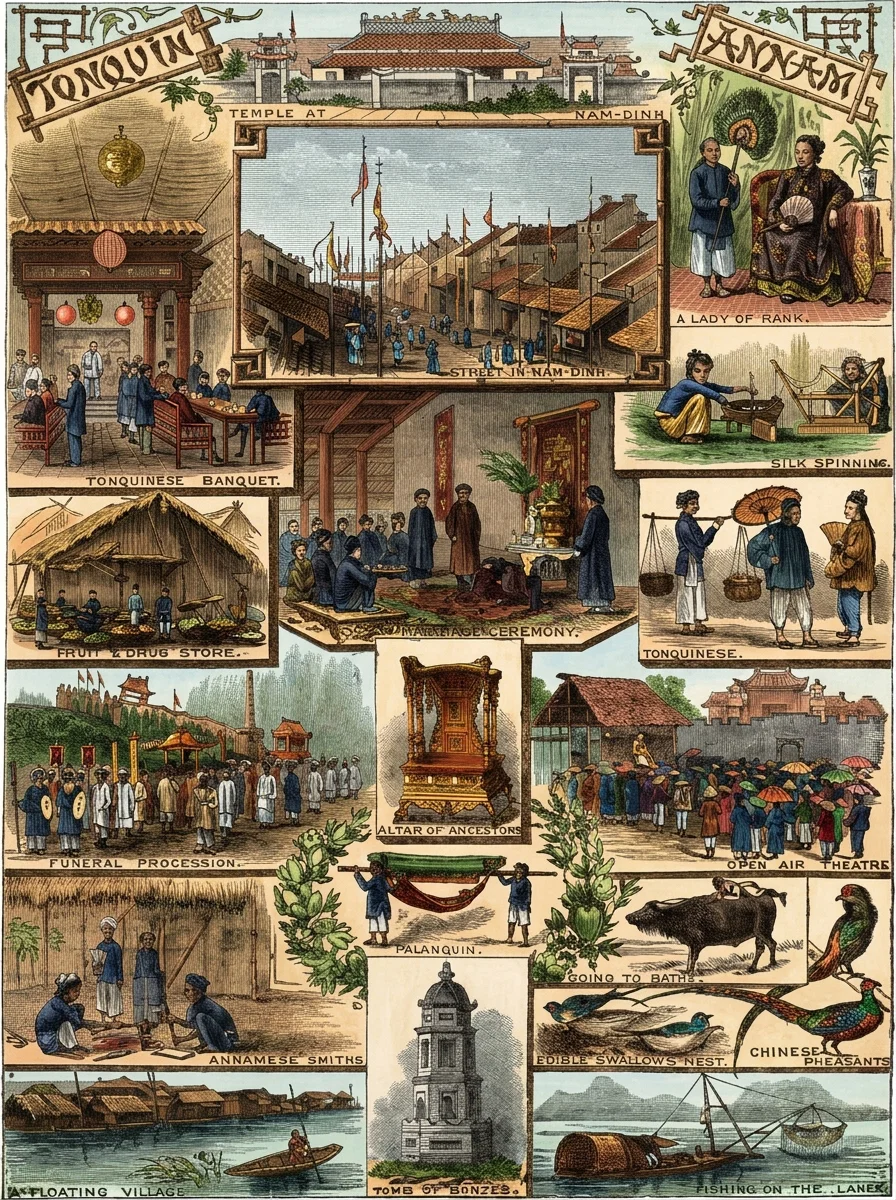
A PEEP AT SOME CHINESE PROVINCES.
For Our Young Readers.
The Chinese emperor, “the son of heaven,” as he is called, used to rule in awful state at Pekin. From north, west, south, there came every year stately processions humbly bringing tribute and splendid presents to his celestial majesty. Embassies from the hot, sunny coasts and tropical forests of Annam and Cochin-China, were always on the march with gifts. Annam sent elephant tusks, rhinoceros horns, nuts, spices, sandalwood, and one hundred pieces of satin, and one hundred rolls of white silk. A letter written in gold from the king of the South said: “As is my duty as your vassal, gazing from afar at the heavenly abode, I have sent my envoy bearing these presents; I humbly wait your acceptance of them.” Tonquin and Cambodia did the same.
But all is changed now, for France has annexed the whole great S-shaped coast, reaching back to the great river Mekong. Driving back the yellow troops of Cochin-China, she has made herself a splendid empire in Southern Asia; so no more tribute will reach Pekin from the South. Tonquin means the “Eastern land.” It is the most northerly of the three provinces we are considering, and the nearest to China. Inland it is very mountainous, but with fertile coasts and valleys.
The coast south of the Gulf of Tonquin is Annam proper, and the great, flat region trending to the southwest is called Cambodia; all three provinces are now really France in Asia. The country is extremely lovely. Palms, bamboos, and giant-flowering trees grow faster than man can destroy them. Teak and gum trees yield splendid timber. Gutta-percha trees, dye-woods, vanilla plants, and spices grow wild. The great staple crop is rice, vast quantities being raised. The indigo plant, the sugar-cane, coffee, tea, pepper, cloves, and excellent cotton, are grown.
From Cambodia comes the yellow pigment called gamboge. Oils and resins are made into brilliant lacquer, and the glossy, coral-red, and gilded wares seen in some museums are the work of these artistic peoples of “farther India.”
In the forests roam the elephant, rhinoceros, tiger, leopard, and apes of many species. Among the birds are peafowl, gold and silver pheasants, and bright-plumaged macaws. In11the marshy deltas of the great rivers Mekong and Saigon are crocodiles, serpents, boas, and venomous reptiles.
Cambodia is a network of river channels, all emptying into the great inland lake of Bein Hoa. Here are the haunts of fever, ague, and cholera. It is death for a European to sleep in these beautiful but deadly glades. Still, people do live there, for where is the temperate or tropical spot which is not “home” to some human beings? The French port of Saigon is fast becoming a rich and busy trade center.
TEMPLE AT NAM-DINH.
STREET IN NAM-DINH.
A LADY OF RANK.
SILK SPINNING.
TONQUINESE BANQUET.
FRUIT & DRUG STORE.
MARRIAGE CEREMONY.
TONQUINESE.
FUNERAL PROCESSION.
ALTAR OF ANCESTORS.
OPEN AIR THEATRE.
PALANQUIN.
GOING TO BATTLE.
ANNAMESE SMITHS.
TOMB OF BONZES.
EDIBLE SWALLOW'S NEST.
CHINESE PHEASANTS.
FLOATING VILLAGE.
FISHING ON THE LAKES.
Hidden among the forest jungles are the famous ruins of Angkor. No man or woman treads the richly carved palace halls of that deserted city. They are a lair for tigers, a haunt for venomous reptiles. Trees and climbers for a thousand years have choked the galleries and courts. When the city was built, and by whom, there is no record. The people must have been far advanced in the arts, and very rich. Now the silence is broken only by the peacock’s cry, or the growl of some beast of prey.
The religion of the richer inhabitants of Cochin-China is Buddhism, founded by Buddha, who is represented in temples by an image sitting cross-legged in deep contemplation; but the poor worship good and evil spirits, which they call Nats. There are many Jesuit missionaries following the French conquerors, but few converts are made. By race the people are a mixture of Malays and Chinese, and are brave, lively, and peaceable. They live very coarsely, eating rice, snakes, locusts, rats, and drinking only tea. They chew betel-nut till their teeth are worn down to their gums. They make and embroider some excellent silk and cotton fabrics, while their houses are mainly of wood, the bamboo furnishings being gaily colored.
Turning to our illustrations, you may see a scene in Nam-singh, a strongly fortified town captured by the French.
Next comes a Tonquinese mandarin’s banquet, which is a very ceremonious affair. Endless are the dishes,—live fish, bird’s-nest soup, sea slugs (tripang), roasted puppy, and half-decayed eggs. The cooks are said to be very skilful, and delight in surprising the guests. With everything is served snowy white rice.
In the center of the page is a wedding scene, which is a long, costly ceremony. The poor bride bends low before her husband, confessing herself his slave. Lower down we show a native forge. With a stone for an anvil, and a few simple tools, a little charcoal, and goatskin bellows, the men do really very fine smith’s work.
Below is a floating village on the Mekong River, and a fisherman with a great square net, which he moves up and down with a kind of crane.
Other features to be mentioned are the altar of ancestors, whose worship is held sacred; a palanquin, showing the mode of traveling; a tomb of the bonzes—that is, the burial-place of the Buddhist priests—and an elaborate funeral procession. You can also see how the women spin silk, and the way in which the people amuse themselves in the open air.
Almost nothing has been done among these people to enlighten them as to the way of salvation. Roman Catholics claim in the entire territory of Annam and Tonquin about 800,000. There are no Protestant missions in either territory. May the time soon come when the true Gospel of Christ shall be preached so that every soul may hear the glad tidings.
MY TEXAS COWS.
By Frank Wilkeson
I OWNED sixty-five acres of bottom land where the coarse, blue-joint grass grew in cane brake like rankness. My Texas cows chose this dense cover in which to bring forth their young. One spring I knew that there were over twenty calves continually hidden in the grass on this bottom. Every morning cow after cow would slip out of the herd and disappear in the tall grass. After an absence of an hour or two, they would return to the herd. In the late afternoon they would again disappear, to rejoin the herd just about corralling time. When the calves were three or four days old, their mothers would bring them out into the herd, and their places in the grass would be occupied by younger calves. Once I desired to see the young calves, and I rode into the grass to hunt for them. After an assiduous search I found one calf lying prone on the earth, with its head and neck extended and pressed into the thick mat of old grass that lay on the ground. The little creature lay perfectly quiet, watching my horse. It did not so much as wink its dark eyes when I dismounted and extended my hand toward it. I leaned over it. It watched me intently, but did not stir. I dropped my hand on its head. Instantly it was on its feet and calling loudly for protection, calling that the wolf, its mother had told of, had come. I heard twenty mother cows bellow, in answer to the calf’s call, that they were coming. The dry grass snapped and cracked in all directions as the maddened cows rushed wildly to their young. I mounted my horse and quickly rode away from that spot. Each cow ran in a direct line to the place where its calf was hidden. The entire herd rushed into the cover to do battle for the calf. What an uproar there was—cows, steers, and bulls, all calling loudly to one another in angry, excited tones! I had a foolish setter dog with me, and he had to mix himself into the trouble. The first cow that saw him bellowed to the others that she saw the wolf. They all pursued him, and he, dog-like, fled to me for protection, and my own cows gave me a brisk chase as I galloped over the prairie. The herd were excited and angry for hours.—Frank Wilkeson, in Our Dumb Animals.
Avoid Excessive Familiarity
“NEVER exhibit too great familiarity with a new acquaintance; you may give offense.”
TRIFLES
What will it matter in a little while
That for a day
We met and gave a word, a touch, a smile,
Upon the way.
What will it matter whether hearts were brave,
And lives were true,
That you gave me the sympathy I crave
As I gave you?
These trifles! Can it be they make or mar
A human life?
Are souls as lightly swayed as rushes are
By love or strife?
Yea, yea! A look the fainting heart may break,
Or make it whole;
And just one word, if said for love’s sweet sake,
May save a soul!
—Anon.
OUR WORK AND WORKERS.
The brethren at Bellvue, Colo., have nearly completed a new church building.12
As a result of meetings held at Boise, Idaho, by Brother E. D. Sharpe, six converts are rejoicing in the truth.
On the 26th ult. four persons were baptized and added to the church in San Diego, Cal., by Brother W. M. Healey.
Brother M. A. Altman notes the addition of six to the faith, and the organization of a church of twelve members at Flora Vista, N. M.
Meetings held at Levi, Texas, by Brother H. Woodruff, have resulted in twenty adherents to the “commandments of God and the faith of Jesus.”
A report from Fort Collins, Colo., in a recent number of Echoes from the Field, states that “nineteen have been baptized, and eight await that ordinance.”
By advise of the district council, Brother J. W. Bagby has changed his field of labor from Upper Columbia to California Conference. He is at present in Oakland.
On the 2d inst. four persons were baptized and added to the church at Denver, Colo. The same report says very few Sabbaths pass without witnessing accessions to this church.
Brother Oscar Hill reports that the patronage of the Workingmen’s Home in Walla Walla, Wash., is on the increase. Also that it has been decided to hold a camp-meeting there sometime this season.
Brother C. E. Leland recently preached in the Methodist meeting-house in Ellsworth, Mich., to a large congregation, and received a cordial invitation from the pastor to return and speak to them again.
Brother J. H. Durland, president of Michigan Conference (which includes Ontario), has appointed to begin a series of special services in Toronto on the 24th inst., which will be continued through the month of May.
Brother J. M. Rees, president of Colorado Conference, reports the organization of a church of sixteen members at Cañon City. Also, that at Florence a new meeting-house was dedicated on the 27th ult. Brethren Rees, Anglebarger, and Mackintosh officiated.
The appointment for a central California camp-meeting, which was set for May 5-15, at Visalia, has been taken up. The conference committee learn from Brother H. W. Thurston that the brethren in that section generally do not think it advisable to hold it, on account of the drought. It is therefore abandoned.
A discussion of the Sabbath question is announced to take place at Peoria, Texas, between Brother W. A. McCutcheon and a representative of the Christian denomination whose name we have not learned. The discussion, which has been a long time urged upon Brother McCutcheon, will begin May 3d and continue ten days.
A Methodist brother who had been twelve years in the ministry, recently took his stand as a Seventh-day Adventist at Oakfield, Me. He had been studying our works for about four years, and consequently came over with his eyes open. There are many who acknowledge the truth of the doctrines we hold who lack the courage to take up the cross.
Arrangements have been made with the managers of the Prohibition Park Hotel, on Staten Island, New York Harbor, whereby this fine summer hotel will be conducted during the present season as a sanitarium, under the auspices of the Battle Creek Sanitarium. A corps of physicians, trained nurses, cooks, and other assistants will be sent from Battle Creek, to conduct a sanitarium in a first-class manner. A summer school of health will be held in connection with the sanitarium.
The following item from a worker appears in a late issue of the West Virginia Monitor:—
“Recently a lady arose in a meeting in a Presbyterian Church, in a West Virginia city, and said in substance as follows: ‘Last September I was traveling on the train. On the same train was a lady going to attend a Seventh-day Adventist camp-meeting at Clarksburg. She was reading the SIGNS OF THE TIMES. She looked so pleasant and happy that I could not refrain from watching her. When she left the train, she left the SIGNS in her seat. I went and picked up the paper and read it; and I want to say to this congregation that that paper was the best one I ever read.’ Moral: Look pleasant (and you will if you are) and happy, and circulate the SIGNS everywhere.”
JOTTINGS FROM OUR HELPING HAND MISSION.
[BRETHREN B. F. RICHARDS AND G. W. REASER IN CHARGE.]
In one of our meetings, the second officer of the recently wrecked ship New York came forward to make a surrender to the Lord, and in his testimony stated that he had promised the Lord at the time of the disaster, that if He would spare his life, he would serve Him the remainder of his days. He believed that God had guided him to that Mission.
On another occasion a young man came forward to seek the Lord, and in his testimony stated that he had once made the foolish remark that he had rather be dead than dead broke, and the statement had nearly cost him his life, as it caused him to make a reckless balloon ascension. While he was in the air, 2,000 feet from mother earth, and in imminent peril of being dashed to pieces, he called upon God for help, and the Lord in mercy spared his life. He that moment purposed that he would give his life to the One who had not only purchased him, but who had saved him from a terrible death.
One poor despondent man took poison and came to the Mission to die; but through the mercy of God, and the prompt action of the physicians and nurses, he was restored to consciousness and health. Many hopeless persons have come to the point where they have determined to take their own lives, but God, in His great goodness, sends them to the Mission, instead of to the place where they thought to end their existence, and the wonderful result not infrequently follows that they are “saved by grace,” and Satan is thwarted in his purpose of trying to plunge precious souls into eternity without hope.
As we started home the other evening after the service, we observed a man lying on his face in the gutter, besmeared with blood and the filth of the street. He was placed in the hands of the trained nurses, who are always ready for deeds of mercy, and in a short time he became conscious, and was sent to his home.
One of the saddest sights that comes to our notice in the Mission work is to see college graduates, who are still young men, but who have so far lost their self-respect and manhood, through following after strong drink, that they really fill the Bible description of “natural brute beasts.” But many of these who have been so terribly depraved, are making good progress toward sobriety, manhood, and a home in heaven. It is truly marvelous to see the change in their countenances when they yield to the drawing influence of the Holy Spirit, and permit the Sun of Righteousness to fill their souls.
It is very encouraging, and strengthens our faith in the fact that this work is established in the providence of God, to receive so many substantial offerings from the Lord’s people in so many parts of the great harvest field. They come in the way of money, fruit, bedding, clothing, and other useful articles. Anything that can be used in the homes of the people can likewise be used to advantage in the Mission, and we can assure the many friends of the work that their liberality is appreciated by the Giver of every good and perfect gift, and by those who are in charge at the Mission.
The presence of Christian friends, who assist us by their songs and by their prayers, is appreciated. When you come to the city, visit the Mission.
We have recently begun a series of health talks in the afternoons, in which a remarkable degree of interest is manifested. These are conducted from the standpoint of the Bible and science, and are intensely practical. God is with the work, and Christ is all in all to the workers; and marvelous things are being done in the name of the Lord.
DELICIOUS BROMOSE THE NEW NUT FOOD
THE FOOD THAT IS ALL FOOD
Delicious, healthful, easy to digest. Makes double the rich blood of ordinary food . . . Thin people gain two pounds a week on a half BROMOSE diet.
A PERFECT FOOD FOR CHILDREN
Our booklet, “NUT FOODS,” free, tells about all our nut products.
A Luncheon of BROMOSE for a 2c Stamp
Seven Samples for 25 cents. Full line of samples, 50 cents.
SANITAS NUT FOOD CO., Battle Creek, Mich.
When you write, please mention the SIGNS OF THE TIMES.
PERIODICALS WANTED.
F. Gush, 430 South E Street, Tacoma, Wash., requests copies of any of our periodicals, English or foreign, for ship work. Please send post-paid until the request is withdrawn.
LITERARY NOTICES.
HOME, MARRIAGE, AND FAMILY RELATIONS IN THE LIGHT OF SCRIPTURE. By James Inglis. H. L. Hastings, 47 and 49 Cornhill, Boston, Mass. About 100 pages. Cloth, 85 cents; paper, 15 cents.
This excellent book is divided into four parts, “Home and the Household,” “Marriage,” “Parents,” and “Filial Duties.” This work contains also nearly 20 poems. It is a worthy book, and will, we are sure, be a blessing to any family where it is given a place.
“EVEN AS YOU AND I.” By Bolton Hall. We have received advance sheets of this readable little book, in which the author makes the attempt “to express in simple and clear forms the fundamental doctrines of earth’s great teachers.” The charm of “Even as You and I” will be found in the simple telling. But every good truth in it is found over and over again in the Word of God and in the life of Jesus Christ, with none of its errors.
“MELODIA—SCHOOL AND HOME MELODIES FOR LITTLE SINGERS.” Bound in dark green linen, 50 cents; tough manila, 40 cents. 64 pages. 65 songs.
The songs are by “the children’s poet,” George Cooper, and the music by Charles E. Pratt. The Melodia Company, Toledo-on-the-Maume, Ohio; Sherman, Clay & Co., San Francisco. It contains many excellent little songs for little folks.
BIBLE STUDENT’S SUBJECT INDEX, OR BEREAN CASKET. By W. H. Wild, 70 Walter Avenue, Battle Creek, Mich. Price, 10 cents. This is a little pamphlet of 28 pages, the ruling of which is so arranged under letters and numbers as to give space for twelve hundred subjects with Biblical or historical references. For those who do not have the best of memories and fullest knowledge this little book will furnish an excellent crutch, the best probably that has been devised.
ANNUAL report of the Board of Education of the City of Duluth, Minnesota, for 1897. An interesting report of 186 pages, full of statistics and well illustrated. Worthy of consideration by educators. The illustrations show some excellent school buildings in this growing city by the lake.
PREDESTINATION; OR THE LOVE OF GOD IN CREATION AND REDEMPTION. By W. T. Drummond, Graysville, Tenn. Price, 10 cents. Lots of good truth candidly told in poor verse. It gives many Scripture quotations to prove its propositions. To our mind it would have been much better expressed in good prose.
INTERESTING contributions, among others, to the March Cosmopolitan are “The Dreyfus Mystery,” by Theron C. Crawford, and “Shall We Annex Leprosy?” and “On the Choice of a Profession,” by Edward S. Holden, LL.D. Price, 10 cents a month, $1.00 a year. Sold by all news agents.
How to See the Point and Place It.
Punctuation without Rules of Grammar.
A book of forty pages which teaches punctuating rapidly by example. Many people who have studied English, Latin, and Greek Grammar are very careless and slovenly punctuators. This book is indispensable to all writers. Memorizing rules and exceptions wastes time and they are soon forgotten. By mail, 20 cents. Cloth, 40 cents.
Laconic Pub. Co., 123 Liberty St., N. Y.
When you write, please mention the SIGNS OF THE TIMES.