LOOK not thou upon the wine when it is red. . . . At the last it biteth like a serpent, and stingeth like an adder.”
When we were married and went directly to our new home, it seemed hardly like home to me, because we began boarding at a hotel.
The town was growing rapidly, and dwellings were not built half fast enough to accommodate the new-comers. The three hotels with many boarding-houses contained many newly-arrived families.
One day a lady came in whose lovely face looked familiar to me. I soon learned that she was one of my old associates in teachers’ institutes, and had come, like myself, a bride, into the thriving new town.
Mrs. Clyde, my new friend, was really attractive, with a fair, delicate face and charming manners. Her husband, who was much older, seemed very devoted and proud of her. He was a man of superior education and business ability, and would have been far above his present position of clerk had it not been for one obstacle, which my husband confided to me that evening, when I could talk of nothing but my pleasure in meeting my charming friend.
He had the fearful habit of drinking to intoxication at intervals, and at those times he left his employment for days at a time. But he had not drunk since his marriage, and, as I thought of the light heart and flower-face of his young wife, I prayed earnestly that he might never again.
Calls were exchanged and visits made, and one evening my husband had come to walk home with me from the Clyde’s, who boarded at a rival hotel. Not having household affairs, we two young wives were talking about our respective boarding-places, and the annoyances of hotel life. I agreed with Mrs. Clyde that her landlady was the more accommodating and did more for the comfort of her boarders. In confirming this, Mrs. Clyde told us that her hostess gave little parties, with wine suppers in her own private parlor.
“The choicest wine I ever tasted; it must have been very costly,” she said. “Now I’m sure your landlady never does that.”
“No,” said my husband, “she does not,” and our eyes met as I arose to go. Out under the stars, with my hand on my husband’s arm, I gave voice to the thought which I knew was in both our minds, whether the lovely young wife whom we had just left knew her own danger, or realized the peril of her husband, when she tasted and praised the wine-cup.
“One thing is certain,” said my husband, “we must not drop into their ways. Our principles are radically different. There must be a change before we can agree, and it is a sorrowful truth that we may deteriorate almost insensibly, while it requires a steadfast purpose to become stronger for good.”
Time passed on and we were just settled in a pleasant home of our own, when to the Clydes there came a baby boy. Then fell the first blow. The young father, elated at the birth of a son, in the reaction from the strain of sharp anxiety, called his friends together and drank to the health of mother and child, till he was no longer the tender husband and the courteous gentleman, but a senseless, drunken creature.
I sat, a silent watcher in that hallowed room, where the young mother yet lay close to the portals of death. Here, at last, he, her sworn protector, stumbled in, incoherently calling out maudlin endearments.
Never shall I forget the emotions that crowded into the face of his wife in the one moment before she became mercifully unconscious. Incredulity, fear, love, entreaty, wounded pride, and apology for him, all passed in turn over her features, and then they became like the porcelain lamp from which the inner radiance, shining through, has been suddenly stricken. One tiny hand of her baby yet lay, like a crumpled rose-leaf, against the sacred pallor of her face, as they forced the drunken man from the room where he had wounded nigh unto death the gentle heart that he had vowed to love and cherish.
Drinking to her health, indeed! He drank to her death and destruction. He failed her, in her hour of need.
Night swept darkly down like the wind of some ill-omened bird, day dawned pallid and cold, and evening drew again about her the purple curtains of the air and clasped them with a star, when a haggard, miserable, penitent man crept humbly into the room of his wife and laid a tear-wet face against the little nerveless hand she feebly moved to meet it.
The child grew and flourished, and Mr. Clyde was once more the happy husband and the genial companion he had been in former days. Still there was a difference. An anxious line began to show between the brows of the still beautiful young mother. Tho she was as gay as before, and her daintily-dressed boy was not more merry nor more admired than she, yet something seemed wanting. We heard that they gave charming little card parties, tho no one ever told us what mothers’ hearts bled when their young sons came home from them, flushed with wine, or daughters threw discretion and decorum to the winds on the homeward way, after sipping the social glass.
Prosperity came to the Clydes. Mrs. Clyde came to me, with pretty eagerness, one day, to tell of her good fortune. A relative had made a bequest to her of nine hundred dollars, and with it they were to begin building a home upon a lot which her husband already owned. I heartily rejoiced with her, but that was the last time I saw my pretty little friend for many a sad day. Her unfortunate husband had no strength to withstand sudden prosperity. From the time of getting her money into his possession, Mr. Clyde stopped work, treated his friends, and, being ashamed to appear before his wife, had gone to11a larger town where a horse fair was in progress, and, in a few days, returned, penniless, disheveled, and sick, unable to give any account of the manner in which the money had been taken from him. But others said it was lost at cards.
After an interval of discouragement and idleness, he was again taken into his old situation, and life went on much as before. Yet not the same. Fine lines were deepening on the face of the proud young wife, and the frank and upright bearing of Mr. Clyde was gone.
At a shorter interval the next blow fell. In an ill-fated moment Mr. Clyde yielded to temptation. Several days were given to drunkenness, and when he finally returned, sober, to his place, he found another man doing his work, and his long-suffering employer was adamant in refusing his entreaties and promises of reform. He had borne enough.
During that day and the next (which was Sunday), the disappointed man passed his time very cheerfully and kindly with his wife and little boy. When he left them on Monday, saying he had a new situation and must go to his work, the heart of his wife was busy, trustfully gathering up the threads of broken hopes, as women will, and weaving them into a firmer strand to hold her husband to her side.
As Mr. Clyde did not come to his meals or return at night, his wife made inquiries and found him drunk at a place of low resort. Overcome with shame and despair, she telegraphed to her father to come to her aid, hoping, by his assistance, to rescue her husband even yet. But, long before her father could arrive, all was over.
The unhappy man had returned to their room in her absence, and there she and the child found him on the bed, in the agonies of death, while the odor of carbolic acid told but too well by what means he had taken his own life.
News of the dreadful suicide spread through the town like wild-fire. But how could I go to my widowed friend? What touch could be tender enough for a heart so sore as hers must be! I dreaded to see that butterfly broken upon the cruel wheel of fate. I even dreaded that her shallow mind might be concerned about the fashion of her mourning, and whether black would be “becoming to her complexion.”
But I had cruelly misjudged her. Like Undine, the soul of her womanhood was coming to its slow awakening. She had sat, the messenger told me, wide-eyed and tearless all the long hours of that first awful night, while I, coward that I was, had wept at home not daring to go to her.
Womanlike, she blamed, not her husband, but herself, for all the wreck of his life and hers.
“O, why did I fail him in his need!” she sobbed. “I was a child, a doll, a butterfly, not fit to be a wife. I never had any will of my own, to guide, to persuade, to protect or shield him. He was older, and I thought he knew best. I ought to have known that men like him were like children, to be kept from temptation, for his appetite was inherited. I ought to have had a strong heart and a wise head, to mother him. But no! like a senseless child I poured the wine and shuffled the cards that made him a drunkard and a gambler. The fault was mine, I say. He was better than I. If I had been in his place, he would not have let me go down to ruin and death without a word of warning. He would have saved me—saved me even by force; but I failed him in his need. O, I see it now. It is a woman’s place to form the social atmosphere. Why didn’t I make a home and read with him! He was such a student when he married me. You know he had a fine mind. But no! reading was too dull for me. I had always been a gay, dancing girl, not fit to be a wife, and he went out to please me, because I was young and gay. O, if he had had a good wife, he would have been alive and honored to-day.”
Thus she accused herself till her passion had spent its force. Her father came, a tremulous, gray, old man, and took with him out of our little city the body of the disgraced suicide, the broken-hearted widow, and the pretty, fatherless boy. We had had our lesson. Ah! had we?
Alas! to-day as then, fair, young girls are holding up the wine glass and dealing the cards that make drunkards and gamblers; and manly boys are drinking a social glass just to show that they “can drink or let it alone.”
And parents are still looking on with indulgent smiles, speaking mildly about “dancing days,” and “sowing a few wild oats,” forgetting that “God is not mocked; for whatsoever a man soweth, that shall he also reap,” forgetting that “at the last it biteth like a serpent, and stingeth like an adder.”
JUST BE GLAD.
By James Whitcomb Riley
O HEART of mine, we shouldn't
Worry so!
What we've missed of calm we couldn't
Have, you know!
What we've met of stormy pain,
And of sorrow's driving rain,
We can better meet again,
If it blow.
We have erred in that dark hour
We have known,
When the tears fell with the shower,
All alone—
Were not shine and shower blent
As the gracious Master meant?
Let us temper our content
With His own.
For we know not every morrow
Can be sad;
So, forgetting all the sorrow
We have had,
Let us fold away our fears,
And put by our foolish tears,
And through all the coming years
Just be glad.
—James Whitcomb Riley.
WATER LILIES FOR THE AMATEUR.
In the March Home and Flowers, Eben E. Rexford, the floral editor, tells how amateurs may, at small expense, cultivate water lilies at home.
The cultivation of water lilies in tubs is very simple. A wooden tank similar to those used in cisterns, only much shallower, is an ideal receptacle for them if six or eight feet wide. An oil barrel sawed in half makes two good tubs for the smaller sorts. If such a barrel is used, burn it out well before putting any plants in it, to prevent possible injury from the oil which has penetrated the wood. Fill the tub two-thirds full of good garden soil, or mucky matter obtained from ponds. Plant the roots of your lilies in it, covering them to the depth of about two inches. Then fill the tub with water. It should be placed in a warm and sunny location. The appearance of a tub made from a barrel can be greatly improved by giving it a coat of paint of some neutral color. I would advise sinking all tubs in the ground, however, if it can be done, as the effect will be much better.
The ornaments and PSALMS. privileges of the church
By Editor
$4.25 Value for $3.25
We have a beautiful Oxford Reference Bible, with large type, bound in leather, with overlapping edges. Its Helps consist of a good Concordance, Subject Index, a Pronouncing Dictionary of Proper Names, Maps, Tables, a series of illustrations showing various historic stones, such as the Rosetta Stone, the Black Obelisk, etc. On the reverse side of the sheets on which these plates are printed, the strange characters traced on them are translated.
The regular price of this Bible is $2.75 net, while the price of the SIGNS OF THE TIMES is $1.50 or $4.25 in all. A limited number of the Bibles will be combined with the SIGNS OF THE TIMES for $3.25. For 25 cents extra a name will be printed on the inside or outside cover of the Bible in gold letters. The price of $3.25 without the name, and $3.50 with it, includes the full prepayment of express or mail charges.
The Bible is furnished free to those sending us four new yearly subscriptions to the SIGNS OF THE TIMES at $1.50 each.
Any one not fully satisfied with this Bible may return it at our expense and get their money back without being asked any questions.
The ornaments and PSALMS. privileges of the church
earth: sing ye praises with understanding.
8 God reigneth over the heathen: God sitteth upon the throne of his holiness.
9 The princes of the people are gathered together, even the people of the God of Abraham: for the shields of the earth belong unto God: he is greatly exalted.
13 Mark ye well her bulwarks, consider her palaces; that ye may tell it to the generation following.
14 For this God is our God for ever and ever: he will be our guide even unto death.
The psalmist calls upon all the earth to hear him.
To the chief Musician, A Psalm for the sons of Korah.
SIZE OF TYPE
Address SIGNS OF THE TIMES, Oakland, Cal.
“WHERE AM I GOING?”
ONE fine summer evening, as the sun was going down, a man was seen trying to make his way through the lanes and cross-roads that led to his village home. His unsteady, staggering way of walking showed that he had been drinking; and tho he had lived in that village more than thirty years, he was now so drunk that it was impossible for him to find his way home.
Quite unable to tell where he was, at last he uttered a dreadful oath, and said to a person going by, “I’ve lost my way. Where am I going?”
The man thus addressed was an earnest Christian. He knew the poor drunkard very well, and pitied him greatly. When he heard the inquiry, “Where am I going?” in a quiet, sad, solemn way, he answered—
“To ruin!”
The poor staggering man stared at him wildly for a moment, and then murmured, with a groan, “That’s so.”
“Come with me,” said the other kindly, “and I’ll take you home.”
The next day came. The effect of the drink had passed away, but those two little words, tenderly and lovingly spoken to him, did not pass away. “To ruin! to ruin!” he kept whispering to himself, “It’s true, I am going to ruin! O God, help me, and save me!”
Thus he was stopped on his way to ruin. By earnest prayer to God he sought the grace which made him a true Christian. His feet were established on the Rock. It was a Rock broad enough to reach that poor, miserable drunkard, and it lifted him up from his wretchedness, and made a useful, happy man of him.—Selected.
OVERWORKING THE CHILDREN.
A SOUTHERN mother, writing to the Ladies’ Home Journal in reference to the matter of overworking children in the public schools, gives her experience as follows:—
I wrote to the teachers of both my boy and girl that under no circumstances would I permit any home study. The teachers came to me and explained that my children would fall behind in their studies. I told them that I was perfectly willing they should. Other mothers hearing what I had done, did the same. The teachers carried the matter to the principal, and to make a long story short, the studies were changed and a study hour introduced at school. The result is that the health of the children is markedly better; progress has been actually greater and surer, and both teachers and principals concede the wisdom of the plan. In consequence, we are a very happy little community of mothers. It simply called for some one to take the initiative.
Again we say that the health of the children is of more importance than the mastery of certain text-books at a certain age. When parents and principals and teachers comprehend this and act in accordance therewith, the health of the children will be better, their morals better, and their brains brighter.
MOSQUITO BITES.
The following cure for mosquito bites is given on the authority of Professor Dr. Voges, the director of the National Board of Health at Buenos Ayres. He says that he discovered it by accident during his trip to Paraguay to study the pest. He had been supplied with all sorts of remedies, among them naphthalene, an article of no value whatever against the pest, but on using it for mosquito bites he found it of surprising effect. It neutralized the poison, even when the spot bitten was highly inflamed. If fresh bites are rubbed with naphthalene, he declares, no swelling follows. The professor considers naphthalene almost a specific against mosquito poison.
Follow the Wise Few
FOLLOW the wise few rather than the vulgar many.
THE INDIA FARMER.
By George Gwyther
The peculiar thing about the India farmer is that he is four persons and not one.
In India different castes have different occupations. The chasa, or agriculturist, only tills the ground. Of course he has his oxen for plowing, and perhaps a few goats, which he fattens for himself or for sale at some notable poojah (festival), when he gets a good price. The Mohammedan chasa keeps half a dozen fowls or so in addition. The swine and turkey are an abomination to the Mohammedan, as the fowl is to the orthodox Hindu. Nevertheless it is a truth that the educated Hindu youths of Bengal are large consumers of the fowl.
The gowalah, or milkman caste, have the run of all the milk cows, and supply milk, butter, cream, and ghee (clarified butter) for cooking purposes. Then the gararee (shepherd) caste breed sheep and goats, and a low caste known as the dho-saad breed swine.
The chasa is a very contented and easily satisfied gentleman. You see him from one year’s end to the other, summer or winter, dressed in nothing else but a waist cloth made of very thin, light linen, which extends from his waist to just below the knees. Every morning you will see him going out to his field with his plow, or else his mower or rake, on his shoulder, his cattle going on ahead, his hat on his head or under his arm. The hat, if I may call it one, is made of palm leaves held together with slit bamboos, made in the shape of a hat, with a strong bamboo rim. This he ties under his chin with two pieces of string suspended from the top. By his side he carries his pipe and a bag containing tobacco, charcoal, and a flint stone. The chasa is a terrific smoker, and has a novel way of lighting the charcoal for his pipe. Holding the flint stone between the left thumb and forefinger, and a piece of pithy sola just below, between the palm and the side of the little finger, he strikes it with a piece of iron which he has in his right hand, and sends a spark downward which lights the sola, and from this he lights the charcoal. So he soon has his hookah (pipe) smoking.
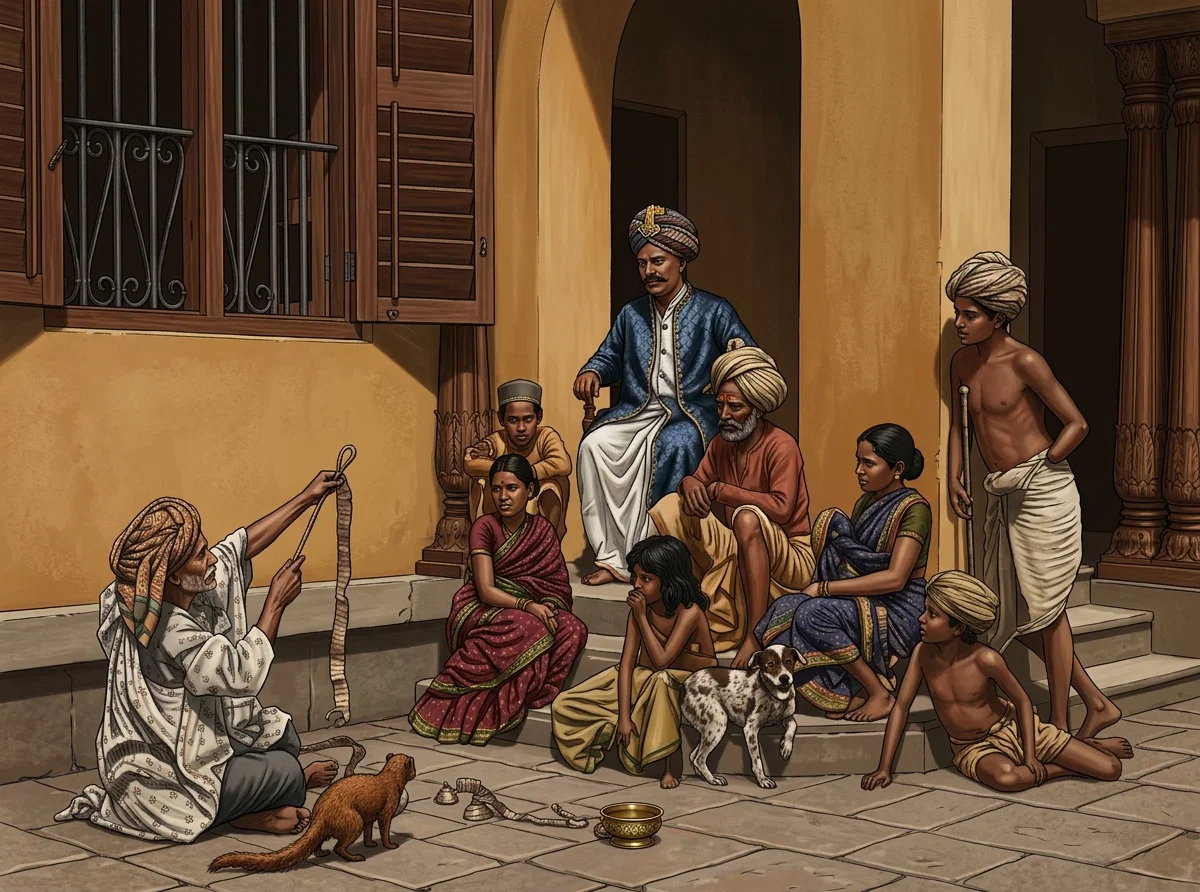
An East Indian Magician.
In the rainy season he has an umbrella made of the same material as his hat, with a bamboo stem. Seldom will you find a prosperous chasa; and no wonder, when he is a prey to the village money-lender or his own landlord who advances him money on interest; and so at harvest time he sells his grain much below market rates to those India Shylocks. Then again numbers are cheated in the weighments. Other chasas are employed as day laborers by planters, and these poor men are even worse off, I know for a positive fact, than in the Tirhoot District; he is paid at the rate of three cents a day, which is scarcely enough to give a man a square meal, to say nothing of supporting a family. A nephew of mine, who was in that region two years ago, said it was a pitiable sight to see these poor beings rubbing the paddy in their hands and eating it. They preferred taking the paddy to pice (coppers), everything that year being at famine prices.
The Bengal chasa lives on dal and rice, and occasionally vegetable or fish curry. The natives of Bengal are large consumers of fish, as it is plentiful and very cheap; they seldom taste meat except perhaps at some notable festival. They also indulge in palm toddy and liquor made from rice. Large numbers smoke the hemp drug, while others eat opium, and some smoke fiendish preparations made from opium, known as chundoo, muddock, etc. These last named are so injurious that the government inflicts a heavy fine with imprisonment on all men who keep these dens.
The chasa of the North West Province differs slightly in one or two respects. For instance, he smokes little but chews tobacco a great deal. His principal food is wheat flour chappaties (hard or unleavened bread) and dal. There are millions of these poor ignorant men and women who are enshrouded in the grossest darkness imaginable. Missionaries are laboring among these classes, but the ordinary run of native Christians one meets raised from their ranks are at their best nominal Christians. The declaration made at our home by an old Baptist missionary will show the quality of Christians I mean. He said “I baptize them, but I would not trust them farther than I could see.”
One of India’s greatest needs is an army of thoroughly trained native Christian workers, who would go out in the spirit and power of Elijah and turn the hearts of thousands of these erring ones from the power of darkness to light, and from the power of Satan unto God. These workers would be able to meet these poor classes, as it were, on their own ground, live among them, work with them, and preach to them; in this way much better results would be obtained. But from where are we to secure this quality of workers?—By the establishment of good training-schools for native children, where they could get a sound education and training that would fit them for such work.
If I may, I will here mention the Karmatar Orphanage, which was started by the late Pastor D. A. Robinson of our Mission. This little institution could be worked up and made into a first-rate training-school; funds, of course, would be needed for this work. We of India are sensible of the great love of our American brethren for us, and of their liberality in supplying our needs, and yet India still needs your help. GEORGE GWYTHER.
Calcutta, India.
THE SAD STATE OF WOMEN IN INDIA.
By Della T. Hotle
[Della T. Hotle, in Pentecost Herald.]
Our hearts are stirred and we feel the burden and groans deeply as we look into the condition of things around us, and especially as we think of India women and girls. We know if the curtain could be lifted and dear ones in the home land could get a glimpse of their real condition, they would come to their help as never before. Truly the lot of India women is a sad one, and only God knows the extent of their suffering. Among the higher castes of the Hindus the little girl must be married by the time she is ten or eleven years of age, and many, many times they are married at an earlier age than that. Often in babyhood they are given away, or rather bargained for. If her betrothed dies, she is a widow as much as tho the marriage ceremony had been performed, and is never allowed to marry again. If the husband dies when she is only a child she may get on quite well, and not feel her disgrace for a while; but by the time she is fifteen years of age, her hair is shaven close to her head, her jewels are all taken off, she is no longer allowed to wear beautifully colored clothing, but a coarse sari is put upon her. She is is not allowed to go in society, no one cares to have her around. If one sees a widow the first thing in the morning, it is a sign of bad luck. If one is starting on a journey and a widow crosses his path, he will put off his intended trip till another day. She is considered to have been a most sinful creature in her former birth, and is punished in this life by being widowed.13
Formerly it was the custom for women to be burned on the funeral pile of their husbands. This custom existed at least two thousand years.
While it was not compulsory, yet great pressure was brought to bear upon them in order to get them to take the step, and it was considered to be a great meritorious act by which they might obtain salvation. After a widow had taken upon her the vow to be burned upon the funeral pile, if her courage should fail at the last she could never be reinstated into her caste or family, but was rejected by all. After missionaries came into the country and the English got control, an order was passed prohibiting the burning of widows.
Again the Purdah system, which exists among the higher castes, is a very bad one. Many poor girls from the time they are married are kept in close seclusion and not allowed to go outside of their doors, except as their faces are covered with a thick chudder, which is thrown over them and hangs nearly to the ground. Among some of the more strict Hindus and Mohammedans their women are taken out only on special occasions, and go in palanquins, or closely covered carts. Others are kept in still closer confinement and never allowed to leave their own doors. We heard of a woman who was never outside of her house but once, and that was when she was taken from her father's home to the home of her husband. We had the pleasure of calling on a high-caste family where there were two beautiful daughters living in a close, poorly-ventilated room with their mother. Before leaving we invited them to our home, to which they replied, “We are never allowed to go outside.” A son spoke up laughingly and said, “We keep our women in cages like birds.”
Much more could be said upon this great and solemn subject, but time will not permit now. Dear friends, will you not pray that light may soon break in upon these dark and superstitious ones who know not the God of love.
Raj Nandgaon, C. P. India.
A PLEA FOR THE HEATHEN.
The night of the world is falling,
And, brothers! no common cry
Comes out from the distance, calling
The multitudes passing by:
“O leave us not here to perish,
Christ died not alone for you,
Your dear ones ye well may cherish,
But can ye not love us, too?”
“Glad tidings your own heart filling
Should surely o’erflow to all;
Answer! Are none of you willing
To follow your Master’s call?”
It is not for the want of pleading
Men go on their way unstirred,
But the Gospel they pass unheeding,
The heathen have never heard.
The sweetness of God’s salvation
Is still to the world unknown,
And many a mighty nation
Does homage to wood and stone.
The Master Himself will measure
Your part in this solemn call;
He noticed the rich man’s treasure,
He valued the widow’s all.
The world for its Lord is waiting!
O, with the pity unfelt before,
And a zeal that is unabating,
Press in through the open door,
Go ye! ’tis a high endeavor!
And happy are all who toil;
The battle is not forever
And you shall divide the spoil.
—Anon.
Wisdom in Hearing, Repentance in Speaking
From hearing, comes wisdom; from speaking, repentance.
A REMARKABLE INCIDENT.
The following incident was related to me by Mrs. D. Bradley, of Lucknow, India. The circumstances transpired in that city:—
A missionary lady was laboring among certain secluded Mohammedan ladies. She was seeking to impress upon their minds that Christ had more power than Mohammed. To do this, she read and commented upon the man who was born blind, whom the Saviour healed and forgave his sins, and who was thus led to worship the Saviour. See John 9. She had no thought of conveying to her hearers the idea that the Saviour would restore the blind now, but that He was able to do this, and consequently He alone could forgive sins, and that any other support would prove a broken reed.
Present at the interview was a lady who had lost her sight. She could only discern light from darkness, and had been told by eminent physicians that there was no hope for her, only by a very painful operation, and then it was ten chances to one if she would not lose her sight altogether. Her desire for sight was so great that her heart was wrung with anguish at the thought that she would probably never again have her sight. The missionary woman took great interest in the case, and manifested much heart sympathy. The next time the missionary returned, she met her with a happy face, having the assurance of her Saviour’s love—her countenance beaming with joy, and her sight had been restored. The following is the substance of the Mohammedan lady’s own story:—
“After you left the other day, I thought I would go to your Jesus and see what He could do for me. I purified a place and made ready, and at the regular season of prayer (Mohammedans pray seven times a day) I told Jesus that the missionary woman had been here, and she had said that He could forgive sins and restore the blind. I told Him that the missionary woman said He was in heaven, but that He looked down and saw us and pitied us, and heard us pray just the same as tho He was upon earth. I then told Him that, as He was not here personally, I would make the clay and put it on my eyes, then I would go and wash and trust that He would heal my eyes. I went and washed and came seeing—my eyes were perfectly restored. Now,” said the poor woman, whose heart was swelling with gratitude and praise to Him who had not only healed her eyes, but had forgiven her sins, “I shall hereafter believe in your Jesus.”
Are there any who would question the power of God in the conversion of this soul to Jesus Christ? Hundreds of young ladies are wanted to enter these secluded homes in India to-day, protected by the English Government, and administer consolation not only to such individuals, but to hundreds of thousands of Hindu widows whose lives are made bitter by servitude and oppression, growing out of the cruel custom of caste. Are there not here open doors? Who is there that reads these lines that will give himself to God for the perishing souls in India? —Divine Life.
OUR WORK AND WORKERS.
The brethren at Bumpus Mills, Tenn., have completed a new house of worship.
The permanent address of the new North Dakota Conference is Box 285 Fargo, N. D.
The camp-meeting for Indiana will be held at Franklin, Johnson County, September 10-21.
An institute for church-school teachers will be held at College View, Neb., August 18 to September 2.
An institute for church-school teachers will begin on the 19th inst. at Huron, S. D., and continue two weeks.
Four converts are reported by Brethren J. E. Collins and R. H. Sparks, at tent-meetings held at Brookville, Ind.
On the 2d inst. a church of twenty-three members was organized at Stuart, Iowa, by Brethren L. F. Starr and N. C. Bergensen.
The Ontario Messenger says that Brother A. Ford and wife, and Sister Anna Benn disposed of 1,000 copies of the “Coronation” number of the Signs.
At Calcutta, India, May 10, five persons were baptized. At Simultula, where Brother G. K. Owen was laboring, three others commenced the observance of the Lord’s Sabbath.
The brethren of Taftsville, Vt., are erecting a combined church and school building. The lower portion, which is designed for school purposes, is ready for occupancy.
Three tent-companies are now operating in the province of Quebec, and Brother S. A. Farnsworth reports to the Ontario Messenger that the prospects for the work in that field are brightening.
The addition of four members to the church at Darien Center, N. Y. is reported in the Indicator by Brother A. O. Burrill. The church is also rejoicing because of being able to remove the mortgage from the house of worship.
The Southern Watchman says: “Brother Hansen has opened a hygienic restaurant in connection with his sanitarium at Nashville, which is receiving a large patronage. We hope soon to see a similar enterprise started at Memphis.”
In the Indiana Reporter, Brother J. E. Dunn notes the interesting fact that two evangelists—husband and wife—who were laboring with a tent in the town of Peru, have publicly proclaimed their acceptance of the Sabbath of the Lord.
Sister Amanda Camp writes: “To those who responded to the call for literature for Farmington, New Mexico, I would say, you may have thought it a small thing to send those papers, but could you see the eagerness with which they are received, you would be glad.”
At the recent camp-meeting held at Crawford, Neb., eleven persons were baptized. This meeting was for Northwestern Nebraska, Wyoming, and the Black Hills. Initiatory steps were taken for the establishment of an intermediate school for that region and a committee was appointed to consider the matter of location.
The Record notes the baptism of six candidates at Hobart, Tasmania, May 29, by Brother E. Hilliard.
The August number of the Life Boat is all that its publishers promised, and is just the thing to put into the hands of persons addicted to the use of intoxicants. The publishers are still anxious to get it into the hands of the victims of alcohol. If you are specially interested in any persons of this character, send their names to the office, with a two-cent stamp for each one, and the papers will be mailed direct to the individuals. Address, Life Boat, No. 28 33d Place, Chicago, Ill.
A letter from Fiji to the Sydney, N. S. W., Telegraph says: “The Seventh-day Adventists, who started a mission in Fiji some years ago, have lately had a large accession of natives in the Lakeba District. It is reported that the whole of the people of Cikobia, and about half of the large town of Mualevu, have gone over from Wesleyanism to this new sect.”
Brother W. A. Alway is making an urgent appeal to our people throughout the country for assistance in building a church and school edifice in Salt Lake City. The need for such a building is pressing. Altho many have accepted the truth in that State, most of them have felt the necessity of moving away, as it is difficult for them to find employment after accepting the Sabbath of the Lord, especially for those who sever their connection with the Mormons. It is a field in which the enemy of truth is well established, as he has planted there a very beguiling counterfeit of the message which God would have scattered broadcast in the last days, namely, the coming of Christ to set up His kingdom. Those who desire to help in this matter should address, W. A. Alway, 63 East First South St., Salt Lake City, Utah.
LIFE’S BURDEN AND RECOMPENSE.
LIFE is a burden, bear it;
Life is a duty, dare it;
Life is a thorn crown, wear it.
Tho it break your heart in twain,
Tho the burden crush you down,
Close your lips and hide your pain;
First the cross, and then the crown.
—British Weekly.
PUBLICATIONS WANTED.
SIGNS, Sentinel, Life Boat, and Our Little Friend, for missionary work. Also would like one copy of SIGNS or Life Boat for six months or a year to supply the county poor-farm. Address, post-paid, Mrs. J. H. Grove, Cotton Town, Tenn.
ANY of our denominational papers or tracts (clean copies) for missionary work. Address, post-paid, Mrs. A. S. Clark, Cordele, Ga.