Joy of the World.—Many rejoice, or have joy, in the lustful things of this life—some in riches, some in fame, some in pleasure, and all in man or some thing or things that man has done or may do. All this, apart from God, we are assured by the wise man is "folly," and folly is joy to him that is destitute of wisdom. The prophet declares that such "rejoice in a thing of naught;" hence, at the best, "the joy of the godless is but for a moment." And this the children of earth know to be true. "Man
THE first amendment to our national Constitution annunciates one of the cardinal principles on which the greatness of our nation rests,—freedom to worship God according to the dictates of conscience. The framers of this memorable instrument recognized the fact that religion had to do with men's duty to God; that it was not within the purview of civil governments to say how a man should worship, or whether he should worship at all. When civil government has protected every man within its jurisdiction in the exercise of his inalienable rights, it has accomplished all for which it was ordained. It was the just conception of what is due to God and what to Cæsar that led our forefathers to give us what some denominate "a godless Constitution." Prominent among this class is the Reformed Presbyterian Church, many of whose membership have conscientiously refrained from exercising the right of franchise because God was not acknowledged therein as the rightful ruler of the nation. They say that there is no respect whatever shown to the Christian religion by this "atheistical blunder." On the contrary, it is susceptible of the strongest proof that the Constitution was made as it is, entirely out of respect to religion, for the Christian churches were the chief factors in the movement.
However, from the very first adoption of the Constitution this people and those holding kindred views on this point, aught to secure a change, and so early as Oct. 27, 1789, "The First Presbytery Eastward in Massachusetts and New Hampshire" sent an address to President Washington, complaining that there was no "explicit acknowledgment of the only true God and Jesus Christ, whom he has sent, inserted somewhere in the Magna Charta of our country." This is but the reflection of the sentiments that have been expressed all the way down through the century until in 1864, when these sentiments had crystallized to the extent that through the efforts of the Reformed Presbyterian church, the National Reform Association was organized, the avowed object of which is to "place9all the Christian laws, institutions and usages of our government on an undeniable legal basis in the fundamental law of the land." This means in effect and fact that if this proposed change can be effected, our government will be run on a theocratic basis.
For years the promoters of this association labored under many discouragements, yet they never lost sight of the one object in view. The writer well recalls a National Reform convention held in Pittsburg, Pennsylvania, in the year 1874, and of the profound impression it made upon him. The attention of an old gentleman, whose father had served in the Revolutionary War, was called to the demand they were making for an amendment to the Constitution, and the arguments in its favor. He shook his head, and declared that the American people too well knew what religious liberty meant to ever seriously entertain their demand. Twenty-two years have elapsed since that time, and what do we see? A bill before Congress championed by influential senators and representatives, the object of which is to secure just the very thing this association has been working for all these years. The Chicago Tribune, of recent date, in a despatch from Beaver Falls, Pennsylvania, one of the strongholds of this people, has this to say:—
"A blank petition, which required a two-horse wagon to transport and which cost $1,200 in postage before it was signed, will start out from the Beaver Falls post office to-morrow morning. For weeks the Covenanters on College Hill have been addressing envelopes to people all over the country. The task was finished yesterday, and 60,000 pieces of mail were hauled in a two-horse wagon and dumped into the Beaver Falls post office. Each envelope contained a memorial addressed to 'the Body of Believers of the Saviour King on the Christian amendment now pending before Congress for the acknowledgment of God and Christ and the Bible in the Constitution of the United States.' Each petition will have as many signatures as it is possible to get, and will be returned to be afterwards presented to Congress in such gigantic form that favorable action is expected. The work is being done under the direction of the National Reform Association of the Covenanter Church."
And what is the meaning of all this? It means that if such an amendment is secured, the days of religious freedom in our land are numbered; it means that the church will then be the dominant power, and history furnishes not a single instance of a civil government conducted in the interest of ecclesiasticism, where innocent blood was not shed.
More than forty years ago Seventh-day Adventists predicted that our government would one day repudiate the heaven-born principles upon which it was founded, and thus become a persecuting power. All reading people know that within the past two years within our borders, scores of honest, conscientious, God-fearing men have languished behind prison bars, and worked in chain-gangs, because they dared to worship God according to the dictates of conscience. This is but a drop in the bucket, to what may be expected if the trend of popular sentiment on religious legislation crystallizes into law. Seventh-day Adventists protested against this when to them it was a matter of faith. They now raise their voice like a trumpet against the evil that is at hand, and will continue to do so until every one shall know what it means to him to join issue in behalf of the wicked thing.
Des Moines, Iowa.
A BOY WHO RECOMMENDED HIMSELF.
JOHN BRENT was trimming his hedge, and the "snip, snip," of his shears was a pleasing sound to his ears. In the rear of him stretched a wide, smoothly-kept lawn, in the center of which stood his residence, a handsome, massive, modern structure, which had cost him not less than ninety thousand dollars.
The owner of it was the man who, in shabby attire, was trimming his hedge. "A close, stingy old skinflint, I'll warrant," some boy is ready to say.
No, he wasn't. He trimmed his own hedge for recreation, as he was a man of sedentary habits. His shabby clothes were his working clothes, while those which he wore on other occasions were both neat and expensive; indeed, he was very particular even about what are known as the minor appointments of dress.
Instead of being stingy he was exceedingly liberal. He was always contributing to benevolent enterprises, and helping deserving people, often when they had not asked his help.
Just beyond the hedge was the public sidewalk, and two boys stopped opposite to where he was at work, he on one side of the hedge and they on the other.
"Hello, Fred! That's a very handsome tennis racket," one of them said. "You paid about seven dollars for it, didn't you?"
"Only six, Charlie," was the reply.
"Your old one is in prime order yet. What will you take for it?"
"I sold it to Willie Robbins for one dollar and a half," replied Fred.
"Well, now, that was silly," declared Charlie. "I'd have given you three dollars for it."
"You are too late," replied Fred. "I have promised it to Willie."
"O, you only promised it to him, eh? And he's simply promised to pay for it, I suppose? I'll give you three dollars cash for it."
"I can't do it, Charlie."
"You can if you want to. A dollar and a half more isn't to be sneezed at."
"Of course not," admitted Fred; "and I'd like to have it, only I promised the racket to Willie."
"But you are not bound to keep your promise. You are at liberty to take more for it. Tell him that I offered you another time as much, and that will settle it."
"No, Charlie," gravely replied the other boy, "that will not settle it—neither with Willie nor with me. I can not disappoint him. A bargain is a bargain. The racket is his, even if it hasn't been delivered."
"O, let him have it," retorted Charlie angrily. "Fred Fenton, I will not say that you are a chump, but I'll predict that you'll never make a successful business man. You are too punctilious."
John Brent overheard the conversation, and he stepped to a gap in the hedge, in order to get a look at the boy who had such a high regard for his word.
"The lad has a good face, and is made of the right sort of stuff," was the millionaire's mental comment. "He places a proper value upon his integrity, and he will succeed in business because he is punctilious."
The next day, while he was again working on his hedge, John Brent overheard another conversation. Fred Fenton was again a participant in it.
"Fred, let us go over to the circus lot," the other boy said. "The men are putting up the tents for the afternoon performance."
"No, Joe; I'd rather not," Fred said.
"But why?"
"On account of the profanity. One never hears anything good on such occasions, and I would advise you not to go. My mother would not want me to go."
"Did she say you shouldn't?"
"No, Joe."
"Then let us go. You will not be disobeying her orders."
"But I will be disobeying her wishes," insisted Fred. "No, I'll not go."
"That is another good point in that boy," thought John Brent. "A boy who respects his mother's wishes very rarely goes wrong."
Two months later, John Brent advertised for a clerk in his factory, and there were at least a dozen applicants.
"I can simply take your names and residences this morning," he said. "I'll make inquiries about you, and notify the one whom I conclude to select."
Three of the boys gave their names and residences.
"What is your name?" he asked, as he glanced at the fourth boy.
"Fred Fenton, sir," was the reply.
John Brent remembered the name and the boy. He looked at him keenly, a pleased smile crossing his face.
"You can stay," he said. "I've been suited sooner than I expected to be," he added, looking at the other boys and dismissing them with a wave of his hand.
"Why did you take me?" asked Fred, in surprise. "Why were inquiries not necessary in my case? You do not know me."
"I know you better than you think I do," John Brent said, with a significant smile.
"But I offered you no recommendations," suggested Fred.
"My boy, it wasn't necessary," replied John Brent. "I overheard you recommend yourself."
But as he felt disposed to enlighten Fred, he told him about the two conversations he had overheard.10Now, boys, this is a true story, and there is a moral in it. You are more frequently observed, and heard and overheard, than you are aware of. Your elders have a habit of making an estimate of your mental and moral worth. You can not keep late hours, lounge on the corners, visit low places of amusement, smoke cigarettes, and chaff boys who are better than you are, without older people making a note of your bad habits.
How much more forcibly and creditably pure speech, good breeding, honest purposes, and parental respect would speak in your behalf!—Golden Days.
WHAT NEXT?
By Editor
ALMOST daily we are confronted with religious innovations that prompt the query, What next? While the world is popularly accredited with habitually doing the will of the great adversary of souls, there is no doubt that the victories which he most highly prizes are achieved in the church. The following despatch gives a case in point:—
“LONDON, November 6.—Arrangements have been completed for the opening of the men’s club in connection with the church of St. Michael and All Angels, in North Kensington. Rev. Mr. Denison, the vicar, has had charge of the scheme. The curate has taken up his residence in the club. In the basement is a roomy skittle alley, and close by is space for boxing. The first floor is a billiard room. On the other side of the passage is a bar. Denison has refused any place for undue restriction for the sale of liquor. He contends that if you teach a man to respect himself, he is more likely to be careful not to forfeit the respect of others. If any man takes too much and makes a beast of himself, he can be kicked out. The bar and game rooms are not open on Sundays.”
WHERE'S THE BABY?
By Alice Williams Brotherton
O DEAR, where is the baby gone?
I can't tell where I missed him;
Why only last night in his crib
I tucked him safe and kissed him!
This boy, with marbles, top and ball,
In knickerbockers dressed,
This can not be the baby small
I cradled on my breast.
I want the weenty teenty thing
In dresses soft and white,
That I could cuddle, kiss, and sing
Soft by-lows to at night.
But stay—here are the self-same eyes,
His very dimpled chin,
These are his rosy, pouting lips,
With milk-white teeth within.
This is my baby. But how changed!
I hear his merry shout
As he goes sliding down the stair,
And dancing in and out;
Splashing and dashing through the brook,
With brow and cheek of tan.
Heigho: My baby's gone; in-tead
I see—a little man.
Ah, well, when evening comes again,
With sleep and story-time,
A little white-gowned form will come
Into my lap to climb;
His wee head cradled on my heart
Will still this yearning pain.
O then I'll know that I have found
My baby boy again!
—Alice Williams Brotherton.
HEALTH WORK AMONG SEVENTH-DAY ADVENTISTS.
By F. M. Wilcox
BY F. M. WILCOX.
The Colorado Sanitarium.
THE Gospel of our Lord and Saviour is neither one-sided, nor restrictive. It embraces blessings for man in all three departments of his existence,—spiritual, mental, and physical. It recognizes the fact that between the body and spirit exists a most intimate relation, and that no true glory can be rendered to God by one irrespective of the other. The laws governing man's physical existence are as truly a part of the great system of principles regulating our relations to Divinity, as are those laws pertaining to moral conduct. The Gospel, then, is a gospel of physical health, as well as spiritual blessing; it has to do as well with man's physical as his spiritual relations. To learn nature's laws, and to render obedience to them, is to elevate the spiritual nature to a higher and truer appreciation of the love and goodness of God.
In recognition of this great truth, the people represented by this journal have realized the duty they owed to physically suffering humanity, as well as to those who were held in the thraldom of sin. For years they have advocated reforms in the matter of healthful living. By medical missions, and medical missionaries located in our large cities and sent to foreign lands, they have endeavored to show that in Christ we have promise both of this life, and of the life which is to come. Their work in so-called philanthropic lines has been carried on largely through the medium of sanitariums and hospitals located in different parts of the world. The parent institution, established at Battle Creek, Michigan, has been long and favorably known. In connection with this institution there has been carried on for years a nurses' training school, from which many devoted young men and women have gone forth to minister to, and alleviate the sufferings of, afflicted humanity. At the present time this sanitarium has a family of four hundred patients, and more than that number of helpers, and those undergoing training for medical missionary work.
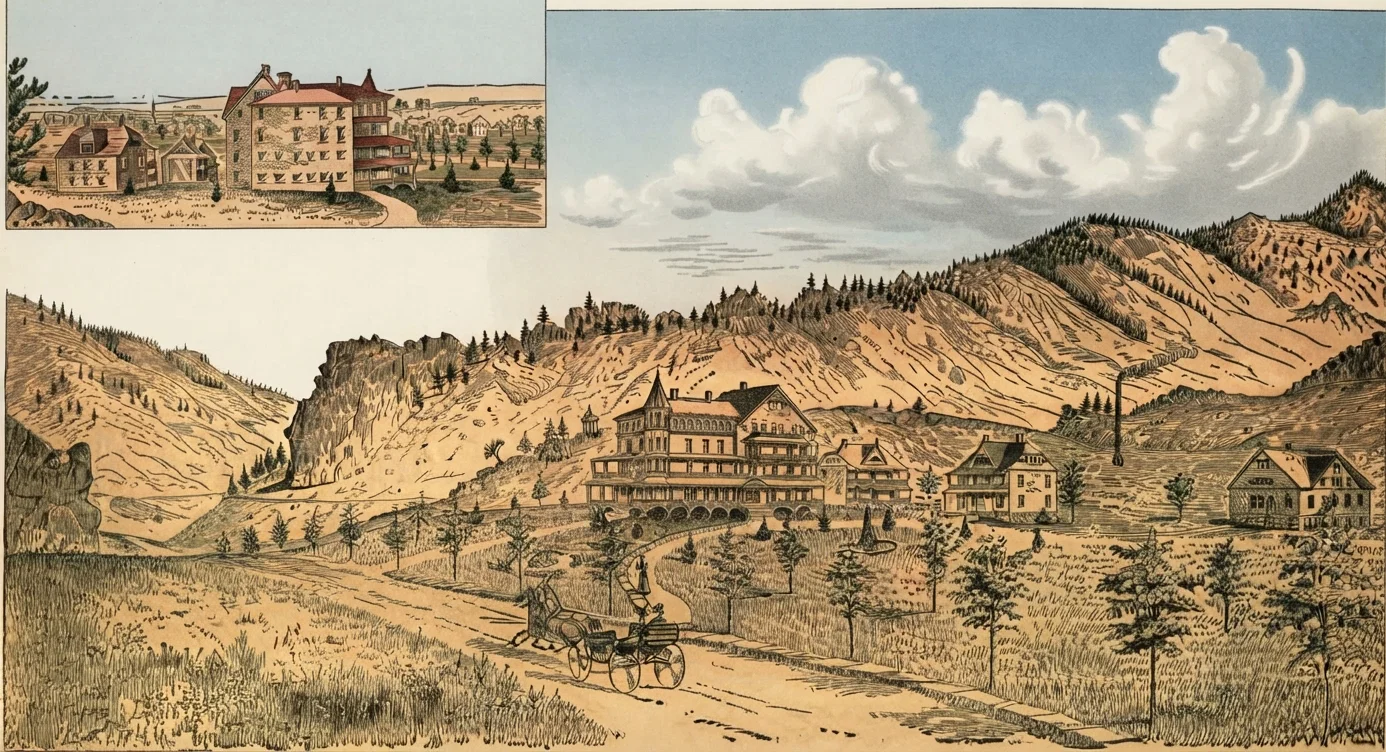
Other institutions have been established at Lincoln, Nebraska, and St. Helena, California, the same excellent results attending the efforts put forth. The work has likewise been extended to other lands. Hospital sanitariums have been located at Guadalajara, Mexico; Basel, Switzerland; Cape Town, South Africa; Sydney, Australia; and a site for one in or near Calcutta, India, is now being secured. As supplying another link in the chain of these institutions in this country, the sanitarium located at Boulder, Colorado, as illustrated in the accompanying cut, has been established.
None of these sanitariums are conducted as money-making institutions. While the majority are organized as stock companies, there is no division of the profits, the entire proceeds going for the benefit of those who are unable to pay for the treatment received, or to further enlarge and increase the facilities for carrying on the work.
While conducted as religious institutions in that the management and helpers are Christian men and women, the work is not carried forward in any sense on sectarian lines. It is conducted rather in recognition of the great principle of the fatherhood of God and the brotherhood of man. It is sufficient to know that any soul is sick and suffering (whatever may be his nationality and religious convictions) to call forth for him the most earnest efforts, and devoted attention.
Without detracting in any degree from the pleasant situation, and excellent work being done by older institutions, it is but appropriate to say that the sanitarium located at Boulder, Colorado, enters upon its life-work with most flattering encouragements to success. As illustrating these advantages, the following enumeration will be of interest:—
1. Its Situation. Boulder, the beautiful little city in the suburbs of which the institution is located, is a town of six thousand inhabitants. It is a city both of the mountain and of the plain. Crowded close up against one of the spurs of the great Rockies, the high peaks, with their everlasting snows, form the background of the scene; while stretching away to the north and east lies the rolling plateau of fertile farming country, dotted here and there with little lakes, making to the wearied vision of the poor invalid a most refreshing scene. The sanitarium itself is located near the mouth of the famous Boulder Cañon, and a few minutes' walk from the grounds brings one into as rugged and picturesque mountain scenery as may be found anywhere in America. All of the advantages of nature in her primitive and diversified forms, combined with the benefits of organized society and modern civilization, are found in the location of this institution.
2. Climate. The fact that this sanitarium is located in the state of Colorado is, of itself, sufficient guarantee of the health-giving climate to be enjoyed. Colorado is a synonym for good climate. The entire state is a sanitarium. Its reputation for climate and scenery is world-wide. To it belong the sun, the mountain breeze, the balmy air. Located on the backbone of the continent, midway in the Rocky Mountain region, it is removed both from the biting blasts of the north, and from the humid heat of the11south. It possesses in reality more sunny days in the year than does the famous "Sunny South," or many parts of the beautiful Pacific Slope. The accompanying table for the five years ending with 1895, gives the number of sunny hours for each month during this period.
The effect of such weather in the efforts of the invalid to win back life and health is certainly invaluable. The weakest patient can spend a great portion of the time in out-of-door life.
Such diseases as chills and fever are entirely unknown. Dyspepsia, on account of the bracing effect of the high altitude and the dryness of the air, finds speedy relief. Nor is it found, as many suppose, that such difficulties as heart disease and kindred ailments are the worse from a sojourn in the altitude of this state, especially at an altitude not higher than that in which the Colorado Sanitarium is located. Of the benefits to be derived in such diseases as asthma, catarrh, and consumption, from a sojourn in Colorado, it is quite unnecessary to speak. For years this state has been known as one especially adapted to the needs of this class of sufferers. Statistics show that fully one-third of those coming to this climate for lung troubles entirely recover; another third have their lives greatly prolonged; and the remainder only die from their failure to seek relief at an earlier stage of the disease.
3. Facilities. A large four-story brick building, one hundred by one hundred and twelve feet, heated by steam, lighted by electricity, with all the modern improvements and conveniences of a first-class hotel, is open for the reception of patients. Three large cottages, in close proximity to the main building and with the same conveniences, are likewise owned by the company. The plant thus established furnishes capacity for more than one hundred guests.
Five departments for the treatment of chronic diseases are maintained, namely:—
Diseases of the Nose, Throat, and Lungs; Diseases of the Nervous System; Diseases of the Stomach and Digestive System; Diseases Peculiar to Women; Diseases of the Eye and Ear.
Competent and experienced physicians of both sexes have charge of each department. These men and women are graduates from the best medical schools of the east, particularly Ann Arbor, and in addition have taken extensive postgraduate training. The superintendent of the institution, Dr. W. H. Riley, was for years one of the leading physicians of the parent institution at Battle Creek, Michigan, and brings to his work here a ripe experience, and a thorough knowledge of medical science. Every means of value known to the medical profession is employed in the sanitarium treatment. These include electricity in its various forms; baths of every description, including the electric light bath; massage; Swedish manual movements by trained manipulators, etc.
In addition to the efficient corps of physicians connected with the institution, trained nurses of both sexes are in constant attendance, to administer the prescribed treatment, and otherwise minister to the needs of the suffering.
In the Laboratory of Hygiene, bacteriological, chemical, and microscopical investigation is carried forward. Special advantages in the way of medicated air compartments for continuous inhalation for patients suffering with catarrhal, bronchial, asthmatic, or other lung troubles, are at the disposal of these classes of invalids.
Particular attention is likewise paid to those needing surgical operations; aseptic operating rooms and surgical wards are maintained in the institution.
The rates for room, board, and treatment vary according to the location and size of the room, and the amount of treatment required. These may be had on application.
It will thus be seen that this institution is established upon a broad basis for the treatment of all chronic diseases. Offensive patients are not received. At the present time there are about eighty patients, representing some eight or ten different states and territories. Among these are found those suffering with dyspepsia in its various forms, with throat and lung difficulties, nervous disorders, and in fact almost all the common chronic ailments afflicting the human family. Most surprising results are seen in the majority of cases. The dry, bracing air and the high altitude serve to quicken the efforts of nature in throwing off sickness, and restoring the wasted tissues and diseased organs to their normal condition.
Nor is the institution alone corrective in its efforts. It aims to be educative as well. Lectures upon physiology, the various forms of disease, and the remedies to be used in correcting the same, are given three times a week in the sanitarium parlor. By gymnastic exercise and Swedish movements, the patients are taught to develop their physical powers, and so overcome the tendencies to weakness and decay.
Reference has already been made to the large training class in connection with the Battle Creek Sanitarium. Similar work, altho much smaller in its scope, is going on at the Colorado Sanitarium. A class of twenty bright young people has been organized, running through two years, for the purpose of receiving instruction in scientific nursing.
Were the Colorado Sanitarium a worldly, money-making institution, we would not present its advantages to our readers. But we believe it to be truly philanthropic in its character. Fully one-third of its proceeds thus far have been devoted to the care of those who were unable to pay but a small part, if anything, toward their necessary treatment. To those who are in need of such advantages as the institution affords, we can unhesitatingly recommend it, and if our friends will extend the notice of its work by calling the attention of the afflicted in their vicinity to the advantages it affords, we are sure it may not only be the means of saving many lives, but also of helping on a truly noble work,—that of Christlike ministry to the sick and suffering.
For further information regarding the institution, correspondence should be addressed to W. H. Riley, M. D., Colorado Sanitarium, Boulder, Colorado.
THE GREAT YERKES LENS FINISHED.
THE lens for the great telescope given by Mr. Yerkes, the Chicago millionaire, to the University of that city, is now ready, according to the Scientific American. The observatory that is to hold it will be far away from the murky air of Chicago, on the border of a Wisconsin lake. Says the authority just named: "The lens of the great telescope of the new observatory at Lake Geneva, Wis., the finest and largest telescope lens in the world, has been completed after two and a half years' labor, and now lies at the workshop of Prof. Alvan Clark, in Cambridge, awaiting the orders of the Chicago University authorities. Its focal distance is 61 feet, the extreme diameter of the clear aperture is 41 3/8 inches. The crown is about 3 inches thick at the middle and 1 1/4 inches thick at the outer edges, and weighs 205 pounds. The flint weighs 310 pounds. The lens and its iron ring and cell weigh about 1,000 pounds. The cost of the glass plates in Paris was $40,000, and the entire cost of the lens is estimated to have been $100,000. For its journey west it will be wrapped in flannel and bedded in curled hair in a box mounted on springs and packed with excelsior in a larger box. It will ride in the center of a parlor car, and will be accompanied by four men."—Literary Digest.
"A BLOCKHEAD."
FOLLOWING is a bit of experience which an Indiana teacher communicates to Dr. Krohn, of the University of Illinois:—
"Some time ago I read an article on the position of pupils in the schoolroom, which made me think very seriously of a boy in my school who was branded with 'blockhead' and other names of similar meaning. I had never thought of the effect of position on the mind, and I therefore permitted him to sit as one sits when all the muscles are relaxed, and that was his only position either in sitting or walking. I persuaded him to 'brace up,' carry his body properly, and walk as if he were really walking. Today that 'blockhead' is one of the best, where he was poorest. He is weak in arithmetic, yet he has always been so. I do not wonder any more. All of the number work for about four years was given him on the blackboard. I have discovered very lately that he can not read my writing, be it ever so plain, across the room. I believe this is another example in which the teacher should be called 'blockhead,' for the boy is really my teacher."
A Missionary-Minded Mother
Tommy—"Mama, I wish you were interested in foreign missions."
Mama—"Why?"
Tommy—"'Cos Billy Barlow's mama is, and she doesn't notice when Billy does naughty things."
Live Well, Not Long
By Thomas Randolph
STRIVE to live well; tread in the upright ways,
And rather count thy actions than thy days.
—Thomas Randolph.
RECORD OF SUNSHINE
By F. H. Brandenburg
During the years 1891, 1892, 1893, 1894, and 1895, showing the number of hours of sunshine each month, and the percentage of possible sunshine as compiled from the records of the U. S. Weather Bureau, Denver, Colorado.
F. H. BRANDENBURG, Local Forecast Official.
OUR WORK AND WORKERS.
By Editor
WHAT is being done at selling the Signs and securing subscriptions for it? In another column are a few figures of what Kansas is doing; but the figures, tho few, are significant. Here are a few more. One church, consisting of 4 families living in the country, is taking 35 copies of the Signs, and selling them each week. Another church in a place of about eight thousand takes 140 copies. In another place one lady takes 25 copies. These are sold, not given away. A brother in Washington, D. C., takes 250 copies a week. Here is a field for every church or person that desires to do missionary work. There are financial returns also. What are you doing? Write to your tract society officers for a place in this message.
1 "VERILY, verily, I say unto you, He that entereth not by the door into the fold of the sheep, but climbeth up some 2 other way, the same is a thief and a robber. But he that 3 entereth in by the door is the shepherd of the sheep. To him the porter openeth; and the sheep hear his voice; and he calleth his own sheep by name, and leadeth them out. 4 When he hath put forth all his own, he goeth before them, 5 and the sheep follow him; for they know his voice. And a stranger will they not follow, but will flee from him; for 6 they know not the voice of strangers. This parable spake Jesus unto them; but they understood not what things they were which he spake unto them.
7 "Jesus therefore said unto them again, Verily, verily, I 8 say unto you, I am the door of the sheep. All that came before me are thieves and robbers; but the sheep did not 9 hear them. I am the door; by me if any man enter in, he shall be saved, and shall go in and go out, and shall find 10 pasture. The thief cometh not, but that he may steal, and kill, and destroy; I came that they may have life, and may 11 have it abundantly. I am the Good Shepherd; the good 12 shepherd layeth down his life for the sheep. He that is a hireling, and not a shepherd, whose own the sheep are not, beholdeth the wolf coming, and leaveth the sheep, and 13 fleeth, and the wolf snatcheth them, and scattereth them; he fleeth because he is a hireling, and careth not for the 14 sheep. I am the Good Shepherd; and I know mine own, 15 and mine own know me, even as the Father knoweth me, and I know the Father; and I lay down my life for the 16 sheep. And other sheep I have, which are not of this fold; them also I must bring, and they shall hear my voice; and 17 they shall become one flock, one shepherd. Therefore doth the Father love me, because I lay down my life, that I may 18 take it again. No one taketh it away from me, but I lay it down of myself. I have power to lay it down, and I have power to take it again. This commandment received I from my Father.
19 "There arose a division again among the Jews because 20 of these words. And many of them said, He hath a devil, 21 and is mad; why hear ye him? Others said, These are not the sayings of one possessed with a devil. Can a devil open the eyes of the blind?"
QUESTIONS.
How is the robber of the sheepfold to be distinguished?
How is the shepherd contrasted with the robber?
How is the shepherd recognized by the porter? By the sheep? What does he do to the sheep?
How does he direct the course of the sheep? With what success? Why?
How will the sheep act toward a stranger? Why?
Was Christ's teaching comprehended by his hearers?
How did he begin the explanation of the parable?
What did he say of those who came before him? Did the sheep respond to them?
What did Jesus declare himself to be? What would be the experience of each one who used "the door"?
What is the purpose of the thief?
What is the object of Christ's work?
What does Jesus now declare himself to be? What distinguishes the good shepherd?
What is an hireling? How does he treat the flock in time of danger? With what result?
What is the real cause of such action?
What bond of union exists between the shepherd and the sheep?
How is this mutual knowledge illustrated?
What sacrifice does the shepherd make?
Is there more than one fold? What will be the experience of the "other sheep"? With what result?
What is the basis of the Father's love for Christ?
Was the sacrifice of Christ a voluntary one? Was it in harmony with God's will?
What effect was produced by this parable?
What did one party say?
How did the other party refute their claim?
NOTES.
1. "Few images could better express the relationship between our Lord and his people than that of Shepherd and sheep, so often applied to God in the Old Testament, and appropriated by Christ himself in the New. . . . The eastern sheepfold is a mere enclosure surrounded by a palisade. The sheep are brought into it in the evening, several flocks being committed to the care of the common keeper, or porter, for the night. In the morning the shepherds return, and knock at the closely barred door of the enclosure, which the porter opens from within. Each separates his own sheep by calling to them; and the sheep respond, disentangling themselves from the rest; and when thus collected, they follow their own shepherd, wherever he may lead."
2. "He goeth before them." "This is the place ever assigned to him in the Old Testament. 'He leadeth me by the still waters.' 'Thou leadest thy people like a flock.' He permits none of his own to go along a path which he has not trodden, and in which he has not had previous experience. . . . Take heart, O trembling believer! However strange and hard your path seems to you, if you look closely at it you will detect in it the footprints of the Shepherd; and where he has preceded you, you need not fear to follow."
3. "The sheep follow him." "The utter dependence of the sheep on the master Shepherd is a beautiful emblem of our attitude toward our Lord. . . . Let Jesus Christ stand between you and everything—between you and circumstances; between you and dreaded trials; between you and temptation; between you and your attainments in the blessed life; between you and your projects of Christian usefulness. Follow him; that is, let him go first. If he does not go forward, wait for him. Every step taken apart from him, or in front of him, will have to be retraced with bitter tears."
4. THE reading of verses 14 and 15 as given in the Revised Version seems preferable: "I am the Good Shepherd; and I know mine own, and mine own know me, even as the Father knoweth me, and I know the Father; and I lay down my life for the sheep." "The mutual understanding between the Eternal Father and the Son is the only parallel to the mutual understanding of Christ and his people."
Suggestions for Further Study.
Who was the first shepherd mentioned in the Bible? What other leading characters in Bible history were shepherds?
Christ is the Door, the Good Shepherd, the True Vine, etc. Why is it made so definite? Compare Acts 4: 12.
Who are the "other sheep . . . not of this fold"?
How many distinct references does Christ make in this lesson to his approaching death?
How is life only in Christ taught in this lesson?
What cause is here assigned for insanity?
Sabbath School Lessons.—There will be found two Sabbath school lessons in this issue. As in the last of December there will be no paper, we are compelled to print an extra Sunday school lesson and Sabbath school lesson between now and that time, and to divide our space, we print the extra Sabbath school lesson this week. In our issue of December 24 will appear two Sunday school lessons.