In far-away Judea,
Beyond the hills and sea,
A little village nestles,
That interests you and me.
For in that distant hamlet
A Child was born one day,—
A winsome, dimpled Baby,
Who in a manger lay.
“No room” for this little darling,
No room within the inn,
But out with the lowing cattle,
Was the only place for him.
No room did they have, dear Baby,
To lay thy tiny head.
Oh, cruel seems the message
To the mother, so wearied!
No room inside for this Baby,
Nor for all he brought at birth;
But there, in a humble stable,
Came our Saviour to this earth.
He came, just a little Baby,
So helpless, yet so strong.
What joy to have held him, like Simeon,
Close to our hearts, and sung,—
“Thy glory, O Lord! have I seen;
Now in peace let thy servant depart;
For this Light shall lighten the Gentiles,
And in love unite each heart.”
No room in the inn for the Baby,
But oh, there is room in our heart!
Come, Saviour, and fill them, we pray thee;
Our Dayspring from heaven thou art.
And so one day is called Christmas,
But none know the real, true time
When this Baby was born in the manger
In far-away Palestine.
And now, loving Saviour, we pray thee
Take the tributes of love that we pay,
In doing, as thou hast commanded,
Good to others this Memory Day.
MARGARET ANDERSON.
A TRIP TO JUNEAU, ALASKA
By A. M. Dart
At the State camp-meeting of the California Conference, held at Oakland, June 4-16 of the present year, it was recommended that Brother T. H. Watson and family, with the writer and his family, go to Alaska to open up the work.
On the ninth of July we were ready for the journey, and took the train for Seattle, Wash. The next day we much enjoyed the Shasta scenery. The clear, rippling waters of the Sacramento River, as we followed it through its various windings to its source, and the snow-capped peaks of Mt. Shasta and Castle Craig, were truly grand.
We reached Shasta Springs at 9:45, and the five minutes’ stay there was improved by all on the train in an eager endeavor to get a drink of the famous Shasta water, which comes rushing and tearing down the steep mountain-side. The delightful ride through the Rogue River and Willamette valleys, dotted with farms of growing grain and fruit, was a pleasant feature of the day’s journey.
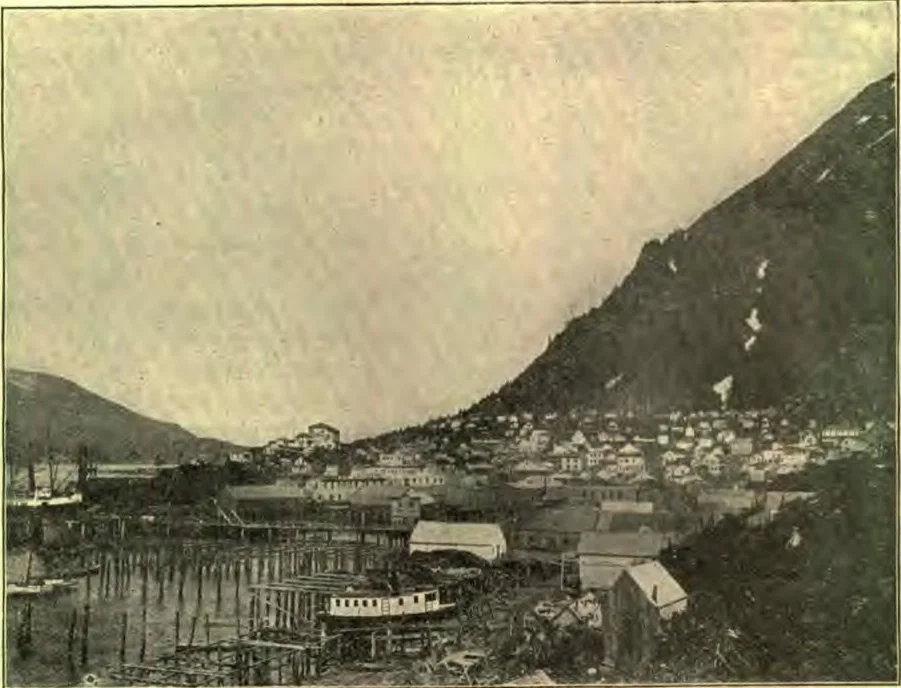
JUNEAU, ALASKA
We reached Seattle at four in the afternoon of the eleventh. The next day we began looking for a ship on which to finish our trip. The “Dirigo,” sailed by Captain Hunter, was at last chosen, not because she was better or faster than others, but because she stopped at many places along the route, and would thus give us an opportunity to become better acquainted with our new field of labor.
We sailed away on the evening of the sixteenth, and hilly Seattle, with her many lights, presented a beautiful sight as we left her glimmering in the darkness. The night of the seventeenth found us only a short way on our journey; for our ship took much of her load at Tacoma, Everts, Port Townsend, and Ladysmith,—places only a short distance from Seattle,—so it was not till nearly noon of the eighteenth that the sailors began to make things fast from bow to stern in preparation for the trip proper.
The first point of interest from Ladysmith was the wreck of a large vessel, the “Miame,” loaded with three thousand tons of coal. The captain, ever ready to make our trip pleasant, gave us a view of her through his glass, and told us how all on board stayed one day on the hurricane deck before they were rescued.
We sailed through channels, sounds, and gulfs, seeing the ocean only three times during the entire trip, and then only for a few hours at a time. We felt a little out of our latitude when they told us that we were in the Gulf of Georgia.
Sometimes the passages were very narrow, so much so as to make them dangerous. One of these places, Dodds Narrows, is only eighty yards wide, with sixty fathoms of water. We threw a piece of coal ashore as we rushed through this place. The tide rushes with tremendous speed through these narrow places, and ships can pass through only with the tide, and in the daytime.
It was about dark the evening of the nineteenth that I noticed a few of the sailors as they stood talking together, much interested in the course we were taking. A few minutes later I happened up by the pilot’s room, and saw the captain anxiously giving his orders, and two men at the wheel. We were passing the last harbor, and entering Seymour Narrows, a very dangerous point, about two hours late. There have been several wrecks here. One English vessel went down with two hundred souls on board. All were lost, and the vessel was never heard of again. An American “man of war” was wrecked here, but no lives were lost. There are whirlpools to be avoided as well as rocks. The captain said that should the ship get her nose into one of these whirlpools, she would become uncontrollable.
The mountains, covered thickly with trees, sloping up from the narrow channel through which we were passing around rocks and whirlpools at the rate of about twenty miles an hour,—for the tide took us about nine knots, and the power of the ship the same; the short, sharp orders of the captain, which spoke to us of danger; the slush of the water against the ship; the stillness and dark shadows of night,—all made an impressive picture.
Soon the face of the captain brightened with a look of relief, as he said, “All right now.” We had passed the dangerous point, and he left the ship in charge of the man at the wheel. He said it would have been suicidal to attempt the passage a half-hour later.
On the morning of the twenty-first we reached Metlakahita Island, where William Duncan has spent the last forty years with the natives, with results that are truly marvelous. We had on394board a large engine for the fish-cannery at this place, and our stop here gave us an excellent opportunity to look around the island. The natives have built a large church and a good school building. Many of them are well educated.
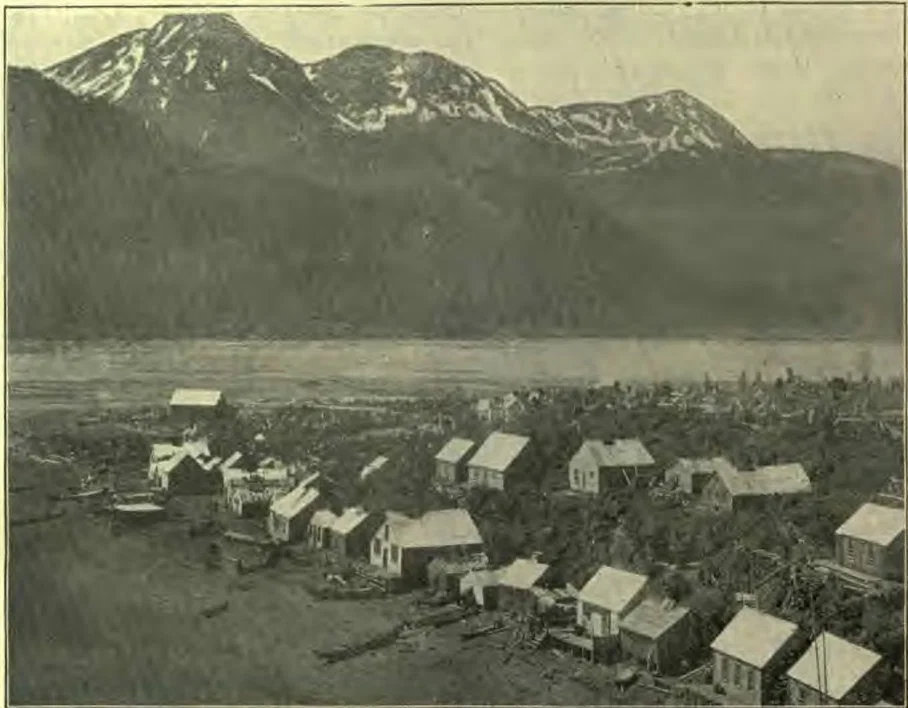
INDIAN VILLAGE, JUNEAU, ALASKA
Monday, the twenty-second, was an eventful day. Early in the morning we sailed into an uncharted harbor. We were gliding cautiously along in the smooth waters, when suddenly there was a bump, a grind, a slight pitch, and we were anchored. We were going carefully, but a thousand-ton ship, heavily loaded, does not strike gently at the slowest. The tide was going out, and it would not rise high enough to lift us off the rock till late in the afternoon. When we went to breakfast, a scene of confusion met our eyes. Things were tipped over in the staterooms and on the dining-table, and we ourselves could hardly stand erect. You see, we struck a rock on the outgoing tide, and as the water lowered, our ship, except that portion which rested upon the rock, followed it, and left us tipping. A leak was sprung, and the pumps were soon at work; but owing to the angle at which the ship rested, the water came in at the port-holes also, and threatened more than the pumps could handle. A boat was lowered, and sailors started in it, with the end of a large rope, for a near-by island. They made fast the end of the rope to a great rock, and the other end was fastened to the mast of the ship. Two or three more ropes were placed in the same position, and there we hung, with about two hundred feet of water at the rear of the ship, and five feet in the engine-room. The captain was advised to throw some of the freight overboard, but did not think it necessary. While there was some danger of losing the ship, there was little of loss of life, as the island was so near. Nevertheless the situation was not very pleasant.
A man at that harbor, for whom we had freight, had a scow and a small tug-boat. The captain sent for him, and the passengers all left the ship, and boarded the scow. The crew with the scow had some small boats, which they kindly gave us the use of, so we had the pleasure of a trip ashore.
As the tide came in, the ship began to right herself, but it was a question whether the tide would lift her or not. High tide was at five o’clock, and when, at half-past four, we were still there, it looked as if we might be doomed for quite a stay; for it was two days before a higher tide. Fifteen minutes to five we were still there; but at precisely five o’clock the boat moved, and all were in high spirits. We struck another rock in getting turned around, but we soon got off, and again on our way.
Several fish-canneries were passed, but the largest was at Petersburg, which we reached the morning of the twenty-third. At this place they can as many as forty-eight thousand cans in one day. The work is done almost entirely by Chinese and native Indians, with a few Japanese. We timed a Chinaman who was cleaning fish, and saw him cut off the fins, heads, and tails, and take out the entrails, of six salmon in one minute.
From Petersburg we passed some beautiful glaciers, from which the captain said there would sometimes fall thousands of tons of solid ice into the water, and cause the ships to rock as in a great storm.
On the morning of the twenty-fourth, at ten o’clock, we sailed into the harbor at Juneau, and bade farewell to the good ship “Dirigo,” with her friendly captain and crew.
A. M. DART.
HEAVEN’S GIFT
By Elizabeth Rosser
Unto us a Child is born,
Unto us a Son is given;
God has shown his boundless love
By the choicest gift of heaven.
Born in poverty and pain,
Humbly clothed the form divine,
Who was wont in heaven’s court,
Brightest of its throng to shine.
In a lowly manger laid,
Near the cattle of the stall,
Helpless on his mother’s breast,—
Lord and Maker of us all.
Hark! the anthem ringing clear,
O’er the dark Judean plain!
“Glory to thy Father be!
Peace on earth, good
will to men!”
ELIZABETH ROSSER.
GIFT-GIVING
By H. B. Farnsworth
At Christmas time, when all the world is gift-giving, our minds should grasp what is the true gift. The costly offerings of the wise men to the infant Jesus were only the outward acknowledgment of the deep reverence and spirit of true worship that filled their hearts. And after they had departed, the gifts would tell to others that these men regarded the Christ Child worthy of their best.
The offerings of the wise men can not be taken as an example to us to bestow rich gifts on our friends and acquaintances. Rather, we should show to all by our example that in a special way at this season our offerings belong to Jesus. And we shall not have far to seek to bestow them upon him. Always in a humble place, as that long-ago night in the manger in Bethlehem, Jesus is to-day warmed, fed, and clothed in the person of his poor. “Inasmuch as ye have done it unto one of the least of these my brethren,” he says, “ye have done it unto me.”
But there are gifts—the best gifts, too—that we may bring our friends and loved ones, as well as all who come within our influence. We can give our time, our love, kind words, helpful deeds, happy smiles, and so brighten the lives of others, even as Jesus by his personal presence brought comfort and joy to many a sorrowing heart, rich and poor alike.
H. B. FARNSWORTH.
GLAD TIDINGS
By Mrs. L. D. Avery-Stuttle
“Peace on earth! good will to men!”
Sound it o’er and o’er again;
Sound it loud, till vale and mountain
Babbling brook, and sparkling fountain,
Loud repeat the angel’s song,
Echo loud and echo long:—
“Peace on earth!” O blessed story!
Christ is born—the King of glory!
Hail, O earth! the infant stranger—
Christ is born in Bethlehem’s manger.
MRS. L. D. AVERY-STUTTLE.
LOVE'S MYSTERY
By Mrs. P. Alderman
None have told nor ever can
All of dark Gethsemane,—
How was wrought the wondrous plan
Of redemption full and free.
None can tell the story here;
We shall know it by and by,
When the shadows disappear,—
Understand Love's mystery.
We shall see His wounded hands
As Thomas saw his pierced side.
Hills of light and glory lands
Ne'er the shameful cross can hide.
MRS. P. ALDERMAN.
OPPOSITES
By H. E. Simkin
For want of a more comprehensive title, we head this “Opposites,” and will notice some things which differ much in Battle Creek, Mich., and Victoria, Australia.
There, in Michigan, the sun is always in the south, and people go to the north side of trees, houses, etc., to get in the shade.
Here, in Victoria, it is always in the north, and people seek the south side of large objects for shade.
There, the tops of all pines, cedars, hemlocks, and other evergreens turn toward the north.
Here, they turn toward the south.
There it is midnight while here it is noon.
There, roses bloom two or three months in summer.
Here, they are seen the year round.
There, new potatoes are in season the “Fourth.”
Here, they are in season any time.
There, small calla lilies grow in pots in the houses.
Here, large ones flourish outdoors all winter.
There, palm-trees grow in the Sanitarium greenhouse.
Here, they grow anywhere without special care.
There, people go to Goguac and Gull lakes in June and July because it is hot.
Here, they camp out Christmas and New Year’s for the same reason.
There, wood for fuel is bought by the cord, and is so light that boys sometimes make rafts of it.
Here, it is bought by the hundredweight, and is so heavy that it sinks in water.
There, the north star and the big dipper are among the most prominent objects of the starry heavens.
Here, the southern cross and other bright stars displace them.
There, the Indians used to keep their ponies, and hunt deer.
Here, there are no native animals with hoofs, horses, cows, sheep, goats, etc., having been originally imported.
There, animals teach their young to run or hide if danger is seen.
Here, the native animals are marsupials; that is, the mother carries her newborn offspring in a pouch outside her body till they are old enough to care for themselves. Young kangaroos and wallabys are seen hopping about feeding, but immediately seek protection in their mother’s apron if danger presents itself.
There, springs unite to form creeks, and the creeks rivers, which run till they reach the sea.
Here, there are no springs, but the showers form rivers, many of which run inland, becoming smaller as they go, till at last they disappear in the dry, sandy soil of the barren interior.
There, pretty lakes abound in every direction.
Here, there are but few lakes, as commonly understood by the term, but only swamps of stagnant water.
In one thing, however, we do not see opposites. The people in both places are much alike. By far the larger portion in both States are living for this world and for self, while some both there and here are living for eternity.
H. E. SIMKIN.
Victoria, Australia.
DIVISION I—GEOLOGY
By O. C. Godsmark
Conclusion of Chapter XIII
135. The age of rock-formation, as generally accepted by geologists, is wholly a matter of speculation, the basis of calculation being dependent upon the kinds, or species, of fossil remains embodied. A rock containing the lower forms of life, such as worms, mollusks, trilobites, etc., would be said to be millions of years older than a rock containing the remains of the whale, mammoth, horse, etc., purely upon the supposition that these higher orders of mammals were millions of years evolving from the lower forms. As to the inconsistency of this position, see Sections 25–28.
¶ 136. When these later strata of rock—those lying above the granite—were made, and for what purpose they contain these fossil remains, form, indeed, an interesting subject for thought. God “hath made his wonderful works to be remembered;” and it is that we may read his dealings with our race, that the very rocks themselves tell of his greatness and power.
¶ 137. At the time of the deluge, God, for man’s own good, swept him from the face of the earth by the waters of the flood. How earnestly has Satan labored since then to efface from the minds of succeeding generations the knowledge of the terrible overthrow that the subjects of his rebellious kingdom then received from the hands of the Almighty!
The Lord well knew that this would be, and that eventually unbelief in the very fact of a universal flood would prevail among the sons of men; and in order to leave indisputable evidence of this great event, and to show to all coming generations his abhorrence of sin, God caused the elements of earth so to unite with the soil as rapidly to form, amid the washing of the waters of that great deluge, the various kinds of rock we now see, containing within their lasting settings the actual remains of the animal and vegetable life then existing.
¶ 138. The rocks themselves, that were then formed for the very purpose of preserving an undeniable record of the flood, differ according to the various kinds of soil from which they were made. When the fountains of the great deep were broken up, and the briny waters of the antediluvian sea washed their contents out over the land surface, they carried with them great quantities of minute shell-fish, whose remains then formed what now is known as the Cretaceous, or Chalk, strata.
¶ 139. The salt of that sea settled in drifts, or layers, forming salt deposits, or what is now called the Triassic strata. The sands of that sea became hardened into rock, forming the Devonian and Permian sandstone strata. Likewise were the leaves, roots, grass, and trees washed together, forming our present peat-beds and soft- and hard-coal deposits, representative of the Carboniferous strata. Many of these very formations may be seen slowly taking place at the present time.
¶ 140. The Huronian, Silurian, Oolitic, Tertiary, and Recent are merely different layers of soil washed together, and containing different species of remains.
¶ 141. But why do these different rocks contain fossils so different in their structure? The answer is apparent. Not that each separate species lived in a separate, distinct epoch, and required ages to evolve into the next higher order, which lived at a later date. Not by any means. Look at the earth as it is to-day: in Asia there are elephants and tigers; in America, buffalo are found; in Australia the kangaroo has its home. Seals and polar bears dwell in the north; parrots and monkeys in the south. These all live upon the earth at one and the same time, but are found in different localities.
¶ 142. Each locality has its own peculiar classes of birds, reptiles, fishes, insects, animals, flowers, foliage, and soil. And as it is now, so it was before the flood. When the soil in different localities became converted into stone, it entombed whatever animal or vegetable life was prevalent.
¶ 143. One question further, and we think the matter of geological strata will be certainly clear; namely, why is it that in the lower strata of rock, such as the Huronian, Silurian, or Devonian, are always found the lower forms of life; while in the Oolitic, Tertiary, or Post-Tertiary, are found the higher orders? The answer is simple. Let us see if we can not understand it.
¶ 144. In the first place always remember that it is the species of the fossil that, in the mind of the geologist, determines the supposed age, and consequently the classification, of the rock itself. Having accepted as true the delusive theory of the evolution of species, it follows as a natural sequence that all rock containing the lower forms of life should be considered as being the oldest in point of time, and as lying nearest the bottom in the matter of arrangement.
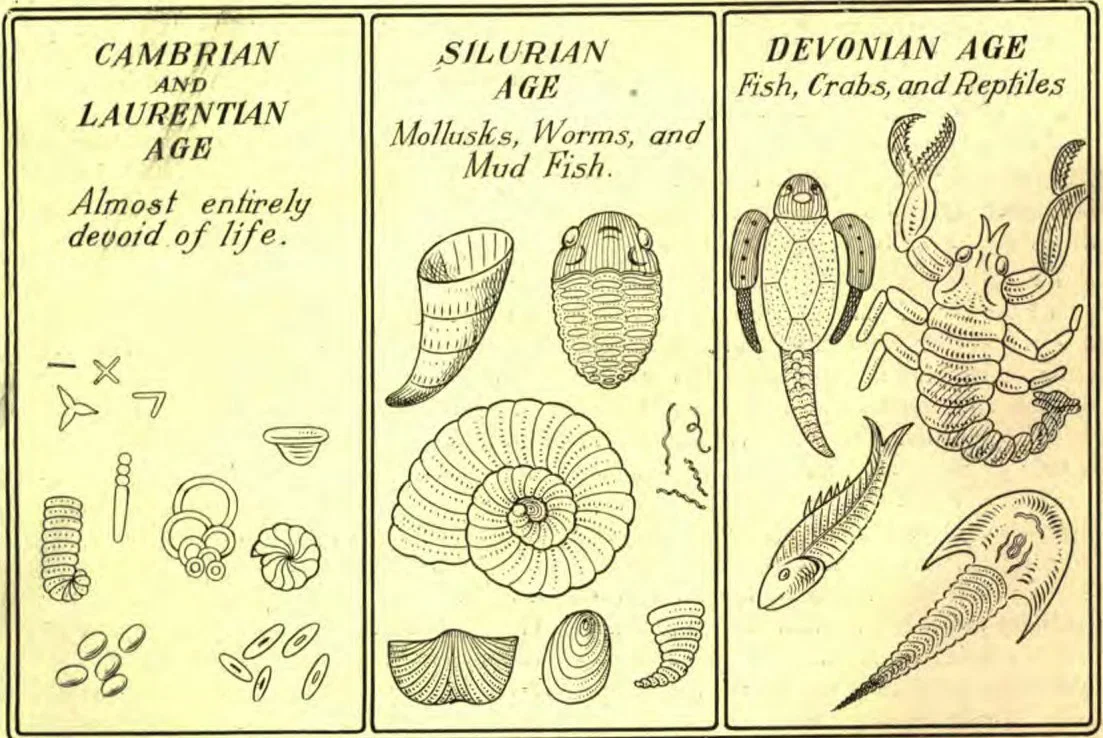
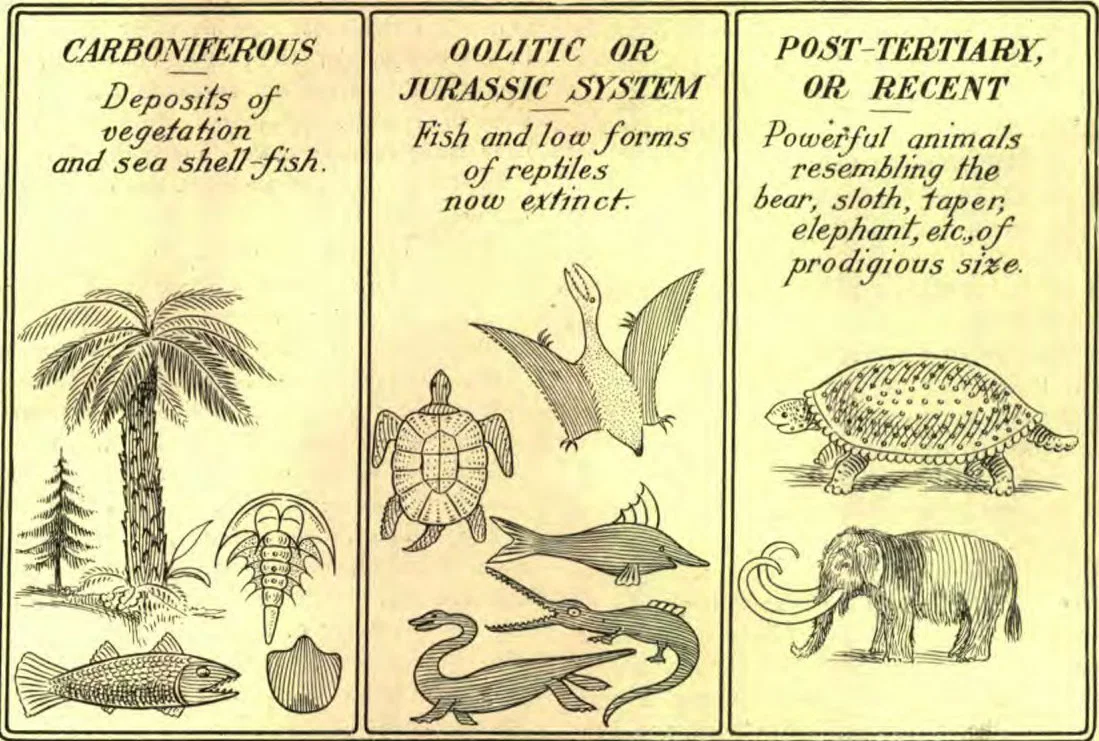
¶ 145. As to the question of the arrangement of the geological strata, we will say that while there is a universal tendency toward the order as given in the illustration presented last week, the exceptions are so many and so pronounced that it requires an almost impossible amount of credulity to believe a rule whose exceptions are so numerous and so marked.
But suppose, for argument’s sake, that all that is claimed by geologists for the strata and their arrangement be true; and that, without exception, they are to be found everywhere in exact accord with the classification given,—is there still an answer to the argument regarding this arrangement’s being a proof of the extreme age of our world?—Yes. And in answering thus, we offer an explanation of any and all phenomena connected with this question.
¶ 146. As to the reason for the different strata containing these different fossil remains there can be no question. When the flood burst upon this earth, and the waters were washed in fury everywhere, the heavy, helpless mollusks and shell-fish, obeying the laws of gravitation, sank to the bottom, and so are there found to-day, representative of what is now called the Silurian age. Next above these would naturally come the lazy, logy mud-fish, eels, etc., also the crawfish,396which, true to their nature, burrowed deep into the mud to escape the danger from the storm. These represent what is termed the Devonian age.
¶ 147. Amid the washing together of the trees and branches which then formed our Carboniferous deposits were entangled many of the less lively fish and other denizens of the sea. Above these, forming the Oolitic or Jurassic formation, is found the stratum of rock and earth containing the remains of such reptiles as, by reason of their superior strength and ability to swim amid the surging billows, were enabled to keep above the washing debris of the buried forests. These succumbed, not to the waters themselves, for many of them were inhabitants of the sea; but to the shock, or concussion, resulting from the bursting rocks and shaking earth. It is well known that reptiles of this class are easily killed by the jar of blasting-powder or earthquake shock.
¶ 148. The last to be destroyed were such prodigious monsters as the mammoth, with elephants, tapirs, sloths, bears, etc.; therefore these remains are found within the stratum of rock and soil claimed to be of more recent date. The accompanying illustrations express the thought clearly.
QUESTIONS
Is the question of geological age a matter of absolute certainty? How has God caused his wonderful works to be remembered? When, how, and for what purpose were the different strata of rock formed? Explain the origin of each rock stratum, as presented in last week’s illustration. Explain why different kinds of animal life are found in different strata. Why does the vegetation differ? State briefly why neither the rock strata nor the fossils they contain prove the extreme age of the world, as generally claimed.
DR. O. C. GODSMARK.
2005 Magazine St., Louisville, Ky.
The Young People's Work
The following cheering reports are taken from recent letters relating to the Young People's work:—
Mrs. J. L. Baker, the New Zealand Conference Sabbath-school secretary, writes: “I am interested in all that has recently been published about the Young People's work, and intend to do all I can to encourage the young folks in this conference to subscribe for the Youth's INSTRUCTOR. I hope, too, that our churches here will respond to the call for this line of work to be started.”
Claude Conard, College Place, Wash., says: “The Young People's work at College Place is doing well. A good interest is being shown among the students, and the meetings are excellent. Active work is being engaged in by many of the members, and others are being roused to unite their efforts also in this work of saving souls. The Spokane young people also report progress. They are doing some good missionary work there. May the Lord bless in this work all over the land.”
Edith M. Cowles, Bethel, Wis., sends the following: “We are intensely interested in the Young People's work. Here at Bethel we have organized a society with a membership of fifty-three. All seem imbued with a spirit of labor, and some very interesting reports were handed in at our last meeting. For instance, one little boy, during the week, had secured twelve subscriptions to periodicals. For the purpose of better advancement, we divided the society into four departments: Home Missions, Foreign Missions, Health and Temperance, and Religious Liberty. The members were privileged to choose their department, and divided themselves so that each division has about the same number of members working in it. Each department is responsible for the program once a month. Although the people in Bethel are mostly Seventh-day Adventists, yet we know that there is a work to be accomplished among us; there must be a personal growth and salvation before we can labor as did Christ for others.”
REWARDS OF SERVICE
By David Paulson
(December 22–28)
READ the study on this subject in the Review of December 17; also chapter entitled “The Work and the Life,” in “Steps to Christ.”
SUGGESTIONS FOR BIBLE STUDY
Acquire the habit of thinking through the entire Bible for securing something that sheds light upon the subject you are studying. If you have never done this, you may be discouraged at the results of your first attempts; for more than likely only a few of the leading Bible characters will stand out boldly before your mind; but as you discipline yourself in this way day by day, studying the Bible faithfully, you will soon acquire an insight into the Holy Book that thus far you have probably never dared hope to attain. Ask for the guidance of the same Spirit that inspired men of old to trace those wonderful words of truth. The better acquainted we become with the Bible, the more we shall love it, and it will become really fascinating to search out and classify its various principles of truth. Do not attempt merely to memorize texts in a mechanical way, and then imagine that you are becoming filled with Bible truth. A verse in the Bible must be fairly crushed, like the grape, in order to secure its sweetness and nourishment. When you have read a verse, settle in your own mind what definite lesson you have acquired by reading it. It is painful to note the vast amount of aimless and superficial so-called “Bible study” that is done. Often those who are studying the Bible in this way wonder why they do not possess more power in their lives, and see more visible results from their labors for others. Much of the ordinary Bible reading is very much like loading a cannon with empty bomb-shells, and then wondering why these shells are so ineffective when they strike. There is something in the Bible for every person,—something particularly suited to his personal needs.
SUGGESTIVE THOUGHTS
The Basis of Reward in Service.—The magnitude of the reward that God bestows upon his servants is not measured by the extent of their service, but by the motive that prompts it. A small ring may be just as round as a cart-wheel. A cup of water, under ordinary circumstances, is about the cheapest thing obtainable; yet Christ declared that if any one should “give a single cup of cold water to refresh one of these lowly ones because he is my disciple. I assure you that by no means will he lose his reward.” Matt. 10:42, Emphatic Diaglott.
The Result of Performing Service Merely to Secure Worldly Gain.—It exposes the soul to moral leprosy. Illustration (2 Kings 5:8-27): The Lord had used Elisha as an instrument by which to bring Naaman into the channel of his healing power; and it was important that Naaman should see clearly that God’s greatest blessings are absolutely free. Elisha had spurned the offer of financial reward, but Elisha’s servant, like some of the workers in the Lord’s cause to-day, put a commercial value upon God’s gifts. As a result God smote him with that terrible disease, leprosy, as an object-lesson for all time, to show what always occurs spiritually to those who dare repeat his error.
Result of Divided Service.—Such service produces spiritual death, and a quick death at that. Illustration (Acts 5:1-10): Ananias and Sapphira. Following what they supposed to be a discreet and far-seeing business policy, they decided to lay by a little of the money that they had promised to the Lord, in case he should forget to take care of them in the future. What happened to them so speedily is precisely what will happen to every worker, as far as his spiritual life is concerned, who pretends to be giving his entire heart, soul, and body for the service of the Master, but who is at the same time secretly scheming to promote his own selfish interests.
God’s Rewards.—God bestows our rewards on the installment plan. He gives us as much as it is safe to intrust us with now, and the remainder will await us on the other shore. Mark 10:29, 30. And God gives to each one just the reward for his service that he can best make use of. To some he grants positions of responsibility and honor rather than financial gain or special spiritual gifts. “Seest thou a man diligent in his business? he shall stand before kings; he shall not stand before obscure men.” Prov. 22:29, margin. Bible illustration: Daniel was living at a time that was perhaps no more conducive to an upright life than is the age in which we are now living, yet the spirit of true service that filled his very being not only determined his selection as one of the one hundred and twenty princes, but also secured for him a place among the three presidents who were over these princes. Furthermore, he was made chairman of this most important committee of three. Yet in spite of these high honors, if Daniel had been superintendent of one of our modern Sabbath-schools, he would not have been above serving the poorest and humblest student in the school. That personal service which is directed toward inspiring others to be what they are not, carries with it a reward which, once felt, is one of the choicest experiences that we are likely to enter into while we are on our earthly pilgrimage. Upon this point a great writer once said, “I want to help you to grow as beautiful as God meant you to be when he thought of you first.”
What to Do with the Gift of Service.—When a criminal in one of our large cities gets possession of a considerable sum of money, he often “plants” some of it; that is, he goes around to some of his old haunts of iniquity, and gives to the proprietors a certain portion of his ill-gotten gains. When misfortune befalls him, which is generally the case sooner or later, he calls upon these persons for friendly assistance in various ways. This partially accounts for the fact that many of these desperate characters so often have some one ready to befriend them when they meet difficulties. And this is only one more illustration of the meaning of the Saviour’s words, “The children of this world are in their generation wiser than the children of light.” Luke 16:8. When God intrusts one of his children with a great gift, which he has neither earned nor toiled to acquire, as, for instance, an amiable temper, a ready ability to acquire knowledge, or a winsome manner that specially appeals to others, the best way for such a person to multiply his gift is speedily to find one with whom to “plant” some of it. The Scripture admonishes us to utilize in a right way this principle, which wicked men pervert. Luke 16:9. DAVID PAULSON, M. D.
ERRATUM
In the last sentence of Section 120, issue of December 5, “Dead Sea” should be substituted for “Red Sea.”