The Youth’s Instructor, Vol. 49, No. 50.

UNTO US A CHILD IS BORN
Earlier text: UNTO US A CHILD IS BORN

A DOUBLE HERO

One afternoon, when Christy Kirby was going home from school, he met his little sister Jo, who had run away from her nurse, and was making pies in the middle of the road. He stopped, and called to her.
“Hello, Jo!”
“Llo!” she answered, smiling sweetly up at him.
“Come on home with me,” said Christy.
Jo returned to her pies, and said nothing.
Just then, hearing shouts and cries behind him, Christy looked back, to see a big wagon with two horses to it plunging down the hill straight toward the very spot where Jo was playing. Three or four men were hurrying out of houses and across fields, only they were a long way off.
It seemed the most natural idea in the world to Christy to run across the road as fast as his fat little legs would carry him, seize Jo by the hand, and drag her out of harm’s way. He was not an instant too soon, for the two small people had barely gained the roadside when the great horses thundered by, their flying hoofs stamping Jo’s pies into powder.
Jo was filled with indignation, but, for some reason Christy did not understand, everybody else thought that he had done a very fine thing. His mother petted him and cried over him; his father gave him a gold-piece; and when he went down the street, the ladies stopped to ask him questions and kiss him. Christy was well pleased with it all. He liked to be called a “nice, brave boy;” he didn’t even mind the kisses so much.
The next day at school most of the large boys who usually kept to themselves had something to say to Christy.
“So you are a hero, are you?” asked one of the sixth-form boys. “How big does that make a boy of your size feel, I wonder?”
“He always feels big,” answered a voice, before Christy could speak. “He always thinks he’s more than anybody else.”
Christy shut his mouth tight. He knew whose the voice was. Dan Sproles was one of the trials of his life.
“Well,” said the sixth-form boy, easily, “I guess he has a right to hold his head pretty high just now. If I were you, I wouldn’t complain of it; ill-tempered people might call you envious.”
He strolled away, while Dan glared after him angrily, and then relieved his feelings by another attack on Christy.
“Being so proud won’t make you get the prize any quicker. It can’t take those absences off.”
“I know it,” said Christy, still trying to keep his temper.
“It can’t teach you to learn arithmetic any easier.”
Christy was silent.
“It can’t make up for the bad mark you got last week whispering,” went on Dan, with a snigger: they both knew who was responsible for that bad mark.
Then Christy forgot that he was a hero. He stamped his foot, and said a number of things not polite enough to be put into a story.
Before he had finished, the bell rang, and they had to go in to school.
“Oh, dear!” thought Christy, dolefully, as he sat down at his desk. “There, I’ve gone and got mad again, when I meant to try not to any more. Mother says I can’t be the right sort of a fellow till I quit that. I think it’s awfully hard, anyway, to be the right sort of a fellow when Dan Sproles is around.”
When school was out, there was a gentleman at the front gate talking to one of the teachers. His name was Dr. Morton, and he lived in the finest house in town. As soon as he saw Christy, he called out to him: “Come here, young man, and let me shake hands with you.”
Christy went.
“You are the chap, are you, that saved your little sister’s life? Well, you are a citizen to boast of, aren’t you? Something ought to be done in the way of a celebration. How would firecrackers and ice-cream suit you,—around at my house?”
Christy did not venture to answer, for fear it might be a joke; but his face, which had been very serious since recess, began to broaden into a smile, and his eyes began to twinkle. The doctor watched him, and needed nothing more.
“We’ll do it,” he said, “to-morrow night. And let me see about the guests. Suppose I invite all the boys in your class here at school. What do you say?”
“Thank you,” said Christy, hastily, growing grave again at having forgotten his manners.
The doctor laughed.
“Not at all. Don’t mention it. But what do you think of inviting your classmates to our party? Would it please you?”
“Yes, sir.”
“Tell me who they are,” said Dr. Morton, taking a pencil out of his pocket and a slip of paper, and using the gate-post for a writing-desk.
Christy gave him the names, glibly at first, but more and more slowly, until finally the doctor did not know whether he had come to the end or not.
“Is that all?” he asked.
“Yes, sir; I guess so.” But Christy hesitated, and Dr. Morton waited. “There’s another boy,” said Christy, at last; “but he doesn’t really belong in our class; he only half belongs. He goes in a bigger room part of the time.”
“Maybe we’d rather do without him,” suggested the doctor.
“Yes, sir,” said Christy, speaking now without any delay.
So the doctor put the list in his pocket and walked off. But he had not gone far when Christy came running and calling after him.
“What’s this?” said Dr. Morton. “Did we forget somebody?”
“No, sir; but I suppose we’d better invite that other boy that only half belongs to our room. Yes, we’d better. I just thought I’d tell you.”
“Very well. What is his name?”
“Dan Sproles.”
The doctor added Dan to his list, and started off again without asking any embarrassing questions. But when Christy got to school the next morning, there, waiting for him, was Dan, full of questions. He began at once: “I say, I’m invited to your party just the same as all the rest. What made you do that? Dr. Morton said you asked him to ask me. Did you?”
Christy looked doubtful.
“What for?”
“Because I wanted to.”
“But why?” persisted Dan. “It wasn’t because you liked to have me.”
“No, it wasn’t,” said Christy, honestly.
“And you didn’t have to have me. Dr. Morton said you didn’t. So what made you?”
Being driven into a corner, Christy explained his point of view with more regard to the facts than either to grammar or to tactfulness.
“Because if you were me,” he said, “and I were you, I knew you wouldn’t ask me; and so, then, I wouldn’t be enough like you to—well—I’d rather you’d come to-night, even if you spoil everything.”
Dan’s face crimsoned as he understood what Christy meant, but he took it very meekly.
“I won’t spoil anything; you’ll see.”
Christy looked doubtful.
“You’ll see,” repeated Dan. “Just wait. Dr. Morton’s a queer man. You tell him things before you think of it. I told him about how you got that mark the other day, and about plaguing you sometimes, because it’s easy. I told him I didn’t think you’d want me at your party. He only listened, and said, ‘Humph!’ and that he guessed you were two kinds of a hero, maybe.”
“What did he mean?”
“Why, one kind is to pull any one out of a danger, like Jo, you know; and those heroes are likely to get fireworks and ice-cream for it. The other kind is to treat any one who plays tricks on you as if he was as much of a gentleman as you are yourself; and these don’t always get any firecrackers.”
“What do they get?”
“I asked him, and he said, ‘Nothing, very often, only just the reward of being high-minded.’ He said perhaps I didn’t know what that was; perhaps I didn’t care anything about that.”
Dan stopped, and wriggled the toe of his boot in the ground, and twisted the middle button of his coat round and round. Then he said, chokily, in a small voice: “But—but I do, you know. And—and, Christy, I guess it’s true, what he said. I guess you were both those two kinds of hero, don’t you know?”
They looked at each other, and looked away again. Being boys, they saw no necessity for saying more on the subject. But Christy added: “Say, Dan, stop for me to-night, will you?”—E. H. Miller, in St. Nicholas.

A LETTER TO THE CHILDREN

Dear Children: The holidays are almost here. In a few days your friends will be engaged in all kinds of entertainments for pleasure. Many thousands of dollars will be spent for foolish and worthless toys, candy, needless articles of dress, etc., etc.
I want to suggest to all our Sabbath-school children something much better. Far across the wide ocean, in India, China, Japan, Africa, and many other places, are thousands of dear children, and older people, too, who do not know about the Saviour’s soon coming, and do not keep his law. They do not have pleasant homes, as you have. They are heathen. Now place your finger on your pulse, and remember that at every beat, one of these poor souls dies, goes down in to the grave without a Saviour. Think how sad this is. Do you not want to help them? I am sure you do.
Let me tell you how. During the week of prayer, when your father and mother are seeking the Lord, you seek him, too, and instead of spending your money for candy, toys, dolls, and presents, sacrifice these for the Lord. Save your money, and on December 28, when the collection for foreign missions is taken up, give it to send the good news of salvation to the heathen across the ocean. The Lord will bless you if you do, and in the kingdom of the Lord in a little while you will see some of these dear souls praising him. Just think how happy you would feel when in the new earth, if some child should come to you, and say, “I would not have been here to enjoy all these beauties and eternal life if it had not been for you.” Then you could go, together with Jesus, to visit some other world. May the Lord bless you all. MRS. DELIA A. THOMPSON.

FOR THE CHRIST-CHILD

We can fancy how He lay In her arms in baby way. Tiny, dimpled fingers curled Like the velvet petals furled In a rosebud tinted pink. Ah, what did the mother think When she cradled, soft and warm, In her arms his little form? Sweetest eyes the world has known Gazing back into her own! Must have made them over-brim,— She to have the care of him!
Still we read, and read again, How those wise, expectant men Came, star-guided, to the place Brightened by that young child-face. “Ah! dear little Christ,” we say, “Had our feet been shown the way To your resting-place, we too Would have brought fair gifts to you.”
Then the Lord Christ smiles, we know, Glad that we should love him so. “Bring your little gifts to me; I have need of them,” saith he. “I would make my birthday fair For the children everywhere. If there be some oversad, Search them out, and make them glad. Change their tears to smiles; ’twill be Just the same as done to me.”
—Selected.

WHOSE BIRTHDAY?

Boys and girls, Christmas is coming! “Ho,” you say, “we know that.”
Yes, but wait a minute. Why are you interested in Christmas? Now I am sure you think I don’t know very much if I have to ask such a question.
“’Course it’s ’cause we hang up our stockings, or have a Christmas tree, or something nice is done for us.”
Well, is that fair? Christmas is supposed to be Jesus’ birthday. Who gets the presents on your birthday? Johnny, how would you like it if Fred got all the nice things on your birthday? Seems to me there is something wrong somewhere. Wish you could find out what it is. Looks to me as if Jesus had been cheated, somehow. Here’s a secret—come up close, and let me whisper it: Let’s surprise Jesus, and give him all the presents this year. What do you say? Let’s. Tell papa and mama that you want Jesus to have his birthday this year. You don’t want to cheat him out of it. Read the twenty-fifth chapter of Matthew, and then I am sure you can think of some way to give presents to him. After Christmas, write and tell me how you did it. Oh, I am sure we can make our Jesus happy! Shall we? LUTHER WARREN.
400 West 57th St., New York City.

STILLING THE TEMPEST

INTRODUCTORY

Preceding Events.—This miracle was immediately preceded by the following events:—
1. The warning of the scribes and Pharisees. Mark 3: 19–30.
2. Christ’s discourse on his true kindred. Matt. 12: 46–50; Mark 3: 31–35.
3. Parables by the sea. Matt. 13: 1–53.
Main Reference.—Mark 4: 35–41.
Other References.—Matt. 8: 23–27; Luke 8: 22–25.
Bible Story of the Miracle.—“Now it came to pass on one of those days when Jesus saw great multitudes about him, and even was come, he saith unto them, Let us go over unto the other side of the lake. And leaving the multitude, he entered into a boat himself and his disciples, and they launched forth: and other boats were with him. But as they sailed, he fell asleep on the cushion, in the stern; and behold there arose a great storm of wind on the lake, and the waves beat into the boat, insomuch that the boat was covered with the waves, and was now filling, and they were in jeopardy. And they came to him, and awoke him, saying, Save, Lord! we perish, Master! Carest thou not that we perish? Master! Master! we perish. And he awoke, and he saith unto them, Why are ye fearful, O ye of little faith? Then he arose, and rebuked the winds and the sea, and the raging of the waters, and said unto the sea, Peace, be still. And they ceased, and there was a great calm. And he said unto them, Why are ye fearful? Have ye not yet faith? Where is your faith? And the men feared exceedingly, and marveled, saying one to another, What manner of man is this, that he commandeth the winds and the sea, and they obey him?” (The foregoing quotation is an interwoven story, in the exact language of the Bible, gathered from Matt. 8: 23–27; Mark 4: 35–41; and Luke 8: 22–25.
Place.—Sea of Galilee, near Capernaum.
Circumstances.—At the close of the day on which the parable of the sower and others had been spoken by the seaside, somewhere near Capernaum, the Saviour with his disciples was passing over to the eastern shore of the sea of Galilee, followed by a number of people in other boats. The storm doubtless was one of the sudden squalls so common on this sea. Owing to its remarkably low level, being hundreds of feet below the sea, the great gorges in the mountains round about served as funnels to bring down the cold wind from the mountains.
Great Lesson.—From this miracle we learn that even Christ and his disciples were in no wise exempt from troubles, trials, and apparent accidents. These things all have a great purpose to accomplish in the experience of the children of God if, in every time of danger, they will call to the Master, who, although it may appear that he is unmindful of their peril, is in reality the One who never slumbers nor sleeps. At all times he knows the danger his children are in.

STUDY OF THE MIRACLE

He Saith unto Them, Let Us Pass Over.—When we move without the word of the Master, we must expect to encounter storms and difficulties; but on this occasion the disciples had embarked at the Master’s command. They started in good weather and good faith, a host of little boats accompanying them. This was a time when not only the safety of the disciples’ boat was in question, but also the safety of the accompanying fleet. Why should the divine mind permit this storm to break upon them at just this time? No doubt Peter reasoned that many a convert would be lost; that the frightened souls in the little boats would look upon Christ as a troublesome Jonah rather than a divine Deliverer. But Christ was not taken unaware by this tempest. Before leaving the shore, he had foreseen all this difficulty as well as its outcome; and it was this perfect understanding, this perfect harmony with his Father’s purposes, that enabled Jesus to sleep peacefully when the storm was raging. It often appears in our experience that the winds of temptation and the waves of opposition break upon us at just the wrong time. We feel it unfortunate that we should be placed in such extremity that we are forced, in spite of our pride and doubt, to hasten to the Master, and before friends, associates, and visitors, cry out, in anguish of soul, “Master! Master! save us; we perish.” Yet how often this very confession of our nothingness, our utter weakness, together with the display of divine power and love that follows, proves to be the very thing that melts the hearts of sinners.
He Was in the Ship.—Christ is with the church, but to-day he is ofttimes in the background, and his presence and mighty workings are not visible to the human eye. Jesus was asleep in the rear of the ship at the very time when it would seem he was most needed on deck. And so when, in our Christian experience, there come times of moral storm and spiritual hurricane, let us remember that the helm of the ship is also in the rear; and that although the Master may appear to sleep while we are troubled with fears and tempted with doubts, he will finally speak the word that will bring peace.
W. S. SADLER.
(To be continued)

Believing in Christ Means Becoming Like Him

To believe in Christ is to be like him. All other faith is a mere mist of words dissolving into empty air. To live our human lives as he lived his—purely, lovingly, righteously—is to share his eternity.—Lucy Larcom.

PARABLE OF THE PRODIGAL SON

(December 28)
LESSON TEXT: Luke 15: 11–32.
LESSON HELP: “Christ’s Object Lessons,” pages 198–211.
1. In Luke 15 whom was Christ teaching?
2. What lesson did he give them in the parables of the lost sheep and the lost coin?
3. What other parable did Christ give referring to the lost?
4. Who was the lost?
5. What ungrateful request did this son make of his father?
6. How did the father grant it?
7. As soon as the younger son got his portion, what did he do? Why, then, was he anxious to leave home? Note 1.
8. What was the result of his having his own way? How did his associates treat him when he was in want?
9. Our lesson says, “And when he came to himself.” What brought this about?
10. In his distress, of whom did he begin to think? What confession does he make?
11. What place in his father’s house does he think to take?
12. As the father sees a wanderer coming a great way off, of whom does he at once think?
13. Notwithstanding all the marks of degradation, what image does the father discern in him?
14. Instead of returning home as a hired servant, how is the lost one received?
15. The father’s best robe reminds us of what beautiful garment that God has for us? Rev. 19: 8. What does the ring indicate?
16. In the parable what one thought fills the father’s heart with joy?
17. Who complains about it?
18. What does the father then do?
19. For what does the answer of the elder son show that he has been working while at home?
20. With what words does he manifest contempt for his brother?
21. How does the father address him in his answer? What would he have called him if he had expected to pay him for his service?
22. As what did all that the father had come to this son?
23. The elder son represents what class of people that Christ was teaching that day?
24. What complaint had they made concerning their “younger brother”?
25. How, then, were they thinking to obtain an inheritance from God? How do we get it?
26. When we do what our Father asks us to do, how are we to look upon our work? Luke 17: 10.

SELECTED NOTES

1. “The son thought he should be happy when he could use his portion according to his own pleasure, without being annoyed by advice or restraint. He did not wish to be troubled with mutual obligation. If he shared his father’s estate, his father had claims upon him as a son. But he did not feel under any obligation to his generous father, and he braced his selfish, rebellious spirit with the thought that a portion of his father’s property belonged to him. He requested his share, when rightfully he could claim nothing, and should have had nothing. After his selfish heart had received the treasure, of which he was so undeserving, he went his way at a distance from his father, that he might even forget that he had a father. He despised restraint, and was fully determined to have pleasure in any way that he chose.”—“Testimonies for the Church,” Vol. III, page 101.
2. “When the father comes out to remonstrate with him [the elder son], the pride and malignity of his nature are revealed. He dwells upon his own life in his father’s house as a round of unrequited service, and then places in mean contrast the favor shown to the son just returned. He makes it plain that his own service has been that of a servant rather than a son. . . . He grudges his brother the favor shown him. He plainly shows that had he been in his father’s place, he would not have received the prodigal. He does not even acknowledge him as a brother, but coldly speaks of him as ‘thy son.’”—“Christ’s Object Lessons,” pages 207, 208.
3. “By the elder son were represented the unrepenting Jews of Christ’s day, and also the Pharisees of every age. . . . In the parable the father’s remonstrance with the elder son was Heaven’s tender appeal to the Pharisees. ‘All that I have is thine,’—not as wages, but as a gift.”—Id., pages 209, 210.
4. “Was the elder brother brought to see his own mean, ungrateful spirit? . . . Concerning this, Christ was silent. For the parable was still enacting, and it rested with his hearers to determine what the outcome should be.”—Id., page 209.

SPECIAL

IN next week's INSTRUCTOR will be printed a hymn to be used with the accompanying Sabbath-school lesson. The subject of the lesson is the Barren Fig Tree, and the hymn represents Justice saying the sad words, “Cut it down, cut it down,” and Mercy pleading, “One year more.” This hymn is found in “Gospel Hymns” (consolidated), No. 238. Let our schools learn this hymn, and sing it at the close of the service on January 4. An impressive way would be to select some to represent Justice, and others Mercy, all uniting in singing the last stanza.

VERY SPECIAL

The Correspondence-Study Department of Emmanuel Missionary College, conducted under the auspices of the Educational Department of the General Conference Committee, will open Jan. 1, 1902. This department will co-operate with, and assist in, upbuilding the Young People's Societies in our churches. Those who can not now become resident students in one of our colleges or training-schools, those who are teaching and wish to become better equipped,—these and many others will find the Correspondence Course a substantial help. A handbook of information is sent upon application to Emmanuel Missionary College, Correspondence-Study Department, Berrien Springs, Mich.

Ladies Wanted to Work on Sofa Pillows

LADIES WANTED to work on SOFA PILLOWS. Materials furnished. Steady work guaranteed; experience unnecessary. Send stamped envelope to Miss S. McGee, Needle Work Dept., Ideal Co., Chicago, Ill.

GRAND TRUNK RY. SYSTEM.

Taking Effect June 2, 1901.
Trains leave Battle Creek.

WEST-BOUND.

No. 9, Mail and Express, to Chicago — 12.15 P. M. No. 7, Limited Express, to Chicago — 7.00 A. M. No. 1, Chicago Express, to Chicago — 9.23 A. M. No. 3, Lehigh Valley Express, to Chicago — 3.50 P. M. No. 5, International Express — 2.17 A. M. No. 75, Mixed, to South Bend — 7.30 A. M. Nos. 9 and 75, daily, except Sunday. Nos. 1, 3, 5, and 7, daily.

EAST-BOUND.

No. 10, Mail and Express, East and Detroit — 3.45 P. M. No. 8, Limited Express, East and Detroit — 4.50 P. M. No. 4, Lehigh Express, East and Canada — 8.02 P. M. No. 6, Atlantic Express, East and Detroit — 2.10 A. M. No. 2, Express, East and Detroit — 7.00 A. M. No. 74, Mixed (starts from Nichols yard) — 7.15 A. M. Nos. 10 and 74, daily, except Sunday. Nos. 4, 6, 8, and 2, daily.
W. C. CUNLIFFE, Agent, BATTLE CREEK.

A Book for the Children and a Book that Children Love.

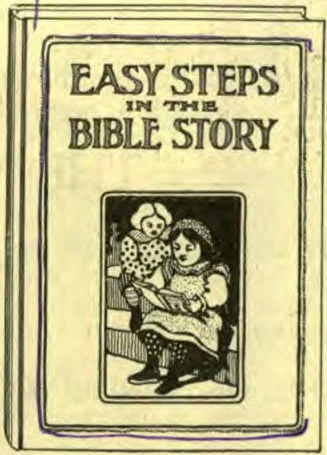
Easy Steps in the Bible Story

By ADELAIDE BEE COOPER.
Easy Steps in the Bible Story
The minds of children turn as naturally to the stories of the Bible as a lily to the sun. They never tire of hearing of the wonders of Creation Week, of the incidents of the Flood, and the building of the Tower of Babel, and of the lives of Abraham, Isaac, and Jacob. And Joseph—what mother does not hear again and again from childish lips the request, “Tell me ’bout Joseph”?
“Easy Steps in the Bible Story” gives all these and other narratives reaching from Creation down to the time when the Law was spoken on Mount Sinai. The stories are told in simple words that the children can understand, and the pictures help make the meaning still more plain.
Do your children have this book? If not, make them happy by giving them a copy. If they do, encourage them to present it to some little friend. In these days when the market is flooded with children’s Bible stories that are filled with teaching that strikes at the very foundations of Christian belief, the placing of this book in the hands of the little ones may be the means of forming in some childish mind an idea of the events of Creation Week that neither time nor later teaching can wholly efface.
“The best of all Bible books for children,” — ALONZO T. JONES.

AGENTS WANTED EVERYWHERE.

Price: Bound in cloth, 50 cents; in paper, 25 cents.
Order of your State Tract Society; Review and Herald Pub. Co., Battle Creek, Mich.; or Pacific Press Pub. Co., Oakland, Cal.
Continue reading: ANNOUNCEMENT!