The Youth’s Instructor, Vol. 32, No. 48.

DANA’S THANKSGIVING

The Youth’s Instructor

Nov 26, 1884

S. D. A. Publishing Association · Battle Creek, Mich. · Nov 26, 1884

DANA’S THANKSGIVING

Written for the Instructor.

DANA’S THANKSGIVING.

MOTHER, can’t I have a new cloak? This one looks like a fright. It’s too short-waisted, the sleeves are half-way up to my elbows, and the edges are all frayed down the front, too. I can most stick my fingers through it.”
“Why, Dana, I am sure it’s not so bad as that. You said only last week that you thought it would do very nicely, and you haven’t worn it but twice since.”
“I know, mother; but Nellie Baker has such a pretty new one, all trimmed with fur, and mine looks so shabby beside hers when I have to sit right next to her in Sabbath-school. Nellie says that they don’t wear cloaks like mine any more either, and I don’t see why I can’t have a new one. Can’t I, mother?”
“I would be glad to have you have a new cloak, Dana, if it could be afforded, and if you really needed it. But you know, dear, that father has been sick and not able to work nearly all summer; and this winter the last payment on the place must be made, or we will lose our little home. It would be too bad to do that after all these years, just to gratify our love for fine clothes, when the old ones will be quite as comfortable and do just as well. If you will only try to be contented, it will make us all much happier than a new cloak could possibly do.”
Dana did not answer, but drummed discontentedly on the window-pane, while her usually pleasant face was marred by an ugly frown. Soon Robbie came in, noisily swinging his dinner-pail, exclaiming as he threw his books on the table, and whisked a shower of water from his cap,—
“There isn’t any more school this week. To-morrow is Thanksgiving Day; and as the next day is Friday, Miss Graham said we wouldn’t study much anyway, so we needn’t come again till Monday. I think she’s just jolly. Hurrah!”
“Don’t, Robbie, you’ll wake the baby,” said Mrs. Warner, gently jogging the cradle with her foot.
“Well,” continued Robbie, more quietly, “we boys had planned to go to Prospect Hill coasting to-morrow afternoon, and down on the flats in the evening to build bon-fires and skate. The whole school was going, girls and all; but I guess our fun is all spoilt. It’s raining by the tubful now. The snow will be gone before morning, and I don’t believe a frog would dare to skate on what little ice there’ll be left in the pond.”
“That’s just the way it always is,” said Dana, spitefully. “It’s sure to rain if you want to go anywhere or do anything.”
“Miss Graham told us, when we were fretting because it looked like rain, that we must be grateful for whatever comes, because God sends it; and he knows it is for the best; though I don’t see what we needed rain for. She said we ought to feel ’specially thankful to-morrow, because it is Thanksgiving Day.”
“Well, I don’t see what I’ve got to be thankful about, unless it’s because I’ve got to stay shut up in this stuffy old house all day to-morrow, all on account of that horrid rain, when it might just as well have snowed; and I’m sure I’m not glad because I’ve got to wear my old clothes this winter, when all the rest of the girls have got new ones; and I’m not thankful that we can’t have a turkey and mince-pie and cake for to-morrow, instead of that chicken and pumpkin pie. We haven’t had anything but pumpkin and apple pies all the fall, and I guess I can’t be thankful for them now.”
“O Dana!” said her mother, reproachfully, “how can you talk so when you have a comfortable home and plenty to eat and wear? How can you look around you, and say you have nothing to be thankful for?”
“Dana Warner, you just ought to be ashamed of yourself to talk so, when father works so hard to get us a home and send us to school. There’s lots and lots of children who don’t have half as good clothes to wear and things to eat as we do, and they don’t get enough of that either,” said Robbie, earnestly.
“Well,” retorted Dana, “there’s lots and lots that have a great deal better, so I don’t see as there’s much difference.”
Mrs. Warner sighed, and laying aside her work, rose to light the lamp and stir the fire. Dana’s heart smote her as she saw how wearily her mother performed the evening tasks; but she was too discontented to offer her any assistance. Later in the evening, when they had all gathered around the glowing hearth, Robbie’s words, “Father works so hard,” came to her with renewed force, when she noticed how tired and pale he looked. Then her mother’s, “How can you look around you and say you have nothing to be thankful for?” seemed to echo in her ears; and she could not help thinking of her little schoolmate whose mother was laid in the church-yard only a few weeks before; of another whose home was one cheerless room, and whose father came staggering home drunk every night. But these thoughts did not drive the clouds from her face, for she had made up her mind that she was a very much misused little girl, and that she was very unhappy, and so of course she was unhappy.
Suddenly a loud knock at the kitchen door startled them all; but they were still more startled when a voice called out, “Neighbor Warner, your house is on fire!”
How quickly they all rushed from the house, unmindful of the falling rain! Yes, it was on fire. Dense clouds of smoke were rising from a large hole in the roof, and now and then a little tongue of flame would shoot up, as if defying the storm or anything else to put it out. The men hastened for ladders, and were soon carrying buckets of water to pour on the flames. The frightened children clung to their mother, who tried to pacify them.
“Mother,” sobbed Dana, “do you think it will all burn up?”
“I can’t tell, dear; I hope not, but we can only pray to the Lord for help.”
“How can I, mother,” moaned she, “when I’ve been so wicked? I said I hadn’t anything to be thankful for, and talked so about having to wear old things; and now, if it burns up, we won’t have anything to wear, or to eat either, and no place to stay.”
“God will take care of us, Dana,” replied Mrs. Warner, soothingly. “Oh, if he will only spare the house, I will never be unthankful again!” As if in answer, the rain beat down harder, till it seemed to fall in sheets, and soon the men came down, and said the fire was out, though it had burned an ugly hole. It had caught in the garret from a crack in the chimney.
“I guess there wouldn’t have been much left if it hadn’t been for the rain,” said the kind-hearted neighbor. “I should have been home three hours ago; but it made the sleighing so poor that I had to let the horses walk all the way. It was fortunate for you that it belated me.”
“Yes, the rain helped in more ways than one,” replied Mr. Warner. “If the roof had been as dry as it was before this storm, water by the bucketful wouldn’t have done much good.”
It was late when Dana went to bed that night, and much later when she got to sleep. She lay a long while thinking over the events of the day; how she had fretted about her old cloak, about the old house, about their plain food, and about the rain; and thinking about the rain made her think of how Miss Graham had said that they should be grateful for whatever came, because God sends it, and he knows what is for the best.
“Oh,” whispered Dana to herself, “I’ll never complain again if it rains as long as it did when Noah was in the ark. To think that I wanted it to snow, and was cross because it didn’t, when if it had, our house would have been burned up! I’m so thankful!”—and Dana fell asleep, and didn’t wake till the sound of her father’s hammer mending that hole in the roof told her that it was morning and Thanksgiving Day. And a glad day it was, too, if it did drip, drip outside.
Dana said the chicken smelled like turkey any way, and that her mother’s nice light bread was better than any cake.
If that was only her imagination, we are sure of one thing; the sight of that patch of bright, new shingles in the roof kept her from fretting so long that at length she was entirely broken of the habit.
ISADORE SUTHERLAND MINER.

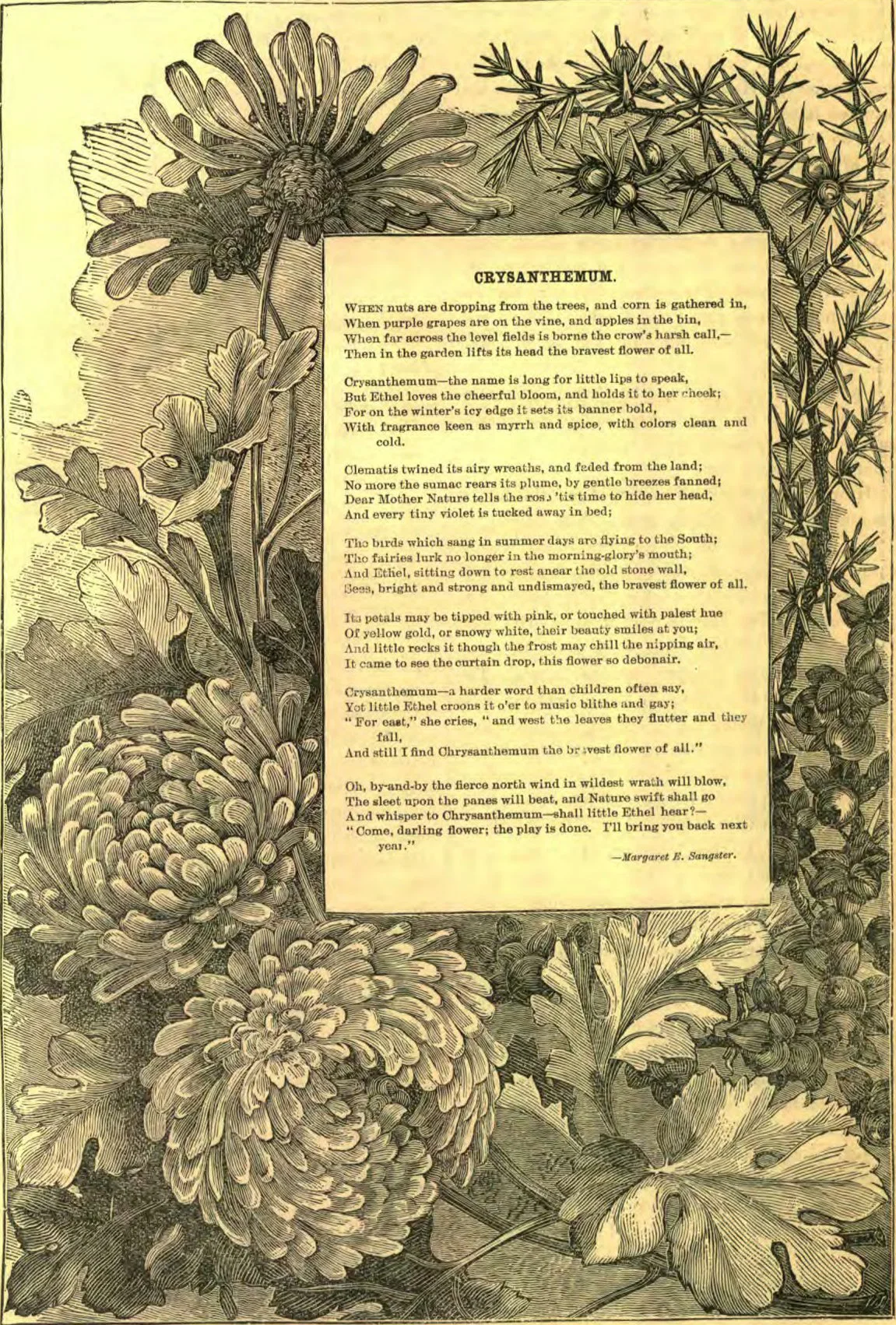
CHRYSANTHEMUM

When nuts are dropping from the trees, and corn is gathered in, When purple grapes are on the vine, and apples in the bin, When far across the level fields is borne the crow’s harsh call,— Then in the garden lifts its head the bravest flower of all.
Chrysanthemum—the name is long for little lips to speak, But Ethel loves the cheerful bloom, and holds it to her cheek; For on the winter’s icy edge it sets its banner bold, With fragrance keen as myrrh and spice, with colors clean and cold.
Clematis twined its airy wreaths, and faded from the land; No more the sumac rears its plume, by gentle breezes fanned; Dear Mother Nature tells the rose ’tis time to hide her head, And every tiny violet is tucked away in bed;
The birds which sang in summer days are flying to the South; The fairies lurk no longer in the morning-glory’s mouth; And Ethel, sitting down to rest among the old stone wall, Sees, bright and strong and undismayed, the bravest flower of all.
Its petals may be tipped with pink, or touched with palest hue Of yellow gold, or snowy white, their beauty smiles at you; And little recks it though the frost may chill the nipping air, It came to see the curtain drop, this flower so debonair.
Chrysanthemum—a harder word than children often say, Yet little Ethel croons it o’er to music blithe and gay; “For east,” she cries, “and west the leaves they flutter and they fall, And still I find Chrysanthemum the bravest flower of all.”
Oh, by-and-by the fierce north wind in wildest wrath will blow, The sleet upon the panes will beat, and Nature swift shall go And whisper to Chrysanthemum—shall little Ethel hear?— “Come, darling flower; the play is done. I’ll bring you back next year.”
—Margaret E. Sangster.

EDITOR'S CORNER.

My wings are weak, I shall never mount,” A nestling sighed; “upon any account Pray do not leave me, I never can reach From twig to twig of this pleasant old beech. Why not just stay where we are here below? I never can mount to yon region, I know.”
The poet represents the birdling making the above plea when the parent birds were trying to crowd their little ones from the home-nest in order that they might learn to use their wings. Our young friends have watched them doing this, oh, so many times, and heard the piteous cries of the nestlings at being so disturbed. As you looked wonderingly at them, did you not see a likeness to yourselves,—who rather be carried along by circumstances than urged forward? Did you not see, too, in the earnestness of the parent birds, a likeness to that teacher who is never at rest unless the minds of his pupils are all the while developing, and who understands that the child left undisturbed will not rise to that degree of eminence in anything that he might, if urged to exercise properly the faculties God has given him?
The readers of the INSTRUCTOR have been repeatedly told that there is no standing-still place; that, like the nestlings, “If you lift not your wings for a higher flight, lower and lower will be your plight.” Again we say, it is dangerous in the extreme to allow a self-satisfied feeling with what you already are to come upon you. The effect is always bad, as can be proved by many examples. We will give only one, the circumstance of a young lad who began learning the printer’s trade. He did the work of an apprentice, and set type until he could correct his own proofs tolerably well, when he conceived the idea, and boastingly stated it to his friends, that there was no more for him to learn, he had learned it all. His mind feasted upon its own flattery until he was beyond reach of the counsel or advice of his superiors; and to avoid restraint, he ran away from his home, and took up with peddling on a railroad, until, for some misdemeanor, he became an inmate of a House of Correction. After serving out his time there, he was released, and then was almost immediately arrested for burglary and stealing, tried, and sentenced to jail.
Self-satisfied, this silly lad claimed there was no more to learn. However, he did learn much more of wickedness, and his life, so far as we know, is a complete failure.
Do our young friends wish to grow to the full height in knowledge, wisdom, and excellence? we repeat, avoid a restful feeling with what you are, and keep in mind that the little you have learned is, in comparison, only as a few gathered grains of sand from the ocean’s great untraversed bed, and that you must keep reaching out and beyond for more.
A good motto for those who wish to make the best use of their talents is found in the words of the late President Garfield: “Be fit for more than the thing you are now doing.” Don’t you see that he who makes this the rule of his life cannot be satisfied with present attainments; for the work of fitting himself “for more than he is now doing” constitutes a growth upward? If the youth would strive to be what they might, to develop all their powers of body and mind, they would be strong in body, keen in intellect, with consciences clear from guilt, and with pure affections. This must be your aim, dear readers, if you make life a success, if you finally enter into the joy of the Lord.
“A sacred burden is the life ye bear. Look on it, lift it, bear it solemnly, Stand up and walk beneath it steadfastly; Fail not for sorrow, falter not for sin, But onward, upward, till the goal ye win.” M. J. C.

NOVEMBER

Yet one smile more, departing, distant sun! One mellow smile through the soft, vapory air, Ere, o’er the frozen earth, the loud winds run, Or snows are sifted o’er the meadows bare. One smile on the brown hills and naked trees, And the dark rocks whose summer wreaths are cast, And the blue gentian-flower, that, in the breeze, Nods lonely, of her beauteous race the last. Yet a few sunny days, in which the bee Shall murmur by the hedge that skirts the way, The cricket chirp upon the russet lea, And man delight to linger in thy way. Yet one rich smile, and we will try to bear The piercing winter frost, and winds, and darkened air. —Bryant.

TIRED BIRDS.

MANY of our birds fly several thousand miles every autumn, passing not only over Florida, where they might find perpetual summer, but over the gulf and far beyond into the great summer land of the Amazon; after a short stay they return again to the North, some penetrating to the extreme shores of the Arctic seas. How the small birds fly so great distances is almost incomprehensible, but I have seen many of our small friends on the little Key of Tortugas, two hundred miles or more from Cape Florida, the jumping off place of the United States. Great flocks of them would alight upon the walls of the fort, especially during storms, evidently thoroughly tired; but the next day they were up and away off over the great stretch of the Gulf and the Caribbean Sea.
Numbers of the English birds and many from Northern Europe make yearly voyages down into the African continent, and careful observers state that they have seen the great storks, so common in Germany, moving along high in the air, bearing on their broad back numbers of small birds that had taken the passage, or were, perhaps, stealing a ride. In these wonderful migrations, many birds are blown out to sea and lost, while others become so fatigued and worn out that they will alight upon boats.
A New England fisherman, who in the autumn follows his calling fourteen or fifteen miles out from shore, informed me that nearly every day he had watched them when he dropped down to rest.
One day the same fisherman fell asleep while holding his line, and upon suddenly opening his eyes, there sat a little bird on his hand, demurely cocking its head this way and that, as if wondering whether he was on an old wreck or a piece of driftwood.—Selected.

LUDOVICO ANTONIO MURATORI.

Ludovico Antonio Muratori was born on the 21st of October, 1672, at Vignola, a small town near Modena, Italy. His parents, who were peasants, were not different from the rest of their class at that time. They never seemed to think that little Ludovic, although a bright, clever boy, ought to go to school. When he was about eight years old, his father, a thrifty man, told him he must now be put to a trade, so as to be able to earn his own living. But the boy’s ambition was not to be thwarted in this way.
On the ground-floor of a certain house in Vignola, a grammar school was held. As the school-room window generally stood open, it occurred to Ludovic to place himself beneath it, close to the wall, so that he could hear all that the master said. One of the boys, looking by chance out of the window one day, saw him standing there, still and motionless. He whispered to the others, who looked out also.
Seeing an unusual movement among the boys, the master himself followed them, and saw the object of all this curiosity. Angry at what he thought the trick of an idle boy to distract his pupils from their work, he went outside, and seized the child by the arm in order to chase him from the wall. Ludovic was frightened at first; but he soon took courage, and begging the master to listen to him, told him, humbly and frankly, that he came there to hear and not to be seen.
“What was it you wished to hear?” asked the master.
“Your instructions, sir,” said the poor boy. Then he told the master how his father was not rich enough to send him to school, that he must soon be put to a trade, and that he had taken this way to learn a little grammar.
The master was pacified, and made him enter the school-room. In order to assure himself that the boy was speaking the truth, he asked him to repeat what he had been teaching that day. Ludovic, who had a wonderful memory, repeated the entire lesson without a single mistake.
The master was so touched by his patience and perseverance that he went to his parents, and told them that if they would only send the boy to him, he would educate him for nothing. With such talents and industry as he already showed, he was very sure that he would be a great man some day.
The parents agreed. It is easy to imagine Ludovic’s delight at this change of affairs.
The boy’s talents were so extraordinary that it was not long before the master saw that he could not teach him more. So he mentioned Ludovic’s strong desire for learning to some rich and cultivated people of Vignola, and persuaded them to subscribe money enough to maintain him at the high school of the city of Modena.
It would take too much time to tell all that followed. His published works might form an entire library. He thought and wrote with such rapidity that his “Annals of Italy” (still the best history of Italy extant), composed when he was sixty-seven years old, and contained in thirty large volumes, were commenced and finished in a single year—scarcely time enough to transcribe it.
None of you will have the need, and few, perhaps, would have the courage, to imitate the little Muratori in conquering adverse fortune. But who would not wish at least to resemble him in making a good use of his natural gifts, and in constant and willing study to improve them?—Harper’s Young People.

TWO CENTS A LETTER.

THERE are seven hundred million postage stamps made every year. In New York, eight million are used each month. It takes eighty workmen and women to make a stamp, so many processes are necessary before it is ready to sell at the post-office. First, the simple white paper is cut in sheets that will hold a hundred ordinary stamps. In passing through different hands, the printers, gummers, perforators, etc., this sheet is counted twenty-six times, that there be no mistake in the numbers delivered and paid for. And there are very few mistakes. A most careful count showed that the errors of four years did not amount to over twenty-two dollars.
It is hard for one who has not seen to understand what quickness and accuracy and fineness are required in the various handlings of these sheets of postage-stamps.

IMPORTANT BIBLE SUBJECTS.

LESSON 22.—IMMORTALITY—THE RICH MAN AND LAZARUS.

[NOTE TO THE STUDENT.—Do not consider the lesson learned until you can give at least the substance of every text, with the correct reference for each. The references in black letters indicate those texts that should be committed to memory. A little diligent application each day will enable you to do this.]
1. Where do you find the story of the rich man and Lazarus? Luke 16:19-31.
2. What description is given of the rich man? Verse 19.
3. What is said of Lazarus the beggar? Verses 20, 21.
4. What happened to them both? Verse 22.
5. Throughout the narrative, in what condition are they both represented as being? Verses 30, 31.
6. What further shows that they are not considered as being alive? Verse 25.
7. What is cited in the narrative as sufficient authority concerning the future? Verses 29, 31.
8. In the Old Testament, what do we learn as to the condition of the dead? Eccl. 9:5, 6.
9. What becomes of their thoughts? Ps. 146:3, 4.
10. How much interest are they able to manifest in the affairs of their friends who still live? Job 14:21.
11. Where is the rich man represented as being after his death and burial? Luke 16:22, 23. (See Revised Version.)
12. What does the word “hell” (hades) signify? 1 Cor. 15:55. (See marginal reading of the word “grave.”)
13. What have we learned as to the dominion of death and the grave over mankind? Ps. 89:48.
14. To what place did Christ go when he died? Acts 2:29-32.
15. What kind of a place is the grave? Job 10:20-22.
16. What can you say concerning the activity of the wicked in the grave? Ps. 31:17.
17. Why should people not put off that which they find to do in their lifetime? Eccl. 9:10.
18. In view of this state of things, what kind of a land is the grave called? Ps. 88:10-12.
19. In the narrative before us, where is the beggar represented as having been taken? Luke 16:22.
20. What does the inspired record say of Abraham at his death? Gen. 25:8.
21. Can this mean that he went to heaven? Josh. 24:2.
22. What is meant by being “gathered to his people”? Gen. 15:15.
23. Was any different disposition made of Abraham than of the rich man in our lesson? Compare Gen. 15:15; 25:9, with Luke 16:22.
24. Then must not all of these persons, if all of them ever really existed, have gone to the same place?
25. What is the place to which all the dead go?
(To be continued.)

ON A STRIKE.

A Sunday-School teacher, finding it difficult to obtain the prompt attendance of the boys in her class, resolved to adopt a plan which she felt sure would be successful. She said to the boys, “Now I will give a bright penny to each one who will be in his place every Sunday.”
This plan seemed to work well until one Sunday not a boy appeared in his place. The teacher was surprised and somewhat discouraged that her plan had not succeeded. But the next day while walking down street and thinking what to do next, she met one of the boys and said to him: “Well, Johnny, where were you yesterday?”
“At home, ma’am.”
“But why did you and the other boys not come to Sunday-school, and get your pennies?”
“O teacher, ’cause we’ve struck; we won’t come for less than two cents now.”—Ec.

WHERE DO YOU LIVE?

I knew a man, and his name was Horner, Who used to live on Grumble Corner, Grumble Corner in Cross-Patch Town; And he never was seen without a frown. He grumbled at this, he grumbled at that; He growled at the dog, he growled at the cat; He grumbled at morning, he grumbled at night; And to grumble and growl were his chief delight.
He grumbled so much at his wife that she Began to grumble as well as he; And all the children, wherever they went, Reflected their parents’ discontent. If the sky was dark and betokened rain, Then Mr. Horner was sure to complain; And if there was never a cloud about, He’d grumble because of a threatened drought.
His meals were never to suit his taste: He grumbled at having to eat in haste. The bread was poor, or the meat was tough, Or else he hadn’t half enough. No matter how hard his wife might try To please her husband, with scornful eye He’d look around, and then, with a scowl At something or other, begin to growl.
One day, as I loitered along the street, My old acquaintance I chanced to meet, Whose face was without the look of care And the ugly frown that it used to wear. “I may be mistaken, perhaps,” I said, As, after saluting, I turned my head; “But it is and it isn’t the Mr. Horner Who lived for so long on Grumble Corner.”
I met him next day, and I met him again, In melting weather, in pouring rain, When stocks were up, and when stocks were down; But a smile somehow had replaced the frown. It puzzled me much. And so, one day, I seized his hand in a friendly way, And said, “Mr. Horner, I’d like to know What can have happened to change you so?”
He laughed a laugh that was good to hear, For it told of a conscience calm and clear; And he said, with none of the old-time drawl, “Why, I’ve changed my residence; that is all.” “Changed your residence?” “Yes,” said Horner, “It wasn’t healthy on Grumble Corner, And so I moved. ’T was a change complete; And you’ll find me now on THANKSGIVING STREET.”
Now, every day as I move along The streets so filled with the busy throng, I watch each face, and can always tell Where men and women and children dwell; And many a discontented mourner Is spending his days on Grumble Corner, Sour and sad, whom I long to entreat To take a house on THANKSGIVING STREET.
—Independent.

Grandmother’s Clock.

It stands in the corner of grandma’s room; From the ceiling it reaches the floor; “Tick-tock,” it keeps saying the whole day long, “Tick-tock,” and nothing more.
Grandma says the clock is old, like herself; But dear grandma is wrinkled and gray, While the face of the clock is smooth as my hand, And painted with flowers so gay.
Backward and forward, this way and that, You can see the big pendulum rock: “Tick-tock,” it keeps saying the whole day long, “Tick-tock, tick-tock, tick-tock!”
The clock never sleeps, and its hands never rest As they slowly go moving around; And it strikes the hours with a ding, ding, ding, Ding, ding, and a whirling sound.
I wonder if this is the same old clock That the mousie ran up in the night, And played hide-and-seek till the clock struck one, And then ran down in a fright!
Backward and forward, this way and that, You can see the big pendulum rock: “Tick-tock,” it keeps saying the whole day long, “Tick-tock, tick-tock, tick-tock!”
—Nellie M. Garabrant.

THE WOODCOCK.

Did you ever see a bird that carried its little ones with its feet? This is what the bird in our picture is doing. The woodcock builds its nest in dry, heathery woods; but it gets its food in marshy, wet places. It goes to hunt its breakfast in the early dawn, before it is very light.
It could not carry food enough from the marshes to its woodland home to keep its little ones alive; so it takes them between its spread feet, as the one in the picture is doing, and carries them to breakfast.
It shows great skill in finding worms to eat, thrusting its long bill into the earth up to its nostrils, and never failing to bring up a worm.
It is a very silent bird, seldom uttering a cry except when it goes to its feeding place.
They fly very high, and are wonderfully swift. They are very hard to shoot, because they have a way of dodging and jerking about when they see a sportsman, and so often escape his shot. But it takes only a slight wound to fetch one down, and they never seem to think of running and hiding when once they are wounded. When they change their home, they fly in companies, and like best to make the journey in calm, hazy weather.
In color, the woodcock is of several shades of brown. It is about fourteen inches long, and weighs nearly a pound. It builds its nest of fern leaves, laid close together, and it lays four eggs, buffy white, with rusty brown blotches.
W. E. L.

TWO PENNIES.

It was a bright spring evening when little Polly stole softly into her father's room, with shoeless feet, and her golden hair falling lightly over her white nightgown; for it was bed-time, and she had come to say “Good night.”
“Father,” said the little one, raising her blue eyes to his kind face, “may I say my prayers beside you, for mother is too ill for me to go to her to-night?” “Yes, pet,” he answered, tenderly stroking her curly head.
And reverently the little child knelt down beside him, and repeated her evening prayer, adding at the close, with special earnestness, “God, bless my two pennies.”
What can the child mean? thought her father in surprise; and when the little white-robed figure was gone, he went and asked her mother if she knew what their little girl meant.
“Oh, yes!” said she. “Polly has prayed that prayer every night since she put her two pennies on the plate at the last missionary meeting.”
Dear children, have you ever prayed to God for a blessing on the pennies you have put in the missionary box? If not, be sure you never forget to do so in the future.—Selected.

Letter Budget.

We have a letter from Valley Co., Neb., but there is no name signed to it, and we cannot tell whether it was written by a boy or girl. The writer is fourteen years old, and lives fourteen miles from Sabbath-school. The mother of the writer is living in New Mexico; and the child is going to try to meet the mother in the new earth, if never permitted to see her here.
GRACIE M. BAHLER, of Galveston Co., Texas, writes: “I am a little girl six years old. I keep the Sabbath with my mamma and papa. I love the INSTRUCTOR; mamma reads it to me every Sabbath. I am learning to read. I read in the First Reader. My home is in Grayson Co., but we are stopping here now. Last evening we went to the beach and took a bath in the Gulf of Mexico. I was some afraid of the big waves. I am trying to be a good girl, so I can go to heaven with the INSTRUCTOR family.”

THE LESSON OF THE BATH.

ONE of the most valuable discoveries made by Archimedes, the famous scholar of Syracuse, in Sicily, relates to the weight of bodies immersed in water. Hiero, king of Syracuse, had given a lump of gold to be made into a crown; and when it came back, he suspected that the workmen had kept some of the gold, and had made up the weight by adding more than the right quantity of silver; but he had no means of proving this, because they had made it weigh as much as the gold which had been sent. Archimedes, puzzling over this problem, went to his bath. As he stepped in, he saw the water, which his body displaced, rise to a higher level in the bath; and to the astonishment of the attendants, he sprung out of the water, and ran home through the streets of Syracuse, almost naked, crying, “Eureka! Eureka!” (“I have found it! I have found it!”)
“What had he found?” He had discovered that any solid body put into a vessel of water displaces a quantity of water equal to its own bulk; and therefore that equal weights of two substances, one light and bulky and the other heavy and small, will displace different quantities of water. This discovery enabled him to solve his problem. He procured one lump of gold and another of silver, each weighing exactly the same as the crown. Of course the lumps were not the same size, because silver is lighter than gold, and so it takes more of it to make up the same weight. He first put the gold into a basin of water, and marked on the side of the vessel the height to which the water rose. Next, taking out the gold, he put in the silver, which, though it weighed the same, yet, being larger, made the water rise higher; and this height he also marked. Lastly, he took out the silver, and put in the crown. Now, if the crown had been pure gold, the water would have risen only up to the mark of the gold; but it rose higher, and stood between the gold and the silver mark, showing that silver had been mixed with it, making it more bulky; and by calculating how much water was displaced, Archimedes could estimate roughly how much silver had been added. This was the first attempt to measure the specific gravity of different substances; that is, the weight of any particular substance compared to an equal bulk of some other substance taken as a standard. In weighing solids or liquids, water is the usual standard.—Harper’s Young People.

A CURIOUS CUP.

A curious egg was recently brought from Madagascar to America, and it is now in New York. The egg is more than one foot in length, and is large enough to hold two gallons of water. It is eight times greater than the largest of the ostrich’s eggs.
The egg is that of a huge bird, now no longer in existence, called the epinornis. No living person ever saw the epinornis; but skeletons of the colossal creature have been found in the sandbanks of Madagascar. The discovery was made in an odd manner. The captain of a merchant vessel went into a harbor on the southern coast of Madagascar to trade with the natives, and while there, he saw the men making use of huge cups in carrying water. Upon investigation, he found that the cups were egg-shells, cut in halves, and he soon obtained a specimen of the egg of the epinornis, which had been preserved for hundreds of years in the dry sandbanks.—Selected.
Continue reading: Kindness Melts the Hardest Heart