The Youth’s Instructor, Vol. 51, No. 22.

The World's Metropolis—I

The Youth’s Instructor

Jun 4, 1903

Review and Herald Publishing Company · Battle Creek, Michigan · Jun 4, 1903

The World's Metropolis—I
Few people, even of those who are born there, know or appreciate the immensity of London. The old original city, around which a wall was built, and which was entered at Temple Bar, did not cover a large area; but as centuries have rolled by, the city's limits have been extended until it is beyond human comprehension to grasp the realities of the size and striking features of this grand old city. I say “grand” without any effort to praise London beyond its merits. No other city is like it. It has its own peculiar ways, which have existed for centuries. Every nook and corner is replete with interest to the careful observer. In nearly every street the shadows of a dim and almost forgotten past are blended with the busy hum and whirl of the enterprising, commercial present.
After visiting several of the fine cities on the Continent, I returned to London; and as I sat with Brother Sisley on the top of a ’bus, and went rolling up Fleet Street, I expressed my sincere conviction when I said, “After all the fine things we have seen, there is no place like London.”
With its six and one-half millions of people, spread out through its almost innumerable short, crooked lanes and streets, London seems to the observer a hopeless network. No one tries to learn the names of all its streets.
True, one soon becomes familiar with such thoroughfares as the Strand, Fleet Street, Oxford Street, Picadilly, Cheapside, the Embankment, and Holborn; and could hardly forget, if he tried, some of the curious little streets, such as Bread Street, Milk Street (they are often called Bread and Milk streets), Wood Street, Threadneedle Street, etc. Instead of trying to learn the streets by name and location, people learn the various common centers and stopping-places of the ’buses; and go from one point to another without any regard to the streets. For example: If one were to go from the office of the International Tract Society, 451 Holloway Road, to the Bank of England, which is the busiest point in the city, he would walk two blocks down to Nag’s Head, which is the nearest starting-point for the ’buses. There he would take a ’bus for King’s Cross, which is another ’bus center; then from King’s Cross to Holborn; and from Holborn to the Bank of England. He would find his way back by reversing the order. A little study of the common centers enables one to travel through London with as much ease and with as little confusion as in New York City or Chicago.
London is a great world in itself. It is said that one may hide himself in London as completely as in the greatest forest or the wildest desert. The masses of humanity are so great, the streets are so many and so intricate, the extent of the city is so vast, that one seems as much lost as if he were alone on the wide ocean. “One’s arrival in London is as a thin needle thrust into the surface of a boundless sea. His departure is its withdrawal. Looking to-day among the London crowds to discover a face which you saw yesterday is as vain an endeavor as on a voyage across the Atlantic to try to locate some crested wave which rushed by the ship on a previous voyage.”
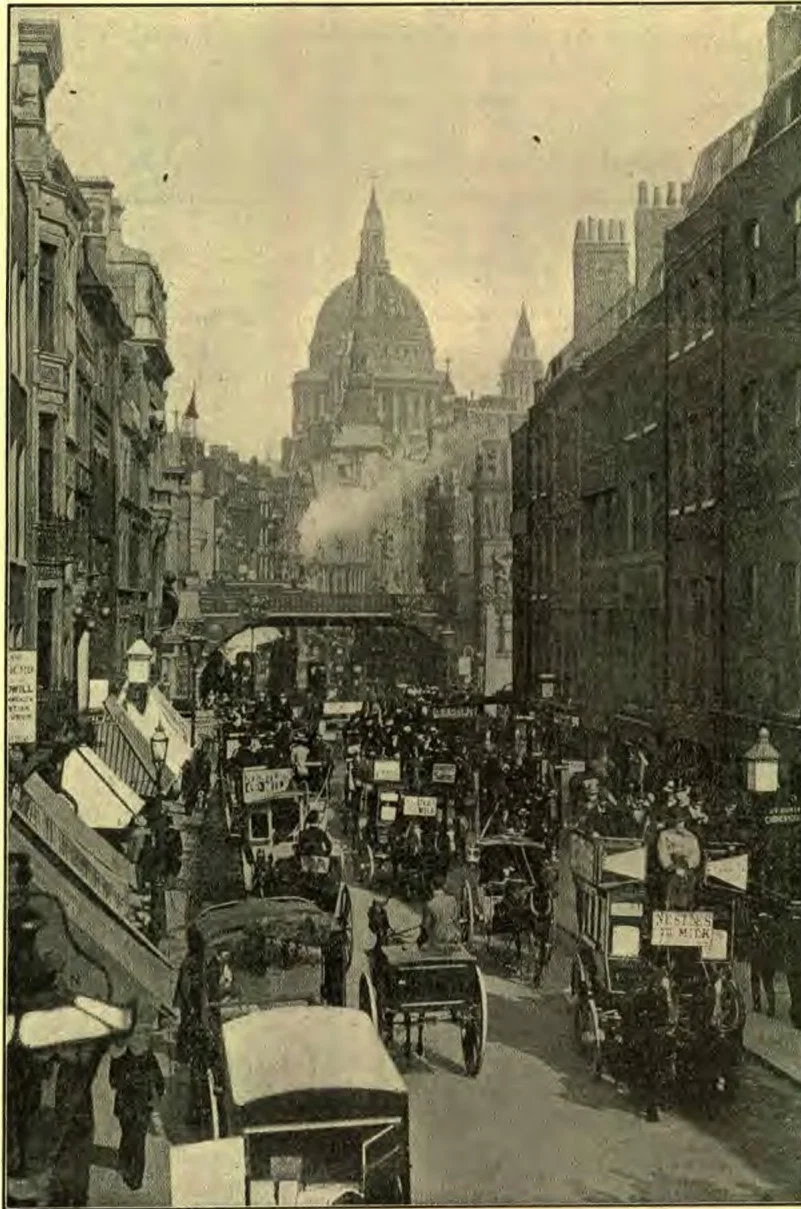
LUDGATE HILL, SEEN FROM FLEET STREET
It is the world’s great center,—the center of its commerce, the center of its wealth, and the point from which its greatest shipping lines radiate. It is the one great circus through which all humanity passes in traveling the wide world. When our missionaries go to Africa, to India, or to any part of Europe, they pass through London. Even when we send missionaries to South America, lying so near us on the South, we send them through London, although when they reach that city, they are fully two thousand miles farther from their destination than when they left the United States. From every point of view imaginable, London is the world’s great center. This fact has an important bearing on the work we have to do in carrying the third angel’s message to the world.

How to See London

If you wish to see London to the best advantage, pay your penny or two-penny fare, and climb to the top of an old-fashioned ’bus. To be sure, there are underground trains and surface trains and underground electric cars, and many persons who are in a hurry use these modern arrangements for transportation; yet, comparatively speaking, the people of London still patronize the ’bus more extensively. Although it is a slow, expensive, and inconvenient mode of traveling, the Englishman clings to it with a persistence which is almost remarkable to a foreigner. Even the busiest Londoner prefers to climb to the top of his “dear old ’bus,” and swing along in the old-fashioned way behind a good pair of horses, thus consuming an hour and a half in going to town, rather than to take the elevator, be lowered into the ground, and whirl along by electricity or steam to his place of business in fifteen minutes. This seems unaccountable at first; but when you have enjoyed a few rides through the streets of London on the ’bus, you will find yourself gradually conforming to the custom, and choosing this vehicle regardless of time, when the weather is fair.

The ’Bus Driver

Get a seat, if you can, close to the driver; for he is an encyclopedia of facts, and from your elevated position he will point out to you hundreds of items of interest which are worth knowing, and which will add interest to your trip. He is the best horseman in the world, and knows it. There he sits stiffly erect, his heavy coat buttoned high under his chin, and his tall silk hat giving the last touch of dignity. When you are tired of looking at the buildings, watch him as he holds his lines steady, and drives with a master hand through the most crowded portions of the busy streets, seemingly running within a hair’s-breadth of everything, and never hitting anything. A friend of mine said that the first time he rode on a London ’bus, he grasped the arm of the driver, and the cold perspiration stood on his forehead all the way down the Strand and Fleet Street.
Although modern civilization is crowding the electric cars and steam cars into London, still the Englishman clings to his horses. Nearly all the street-cars are still drawn by horses, and they are fine ones, too. Most of them are imported from Holland, and are selected with great care; for the laws of the city are very strict against using poor or lame horses. One may travel through London, and see thousands of horses without ever seeing one that is lame, or poor, or being misused by his master. It is said that a man in London may treat his family cruelly with much less liability of being arrested than if he kicks or whips his horse, or drives it when it is lame.

Ludgate Hill

The accompanying illustration gives an excellent view of a busy street in London. This is Ludgate Hill, seen from Fleet Street. On the extreme right-hand side of the picture is a London ’bus, which we have already described. Just behind the ’bus is a two-wheeled hansom cab. Nearly all the small vehicles have only two wheels, as you will observe. The street on each side is crowded with the great four-wheeled ’buses, with passengers inside and on top. This is London as you see it every day.
The buildings are plain and substantial, as you will observe from the picture. Few buildings in London are higher than these. Seven or eight stories is about the limit.

St. Paul’s

In the center of the picture, on the top of the hill, can be seen the great dome of St. Paul’s Cathedral, which is one of the great attractions of London, and is visited by thousands of persons every day. It was built by Sir Christopher Wren after the great London fire, in 1666, and is the third largest Christian church in the world, St. Peter’s at Rome and the Cathedral of Milan being the only larger ones. The king and queen, and many of the great men of the nation, attend here; and the great Jubilee and Thanksgiving services are often held there. It is the burial-place of many of the nation’s great and honored men, such as Wellington and Nelson.

Bow Church

Bow Church is in Cheapside. All who are born in London within the sound of the Bow Bells are called Cockneys.
A pretty story is told in connection with these Bells. It is said that years ago Dick Whittington, a poor boy who lived out in the country, went to London to seek his fortune. He fared hard; and finally becoming discouraged, decided to return home. He had gone as far as Highgate Hill, and when about half-way up the hill, sat down upon a stone with his pet cat to rest. While sitting here, the Bow Bells began to ring; and to his boyish fancy they seemed to say, “Turn again, Whittington; thrice mayor of London.” Finally, he decided to throw down his cat, and either return to the city or go back to the country, according to the direction which the cat took. The cat started for London, Dick Whittington followed, and, as is well known, years afterward he was three times elected Lord Mayor of London. A stone with a little iron fence around it still marks the spot where he sat on Highgate Hill; and on a window of a public house opposite is a picture of Dick throwing down his cat to see which direction she would take. Near this spot are the Whittington Orphanages.
E. R. Palmer.

A Word

It was but a word, a little word, But it soothed like a healing balm; It was but a word of kindliness, But it seemed like a joyous psalm;
For it healed a weary, aching heart That burdened was, and sad; And it brightened all, like the beaming sun, For it made the spirit glad.
Like the golden gates of the dawn of day Its gentle accents seemed, And the sky grew bright with a silver light To the soul that had sadness dreamed.
Did it cost you much, did it spend your coin,— This balm that the spirit stirred? No! your own spirit glowed like the beaming sun; As you spoke that loving word.
B. F. M. Sours.

Lessons from the Life of Daniel—IV

Daniel's Temperance Principles—I

DANIEL early gave promise of the remarkable ability developed in later years. He and his three companions who were selected to serve in the court of the king, were of princely birth, and are described as “children in whom was no blemish, but well favored, and skilful in all wisdom, and cunning in knowledge, and understanding science, and such as had ability in them.” Perceiving the superior talents of these youthful captives, King Nebuchadnezzar determined to prepare them to fill important positions in his kingdom. That they might be fully qualified for their life at court, according to Oriental custom, they were to be taught the language of the Chaldeans, and to be subjected for three years to a thorough course of both physical and intellectual discipline.
The youth in this school of training were not only to be admitted to the royal palace, but it was provided that they should eat of the food, and drink of the wine, which came from the king's table. In all this the king thought that he was not only showing them great honor, but securing for them the best physical and mental development.
In the food provided for the king's table were swine's flesh and other meats which were pronounced unclean by the law given through Moses, and which the Hebrews had been expressly forbidden to eat. Here Daniel was brought to a severe test. Should he adhere to the divine teaching, offend the king, and probably lose not only his position but his life? or should he disregard the commandment of the Lord, and retain the favor of the king, thus securing great intellectual advantages and the most flattering worldly prospects?
Daniel could have argued that, dependent as he was on the king's favor, and subject to his power, there was no other course for him to pursue than to eat of the king's meat and to drink of his wine. But Daniel and his fellows counseled together. They considered how their physical and mental powers would be affected by the use of wine. The wine, they decided, was a snare. They were acquainted with the history of Nadab and Abihu, the record of whose intemperance had been preserved in the parchments of the Pentateuch. They knew that by the constant use of wine these men had become addicted to the liquor habit, and that they had confused their senses by drinking just before engaging in the sacred service of the sanctuary. In their brain-benumbed state, not being able to discern the difference between the sacred and the common, they had put common fire upon their censers, instead of the sacred fire of the Lord's kindling, and for this sin they had been struck dead.
A second consideration with these youthful captives was the fact that the king, before eating, always asked the blessing of his gods upon the food. A portion of the food, and also of the wine, from his table was set apart as an offering to the false gods whom he worshiped. According to the religious ideas of the day, this act consecrated the whole to the heathen gods. Daniel and his three brethren thought that even if they should not actually partake of the king's bounties, a mere pretense of eating the food or drinking the wine, where such idolatry was practised, would be a denial of their faith. To do this would indeed be to implicate themselves with heathenism, and to dishonor the principles of the law of God.
Daniel did not long hesitate. He decided to stand firm in his integrity, let the result be what it might. He “purposed in his heart that he would not defile himself with the portion of the king's meat, nor with the wine which he drank.”
In this decision there was much involved. The Hebrew captives were regarded as slaves, but Daniel and his companions were particularly favored because of their apparent intelligence and their comeliness of person. In making their decision they did not act presumptuously, but revealed a firm love for truth and righteousness. They did not choose to be singular, but they must be, else they would ruin their own characters, set a wrong example for others, and dishonor God.
Among professed Christians to-day there are many who would decide that Daniel was too particular, and would pronounce him narrow and bigoted. They regard the matter of eating and drinking as of too little consequence to require such a decided choice,—one involving the probable sacrifice of every earthly advantage. But in the day of judgment those who reason thus will find that they turned from God's express requirements, and set up their own opinion as a standard of right and wrong. They will find that what seemed to them unimportant was not so regarded by God. His requirements should be sacredly obeyed. Those who accept and obey one of his precepts because it is convenient to do so, while they reject another because its observance would require a sacrifice, lower the standard of right, and by their example lead others to regard lightly his holy law. A “Thus saith the Lord” is to be our rule in all things.
MRS. E. G. WHITE.

“That” Is Proper

THERE is one word in the English language, which can appear six times consecutively in a sentence, and make correct English.
To illustrate: A boy wrote on the blackboard, “The man that lies does wrong.”
The teacher objected to the word “that,” so the word “who” was substituted. And yet it must be evident to the reader, for all that, that that “that” that that teacher objected to, was right after all.—Selected.

Never Knew Him

A TOUCHING story is told of the child of a well-known French painter. The little girl lost her sight in infancy, and her blindness was supposed to be incurable. A famous oculist in Paris, however, performed an operation on her eyes, and restored her sight.
Her mother had long been dead, and her father had been her only friend and companion. When she was told that her blindness could be cured, her one thought was that she could see him; and when the cure was complete, and the bandages were removed, she ran to him, and tremblingly pored over his features, shutting her eyes now and then, and passing her fingers over his face, as if to make sure that it was he.
The father had a noble head and presence, and his every look and motion was watched by his daughter with the keenest delight. For the first time his constant tenderness and care seemed real to her. If he caressed her, or even looked upon her kindly, it brought tears to her eyes.
“To think,” she cried, holding his hand close in hers, “that I had this father so many years, and never knew him!”
How many of us are like the little blind girl? The Heavenly Father is so near in Jesus Christ, but our “eyes are holden.”—Selected.

A Question of Time

You say that you haven't the time for a word Of hope or of comfort or cheer? Your life with its care and its trouble is stirred Throughout every day of the year? The words you could say that would drive pain away Have never a chance to be said? You haven't the time to be good? But some day You'll have time to regret, I'm afraid.
You say that you haven't the time for a deed That's earnest and honest and true? You're hurried and worried with each passing need,— You always have so much to do? The word and the deed that would sow sunny seed In hearts quite as sad as your own, May never be said; but to this thought give heed: You'll have time to regret, all alone.
You haven't the time to say words that are kind? You say you can't help being rude? You always have duties to take up your mind, You haven't the time to be good? There are trouble and care to be found everywhere,— This fact you should never forget; And when you have nobody's troubles to share, You'll have plenty of time to regret.
You say that you can not find time to do right, But you certainly can, if you will. You can not find time? Then make time; and the fight Will steadily wage on, until You'll wonder that you could have been so untrue To needlessly worry and fret; The seeds of the deeds that from now on you'll do Will give you no cause for regret.
BENJAMIN B. KEECH.

How Diamonds Are Polished

THE diamond is the hardest of all substances, as well as the most valuable of all precious gems. The most noted diamond fields are found in South Africa. Sometimes diamonds are imported still enclosed in the soapy, clay matrix, just as they were taken from the mines. The triangular sides of a diamond are called its faces, or facets. In its natural state the gem has but few facets; but one that is perfectly cut has fifty-eight of these pretty three-sided faces. They are made by what is known as “cutting,” which is done in at least two ways. One of these is by rubbing two diamonds against each other over a box, thus catching the dust, which is afterward mixed with olive oil to make a paste used in polishing the stone. Another method of “cutting” is by a “rapidly revolving tin disc, that has no teeth, but is perfectly smooth on its edge. These discs vary in size from the head of a pin up to twenty inches or more in diameter.” When in use, they are placed upon the mandrel of an ordinary foot-lathe, and the surface of the disc is kept running in a bath of oil, in which is mixed a quantity of diamond dust. By this process the hardest of stones are easily cut.
The savings of the diamond dust are not nearly enough to do all the polishing, so large quantities of “bort,” or imperfectly crystallized diamonds, and fragments made by cutting diamonds, are pulverized in a mortar, and used in the same way as the dust. Before they can be polished, the gems are fastened by means of cement into the end of a stick four or five inches long, and then held against a slowly revolving wheel, which has been smeared with a mixture of water and diamond dust. Sometimes the diamond is fastened into a ball made of brass, the top of which is covered with lead. The ball is held over a gas-jet till the lead is softened, and then with pincers the diamond is inserted in the softened lead. When the lead hardens, the ball is placed in a sort of arm, or vise, fastening it in the machine in such a position that the gem is held firmly against a swiftly revolving polishing disc. Every time a facet is polished, the lead has to be melted and the stone turned, and inserted in the same manner as before, till the whole fifty-eight faces have been polished. The length of time required to polish a gem depends on the hardness of the stone. In some cases one hundred facets are polished in a day. Sometimes, however, defects are found in the stone, and then a longer time is required. A case is recorded where four years were consumed in perfecting one gem, and another where the gem was nearly polished away before the flaw was gone. In such a case the lapidary had the more polishing dust, and the owner less diamond.
It has been said that this world is a workshop where the Lord is preparing precious jewels to be gems in the crown of his rejoicing. These gems lie hidden in the deep mines of the sin and pollution of this world, and the Lord has reached down into the depths to raise them out. Now is the time of cutting and polishing, and soon he will have all ready to be taken to the place where they will shine with such brilliancy as no eye in this world has ever seen. We wonder if all who read these lines are being thus polished and refined. Let us not murmur if sometimes we suffer pain of body or mind, through having to be separated from those things which mar the luster of the precious jewel.
MRS. J. A. CORLISS.
Leicester, England.

Morning-Glories

A MAN who had built a new house was particularly anxious to make a fine lawn and garden for a setting to his home, and to that task he gave much of his spare time. One of his neighbors brought him some wild morning-glory vines to plant beside the back porch. He welcomed the gift, set out the vines and watered them, and enriched the soil about them; then, seeing them well started, he gave his attention for the next few weeks to other parts of his grounds.
When he came to view his morning-glories, he could hardly find them. A closer investigation showed that they had grown, indeed, but only in creeping fashion, tangling themselves with the adjacent grass and weeds. Friends had advised that the new grass should not be cut the first year, but allowed to go to seed. There was a rank growth close to the back porch, and through it the morning-glory vines were running.
The owner of the house then stretched some strings from the top of the porch to the roots of the vines, and sought to change the habits of his plants; but he found that every tendril which was meant to help them climb now helped only to fasten them down.
At length, and not without damage to the plants, and patient watching of them afterward, he succeeded in starting them upward, winding the vines about the strings, and replacing them when they fell, until new tendrils had grown and developed sufficient strength to cling. So at last the vines grew upward, and the back porch became a bower of beauty.
“I thought of it as a parable,” he said. “Man's growth is not always upward, although he is possessed of spiritual impulses and aspirations. The very qualities which, under right guidance and direction, might make him useful and honored may, if perverted, render him a menace and a scorn.”
The truly blessed life is the one which, rooted in sincerity and faith and God, grows erect and strong and beautiful in the sunshine of true living, bearing as its justification and crown the blossom of high service to its fellows.—Companion.

Is Christ Seen in Us

I AM told that Dannecker, a celebrated sculptor, spent eight years upon a statue of Jesus. After having spent two years upon it, he brought into his studio a little child, and, turning to her, he said:— “My dear, who is that?”
She looked up at the wonderful work, and, after a moment, replied: “It is a great man.”
The sculptor saw that his artistic eye had been deceived, and he was smitten with disappointment. He said to himself: “This will never do. The statue must be a truer likeness than this.”
Without loss of time he worked with chisel and mallet for two or three years longer. He prayed about it in the vigils of the night, asking God to help him, that he might reproduce the likeness of Christ in the face of the marble.
The second time he paused. Once more he brought a little child into his studio, and asked: “Who is that?”
The child looked at the masterpiece in silence, and, bursting into tears, said: “Suffer little children to come unto me.”
My friends, when people look at you, when they watch with critical eye your life, and examine with careful gaze your actions, whom do they see? Do they find an example of the world, or do they see an exemplification of Jesus Christ? Do they see something which belongs to self and pride and worldliness? or do they find something which belongs to the other world—divine love and faith and true Christianity? We should never forget that we are His epistles, known and read of all men.—Selected.

Morning-Glory Grace

Simply fed, but fully nourished, Spring the morning-glories blue; Drinking air and breathing sunshine, Daily bathed in rain or dew; Lightly clothed, but fresh and dainty, Busy climbing all the time,— Anything grows strong when living Like the morning-glory vine.
Air-filled trumpets turned toward heaven, Whence the listening soul can hear Melody of praise incessant, From the blue throats piping clear; Always seeking higher levels, Always cheerful, rain or shine;— Everything is good that's growing Like the morning-glory vine.
Now the dawn-light strikes the blossoms, Breezes toss them to and fro, While the leaves and graceful tendrils Many a dainty beauty show; But with loveliness so modest Vanity can not combine; So all things are fair whose pattern Is the morning-glory vine.
MINNIE ROSILLA STEVENS.

What Hath God Wrought!

WHEN you open a great metropolitan daily to learn what the world was doing yesterday, it may not occur to you that the words on those pages are the gleanings of more than three million miles of wire. Yet that is just so, and it is all the growth of less than sixty years. Fifty-nine years ago, after almost insurmountable difficulty, Professor Morse succeeded in getting a trial line put through from Washington, D. C., to Baltimore. With trembling hands he touched the key. Back came the response. And then he sent the first message ever wired on this earth, “What hath God wrought!”
No man can tell—fully. But we do know that a piece of news can now be sent to over one hundred and three thousand telegraph stations in less than twenty-four hours. Think what that will mean when God’s witnesses are doing their complete work in the earth,—when the message flashes from shore to shore like this:—
The days of Christ have come again. Preachers of the coming of Jesus heal all the sick who apply to them. Blind, deaf, dumb, and lame are all restored, and it is reported that even the dead are raised.
Would not such a message crowd its way over the wires quickly! And what a stir it would make in the earth! Every home would hear it. Every heart would be swayed by it.
The wires are up. What an encouragement to us who bear the motto, “The Advent message to all the world in this generation.”
Edison J. Driver.

Our Young People's Work in Tokyo, Japan

THE readers of this department will be interested to learn that a ‘beginning’ has been made in the Young People's work in Japan. A number of our young men have organized a Society for study and Christian work, much after the plan followed in America. They are few in number, barely half a dozen; but their earnestness will certainly insure success.
Their meetings are held once a month. A presiding officer and a secretary are chosen for each meeting, thus giving all an experience in this work. With so few members, there is time for all to take some part at every meeting. Each one chooses some Bible verse or topic, and gives a brief talk or study on the subject chosen. Their older brethren join them in this work, and also aid them by their counsel and prayers.
These young men are also earnest workers. They are all young in experience as well as in years, and have much to learn about the best methods of labor; but they are doing what they can, and we hope to see them develop into strong, useful laborers.
Some of their experiences may be of interest to INSTRUCTOR readers. Whenever opportunity offers, they go out canvassing for papers, tracts, and pamphlets. They also sell Scripture portions, especially the Gospels, printed in cheap form so as to sell for about one cent apiece. Our tracts and papers are correspondingly cheap, so that profits are not very great. In their work they meet much indifference on the part of some, prejudice and antagonism on the part of others. This opposition is not especially against our church, but against Christianity in general. Yet often the people are very kind to them; and some are willing to listen, and buy the tracts and Scripture portions.
Sometimes, instead of going from house to house, two or more of the young men take a position on the street, and speak to the people about their faith, finally offering their tracts and papers for sale. In this work they have been several times interrupted by the police. There seems to be no law against such work, and street sales of almost everything imaginable are common. Much seems to depend upon the temper of the individual policeman. Some of them seem to have a spite against religion. One such interrupted one of our young men, who replied that he was simply exposing some books for sale. Whereupon the man with the sword remonstrated, “But your tone sounds just like preaching.” From this it would appear that a “ministerial tone” is recognized the world around, and that it has its disadvantages wherever heard. We hope that our young men will profit by this experience.
There is a great work to be done among the forty-two millions of Japanese; and we look to our young men as our future workers. We hope soon to be able to offer them better advantages for securing the necessary preparation for the work that awaits them. F. W. FIELD.
Tokyo, Japan, April 19, 1903.
Continue reading: On the Frontiers of Tibet