The Tibetan tableland lies in the heart of Asia, at an elevation of from ten to seventeen thousand feet above the sea, with an average height equal to that of Mount Blanc, surrounded on all sides by gigantic snow-crowned mountains. This “Great Closed Land” has an area of over seven hundred thousand square miles. Tibet, girded by these barriers of eternal snow, “where the silence lives,” remains up to the present time more shrouded in mystery than any other land.5
The country, which has been a dependency of China since 1720, is cold and uninviting. Some few travelers, from Thomas Manning, an Englishman, who went in 1811, to Dr. Sven Hedin, the Swedish explorer, who has just returned, have in recent years essayed to penetrate the “Forbidden Land,” to Lhasa. The sacred city is strictly guarded against foreign approach, on religious grounds.
This stronghold of Buddhism has been besieged by missionary heralds for many years, but with little success. Noble as the record is, it is still one of “working and waiting.” Perhaps the most notable of these struggles to enter Tibet belongs to the Moravians. The story of their mission to Tibetan-speaking natives, in the provinces of Lahul and Kunawar, on the borders of British India, in the Western Himalayas, is a perennial inspiration. After nearly fifty years’ toil, their converts are not numerous, but they have prepared the ground for assured harvests. No stone have these dauntless pioneers left unturned to win a people sunk in indifference and degradation. One of their number writes that any missionary working on the borders of Tibet would almost be prepared to start for Lhasa at five minutes’ notice if the way were unexpectedly opened. Such is the intrepidity of the Moravian missionaries at these Himalayan outposts, eleven thousand feet above the sea. They are sowing the word of life in perilous journeys across the bleak plains of Rupshu, Ladak, Nubra, and other lands.
In 1856 the Moravian Church made its earliest assault on Tibet, and although foiled in their attempt to enter, the pioneers Heyde and Pagell settled in the great valley of Lahul at Kyelang. This station, together with Poo, a village of Kunawar, and Leh, the capital of Ladak, the highest mission station in the world, are the oldest mission settlements of the Moravians. Five other stations are likewise occupied, and, lately, Shipki, the first village in Tibet proper, seventeen thousand feet above the level of the sea. When Chinese Tibet is opened, the plow-share is ready in the form of a Tibetan dictionary and grammar, and the seed is prepared in the translated New Testament and several books of the Old Testament.
Never has the Moravian Church lacked heroes. The devotion of Pagell and Heyde, of Heinrich Jaeschke, a man of marvelous perseverance and extraordinary linguistic faculty, first translator of the Tibetan New Testament, and pronounced by Max Muller as the highest authority on Tibetan matters, or of Drs. Marx and Redslob; of Mr. Ribbach, present senior missionary at Leh, and the tireless medical worker, Dr. E. Shawe—these and other representatives of the Tibetan missions are of undisputed ability and character.
And there have not been wanting in these regions women endowed with the heavenly fire of love. In the first decade the lone mission saw the arrival of three brides, women of intrepid heart, one of whom was Emilie Auguste Rosenhauer, the future wife of Jaeschke, and destined to survive him. Strenuously did the sisters fulfil their part in those deep, untrodden, and silent valleys, where not infrequently the buds of the household withered before the piercing winds and terrible climate of “bleak, sterile, and desolate Tibet.” Reading the narratives of these faithful toilers, one’s heart warms itself at the fires which glow upon it from such consecrated lives.
At present the Rev. A. W. Heyde, loaned by the Moravian Missionary Society to the British and Foreign Bible Society, is engaged as the chief reviser of the Tibetan New Testament, together with a small company of expert co-workers. This Tibetan veteran, associated with the New Testament version from its commencement, is devoting his ripest years to making the translation still more perfect.
Of recent missions on the Tibetan frontier, besides the Moravians and Scandinavians on the western border, must be named the Kashgarian Mission of the Swedish Missionary Society (1891), with stations at Kashgar and Yarkand, on the northwest, and the Church-Scholand’s Mission at Kalimpong, on the southern border. The London Missionary Society occupies Almora as a strategic point, and has commenced work among the Bhotiyas, hill tribes on the southern slopes of the mighty Himalayas. In addition to intercepting Tibetan traders with copies of God’s word, the Rev. G. M. Bulloch writes that they mean to be among those who are first in Tibet, and help to bring its wild nomads to the feet of Christ.
The unswerving persistence of Miss Anna R. Taylor to enter Tibet is widely known. She is now stationed at Yatung, and has tried again and again in vain to secure an entrance into Tibet. Meanwhile she gives medical treatment to travelers, and circulates portions of the Bible in their own tongue to the Tibetans passing through with caravans. Miss Taylor’s toils and endurance are remarkable. After occupying her station for three years, save during a brief furlough, in a mountain hut, three thousand feet above Yatung, Miss Taylor left for Calcutta in December, 1901, in order to reinforce her stock of provisions and stores, having previously vaccinated hundreds of the natives to prevent further epidemic from smallpox. Large crowds of the natives awaited the return of their good physician and friend.
Along the southern border, the Assam Frontier Pioneer Mission has broken ground at Sadiya, among the wild Abor tribe, where Messrs. Lorrain and Savidge have exhibited much daring to evangelize these savage and degraded tribes.
To the east and northeast the Tibet Prayer Union (C. I. M.), at Ta-chien-lu and surrounding country, has been ably represented by Mr. and Mrs. Polihill-Turner. At Min-cheo, in Kansuh, China, the Christian and Missionary Alliance has distant toilers amid the darkness, and so long ago as 1856 the Roman Catholics began work on the eastern borders, continuing the same amid much suffering and persecution to the present day. One of the most heroic endeavors to enter Tibet will always be identified with the Rijnhart family. Probably no more thrilling and pathetic story has ever been written than Dr. Susie Rijnhart’s “With the Tibetans in Tent and Temple.”
Although Tibet remains barred to the torch-bearers of the gospel, no doubt by means of the Scriptures distributed among the traders, God is giving into the hands of his servants one of the keys with which to unlock the closed doors to carry the light to the six million souls under the blighting system of Buddhism, which for centuries has held sway over the Tibetans.
The celebrated explorer, Dr. Sven Hedin, a Swede, returned to Europe in December, 1902, after three years and three days of what may justly be described as the most remarkable land journey of modern times. He had traversed at least six thousand miles of land in Central Asia unknown to Europeans. The intrepid traveler made two attempts to reach Lhasa, disguised as a Mongolian pilgrim, and succeeded in reaching within one day’s journey of that mysterious city, but was discovered and turned back. The doctor now thinks it impossible, under existing conditions, for any European to penetrate to Lhasa even in disguise.—James Johnston, in the Missionary Review of the World.
Busy Workers
By L. F. P.
WE take the liberty of extracting from a private letter from Mrs. A. R. Hawkins the following very interesting items concerning the young people's work at Stockton, California. She says:—
“The motto for our ‘Lookout Work’ is ‘The cause that I knew not, I sought out.’ The divisions of our work are as follows: Department of Spiritual Work; Department of Mercy and Christian Help; Department of Circulation of Literature; Department of Social Work, including committee on invitations and welcome, introducing strangers, etc.; Department of Missionary Correspondence. The heads of these departments are all older members, and they have the supervision of the work which is performed by the youth.
“We have also a Floral Committee, whose duty it is to see that flowers are placed on the altar and organ for our services, after which they are to be taken to the sick or to the hospital, or given to those who have not the privilege of enjoying these tokens of God's love. It is also the duty of this committee to see that our place of meeting is kept nice and neat, fit for the heavenly guests whose presence we are promised when we meet in His name.
“The object in arranging the work in this manner was to get the greatest number possible into active service, and to have them feel a direct responsibility for some portion of the work. The plan has worked well. The Department of Mercy and Christian Help has started a Dorcas Society, and gifts of clothing have poured in from those not of our faith. In our Department of Circulation of Literature all our members engage, even the children, who are full of zeal and greatly enjoy the distribution of tracts, in which work they are sometimes more successful than the grown-ups. One little girl of nine years has secured the attention of a middle-aged gentleman, who has promised to buy all the tracts she will bring him. We are using the envelope plan.”
In commenting upon the work in general, Sister Hawkins remarks: “How many of our people make the mistake of looking upon the church as the field instead of the force to work the field.” And that is a serious mistake to make in these days when the gospel is to go to all the world in this generation. L. F. P.
(d) A Glimpse of the Holy Week in Rome. (Review of May 26.)
(e) The Young People's Work in Tokyo, Japan. (This page.)
(f) Cities of Iceland. (Review of May 19.)
(g) The Closed Continent — Tibet. A paper by leader. (See this page.)
(h) Sentence-reports from India, Spain, Argentina, British Honduras, Bermuda, South Africa, Cook Islands, Porto Rico, Scotland, Danish West Indies, Chile. (To be gleaned from the Review and the INSTRUCTOR.)
3. Closing Exercises.
Young People's Societies Organized in New York Conference
From New York
Mrs. J. R. Calkins, State Sabbath-school Secretary of the New York Conference, writes: “We have now four Young People’s Societies in our Conference. We have just organized one here at Rome in my home church. We have not many young people here, but have started out with six. An excellent spirit of earnestness prevails.
“We had some hesitation about starting the work here, and seemed to see the evils that might result, unless we started right. Now we are sorry we did not start sooner, although I do feel that we have never before been ready for it. I am so sorry it takes so long to do God’s bidding. We studied the Membership Card together very carefully before we invited the young people to become members. We hold our meetings at 4 P. M. on Sundays. We hope to conduct these meetings in such a way as to make the young people more efficient in any line of God’s work to which they may be called. There seems to be a desire on the part of all to do the right thing, and as the other youth of our Sabbath-keeping families come in and join us, we hope to have their hearty co-operation. We shall encourage the members to bring in their friends.
“I do not expect our experiences will be all sunshine, but we hope to avoid any unnecessary openings for the enemy to come in.”
Glimpses of Child Life in Japan
By Theodore Wores
(Concluded)
Japan fairly swarms with children, and among the most amusing sights, to a stranger, are the numerous small boys and girls that are met with everywhere, carrying babies on their backs. Sometimes these little tots are not much larger than the babies themselves, but they cheerfully assume this burden, for among the lower classes it is considered to be the duty of brothers and sisters to take charge of the next youngest. This does not interfere as much as one would suppose with their childish pastimes, for I have often seen them playing and romping while the baby, whose head wabbled about in all directions, was sound asleep.
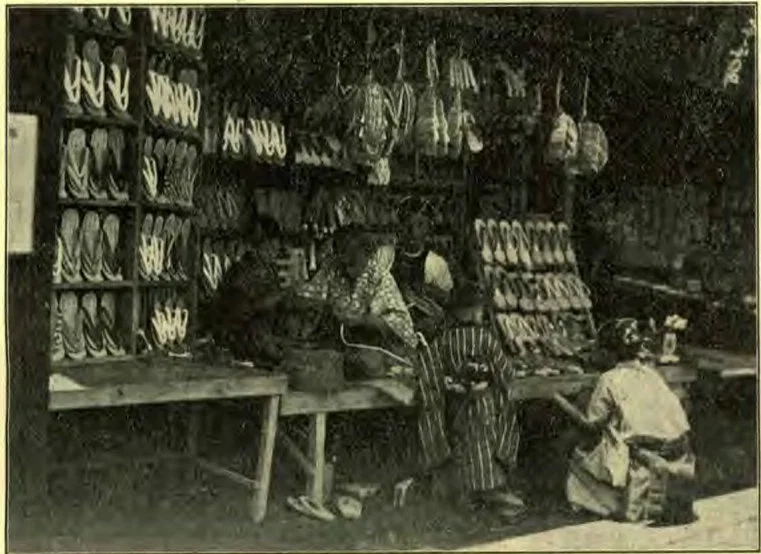
A Japanese shoe store. Shows little girl's dress, also two boys at work. At the left are straw sandals; to the right, wooden clogs, or geta. About the only work done in such a store is to fasten the straps on the wooden shoes or straw sandals.
As Kumataro’s parents belonged to the wealthier class of Japanese, they employed a nurse, a country girl named Otake-san, whose sole duty was to care for and carry Kumataro about. Otake-san, or “Miss Bamboo,” gave her entire time and attention to Master Bear, and good-naturedly submitted to his childish whims, and never scolded, though at times he ordered her about in a most lordly manner.
On one occasion she appeared with Matsujiro on her back, and was about to go out on an errand with him, when Kumataro insisted upon going along. As there was no putting him off, Otake-san placed Master Pine-tree on the ground, and after helping Kumataro upon his back, she picked up both boys and carried them off. Master Bear had a doll strapped upon his back, and this gave a most comical three-story appearance to Otake-san’s burden.
The Japanese seem to consider the children in almost everything that they do. Wonderful and picturesque processions, known as matsuri, are frequent in the large cities, and great two-wheeled carts and floats are most gorgeously decorated and drawn through the streets by oxen. Models of these carts on a smaller scale, and drawn by crowds of happy children, usually form a part of these processions. Toy temples, built especially for children, are often seen alongside of the large ones.
Peddlers of all kinds who trade altogether with children are met with everywhere. One of the special favorites of this class is the amea, or candy man. He wanders about through the streets with two boxes slung on a pole which he carries on his shoulders. Every once in a while he puts down his burden and blows a tin horn, whereupon the children of that neighborhood come trooping up to him from all directions. Kumataro and his brother rarely failed to get a few copper coins, worth about one tenth of a cent apiece, wherewith to buy candy.
The stock in trade of this popular tradesman usually consists of a quantity of soft molasses candy. A lump of this is fastened to the end of a thin bamboo tube, and then he proceeds to blow into it very much after the manner of a glass-blower, forming, at the same time, with his fingers, very clever representations of animals, masks, birds, fruits, and flowers—in fact, anything that his little patrons chance to order. I have often amused myself, at an outlay of ten cents, by treating a crowd of ten or twenty children that had gathered around one of these candy men. Nothing could be funnier than the critical attitude that these little men sometimes assumed; for they were always ready to point out faults in these works of art, and to insist on having them corrected before paying for the wares.
Another favorite of the children is the pancake man. Like the candy man, he carries two boxes, the tops of which are covered with sheets of polished copper, underneath which are braziers filled with burning charcoal. The children gather about him, and for a small copper coin each one buys a cupful of soft dough.
They then proceed to make pancakes by pouring out a little of the dough onto the hot copper plates. The pancakes are made about as large as a silver dollar, and the process is continued until the supply of dough is exhausted.
Two holidays especially for children are observed by the Japanese during the year. One occurs on May 5, and is called “Boys’ Day,” and the other, on March 3, is known as “Girls’ Day,” or the “Feast of Dolls.” On Boys’ Day the streets present a very bright and festive appearance, as almost every house is decorated with a tall bamboo pole to which one or more large paper fish are attached. The number of fish hung from each pole corresponds to the number of boys in the family.
These fish are very cleverly constructed, and are painted so as to present a very natural appearance. They are fastened to the pole by a cord passed through the jaws, and openings at the mouth and tail allow the wind to blow through, filling them out and causing them to plunge about in a most lifelike manner. These paper fish vary in length from three to twenty feet.
In many houses, on this occasion, miniature stands of arms, containing swords, spears, bows, banners, and suits of armor, are brought out of the kura, or storehouse, and placed on view. Some of these toy weapons are as carefully made as the real things, and are often very old, having served on Boys’ Day in the same family for many generations. On Girls’ Day almost every household has more or less of a collection of dolls on view. These dolls are carefully packed away, each in its own wooden case, during the year, and are only brought out on these special occasions, when it is the custom for little girls to pay visits to one another, exchange the compliments of the season, and admire one another’s dolls. In addition to these dolls, all sorts of miniature household articles, consisting of dressing-cases, toilet-sets, furniture, and kitchen utensils, etc., made of silver and lacquer, are displayed. The principal dolls imitate the mikado and his empress in ancient court dress. Many of these collections of dolls are centuries old.
It will thus be seen that Japan has not without reason been called a “children’s paradise.” While my own observations have proved to me that Japanese children are about the happiest I know, I have also observed that they always display the greatest respect for their parents and elders, who are thus more than repaid for the unfailing love and attention they bestow upon the little ones of the “Sunrise Kingdom.”—Theodore Wores, in St. Nicholas.
Charley's Reform
By Edith O. King
CHARLEY had learned to chew gum, and papa and mama did not approve of the habit, but what to do to break it they could not tell. Every method seemed to fail; for Charley still persisted in chewing. When he could not have gum, he chewed beeswax or pieces of paraffin that his sister used in modeling.
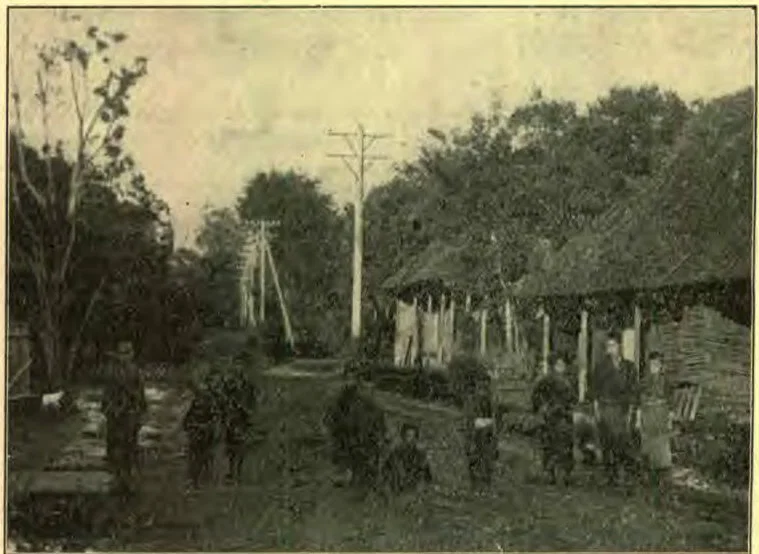
Japanese children, who have left their play to have their pictures taken. Notice the babies on backs, and the little lad wearing a school cap.
One evening as he was tucked into bed ready for his sleepy-time story, papa held Charley's little hand in his while he told the beautiful story of the boy Daniel. He gave a vivid description of how Daniel was taken away from his Judean home to the great palace. There he was offered rich food to eat and wine to drink. The food from the king's table no doubt tasted better than the plain pulse and water, but Daniel wished to become a strong, wise man, and he knew that wine would make him weak. He remembered, too, that his body was God's temple, and whosoever defiles the temple of God, him will God destroy. So “Daniel purposed in his heart that he would not defile himself with the portion of the king's meat, nor with the wine which he drank: therefore he requested of the prince of the eunuchs that he might not defile himself.”
The next evening at story-time papa asked: “Shall I tell you about Daniel?”
Charley said, “Yes, papa;” and the story was again told.
Several evenings the same story was repeated,6and each time it was made more clear that Daniel would not eat anything or do anything that would injure his health. Charley became an admirer of Daniel, so much so that during the day he played he was Daniel the captive, in the palace of Babylon.
At length papa received his reward. After the story was finished one evening, Charley was lying so quiet that papa thought he was sleeping. Suddenly two bright eyes opened, and Charley cried: “Say, papa, do you think Daniel would 'a' chewed gum?”
“No, son, I am quite sure that he would not.”
“Well, then, you can say, ‘Charley has purposed in his heart that he will not defile himself with any more chewing-gum,’” replied the little boy, and he kept his word. EDITH O. KING.
Mother's Motto
By Grace C. Littlefield
I GIVE you a motto, my little child,
To take with you everywhere—
Into the play world, into the real world,
Into the world of care:—
“Not the things that I like to do,
But the things that are right to do;
Not everything that I want to do,
But whatever I ought to do.”
This is the way to be good and great,
This is the way to master your fate;
This is the beautiful, blessed way
That will make you glad at the end of the day:—
“Not the things that I like to do,
But the things that are right to do;
Not everything that I want to do,
But whatever I ought to do.”
— Grace C. Littlefield.
Why Minnie Could Not Sleep
She sat up in bed. The curtain was drawn up, and she saw the moon, and it looked as if it were frowning at her.
“You need not look at me, Moon,” she said: “you don’t know about it; you can’t see in the daytime. Besides, I am going to sleep.”
She lay down and tried to go to sleep. Her clock on the mantel went “tick-tock, tick-tock.” She generally liked to hear it, but to-night it sounded just as if it said, “I know, I know, I know.”
“You don’t know, either,” said Minnie, opening her eyes wide, “You weren’t there; you were upstairs.”
Her loud noise awoke the parrot. He took his head from under his wing, and cried out, “Polly did!”
“That’s a wicked story, you naughty bird,” said Minnie. “You were in grandma’s room!”
Then Minnie tried to go to sleep again. She lay down and counted white sheep, just as grandma said she did when she couldn’t sleep. But there was a big lump in her throat. “Oh, I wish I hadn’t!”
Pretty soon there came a soft patter of four little feet, and her pussy jumped up on the bed, kissed Minnie’s cheek, and then began to “pur-r-r-r, pur-r-r-r.” It was very queer, but it sounded as if pussy said, “I know, I know.”
“Yes, you do know, kitty,” said Minnie, and then she threw her arms around kitty’s neck and cried bitterly. “And—I—want—to—see—my—mama!”
Mama opened her arms when she saw the little weeping girl coming, and then Minnie told her miserable story.
“I was awfully naughty, mama, but I did want the custard pie so bad, and so I ate it up, almost a whole pie, and then I—I—shut kitty in the pantry to make you think she did it. But I’m truly sorry, mama.”
Then mama told Minnie that she had known all about it, but she had hoped that the little daughter would be brave enough to tell her all about it herself.—Little Men and Women.
The Only Cure for Shame
“THE only cure for shame is at the cross. No counterfeit can live at Calvary. There the hypocrisy is pierced, the mask falls off, and all is revealed. There also we find forgiveness; there all the wild and bitter past is blotted out; there we learn to love; there we learn to live.”
MEMORY VERSE: “Be strong and of a good courage, fear not, nor be afraid.” Deut. 31: 6.
“For the last time, Moses stood in the assembly of his people. Again the Spirit of God rested upon him, and in the most sublime and touching language he pronounced a blessing upon each of the tribes, closing with a benediction upon them all.”
“Moses turned from the congregation, and in silence and alone made his way up the mountainside. He went to ‘the mountain of Nebo, to the top of Pisgah.’ Upon that lonely height he stood, and gazed with undimmed eye upon the scene spread out before him. Far away to the west lay the blue waters of the Great Sea; in the north, Mount Hermon stood out against the sky; to the east was the tableland of Moab, and beyond lay Bashan, the scene of Israel’s triumph; and away to the south stretched the desert of their long wanderings.”
“And now a panoramic view of the land of promise was presented to him. Every part of the country was spread out before him, not faint and uncertain in the dim distance, but standing out clear, distinct, and beautiful to his delighted vision.”
“Moses saw the chosen people established in Canaan, each of the tribes in its own possession.”
“He was permitted to look down the stream of time, and behold the first advent of our Saviour.”
“He followed the Saviour to Gethsemane, and beheld the agony in the garden, the betrayal, the mockery and scourging,—the crucifixion.”
“Moses beheld the disciples of Jesus as they went forth to carry his gospel to the world.”
“And now another scene passed before him. He had been shown the work of Satan in leading the Jews to reject Christ, while they professed to honor his Father’s law. He now saw the Christian world under a similar deception in professing to accept Christ while they rejected God’s law.”
“Still another scene opens to his view,—the earth freed from the curse, lovelier than the fair land of promise so lately spread out before him. There is no sin, and death can not enter. There the nations of the saved find their eternal home. With joy unutterable, Moses looks upon the scene,—the fulfilment of a more glorious deliverance than his brightest hopes have ever pictured. Their earthly wanderings forever past, the Israel of God have at last entered the goodly land. Again the vision faded, and his eyes rested upon the land of Canaan as it spread out in the distance. Then, like a tired warrior, he lay down to rest.”
“Upon the mount of transfiguration, Moses was present with Elijah, who had been translated. They were sent as the bearers of light and glory from the Father to his Son.”
Questions
How old was Moses when the time came that the children of Israel should cross over Jordan?
What did he tell the people that the Lord had said to him?
What did Moses do when he first knew that he could not go into the promised land?
MEMORY VERSES: “And the third angel followed them, saying with a loud voice, If any man worship the beast and his image, and receive his mark in his forehead, or in his hand, the same shall drink of the wine of the wrath of God, which is poured out without mixture into the cup of his indignation; and he shall be tormented with fire and brimstone in the presence of the holy angels, and in the presence of the Lamb; and the smoke of their torment ascendeth up forever and ever: and they have no rest day nor night, who worship the beast and his image, and whosoever receiveth the mark of his name.” Rev. 14: 9-11.
Now we beseech you, brethren, touching the coming of our Lord Jesus Christ, and our gathering together unto him; to the end that ye be not quickly shaken from your mind, nor yet be troubled, either by spirit, or by word, or by epistle as from us, as that the day of the Lord is just at hand; let no man beguile you in any wise: for it will not be, except the falling away come first, and the man of sin be revealed, the son of perdition, he that opposeth and exalteth himself against all that is called God or that is worshiped; so that he sitteth in the temple of God, setting himself forth as God. Remember ye not, that, when I was yet with you, I told you these things? And now ye know that which restraineth, to the end that he may be revealed in his own season. For the mystery of lawlessness doth already work: only there is one that restraineth now, until he be taken out of the way. And then shall be revealed the lawless one, whom the Lord Jesus shall slay with the breath of his mouth, and bring to naught by the manifestation of his coming; even he, whose coming is according to the working of Satan with all power and signs and lying wonders, and with all deceit of unrighteousness for them that perish; because they receive not the love of the truth, that they might be saved. And for this cause God sendeth them a working of error, that they should believe a lie: that they all might be judged who believed not the truth, but had pleasure in unrighteousness.—American Standard Revised Version.
Questions
1. What two things seemed to be troubling the minds of the Thessalonians?
2. Why were they especially exercised over the coming of the Lord? Had the apostle given them this impression?
3. What warning is given concerning the time of Christ’s coming?
4. What power would be revealed before this event? What would occur even before the man of sin was revealed? First part of verse 3.
5. What is this man of sin called?
6. What is his attitude toward God? How does he manifest this attitude?
7. Had the Thessalonians been warned of this before?
8. What power was then working in the church? Verse 7.
9. Why had its workings not been fully revealed already? Verses 6, 7.
10. What is the leading power in the mystery of iniquity? Verse 3.
11. When all restraint is removed, what will occur? Verse 8.
12. What will immediately follow the revelation of the mystery of iniquity?
13. What effect will the coming of the Lord have upon this iniquitous power wherever it is found?
14. What events in the development of the mystery of iniquity mark the time of Christ’s second coming?
15. How will Satan work at this time? Through whom will he work?
16. Why is he permitted to work in these?
17. Then what follows the rejection of truth?
18. What will be the sure result of the rejection of truth?
19. What is God’s will concerning every one? 2 Peter 3: 9. To what time does this statement especially refer?
Notes
1. Not against God alone does the man of sin exalt himself, but against all that oppose him. He assumes to be the true God. He places himself in the church of God (1 Cor. 3:16; Eph. 2:19-22) as its director. The one power which has done this pre-eminently is the papacy; and in whomever it is done in a limited degree, the same spirit rules.—S. S. Quarterly.
2. God would not permit the development of this power in his church till the time came when the church refused to be longer guided by him. Then it would be the time of the papacy, “the lawless one.” See a fuller description in Dan. 11:36-39.—Id.
3. “One that restraineth.” The body of the individual is designed to be a temple of God, filled with his Spirit. 1 Cor. 6:19, 20. No lesser power can keep man from sin and preserve him from the power of the enemy. Gal. 2:20. This is as true of the church as it is of the individuals who compose the church. As long as Christ reigns within, as long as his word is the law, his Spirit the sanctifier, no power can set its throne there or have any control over the life. And as long as faith bids Christ dwell in the heart in a sufficient number of his people, the lawless one will be restrained in the church. Not until the heart shall say, I prefer my way to God’s way, not until Christ is shut out, taken out of the way, can the lawless one—of whom the highest type is Satan—reign in the place of God. “Keep thy heart above all keeping.”—Id.
4. God sends no arbitrary punishment, no delusion to destroy. It is Satan who seeks to destroy, and not until men reject every means of salvation, does God give them over to Satan’s delusions. But that soul who receives the love of the truth can never be deceived to destruction.—Id.
Come Unto Me
By Eben E. Rexford
Of all our Saviour’s tender promises,
It seems to me the sweetest one is this—
Sweeter than balm to souls with sin opprest—
“Come unto me, and I will give you rest!”
“Come unto me,” he whispers as he stands,
And shows the nail prints in his bleeding hands.
“O weary sinner! come and be my guest,
Come unto me, and taste of heavenly rest.”
“Come unto me!” O words divinely sweet!
My soul remembers, and my lips repeat,
The promise of the love that follows me
Through life, through death, and all eternity!
— Eben E. Rexford.