The Youth's Instructor, Vol. LI, No. 25

The Isle of Wight

The Youth's Instructor

June 25, 1903

Review and Herald Publishing Company · Battle Creek, Michigan · June 25, 1903

The Isle of Wight

While looking for a suitable site for a sanitarium for Great Britain, the writer had the opportunity of spending a short time in the Isle of Wight, which lies just south from England, and is separated from the mainland by the Solent.
This little isle is undoubtedly one of the most beautiful spots in Great Britain, and is a favorite health and pleasure resort. It is best known to Americans as having been the home of England’s most beloved sovereign, the late Queen Victoria, who spent her last days at Osborne House.

Osborne House

Osborne House is about half a mile from Cowes. Since the death of the queen, her son, King Edward, has presented the property to the British government as an asylum for aged, infirm, and wounded officers of the British army and navy. He has definitely stipulated, however, that the grounds and the queen’s private rooms shall forever be open to the British public.

Whippingham

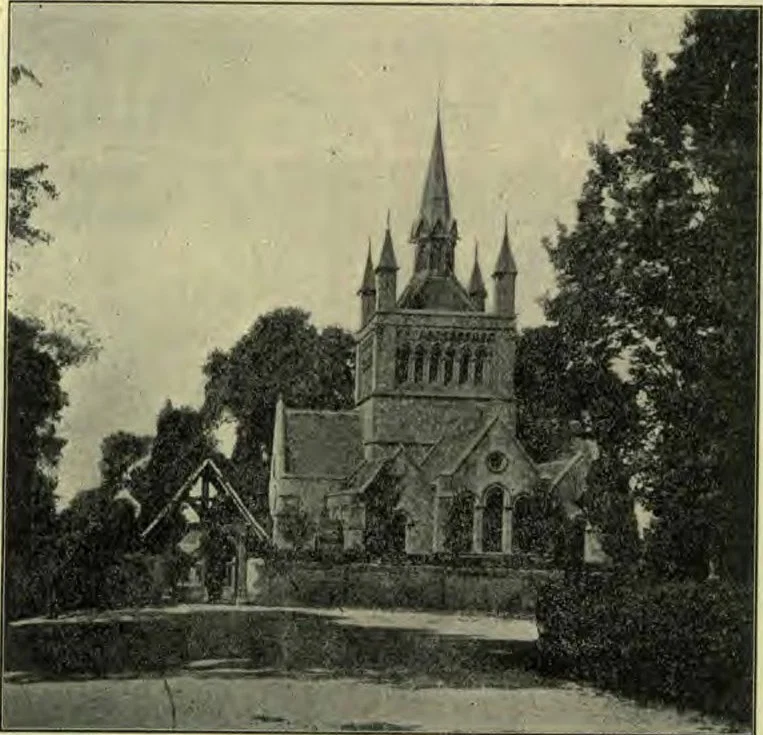
About half a mile south of Osborne House is Whippingham, the beautiful little church where Queen Victoria and other members of the royal family often attended service. It is a charming chapel, embowered among stately trees, vines, and ornamental shrubs, and surrounded by well-kept hedges. These are shown quite distinctly in the accompanying picture.
The church was founded in 1066; but the original structure has been removed. The present church, shown in the illustration, was designed by Albert, the prince consort, and built by Queen Victoria in 1851. It was in this little chapel that Princess Beatrice was married to Prince Henry of Battenberg. Prince Henry, who for several years was governor of the Isle of Wight, was a great favorite with the queen. He died of fever in 1896, and was buried at Whippingham. His tomb, which occupies the whole of the north side of the chancel opposite the reserved seats for the royal family, was erected to his memory by Queen Victoria.

Carrisbrooke Village

From Whippingham we paid a brief visit to Carrisbrooke Village, once the capital of the island. The most interesting feature of the village is the old church, erected in 1088. Considering its great age, it is in a remarkably good state of preservation.
In the garden of the vicarage are distinct remains of an old Roman villa, probably built between 40 and 50 A. D. This villa can be accounted for by the fact that the Isle of Wight was conquered for the Romans by Vespasian in the reign of Claudius, 43 A. D. Probably it was built about that time.

Carrisbrooke Castle

CARRISBROOKE CASTLE
CARRISBROOKE CASTLE
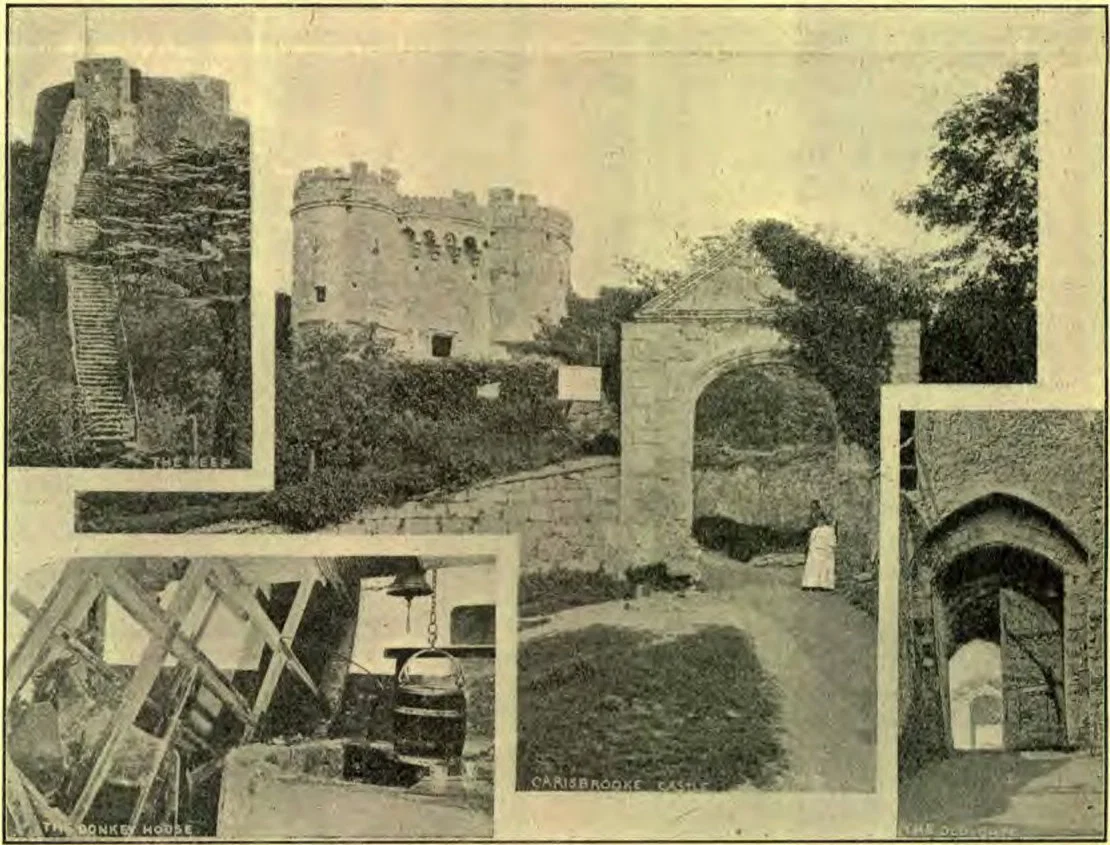
Beautifully situated on the slope of a prominent hill near by is Carrisbrooke Castle, the most picturesque feature of the surrounding landscape. This is one of the most interesting and famous old castles of Great Britain. It is best known in history as having been one of the prisons of Charles I. The keep, which is shown in the upper left-hand corner of the picture, is in an excellent state of preservation. Here the ruins of the apartments occupied by Charles I during his confinement may be distinctly seen. Even the window through which the monarch attempted to escape is pointed out. This attempt to regain his liberty was made during Christmas week of 1647; but his enforced idleness at the castle had made him too stout to slip through the window, and there he stuck, “most unkinglike,” until his keepers found him in the morning, and extricated him from his laughable as well as rather unpleasant position.
In the keep was a well, which is said to have been three hundred and ten feet deep; but it has long since been filled up.
In the garden there is another well, which forms one of the greatest curiosities of the island. Its depth is one hundred and forty-four feet, with thirty-seven feet of water, which is drawn by a wheel turned by a donkey. The donkey drawing water may be seen in the lower left-hand corner of the picture. Every visitor drinks a glass of water from this well, unless, as in our case, the visit is made on Sunday, when the donkeys are turned loose in the garden. We were quite disappointed that we could not see the donkeys draw the water, or obtain a drink from the well, the water of which is remarkable for its coolness; but, as we went away, the two donkeys came to the edge of the great fortress, looked down between the vines in a sympathetic way, and brayed at us, as if to say, “At your service on week-days.”
The many ivy-clad ruins of the ancient castles and strongholds of England are among the most charming features of its varied landscapes. They may be seen on the hillsides in nearly all parts of Great Britain, and they form one of the strongest links binding the present with an interesting history of long ago.

Stratford-on-Avon

When on our way from London to Leeds, England, with the purpose of attending the camp-meeting at that place, we stopped off overnight at Birmingham. Early the next morning we took a flying trip down to Stratford-on-Avon, the birthplace, home, and resting-place of Shakespeare, which is about thirty miles south of Birmingham. Stratford is only a little country village, and its chief business seems to be to show visitors the places made sacred to them by their association with the world’s greatest poet. The people of many nationalities besides the English pay their tributes of respect to this place; during the year 1901 it was visited by people from forty-three different countries. The house where Shakespeare was born would be recognized at once from the familiar picture, which many of you have seen. It is built of a heavy wooden framework filled in with cement. Although nearly four hundred years old, many parts of the house are well preserved. The room in which Shakespeare was born is in the best condition. The “Great House,” or “New House,” as it is often called, where the poet lived and did much of his work, has decayed. Only the foundation and well remain. These are covered with glass and wire netting.
The church in which Shakespeare and his wife are buried is very old. It was dedicated in the tenth century. Parts of it, including the roof and several pillars, have been rebuilt; but much of it is the original, and bears on its quaint pillars and arches the crumbling marks of time. The church has one striking peculiarity. It is built in the form of a cross; but the head of the cross bends to the left several feet. This inclination is supposed to represent the recline of the Saviour’s head upon the cross. The grave of Shakespeare is in the floor; and upon the slab is the following peculiar epitaph, probably written by himself:—
“Good frend, for Iesvs’ sake forbeare, To digg the dvst enclosed heare; Blesst be ye man yt spares thes stones, And cvrst be he yt moves my bones.”
In the above lines v is used in the place of u; ye is the; and yt is that. E. R. PALMER.

In Boyhood's Day

The First Great Mile-stone
You boys reach your first great mile-stone somewhere along between your fourteenth and seventeenth birthdays. You never know exactly where; but there came a time, you realize later, when you resented being treated like a child by your mother and older sister, especially in public. You adopted long trousers, and became particular about your necktie. Changes there had been earlier, and important ones, such as the losing of your baby curls, the obtaining of jackets with pockets, and being asked to run errands and to lend a helping hand wherever needed; but you did not think much of them at that time. You still liked to sit with your head on your mother's lap, and to hold long, confidential talks with her in the twilight—and, let me whisper, if ever you get over this liking and beyond that habit, it will be because there is something wrong with you.
Youth, in the earliest stage, is not an easy period for a boy. He is apt to be a little conceited then, to swagger boastfully, and to speak with too much certainty on matters in which he has no experience. People lose patience with him, especially fathers and older brothers. They seem quite to forget that they once stood where this boy is now standing, and that then they behaved in precisely the same manner.
I do not know what a boy would do if there were no mother to be his gentle champion and constant friend, until he is well past the quick-sands which lie all too near his path. Next best to a mother is a sister,—a sister who is a fellow's chum and understands him, who cares about what he does, and is interested in his sports and games, as well as in his daily duties. A preoccupied sister who cares only for her own affairs, and not for Jim's or Fred's engagements, who is so taken up with dress, or society, or even study, that her brother bores her, is of very little use to him at this critical period, and she is sacrificing on the altar of self a golden opportunity to elevate and refine her brother.
A mother or the loving older sister sees that a boy does not avoid people when he begins to be gawky and overgrown. She has faith that the awkward age will soon pass, and the lad will glide into graceful manhood. Meanwhile she realizes that he must not lose the advantage of meeting the home friends and mingling in society, even though he is bashful and immature.
THE OLD CHURCH AT CARRISBROOKE VILLAGE (SEE FIRST PAGE)
Now let me tell you this, my boy: It is only as we think about ourselves that we are ever awkward. The person who is not occupied with the impression he is making, who goes right on doing what he ought day by day, will always be free and at ease when with others. Besides, a boy may resolve to know how, and to do the right thing in the right way. Years ago, I had a boy friend who consulted me, then a young matron, on many minor points of etiquette. “How shall I introduce a girl to a boy?” he said one day. “Not at all,” I replied. “Introduce the boy to the girl. Mention her name first.” “What about rising when a lady comes into a room, if she is not a lady I know?” “In a hotel parlor,” I said, “keep your seat, unless you are occupying the only comfortable chair, when, if she is a woman older than you, it is polite to resign it. In your own home, always rise when any woman—your mother, your sister Susy, your cousin Grace, or the school-teacher who is boarding in the family, or a visitor, in fact, anybody of the other sex—happens to come in. Stand until the lady has taken a seat. If she be an old or feeble woman, find her the easiest chair, and place her in it.”
I gave my boy friend many such hints, for he constantly sought advice. And now, in his maturity, I know few more useful and attractive men than he.
When a boy is cross, he is, like other people, very apt to put the blame upon some one else. Father is “despotic,” the teacher “unreasonable,” comrades “unfair.” These, to put the matter plainly, are the common excuses of Satan. He fools us into believing we are ourselves perfect—other people at fault. Now look at it. A boy who goes about with a gloomy and sullen brow, morose, black as a storm-cloud, is not a cheerful and happy boy; he is uncomfortable company for himself. Perhaps he is chafing at restraint and fretting against the curb; wishing more liberty, and vexed because he must stay at home after dark.
The day will dawn when he will be very grateful that he was hedged about by wise laws when he was crossing the border-line into manhood.
There is a natural wish on the part of the boy who feels already grown up, to be treated not as if he were a mere child, but with some reference to the dignity of his years. And this is right. Tactful older persons recognize this, but there are some who do not. But the manly boy, instead of resenting too much the patronizing air of older people, acknowledges that he is immature, and has much to learn, and sets about learning. Boys are the better for being simple, and, as they advance in wisdom, any air of conceit they may have adopted drops off. A senior in college is generally simpler in manner and less aggressive in bearing than a freshman. If I were a boy of sixteen, I would try to refrain from contradicting my elders, or talking as if mine were the final word, or making assertions with undue emphasis.
I would defer to those who had lived longer than I. If I felt vexed or dissatisfied, I would do my best not to show it, and in the very effort to conquer the outward appearance of peevishness, I would gain freedom from the disagreeable mood. There is no better way of routing the black dog of sullenness than by meeting him with a brave and smiling face. We may be cheerful outwardly, even if we are not very merry inside.
One of the things most needful for the boy to cultivate at the mile-stone of youth, begins with an R. Boys, be responsible. If you promise, perform. If you undertake a thing, carry it through. Do not belong to the throng of young men who forget when they have something depending upon their care, and then plead forgetfulness as an excuse. A boy who has a message to convey, or a letter to mail, or a sum of money to take to the bank, or a telegram to deliver, should be as steady and swift and faithful as Time himself—Old Time, that, through the centuries, has never slackened his pace, nor lost a day from the calendar.—Margaret E. Sangster, in Young People's Weekly.

Hard Medicine to Take

“Doctor,” said a fashionably dressed woman to her new physician, “I want you to give me a prescription which will cure me of a most irritating trouble.” The doctor bowed, and waited for her to go on.
“About eleven o’clock every evening,” said the patient, “I am overcome by a feeling of sleepiness. No matter where I am, this dreadful sensation comes over me. I have suffered from it now for five weeks; no remedy seems to help.”
“Oh, I can give you a prescription that will help you,” said the doctor.
His new patient was radiant, but her face clouded as she read: “Bed from ten at night till seven the next morning. Repeat dose once in twenty-four hours, whenever symptoms recur.” —Selected.

FRANK WALCOTT HUTT

Standard-Bearers

INTO the thickest of the fight The standard-bearer goes; And while the flag is still in sight, The valiant soldier knows That there, amid the driving rain Of shot and shell, his duty’s plain.
Boys, duty never fails us, where Truth’s standard-bearer leads; And honor bids us do and dare When Right a champion needs. True heroes who such standards bear, And they who follow and who dare.

FRANK WALCOTT HUTT

The Wind

HOUSEKEEPER WIND is up and out Before the Sun can get about; And with his broom he sweeps away The shadows from the dawn of day, And drives along with might and main The clouds of dust and clouds of rain, And here and there and everywhere Makes clear and fair the morning air; And though you look In every nook, Beside the field, the hill, the brook, You'll always find Housekeeper Wind Leaves not an unswept place behind.
FRANK WALCOTT HUTT.

A Wise Choice

A True Story
(Concluded)
It is a little over three years since I returned from the city with the children. Yesterday was Harry’s birthday,—he was fourteen years old. He is the joy of his father’s heart,—“a bright and interesting boy,” I often hear him say, “and I could not well get along without him.” Thus far our cup of happiness has been full to overflowing.
The children were making rapid progress in their studies, and their health was all that could be desired. Fresh air and exercise, with proper dress and diet, wrought wonders for them physically, but they were causing me much anxiety as I detected in them a tendency to treat spiritual things lightly. In vain had I put forth my best efforts to get them interested in the Sunday-school. When I would talk with them on the subject, Harry would reply that the boys who went there smoked and talked about things that he would be ashamed to repeat. The children would go with me to church, but it was evident that they preferred to remain at home with their father. Had they been proud and disobedient, I should not have thought it so strange, but being so kind and gentle, I thought it would be an easy task to lead them to Christ. I was sure that I had done my duty faithfully in trying to guide their steps in the better way.
About this time two ministers pitched their tent near our place, and began a series of Bible studies on the prophecies. Soon every one was talking about them. Some said they were ignorant men, others that they understood the Scriptures, but kept Saturday for Sunday.
I soon noticed that every time any one was talking about the meetings at the tent, Harry was intensely interested. For a long time I managed to keep him away from the tent, without forbidding him to go; but one day I heard him ask his father if he could go to the meeting at the tent that evening.
“O, yes,” was the reply, “I am willing that you should go, but you had better ask your mother.” Turning to me, he said, “You will be glad to have me go, won’t you, mother?”
“No, Harry,” I said; “I am not willing that you should go near that tent.” His father noticed the disappointed look on his face, and said, “Really, I am unable to understand why you object.” I replied that last Sunday the minister said that if we were wise, we would not only stay away ourselves, but keep the children away also.
“Well,” he said, “if that is the only objection, you’d better let the boy go.”
With many misgivings I gave my consent, but my heart was sad, and I passed a sleepless night. There are many mothers who will understand my feelings. When Harry returned, he brought with him two tracts, “Is Man Immortal?” and “Is the End Near?” and gave them to his father, who read them before retiring. In the morning I noticed that he put them away in a safe place. This excited my curiosity; I wanted to see what was in them. After glancing through them hastily, and seeing that there was no Saturday Sabbath in them, I did not worry much about them. I thought perhaps if he thought the end was near, it might arouse him to a sense of his danger. But what could I do to save my precious boy, I cried, in agony. It is impossible to convey in words my feelings of helplessness to do anything to stay the influence that I feared. All day I heard Harry telling Esther the wonderful things the minister had said at the tent,—that Christ was soon coming, and that those who believed in him, and obeyed his commandments, would have a home in the city of jasper and gold.
Again I heard him explain about the tree of life that bears new fruit every month, instead of once a year.
Esther had become so much interested that I had been expecting that she would ask to go, and just a little while before the time for service she came in, and asked to go with Harry. I replied that I did not think it best to let either of them go. “But he has to go,” she said.
“How is that, child?”
“The minister asked him to come again to-night, and he promised he would. You would not like to have him tell a lie, would you, mama?”
“No,” I said, “but a bad promise is better broken than kept.”
She bit her lip to keep back the tears, and turned away. Just then Harry and his father came in from their work, and I soon heard Esther talking to her brother in a low tone; presently he turned and sat down on the steps. In a moment her arms were about his neck. As she tried to comfort him, father asked what was the matter with the children, and I explained that I had decided not to let them go to the meeting at the tent.
“I don’t see why you object to their going,” he said. “I fear you are not acting wisely. Some of the best people in the neighborhood attend every night, and take their children with them.”
Then, washing my hands of all responsibility, I told them they could go as often as they wished; and father added that mama meant it all for the best. “Go to the meeting,” he said, “and do not forget to bring me something to read.”
Next day I heard Harry asking his father for money to buy a Bible. When told that there were plenty of Bibles in the house, and he could take his choice, Harry said he wanted one like those they had at the tent,—a “genuine Oxford Bible.” The lad had the idea that there were some counterfeit Bibles. His father laughed, but Harry got his Bible, and kept his father well supplied with reading-matter.
The following Sunday I went to church, and the children went to the tent. As Esther returned, bringing a large book, her father asked, “What have you there, another Bible?”
“No; the man at the tent sent you this to read, and said you need not buy it, nor be in a hurry to return it.”
“Yes,” I said, “they will lend you all the books they have at the tent, if you will read them. I heard all about them at meeting to-day. They are trying to turn the world upside down.”
He smiled, and then took up the book, and began reading it. As the children started for the meeting that evening, he told Esther to inquire the price, and the next day he sent the money for it.
For a number of days the minister at the tent had been discussing the Sabbath question, and Harry was sure the seventh day was the Sabbath, and that he and Esther must try to keep it holy. One Friday the children were seated under the fall pippin tree, laden with its golden fruit. Harry was reading to Esther from his new Bible, as they watched the glorious October sunset; and as the sun sank below the horizon, they bowed their heads in prayer. Father and the hired men were just returning from their work, and I heard him say to them that they need not come again until Monday. As the work was pressing, I knew what this meant. My worst fears were realized.
In despair, I cried out, “Lord, restore to me the joy of thy salvation.” Then he revealed to me the wickedness of my heart.
The children went early to bed, and their father and I had a long talk about the meetings at the tent. He said he believed the seventh day is the Sabbath, and that the second coming of Christ is near, and that he was lost unless something could be done for him. When I saw his distress, I realized my mistake in trying to keep the children away from the tent, so I told him that I would go with them to the meeting at the tent the next morning.
Just before retiring I went up-stairs as usual, to see if the children were safely in bed. I found them in each other’s arms, in a large arm-chair, fast asleep. The traces of tears were plainly visible on their faces. I awoke them, and asked why they were not in bed. Harry said that they were afraid that if they kept the Lord’s Sabbath, they would have to give up their new home, and go away. When I told them that father and I were going with them to the meeting at the tent in the morning, the sad expression on their faces quickly gave place to one of peace and happiness. Only once before had it been my happy lot to bear a message of such joy to the children.
It was a bitter cross for me to turn my footsteps toward the tent, but it will only be necessary to add that a few days later we were all baptized in the likeness of the Saviour’s death and resurrection. Since that time, we have been made happy by the growing power of Christian principles in the children’s conduct, their clear and steadfast faith, their endeavors to live a holy life, and their resolute efforts to improve in every part of their character.
And now we believe the choice in the selection of the children was a wise one. We gave them an earthly home, and they helped us to obtain a title to a home in that city whose builder and maker is God.

Self-Culture

The acquisition of education, of wisdom, of culture, does not depend upon where one is, or what his work in life may be. One may spend all his days in a retired and quiet community, and yet become truly educated, cultured, wise. The paths of inquiry open from every point and in all directions. No place has a monopoly of God’s wonderful works. The republic of truth is world-wide. The vast disclosures of geology lie beneath our feet. The luring lore of botany appeals to us in every shrub and tree. Nightly the marvels of astronomy unfold above our heads. All of history converges upon our town, as well as upon London or Berlin. Rome is present in the town government, Greece in the books we read and the pictures we see. Israel still speaks to us from Sabbath to Sabbath. We live in the light of past ages and civilizations. A chance clew picked up anywhere, the meaning of a word, the color of an insect’s wing, will lead one into realms of knowledge vast as the providence of God.
What would you at the hands of the God of knowledge? Literature? Books are no longer the privilege of the favored few. The world’s best may lie upon your table and mine as well as upon that of the millionaire or bibliomaniac. Art? Art, to a certain extent at least, is at the command of all. I have a photograph of the “Angelus” that cost me five cents. It can not reproduce that wondrous sunset glow that makes the original so fascinating; nevertheless, it gives one the true motive and message of the picture. And as for the sunset glow, I may have the original of the original from my own dooryard. Science? What does science cost? Nothing but time, a good pair of eyes, and an inquiring mind. Philosophy? Any one may become a philosopher; not a Plato or a Kant, to be sure, but a bona fide sage, who thinks and infers and relates and theorizes.
All the resources of nature, the treasures of literature and art, philosophy and religion, are ours if we will, and so far as we will. An open, observant, inquiring mind, which delights to read God’s thoughts after him, will find the means of self-culture at hand, whatever one’s place or lot. —Selected.

Young People’s Work in Iowa

At Exira, Iowa, a Young People’s Society was organized last February, with a membership of twenty-eight. At their weekly Sunday-evening meetings they have studied the prophecies of Daniel and the Revelation and the subject of The Cleansing of the Sanctuary. Up to March 31, the Society had raised eight dollars toward the thousand-dollar fund for France.
At Boone, Iowa, a Society of twelve members meets once a month. The outline lessons in the INSTRUCTOR have formed the basis for study. Their missionary efforts consist in selling The Life Boat, distributing tracts, and making quilts. The funds collected have been used for the latter purpose. The secretary writes: “The children are taking a lively interest in the work and in the meetings. We are all of good courage.”
Clinton, Iowa, reports a Society of seventeen, with three added during the last quarter. The members hold meetings twice a week: on Sunday evening they meet for Bible study, and on Wednesday evening for missionary work. “The general interest is good, and a great deal of Bible study is taken up in our meetings,” is the report of the secretary. And we may well add, The result of much Bible study must always be a good interest in missionary work — helping those who need help anywhere. How can any one become familiar with the principles of the gospel through the study of God’s word without immediately realizing an earnest desire to do something for somebody? Try it and see! Christ said, “My Father worketh hitherto, and I work.”
From Algona comes the report of good interest in the Young People’s work, and a willingness upon the part of all, especially the younger members, to take a part in the meetings. The Society is composed of twenty members, and their meetings are held every Sabbath afternoon. Collections to the amount of $2.27 were taken for the work in India; besides this some books have been purchased for the use of the Society.
The secretary of the Smithland Society reports that the general interest there is good, considering that the Society is just starting. Twelve members are banded together, of whom one was added during the last quarter. The Society has sold copies of The Life Boat, distributed tracts and other periodicals, pieced quilts and made garments. A fund of $1.55 has been used in this work.
The report of the Mt. Pleasant Society, of fourteen members, for the first quarter of 1903 is as follows: Missionary letters written, 3; periodicals distributed, 24; pages of books and tracts distributed, 3,547; hours spent in Christian Help work, 21; persons supplied with food, 2.
At Sioux Rapids is an enthusiastic, working Society of sixteen members. One was added during the last quarter. The following extract speaks for itself:— “Two of our members are spending all their time in the canvassing work. One is sixteen years old, and the other thirteen. They have been selling The Life Boat, having taken one hundred and thirty-one yearly subscriptions and sold four hundred copies of that paper. All seem to be of good courage. We have interesting meetings, in which all take part. The lessons we have been studying the past quarter have been in the YOUTH’S INSTRUCTOR. We have had one temperance meeting. All seem to be willing to do all they can in the Lord’s service.”
Several quarterly reports have been received from isolated Iowa young people, who are members of the State Society. One of these is as follows: Letters written, 17; letters received, 14; periodicals distributed, 11; pages of tracts distributed, 129; missionary visits made, 8; hours spent in Christian Help work, 10. Another member reports the following work done: Letters written, 15; letters received, 12; periodicals distributed, 7; pages of books and tracts distributed, 520; missionary visits, 7; hours of Christian Help work, 5; offerings, 11 cents. One little girl, of seven, sends the following: Periodicals given away, 7; missionary visits, 6; offerings, 57 cents.
As we read the reports that come from the various places, we are forced to the conclusion that it is the small companies and the isolated members who are doing the most work. Let us bear in mind that the Young People’s Societies stand for work — earnest, hard work. It is not our object simply to attend meetings and lectures for the purpose of being entertained. Far from it! Our object must ever be to spread the gospel of Jesus, and to help prepare a people to meet him at his soon coming. If we are scattering the printed pages, “like the leaves of autumn,” or coming in contact personally with the people, we shall exert an influence that will in God’s own time produce a bountiful harvest. “Cast thy bread upon the waters: for thou shalt find it after many days. . . . In the morning sow thy seed, and in the evening withhold not thy hand: for thou knowest not whether shall prosper, either this or that, or whether they both shall be alike good.” C. A. H.

Worthy of Imitation

To those who are looking for definite results from the work of the Young People's Societies, the following information concerning a memorial erected by the California young people will be of interest:—
At the San Francisco Hydriatic Dispensary is a fine electric-light bath on which is a plate that reads: “This electric-light bath was erected by the Young People's self-denial fund.” To the amount of nearly one hundred dollars, California young people gave their nickels and dimes, which otherwise would have been largely spent for candy, ice-cream soda, and gum, to buy this bath.
We can not refrain from commenting upon this noble work. This is an example which many more of our young people might profitably follow, just at this time of the year, when it is so easy to drop in at some convenient place for a “cooling soda.” It will require a little will power, to be sure, to prevent the nickels and dimes from slipping through our fingers in this way. But did you ever stop and ask yourself how much better off you are an hour or two after some petty indulgence? The fact is, such indulgences more often work harm than good. And by refraining from them we may do profitable missionary work, not only in helping on some public enterprise, but to our own bodies as well.
Did you ever count up how much you had spent foolishly in a year, perhaps not for the trifles named, but for others equally as useless? How much God's cause needs our nickels and dimes! Why!—a penny will buy a tract that will save a soul from death. Then why spend it carelessly? As God blessed the poor widow's mites, so he will swell our offerings to the good of suffering humanity if we but exercise a little self-sacrifice.
Let us remember that it is the little foxes that spoil the vines, and little leaks that sink great ships. Some little indulgence may grow into a habit which it will be hard to break. Let us also remember that it is the little things of which our Heavenly Father takes notice, and that the final reward will be given to him who is “faithful in that which is least.”
Who will imitate the example of the California young people?

THE WEEKLY STUDY

The People Had a Mind to Work

(June 28 to July 4)
Our study has brought us to the days when quite a corps of laborers began to enter the field. As chapters XVIII and XIX of “Rise and Progress” are briefly reviewed, seek for the lessons we may learn in labor. One gets a picture, in these chapters, of a small people, full of zeal and enthusiasm, each one ready to do anything that God's providence made possible to advance the truth. The hope of the coming of the Lord was a real thing, and every plan was brought into subjection to the one purpose of preparing the way. Had that spirit always been sustained, the work would ere this have been finished, we are told.
The main topics in these two chapters may be presented as follows:—
1. From the text at the top of chapter XIX, Haggai 2: 18, 19, sketch the westward movement in the work, the removal of the headquarters to Battle Creek, the development of publishing interests, use of tents, activity of laborers in new communities, and first efforts for people of other tongues.
2. The idea of a probation and a gospel work on the earth after the second coming of Christ—the “Age-to-Come” doctrine, as it was called—made much trouble in those days, as these chapters show. Let one member give a very short Bible reading showing the work that is to prepare the way for the second coming, the events associated with the advent, what it means to the saints, to the wicked, and to the earth, and the events of the thousand years following. While not called by the same name, the false idea prevalent then is still all abroad. A few landmarks of Scripture truth refute the whole mass of confusing teaching on the subject.
3. The special providence in preserving from danger, mentioned on page 201, suggests the ministry of good angels in protecting God's servants in time of danger. Bible texts may be cited as showing this, and a few paragraphs from “Great Controversy,” pages 589 and 258, may be read to show how great is our need of protection, and how much assurance we have. The first reference is to Satan's plan of reaping his harvest by disasters, and the latter reference is to the experience of Wesley under the protection of angels. Let us fully understand that there is a God in heaven who actually does things for his children on earth. Members may relate other such special providences.
These three divisions of the study may easily be presented in from ten to fifteen minutes each if preparation is made beforehand. We shall quickly finish the look at the past, and may then take a view of the future, as outlined in the “Great Controversy.” W. A. S.
Continue reading: Some Bible Rivers