Your ShelfYour Projects

Signs of the Times, Vol. 34, No. 30.

SIGNS OF THE TIMES

Signs of the Times

Jul 22, 1908

Pacific Press Publishing Company · Mountain View, California · Jul 22, 1908

SIGNS OF THE TIMES
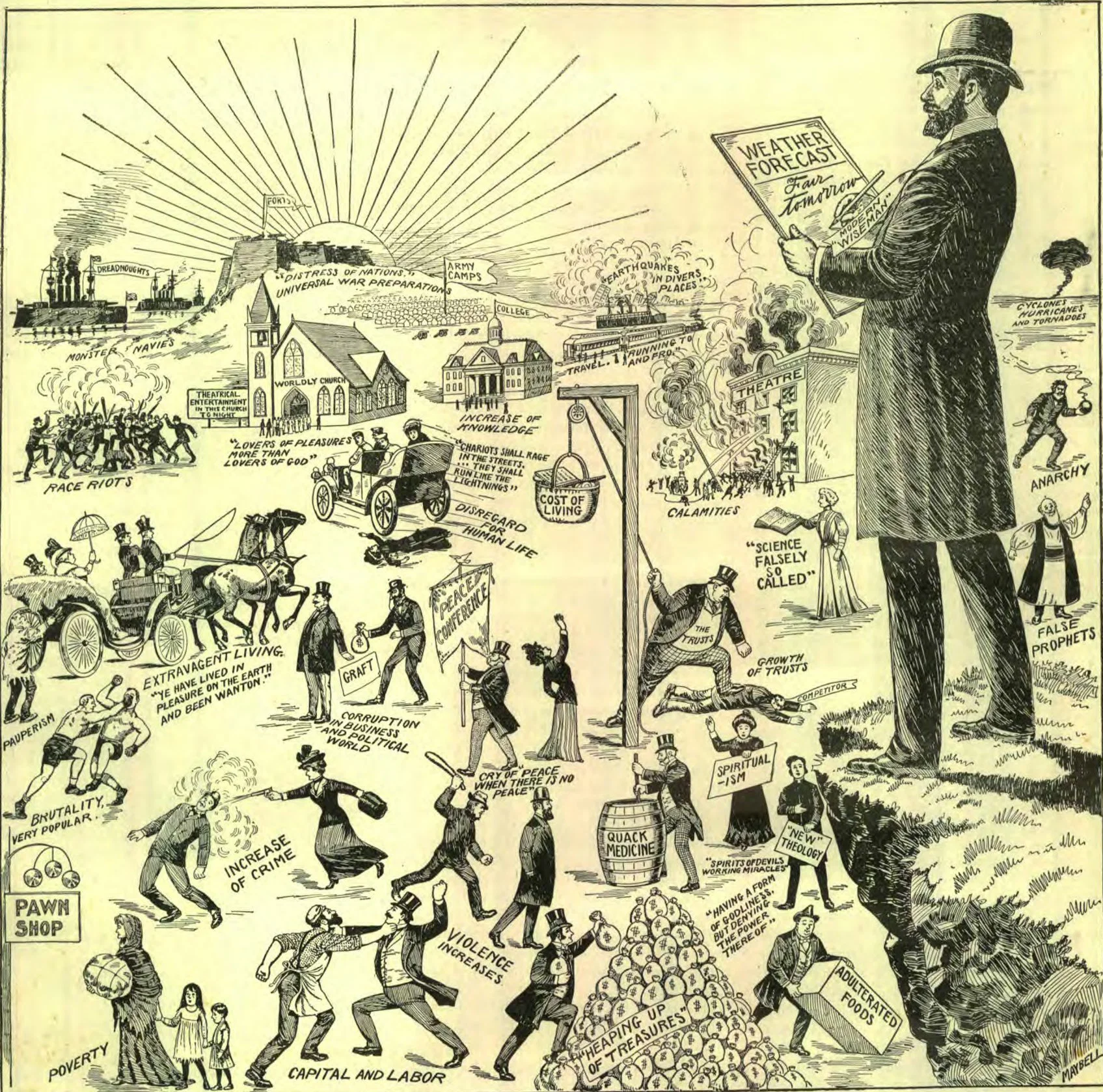
"When it is evening, ye say, It will be fair weather . . . and in the morning, It will be foul weather: . . . Ye can discern the face of the sky; but can ye not discern the signs of the times?" Matt. 16:2, 3.
"His watchmen are blind: and they are shepherds that can not understand: they all look to their own way, every one for his gain, from his quarter. Come ye, say they, . . . To-morrow shall be as this day, and much more abundant." Isa. 56:10-12.

With Our Inquirers

"If ye will inquire, inquire ye."
This Inquirers' Department is conducted for the purpose of helping those who are studying the Bible. The answers are oftentimes only suggestive. They are never to be considered infallible, only as they agree with the infallible word. The writer who may answer them does not consider that his opinion is infallible. He will simply give the best that he has, and plead with the inquirer to search the word. Such questions only will be answered which, to the editors, seem to minister to the good of the readers and to the mission of the paper. We can not answer repeatedly in the same volume questions upon the same scripture. The name and address must accompany question, not for publication, but as an evidence of good faith, and that answer may be made by letter if deemed advisable. No letters are answered which do not contain the name of the writer. It is well always to enclose stamp for reply.

2565.—Easter Sunday.

When was Easter instituted and by whom? The claim, of course, is that now it is held in commemoration of the Saviour's resurrection.
It is almost impossible to tell just when any of these voluntary feasts and practises crept into the church. It was at a comparatively early age that the celebration of Easter began. There is no doubt but that at an early date the primitive Christians celebrated, in a way, Christ's resurrection from the dead, but they never designed to set apart a day for that purpose. That is stated over and over again by the early fathers. The yearly celebration of that day they connected with the Passover, and it was called the paschal feast. It is an utter mistranslation which places “Easter” in the text of Acts 12:4. Instead of Easter it ought to be the Passover, as it is in the Revised Version. Therefore, the early Christians kept it at the time regulated by the Passover; but at an early day, the Roman Church endeavored to place the celebration of the resurrection on Sunday instead of on the day of the Passover. Victor, Bishop of Rome, about the close of the second century, attempted to lord it over his brethren of the East, Dowling tells us, by forcing them to follow the rule which was observed by the Western churches in the keeping of the paschal feast. He wrote them an imperious letter commanding them to observe the same days he did. But the Eastern churches answered the lordly summons by the Bishop of Ephesus, Polycrates, that they would by no means depart in this matter from the custom handed down to them by their ancestors; upon which Victor, exasperated, pronounced them unworthy of the name of his brethren and excluded them all from fellowship with the church of Rome. This Dowling denominates the earliest instance of Romish assumption, but it was not even at that time called Easter. The term “Easter” comes from the Anglo, “Eostra,” the name of a Saxon goddess, worshiped in spring, as exemplifying the fruitfulness and productiveness of nature, worshiped with flowers, eggs, and other symbolical characteristics, and, as with other heathen festivals, the rapidly apostatizing church thought it would be a good thing to connect the Passover celebration with the heathen feast of Easter, so it came into the church. There is no warrant of Scripture for it whatsoever. There is no sacredness in any way attached to the day; and those who observe it in memory of the resurrection of Christ can well bring home to their hearts the question which the Lord Himself asks, “Who hath required this at your hand?” But is it not well to celebrate the resurrection of Christ? some may ask. Surely it is; but the truest, grandest, most fitting memorial of Christ's resurrection is the godly life of His followers. The resurrection of Christ demonstrated His power over sin, and if His followers wish to keep His resurrection before the world, it will be by living Christ within, demonstrating the power of His people over sin. That is one constant, living representation of the resurrection.

2566.—Mark of the Beast.

What is the mark of the beast? Is it Sunday-keeping? Do Seventh-day Adventists teach that it is? INQUIRER.
Seventh-day Adventists do not teach that Sunday-keeping is the mark of the beast. There are many thousands of God's children who have observed Sunday and are observing it. They have believed and do believe that it is a holy day, and that they are glorifying God in its observance.
In this they are in error. “The seventh day is the Sabbath of the Lord thy God.” So the voice of God declared from heaven. So His finger wrote in the very heart of His holy law. The good of all Biblical ages from Adam to our blessed Lord and His apostles observed it; and we are over and over assured in the Book of God that His holy law is unchangeable, even to the jots and tittles. Ps. 111:7, 8; Isa. 51:6, 7; Matt. 5:17-20. Thus God has given us law and example for its observance, and its deeper study will show that it is founded on the eternal principles of the character of God.
Sunday is an interloper. It has neither divine command nor example. By no word of Inspiration is a sacred character for it predicted or assumed. It is one of the “six working days” and no more. Religiously, it is “the wild solar holiday of all pagan times,” dedicated to the worship of the sun, among the seasons and times forbidden of God. It came into the Christian church thru that apostasy which should “magnify itself,” and “think to change the times and the law.” Dan. 8:11; 7:25; 11:36-39; 2 Thess. 2:3-7. The Roman Catholic Church declares Sunday-keeping in the church to be the mark of her power to command fasts and holy days. “That the (Roman Catholic) church hath power,” she declares, is proved “by the very act of changing the Sabbath into Sunday.”—“Abridgement of Christian Doctrine.”
Protestants have no other authority than that of pagan and papal tradition. Yet many have not understood, many do not understand, that they are in error, and God blesses them, not because of the error, but notwithstanding the error; for “the eyes of Jehovah run to and fro thruout the whole earth to show Himself strong in the behalf of them whose heart is perfect toward Him.” True service is a matter of love; knowledge is a matter of revelation and instruction. There are many who know little but love much, and God is leading them on to greater light and knowledge. It is also sadly true that there are many who know much but love little or not at all. For them God waits. Unless the heart and affections are yielded to Him to be changed by His Spirit, knowledge will avail nothing, and the light which is in them will become darkness.
Now in God's providence and plan His great Threefold Message of Rev. 14:6-14 is going to the world to call men from darkness to light; is going to Babylon to call men from confusion of cruel dogma and tradition back to the word of God. Some in every nation, tribe, and people, will hear, and heed, and do; will return to “the everlasting Gospel,” and be found among those who keep the commandments of God and the faith of Jesus.” Rev. 14:12. Others will abide in Babylon, will in Babylon commit spiritual fornication by uniting with civil power to enforce the dogmas and traditions of error, among which will be Sunday. Around this all the union of church-and-state forces are gathering. This union and consequent conditions between church and state compose the beast and the image, till organized apostasy and church-and-state tyranny are world-wide. The mark and test of allegiance to this power will be the legal Sunday, the great mark of apostasy, the change in God's law; and he who in the light of God's word turns from that light, from that law, from that Gospel and its power, to the darkness of tradition and apostasy, to the power of the civil arm, receives in his very worship and yielded allegiance the character of the power he serves, and he crowns that with the badge of beast authority, the mark of his servitude, by the observance of Sunday as enforced by the beast and his image, in contradistinction to the true service of God in the Sabbath of the fourth commandment.
This is in principle the mark of the beast. Just the particular form it may assume in the future development, we do not know. Just at what stage of character development men possess that mark and cut themselves off from God, it is not for mortals to say. Judgment rests with God, not man. It is for us to proclaim the solemn warning against false worship, the dread consequences of sin; to set forth the eternal principles of the true; to plead with men to come to Christ in the faith that changes character; to entreat that Spirit which writes God's holy law upon the heart, and makes the doing of His every command a delight. But, praise God, the judgment of those who reject His truth rests not with us, but with Him.

2564.—The First-Born of Every Creature.

Does Col. 1:15-19 mean that Christ was really begotten in His origin? If He was not, how could He lay down His life?
J. H.
The passage in Colossians has to do not with the origin of Christ simply, but His humiliation also. He was born of woman and made a brother-man; therefore, He is the Head of the body of the church, kindred with them; “the first-born from the dead,” not in point of time, but in the purpose of God, and in the preeminence shown in the next clause, “that in all things He might have the preeminence.” As to how He could lay down His life, we do not know. He declares, “I have power to lay it down, and I have power to take it again.” The whole sacrifice of Christ was not enacted on Calvary. When sin entered God's dominion, Christ gave Himself, laid aside His glory, took upon Himself the form of a servant, was an angel with the angels; still later He takes another step downward, and takes upon Himself the form and likeness of sinful flesh and becomes in all things like His brethren of the human family, and suffers with the infirmities of the human family upon Him, dying at last upon the cross. That act was but the climax of a series of acts, extending from the time when He gave Himself for man's sin, at the foundation of the world, till He died upon the cross. Human minds can never understand it. “Great is the mystery of godliness.” How He who was “from the days of eternity” (Micah 5:2, margin) could become as His creatures, going down to the very depths of wo and sin, will be utterly incomprehensible to the creature. Just so long as endless ages roll, he will see new depths, new beauties, new glories, in the great love of God. As has been expressed, the plan of salvation will be “the science and song” of the redeemed thruout all eternity. But He did it all, and He did it for us; and while our minds can not comprehend, faith can apprehend the great fact, and so the means of another mighty miracle, Christ dwelling in us.

2567.—The Pronoun “His” in Rev. 22:14.

Will you please explain what is the antecedent of the pronoun “His” in Rev. 22:14? Can this possibly refer to Christ? Is it the so-called revised code of the Ten Commandments which some of our Christian friends talk about? A. L. M.
We can very easily understand to whom it refers if we will remember that it is Christ Himself who is talking. Read the 12th verse in connection with the 14th, between which there is no break. “Behold, I come quickly, and My reward is with Me to render to each man according as his work is. . . . Blessed are they that do His commandments, that they may have right to the Tree of Life.” Connect this also with Rev. 14:12: “Here are they that keep the commandments of God, and the faith of Jesus.” There can be no question as to the antecedent of the pronoun “His,” and that is God the Father. Note also the 16th verse which still holds the connection, “I Jesus have sent Mine angel to testify unto you these things for the churches.” There is no such thing in all the Bible as a revised moral code, or a revised code, of the Ten Commandments. Perfection does not admit of revision in God's plan.

"God Is Our Refuge"

By Mrs. E. G. White
In his long life, David found on earth no resting-place. In his manhood a hunted fugitive, finding refuge in the rocks and caves of the wilderness, he wrote: "O God, Thou art my God; early will I seek Thee: My soul thirsteth for Thee, my flesh longeth for Thee In a dry and thirsty land, where no water is. . . . Thou hast been my help, Therefore in the shadow of Thy wings will I rejoice." "Why art thou cast down, O my soul? And why art thou disquieted within me? Hope thou in God; For I shall yet praise Him, Who is the health of my countenance, And my God." "God is our refuge and strength, A very present help in trouble. Therefore will not we fear, tho the earth be removed, And tho the mountains be carried into the midst of the sea." In the ninety-first psalm is a most wonderful description of the coming of the Lord to bring the wickedness of the wicked to an end, in which He gives to those who have chosen Him as their Redeemer the assurance of His love and protecting care: "He that dwelleth in the secret place of the Most High Shall abide under the shadow of the Almighty. I will say of the Lord, He is my refuge and my fortress: My God; in Him will I trust. Surely He shall deliver thee from the snare of the fowler, and from the noisome pestilence. He shall cover thee with His feathers, And under His wings shalt thou trust: His truth shall be thy shield and buckler. "Thou shalt not be afraid for the terror by night; Nor for the arrow that flieth by day; Nor for the pestilence that walketh in darkness; Nor for the destruction that wasteth at noon-day. A thousand shall fall at thy side, And ten thousand at thy right hand; But it shall not come nigh thee. Only with thine eyes shalt thou behold And see the reward of the wicked. "Because thou hast made the Lord, which is my refuge, Even the Most High, thy habitation: There shall no evil befall thee, Neither shall any plague come nigh thy dwelling. For He shall give His angels charge over thee,
To keep thee in all thy ways. They shall bear thee up in their hands, Lest thou dash thy foot against a stone. Thou shalt tread upon the lion and adder: The young lion and the dragon shalt thou trample under foot. Because He hath set His love upon Me, therefore will I deliver him: I will set him on high, because he hath known My name. He shall call upon Me, and I will answer him: I will be with him in trouble; I will deliver him, and honor him." The time has come when the righteous should understand that the judgments of God are to fall upon all those who transgress His law, but that those who walk humbly before Him will triumph with holy gladness, realizing constantly that they are under the assuring protection of His everlasting covenant of love. As Jehovah is holy, He requires His people to be holy, pure, undefiled; for "without holiness no man shall see the Lord." Those who worship Him in sincerity and truth will be accepted by Him. So long as God's people, in this time of peril, are sincere and upright, pure and undefiled, and trust alone in the One who is all-wise, all-merciful, and full of compassion, they walk in safe paths, and will not be turned aside. God is their defense, their front-guard and rear-ward.

Slighting God's Mercies.

At any moment God could withdraw from the impenitent the tokens of His wonderful mercy and love. O, that human agencies would consider what will be the sure result of their ingratitude to Him, their disregard of the infinite Gift of Christ to the world! Loving transgression more than obedience, the blessings of God, which they enjoy but do not appreciate, will become the occasion of their eternal ruin. Choosing to engage in worldly amusements and sinful pleasures rather than to check themselves in a course of sin and live for the honor of God, they learn too late what it means to be without God, without hope. Then they learn what they have lost by choosing to stand in rebellion to His commandments. In the past they have defied His power, rejected His overtures of mercy. When His judgments fall upon them they realize that they have lost happiness, life—eternal life in the heavenly courts. Surely they will say, "Our life was full of madness against God, and now we are lost." In the time when God's judgments are falling without mercy, O, how enviable to the wicked will be the position of those who abide "in the secret place of the Most High,"—the pavilion in which the Lord hides all who have loved Him and obeyed His commandments. But when probation has ended, the door of mercy is closed to the wicked. No more prayers in their behalf are answered.

There Is Yet Time.

But this time has not yet come. Mercy's sweet voice is still heard. The Lord is still calling sinners to come to Him. As the light of truth reaches their hearts, will they repent and be converted? Will they, in humility, in meekness and lowliness of heart, come to the foot of the cross to learn of Jesus? Will they say to Him, "I will wash mine hands in innocency; so will I compass Thine altar, O Lord: that I may publish with the voice of thanksgiving and tell of all thy wondrous works"? The righteous understand God's government, and will triumph with holy gladness in the everlasting protection and salvation that Christ thru His merits has secured for them. Great joy will come to them in that day when every man shall receive according to his works; and songs of joy will burst from their lips as they recall all that God has done for His people. Until that day of final triumph comes, it is the privilege of every trusting believer to join in the song: "The Lord is my light and my salvation; whom shall I fear? The Lord is the strength of my life; of whom shall I be afraid? When evil-doers came upon me to eat up my flesh, Even mine adversaries and my foes, they stumbled and fell. Tho an host should encamp against me, My heart shall not fear: Tho war should rise against me, Even then will I be confident. One thing have I asked of the Lord, that will I seek after; That I may dwell in the house of the Lord all the days of my life, To behold the beauty of the Lord, and to inquire in His temple; For in the day of trouble He shall keep me secretly in His pavilion: In the covert of His tabernacle shall He hide me; He shall lift me up upon a rock. And now shall mine head be lifted up above mine enemies round about me; And I will offer in His tabernacle sacrifices of joy; I will sing, yea, I will sing praises unto the Lord."

Open Your Being to Christ

"KEEP all your being open to all the sympathy of Christ. Do not banish Him from your earth and He will not shut you out from His heaven."

The Seventh or One Seventh

A Review of the "Christian Statesman"

THE Pacific Press Publishing Company publishes a little tract entitled "The Seventh, or One Seventh; a Sabbath Query." By illustration and scripture it clearly shows that the seventh day is the Sabbath, the day commonly called Saturday, from sunset Friday night, of course, till sunset Saturday night. The little tract also shows that the seventh-day Sabbath is the seventh day of the week.
Utterly ignoring this, however, The Christian Statesman for May makes a long and labored argument of eight columns, nearly, to endeavor to prove that the seventh day of the commandment means the seventh after six days of labor, or the seventh day in any series of seven. The core of its argument is found in the following expressions which we number (italics are ours):

From the "Christian Statesman."

1. "It is not true that God has given specific command in the Fourth Commandment to keep the seventh day of the week."
2. "The expression 'the seventh day' occurs about fifty times in the Old Testament. In fifteen of these Scripture passages the undoubted reference is to the day of rest. The thirty-five other texts in which the day of rest is not named should be first examined so as to determine the significance of the term from its use. If the argument of the observers of the seventh day is of any value, they must show that the expression 'the seventh day' is a specific name for the Sabbath and that it invariably means the seventh day of the week. If there is failure in a single instance to show this, it becomes possible that such is not its meaning in the Fourth Commandment."
The Statesman then refers to the days of the Passover, of the glory of the Lord abiding upon Mount Sinai, of the days of the shutting up of the leper, of the days concerning the Nazarite, of the days of purification from touching a dead body, where the term "the seventh day" is used, in which it says:
3. "In all cases it denotes, not the seventh day of the week, but the seventh of a series which might begin on any day. It is highly probable, therefore, that in the Fourth Commandment and elsewhere when the Sabbath is designated as the seventh day the meaning is the seventh of a series which might or might not begin on the first day of the week. The fact that the Sabbath of the Hebrews was observed on the seventh day of the week is no doubt the cause of confusion in many minds."
The fifteen references to the seventh-day Sabbath are given by The Statesman, and Gen. 2:2, 3; Acts 16:26, 27, 29; Acts 20:10, 11 are referred to as examples of the use of the term "seventh day," and again it is declared:
4. "In all the places where the language 'the seventh day' is found without a specific reference to the Sabbath it means simply the seventh after a series of six which might begin anywhere in the week. . . . The only logical inference is that the inspired writers did not use it as a distinctive name for the Sabbath, but only to denote the seventh after six other days previously described."
5. "The Fourth Commandment needs no amendment to continue its authority when the rest day is changed, no matter on what day of the week it may be fixed. There is need, however, for divine authority for any change that may be made. One chief difficulty with seventh-day observers is that they consider the Fourth Commandment and similar scriptures as fixing the day of rest irrevocably and are not able to feel the force of the argument for the change. God has His own way of appointing religious institutions and of making changes in the same. The Sabbath was set apart at the first not by command, but by example. God rested after finishing the work of Creation. Similarly by example the day of rest was changed from the seventh to the first. This example was given by Jesus Christ, who claimed to be the Lord of the Sabbath. This example is repeated in His frequent meetings with His disciples on the first day of the week. (Matt. 28:1-10; Mark 16:9; Luke 24:1, 13, 36; John 20:14, 19, 26.) The apostles so understood it and acted accordingly. (Acts 20:7; 1 Cor. 16:2; Rev. 1:10.)"
6. "But some people are not satisfied with this proof and demand more specific evidence that the day was changed. They ask for a command declaring that the first day is the Sabbath just as they claim that there is a command stating that the seventh day is the Sabbath. When people presume to dictate to the Lord the manner in which He shall appoint and change His institutions, they take a position which prevents their understanding His word. The proof that God Himself changed the day of rest is as clear as the proof that He ever appointed such a day."
Here are six reasons which The Statesman has advanced. It gives another, but it is extra-Biblical. We may refer to it later on. We reply to the above statements categorically.

Has God Commanded It?

1. Is it or is it not true that God has commanded the seventh day of the week? In the first place the Sabbath makes the week. We would have had no week at all were it not for the Sabbath. After six days of labor, God made the Sabbath. Gen. 2:2, 3. The septenary cycle has without any break whatsoever come down from Creation to the present time. There may be a thousand other periods of seven days; that has nothing to do with this particular seven days, the last of which is the Sabbath. To use an illustration of our own time: Men do not become confused when we speak of the seventh-day Sabbath, or the first-day sabbath. We never need to say, the first-day-of-the-week sabbath, or the seventh-day-of-the-week Sabbath; the seventh-day Sabbath is perfectly understood. No one declares for a moment that that may mean any seventh day—the seventh day of a law-suit, or the seventh day of a case of sickness. It is understood by every soul that it has reference to the seventh day of the week.

The Seventh Day.

2. Seventh-day Adventists never contend, nor so far as we know, seventh-day observers of any class, that the expression "the seventh day" always means the Sabbath. That were folly. Nor can The Statesman point to one single instance where such contention is raised. That journal has had no trouble at all, at least in its own mind, in segregating the texts which refer to the Sabbath, and the thirty-five instances which do not.

Of the Week.

3. The Statesman admits as a "fact" that "the Sabbath of the Hebrews was observed on the seventh day of the week." It was; for the language can only mean the seventh day of the week, because the week was made with especial reference to that day. In the monumental chart prepared by the noted antiquarian, Rev. Wm. Jones, of London, it is shown that the seventh day of the week has been regarded by nearly all Oriental nations as the Sabbath, and the days of the week are numbered with reference to that: "the first toward the Sabbath," "the second toward the Sabbath," "the fifth toward the Sabbath," "the sixth toward the Sabbath," "Sabbath eve," and "the Sabbath,"—the crowning day of that septenary cycle, which we call the week.

The Origin of the Sabbath.

4. The origin of the Sabbath is more than the designations of a mere day. It does not rest on a mere arbitrary command: (1) God labored for six days; on the seventh day He rested; not on no particular day, but on some particular day, because it is impossible to rest on a day without resting on a particular day. (2) That day He sanctified, or set apart, from the other days, holy unto Himself; for this is the meaning of the word sanctify. (3) He blessed that day as the day upon which He rested, the day which He had set apart, placing His blessing upon it for His people for all time to come. It was that which made the seventh day of that cycle a holy day. Not any seventh day, after six of labor, but the seventh day which God had invested with His own example, sanctification, and blessing. That the seventh day is not the seventh after six other days previously described, that is, some indefinite seven, is clearly shown by Inspiration in Matt. 28:1, Mark 16:1, 2, and other scriptures. Note there, that the first day mentioned is "the first day of the week," and that the Sabbath comes the day just previous to the first day of the week. Therefore we are not stating an un-Biblical truth or one which can not be clearly proved by the Scriptures, when it is said that the Sabbath is the seventh day of the week.

God's Own Way.

5. God has His own way of appointing institutions, as shown in our previous statements, and that way He has condescended to reveal to His children. Not only has He condescended to reveal it to them, but He has taken express pains to reveal it to them in order that they might see and know the nature of the institution itself. He has revealed that the Sabbath rest is not mere cessation from work. "The Most High fainteth not, neither is weary." "On the seventh day He rested and was refreshed," we are told elsewhere. He received satisfaction, delight, in contemplating His own work, and so He has asked His people to make the Sabbath day just what it was to Him, a delight in contemplation of the works of the Lord. He has made "His wonderful works to be remembered," we read in the 111th psalm, and that memorial of His works is the seventh-day Sabbath as given in the Fourth Commandment, to be kept holy to the Lord, honorable, as interpreted by Inspiration in Isa. 58:13. Nor did He give us simply His example. To "sanctify" is to set apart, or separate, as before remarked, but it would be manifestly impossible for God to set apart or separate a day for an institution made for man (Mark 2:27) and not give instruction concerning it. This is very clearly evident from Exodus 19, when God sanctified Mount Sinai. He did that by setting bounds about it, separating it from the adjacent country; and gave command to the children of Israel that they were not to pass those bounds; and so Lange's Commentary on Gen. 2:2 declares that the very record there must imply a command. It could not be understood otherwise.
Such a command we have not concerning the first day of the week, neither have we any example for the first day of the week such as we have for the seventh. It is expressly stated that God rested upon the seventh day. It is never stated anywhere that Christ rested upon the first day of the week. It is not stated anywhere that He honored the first day of the week in any other way than He did the other days of the week. He merely appeared to some of His disciples in the early morning of that day, and then He leaves them alone in doubt and perplexity until the very close of that day before He manifests Himself to them. With brooding, sad hearts some of them remarked toward the close of that day, "We thought that it had been He that should have redeemed Israel, but now this is the third day since these things were done," bringing from the Master's lips Himself: "O fools, and slow of heart to believe."
We ask the reader to faithfully, slowly, and carefully read all the New Testament references given in the quotation from The Statesman above, and find, if he can, one utterance in any one of them which would indicate that the first day was to be regarded as a holy day.

What Should Satisfy.

6. There are some people who are not satisfied with such proof as The Christian Statesman offers, and, believing the Bible, one does not wonder that they are not satisfied. They do ask for a command; God has taught them that they should do this. The Statesman says, "When people presume to dictate to the Lord the manner in which He shall appoint and change His institutions, they take a position which prevents their understanding His word." But we would ask in this case, Who is presuming to "dictate to the Lord the manner in which He shall appoint and change His institutions"? Those who hold to the seventh-day Sabbath are simply taking God's word for it. They are neither presuming nor dictating as to how He should set apart the Sabbath for man, they are simply taking it just as He has given it in His word. They have no ifs nor ands nor presumptions, nor assumptions connected with it. It is simply the straightforward word spoken from heaven by the voice of God and lived out in patriarch and prophet, and above all else, in our Lord Jesus Christ. Then to say that if we do not accept of a rival institution which has neither command nor example to sustain it we are presuming "to dictate to the Lord the manner in which He shall appoint or change" it, is worse than begging the question.
It is God Himself who has declared that His law is unchangeable. He has said that it can not be changed in one jot or tittle, the smallest letter or smallest point of a letter, which would affect the precept, the obligation. He has enjoined upon us that we should not add to or take from that which He has spoken in order that we may keep His commandments. Deut. 4:2. And the necessary inference is that to add to or take from is to place ourselves in that position where we can not observe His law.
To demand acceptance and observance of an ancient institution because kept by good men, would be to demand that the government use and accept as genuine a counterfeit note because good men passed it as genuine. On the same supposition the children of Israel could have demanded the worship of the serpent of brass which Hezekiah ruthlessly and justly destroyed, calling it Nehushtan, "a piece of brass." "Why," the idolaters could have said, "that was made originally according to God's command,"—something which by the way could not be claimed of the Sunday Sabbath,—"and we have paid adoration to that ever since the days of Moses. Who are you that should 'presume to dictate to the Lord the manner in which He shall appoint and change His institutions'?" Presumably there were those who offered just such arguments in the days of Hezekiah, but they did not change the course of the true-hearted king. It is Jesus our Lord who says, "Ye are My disciples if ye do whatsoever I command you." And again, "If ye love Me, keep My commandments," and again, "Why call ye Me Lord, Lord, and do not the things which I say?" And He justly rebukes His ancient people who had multiplied fasts and feasts, and thought that by so doing they were honoring God, with the words, "Who hath required this at your hands?"
The Statesman remarks that "the proof that God Himself changed the day of rest is as clear as the proof that He ever appointed such a day." But all that it condescends to give us is its own statement. The proof they present is just as clear as the rest of their argument.

Unscriptural Positions.

7. The reference to Colossians bears just as strongly against The Statesman's position as it does that of seventh-day observers; for if the expression, "Let no man, therefore, judge you in meat, or in drink, or in respect of a feast day or a new moon, or a sabbath day," applies to the weekly Sabbath, and, if it is true, as The Statesman declares, that "it is sufficient to say that the Fourth Commandment is as binding now as any other precept of the Decalogue," and that the first day of the week is now the Sabbath, then Paul's letter to the brethren in Colosse applies with equal force to the first day as to the seventh. But those who are familiar with God's word know that there were certain annual sabbaths, all typical in their nature, pointing forward to Christ Jesus, the body and the substance. When the substance was reached, the shadow ended, in the very nature of the case, expired. Some of the Jewish Christians observed those annual feast days and sabbath days, others did not. They concluded every day was alike outside of the Sabbath of the Lord. The injunction of the apostle is not as to whether one ought to keep them or ought not to keep them, but let no man judge you or condemn you in the doing of those things. Neither did some of the Jewish Christians keep both days, as The Statesman declares. Church historians tell us that the first day of the week was never observed as the Sabbath, nor was it called the Sabbath until we come down hundreds of years this side of Christ. Tertullian tells us that they had no command whatsoever, only custom, for the early morning services which were held in his day, two hundred years after Christ.

Early Christian Churches.

It is generally conceded by all candid church historians that all of the early Christian Jewish churches kept the seventh-day Sabbath. Paul, in the 28th chapter of Acts, challenges his Jewish brethren to bring anything against his own example concerning the law of God; and he commends the Christian church in Thessalonica for becoming "followers of us and of the Lord" (1 Thess. 1:6) and for becoming "followers of the churches of God which in Judea are in Christ Jesus" (1 Thess. 2:14). This certainly shows that the customs among the Thessalonian brethren, converted from the Gentiles, were similar to those of the Judean Christians.
The passage in 1 Cor. 16:2, as every one knows, refers to the reckoning up of accounts and the laying aside at home whatever each was able to do, as the week went by; and this was done as a purely business matter on the first day of the week.
Acts 20:7, if the context is studied, clearly shows that Sunday was used as a regular working and traveling day by the apostle. And Rev. 1:10, if interpreted by the Scriptures, refers not to Sunday, but to the Sabbath of the Lord; for the Lord's day, interpreted by the Lord's word, is demonstrated to be the Lord's Sabbath, or the seventh day of the week. This much for "The Seventh, or One Seventh."
He who gave the day also designated the time where the day should fall. To say that it is indefinite, is to charge God with the confusion which human beings, wise above what is written, have brought upon themselves.
We plead with our readers to be loyal to that law, before which they must stand in the last great day. For our judgment will not be as to what human custom was, but as to what the Lord Himself taught. "So speak ye, and so do as they that shall be judged by the law of liberty." ABDIEL.

The Divinity of Christ.

CHRIST's divinity accounts for His exaltation to the right hand of God, justifies the worship of angels and the confidence of mankind. It makes clear His right to the throne of the universe, and enables the mind to understand why He is exalted in providence, in grace, and in judgment. It is the unifying truth that harmonizes all other teachings of Christianity, and renders the entire system symmetrical and complete. —George C. Lorimer.
Continue reading: Christ the Eternal King