GEOGRAPHICALLY, Greece appears as one of the small things of earth, being but the ragged extremities of southernmost Europe, and containing two and a half million inhabitants. If we accept Hellas in the extended sense in which the ancient Hellenes used the term, and in which, in truth, the modern also regard it,—including all the Greeks, wherever found,—we must multiply the population by four, for there are ten million Greeks around the shores of the Eastern Mediterranean and scattered to the uttermost parts of the earth.
Athens, the present capital of the kingdom of Greece, and the center of free Hellenism, is a modern built city of 130,000 people, and is rapidly growing. But Constantinople alone, the old metropolis of the Greek world after the division of the Roman empire, and still spoken of familiarly by all Greeks as "the city," contains 500,000 Greeks, 100,000 more than the Turks themselves. Alexandria, Egypt, since the time of the great conqueror who founded it and whose name it bears, has always been largely Greek, and is still.
There are more than 125,000 Greeks in the United States, about 20,000 of whom landed there during the past year; while the ubiquitous Greek merchant may be found in far-off Honolulu, Australia, and the islands of the Pacific, as well as in the Orient. If the Greeks should all return at once to their fatherland, every square mile of its territory would contain four hundred people. If all should stand abreast in a line, with outstretched arms, they would form a Greek equator half way round the globe.
Her History.
Historically, Greece stands second to none.
The student of history will never cease setting a high estimate upon the service rendered civilization by the ancient Greeks in the early impulse given to letters and art, in their energetic activity in intellectual and physical culture, and in their heroic, and successful turning back of the tide of Asiatic barbarity and despotism which sought to extend itself into Europe in the time of Darius and Xerxes. Even their idolatry was superior to that of many nations, since they never worshiped animals, as did the Egyptians, and never made their gods in hideous shapes like the Hindus and Chinese.
And not only this, but they pushed their own civilization into the western parts of Asia, and in the providence of God their language became the tongue in which our Saviour taught the eternal principles of holy living, and the medium thru which the New Testament, with its marvelous mysteries and revelations, was given to the world for all time. And who knows but that the untiring perseverance of many of the most intelligent modern Greeks in purging their language from its corruption during four hundred years of bondage to the Turk, and in endeavoring to restore it to its Xenophanean purity, is not within the divine purpose to keep alive a language to which have been entrusted the treasures of the Gospel in the last dispensation?
As to men of eminence, what nation, great or small, can produce a more splendid galaxy of illustrious characters than can Greece? One needs only to mention the names of Homer, Solon, Themistocles, Pericles, Phidias, Socrates, Demosthenes, and Alexander, to recognize men with scarcely a peer in their particular phases of greatness. The hardiness and pertinacity of the race is well attested by their heroic struggle for independence from the oppressive Turk (1821-9) and by the substantial progress they have made since their reestablishment as a separate nation, after seventeen centuries of servitude to foreign powers. As long as time and history continue, Greece and the Greeks will occupy no mean place in the attention of thinking men.
Greece Socially.
Socially, France is the ideal of modern Greece, especially of Athens, the hub around which revolves the wheel of the nation. Three fourths of the people in the capital city speak French. French is taught in some of the government and all the numerous private schools. French fashions prevail. French gold is the principal medium of exchange with foreign nations. French literature abounds in all the book-stores and libraries, and French skepticism, atheism, and evolution permeate society among the educated classes. This bond with the French was recently strengthened by the marriage of Prince George, the king's second son, to Princess Marie Bonaparte, of the royal line; and the Greeks stoutly maintain that Napoleon Bonaparte was of Greek descent.
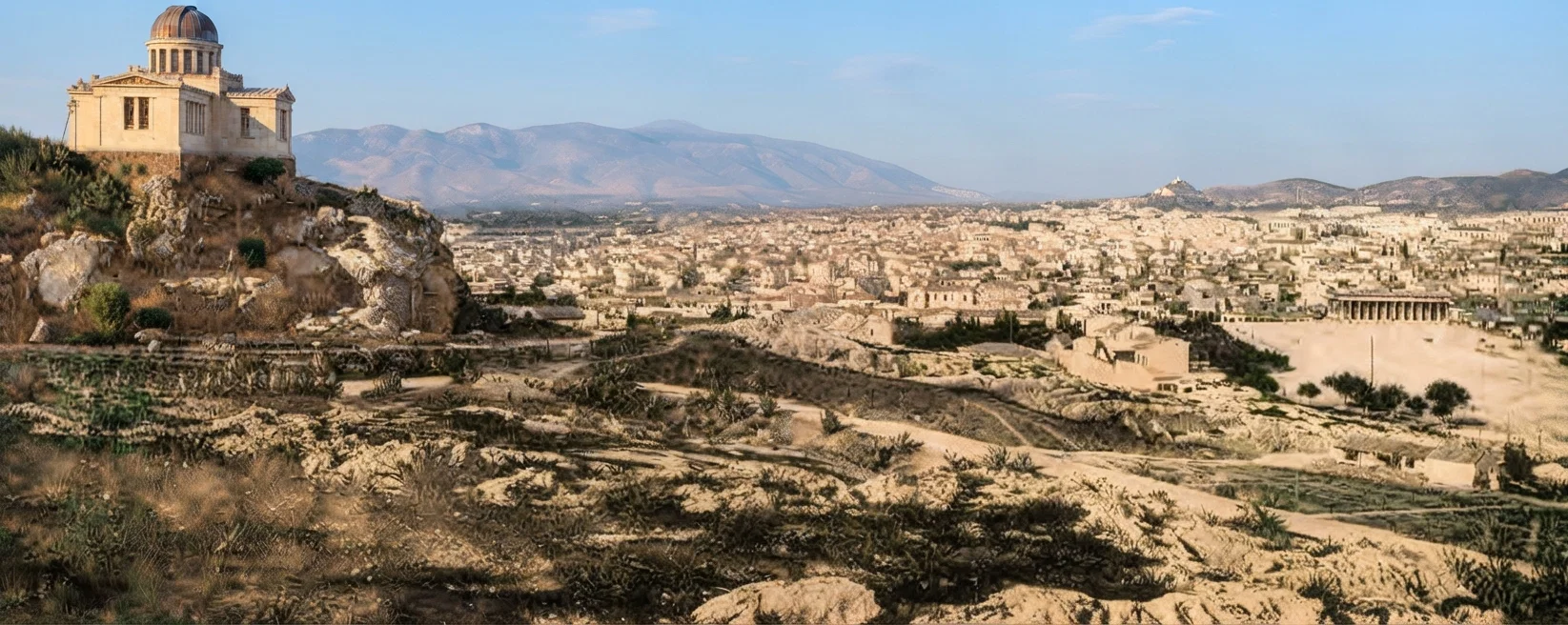
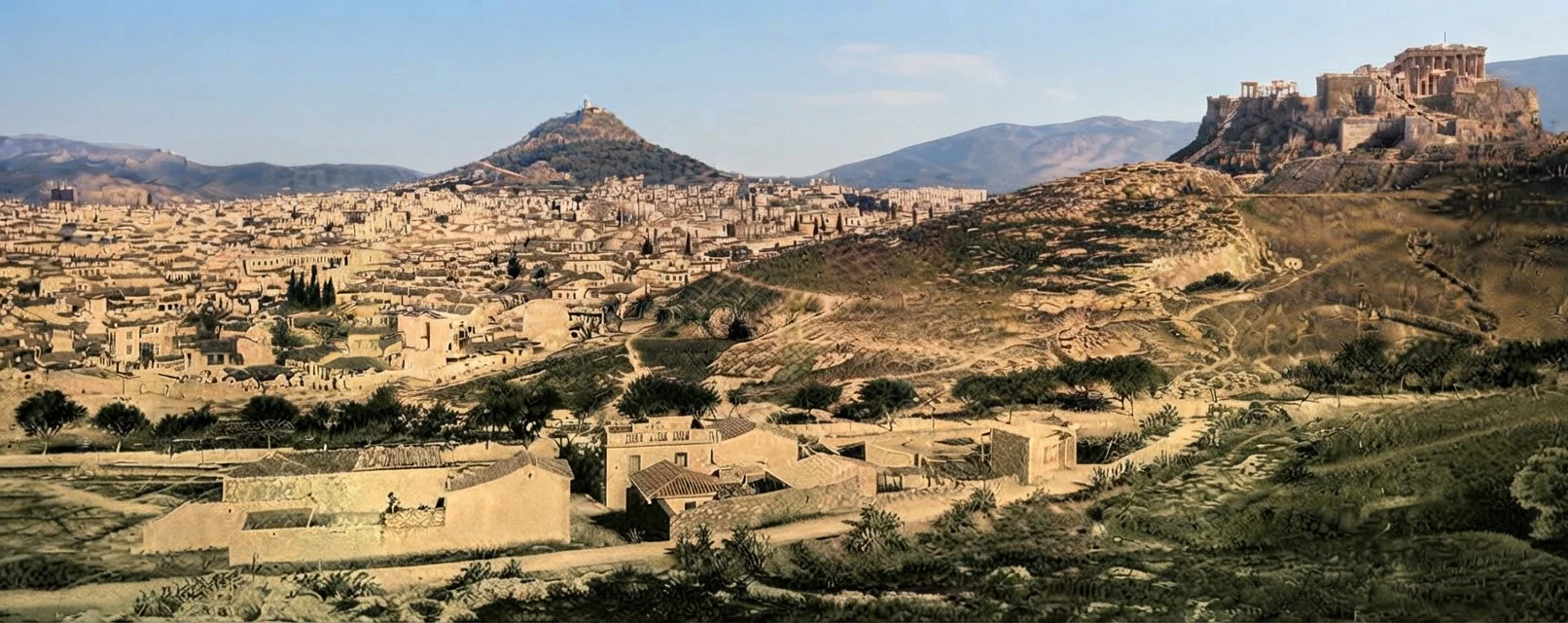
PANORAMA OF MODERN ATHENS.—(1) Parthenon, ancient temple of solid marble, dedicated to Athena, the protecting goddess of Athens; without question the most perfect of buildings. (5) The whole eminence on which Nos. 1 to 4 are situated, called the Acropolis. (6) Mars Hill (Areopagus), place of meeting for the highest ancient court and tribunal. (9) Syntagma, or Constitution Square, facing which are the chief tourist hotels. (10) Metropolitan Church. (11) Mt. Lycabettus, crowned with the Church of St. George, with a convent near the summit. (12) Ancient Theatre of Dionysius, the scene of the great dramatic contests. (13) The Odeon of Herodes Atticus, a theatre built in Roman times. (14) The modern city of Athens, which, unlike those on top of the Acropolis, and which still supplies the market to-day. The upper part of the ancient quarry is visible in the picture as a light patch on the side of the hill. The long street extending beyond the buildings in the foreground is St. Paul Street, which as it passes around the Acropolis takes the name, Street of Dionysius the Areopagite. The Stadium, now restored, is seen beyond the city.
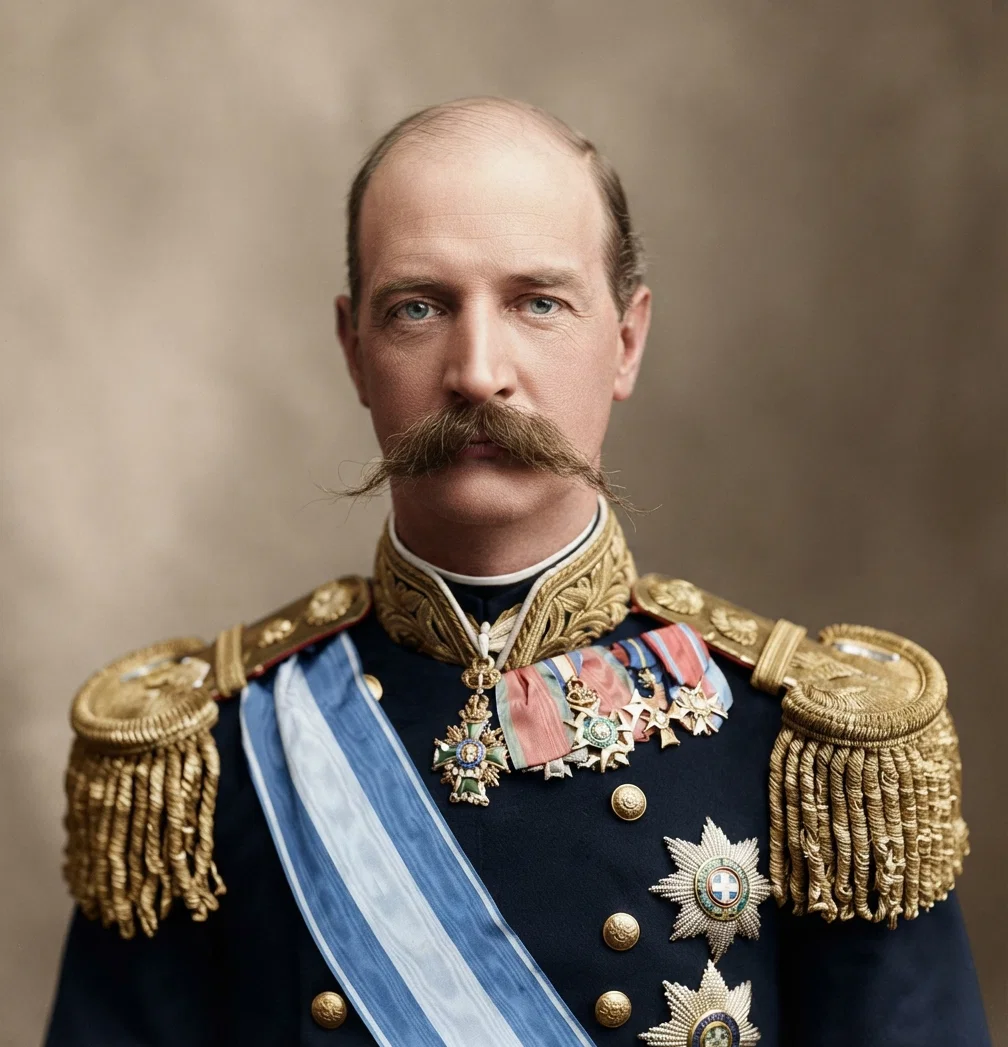
George I, King of Greece, 1863—, Son of Christian IX of Denmark, brother of King Haakon of Norway, and uncle to Czar Nickolas. He is a Lutheran.
Olga, Queen of Greece, second cousin of the Czar of Russia, a Greek Catholic.
Social caste is well defined. A diplomat of nine years' residence in Greece has remarked that it is stronger here than in India. From the pluto-aristocrat at the top to the boot-black at the bottom, every one regards as his inferior the man whose lot for any reason has fallen in the next rank below. And from the lowest stratum to the highest every one caters in a servile way to his fellow being in the next gradation above. Nor is this idea of inequality, of being waited upon, any less noticeable among the common people than among the elite. For instance, there might have been observed the other day on the principal street of Athens a common dirt-begrimed workman, with a wrench in his hand, passing from post to post to turn off the gas from illuminating arches across the street. Altho free-handed himself, he had a waiter at his heels carrying a small hand-ladder which he would set up and take down at each post for his superior's use. Above the laboring classes no one is anybody who carries his own parcels while shopping or passing to and from a railroad station, or,13in fact, who turns his hand to anything that could be called menial.
The Greeks are hospitable almost to a fault, both to one another and to strangers. When one is a guest of another, or even calls on an errand, he must invariably have some light refreshment. When friend meets friend on the street, they must drop into the ubiquitous coffee-house and take a sweetmeat or a drink while they chat for a few minutes. If you are inquiring your way in the town, busy men will accompany you or send some one with you to the next corner or even several blocks to set you on your way.
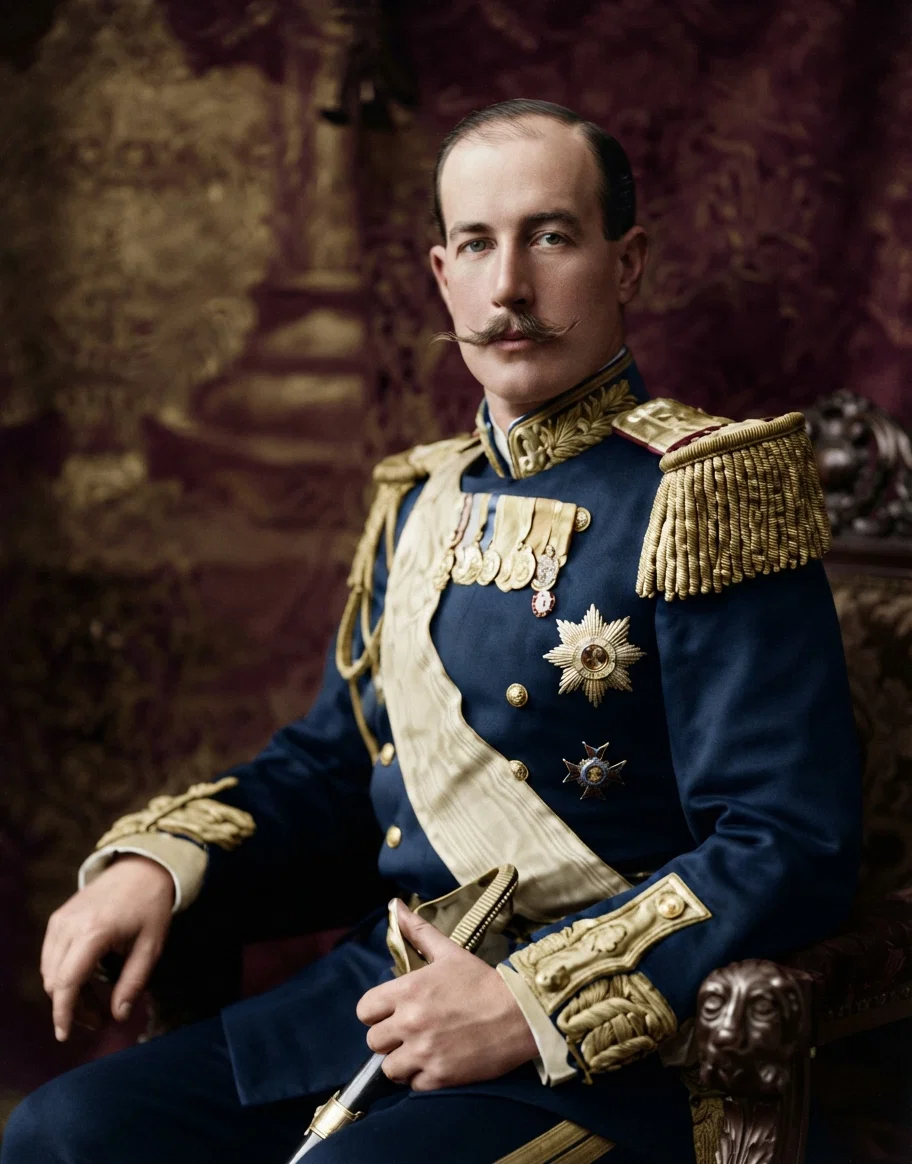
Prince George, second son of King George, formerly governor of Crete. Of fine physique and most kingly bearing of the king's five sons. Greek Catholic.
Political Greece.
Politically, the kingdom of Greece has the same ambitions and disappointments, perturbations and pacifications, sorrows and consolations, as do her more powerful neighbors. In servitude to others for seventeen hundred years, four hundred of these to the drastic Turk, she has now enjoyed independence for eighty years. Much of her present glory and no mean part of her income grow out of the relics, reminiscences, and reflections of the past. Her most bitter political enemy is Bulgaria, her most active and stubborn contestant for supremacy in old Hellenic Macedonia. She aspires and confidently expects to annex the principality of Crete to her territory in the near future. Her limitations, as well as her strength and safety, lie in the concert of the great powers. Her present and second king, George I, is now in the forty-fifth year of his reign, and looks young and vigorous still. Politics is the great topic of discussion, in the newspaper, in the coffee-houses, on the street corners, everywhere.
Greece Religiously.
Religiously, church and state are one. Every one is a member of the church. Every one calls himself a Christian, regardless of what his occupation or his daily life may be. Religion permeates everything, from the solemn deliberations of Parliament to the hawking of the most trivial article by the vender on the street. Religion regulates the class, quality, and season of many mercantile supplies, as also the daily bill-of-fare, because of the numerous feasts and fasts during the year. Religion appoints practically all the holidays, national and otherwise. Church ritual is a part of almost every public function. Religion calls to the church every day in the week, and often twice a day. The school-books are full of religion. The newspapers teem with it. Religion is in the very air.
But when we say "religion," what do we mean?—In a phrase, it is the observance of forms, feasts, and fasts. The buying of a taper, lighting and placing it before an icon, the kissing of a cross and a priest's hand, kissing and bowing before a picture or icon of Christ, Mary, or some saint, with the preference for Mary, and the making of the sign of the cross, not only while at worship in the church, but every time a church building or a chapel is passed on the street or on the train,—this is about the round of ordinary individual worship. In addition to this, on feast-days of importance, ritual and selections from the Gospels in the original Greek are read publicly, the same selections for the same appointed occasions, time after time, without explanation, with responses by the psalterers. During fasting seasons, varying in length from one to forty-eight days, certain articles of food are forbidden—a large item with which dealers in milk, butter, cheese, olive-oil, olives, and meat, have to reckon. Every day in the week is a feast day, of more or less importance, in memory of some revered person or event. The ritual for less important feasts the priest is allowed to read in his own home.
In short, this entire ceremonial system is one round of celebrating past events and of doing honor to canonized saints—a constant looking backward with little comfort or knowledge of the momentous future. It is a religion that perpetuates idolatry by the process of substitution—of Christian names and forms for those of pagan times; of Mary and the saints for the invisible gods and goddesses of the ancients; of images and pictures for statues and idols, with essentially the same abstentions and revelries at appointed seasons. And it produces the same crop of infidels, skeptics, agnostics, atheists, and devotees, as every other form of godliness without the power thereof.
monument of ancient art. (2) Propylaea (front gate) to the spacious top of the Acropolis. (3) Beulé Gate, later entrance. (4) Erechtheion, ancient palace of Athenian for general assemblies. (7) Mt. Hymettus, on whose sides and base is produced the world-famed honey of Hymettus. (8) Present palace of the king. (9) Palace Square on its side. (12) The University of Athens. (13) Mt. Pentelikon, which has supplied the famous Pentelic marble for so many noted buildings in the world, including the mountain. (14) The Theseion, ancient temple, the best-preserved edifice of the ancient Greek world. (15) Astronomical observatory, built in 1842. The first street fully restored and in use, lies behind the Acropolis. Ancient Athens also lay behind and immediately around the Acropolis.
Princess Marie, wife of Prince George, great-granddaughter of Lucian Bonaparte, brother of Napoleon the Great. Roman Catholic.
The missionary has this situation to face: The translation and circulation of the New Testament in modern Greek is forbidden by law; that of the Old Testament is opposed, the not absolutely prohibited. Proselyting is not permitted. Open public meetings are impracticable owing to disturbances by the populace. One door of entrance is open—a free press (outside the Bible itself), and one beam of hope and encouragement is discernible,—a few noble hearts are weary of the old regime and are seeking better things.
With this very cursory glance at the general situation in Greece, the presentation of special phases of interest in life among the Greeks must be deferred to another time.
God Loves to Be Longed For
By Faber
GOD loves to be longed for, He loves to be sought,
For He sought us Himself, with such longing and love;
He died for desire of us, marvelous thought!
And He yearns for us now to be with Him above.
—Faber.
Books as Our Companions, and Their Influence
By Ada M. Learned
(An echo from the Mutual Edification Club by Ada M. Learned)
"He that loveth a book will never want a faithful friend."—Barrow.
IN considering the subject of books as our companions and their influence, we can not place in the same catalog with the many books listed on the shelves of libraries that most wonderful of all books, the Bible. Excluding all reference, therefore, to the Book of Books, and considering only those which are creations of man's mind and the product of his genius, there are five phases of this question which may be briefly mentioned as follows:
1. The spirit which some books breathe exerts a strong restraining influence over men and women to keep them from becoming careless and negligent of doing what they know to be right. The influence of these books really becomes almost an inner conscience speaking to the individual.
2. From the volumes of poems which have been written,—good, bad, and indifferent,—there are some which will never be forgotten, some which we all love to read and reread. In certain moods they bring to us consolation and comfort which at the time we may not be able to find anywhere else.
3. There is a type of books to which the general name, "Character Builders," might be given; books which make one want to do and to be; biographies, histories; books which cultivate a spirit of progress and growth—the kind of books that Theodore Parker had in mind when he said, "The books which help you most are those which make you think most."
4. There are many helpful books leading one away from the works of man, back to the creations of God. Some of Henry Van Dyke's beautiful little sketches are illustrations of this class. It is difficult to understand how one can read such books and not feel that he must get out under the blue skies and listen to the voice of the out-of-doors.
5. Then there are bright, happy little books, simply written perhaps, but perfectly suited to bring smiles to sad faces, to bring sunshine where there may be showers.
Perhaps the following overheard conversation may help to make clear a few thoughts along this line.
The Gossip of the Books.
It was only a row of well-worn books; silent usually, but on this dull and rainy afternoon something was needed to bring in cheer and to dispel the gloom in the old home. It made no difference to the books if they had been relegated to a dark and dingy attic. Talk they could, and talk they would.
Many, many years ago an ambitious Sailor Lad, with eyes turned seaward, had bravely said good-by to the old home and mother. It was a dilapidated, water-soaked little book that was speaking just as we opened the attic door that rainy afternoon:
"Yes," the little book was saying, "you may smile, but I did get lonely. I was the only companion he had on all those long sea voyages. His mother slipped me into his little box just before he left. We stopped at many strange ports and heard many strange languages, and sometimes my Sailor Lad would be so interested in the new sights, amidst new peoples, that I feared I would be forgotten; but he did not forget me. I think his mother said something to him about me just before he left home, and occasionally he would take me out very tenderly, and read me very thoughtfully. I have grown old and worn, I admit. My Sailor Lad used to talk to me sometimes and tell me how I kept him from trouble, but I never understood just what he meant."
"Only a Row of Well-Worn Books."
A sigh escaped the leaves of another well-worn book, a volume of sweet, old-fashioned poems. "Ah, I wish I had seen something of the world. Why, I can't remember that I was ever out of the house! A dear old white-haired lady used to keep me near her, but I haven't seen her for a long, long time. I well remember the morning she put you in that tin box. I was new then, and so proud that she didn't send me away!"
"And it was well that I did stay at home, for at times I was certainly needed. She used to take me down from the shelf, and read and read; and I know—or, I am pretty sure I know—what might have happened if she hadn't found some pleasure and consolation in my little verses."
"Well, I think I had a pretty hard life," spoke up a rather bulky-looking volume, bearing the imposing title "Character Builders," badly thumbed and soiled. "I realize that I, too, look the worse for wear, but it is better to wear out than to rust out (casting a disdainful glance to a corner of the attic where a number of books, only paper-covered, were lying, dusty and not so badly worn). You are familiar with the old saying that sometimes one has to blow his own horn if no one else will blow it for him. Can any of you row of books tell me who that distinguished gentleman was who slipped in here one day not long ago, and when he espied me grabbed me by the back, he was so delighted to see me once more? Of course you don't know. He is called 'Senator,' and that day he told me a little secret that I am going to tell you."
"He said that when he was a boy he liked to read stories; spent hours reading 'blood and thunder' books, detective stories, nonsensical, imaginative tales. Finally one day he said to himself, This will never do. I must stop. I can't remember anything I read any more; I am getting so I don't care for good reading. I mean to be a great man when I grow up, and as people are
not better than the books they read, I am going to read only good books—books worth reading.
"So he selected me (some of the row of books smiled rather sarcastically), and he told me the other day that he truthfully believed no small part of his success was due to the good, solid reading he had found within my covers. I know I'm considered 'dry,' and called 'dull reading,' but I have worn well, and I can be read and reread to advantage."
The bulky volume straightened up so squarely after this long, conceited speech that a small book at the very end of the shelf almost fell off; but gaining its equilibrium, the little book ventured that they might be interested in its tale, and the row of books instantly looked "Attention!"
"I have always lived in the big, noisy, dirty, bustling city. I didn't like it, either, for I know what blue skies, and flowers, and green grass, and birds, and babbling brooks are. Why shouldn't I know? I tell people what they are. I'm called a 'Nature Book.'"
"But the Boy decided he wanted to go to the city, and go he must. He took me along. I wanted to stay with the Boy, but how I did dislike that city! I was left alone in the room a great deal. When the Boy had a moment to drop into a chair, he seemed so tired, and it was so noisy there that he would pick me up, read a line, and then actually throw me across the room."
"No wonder your back is broken," interrupted the Book of Poems.
"But I still remember whenever he was15the most weary his hand always reached out for me.
"Finally after a number of such experiences—O, so many that I lost count!—he said one day, 'Little Book, I am going back to the country, back to God's country. I am going to leave this grind, and turmoil, and tumult, that people call living, and I am going back to the real country you tell about.'"
"And he did go. I suppose that's why I have eventually found my way here. But I would rather be sitting here this rainy afternoon, quietly visiting with you, than to be in that dirty, noisy city. And I have hosts of brothers and sisters, and every one of them will tell you the same story. Somehow we get around the hearts of men and women until they respond to the call that we give to come back to Nature and to the simple life."
The next book we heard speaking was a volume called "Smiles" by its companions. It was not very large, but had bright cheery-looking covers, still intact altho the leaves certainly indicated hard and constant wear.
"Where do you suppose I have spent most of my life?" the cheery book was asking, "can you guess?"
"In some hot climate, I should judge, for you look well-baked," replied one book.
"Somehow I fancy from your peculiar odor that you have spent most of your days in a drug store," said another book.
Said the Sailor Lad's book, "Maybe you've been sea-voyaging, too, for you certainly look as tho you had had salt water or something even more destructive spilled on your leaves."
"You haven't guessed yet," replied Smiles. "I have made my home in a hospital. I think it is a fine place to live. One can do so much good, and really it is not such a dreadful place after all. Time and again the lady in white cap and apron has handed me to some long-faced, solemn, tearful-looking patient, and within five minutes you should note the change of
countenance! Sometimes they would smile, and more than once I have known the sadest to actually laugh out loud. I never knew exactly what there was about me that proved so amusing, but I know I always affected people that way. So you see I enjoyed my hospital life.
"My last case—you know after a time I really came to consider myself one of the nurses, I was so invaluable—was an especially querulous old fellow. I remember the first time he took me. He didn't keep me very long. But soon he called for me again; and after we were acquainted I hardly had time to visit any one else. He really quite fell in love with me, for when he left he begged the nurse to let me go with him, and she did after obtaining a promise that my twin brother should be sent to take my place.
"But I hadn't been at this home long before the old gentleman left very suddenly, and from all I could ever observe he took none of his belongings with him; and so here I am. But I am just as happy and cheerful as ever, and I am confident if I had a chance I could still do much good in this old world."
The books heard voices, real human voices, and immediately ceased their book talk; and when two elderly people entered the attic, the row of books were as demure and silent as only a row of old books can be.
"John," said the old lady, "let's take this row of books down to the living-room. They mean so much to us. They have been companions to all the family, and the influence they have had for good can never be measured. I feel as if they were almost human. You remember Charles Kingsley said, 'Except a living man, there is nothing more wonderful than a book.' Even now I often like to read one of them, and I do not think their days of usefulness are passed. A good book is the best of friends, the same to-day and forever."
The prospect of leaving the dingy attic and occupying their rightful place as mem-
A Rare Pamphlet.
By Editor
Only a few copies left. Defends American Protestant principles. Inside history of Rome's Modern Literary Inquisition. Tells in detail of Catholic boycott of the book "Castilian Days," written by John Hay, late U. S. Secretary of State. Also concerning its exclusion from numerous public libraries. What Mr. Hay said concerning the influence of the confessional, a corrupt priesthood, and of Catholicism in general, upon Spanish society,—his impressions while connected with the U. S. legation at Madrid.
In its issue of May 16, 1908, the Citizen, of Boston, prints the following unsolicited commendation on its front page:
"Attractive and very lively. Contains a biographical sketch of the late Secretary John Hay. This sketch alone is worth the price of the — for one year (50c). There are other good articles in the number."
Other articles: "Rome's Plans to Capture Protestant England" (Cardinal Manning's own words); "How the Pope Can of Wrong Make Right" (Catholic quotations); "Rome's Promise to America;" etc.
Just the thing for Protestant ministers and Bible workers to show the fulfilment of Bible predictions concerning the imminent supremacy of the Papacy in these last days. A San Francisco clergyman sells them regularly after his evening lectures on "The Papacy in Prophecy," and an Oakland minister sold over 100 copies after a forenoon's discourse.
Mailed, postage prepaid, as follows: one copy, 6 cents; 2 copies, 12 cents; 5 copies, 25 cents; 12 copies, 50 cents; 25 copies, $1.00; 50 copies, $1.75; 100 copies, $3.25. Address all orders to
CALIFORNIA BIBLE HOUSE
Mountain View California
Colds
By George Henry Heald
Colds.—By G. H. Heald, M.D. A treatise on the causes, prevention, and cure of colds. White leatherette binding. 58 pages, 25c.
Address this office.
Imported Beauties
By Editor
Special 100 Bible Cards $3.00; 100 Heavy Paper Mottos 12x16, $6.00; (27,000 sold in April and first half of May). We have four languages: English, German, Danish, and Swedish. The more you buy, the less they are. 15 for $1.00. Address with stamp.
HAMPTON ART COMPANY
Lock Box 257
Hampton, Iowa
A Faithful Laborer in North Carolina
By Editor
A touching, earnest note comes to us from an aged laborer in the cause, Elder D. T. Shireman, of North Carolina. For fifty years he has been laboring in the missionary work, handicapped by a lack of education which he longed for, and yet reaching precious souls by the earnestness and devotion to the Master's cause. For a number of years he has been establishing schools for orphans and needy children in North Carolina. Having established them, he has moved on to a more needy field, leaving others to carry on the work established; he himself taking the hard part of gathering the children, building the schools, cultivating land, fitting the children for real work in life. Two serious accidents have happened to him of late, in one of which he fell into a well a distance of thirty feet with a mass of rock and cement. Recovering from this he had another fall which injured him even more, but he is still pressing on. He always has a needy field; these have appealed to his heart more, and they may appeal to other hearts. His present address is Toluca, North Carolina.
Deaths from Heat in New York
The intense heat in New York City was responsible for fourteen deaths and nearly one hundred prostrations in the two weeks ending July 4. Twenty-three died July 7. Counting those in Manhattan and Brooklyn, the number of deaths was increased to thirty. Other Eastern cities suffered from the heat also.
Queen Alexandria’s Catholicism
"The Western Watchman" of July 2, 1908, intimates that Queen Alexandria of England is a Catholic. In her private bedroom is an ivory crucifix, posed as it would be by a mother superior of a convent, three paintings of the Virgin Mary, a holy water font—the whole room, it is said, presenting more the appearance of a shrine than a bedroom.
On the way.
By Editor
A letter from Elder R. C. Porter, on his way to South Africa via Honolulu, writes, as he nears that port (June 26) that his party—Miss Trunk, Mrs. Porter, and himself—are all well, and proving to be good sailors, after the first day. The “Manuka” is a small steamer, only 4,500 tons, but a good ship with excellent service. All send Christian love to us and our associates, which means our whole SIGNS family. God give them a safe voyage.
Truth and Creed
By Editor
Truth is of more consequence than creed. The living, inspired word of God is more important than men's endeavor to crystallize it into fixed declarations of faith. We believe that God's word is sufficient, if men will receive it, to lead into all truth. It is differences in human opinions which have split the church. When men are willing to take God at what He says, with His word as its own interpreter, they will not be led apart. Equally important is the life of the Master as the bond of union.
The Seventh or One Seventh
By Editor
In this issue we have an article entitled "The Seventh or One Seventh," by Abdiel, a review of an article which appeared in the Christian Statesman—a journal which has been the foremost exponent of definite Sunday laws in the United States. In fact, it has been the leading journal in this respect, demanding a national Christianity. We believe that the article will be read with interest. There is nothing of particular strength in the Statesman's article, but it has served to emphasize some points which are worthy of emphasis in connection with the Sabbath question.
International Sunday-School Convention
By Editor
The Twelfth International Sunday-School Convention, held in Louisville, June 18 to 23, voted to continue the uniform lesson system, and also to develop a graded system for the schools which desired it. There was great unanimity in the convention over the lessons. The new president of the association is Hon. John Stites, Louisville, Ky.; the secretary, Marion Lawrence, Chicago. One of the great features of the convention was the demonstration for the adult study of the Bible, especially men's study. We are glad to see it. The total enrolment in the Sunday-schools of North America is nearly 1,000,000 larger than it was three years ago.
Psychic Matters
By Editor
Psychic Matters.—Prof. Edgar L. Larkin, of Mount Lowe Observatory, has an article in the San Francisco Examiner of June 13, 1908, entitled "Seven Thousand Questions," questions which have poured in to him. Many of these, of course, are scientific, many of them are of a religious character; but among the great mass of them are questions of the psychic nature, pertaining to Spiritism. He says that a great mass of questions which have come to him indicate some "deep-seated movement thruout the country." And this is true. There are souls who are seeking for evidences of immortality. The only book which has revealed it is God's Book, and that thru Jesus Christ alone and the resurrection. Satan is endeavoring to pervert this great truth and to substitute in the place of it the immortality of the soul, with all of the demon possessions and manifestations which have been connected with it in past ages. He who has the word of God will not be deceived.
Imaginary War Between Japan and America
War between Japan and the United States is the general theme of a "dreamer" of Berlin who has published the account of an imaginary war between these countries, a war in which the Japanese are the victors in many battles, both on sea and land, but the United States troops gain the final victory. While purely imaginary, such things tend to hard feelings where only good-will should exist.