“The heavens declare the glory of God; and the firmament showeth His handiwork.” Ps. 19:1. “In My Father’s house are many mansions.” John 14:2. The Revised Version admits the following reading: “In My Father’s house are many abiding-places.” Continuing this verse, Christ says, “I go to prepare a place for you.” The sense of the text is that in God’s house, i. e., in God’s universe, are the “mansions,” or “abiding-places,” in which we are to dwell if we are found worthy of a dwelling-place with God.
This text may be considered an astronomical one, and, like many others, the greater our knowledge of the structure of the universe, the more clearly we will see and comprehend its meaning. While the astronomer himself only faintly comprehends the overwhelming greatness of our Father’s house, his conception is vastly above that of the casual reader. While he would be indeed a bold astronomer who would shrink from the task of explaining this and similar texts, yet he can with some degree of intelligence direct the mind of the earnest seeker into paths that are ablaze with the glory of God.
Ask an astronomer, How large is our Father’s house? and instantly he would see in imagination unnumbered millions of worlds, systems, constellations, clusters, and aggregations in our, or the visible, universe, and beyond this he is reasonably certain that other universes, universe after universe, infinity after infinity, unspeakable in dimensions and duration, stretch away into unfathomable, endless space, until his imagination is stunned, his mind reels, and his reason cries, Halt!—for the finite mind here meets the incomprehensible, and nature challenges the astronomer.
We often hear from the pulpit the word “universe.” What is our preacher talking about? Evidently something pretty big, for it is usually the grand finishing point, when he wishes to impress us with something vast and unlimited. What is the universe? Can we understand it? Let us examine into this matter and see if we can know anything of our Father’s house, for surely it is right for us to use the mind He has given us to add to our knowledge of His glory; nay, would it not be sin if we did not use our best endeavors to know all we can of the great Master Builder and His works?
Come, reader, let us, in imagination, go on an infinite voyage, and see for ourselves something of our Father’s house, with its many “abiding-places.” We have no time for details, but at once select a starting-point. For this the astronomer would naturally turn to the sun as the great center, and from which we receive the light and heat that make this world of ours habitable. The question of the speed with which we must travel is more difficult; but, assuming that we have the choice in this matter, we will soon settle this most important point. Railroad speed of a mile in a minute is entirely out of the question, for our time is short and the journey long; besides, we want to return in time to tell the SIGNS readers something of what we see. There is a cannon-ball—that travels about twenty miles a minute! But that, too, is too slow—entirely too slow. But there is light?—Yes, now we have it. We will travel with the inconceivable speed of light itself, for we must travel with infinite speed on an infinite journey, and light travels one hundred and eighty-six thousand miles in a single second of time. This is equal to over eleven million of miles in a single minute (186,000 x 60 = 11,160,000).
Fearing that our unusual performance will produce undue excitement in the worlds we are about to visit, we will send before us a messenger to announce our arrival, and we will select for this purpose a cannon-ball, traveling at the rate of twenty-eight thousand miles a day; and, that it may have plenty of time, we will give it a start of a hundred years. We want to be perfectly fair in all that we do in this wonderful journey, and, to “start fair,” we will not start from the sun, but from the center of that vast globe. While we are in such a good position, we will find out something about the sun’s enormous dimensions. He is over thirteen hundred thousand times as large as our earth. His diameter is so vast that, if he were a shell, the earth could be placed in the center, and the moon could travel in her usual orbit, and then be only about midway between the earth and the surface of our gigantic primary, his diameter being eight hundred and sixty-four thousand miles. From the sun’s center we will direct our course toward the nearest fixed star, and see what will be our experiences. Now, then, all ready, full speed, ahead!
At the prodigious rate of speed we are going, less than three beats of the clock will find us entirely clear of the sun, and thousands of miles on our way to his nearest planet, Mercury, and in about three minutes we will reach him. Mercury is about thirty-six million miles from the sun, and is about three thousand miles in diameter. His year is equal to eighty-eight of our days, therefore his seasons are only twenty-two days long, if he has any seasons; for you must remember that he receives a vast amount of heat and light from the sun, which to the Mercurials appears two and one-half times as large as to the inhabitants of earth. Our tremendous velocity carries us by the “messenger of the gods” so quickly that we have no time to make a close examination of him, and in less than three minutes we will cross the orbit of Venus.
Here we will find a world surprisingly like our own in many particulars. Venus is only twenty-six million miles nearer the sun than we, and, as we are ninety-three million miles distant, this “mansion,” with very moderate changes in the condition of her atmosphere, may be as habitable as the earth, to life with which we are acquainted. Venus is only two hundred miles less in diameter than the earth (all distances and dimensions are given in round numbers), and her year is equal to two hundred and twenty-five of our days, and, so far as the astronomers know, life is just as probable on Venus as on any other planet; but if we find out much about her we must be sure to tell the astronomers about it, for they are very anxious to know something of the condition of all the planets. In an instant Venus is left far in the rear, and looking behind us we note the sun is growing smaller, while ahead we see two brilliant stars—or what appear to be stars—one of which is wonderfully bright, and the other is close beside it. We draw toward them with more than lightning speed, and they soon bid fair to rival the sun himself in brightness, for he is less than half the size we saw him from Mercury, and gives us less than one-fourth of the light and heat he pours out on that planet. In a little over two minutes we reach our two stars, and find this marvelous object to be Earth, and the companion star to be the moon. We must be careful here, for if we draw too near we may5be drawn upon its surface like many a venturesome meteorite (popularly called “falling stars”) that has approached too near. But our speed is our safety, and gravitation will not be able to overcome such velocity as ours.
A feeling of reverential awe overcomes us as we draw near this tiny speck in God’s great universe that we call Earth. Here is a little world, perhaps the only one in all our Father’s house upon which sin ever obtained a foothold. It may be absolutely unique in this respect, in all the length and breadth of His dominion. It was here that man fell, and here God’s only-begotten Son came to die, that the earth might be replenished with beings worthy to be called children of the great Creator, and that His Father’s house might again become clean and the universe restored as it was when it came from the hand of the Great Architect.
We pass the earth reluctantly, for here we have the history of the life and trials of God’s Son while upon earth; we have His promises, His teaching, His example; we have everything that the heart of a Christian could wish. Here, too, is being enacted the great drama of sin and righteousness, of life and death. We see the struggle of the saints, and wonder why judgment is delayed so long. But all we see is not black and cheerless, for God has a people here on this little world; saints are here, and here are they that keep all the commandments of God.
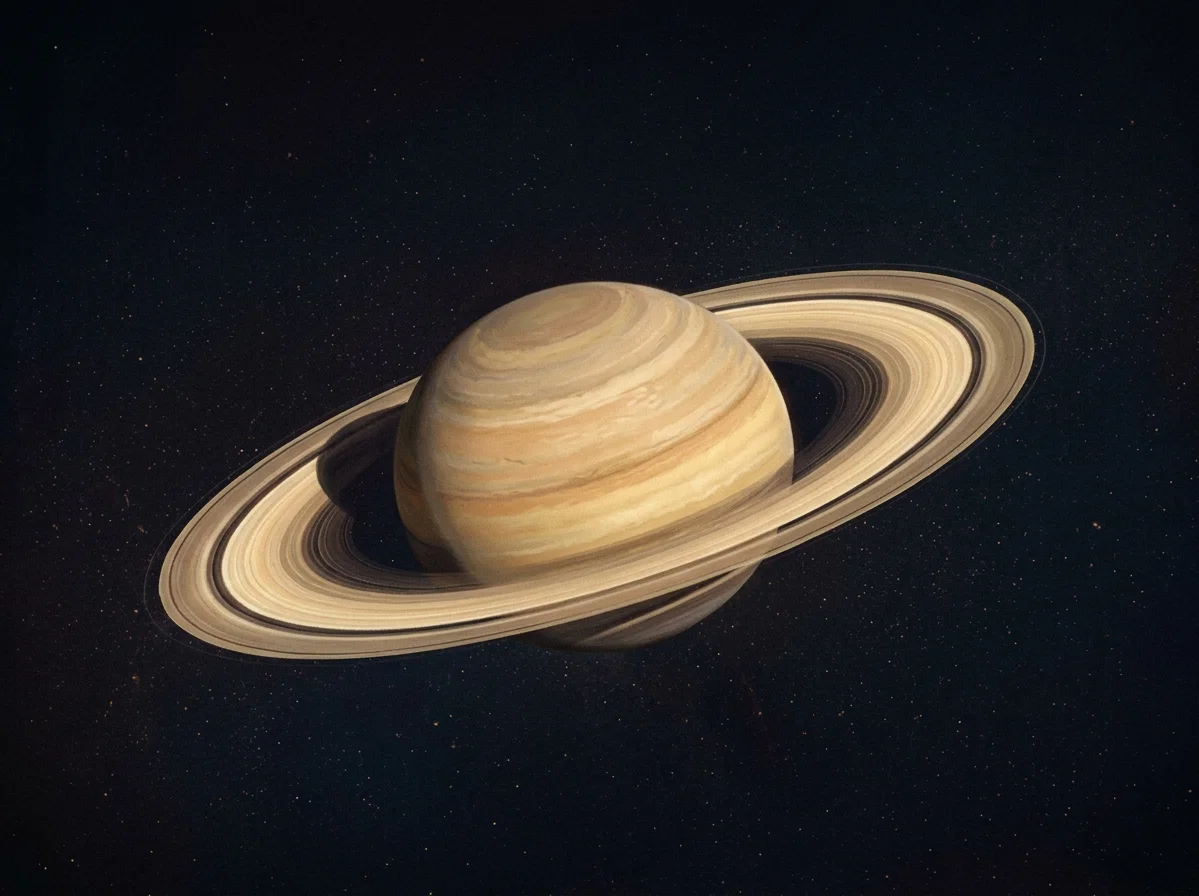
A view of Saturn, the planet next beyond Jupiter. Its distance from the sun is about 886 million miles; its period, or year, 29½ of our years; its diameter, 75,000 miles at the equator; its rotation, or day, 10 hours 14 minutes. It is chiefly remarkable for its 8 satellites, or moons, and its rings, three in number, two flat bright ones, and another darker, called the “crape ring.” These rings are supposed to be composed of small satellites revolving about the planet.
The eight minutes in which we are allowed to come from the sun to the earth have passed, and we must haste away if we are to see the glorious dimensions of our Father’s house. A bright star looms up ahead, and in less than four minutes we find ourselves at the distance of Mars’ orbit after passing the Earth’s. Our (apparent) star proves to be the little planet Mars, with his two little moons of only about five and seven miles in diameter; baby mansions, truly. We will find, if he is in that part of his orbit we are passing, a world four thousand miles in diameter, and the great telescopes that we have left behind can plainly show his seas and continents, his snowy poles and his equatorial regions in which snow never appears—just like our Earth. The Martial day is about as long as our own, but his year is as long as six hundred and eighty-seven of our days. The sun appears considerably smaller, and his light and heat are much less.
After hastily noting the above facts, we pass the ruddy planet, and are soon darting through a great number of little worlds called the Asteroids. About four hundred have been discovered, all within this century, and there may be thousands more that have as yet escaped the sharp-eyed astronomers of earth. Their average diameter is only about forty-five miles,—more baby mansions!
But we have no time, however, to look for undiscovered Asteroids, for we are now about to visit the “giant of the solar system,” Jupiter. It will take us over a half hour to reach him from Mars, or about forty-four minutes from the sun, so we will have a little time to look out for comets, for we may come across one almost any time now, on its journey to or from the sun. However, comets don’t amount to very much, and we only mention them to show we haven’t forgotten these erstwhile terrible visitors. But Jupiter is worthy of our greatest admiration. Swinging around in a majestic orbit, requiring twelve of our years for one of his, he pursues his stately path, a real giant. His mean diameter is about eighty-seven thousand miles, and he is as large as thirteen hundred and nine (Young) of such worlds as ours put together. He has five moons, three of which are larger than ours; indeed, one of them is larger than Mercury, and rivals Mars in size, while a late discovery has added a very tiny one. In passing we note that a great change has come over our sun; he appears to be only about one-fifth the size as we saw him from the Earth, and he gives only one twenty-fifth as much light and heat to the Jovians (assuming that there are Jovians) as we receive. We could find much of interest here if we had time to stop, but our tremendous speed carries us by Jupiter in a twinkling, and before we realize it we are crossing the enormous gulf of over four hundred million of miles that separates the orbits of Jupiter and his big brother Saturn—our next station.
Saturn is the farthermost planet easily visible to the unaided eye. His dimensions rival those of Jupiter. His mean diameter is seventy-one thousand miles. While his day is only ten hours in length, his period (year) is twenty-nine and one-half of our years, and his volume is over seven hundred times greater than the world upon which we live. He has eight moons to keep him company in his vast orbit, in addition to his enormous ring system, the outer ring of which is one hundred and sixty-eight thousand miles in diameter. There is nothing like him in the system presided over by that great autocrat the sun, or in the universe as far as we know, and he is at once the marvel and the admiration of astronomers. The sun now seems to be growing alarmingly small, while his light is only about one-eightieth of that received by the Earth. We can not tarry, however interesting this “abiding-place” may be, but we will hasten on to Uranus.
A distance of nearly nine hundred million miles separates these two planets, and it will require over an hour and a quarter to carry us to Uranus, buried in space as he is, nearly one billion eight hundred million of miles from the sun, from which we have so recently parted company. We will just settle ourselves comfortably for our flight across this mighty span,—and, whiz! what was that?—Why, it is our messenger, the cannon-ball, that left the sun a hundred years ago, while it is less than one and a half hours since we left on the wings of light. This is very astonishing—to none more so than the astronomers. In a single beat of the clock our messenger is one hundred and eighty-six thousand miles behind us, and we must henceforth go unheralded. When we have crossed this great abyss, we will find Uranus to be thirty-two thousand miles in diameter, and as large as sixty-five worlds like ours. He has four moons, and it requires eighty-four of our years to see his age increased by a single one of his years. We have no time to study the wonderfully peculiar axial rotation of this far-away planet—much to our regret and that of the astronomers on Earth, who are so interested in him, and who know so little about him.
Another mighty plunge and we will meet the sentinel—the outer guard, so to speak—of our system. We would rest here for a few minutes if we could, for we are on the very frontier of the grand scheme of worlds that comprise the majestic family of the sun. After we leave Neptune, we will have passed the last of the planets, and at most we can only hope to meet one of those celestial tramps, a comet, making his regular pilgrimage to or from the sun, for all periodic comets must visit him at stated times, to report, as it were, that they are still faithful, and have not deserted him for some of his mighty neighbors. We would find Neptune eighty-five times larger than the Earth, upon which we dwell, and it requires one hundred and sixty-four of our years to equal one of his. His vast orbit is five billion five hundred and eighty-four million miles in diameter.
We do not wish to discourage our friend and messenger, the cannon-ball, but it would take him three hundred years to cross the tremendous distance from the sun to Neptune, and a railroad train going a mile a minute—no stops—would require ten thousand years to cross the orbit of this, the most distant of the sun’s family. We get thoroughly bewildered in dealing with these vast dimensions, and they cease to have a meaning, and, lest we forget it in dealing with the gigantic magnitudes of the planets, it is well to remember that the sun is over seven hundred times as large as all of them put together. Our sun now gives us much concern, for he no longer shows us a disk, but is only a point of light, and, as a sun, we do not recognize him. Of course he is much brighter than any star that we can see, but his light and heat are only one-nine-hundredth part that we receive on earth. At this rate we fear that we may lose him altogether. About four and a quarter hours have elapsed since we left the sun, and we are so far away that we are getting lonesome, altho only on our farthest known planet.
Perhaps, reader, we have traveled too fast for you. Maybe you regret it, thinking you have seen God’s house. What! this God’s house! Will we call this worthy of Him?—Not so; for in our Father’s house are “many mansions;” and if you think we are near our journey’s end, be at once undeceived, for at this point we are still standing upon our own threshold. GAMMA BETA.
(Concluded next week.)
WATCH
By E. A. Stockman
THIS is no time for slumber. We are too near the end of the age to sleep now. The perils of the last day are upon us, and to cease our vigils now is to peril our eternal salvation. Life’s cares are pressing heavily, and if we do not watch, we may be overcharged, and so the day of the Lord come upon us unawares. Earth’s gaudy trappings are arrayed before the world in every alluring form, and if we do not watch, we shall be attracted with their glitter, and so lose sight of the resplendent glory of the world to come. Satan with all his forces is fast throwing his coils around the world, and if we do not watch, we may be brought within his folds. His power over the world is marvelous, and our only safety is close to the side of One who is stronger than the strong man armed. Then we are secure. But if we do not watch, we may stray from His side, and thus expose ourselves to the power of the wicked one.
In view of the last-day dangers our beloved Lord run up the danger signals when he said: “Take heed to yourselves, lest at any time your hearts be overcharged with surfeiting, and drunkenness, and cares of this life, and so that day come upon you unawares. For as a snare shall it come on all them that dwell on the face of the whole earth. Watch ye therefore, and pray always, that ye may be accounted worthy to escape all these things that shall come to pass, and to stand before the Son of man.”
O man of God, keep faithfully thy vigils, lest thou be taken in the snare! The storm signals are flying, the shelter is provided, and if the storm bursts upon our unsheltered heads, it may be because we ceased to watch.—E. A. Stockman.
A Life of Loving Service
By Hon. Mrs. Norton
Ah! blessed they
Who leave completed tasks of love to stay
And answer mutely for them, being dead.
Life was not purposeless, tho life be fled.
—Hon. Mrs. Norton.
COME
THERE are many who read this paper, we are persuaded, among rich and poor, high and low, as the world measures, who do not know Christ by personal acquaintance.
They have heard of Him as a friend of the poor, as a prophet, as a teacher, as a saviour of the world, as one who died upon Calvary. In a vague, uncertain sort of way they have hope in Him. And yet they do not know Him by personal acquaintance, by personal contact. They have never felt His blessed hand laid upon their head with cleansing touch, have never heard His voice say to them, “Thy sins be forgiven thee.”
Yet they long to know Him. They long to know His pardoning, cleansing love, His power to take away sin and sinning.
Some of these are discouraged over former ineffectual efforts to find Him. Some are held back by those who profess Christ, and yet do not seem to reveal Him in their lives. Some are restrained for other reasons.
But, dear soul, turn from all these hindrances forever. Not one thing on earth may hinder you from possessing Christ unless you desire to be hindered. The saving relation between your soul and His great heart of love must be purely personal. He does not want you to drink of His truth distilled through lying tradition. He does not wish you to talk to Him by some self-constituted representative. He has not separated you from Himself by a cordon of priests or by ecclesiastical red tape. Go to the fountain of Christian truth, His Word. Men who are there may invite you to come. His ambassadors may point the way; but the blessed Christ desires to bring you into as close and living relation to Himself as they.
Here is an invitation from Him so broad that it embraces every soul who desires to avail himself of it:—
“Ho, every one that thirsteth, come ye to the waters, and he that hath no money; come ye, buy, and eat; yea, COME, buy wine and milk without money and without price.”
“The waters” are the waters of life, “a well of water springing up unto eternal life.” The “wine and milk” are representative of all the abundant and delectable provisions which God has in His storehouse for all the weary and hungry who may come. And when He offers these so freely and we refuse, is it any wonder that He asks, “Wherefore do ye spend money for that which is not bread? and your labor for that which satisfieth not?” O, why toil and moil and drudge and pour out your whole life for that which only disappoints? Listen again to the Saviour:—
“Hearken diligently unto Me, and eat ye that which is good, and let your soul delight itself in fatness. Incline your ear, and come unto Me; hear, and your soul shall live; and I will make an everlasting covenant with you. . . . Seek ye the Lord while He may be found, call ye upon Him while He is near.”
But you say, “I am not worthy to come, am not worthy to partake.” And in reply we say, No mortal soul is worthy; but listen further; God is not yet through:—
“Let the wicked forsake his way, and the unrighteous man his thoughts; and let him return unto the Lord, and He will have mercy upon Him; and to our God, for He will abundantly pardon.”
This, reader, is a part of God’s glad message to you in that wonderful fifty-fifth chapter of Isaiah. Will you not accept the invitation, and let Christ be your Leader, your Witness, your Commander forevermore? For your own soul’s sake, accept His invitation now. It is your only hope. If you do, you will never regret it. His presence will be a well-spring of joy and strength all the way.
GIFTS OF THE SPIRIT.
“The Gift” and “Gifts.”
KEEP ever in mind that the gifts of the Spirit are distinct from the gift of the Spirit, or “the gift of the Holy Ghost.” The latter, as intimated in past articles, comes to every child of God, in what may be called its regular order, at baptism, sometimes following baptism, and sometimes by the laying on of hands by those who have received the gift.
A most definite promise of the gift of the Spirit is found in Acts 2:38, 39, in Peter’s answer to the question from penitent hearts, “What shall we do?” His reply is: “Repent ye, and be baptized every one of you in the name of Jesus Christ unto the remission of your sins; and ye shall receive the gift of the Holy Ghost. For to you is the promise, and to your children, and to all that are afar off, even as many as the Lord our God shall call unto Him.”
This is definite, explicit, positive, and general. It includes every soul that comes in the name of Jesus—emptied of self and sin—that God may fill him and fit him for service. If men fail to receive it at baptism, it is because they do not know that it is for them, or their faith does not grasp and appreciate the promise. But it is there, for every one. O, the barrenness of the church of Christ when God has such a well-spring of abundant fulness and fruitfulness awaiting her demand and reception!
In Acts 10:44 we are told that “while Peter yet spake these words [to the Gentiles, Cornelius, and his company], the Holy Ghost fell on all them which heard the Word.” This was before baptism, and also beyond Peter’s faith. It seemed necessary that God should thus work because of the limitation of Peter’s views and the Jews who were with him. He then baptized them.
In Acts 8:15–17 is a record of where the Holy Ghost was bestowed some time after baptism, by prayer and the laying on of hands.
The gift of the Holy Spirit is to sanctify, cleanse, and fit for the service of God every believer. See 1 Peter 1:2; 2 Thess. 2:13. But the gifts of the Spirit are the Spirit’s equipping for service, not as the believer will, but as the Spirit will, “dividing to every man severally as He will.” 1 Cor. 12:11. Whether we shall be “by one Spirit” “baptized into one body,” “the body of Christ,” is a matter of our will. We may be if we so desire. God longs so to baptize every one of us. But the place we are to occupy in that body is not a matter of our will, but of God’s will. By the gift of the Holy Spirit “the love of God is shed abroad in our hearts” (Rom. 5:5); by the gifts of the Spirit we are made ministers of that love to the needy everywhere. See 1 Peter 4:10, R.V. Blessed is he who learns these lessons.
Knowledge and Wisdom.
“For to one is given by the Spirit the word of wisdom; to another the word of knowledge by the same Spirit.” These are both gifts necessary to the church. Knowledge is accumulation of facts. The gift of knowledge would be that which would more readily enable its possessor to grasp the great facts of salvation, the great truths of the Word of God. It is a most necessary gift for a preacher, or a teacher.
Wisdom applies rather to the use of what we know, the best disposition of the means at hand, rather than to an accumulation of knowledge. Cowper has beautifully expressed the difference in the following:—
“Knowledge and wisdom, far from being one,
Have oftimes no connection. Knowledge dwells
In heads replete with thoughts of other men;
Wisdom, in minds attentive to their own.
Knowledge, a rude, unprofitable mass,
The mere materials with which wisdom builds,
Till smoothed, and squared, and fitted to its place,
Does but encumber whom it seems to enrich.
Knowledge is proud that he has learned so much;
Wisdom is humble that he knows no more.”
And yet the knowledge given by the Spirit is good. If it be coupled with wisdom in the possessor, it is better. If alone, let it possess this knowledge, to seek wisdom’s aid. How many times we find in a church a person with a wonderful grasp of knowledge! He is a prodigy of accumulated facts. He knows much of Scripture truth. And yet the knowledge never amounts to anything. He does not know how to use it himself; and sometimes he is “puffed up” and is not willing to be counseled. Such an one should lay it upon God’s altar, and ask in faith for wisdom from Him “that giveth to all men liberally, and upbraideth not; and it shall be given him.” James 1:5, 6. But let him be willing to humbly receive it in any way God may send it; for He may choose to send wisdom by some poor, unlettered brother upon whom the Spirit has bestowed the gift of wisdom. The wise, unlearned brother may be able to tell the brother of knowledge what to do with his knowledge, how to use it, so as to glorify God. And if one received and the other gave in the love of God, both would be helped, their hearts knit together, and the world made better.
The members of the church should prize both gifts. They should not condemn the wise brother because he has no more learning, nor the knowing brother because God gave him so little wisdom; but they should praise God for the gift of each, and that one supplements the other, even as the eye the hand, and the ear the eye; for “the excellency of knowledge is that wisdom giveth life to them that have it.” “There was a little city, and few men within it; and there came a great king against it, and besieged it, and [by knowledge, of course] built great bulwarks against it. Now there was found in it a poor wise man, and he by his wisdom delivered the city. . . . Then said I, Wisdom is better than strength.” How much7God’s Word, especially the book of Proverbs, has to say of wisdom and knowledge. God’s Word is full of it. And while all may not be especially endowed with these as spiritual gifts, they may “know” God in Christ, and be “wise unto salvation.”
Other gifts of the Spirit will be considered in future numbers.
EVERY MAN A POPE.
By T.
THERE is an element in every living man that, unless suppressed by divine grace, would make him a pope if opportunity favored. Indeed, the great majority of men are popes on a small scale, usually, of course, without realizing it.
All that there is to the Papacy, so far as its foundation principle is concerned, is the disposition and desire to manage things. The actual Papacy wishes to make laws to govern the church and then compel every one to subscribe to them. And it should be perfectly evident to any one that in doing this the work and position of God Himself are usurped. For since Christ is the head of the church, no one but Christ should assume in any way to regulate that church.
Now when one man sets up a standard and says that another must bow to it or suffer, he is simply acting out the principle of self. He wants to rule, not for the good of those who are ruled, but for the personal, selfish, ambitious glory of himself. His position may be such that he could have no hope or prospect of being pope at Rome, and rule a large church by his decrees, so he exercises the papal attributes just where he is. He domineers in his home. He seeks to make everything and everybody bow to the whims and fancies of his selfish will. He wants to have his own way. He wants every one in the circle of his influence to think as he does. And in talking with another, if he does not fully agree with him, he becomes enraged, and often furious.
Now such a disposition as this is no peculiar characteristic of any particular church or of any particular officers or members in that church. It is the depraved and fallen sinful heart in mankind generally. It is the selfish, carnal mind that would thus seek to lord it over others. And that carnal mind is in all alike, until we permit the grace and purity of Christ to enter and drive it out.
Protestants are apt to think that all this arbitrary ruling and forcing the decrees and dogmas of ecclesiastical councils upon the minds of men is confined to the Catholic Church. But that is too narrow and restricted a view. It is the depraved human heart in all fallen mankind that would thus rise up to domineer over others. Protestants and Catholics alike need to learn that it is only the gentle, pure, deep, and powerful righteousness of Heaven, distilled into the heart by the divine Word and Spirit, that can overthrow this deep-rooted evil.
Christ Himself is the only rightful ruler in His church. He should be allowed full sway in the hearts of His people. For He does not come as an arbitrary, dictatorial task-master, but as the Lamb of God. He is the Lion of the tribe of Judah in His strength and might to perform His powerful deeds, but when He comes into the hearts of His own as their true and rightful ruler, He is the gentle Lamb of God.
Whoever you are, and whatever your religion or irreligion, please think of this. That human, carnally natural disposition to “boss” would, if allowed to take its course, make you the worst pope that was ever pictured, if only the opportunity was offered. And if you find yourself seeking to rule things simply for the sake of ruling, or that you may have your own way, it should alarm you.
There is no selfishness with Christ or God. And as they rule, it is only over perfectly willing subjects. And then their ruling is purely in the interest of the subject ruled. And their joy is founded in the thought of the supreme happiness of the creatures over whom they rule. In that fair dominion the relations are not that of a slave to a task-master, but loyal hearts bring their devotion to the One who acts as their guide in the ways of right.
And it should not be overlooked that there are always two sides to this papal idea. There is the one who arbitrarily and often tyrannically rules. And then there is the obsequious, cringing, subservient person, who prostitutes his God-given manhood to be thus ruled over. And the one who thus submits is just as bad as the one who so despotically rules. And this is true whether it is in the home, the nation, or the church. The crouching flatterer who bows at the feet of a mortal man, would, if only the opportunity and power were given him, bring others to his feet in the same way. And it would be hard to decide which would be the more to blame, the one who so haughtily rules or the one who so slavishly yields.
“Put not your trust in princes, nor in the son of man, in whom there is no help. His breath goeth forth, he returneth to his earth; in that very day his thoughts perish. Happy is he that hath the God of Jacob for his help, whose hope is in the Lord his God; which made heaven, and earth, the sea, and all that therein is; which keepeth truth forever; which executeth judgment for the oppressed; which giveth food to the hungry. The Lord looseth the prisoners; the Lord openeth the eyes of the blind; the Lord raiseth them that are bowed down; the Lord loveth the righteous; the Lord preserveth the strangers; He relieveth the fatherless and widow; but the way of the wicked He turneth upside down. The Lord shall reign forever, even thy God, O Zion, unto all generations. Praise ye the Lord.” Ps. 146: 3-10.
We may not put our trust in man. But how good it is that we may come to the Almighty God Himself and place our full trust in Him! O, let us break away from the narrow ideas that bind us to men and human standards, and reach out to the fulness of the living God!
T.
How Like Humans.
On the other side of the street from our office is one-half a block belonging to a wealthy gentleman. Here he has a fine residence, beautiful shade trees, and tropical foliage, with playground for children, barns for horses, kennel for dogs, etc. Among those who enjoy the yard is a pug dog, who roams where he pleases, and seems to be well fed and groomed. There is also a cat who would be glad to enjoy it were she allowed the privilege. As it is, much of the time during the day she is confined to an oak tree by the dog, who seems to take a special delight in chasing her off the ground up a tree. The dog does not want all the ground. He can use at the most only about a foot by a foot and a half at a time. He never cares for the ground under the tree, for as soon as the cat is in the tree he leaves for the back porch at some distance, tho in sight of the tree. In short, the whole scene is the old parable acted over again of the “dog in the manger.” He does not need nor could he use the greater part of the yard, but he can not bear that anything else which he can dominate should use it. How like some humans he is, isn’t he? How mean it seems in a dog! Is it not just as mean in humanity? Is it not just as mean in us?