The Youth’s Instructor, Vol. 36, No. 31.

THE LITTLE RUNAWAY

The Youth’s Instructor

Aug 1, 1888

S. D. A. Publishing Association · Battle Creek, Mich. · Aug 1, 1888

THE LITTLE RUNAWAY.

The church was dim and silent With the hush before the prayer, Only the solemn trembling Of the organ stirred the air.
Without, the sweet, still sunshine, Within, the holy calm, Where the priest and people waited For the swelling of the psalm.
Slowly the door swung open, And a little baby girl, Brown-eyed, with brown hair falling In many a wavy curl.
With soft cheeks flushing hotly, Sly glances downward thrown, And small hands clasped before her, Stood in the aisle alone;
Stood half-ashamed, half-frightened, Unknowing where to go, While, like a wind-rocked flower, Her form swayed to and fro;
And the changing color fluttered In her troubled little face, As from side to side she wavered With a mute, imploring grace.
It was but for a moment, What wonder that we smiled, By such a strange, sweet picture From holy thought beguiled?
Then up rose some one softly, And many an eye grew dim, As through the tender silence He bore the child with him.
And I—I wondered (losing The sermon and the prayer), If, when, sometime, I enter The “many mansions” fair,
And stand abashed and drooping In the portal's golden glow, Our God will send his angel To show me where to go. —Selected.

AT THE “KIMBERLEY DIAMOND MINE.”

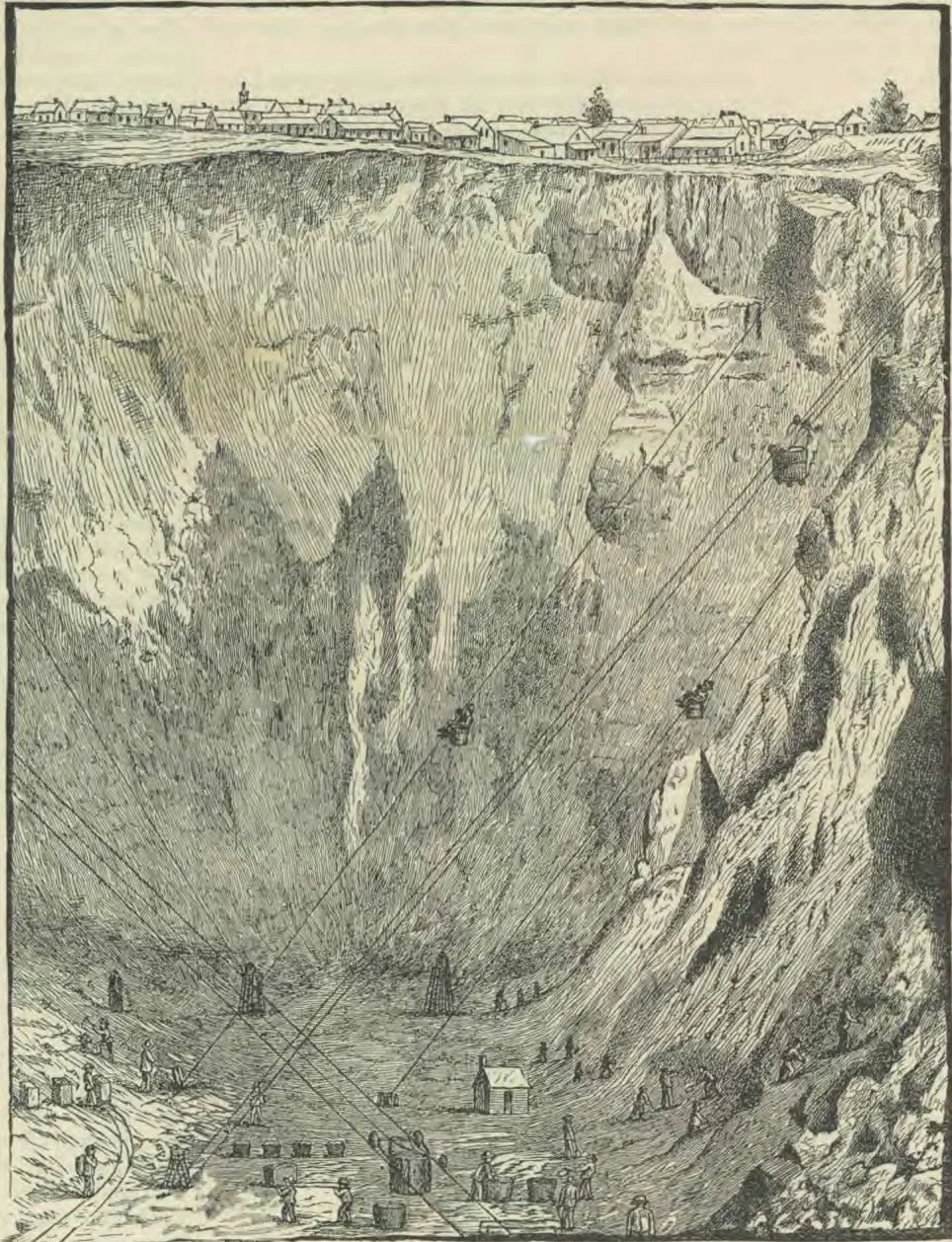
BEFORE us, as we lean over the “wire fence,” referred to last week, is an enormous excavation, measuring in capacity about 9,500,000 cubic yards, deplacing over 40 acres of land surface, and more than 20,000,000 tons of earth, and reaching in depth (not including the under-ground workings), over 500 feet. The walls of this huge orifice are not perpendicular, but slant to the center, from the surface downward.
Looking at the bottom of this immense hole, we notice lively movements of human beings, who appear no larger than clothes-pins. We can distinguish neither race nor color. We are only quite sure that they are men. They are filling those tubs, which we see playing up and down all sides of the mine, with “diamondiferous earth,” that is, earth containing diamonds.
Each tub, we notice, is supported by a car, or truck, which runs on two steel wire ropes, the wheels being grooved so as to ride safely on the ropes. You notice (see picture) that attached to this car is a third rope, smaller than the others. This rope is fastened at the other end to a large horizontal cylinder pulley, which, driven by an engine, draws the tub to the “receiver” at the top of the mine, where it automatically empties. This pulley has two such ropes, one winding over, the other under; thus, at the same moment a filled tub starts from the bottom of the mine, an empty one enters it. There are as many as twenty of these tubs emptying their precious burdens day and night, resting only four hours out of the twenty-four. In these four hours the blasting is done. In the morning at 6:15, at noon at 12:15, in the evening at 6:15, and at 12:15 at midnight.
In the bottom of the mine you notice two stagings. These are directly over two shafts which go deep into the earth, and lead to the under-ground workings. Let us make application to enter. We succeed in securing a pass, since all who enter the mine must have one, and all visitors must also be accompanied by a guide; not alone for the visitor’s benefit, however, but also the Company’s, as some might be tempted to conceal and carry away one or more of those precious gems, which are quite abundantly found in this mammoth excavation.
Our guide tells us to follow him. Soon we arrive at one of the “diamondiferous receivers.” Here we wait a moment until one of the tubs reaches the “receiver.” Instead of its immediately returning into the mine this time, it is ordered to be halted. We wonder why, but soon discover the reason, for the guide tells us to “climb in;” yes, climb in to that empty tub, to be dispatched, as it were, along the wire, to the bottom of the mine. We very hesitatingly obey. It is, “Ruba-dub-dub, three men in a tub,” sure enough. The signal given, away we glide. Although it is a very warm day, during our flying trip we feel sufficiently cool.
In less than two minutes we find ourselves on the bottom of the mine. Our guide now calls our attention to the different strata of earth under and around us. The one in which the diamonds are found is quite blue. It is termed “the blue” by all the miners.
Walking over to one of the stagings previously referred to, our guide says, “If you wish, we will go down this shaft, and see what is going on far below us.” Inwardly questioning as to the safety of such a venture, we reluctantly follow him. [Text obscured.] The visible text continues: “first case. After being [text obscured] from the wire rope, it is pushed by Kaffirs along a track to one of the tubs, and there emptied. Its capacity is just the same as that of the tub, being about 1,000 lbs.”
An empty car is now attached to the shaft cable, and our guide, after furnishing us each with a miner’s lamp, cries again, “Climb in.” Down, down we go, deep into the bowels of the earth,—not quite so pleasant as the first descent, for we have no light save that from our smoky lamps. On the way our guide tells us that our time will permit us to descend only as far as the first horizontal shaft, or tunnel. On reaching it, we are only too glad to stop, and stand on solid ground.
Here we meet a number of men, principally Kaffirs, who are engaged in digging up the precious ground, and filling these little cars ready to be hoisted to the surface. Our guide informs us that over four thousand Kaffirs are employed in this mine, a good proportion of whom work under the ground. Said he, “This ground over, under, and around us, is completely honey-combed with shafts and tunnels, and the bees [men] are kept at work night and day. Of course you understand that at night a fresh set of ‘bees’ go to work.”
After following our guide around to some of the most interesting parts of the under-ground mine, we cheerfully return to the perpendicular shaft, where we “climb in” once more, and are soon safely hoisted to the “beautiful sunlight.” Oh, that is how to test its beauty!
As it is rather late, we endeavor to “catch the first tub.” For the last time we climb in, and have quite an enjoyable trip, no doubt owing to the fact that we are homeward bound. It is certainly something desirable to have the privilege of going down into a diamond mine; but we do not hesitate to assure you that the desire to get out of one is much greater than the desire to go in.
With the payment of a few additional shillings, the guide consents to show and explain to us the process of separating the diamonds from the “blue ground.”
“Let us commence,” says he, “with the ‘receiver,’ one of the places where the tubs are emptied.”
“It is said,” continues he, “and truthfully, too, that no tub in which is diamondiferous ground, comes out of the mine without containing one or more diamonds. You notice this ‘receiver’ has two shoots, which serve to fill those little trucks which you see just now being placed under the shoots. Let us follow this truck load. It is not at all improbable that that load contains several fortunes.”
The truck, having been pushed by men several rods, is now linked with a number of others, and a horse is made to draw the little train of cars for some distance to an open, level piece of ground, which is inclosed by a wire fence. Here the “blue” is emptied on to the ground. This inclosure is almost covered with the “blue.” Hundreds of men are busy at work preparing it for the washing machine. It is done in this wise: At first the “blue” is sprinkled with water, which softens it. Then the large lumps are broken with mauls, and watered again, and lastly rolled with heavy iron rollers, drawn by oxen. Now it is ready to be trucked to the washing machines. Next week we will learn more about this process.
R. S. ANTHONY.
South Africa.

Johnny and Ethel's Drive with the Basket Girl

Without a second invitation, and in a few moments the two laughing children were rolling along the avenue toward the bustle and traffic of Broadway. They drew up to the curb in front of one of the dry goods’ palaces of this famous thoroughfare, and Mrs. Benson left them to go inside.
The children sat idly looking at the throng passing up and down, when they caught sight of a little girl about Ethel’s age, with a basket on her arm. She was gazing at the happy children in the coach, in utter forgetfulness of her errand. She had a good face, smoothly braided hair, and her clothes, though patched, were nice-fitting and clean. She was not an ordinary beggar, for her whole appearance showed some careful hand.
“Wouldn’t it be a lark to take her for a drive?” said Johnny. “It’s awful tiresome doing nothing.”
“Why, what would mamma say?” exclaimed Ethel.
“I am going into the store to ask her. Don’t let the little girl go away till I come back.” And suiting the action to the word, he was out of the carriage and halfway across the walk before Ethel had time to remonstrate. But with her, whatever Johnny did was right and brave; so she awaited his return and kept watch of the girl.
Mrs. Benson was a woman of good sense as well as wealth, and she was glad to give her children a chance to know by experience the blessing that attends a good deed. So when she had patiently listened to Johnny’s plan and his description of the girl, she consented.
He soon came out of the store, and told the coachman what he proposed to do, and that his mamma had consented.
“All right, Master Johnny,” Jem responded; “but it’s a queer passenger we’ll be having this morning, I’m thinking.”
And beckoning to the girl, Ethel said, “My brother and I are going to take you for a short drive if you would like to go.”
The little girl’s pinched face flushed and paled by turns, as she stammered, “You cannot mean it, Miss; my clothes do not look good enough. I am afraid to get into that beautiful, shiny carriage with these ragged shoes; and I’ve got the basket, besides.”
“Oh, chuck the basket behind a door somewhere till we come back,” responded Johnny. “You look clean anyway, and we’ll cover you up with the lap-robe.” And he hurried her in before the crowd on the walk had begun to notice anything unusual.
The sleek little pug turned up his aristocratic black nose still higher in the air, and moved not an inch to make room for her on the cushion; but the children were so kind that Mary could easily endure his scorn.
What pleasure that drive gave to the little girl! They talked only of pleasant things, and when they returned to the store to meet their mamma, bright red roses glowed on her cheeks for the first time in many a day. For the moment she had forgotten that she was poor and hungry, and laughed almost as joyously as her companions. But the quick tears filled her eyes as she said to Mrs. Benson, “I must hurry; for I have left my mother so long, when I ought to have been gathering cold pieces for their breakfast.”
For answer, Mrs. Benson took their number and street, and said, as she gave her some money, “Never mind. This will get you all something for breakfast; and this afternoon I will come to see you, and if you deserve it, you shall be cared for. You wear a good face, and I think must have good parents. Now run home.”
When the children reached home, they rushed upstairs to select some toys for Mary and her two little brothers. Ethel packed up one of her dolls and its wardrobe, and Johnny made a package of picture books, tops, and marbles. After luncheon they started with Mrs. Benson on their mission of charity. Through narrow streets and past dirty commons they picked their way, till they came to the number Mary had given. Here they found a tall brick block filled to overflowing with poor families. Inquiring for George Stevens, they were directed to a pair of stairs leading down from the ground floor.
“We’re going down into the coal bin!” exclaimed Johnny, under his breath.
But they found themselves in a large, unfloored cellar. One wall extended under the sidewalk, two formed the dividing walls between the houses, while the fourth had a door leading out to the ground, which was dug out into a sort of court. In this corner were two rooms boarded off. One room had a window, and the other was a dark bedroom extending back into the cellar. Its only light came through the door of the larger room. In these two dismal rooms (for I am describing a house I have actually seen) lived five persons,—and one an invalid,—shut out almost entirely from God’s fresh air and sunshine. A stove, table, crib, and three chairs filled the room so nearly that there seemed no place to stand, and Johnny felt that somehow his playthings were out of place; for there seemed so much sorrow and want there.
Mary’s mother took Mrs. Benson’s hand in her own, and in broken tones thanked her for the kindness of the morning. She told her how her husband had lost his employment through long illness, and they had gradually gone down from a comfortable home to the wretched place they now lived in. She had managed to keep starvation from the door by sewing for the shops, until even that had failed; and that morning Mary had been obliged to go out for the first time to beg for food. She had earnestly prayed the Lord to protect her from evil while away, and he had generously answered her prayers.
The children had become busy with the toys, and soon were laughing gleefully; for
“The tear down childhood’s cheek that flows Is like the dew-drop on the rose: When next the summer’s breeze comes by And waves the bush, the flower is dry.”
Mrs. Benson immediately set out to better the condition of the family. They were removed to a healthier location. Work was given Mrs. Stevens, and pay sufficient to support them till her husband regained his strength, when a place was found for him in a factory.
Mary is now a healthy, happy school-girl, with two well-fed and well-clothed brothers; and all these blessed consequences followed from Johnny’s one unselfish act of kindness to one less favored than himself. “Inasmuch as ye have done it unto one of the least of these, ye have done it unto me,” says our Saviour.
L. E. ORTON.

APPRECIATION

Twice blest is he whom God endows With truest gifts of seeing, Who feels each beauty day by day Throughout his inmost being; Who reads the language of the breeze, The brooklet’s rippling laughter, Who hears the whispers in the trees, And bird-songs coming after.
—American Magazine.

THE CITY OF SIOUX FALLS.

Ten years ago the city of Sioux Falls was a small western hamlet, without any commercial communication whatever with other cities. But so rapidly do towns spring up in the West that there are now four trunk-line railroads passing through the place, making it a central point of travel and traffic for the whole of Dakota Territory. It has rapidly grown from a little frontier village to a city of 11,000 inhabitants. It is situated on the Sioux River, which was named after the Dakotas, or Sioux Indians.
The finest quality of building stone in the United States is found here in large quantities, and the thundering boom of the dynamite blast can be heard several times an hour all day long. A few rods from the present quarry has recently been discovered a very fine quality and color of jasper stone, and a quarry will soon be opened. This stone takes on a very fine polish, and is used for pillars in large buildings.
But we wish to speak more particularly about Sioux River and its falls.
Between two ranges of hills lies a fertile valley, through which the river passes. It is a slow stream, not over ten or twelve rods wide. It flows peacefully along until it strikes a solid bed of rock, that extends across the entire river, portions of which are so elevated as to divide the river into several small streams. These little streams here and there plunge down declivities from six to eight feet high, thus making miniature water-falls, which look clear and beautiful, as they sparkle in the bright sunlight.
The distance from the beginning of the rocky incline, where the stream divides, to its base, where it unites, is said to be three-fourths of a mile, and the entire hight one hundred and twenty-five feet. This unbroken bed of rock, over which the river flows, extends some distance beyond either margin of the river, and its depth is unknown. In places it has been blasted down over twenty feet, and still the solid rock appears.
The main falls, near the base of the incline, are about forty feet wide and twenty-five feet high. Near the west side is a shoot of water, that pours through a rock gateway with perpendicular sides, into a rock basin, very much resembling a cistern. There is no visible outlet, and although a perfect torrent of water is continually pouring in, the basin never overflows. Undoubtedly there is some subterranean passage through the rock.
It is a beautiful sight to watch the river sweeping over its rocky bed, dividing into streamlets, shooting hither and thither, dropping here and there down a perpendicular hight, until it makes its final plunge over a steep precipice, and, uniting on the plains below, pursues its way over the treeless prairies to the waters of the great Missouri.
It was a delight to leave the dusty, noisy cities of St. Paul and Minneapolis, as we did a few days ago, and journey on over the fresh, green prairies. In all directions stretched the boundless expanse, until the green of the earth and the blue of the sky seemed to meet. Our minds went forward to the time when the vast territory before us would give place to the plains of Eden restored, where houses will be built and vineyards planted, that will not be left for others to enjoy.
E. HILLIARD.

NOT AFRAID.

A VOLUME of annals of old Philadelphia contains an anecdote of Franklin which will, we think, be new. A few days after he began to publish a newspaper, he commented sharply on the dishonest conduct of certain influential and wealthy town officials. Three or four of his friends, young mechanics like himself, anxious to rise in the world, sharply reproved him for his imprudence, and told him that a poor man could not afford thus to make enemies.
Franklin listened in silence and patience, and when the lecture was over, asked his critics to sup with him. They came, and sat down, expecting a luxurious meal, such as was common in those days among the well-to-do. Before each guest, however, was a bowl of mush and milk, and a pitcher of water. They tried in vain to swallow the coarse fare, watching Franklin as he emptied his bowl with evident relish. When he had ended, he said:—
“That is my usual supper. I have an advantage over you, as you see, for when a man can live on sawdust pudding and water, he needs no patronage.”
“The only freeman,” says Beuchet, “is he whose simple habits lift him above the desire for wealth.”
How many young men among our readers beginning life would be willing to wear the coarse clothes which formed Franklin’s dress, or to live on mush and milk, in order that they might express their opinions and live out their own lives without the fear or favor of wealthier men.—Sel.

WHAT CONSTITUTES A GOOD TEACHER.

No one specialty can alone give success to the Sabbath-school work. There may at times be local difficulties, that require a remedial specific; but it will not do to rest on such to meet other and paramount necessities. The plans for successful Sabbath-school work need careful thought for development, and should be formed so as to meet every existing want. The lack of a single element needed in the school may prove a serious detriment to its usefulness.
The success of a Sabbath-school does not wholly depend on its superintendent. True, much responsibility falls on him, but if he does not have faithful co-workers, many of his best efforts will prove unavailing. Very much, in fact the greater part, depends on the efficiency of his teachers. If they act their part faithfully and earnestly, in the fear of God, gratifying results are sure to follow. It is true that all are not naturally qualified to teach others, and it may be that in some schools there is a dearth of such material as would be best fitted, from the start, to teach successfully. But for all that, when a selection has been made, it is incumbent on each appointee to fill the place to the best of his ability, and also to improve his talent every week he holds the place of teacher. This is absolutely necessary, not only for the good of the teacher, but for the prosperity of his class as well. If a particular lack exists on the part of the teacher when first called to manage a class, the effect of it will be seen on his class until that lack has been supplied. And yet no one is at first free from all blemish. It is a part of the teacher's work faithfully to examine himself to find whether he is doing all that he might do for the welfare of those intrusted to his care. It must be conceded that if the teacher fails to correct any oversight that may have attended his earlier work, it cannot fail to affect in some measure his own efficiency, and also the standing of his class.
The first qualification for a teacher, provided he possesses some degree of natural ability, is to know how to secure the help of God in his work. To do this, one must be constant at the throne of grace, and earnest in presenting his petitions. But this is not all. Much prayer will not take the place of study. While it is imperative for one to seek God in faith for his blessing, he cannot expect needed help unless he shall try to co-operate with the Lord.
Every lesson should be studied—not simply looked over. On this particular point many fail. They put off the lesson until there is only time to look hurriedly through it, and think, “Well, I have the advantage of the class in the fact that I have the paper from which to ask the questions; and as I have nothing else to do, I will get along well enough.” This is a sad mistake; the one who has the questions to put should understand not only the lesson itself, but those points not marked in the lesson, yet bearing upon it.
When a question arises concerning any point under consideration, without any argument the teacher should be able immediately to propound a series of two or three questions that would, by scriptural answers, furnish the desired information. It is true this will cost labor and study, but it pays in the end. A teacher who does not try to settle any query that arises in his class, but passes it in silence, will soon find himself losing influence with his pupils, and this should be a signal for him to relinquish his charge.
To avoid such a calamity, a teacher must do something to retain his standing before his class. If he is not thoroughly acquainted with the lesson, so that he may act on the foregoing suggestion, or in a brief manner give the explanation sought for, his next resort will be a rambling talk to cover up his lack of knowledge. In other words, he will “preach” to his class. But in such cases the real design of the teacher is so ill-concealed, that the effect on the class is the opposite of a wholesome one, and harm is liable to arise from it.
There are those, however, who suppose they must do more or less “preaching” to their classes, in order to enforce the moral which the lesson is supposed to contain. This is another mistake. If the pupils are not more than ordinarily dull of comprehension, and if they have studied the lesson, they have probably seen the point before. If the lesson did not bring it out, it was something outside of the lesson, and the more these outside matters are discussed, the less impression designed to be made by the lesson will be left on the minds of the pupils. Do not try to make them understand too much at one time. Surely the design of the lessons themselves is to teach morals, or they are seriously defective, and should be remodelled.
Instead of moralizing too freely before a class, it is a great deal better to learn the art of framing questions in a way that will be comprehensive, and will lift into prominence, without any seeming effort, those practical points which lie below the surface of the lesson. Should we be asked for a definite rule whereby this art is attained, we must reply that there is none except diligence in the preparation of the lesson, and a firm reliance on God for his help. Some acquire it by one process, and others by another method. Experience in any line of work is necessary for the attainment of excellence, and this is no exception.
If one does not meet his own ideal of what a teacher should be, there is all the more need for a closer application that he may come up to the mark. To become discouraged does not help the matter in the least, and one must continue actual work if he ever hopes to succeed. Then do not give up the struggle. In time you may be cheered by taking a retrospective view from the heights to which you have patiently toiled. And if you have really struggled for the mastery, it would be for your encouragement to take these backward looks frequently, that you may appreciate the progress made. But above all this, do your work cheerfully, and many of the uneven places will seem smoother as you come to them in your journey. In this way you will not only bring sunshine to your class, but your experience will fit you to impart courage to any fellow-teacher who feels dissatisfied with his work, and knows not how to provide for the lack he sees.
There is a great work before the faithful teacher, and a corresponding joy awaits him when the crowns of life are bestowed. Courage, then, should be the watchword of all, while they are reaching toward the summit of excellence in their calling. J. O. CORLISS.

NOTICE

We regret to say that Miss Winnie E. Loughborough, who has filled the office of Secretary and Treasurer of the International S. S. Association so long and so well, thinks she must be relieved from the responsibilities of the position. Her resignation was handed in soon after her election, but it was not acted upon until a short time ago. In consultation with other members of the Executive Committee, we have thought best to appoint Sr. E. H. Whitney to act as Secretary and Treasurer for the remainder of the year. Sr. Whitney has kindly consented to take the position, and hereafter all communications to the Secretary and Treasurer of the International S. S. Association should be addressed to Mrs. E. H. Whitney, Battle Creek, Mich. C. H. JONES, Pres.

CORRESPONDING SECRETARY.

At the last session of the International S. S. Association, the Constitution was so amended as to call for a Corresponding Secretary, and Sr. Jessie F. Waggoner was accordingly elected to fill the position. The work of this Association is rapidly increasing, and it cannot be expected that the one who acts as Secretary and Treasurer can also attend to all the correspondence. Companies of Sabbath-keepers are constantly being raised up in different parts of the field, outside the jurisdiction of any State Association. These companies should be organized into Sabbath-schools. They need counsel and advice, and it is the special duty of the Corresponding Secretary to look after such companies as these.
Already a good work has been done, and we have encouraging reports from several schools, but we are satisfied that much more might be accomplished if the Secretary could be informed of every new company that commences to keep the Sabbath, outside the bounds of any State Association. We therefore request persons who know of such companies now, or who may learn of them hereafter, to send the address of some one of the number to Mrs. Jessie F. Waggoner, No. 1465 Castro Street, Oakland, Cal. Ministers and other laborers in new fields are especially requested to comply with this request.
A complete outfit of Sabbath-school supplies with letters of instruction have been sent to our brethren on Pitcairn Island, by the hand of Brother Tay, who has just sailed from San Francisco for that island. Supplies have also been sent to the little company in British Guiana, and an interesting correspondence opened up with several companies in the Southern States. Thus we see that the work is onward.
Do not make a mistake. Quarterly Reports and everything of a financial character from our State Associations should be sent direct to the Secretary and Treasurer, Mrs. E. H. Whitney, Battle Creek, Mich. The other correspondence above referred to, in regard to new schools, etc., should be addressed to the Corresponding Secretary, Mrs. Jessie F. Waggoner, Oakland, Cal.
C. H. JONES, Pres.

DISCIPLINE IN THE SABBATH-SCHOOL.

To maintain good order in his class is one of the important duties of every Sabbath-school teacher. The earnest teacher should be in his place some minutes before the time for the school to begin, and should feel himself responsible for the behavior of his scholars as much before as after the opening of the school. They should be made to feel that nothing short of a quiet deportment is appropriate to the house of God and the Sabbath day. Whispering, laughing, and playing should not under any circumstances be allowed. But if you require this of your pupils, it will not do for you, my dear teacher, to be whispering and laughing, in ever so quiet a way, with your fellow teacher just ahead of you, or across the aisle. Children are keen observers; and your precept will not be forcible enough to impress what your example contradicts.
It is a good thing for the teacher to engage in a quiet conversation with the members of his class as they come in, upon some profitable theme proper to the day. This will keep the younger ones from getting into mischief, and in older classes will prevent the silly giggling and gossiping which too often occupies any time that may elapse before the opening of the school. There should be quiet and attention in the class during the school, and especially the recitation hour. Whenever this is not the case, the teacher should stop teaching, and give his attention to the matter until order is restored. It is of no use to go on teaching when half the class are inattentive or restless. The teacher should be sure to speak distinctly, and to have every scholar hear what both he and the other members of the class are saying. The scholars should be so arranged that the teacher can easily and at all times see what each is doing. In this way he may know that all are in order, and listening to what is said.
An old superintendent once said that the worst disorder was that which begins with the teacher, and certainly it is the hardest to cure. No teacher should fail to give instant attention to the sound of the bell or the superintendent’s voice; and whenever any change takes place in the routine of the school exercises, he should be especially vigilant in suppressing any risings of disorder. If, when the superintendent’s bell calls for silence at the opening of the school, a teacher continues to speak to a pupil or to a fellow-teacher, the class understand that the call is not to be heeded, and act accordingly. If, when the opening song is announced, the teacher keeps his seat, the scholars take it that rising or not is a matter of choice. If, when the bell to close the recitation is struck, the teacher continues to talk, the superintendent cannot hope for silence from the school. Let teachers lead their scholars in obedience to rules, if they expect to have good order.
The sooner the members of a class understand that they are to show to their Sabbath-school teacher the same respect and obedience that they are expected to give to their day-school teacher, the better it will be for class, teacher, and school. The idea formerly prevailed to quite an extent that the Sabbath-school teacher, because his labor is unpaid in money values, is to submit to an amount of disobedience and disorder that the teacher of a secular school would not for a moment think of enduring. If the children were unruly, they must not be controlled, but coaxed into decent behavior, by the teacher. This is, however, all a mistaken notion, and happily is losing ground among sensible people. Why should not children behave as well when learning the Bible, as if it were their reading or geography lesson under consideration? Does any one know why the teacher who is paid for his labor is to have more respect than the one who bestows it freely? Those who doubt the propriety of discipline in the Sabbath-school would do well to think a little on the subject.
EVA BELL GILES.

Work for God as an Unprofitable Servant

It is a privilege to work for God; but he who does best and most for God, is “an unprofitable servant” whom God has honored in spite of his unprofitableness.
Continue reading: A MODEST BEGINNING