The rapid pace at which present truth is advancing in the German empire is best seen by the development of its members and means, and the increasing number of its organizations. On going to that country twenty-three years ago, the writer found two little companies of about twenty-five members, which were located in Rhenish Prussia, and were the only ones at that time in the whole German empire. In the winter of 1889, the third company was organized, in Hamburg. In 1898 the first conference was organized; in 1901 the first union conference; and now there are two union conferences, and in Germany alone, twelve conferences. The writer remembers the time when he knew every member, and baptized every new one, and visited every church; but the conferences have increased so rapidly that this winter it was impossible to visit all. In five weeks' time we held nine conferences, and the very cities where these conferences were held show the spread of the work throughout the empire. They were as follows: Insterburg and Breslau in the extreme eastern part of Germany, Stuttgart in the south, Bremen in the north, Elberfeld in the west, and Frankfort-on-the-Main, Frankfort-on-the-Oder, and Halle in the center. There is yet to be held a general meeting in the spring at Berlin.
There are now over 8,000 Sabbath-keepers in Germany, which places the “Cradle of the Reformation” next to the United States in membership. These have paid over $100,000 tithe during the past year, which makes an average of about $12.50 per member. Of this tithe, fully $20,000 was given to fields beyond,—outside of the German empire,—besides over $18,000 in offerings. More than 1,700 members have been received during 1909.
Our first meeting was held in Breslau, Silesia, from January 5 to 9. There was a good outside attendance at the public lectures, and also a full representation of our people.
While Brother Guy Dail and Elder H. F. Schuberth went to Insterburg to attend the meeting of the Prussian Conference, I went to Stuttgart to assist Elder J. H. Schilling in the South German Conference gathering, which was held January 12-16. We were pleased to see all our churches and companies well represented, about four hundred of our people being in attendance. These, with the strangers who came into the meetings, made good audiences. Not less than 267 members have been received into this conference during the past year; its tithe has risen to over $13,000. Its total membership is 1,115, so the time had come, when, according to the decision of the last union conference meeting in Friedensau, this field should be divided. Old Bavaria, with nearly six million people, was organized into a separate conference, its membership being about 335. The South German Conference still retains over 8,000,000 people, and nearly 800 members.
Our readers will remember that only a few years ago, our work in Bavaria was greatly hampered. We were forbidden to have our worship or celebrate the ordinances. But the Lord answered prayer, and finally, after several petitions had been sent to the prince regent, we gained recognition, and were given liberty. Since then quite a sturdy membership has been developed in Bavaria, and there are now good strong churches in the larger cities,—in Munich, Nurnberg, Augsburg, etc.,—and everything promises well for the future of these conferences. With tears of gratitude in their eyes, our brethren in Bavaria told of their former trials, and praised God that the time had now come when they could have their own conference. In view of the weakness of the membership, the South German Conference nobly voted that they would divide equally the remaining capital with them, while on the other hand, the new Bavarian Conference promised to turn over its first and second tithe to the union conference for the work in the mission fields. Elder D. P. Gaede was elected president of the South German Conference, in the place of Elder Schilling; and Elder F. Prieser took the Bavarian Conference.
The business of the conference passed off harmoniously. Our people showed deep interest in the mission work, and listened with the best of attention to the reports which Brother E. Kotz and the writer gave of the progress of the work in Africa. There were good offerings on the Sabbath for missions. Our brethren raised nearly $800 in cash and pledges for the school in Friedensau. They also voted about $500 for the work in Austria and the educational fund. On the Sabbath the Lord came very near to us, and there were many hearty confessions made. Brother Erzberger was present during the meeting, but was laid up with a severe cold.
Our canvassing work is also gaining strength. We still have to pay quite a high license in Bavaria, but the canvassers' reports show that there was about $10,000 worth of books sold in the South German Conference last year.
Several interesting incidents occurred during the meeting. Elder Kotz's speech on Africa was announced in the papers; and at the beginning of his talk, he was approached by a fine gentleman who had read the notice. To Brother Kotz's12great surprise, he recognized in this gentleman the chief officer of the county of that district of German East Africa where our missions are located. He had come home to Stuttgart on a furlough, and when he learned of the meeting, he came with his lady friend. I also had an interesting visit with him. He has visited our stations several times, and invited us all very heartily to call on him in Africa.
Another instance of God's working was this: As we gathered for our dinner in the vegetarian restaurant, I made the acquaintance of one of our stanch brethren from Wurtemberg. His wife was with him, and when I asked her if she was also a sister in the truth, she emphatically declared in the negative, and that she did not want to be. I then told her that my experience had been that those most bitterly hostile to me on account of the truth became my warmest friends after accepting it, and gave a few instances. She became deeply interested during the meetings, and a week later the good brother wrote to us, and, with his heart full of joy, informed us that his wife had yielded.
At this meeting the first company from the little grand duchy of Luxemburg was received, with seven members, several of whom were present. The grand duchy has about 250,000 inhabitants, and does not belong to the German empire. Its inhabitants are nearly all Catholics, but the country is very free. As we could not obtain the hall for Sunday, the sixteenth, I spent that day in Zurich, Switzerland, and spoke to a crowded house on Abyssinia. Next day we had our audit for the German-Swiss Conference, which now has about 527 members, and I was well pleased to learn from the committee that they appreciated their new president, Elder O. E. Reinke. On the seventeenth I spoke to the church at Strassburg. The work is also growing in Alsace-Lorraine, and we have now over 100 members in that province. On the eighteenth I spoke to an attentive audience at Karlsruhe, my birthplace.
From January 19 to 22 we attended the West German Conference in Frankfort-on-the-Main. The West German Conference takes in the provinces of Westphalia and Hesse, and also the grand duchy of Hesse. There was a good representation of our people from the field. During the past year 175 members have been added, of which seventy-six came in during the past quarter. Lately twenty-seven have been baptized in the city itself, and there are now 118 members there. Being so centrally located for the western part of Germany, as well as Austria and Switzerland, Elder Schilling has chosen this place as his headquarters for the West German Union Conference. An excellent spirit prevailed also in this meeting. The people took a deep interest in our mission work. Over $600 was given for Friedensau, and about $500 for the mission in Austria and the educational fund. The meetings were held in a small hall in one of the finest establishments in the town, and were well attended.
Elder H. Fenner was unanimously elected again president of the field. On Sabbath young Brother Erzberger (the son of Elder Erzberger) was ordained to the ministry. The other son of Elder Erzberger is head nurse in the Gland institution. So one son is serving the Lord in the French Conference, and the other in the German. We are glad to notice that our young people are thus dedicating themselves to the work.
Receiving a despatch from Dresden, I spent Sunday there at the Saxon Conference. They held their meeting at Loebtau, a suburb of the city. This conference has now a membership of 503. During the last year 164 were added. Elder W. Prillwitz was chosen as their new president. Our liberty is still restricted there, but we are sure that God will hear the prayers of his people, and ere long will grant us full liberty in this field also.
As we see one strong conference after another being organized in Germany, the finances developing, the work increasing, and note the good attendance at the general meetings, and that many strangers attend, we can but say, “Germany is indeed ripe for the message.”
God has already done great things, but we are sure that if the people and ministry will keep close to him, we shall see still greater things in the near future, and that Germany will once more be a mighty factor in this last reformation. May God grant it! is my earnest prayer.
Hamburg.
God's Love
By Louis A. Banks
MARGARET MEREDITH tells how a notorious rough named Ike Miller, the terror of a mining district in the north of England, was converted. Henry Morehouse, a young evangelist scarcely out of his boyhood, was preaching to a company of these miners, when Ike Miller came in, and took a seat near the front. Preachers and helpers trembled, for this wicked man had threatened to break up the services. Henry Morehouse preached on God's love in Jesus Christ, and he longed to reach the heart of the wild, grimy miner who sat so strangely quiet, gazing into his face.
After the meeting the men gathered around the preacher regretfully.
“Ah, Henry, you didn't preach right. You ought to have preached at Ike Miller. You had a great opportunity, and you lost it. That softly sort of preaching won't do him any good. What does he care about love? You ought to have told him the dreadful punishment he is going to get.” The young preacher only said, in a 'boyish tone, “I am real sorry I did not preach to him right. I did so want to help him.”
Meanwhile the big miner was tramping home. His wife ran in front of the children as he came in, but she stared in bewilderment; he was not drunk; he was not scowling. He put his arms around her, and kissed her, and said, “Lass, God has brought your husband back to you.” Then, gathering up the shrinking children, “My little boy and girl, God has brought your father back to you. Now let us all pray,” and he knelt down. There was a silence, but for many sobs; he could not think of any words; his heart was praying, but Ike Miller had uttered no prayer since he was a little boy. At last, words from those distant days came back to him—something that his mother had taught him; and from that loved floor, in the midst of that remnant of an abused family, to be abused no more, he sounded out in rugged gutterals through his sobs:—
“Gentle Jesus, meek and mild,
Look upon a little child;
Pity my simplicity,
Suffer me to come to thee.”
— Louis A. Banks, in S. S. Times.
The Lord Is My Shepherd
“The Lord is my shepherd.”
The India Mission Field
By John L. Shaw
J. L. SHAW
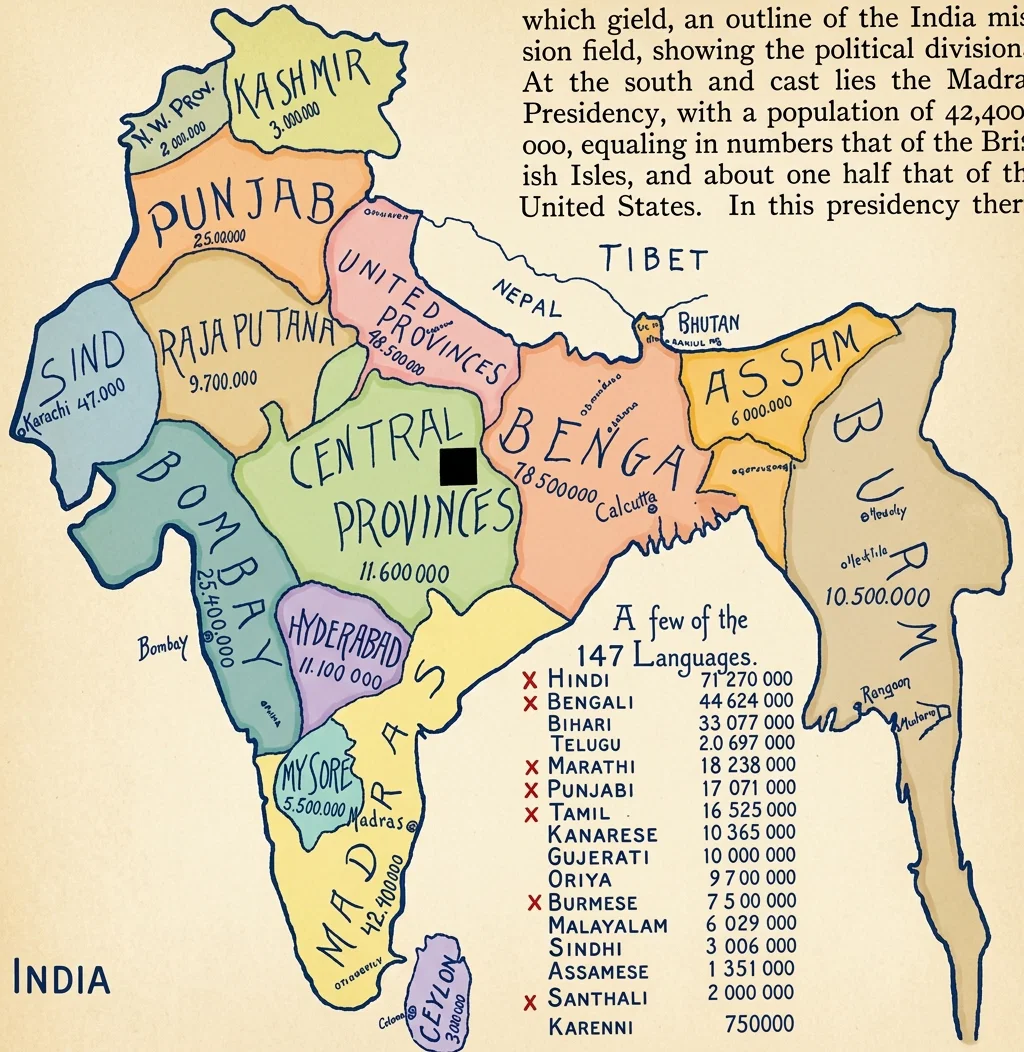
The Master said, “Behold, I say unto you, lift up your eyes, and look on the fields; for they are white already to harvest.” “The field is the world,” and India is a great unwarned and waiting part of that field. Though not comprehending more than one thirty-fifth of the world’s area, in population it is a continent in itself. The figures are 297,970,499—but these are bare figures. And how wholly wanting are they to give any adequate idea of this one fifth of the human family, which, hemmed in to itself, forms a world all its own.
PROVINCES, POPULATION, AND PRINCIPAL LANGUAGES OF INDIA. THE BLACK SQUARE SHOWS THE PROPORTION OF CHRISTIANS TO THE HEATHEN
Let us look at the accompanying map, which gives an outline of the India mission field, showing the political divisions. At the south and east lies the Madras Presidency, with a population of 42,400,000, equaling in numbers that of the British Isles, and about one half that of the United States. In this presidency there are two families and one single worker located, in the southernmost extremity among the Tamil Sabbath-keepers. Madras, its capital, the third city of India, has no laborer. We met one Sabbath-keeping family a year ago when there. They besought us for a minister to come, and desired to know whether, if money were found to pay transportation, one would come and help them. This city, with nearly half a million people, is a great field in itself. Few, if any, cities are there so great in numbers without an appointed representative of present truth.
To the north, yet mostly within the Madras Presidency, are the more than twenty millions of Telugus. We have gone through their country several times, and have seen the people, and talked with them. Other missionary societies are operating in this territory, making many converts, multiplying missions,13schools, and hospitals, yet we have no one among the Telugus who can speak their language, and we have never so much as voted any one to them. Think of it, dear friends! twenty millions—one fourth the population of the United States, three times the population of Australia, and more than double that of the South African Union Conference, and yet no entrance. At the present stage of the work there are few languages spoken by so many millions without at least one or two centers of light.
Going farther north and east, we find Bengal, with 78,500,000—more than four fifths as many as the population of the United States. The Bengali people alone number 44,620,000. Among them are located three families and a single worker. But what are three families without a mission property, a school, or a hospital? True, some literature has been prepared, and a few Sabbath-keepers have been gathered out. A Bengali church has been organized in Calcutta.
Farther west and north are the United Provinces, with 48,500,000. Within their boundaries lie the Mountain Mission Rest Home, which is the largest property we own in India, costing eight thousand dollars. These provinces are the very center of the great Hindustani world. A few Sabbath-keepers have been gathered, and a year ago the first church was organized. Here we have two families and three single missionaries.
The Punjab, Northwest Provinces, and Kashmir, lying still farther north and west, with more than 30,000,000 inhabitants, have no representative of the present truth. Punjab alone has a population of 25,000,000. To the south are the provinces of Rajputana, and Central India, and Central Provinces, neither of which has a Seventh-day Adventist within its borders.
To the west is the Bombay Presidency, with two families. East and south are the native states of Hyderabad and Mysore, into which we have not entered. To the east, across the Bay of Bengal, is Burma, with three families and three single representatives of the message. Other small provinces, like Baroda and Berar, in the west, and Assam in the northeast, lie unentered. Considerable has been done in different parts of India in English, mostly on the Calcutta side. There is a church at Calcutta, Lucknow, and Mussoorie. Yet the English-speaking people of this country are few, only a drop in the bucket of Indian humanity.
We have made a small beginning in seven of the languages—seven out of one hundred forty-seven marks the hand of progress here. And so these nations tell us of vast unentered territories. They speak to us in an unknown tongue. We do not hear or know their need, yet they are waiting, in their ignorance, waiting for the Light of the world, and the glorious message of our coming King. Who now is willing, who is able, who is ready to pioneer the way among the unentered dialects of India?
Takoma Park, D. C.
Among the Churches in Korea
By C. L. BUTTERFIELD
C. L. BUTTERFIELD
HAVING been in this field about thirteen months, and during that time not able to visit all our churches, it seemed best for me to make a trip before the end of the year. Therefore, I left Seoul November 7, for—
Soonan
Since moving from Soonan to Seoul, this was my first visit to a local station. Dr. R. Russell and wife and Miss May Scott are at this place. I was met at the station by Dr. Russell and about twenty students from the school. Three days were spent there. I was much pleased with the progress being made. The school is in excellent condition. The students (about forty) are working in a commendable manner. Dr. Russell seemed to have things well in hand. The dormitory had just been finished, and the boys were moving in. It accommodates twenty students. I enjoyed my stay very much. The time to go came all too soon. From Soonan I went to—
Ping-Yang
One of the native helpers has been located here for some time. He told me he had decided to stop preaching. For several reasons it seemed best to accept his resignation. But after talking and studying with him for some time, he asked to be allowed to preach again. So it was decided for him to go to another place to labor. There is a church-school here of thirty boys and fifteen girls. I was much interested in this. The students are the making of a good church. Our church building is very small, only eight by twenty-four feet. The evening I was there, about seventy persons assembled in this little building. The ceiling is so low that one can scarcely stand without bumping his head. As this is next to the largest city in Korea, I think something should be done to assist our people there in putting up a suitable house of worship.
KOREAN MUSICIANS
Chinnampo
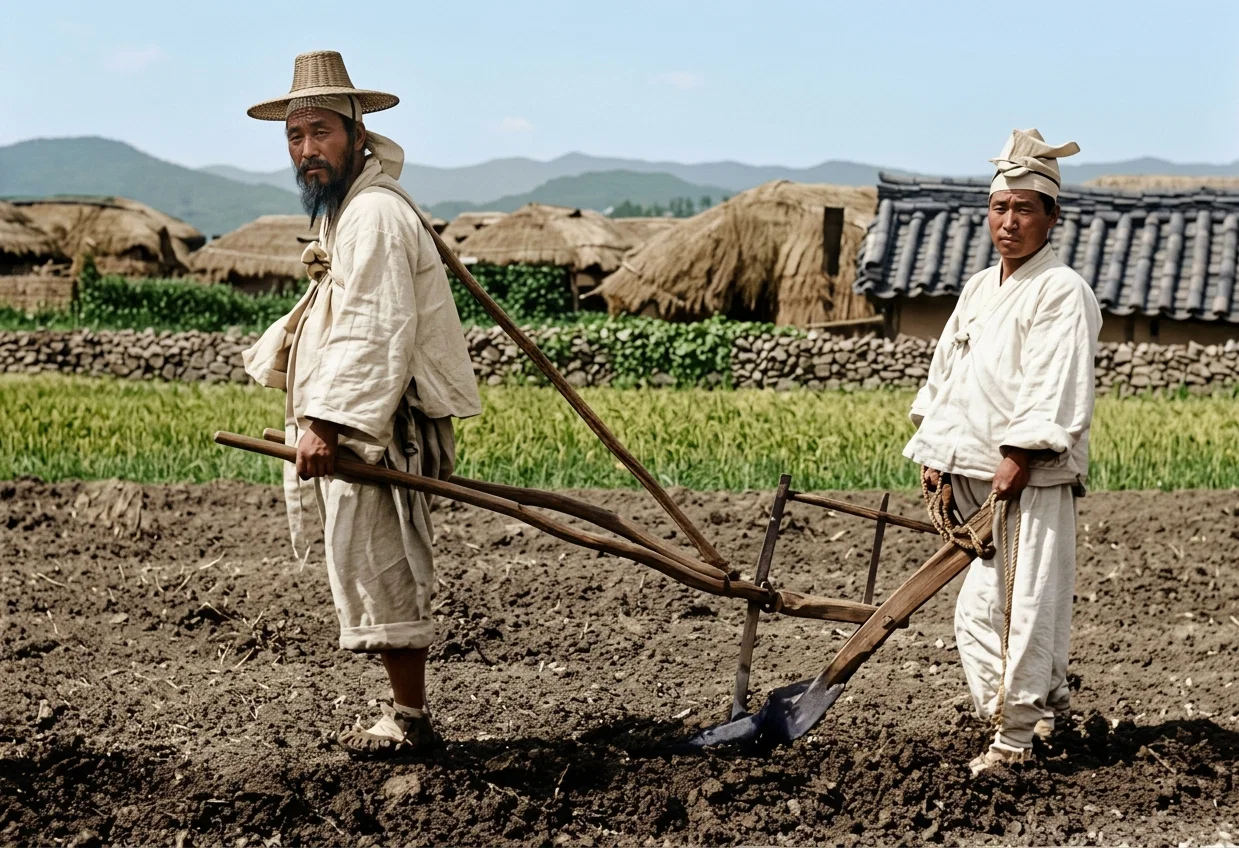
Here I found Miss Scott spending a few days with the girls’ school. There are about twenty students in attendance at present. The teacher is one of our native Bible workers. Miss Scott is getting along nicely with the language, and was quite a help while there. I had spoken at each of the above-mentioned places in the Korean. But from here on I was to be among those who did not know a word of English. And as I know only a little Korean, I trembled at the thought of going. But I believed that God was leading, and I went on, trusting that he would be with me. And he was. One of our native laborers accompanied me to act as guide and helper.
FARMING IN KOREA
Sundol
Our next stop was at this place, where the message first began in Korea. I met two more of our workers here, and spent two days with them. I had the privilege of speaking to this company on the second coming of Christ and the importance of our preparing for it, as it is not far distant. This is one of our largest churches. There are fourteen members, and about forty Sabbath-keepers in all. I had five more towns to visit,—Kan Dem Ero, Sam Mal, Yuppo, Nong Dong, and To Kae. At each I had interesting experiences, and especially at Nong Dong, where I spent Sabbath.
This is the home of my helper. I stayed with him. It was not a grand house, yet it was clean, and he made everything very pleasant for me. For a part of my food at his house, he presented me with two dozen nice persimmons and a few pears, which he had bought on our trip and carried home in his hand luggage.14
Very likely that amount of fruit had not been in their house for some time, and it must have taken more than a day’s wages to purchase it. I shared it with them as much as they would allow me to. It is such things as this that show the appreciation of the people for our help, and it endears them to us.
The company, while small, is certainly alive and working. The women all read; but that is quite out of the ordinary, for there are not many women in Korea who can read. I felt much at home, and was sorry that I could not spend more time here.
While I should have been thankful had I known the language better, yet I enjoyed helping all I could, and God richly blessed my efforts to preach the truth. Next month I expect to take another trip, and shall then have visited all our companies except one. Most of them are sadly in need of instruction. But we hope soon to be able to give them the assistance they so much need, through our native helpers.
While it may seem that the message is going slowly in this field, yet it is making some progress, and a people is being prepared for the soon coming of our Saviour in the clouds of heaven. We are indeed grateful for the help that we have recently received in Brother R. C. and Sister Wangerin and Brother H. A. Oberg. We believe that God will abundantly bless their service in this field. We are well, and enjoying much of his blessing.
Seoul.
E. T. WILSON
By E. T. Wilson
Peru
I HAVE been out with the new Spanish health book, “Salud y Hogar,” and find my sales have amounted to $185.75, gold, in six days. In less than one hour, while waiting for a work-train in the small village of St. Nicholas, I took fifty-three dollars’ worth of orders. These figures are not for the purpose of showing how much I can do, but to show that God is in the work. I wish to call the attention of those in the home land, who think the people are too poor to buy books, to the fact that in this village of over two thousand inhabitants there are not six houses that have beds in them, and floors are not even dreamed of!
While our colporteurs are looked upon as intruders by many, and are often compelled to walk for miles through the dry, burning sand, or over the rugged roads, in order to reach many of these people, yet, I thank God that as the result of this very work done by the faithful colporteurs, we have even here in Peru companies of believers springing up in different parts and calling for a minister to be sent to give them further instruction regarding our faith. My observation of this field forces me to the same conclusion at which nearly all the missionaries arrive, that there is one leading agency by which the gospel will reach the world in this generation, and that is through the printed page.
We are expecting to hold a canvassers’ institute in April, at which time we are hoping to have several natives present who have accepted the truth. We hope to train these to sell our books to their own people, many of whom spend what little they get for candles, images, etc.
We are well, and of good courage in the Lord, and pray that the work may be quickly finished, and that our blessed Lord may come and take us all home.
E. T. WILSON
Mission Schools
By C. A. Chichlow
IN our daily visits among the people, and in the closer association with our students in the schoolroom, it is all too apparent the part that mission schools have to play in the scheme of the great work to be done for “this backward child race” of the South. There is no more positive and uplifting factor, no schools better adapted to the present and future needs of these simple folk, than our mission schools. In the minds of many of the Southern white people no amount or kind of training and education can ever fit the Negro to assume the duties and responsibilities of life, in their fullest extent, or lift him above “the place where his inferiority naturally puts him;” but we are assured that if his training is neglected no longer, but begun at once, he can be lifted above his present state, and fitted for a useful life here and the eternal home above. But how shall this be done? By what means shall it be accomplished? We quote the words of another:—
“No line of work will be of more telling advantage to the colored people in the Southern field than the establishment of small schools. Hundreds of mission schools must be established; for there is no method of giving the truth to these people so effectual and economical as small schools. This line of work has been specially presented before me.”
Brethren, that which is to be done to help push forward the work among this unfortunate people must be done quickly, now. There is much indeed to occasion alarm. Events are so shaping themselves, and rapidly, in the thoughts and tendencies of the Southern people, both white and colored, as to call loudly and insistently for the last full measure of our devotion to a cause long neglected. Let us watch and take heed that that day, when all efforts in behalf of the colored race shall perforce have an end, come not upon us unawares. A people as enlightened as we are should both jealously and zealously guard against the possibility of such an event, by enlarging our gifts and helping the work along in its various needs. The time to prepare for war is in time of peace; the accepted time to prepare a people from among this race for the great and awful day of God’s judgment is now. This responsibility rests upon each one of us, and by no means can we avoid it or shift it upon another. “So thou, O son of man, I have set thee a watchman unto the house of Israel; therefore thou shalt hear the word at my mouth, and15warn them from me. When I say unto the wicked, O wicked man, thou shalt surely die; if thou dost not speak to warn the wicked from his way, that wicked man shall die in his iniquity; but his blood will I require at thine hand. Nevertheless, if thou warn the wicked of his way to turn from it; if he do not turn from his way, he shall die in his iniquity; but thou hast delivered thy soul.' Eze. 33:7-9.
May the softening influence of God’s Spirit touch and tender every heart to respond quickly to this call, ‘while it is day: the night cometh, when no man can work.’ C. A. CHICHLOW.
Paul’s Life as a Whole Burnt-Offering
“At a missionary conference in Bristol, England, May 17, 18, Mr. Hogg, of China, beautifully commented on Paul’s words to the Philippians, ‘If I be poured out upon the sacrifice and service of your faith,’ stating that the drink-offering, or libation, was simply poured upon the burnt-offering, and with it consumed. Paul compares Philippian ministries to God and himself to a whole oblation of burnt-offering; while his own self-sacrificing life, so much more costly an offering, is humbly made to answer to the mere cup of liquid, poured upon the greater offering. But, as Mr. Hogg well added, in the Lord’s eyes Paul’s life was the burnt-offering, and theirs only the comparatively insignificant libation. How pathetic is the figure! The self-surrendered life services of the true missionary, a whole burnt-offering, laid on the altar as a sacrifice to God; and the gifts of the supporters of his work, like a cup of wine, poured out upon the sacrifice and service of his faith, and, though insignificant in comparison, with it ascending to God as a sweet-smelling savor!’”
The Value of Conversions
As to the value of conversions, God alone can judge. God alone can know how wide are the steps which the soul has to take before it can approach to a community with him, to the dwelling of the perfect, or to the intercourse and friendship of higher natures.—Goethe.
The Cause Is the Lord’s
By William Brickey
WILLIAM BRICKEY
WE are nearing, indeed,
That sweet haven of peace:
Shall we slacken our speed
Now, or shall we increase?
Let us strengthen each stake,
Let us lengthen our cords;
O my brother awake!
For the cause is the Lord’s.
And this message must go
To the ends of the earth.
O, then, why be so slow
To send messengers forth?
Let the swift, lightning tongue
Speak encouraging words
To the old and the young;
For the cause is the Lord’s.
All your silver and gold
Is a gift from his hand;
O then wherefore withhold
Either houses or land?
For this may be the test
That his mercy affords;
Let us all do our best,
For the cause is the Lord’s.
Then my brother, arise
In the strength of his might;
Let us fight for the prize,
Which is almost in sight.
With our banners unfurled,
With the foe we cross swords,
Till ye conquer the world;
For the cause is the Lord’s.