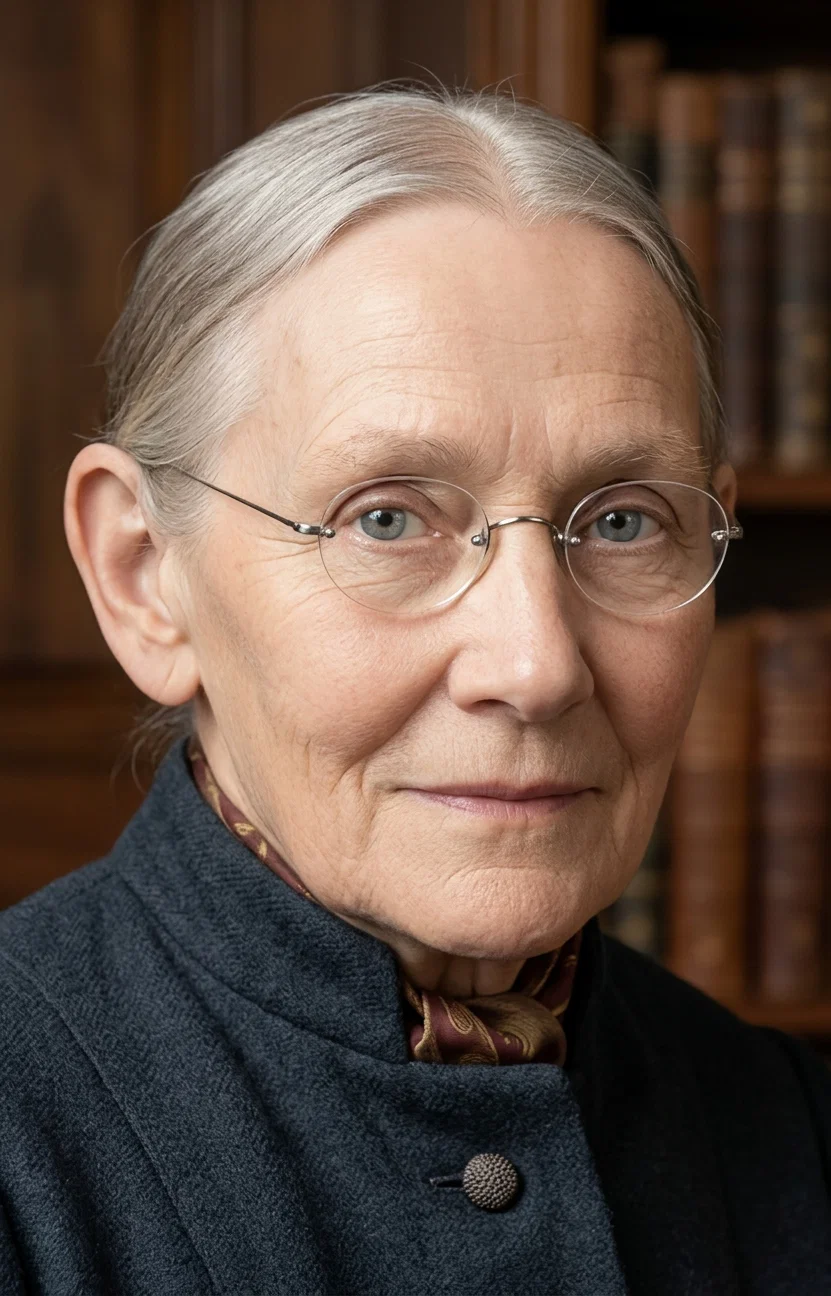
ONLY the eleventh of last November we buried Father Locke, at the ripe age of seventy-nine years; and now death has taken our dear mother, Sally Underwood, at the advanced age of nearly ninety-six years. Mother was born June 28, 1817, in Williamsfield, Ohio, and died at her daughter's home in Youngstown, Ohio, Jan. 18, 1913. Mother’s maiden name was Morse. Her parents moved on an ox sled from Massachusetts to Ohio when the latter State was a wilderness. It required six long weeks to make the journey. She knew the hardships of a pioneer life of nearly a century ago. At that time the population of the United States was less than eight million. Mother recently told me of her oldest brother's going seven miles through a dense forest to the nearest neighbor to get fire, after they had tried in vain by the use of flint to light some punk that had become damp. Such a thing as a lucifer-match was not invented till mother was twelve years of age. The only pen used in those days was made from a goose-quill, and the postage of a letter was twenty-five cents and upward, according to the distance sent. Mother was about ten years old when the first railroad was chartered. She was twenty-seven when Professor Morse sent his first telegraph message.
MRS. SALLY UNDERWOOD
Mother was married twice. Her first husband, Smith Allen, lived only two years. Her second husband was Alfred B. Underwood, a Baptist minister. She was the mother of nine children, eight of whom are living, and seven of her children were present at her funeral. She had thirty-two grandchildren, and forty-two great-grandchildren, and four great-great-grandchildren.
In my boyhood days mother spun and wove into cloth all our linen wear from the flax father raised. She took the wool from the sheep's back and made it also into garments for all her children and household. Mother's life was one of true heroism in spiritual ministry no less than in the care of her large family and the needy about her. She gave much time to nursing among the sick, especially among those who were unable to pay for any service rendered. Mother was a232great help to father in his public ministry, particularly was this so in his revival efforts, as she was especially gifted in song and as a personal soul-winner.
It was in 1864 that father and mother both attended meetings conducted in a tent by Elder J. H. Waggoner in Wayne, Ohio, where their minds were directed to the Sabbath of the fourth commandment and the kindred truths of the third angel's message of Revelation 14. After earnest, diligent study and much prayer, father and mother called their children together and stated that they had decided to obey the light that God in his love had sent to them. Father soon resigned his pastorate of a large Baptist church, and united with the Seventh-day Adventist Church, to which both he and mother faithfully adhered till their death.
The last few weeks of mother's life were full of evidences of God's acceptance. She retained her faculties, both mental and physical, to a remarkable degree to the very last. Only three hours before she closed her life in a peaceful sleep in Jesus, she was able to walk across the room, supported by her daughter. The same evening that she died, she joined in a clear voice with the others in singing “Face to Face,” No. 861 in “Christ in Song,” and when she sang “Face to face in all his glory, I shall see him by and by,” she exclaimed, “Yes, I shall, praise the Lord,” and soon peacefully passed away.
Mother had recently spent some months in my home. She read the Bible and REVIEW most of all. She was awake to the current events, especially she read everything she could about the war with Turkey, and recognized it as a sign of the approaching end of that government and of the coming of Jesus Christ to take his kingdom. She often referred to the falling of the stars in 1833 and to the many signs of the end. The last chapter she read was 1 Chronicles 29, in which is given the closing acts of David's life.
Appropriate services were held at the residence of her daughter in Youngstown, Ohio, and also at the Congregational church in Williamsfield, Ohio. The local pastors and the writer took part in the services. We laid mother to rest beside our dear father, to await the voice of Christ, which will call them forth from death and the grave into immortal youth and glory at his soon coming. And may God grant that the earnest prayers of our dear parents may be answered in the salvation of their children and the large number of grandchildren, great-grandchildren, and great-great-grandchildren.
R. A. UNDERWOOD.
The Loma Linda Medical School
By Ellen G. White
A Symposium
The True Education
It is not necessary that our medical missionaries follow the precise track marked out by medical men of the world. They do not need to administer drugs to the sick. They do not need to follow the drug medication in order to have influence in their work. The message was given me that if they would consecrate themselves to the Lord, if they would seek to obtain under men ordained of God a thorough knowledge of their work, the Lord would make them skilful. Some of our medical missionaries have supposed that a medical training according to the plans of worldly schools is essential to their success. To those who have thought that the only way to success is by being taught by worldly men and by pursuing a course that is sanctioned by worldly men, I would now say, Put away such ideas. This is a mistake that should be corrected. It is a dangerous thing to catch the spirit of the world; the popularity which such a course invites, will bring into the work a spirit which the Word of God can not sanction. It is a lack of faith in the power of God that leads our physicians to lean so much on the arm of the law, and to trust so much to the influence of worldly powers. The true medical missionary will be wise in the treatment of the sick, using the remedies that nature provides. And then he will look to Christ as the true healer of diseases. The principles of health reform brought into the life of the patient, the use of nature's remedies, and the cooperation of divine agencies in behalf of the suffering, will bring success.
I am instructed to say that in our educational work there is to be no compromise in order to meet the world's standards. God's commandment-keeping people are not to unite with the world to carry various lines of work according to worldly plans and worldly wisdom.
Our people are now being tested as to whether they will obtain their wisdom from the greatest Teacher the world ever knew, or seek the god of Ekron. Let us determine that we will not be tied by so much as a thread to the educational policies of those who do not discern the voice of God, and who will not harken to his commandments.
Shall we represent before the world that our physicians must follow the pattern of the world before they can be qualified to act as successful physicians? This is the question that is now testing the faith of some of our brethren. Let not any of our brethren displease the Lord by advocating in their assemblies the idea that we need to obtain from unbelievers a higher education than that specified by the Lord.
The representation of the Great Teacher is to be considered an all-sufficient revelation. Those in our ranks who qualify as physicians are to receive only such education as is in harmony with these divine truths. Some have advised that students should, after taking some work at Loma Linda, complete their medical education in worldly colleges. But this is not in harmony with the Lord's plan. God is our wisdom, our sanctification, and our righteousness. Facilities should be provided at Loma Linda, that the necessary instruction in medical lines may be given by instructors who fear the Lord, and who are in harmony with his plans for the treatment of the sick.
I have not a word to say in favor of the world's ideas of higher education in any school that we shall organize for training physicians. There is danger of such physicians attaching themselves to worldly institutions, and working under the ministrations of worldly doctors. Satan is giving his orders to those whom he has led to depart from the faith. I would now advise that none of our young people attach themselves to worldly medical institutions in hope of gaining better success, or stronger influence as physicians.
Mrs. E. G. White.
Look Toward the Sunlight
By Orison Sweet Marden
It is just as easy to go through life looking for the good and the beautiful instead of the ugly; for the noble instead of the ignoble; for the bright and cheerful instead of the dark and gloomy; the hopeful instead of the despairing; to see the bright side instead of the dark side. To set your face always toward the sunlight is just as easy as to see always the shadows, and it makes all the difference in your character between content and discontent, between happiness and misery, and in your life between prosperity and adversity, between success and failure.—Orison Sweet Marden.
A Pressing Need
We owe it to our young people who desire a full preparation for medical work, to provide at the earliest possible moment the facilities necessary to enable our own Christian doctors to give a medical course equal to any in scientific lines, and so far superior in moral and spiritual lines that there can be no comparison. The world is full of those who need to be ministered unto—the weak, the helpless, the ignorant, the degraded. The continual transgression of man for nearly six thousand years has brought sickness, pain, and death as its fruit. Multitudes are perishing for lack of knowledge.
The world's need can not be met fully by the ministry of God's servants who preach the word. While it is well, as far as possible, for evangelical workers to learn to minister to the necessities of the body as well as of the soul, yet they can not spend all their time and strength in relieving those in need of help. There must be associated with these, Christian physicians and nurses who have received special training in the healing of disease and in soul-winning. Medical missionaries and workers in the gospel ministry are to be bound together by indissoluble ties. By their combined efforts the world is to be prepared for the second advent of Christ.
The students at Loma Linda are seeking for an education that is after the Lord's order, an education that will help them to develop into successful teachers and laborers for others. When their education at Loma Linda is completed, they should be able to go forth and join the intelligent workers in the world's great harvest-fields who are carrying forward the work of reform that is to prepare a people to stand in the day of Christ's coming.
We should do all in our power to enable those who desire to be thus fitted for service to gain the necessary training. The Lord has given us great advantages in bringing into our possession such an institution as Loma Linda. Let us co-operate with him in making this place a blessing to humanity. By liberal gifts let us say to the burden-bearers at Loma Linda, “Put up your hospital quickly.”
Let those who have money make in-
Medical Missionary Department
By L. A. Hansen
Conducted by the Medical Department of the General Conference
L. A. HANSEN - - - - Assistant Secretary
Reasons for a Hospital
By T. J. Evans
While Seventh-day Adventists have done much in the establishment and maintenance of sanitariums, they have done comparatively little along hospital lines. There are many reasons why we should now undertake such work in connection with the College of Medical Evangelists. Among these are:—
1. Hospitals are most successful when connected with medical colleges.
2. The efficiency of hospitals is greatly increased when the patients receive the attention of medical students who have been trained in the care of the sick.
3. No medical college can be successfully conducted without a properly equipped hospital.
4. The expense of caring for patients is less in hospitals than in sanitariums; for in hospitals the number of attendants is much less, and even some of these, notably the interns, devote their time to the comfort of the sick, without any financial compensation.
5. A hospital connected with a medical school is assured of the highest skill in the care of the sick. Everything is carried on scientifically. The best of laboratory facilities are available for making all tests that are necessary for the good of the patients.
6. Men of experience do the work in surgery and medicine, and this is an additional safeguard for the welfare of the patients.
7. A hospital is most desirable in the country, for convalescing patients have all the advantages of fresh air, sunshine, attractive foliage, and a minimum of noise.
T. J. EVANS, M. D.
A Personal Appeal
By C. McREYNOLDS
This college and sanitarium have been established by the direction of the Spirit of God. The General Conference Committee has appointed a day for a special collection to be taken in all our churches in the United States and Canada to raise funds for this college—not to pay a debt, but to build a hospital.
The necessity for this building has been explained by others. Our graduates will be debarred from taking the State board medical examination if this hospital is not secured, and it must be done without delay. Brethren and sisters throughout the land, please give consideration to this matter. Prepare for it, and place not dimes only, but dollars—ones, twos, fives, tens, twenties, and up—in this general collection for the hospital. Its purpose is not only to benefit the students now being educated, but to give free treatment to hundreds of sick poor, thus blessing them with a renewal of physical life and bringing them in touch with the influence of the saving truths of the third angel's message.
This letter is an appeal to those with whom I have been associated in the past, from the Gulf of Mexico to the Great Lakes in the north. You have never been called upon to donate to a more worthy or a more needy enterprise than this. Let us lift together, and the result of this one day's work will place the college where it will be recognized by the medical fraternity of America, and enable it to furnish free treatments to many hundreds of poor afflicted ones.
C. McREYNOLDS.
A Call for Seventh-Day Adventist Medical Missionaries
By L. A. H.
There is no question but that a man or woman with a medical education can be much more useful as a missionary than one without this training. There is great advantage in knowing how to treat those who are sick in body as well as to minister to sin-sick souls. A laborer thus qualified will find ready access to many hearts and homes that might otherwise never be reached. Intelligent care of the sick and sound instruction in health principles will gain the confidence of many to whom no other method of labor would appeal. Spiritual instruction and prayer will often find acceptance and response on the part of those who are brought low in spirit through sickness, and may readily lead them to him who can give complete healing. The worker who has a medical education and a good knowledge of present truth is doubly equipped, and his possibilities for usefulness many times increased. This is true of the minister, Bible worker, or canvasser, as well as of the physician or nurse.
It was not chance that associated the health work with this people and made its truth a part of our message. Its place in the cause has been as clearly defined as have the relations of other phases of our denominational work. In the first instruction given regarding health reform among us, we are told that “it is a part of the third angel’s message, and is just as closely connected with it as are the arm and hand with the human body.”—“Testimonies for the Church,” Vol. I, page 486.
Its special place in connection with the basic doctrines of our message is given very clearly in a later statement, as follows:—
“Health reform is one branch of the great work which is to fit a people for the coming of the Lord. It is as closely connected with the third angel’s message as the hand is with the body. The law of ten commandments has been lightly regarded by man; but the Lord would not come to punish the transgressors of that law without first sending them a message of warning. The third angel proclaims that message. Had men ever been obedient to the law of ten commandments, carrying out in their lives the principles of those precepts, the curse of disease now flooding the world would not be.
“Men and women can not violate natural law by indulging depraved appetite and lustful passions and not violate the law18of God. Therefore he has permitted the light of health reform to shine upon us, that we may see our sin in violating the laws which he has established in our being. All our enjoyment or suffering may be traced to obedience or transgression of natural law. Our gracious Heavenly Father sees the deplorable condition of men, who, some knowingly but many ignorantly, are living in violation of the laws that he has established. And in love and pity to the race, he causes the light to shine upon health reform. He publishes his law, and the penalty that will follow the transgression of it, that all may learn, and be careful to live in harmony with natural law. He proclaims his law so distinctly, and makes it so prominent, that it is like a city set on a hill. All accountable beings can understand it if they will. Idiots will not be responsible. To make plain natural law, and urge the obedience of it, is the work that accompanies the third angel’s message, to prepare a people for the coming of the Lord.”—Id., Vol. III, page 161.
We have been especially blessed in having committed to us the light on health reform, but with the blessing comes proportionate responsibility. We are under obligation to God to let this light shine, and will surely be held guilty if we do not make a right use of it. This is true of us as a people and as individuals.
Individuals who are qualified to work and instruct in health lines owe it to the Lord, to his cause, and to their fellow men to make wise and faithful use of their talents. The identity given our health principles because of their connection with other truths and their adaptation to physical conditions and needs, makes it particularly essential that they be disseminated as fully as possible. Health lectures in connection with regular evangelical meetings should be given. Schools of health are important. Frequent lectures in sanitariums should be presented. Personal instruction in right living is nearly always in place. Health literature, tracts, journals, and books should be freely used. In every proper way, by pen or voice, should we make known these Heaven-sent truths.
The instruction that has long come to us about combining our medical and evangelical work finds echo in many places. The very need of it answers back from one situation and another in corroborating appeal, and every effort to carry out the instruction confirms its value. The call is strong for Seventh-day Adventist medical workers, those whose first adherence is to the truth. Those are needed whose conception of their abilities is governed by the needs of the cause and whose course is controlled by loyalty to its advancement. We may ask, What other motive should our young people have in taking any special training or securing advanced education than to be better prepared to work in the cause, giving the soul-saving truths of this time? I take the liberty of quoting from our office correspondence to indicate some of the sentiments expressed on this question. A union conference president, a worker of long experience, says:—
“If it is important that ministers should be prepared by a medical knowledge to create openings for the presentation of the message, is it not vastly more important that the medical man should be prepared to present the living message for which his medical work may create openings? If an individual can be trained for one line of work only, then by all means let that training be to prepare him for the work of preaching the message, the all-important work. The evangelical and medical lines will never be successfully united for the advancement of the truth so long as they are not united in the individual. Men are sanctified through the truth. An individual who is not thus sanctified is unfit to minister truth to others. The unsanctified doctor can not, in any way, be helpful to our field workers.
“The minister who is wholly without knowledge of that which is declared to be the right arm of the message is greatly lacking in power to create opportunities for the preaching of the message. The doctor who is wholly without a training as to how to impart the great message of truth to mankind, has power to create opportunities without power to deliver the message for which opportunities are created. And another individual who has the power to use the opportunities created can never compensate for the failure of the doctor to be able to do the same. Our sanitariums afford a wonderful opportunity for the doctor to present the truth. If these opportunities were faithfully embraced and improved, it would be a wonderful help to the advancement of the work in general.”
It is encouraging to note that in many places in the field, in and out of sanitariums, in conference work and out of it, work is being done in the spirit herein outlined. It is being demonstrated that medical work may be most successfully carried forward as a distinctive missionary factor, and that there is great advantage in its close relation to our denominational interests. We shall be pleased to make mention of some instances of this kind at another time.
L. A. H.
Investing in Medical Missionary Training
By George A. Irwin
vestment in the work of God. Use it freely in opening the way for workers to get a training as medical missionary evangelists. The Lord will reward all who come forward in emergencies and do their best. G. A. IRWIN.
A Clinical Hospital Needed
By W. A. Ruble
A hospital is required where students may have under their care and supervision, subject to the direction of the instructor, patients whom they treat for the purpose of establishing in the minds of the students the benefits to be derived from true physiologic therapeutics. They should receive the most thorough training in rational methods of treating disease, and there can be no better provision made for this than in a hospital under the supervision of our own medical schools. The effort to safeguard the religious welfare of our young people is a most essential one, and of itself a sufficient reason for providing educational facilities of our own for imparting a high-class medical training. But we should show no less determined effort to provide such a training in rational therapeutics as will maintain the integrity of our medical work as a denomination.
There are scores of our own people who are every year seeking help in hospitals of the world because they feel that they can not come to our sanitariums and pay the prices there charged. Such a hospital as is proposed for the college will make it possible for our own people to receive the best of medical attention at moderate cost. It will also bring under the influence of the truths for to-day a large number of people from without. In this hospital they will receive as good treatment and as much kindly consideration as in any sanitarium in our midst, and the scientific phases of the work will be kept at the highest point of efficiency possible.
Another reason for the establishment of a hospital is the demand of the law, which requires of a medical school a certain standard of clinical work and experience for its students. There is no other class of people that have placed in their hands the responsibilities that come to medical people. In giving into the hands of a special class of men this responsibility, the law has a right to stipulate the thoroughness of the training that shall be given this class of people, and to say what facilities shall be provided to give such training. Seventh-day Adventists, above all others, should submit to and encourage such supervision of the medical profession as to medical training. Everything we have tried to put into our medical school is recognized as being a requisite for giving students the preparation they must have to take the lives of human beings into their hands.
W. A. RUBLE, M. D.
An Appeal for Right Training
By G. K. Abbott
When a Seventh-day Adventist is ill, he wishes to be cared for by a physician who has been thoroughly trained in natural methods of treatment, and whose faith and practise is not dependent on drugs.
We wish the same for our neighbors to whom we recommend our sanitariums. We might as well expect properly to educate our ministers in the theological schools of the world by afterward giving them a six months' course in Bible doctrines, as to expect our physicians to learn natural methods of treating the sick after they have spent four or five years in the medical schools and hospitals of the world. Right principles and methods can not be tacked on after the education is finished. They must be inground and interwoven from the very first day the student enters school until the last day before graduation, and especially during the last half of his course, when he gains his practical knowledge of treating the sick.
Shall we not help train our young men and women in these physiologic methods by giving of our means to assist in providing the necessary facilities for a medical school in which they can be properly trained? Does not the Lord hold us all responsible for the training we might, by a little sacrifice, provide for our physicians? G. K. ABBOTT, M. D.
A Religious Liberty Campaign
By W. F. Martin
In view of the fact that the World's Christian Citizenship Conference is to be held in Portland, Oregon, during the present year, and because of this a strong effort will be put forth by the promoters of this conference to forward the aims of the National Reform party, it was thought best to inaugurate a religious liberty campaign in the North Pacific Union Conference. Already the forerunners of the Christian Citizenship Conference have been on the ground preaching the doctrine of religious legislation. It has been the privilege of the writer to hear a number of these men.
To prepare for the religious liberty campaign, theater buildings and good halls were rented in several of the best cities of the union. It had been hoped that Prof. W. W. Prescott and Elder C. S. Longacre could be with us throughout the campaign. After arrangements had been made, it was learned that Professor Prescott could not be present, as he was detained in Washington, D. C., on account of the Johnston Sunday Bill. Arrangements were then made for Elder J. O. Corliss to come instead of Professor Prescott. Elder Longacre joined us at Seattle, Wash. Both of these brethren gave good instruction, which was much appreciated by our own people and by the large number of strangers who attended.
Our first meetings were held in the Keylor Grand Theater in Walla Walla. Thorough advertising had been done and full arrangements made. Two meetings were held. Fully one thousand persons were present at each meeting. Elder Corliss spoke each evening. Excellent attention was paid to the truths spoken. Much good literature was distributed. The people from College Place assisted in the meetings, and a good-sized chorus from the college rendered excellent help.
From College Place we went to Spokane. The large auditorium in the new Lewis and Clark High School building had been secured for the meetings here. Notwithstanding a severe snow-storm, the worst for years, we had good congregations. Never in my experience have I seen more attentive audiences nor finer-looking congregations. Here also much interest was manifested in the literature. It was refreshing to have fine-appearing people come and say, “I have read your tracts, and want to get more of them to send to my friends.” One man, the last evening, said he had a friend who was a senator, to whom he wished to send some of the literature. At the first meeting small cards were distributed to be signed by those who wished to read further on the subject of religious liberty. A good number of these were signed and handed back. These names will be followed up by the local workers. This same plan was followed at all the meetings. We consider this one of the most important features of the campaign.
Our next stop was at North Yakima. The Masonic Hall had been secured here. Between five hundred and six hundred persons attended the Yakima meeting. Here, as elsewhere, a deep interest was manifested by both our own people and those not of our faith. From here we went to Tacoma and held a meeting in the Temple of Music. The attendance at Tacoma was not what we had hoped for, but some were deeply interested.
One of the most interesting experiences we had was at Seattle. The Guardians of Liberty attended our meetings in a body, and manifested a deep interest. They gave us a cordial invitation to speak to them in their place of meeting. We intend to do this in the near future. Meetings were also held in Bellingham, Mt. Vernon, and Olympia in the Western Washington Conference. Theater buildings and good halls were secured in all these places, and the members of the churches did a good part to make the meetings a success. Elder E. H. Huntley, religious liberty secretary of that conference, was present at the meetings and rendered valuable service.
Two meetings were held in Portland in the Bungalow Theater. Excellent work had been done to advertise the235meetings. A hard storm and deep snow came, however, and hindered the attendance, but good and appreciative audiences were present each evening.
On the way back from the council in California, Elder Longacre lectured in Medford, Grants Pass, Roseburg, Cottage Grove, and Eugene in the Southern Oregon Conference. He reported good meetings in all these places. Elder T. G. Bunch, the religious liberty secretary for that conference, was with Elder Longacre.
About this time, a Sunday bill was introduced into the Oregon Legislature. After consulting with the local brethren, it was decided to hold two meetings in Salem. The opera-house was secured and two meetings held. The local church and workers took a good interest in the meetings. Elders M. H. St. John and C. F. Folkenberg are religious liberty secretaries for Western Oregon. These brethren were present and took part in the service. The Sunday bill met with but little favor in the legislature. The report of the committee to which it was referred was adverse, and it took the house of representatives not more than three minutes to kill the bill. A delegation of ministers had been appointed to lobby for the measure; this was known and resented by the members of the house. The bill was hurried through and killed only a few moments before these ministers reached the Capitol, and they were much disappointed. We felt that the Lord gave a victory for the truth.
The meetings in Salem closed the campaign for the present. Requests have come in for meetings in other places; these we hope to fill soon.
In looking back over this, perhaps the first campaign of its kind ever held, we have asked, Did it pay? There is no question that it did. There were many difficulties to meet, but the God for whose truth we were fighting enabled us to overcome them. When we think of the thousands of fine, intelligent men and women who listened so attentively to what was said, and many times broke into applause at hearing the simple truths of the message; and again when we think of the many thousands of pages of literature distributed, and last but not the least, when we think of the splendid interest taken in the work by our own people, and the effect it had on them, we say the campaign was a success. The officers of all the conferences gave their full cooperation and did all in their power to make the work succeed. Knowing this to be true, there is no doubt that they will lend their influence in the follow-up work. If this is done, we feel sure many souls will be gathered in when the harvest-time comes. W. F. MARTIN.
State and Church
By William Warren Prescott
Reports, Notes, and Comments Pertaining to the Current History of Religious Freedom, and the Campaign "to Make America Catholic."
Conducted by the Religious Liberty Association.
W. W. PRESCOTT - . . . - SECRETARY
From the Field
IN a report printed in the Atlantic Union Gleaner Brother Ellery Robinson writes of his experience in soliciting subscriptions for the Protestant Magazine among ministers of other denominations. We quote a portion of his article:—
“From the fact that many Protestant clergymen are on terms of more or less intimacy with Roman Catholic priests in efforts with them for ‘moral uplift’ in their communities, the introduction of the Protestant Magazine seems to them as almost a vicious attack upon those whom they have come to regard as Christian brethren. Many have told me point-blank that they are not in sympathy with my propaganda, that there is no danger from Romanism in this enlightened age, that Romanism is different from what it was, and that my procedure would tend to excite animosity and division when it is so desirable that all Christian bodies should unite and work together. So much for their side of the question.
“Other ministers, I am glad to say, are not so, but are very appreciative, expressing hearty approval and sympathy for my work, which they say has been started none too soon. From these, when their circumstances permit, subscriptions are easily secured.
“I am deeply impressed that the Protestant Magazine should be quickly introduced to every minister, so that those whose hearts respond to its principles may, by reading its pages, be trained to act with definiteness and power to restrain the ever-increasing tide toward Romanism among their fellow ministers.”