In the studies on heat, I spoke of the fact that heat caused the particles of water to vibrate. This vibration causes a separation in the molecules of water, so that they become lighter than the air, which presses under them and forces them up. As an illustration of the wonderful action of heat on water, thus causing it to separate, it may be stated that at the moment of evaporation the water has expanded to about 1,700 times the volume that it has in its liquid state. That is to say, that if heat could be so applied that a quart of water could be evaporated in an instant of time, it would occupy the space of 1,700 liquid quarts. The air is naturally heaviest near the earth, owing to its weight from above pressing down and condensing it. The air forces these particles of water up until they reach a place where they are just the weight of the air.
The law that heat expands an object and cold contracts it, plays an important part in the formation of the clouds. When this vapor, through the action of heat, has arisen to the place where it is just as heavy as the air, it forms clouds. The atmosphere has cold and warm currents passing through it. As these clouds come into a strata of cold air, the vapor is condensed and falls in the form of rain, hail, or snow. As the particles of water fall through the air, they gather moisture from the air and increase in size. If the condensation takes place in an atmosphere below the freezing point, the vapor crystallizes into snowflakes. Of these there are many forms, but all agree in being six-pointed or six-sided, and of having angles of 60 degrees between their branches.
The exact method of the formation of snowflakes is not clearly understood; but it is thought that electricity often plays an important part in the formation of hailstones. Hailstones are masses of ice, or of snow and ice, which are sometimes as large as hens’ eggs, or even larger, often weighing several ounces; but the Scripture says that, before the end of this world, there are to be hailstones weighing over a hundred pounds. The structure of hailstones is often composed of layers of ice and snow alternating. This would show that they have passed through various conditions of atmosphere.
Clouds are continually changing in form and color. In form they are of four kinds, named cumulus, cirrus, stratus, and nimbus. Then there are many combinations. The most common of these combinations are the cirro-stratus, cirro-cumulus, and strato-cumulus. I want to make a little study of these various forms; for when one has learned to distinguish them, he will have a never-ending source of pleasure in watching them. Cumulus clouds are mountain-like masses, often looking like piles of wool. They are generally seen on warm summer afternoons, and are very common in equatorial regions. They often result in showers and thunder-storms. These clouds often pile up to the height of five miles or more. Cirrus clouds are light and feathery, and resemble cats’ tails, ostrich plumes, daubs of thin white paint, or loose wisps of straw. They take on various fantastic and queer forms. The usual height of these clouds is about five miles, and they are composed of minute crystals, or snowflakes.
Stratus clouds vary in height from 1,000 feet to three miles. They are those clouds which extend in long, horizontal bars or layers. Nimbus clouds are those from which rain or snow is falling, no matter what may be their form.
Various forms of snowflakes. Observe the hexagonal (six-sided) forms of crystallization in all.
This division of clouds which I have above given was made by Mr. Luke Howard in 1803. The names are descriptive. Cirrus is a Latin word meaning lock or curl. So we have the feathery, curling clouds so named. In the word cumulus we get the idea of heaping together; while the word stratus gives us the idea of a layer, from the Latin stratum, to spread. Nimbus is a Latin word meaning cloud.
The difference between clouds and fogs is that fogs are near the earth, and clouds higher. So when we are in the midst of a very heavy fog, we can get a very good idea of how it would seem to be in the clouds.
Various forms of hailstones. Note their irregularity.
Every form of clouds is beautiful, from the dull-gray stratus to the golden-edged cumulus. They are continually undergoing a change of shape. God paints the clouds, and gives them their changes of form for the delight of His children. There is beauty in the heavens—always beautiful—as well as in the earth. These things of beauty which God gives us are given to draw our thoughts away from ourselves to Him. If we could only learn this most valuable lesson! and we can. There is much in the clouds to call our minds to God. The Lord speaks of the clouds as garments, with which He has clothed the waters that are to be scattered upon the earth at His command. He also speaks of them as a bottle, in which He confines the waters sent forth upon the earth, as it were through a watering-pot. The children of Israel were led by a pillar of cloud when they departed out of Egypt. This pillar was ordinarily in front of the people; yet when they came to the Red Sea it was placed behind them, and thus hid them from their foes, the Egyptians. When, however, the Egyptians saw this cloud moving forward the next morning, they followed and were led into a death-trap; for the waters of the Red Sea, which had been opened for the children of Israel, closed over them, and they were drowned. Thus does God protect His people. Clouds are a shelter from the great heat of the sun. Who has not exclaimed, as a cloud has for a few moments shielded him from the rays of the sun, “How good this shade seems!” So does the Lord not only shade His people in a physical sense, but in a spiritual as well; for He protects His children from the fiery assaults of the enemy of their souls, as the land is protected from the heat of the sun by the clouds. On the other hand, the goodness of those who trust to their own goodness, is compared to a morning cloud, which vanishes with the sun, and affords no protection.
After one has looked up the texts in the Bible, and made a study of clouds as spoken of by the Lord, he can not fail to find a continual inspiration from a study of the coverings of the heavens. The Maker of heaven and earth, when He ascended to heaven, after having accomplished the redemption of His people, was received out of sight in a cloud; and when He returns, He will again come on a cloud. The throne of God, as it appeared to the prophet Ezekiel, was as a cloud. These clouds, however, can not be of water, but rather of heavenly messengers. “By His knowledge the depths are broken up, and the clouds drop down dew.” FREDERICK GRIGGS.
So. Lancaster, Mass.
THE HOME LIGHT.
The light of home's a wondrous light,
So tender is its shining.
So soft it follows through the night,
Our weary road outlining:
Tho lonely and for years we roam,
Far from the ones who love us,
Yet ever shines the light of home,
Like God's grace spread above us.
The light of home's a wondrous light,
Through life it follows, seeming;
Yet when with age the hair is white,
Clear in the front 'tis gleaming.
It shines from where our loved ones are,
O, this is love's divining!
And through the gates of heaven ajar
At last we see it shining!
—Saint Louis Republican.
East River Bridge.
When the Brooklyn Bridge was opened for traffic eighteen years ago, an epoch in the history of New York and Brooklyn was marked. The structure was a marvel, and continues to this day to be one of the sights of this great metropolis. But it will have to divide the honors now with what is called the New East River Bridge, which crosses the river a short distance north of the first bridge; and in a few years these two structures will be overshadowed, so to speak, by the greater bridge which is to cross the river at Blackwell's Island. These three in time and turn will be small and insignificant indeed when the proposed Hudson River Bridge connects New Jersey and New York and is open for business.
A few weeks ago three steel cables, the first to connect the New East River Bridge, were stretched and secured, and now the vast undertaking will be pushed rapidly to completion. Altho by no means the handsomest among notable suspension bridges of this country, the New East River structure will at least be the largest and stiffest. The span from tower to tower is 1,500 feet, the length from terminal to terminal 7,200 feet, and the width 148 feet, providing for four trolley tracks, roadways, bicycle paths, and promenades.
The suspended structure will weigh 7,500 tons, and 45,000 tons of steel will be used all told. Besides this enormous amount of steel material, the bridge will require 60,000 cubic feet of cement, 130,000 cubic feet of masonry, and 6,500,000 feet of timber. More than 500 houses in New York and Brooklyn will have been destroyed before the approaches and plazas are completed.
For 800 feet the central span will hang 135 feet above mean high water. The tower foundations are built on solid rock, standing twenty feet out of the water, and upon them the massive, curiously shaped steel towers rise to a height of 310 feet. For 100 feet at each tower the span will be supported on the cantilever principle. Unlike the span of the present bridge, which is joined in the center, the span of the new bridge will be unbroken throughout its entire length.
The cost of the new bridge has been estimated at $8,000,000, but it may largely exceed that sum when provision has been made for the purchase of the necessary real estate.—New York Christian Advocate.
SHORT RULES FOR LONG COMFORTS.
Put self last.
Be prompt at every meal.
Take little annoyances out of the way.
When any one suffers, speak a word of sympathy.
Tell neither of your own faults nor those of others.
Have a place for everything, and everything in its place.
Hide your own troubles, but watch to help others out of theirs.
Never interrupt any conversation, but watch patiently your turn to speak.
Look for beauty in everything, and take a cheerful view of every event.
Carefully clean the snow and mud from your feet before entering the house.
Always speak politely and kindly to servants.
When inclined to give an angry answer, press your lips together and say the alphabet.
When pained by an unkind word or deed, ask yourself, “Have I never done an ill and desired forgiveness?”—Soldier and Servant.
WHAT A GIRL SHOULD LEARN
To sew.
To cook.
To mend.
To be gentle.
To value time.
To dress neatly.
To keep a secret.
To be self-reliant.
To darn stockings.
To avoid idleness.
To respect old age.
To make good bread.
To keep a house tidy.
To make home happy.
To control her temper.
To be above gossiping.
To take care of the sick.
To take care of the baby.
To sweep down cobwebs.
To marry a man for his worth.
To read the very best of books.
To take plenty of active exercise.
To keep clear of trashy literature.
To be a helpmate to her husband.
To be light-hearted and fleet-footed.
To wear shoes that won't cramp the feet.
To be a womanly woman under all circumstances.
The Effects of Cigarette Smoking on Boys
THE principal of a Chicago school gives this result of three years' investigation: In one school 125 boys were addicted to the cigaret habit; 25 of these confessed that they were too sleepy to study; 30 of them said they were dizzy after smoking; 22 could not write neatly because their hands trembled, and several said they felt “shaky” when they walked. It was also shown that the cigaret habit gradually blunted the moral sensibilities of the boys, making them deceptive, secretive, and untruthful, while very few of them were able to keep up with their classmates who were not addicted to the baneful habit.
Trusting Beyond the River
“I HAVE no power to look across the tide; To see while here the land beyond the river; But this I know, I shall be God’s forever, So I can trust.”
Where Art Thou, Beloved To-morrow?
By Shelley
WHERE art thou, beloved To-morrow?
In thy place? “Ah! well-a-day!
We find the thing we fled—To-day!”
—Shelley.
The Father's Face
By Phebe Carey
My sorrows have not been so light
Thy chastening hand I could not trace,
Nor have my blessings been so great
That they have hid my Father's face.
—Phebe Carey.
The Work God Appoints
By Jean Ingelow
I am glad to think
I am not bound to make the world go right,
But only to discover and to do,
With cheerful heart, the work that God appoints.
I will trust in Him,
That He can hold His own; and I will take
His will, above the work He sendeth me,
To be my chiefest good.
—Jean Ingelow.
The Only Tears in Heaven
By FRED T. ELKIN
COME, brothers, ease the Saviour’s pain;
Let flesh and soul to Him be given;
Shall He who loves us love in vain,
And shed the only tears in heaven?
FRED T. ELKIN.
Eternity Is Nigh
“‘How far from home?’ I asked, as on
I bent my steps. The watchman spake:
‘The long dark night is almost gone,
The morning soon will break.’
‘I asked again; earth, sea, and sun
Seemed with one voice to make reply:
‘Time’s wasting sands are nearly run,
Eternity is nigh.’”
WHAT IS DEMANDED.
A LITERARY journal gives this timely hint to writers: Readers demand, and certainly the highest literary ideals require, a certain seriousness in the man behind the pen. . . . The mere stylist may entertain for a passing moment or so, as does the man who starts off the rockets on a Fourth of July evening, but his pyrotechnics will speedily be forgotten as the world rushes on. It is the knowing, patient, purposeful man, the man of high ideals toward which he steadily works, who wins himself a lasting place in literature, or, if he does not quite accomplish that, serves his own generation well with brush or pen. It may not be given to any literary worker to light a star, but every writer should feel impelled by a sense of the dignity of his calling to do more than fire off a rocket.
MOSQUITOES AND MALARIA.
A CONSULAR report illustrates what has already been accomplished in Italy in allaying the ravages of malaria there. The Mediterranean Railway company has equipped all stations and employees' houses in malarial districts with mosquito-proof screens, and those who are obliged to be out after nightfall are provided with mosquito-proof clothing. By this means the railway company has secured complete immunity for its servants and their families, even in the worst localities, as Battipaglia and San Nicola. Formerly an appointment to these districts meant little less than a death sentence, and no man could hope to have his family with him. The families have been perfectly healthy in these protected houses.—Med. Times.
BEEF TEA.
A PERSON who was in doubt over the question of nourishment in beef tea wrote the editor of The Era for an opinion on the subject. Here is the editor's reply to the query:—
It is pretty safe to say that in the general opinion of the medical profession beef tea has no nourishing qualities whatever. It has been supposed among laymen that a large proportion of the nourishing part of meat is abstracted in the form of beef tea, and that the remainder is of no food value. In point of fact, all the real nourishment in meat is thrown away in the debris remaining in the jar after the tea has been strained off. The protein, or nourishing part of the meat, is quite soluble in boiling water, or, in fact, in water above 160 degrees Fahrenheit. This fact can easily be proved by any one who will take the trouble to feed two dogs—the first upon the strongest beef tea that can be made, and the other upon the shreds of meat from which it has been extracted. The first will die of starvation before long; the other will live in perfect health and strength.
The Filth in Cigarette Making
SCAVENGERS go around to saloons and bar-rooms, picking up stubs of cigars and raking over the contents of spittoons for rejected quids of tobacco. These are thrown into a sack and carried to the manufactory, where they are cleansed (?), ground up, sprinkled with liquor, Havana flavoring and other chemicals added, and allowed to stand till the whole mass is permeated with the flavoring. It is then rolled up in its paper wrapping, and becomes the cigaret considered so dainty. The rolling introduces another element of filth, as in doing it the rollers continually moisten their fingers with their own spittle. This work is often done at home in the lowest and filthiest tenement houses, often in the very room with contagious diseases. Thus cigarettes often become the means of spreading the most loathsome disease. Leprosy has thus been disseminated from leprous hands engaged in rolling cigarettes.
The Lamp for Your Oil
You picture to yourself the beauty of bravery and steadfastness. And then some little, wretched, disagreeable duty comes, which is your martyrdom, the lamp for your oil; and if you do not do it, your oil is spilled.—Phillips Brooks.
The Effects of Worry
“WORRY kills ten where work kills one; if long continued, it completely breaks down the strongest constitutions and the most iron-like nerves. Calmness and serenity are highly conducive to health and longevity.”
Giving to God’s Cause with Gratitude
“Do you find yourself planning with a heart filled with gratitude, to help God's cause, or do you give because God shows you it is your duty?”
Govern Thy Lips
By Edwin Arnold
Govern thy lips
As they were palace doors, the king within.
—Edwin Arnold.
Truth and Sacrifice
“’Tis man’s perdition to be safe, When for the truth he ought to die.”
Judas and the Ointment
“At thirty pence he did Christ’s death devise, Who at three hundred did the ointment prize.”
THE McALL MISSION.
The McAll Mission is doing a great work in France by means of its mission boats. A part of each boat is fitted up as an audience room, with comfortable seats, and bright lights, and some kind of musical instrument, while the rest of it makes a home for the missionary in charge. This boat passes up and down the waterways of France “bearing glad tidings of good cheer” to one and all. The boat stops now at this village, now at that, and the people gather to hear of the love of Christ as told in song or sermon. When a man has once attended13one of these services, he usually comes again and yet again, till at length he accepts Christ as his Saviour. The work is wholly non-sectarian, and when a man becomes a Christian, he is urged to join the church of his preference. Rev. S. S. Rossiter, General Secretary of the McAll Association, said recently:—
“We expect by the services held in this boat to reach at least 30,000 people every year. No other agency in existence is so effectual for reaching great numbers of people. This is our second boat, Le Bon Messager (The Evangelist) being the first. We hope in time to have a fleet of boats on the rivers of France, a veritable Salvation Navy; or, as the French newspapers express it, ‘The good God upon the waters.’”—Selected.
A SKETCH OF THE EARLY HISTORY OF PARAGUAY.
By E. W. Snyder
(Concluded.)
The Period of Independence.
IT was not until May 14, 1811, that permanent independence was secured for Paraguay. Ferdinand VII., king of Spain, having been deposed and imprisoned by Napoleon, Spain could make but feeble resistance to the efforts of Argentina and Paraguay in this direction. The Paraguayans, infused with the spirit of General Belgrano, the Argentine patriot, determined to strike a blow for independence. This fell on the night of the 14th of May, 1811, when Pedro Caballero, with a few companions, surprised and captured the general arsenal without encountering the least resistance from the garrison. The greater part of the people, on assembling in the plaza, adhered to the revolution, which was thus consummated without the effusion of blood.
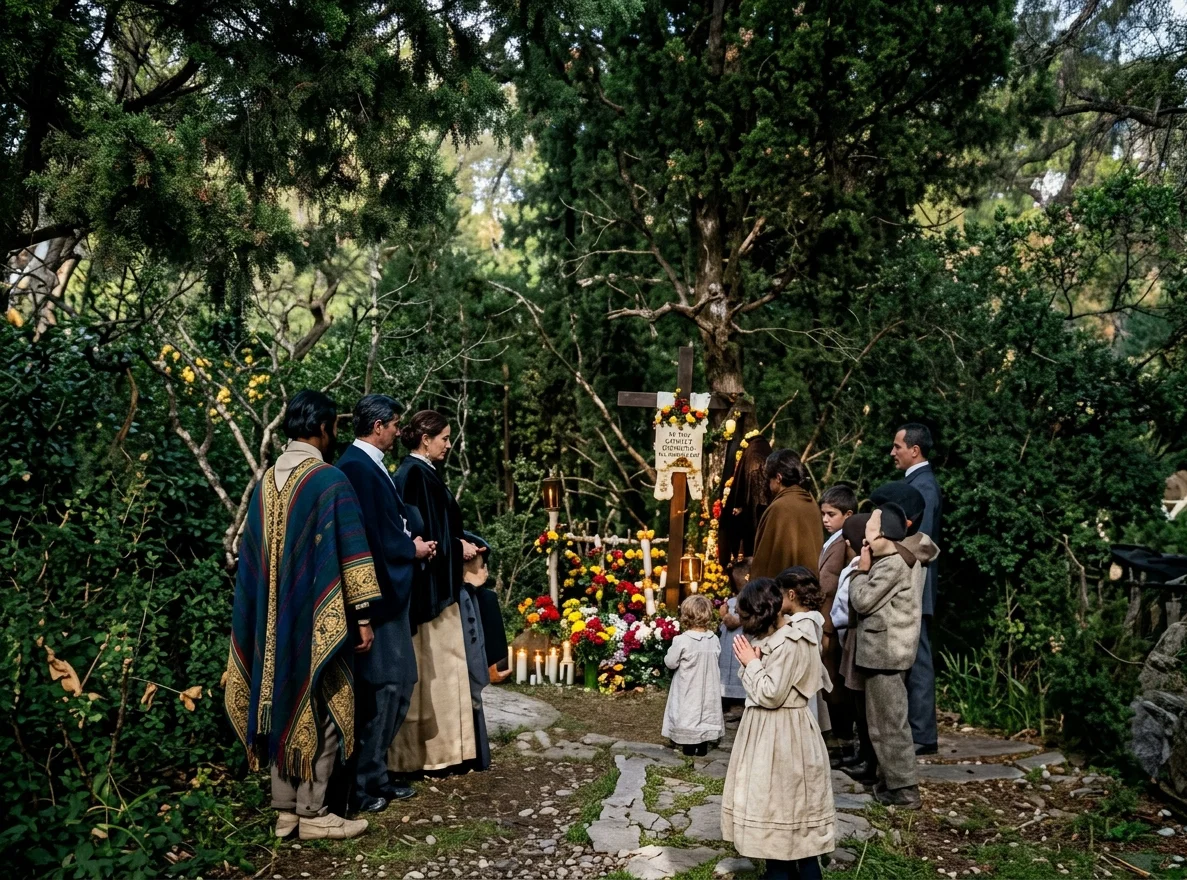
On the Plate River. A scene in a Catholic cemetery on All-saints' Day.
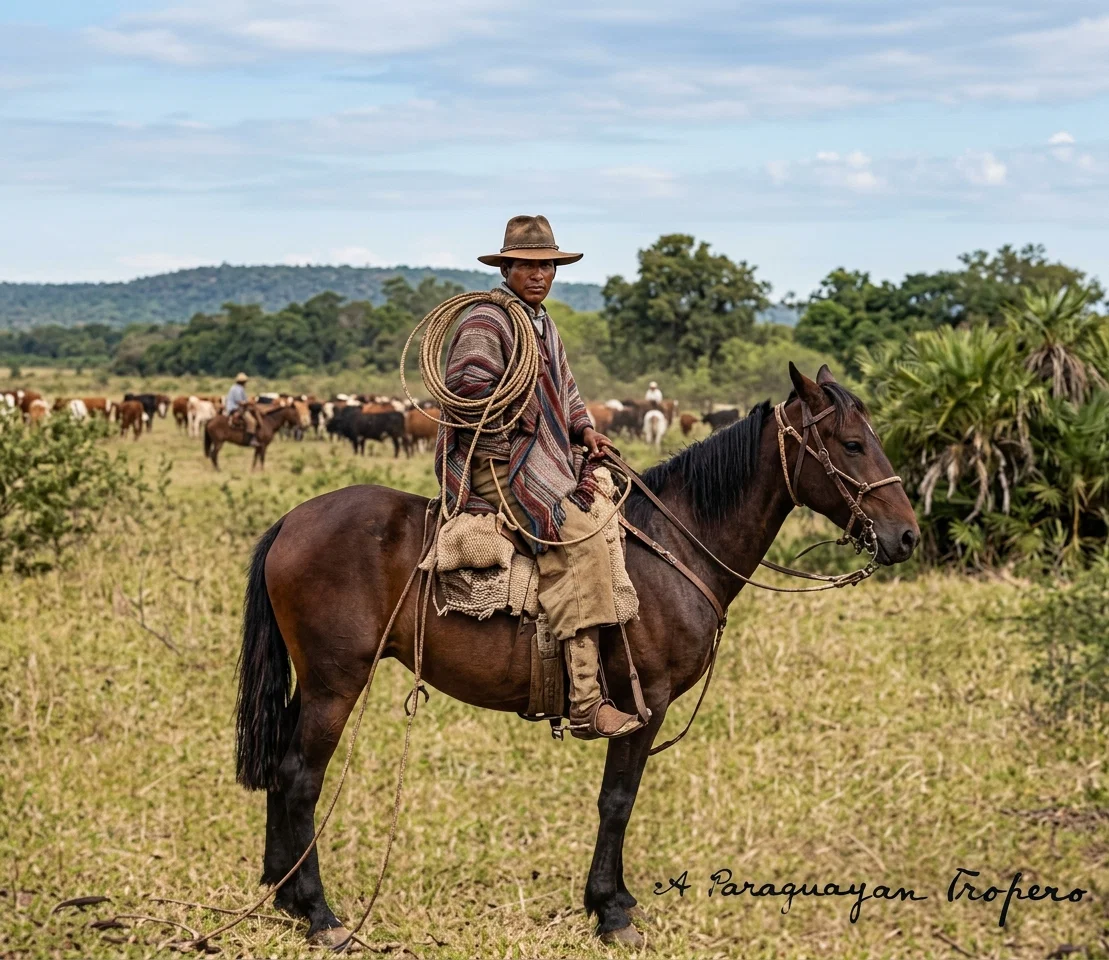
A Paraguayan Trooper.
The first congress assembled June 18, of the same year, and was composed of a governing board of five members. The first act of the legislators was to decree the deportation of Velasco, the Spanish governor. Various decrees were made for the promotion of commerce, and a treaty was celebrated with Buenos Ayres, by which the latter recognized the independence of Paraguay.
Oct. 1, 1813, the second congress sat, consisting of a thousand deputies elected by the popular vote. This body conferred the chief executive power on two men, who took the title of consuls. October 12, Rodriguez de Francia and Fulgencio Zégros were elected to this office by acclamation.
During the session of the third congress, assembled October 15, 1814, a demand was made to substitute a temporal dictatorship for the existing government, in imitation of the practice of the ancient republic of Rome. To meet this demand, Dr. Francia was elected for three years at a salary of $9,000. As a result of his efforts to ingratiate himself with the governing classes, the congress, at its annual session in 1816, proclaimed Francia perpetual dictator.
Unhampered by any rival, with his highest ambition realized, Francia soon entered on a career of despotism that characterized his whole administration. Among his first acts was one prohibiting the marriage of Spaniards to other than Indians, mulattoes, or negroes.
Other decrees were issued, rooting out the corruption of the clergy, cutting off the authority of the Vatican, and proclaiming himself head of the church, besides suppressing the Inquisition. Proceeding further, he restricted religious processions, abolished Catholic feasts, and suppressed convents, confiscating their property for the State. As a crowning act of despotism, he decreed that all marriages celebrated without his consent should be void.
Finally, in 1820, a conspiracy was formed to assassinate him; but the knowledge of this came to him by means of a letter addressed to one of the conspirators, which fell by chance into his hands. By means of tortures he drew confessions from suspected conspirators; and, under pretext of holding them guilty of treason, he executed them to the number of seventy-six in nine days. His persecution of the Spaniards also continued, and by June 9, 1821, 300 of them were imprisoned, including the bishop.
Under Francia agriculture received quite an impetus, his object being to make Paraguay independent of the world by enabling it to subsist on its own products. In harmony with his policy of isolation, Francia prohibited foreigners entering or leaving Paraguay. In 1819 the country suffered devastation by locusts, whereupon he compelled the natives to plant a second time. It was then first discovered that more than one harvest could be secured in a year. The compulsory labor under Francia brought quite a degree of prosperity to the country; and as one sees the square miles of uncultivated wild land, almost in the shadow of the palace of Lopez, he is impressed with the expediency of adopting Francia’s compulsory policy in dealing with the natives of the present generation.
In conclusion, the historian tells us that Francia governed by holding the people in abject terror, which he was enabled to do by inflicting the most cruel punishments. He died a natural death Sept. 20, 1840, at the age of seventy-four years.
Following the death of Francia a provisional government was organized, consisting of two consuls as executives, and 300 deputies, which made itself memorable by ratifying the declaration of independence by special act on the 25th of November, 1842. A constitution was then adopted, authorizing a government of 200 deputies, a chief executive, to be elected for ten years, and a judicial department.
Don Carlos Lopez was the first president under the constitution. His first act was to secure the recognition of the independence of the country by the European nations. This was denied by Argentina, that country still claiming Paraguay as an Argentine province. The feeling on the part of the latter country led to commercial difficulties between the country and Rosas, the Argentine dictator, which culminated in a short war. The difficulty, however, was removed by the mediation of Mr. Brent, U. S. minister to Buenos Ayres. This period is notable as marking the establishment of the first newspaper of the country, April 26, 1845. Such was the prosperity attending Lopez’s administration that on the expiration of his term of office, in 1854, he was re-elected for ten years. Under him the country became possessed of arsenals, iron foundries, powder and ammunition factories, and numerous schools, and a railroad was built, the first one in South America. Lopez did much to encourage the mechanical arts and the sciences, bringing the best artisans from Europe as instructors.
On the death of Lopez, in 1862, his son, Francisco Solano Lopez, assumed the reins of government. Owing to disputes over boundaries with Brazil and Argentina, this became a very critical period for Paraguay. Uruguay, being at this time threatened with an invasion from Brazil, appealed to Paraguay for mediation, which was rejected by Brazil. Paraguay then declared any invasion of Uruguayan territory would be considered an affront to herself, at the same time closing Paraguayan waters to Brazilian ships. The seizure of the Brazilian ship Marquez de Olinda determined the rupture of diplomatic relations between that country and Paraguay, and war was declared Dec. 14, 1864. In the early part of the struggle Argentina violated her neutrality by permitting Brazil to mobilize, in Argentine waters, a squadron of war vessels with which to attack Paraguay. This fact, coupled with Argentina’s refusal to permit the Paraguayans to pass Argentine territory, led the former to declare war against the latter the 5th of March, 1865. Hostilities began April 13, by the seizure of Argentine ships and the occupation of Corrientes.
May 1, 1865, Brazil, Argentina, and Uruguay celebrated an alliance to make war against Paraguay. In the early part of the conflict the latter seemed to have the advantage, overrunning the State of Matto Grosso, Brazil, and capturing a large amount of arms and munitions of war. Argentine territory was also invaded; but the army of invasion, being attacked by superior numbers, was forced to capitulate. Finally Paraguay was invaded by the allied forces, and eight engagements fought, the Paraguayans being successful in four. However, Lopez, with an army of scarcely 10,000, was confronted by the Brazilians, 32,000 strong, in the battle of Itá Ibaté, which lasted six days, and resulted in the annihilation of Lopez’s forces. He then gathered a few recruits, consisting of old men and boys, and retired to the mountains. His final stand was made at Cerro Corá, where he died defending himself, March 1, 1870.
The death of Lopez ended not only the war, but a reign of despotism hardly surpassed by that of Francia. We are told that his troops were so dominated by a fear of him that at his order they would fight to the cannon’s mouth, being made to believe by Lopez that if killed they would be alive again in three days, and receive great honors.
We have now arrived at the constitutional period, or the period of reorganization, which we shall reserve for another time, together with a sketch of the Jesuit missions of Paraguay. E. W. SNYDER.
Asuncion, Paraguay.
IS IT NOTHING TO ME?
By Alice May Douglas
[Alice May Douglas, in Gospel in All Lands.]
Is it nothing to me that the children cry
For bread in some foreign land,
When some at least could be amply fed
By a little coin from my hand?
Is it nothing to me that souls now die
Who ne'er heard of Jesus' name,
That to countless thousands across the sea
Salvation never came?
Aye, 'tis much to me; so with cheerful heart
My coin will I freely give,
And daily I'll heavenward send my prayers
That their perishing souls may live.