“And the Lord said unto Cain, Where is Abel thy brother? And he said, I know not: Am I my brother’s keeper?” Gen. 4:9.
Every person who lives in this world becomes a part of the great web of humanity. It is impossible for any one to so shut himself up to himself that his life will not come in touch with and affect some other life. When Cain thought that his brother Abel had been put beyond the sphere of his life, the Lord said to him, “The voice of thy brother’s blood crieth unto me from the ground.” It is impossible for us to occupy a position in this world where the influence of our lives does not affect either for weal or woe those who are about us. The apostle stated this truth in these words: “For none of us liveth to himself, and no man dieth to himself.” Rom. 14:7.
Unlike Cain, who tried to escape responsibility by declaring that he did not know where his brother was, is the example of Job, who said, “The cause which I knew not I searched out.” Job 29:16.
To a certain lawyer who would escape responsibility, one who, “willing to justify himself, said unto Jesus, And who is my neighbor?” Jesus spoke the parable of the man who, going from Jerusalem to Jericho, fell among thieves, and was robbed and left half dead, and who, after being passed by the priest and the Levite, was ministered to by the good Samaritan. He then asked the lawyer, “Which now of these three, thinkest thou, was neighbor unto him that fell among the thieves?” The lawyer answered, “He that showed mercy on him. Then said Jesus unto him, Go, and do thou likewise.”
If the good Samaritan was neighbor to the man who fell among7thieves was neighbor to the good Samaritan. The man who fell among thieves represents every soul in this world who is in the bondage and darkness of sin, while the good Samaritan represents the true followers of the Lord Jesus Christ.
This makes China’s 435,000,000, Japan’s 50,000,000, Korea’s 10,500,000, India’s 300,000,000, Africa’s 127,000,000, and South America’s 40,000,000, our 962,500,000 next-door neighbors, who truly have fallen among thieves, been robbed of the blessed gospel of peace, and left to die in the darkness of sin and unbelief, without God and without hope.
What have we been doing to give to these, our neighbors, the blessed news of salvation, which has been so richly unfolded to us? Think of one little hand-power printing-press, operated in a Chinese dwelling-house, the rooms of which are dark and dingy and most unfavorable for health and good work, and this the only means for publishing this glorious message to China’s four hundred thirty-five millions of unsaved and unwarned people. In this great, needy field, also, we have no suitable school for the training of workers who accept the truth.
Think of our only printing-plant, a small press turned by hand, and our only school in Japan, both conducted in the private dwelling of one of our workers! These are indeed meager facilities for giving the message to the intelligent, thrifty millions of Japan.
What has been said of China and Japan is true of Korea, where we also have a small printing-plant and a school in operation. Here, notwithstanding our feeble efforts, the Spirit of God has been moving upon hearts, and we have over four hundred Korean Sabbath-keepers.
But space forbids our even touching upon the crying need of facilities for carrying forward our work in India, South America, Africa, and other dark portions of the earth.
Who does not see the justice of quickly doing his part in the raising of the $300,000 Fund with which to provide the needed facilities for carrying on the work in these great, needy, unworked fields, and also to provide homes for our workers? Already many have fallen at their post of duty, and others have been obliged to return to the home land, who, if they had been provided with suitable places in which to live, might now be doing valiant service for the Master.
Will you not respond to this, the call of the hour?
Boulder, Colo. *
Plum Blossoms
By George E. Tack
GEORGE E. TACK
The angel of earth’s spring came down
From fields of paradise,
And called unto the meadows brown,
“Ope now your violet eyes.”
The meadows sighed, then whispered
low,
“We fear the winter’s wrath;
His blighting breath doth coldly blow
Above the aftermath.”
The angel smiled, then softly sang
Of golden days to be;
And hark! the woodland echoes rang
The mock-bird’s threnody.
The March skies heard the enchanting
sound,
And smiled with keen delight;
A thrill went through the pulsing ground,
And lo! spring’s banners white,
Unfurled in camps embrowned, were
seen;
While bugle-calls rang sweet
From lips of south winds o’er the green,
To winter’s swift retreat.
Baltimore, Md.
How to Treat a Cold
By Kate Lindsay
KATE LINDSAY, M. D.
THE first thing to do is to give the digestive organs a rest. In many cases, where there is catarrh of the stomach and indigestion, a large and thorough enema or a mild saline cathartic will help matters greatly. The old and feeble and infants and young children should have complete rest in bed for twenty-four hours. During this time no food should be taken, unless it be mild, strained fruit juices. After the acute stage is past, as manifested by the cessation of sneezing, aching, fever, and change in the character of the expectoration and cough, the former being now thicker, more like yellow pus, and the cough what is known as “loose” and “easier,” gruels, well-cooked grains, and zwieback may be added, but still no full meals should be taken.
The lessening of the constitutional symptoms indicates that nature is doing her work of cleaning, and is being successful in the battle with disease, and, if given a chance, will succeed. But extra work for the liver, kidneys, lungs, and mucous surface, caused by chilling and dampness, too much food, fatigue, or any other cause which adds to the work of the eliminative organs, may cause a relapse and further extension of the disease, involving not only the air-passages, but extending to the lung-cells, and causing pneumonia; involving also the digestive tract, and causing catarrh of the stomach and bowels, and even infecting the bile-ducts of the liver.
A neglected cold in the aged and feeble may, and often does, lead to a fatal pneumonia, because of lack of proper treatment at the outset.
Few either of people or physicians give much attention to the treatment of a “common cold,” as it is called, until some grave symptom develops. Then it is sometimes too late to save the patient. A few days’ rest, fasting, bathing, and cleansing the system at the outset of a cold might have saved many a life which, because of neglect of proper treatment at this time, was speedily taken by pneumonia; or perhaps the patient partially recovered, only to succumb to tuberculosis.
Infants and small children allowed to acquire the cold-catching habit by neglecting proper treatment at the outset, are likely to develop enlarged tonsils, chronic nasal catarrh, adenoid growths in the nose, and inflammation of the middle ear. These disorders may wreck their lives from mouth-breathing and deafness, causing dulness of intellect as well as physical ill health and weakness. Such patients suffer from repeated attacks of tonsillitis, and take cold easily. Mouth-breathing also greatly increases the danger of throat and lung infection, because the inspired air is not filtered and freed from germs and dirt by passing over the mucous surfaces of the nasal membranes, which, when healthy, free this important gaseous food from dirt, and also disinfect it by destroying disease germs.
The old and oft-repeated adage, “Feed a cold and starve a fever,” is responsible for much damage to both classes of patients. Undoubtedly the cold-taking victims have suffered the more from this treatment.
The chief directions for treating a cold hydropathically run something like this: Get the skin active by taking a hot bath, and inducing free perspiration, or take a hot foot-bath and drink plenty of hot lemonade or other hot drink. So the sneezing, watery-eyed city victim of a cold in the head rushes off to some bathing establishment to get rid of his coryza by sweating in a hot-water, Russian, Turkish, or electric-light bath. Then a ride home in the cold in a street-car, or a walk in the cold, damp air, chills the heat-relaxed cutaneous surface. More congestion and more wastes for the already overburdened mucous membranes and excretory organs result, and the patient is surprised to find his cold worse instead of better; in fact, he feels ill8enough to go to bed, which is just where he should be.
The hot treatment for the purpose of increasing the action of the skin, is all right in theory, but fails in practise because improperly administered. A hot bath should never be taken unless the patient suffering from cold has freed the alimentary canal, is giving the digestive organs a rest, and can lie down in a moderately warm, well-ventilated room for several hours afterward. A hot bath is best taken before going to bed at night. It should be followed by a cool sponge, spray, or cold-mitten friction, to tone up the skin. In fact, the moderately strong toning up of the skin by cool or cold bathing, especially in the morning, is much better than parboiling the cuticle and paralyzing the coats of the cutaneous blood-vessels by overheating through excessive hot bathing.
Summing up the treatment for an incipient cold: First, stop eating, to give the digestive organs needed rest, and the eliminative organs a chance to expel the toxins from the body. If the patient is weak, or a young child, he should rest in bed from twenty-four to forty-eight hours in a well-ventilated room, the temperature of which is not above sixty-five degrees. If there is nausea and loss of appetite, with coated tongue and constipated bowels, give a lavage, enema, or saline cathartic. To tone up the skin, give two or three cold-mitten frictions, sponges, sprays, or quick, short, cold, full baths, being sure to leave the skin warm and ruddy. At night a thorough hot bath may be taken once or twice at the outset, being careful to avoid chilling afterward. When the throat is sore and dry, spraying with hot water and salt,—a teaspoonful of salt to the pint,—or, better still, a nasal douche of the same, may relieve the pain and discomfort, and cleanse the mucous surfaces of the throat and nose. A pocket menthol inhaler is also useful in cases of this kind.
In infants, who often suffer from being unable to nurse when the nose is stopped up, the nostrils should be freed from dried mucus by cotton saturated in warm sweet oil or liquid vaseline. Wrap small pieces of the cotton around wooden toothpicks, making small swabs, and, dipping in the oil, cleanse out the nose thoroughly. Also apply oil to the outside, and gently massage the nose downward from root to openings. Keep the eyes cleansed with a warm saline solution; and watch closely for middle-ear infection in cases where a baby has a cold in the head.
Air-baths, sun-baths, and oil rubs are all good treatments for colds; also the use of soothing and disinfecting solutions by means of inhalers, sprays, nebulizers, etc. But when a cold has been contracted, and its symptoms have been manifested, systemic infection is indicated. Then the main treatment to shorten the attack, and prevent complications and troublesome or dangerous after-effects, is to fast, rest, cleanse the alimentary canal, and by judicious water treatment tone up the skin, avoiding overheating and chilling afterward by exposure to cold and dampness. Breathe pure air of moderate temperature.
A robust adult may overcome a cold at the very outset by fasting and by out-of-door exercise, provided he keeps active enough to avoid chilling the skin, and does not expose himself to dampness, or allow his feet to become cold.
Boulder, Colo.
Excavations in Ancient Babylon
EXCAVATIONS in the ruins of ancient Babylon during the last year, by Professor Koldewey, bring to light some interesting relics. It is claimed that the hall where Nebuchadnezzar was enthroned, which was the scene of Belshazzar’s feast, has been uncovered; also that it was in this hall that Alexander gave his generals the last commands for the final conquest of the world.
When Food Becomes a Luxury
IN the December Popular Science Monthly, Prof. E. H. S. Bailey, of the University of Kansas, discusses the modern tendency toward buying foods in small packages or tins, rather than by the bulk or weight. He says:—
“One of the most conspicuous illustrations of the tendency to allow the manufacturer to reap, to say the least, a large profit, because the consumer wants to buy his food ‘ready prepared,’ is the fad of making the breakfast to a great extent of the newly invented ‘breakfast cereals.’ A few years ago the people did not know the meaning of these words, and now they are common in the most modest bill of fare.”
“Since these foods are made mostly from wheat, corn, and oats, it is absurd to suppose that the claims of some of the manufacturers are true, when they say that these foods are in every way better than the original grains from which they are made. . . . It is a question, anyway, whether the normal stomach welcomes the appearance of predigested food; it is provided by nature with ‘apparatus and chemicals’ necessary for the digestion of food, and why should the work be taken away from it?”
But the point in the article is the cost of specially prepared foods in packets, over the cost of the ground cereals in bulk. Professor Bailey says:—
“From the Bulletin of the Maine Agricultural Experiment Station for 1906, we quote the following cost in cents per pound for some of these foods: Quaker Oats, 3.1 cents; Nichol’s Pearl Hominy, 4.5; Cream of Wheat, 8.8; Grape Nuts, 14.6; Shredded Whole Wheat, 15.5; Force, 16.5; Flaked Rice, 18.2; Granula, 27.2. To this may be added the cost of some other brands, as Quaker Corn Flakes, 13.3; Kellogg’s Corn Flakes, 13.3; Maple Corn Flakes, 14.5; Post Toasties, 14.5; Grape Sugar Flakes, 17.8; Malta Vita, 18.4; Sugar Corn Flakes, 20; Holland Rusk, 22.8; Puffed Wheat, 29.1 cents. At this rate a bushel of wheat, which might be originally worth one dollar, would when made into a breakfast food, cost the housekeeper from five dollars to twelve dollars, calculating that seventy-five per cent of the grain is available as food, as is the case in making wheat flour. Oatmeal in bulk sells at five cents a pound, and simple preparations of the other grains at from five to seven cents.”
“These are a few of the illustrations to show ‘where the money goes,’ or at least some of it. Some of us are living on the luxuries of the market. . . . Instead of using the oak and maple and pine for fuel, we are feeding the fire with mahogany, and walnut, and rare imported woods.”
Are All the Children Home?
By Robert Hare
ROBERT HARE
The twilight deepens, day is done,
And sunset glories leave the west!
The wood grows silent, and apace
The song-birds seek their nest.
Yes, day is done; perhaps thy toil,
Since now the night has come.
But are your birdlings all at rest?
Are all the children home?
Perhaps behind the gloom there lies
A tempest deep and wild;
Some storm-born spirit might destroy
Thy wandering, helpless child.
But darker than the gloom of night,
Where thoughtless footsteps roam,
The paths of wickedness are spread—
Are all the children home?
What hand can shield them but thine own?
What lips should whisper love so sweet?
What heart like thine could so inspire
With hopes that make complete?
Then, art thou living for the hour?
Sunlight has left your dome!
Gather thy treasures ere too late—
Are all the children home?
The night has come, O kingdom child,
Born for hope's destiny,
What of thy flock, thy beauteous flock?
Are they all safe with thee?
All safe? What of the erring one,
Whose footsteps distant roam
Out in the darkness? God of heaven,
Are all the children home?
Great Father, when the trumpet blast
Rings from the upper skies,
And when from out the silent dust
The dead in Christ arise,
Wilt thou in mercy to us all,
When earth's last night has come,
From crimsoned sea and riven plain,
Gather the children home?
Reputation
A good name is better than great riches, but a good character is far more important than a good name. Character makes reputation; reputation never can make character. Reputation is what people think you are; character is what God knows you are. A pure, strong, upright, godly character is a power, a mighty force in the world; but reputation may be like the noise of sounding brass or of tinkling cymbals.
Let all the machinery in the clock be right, and the hands will give little trouble; but if the machinery is wrong, nothing that we can do will make the hands go right. So if the inner life is right, the outward reputation will in due time take its shade from it; but if men care for the outward reputation, and neglect the inward life, the result will only be emptiness and hypocrisy.
“Behold, thou desirest truth in the inward parts; and in the hidden part thou shalt make me to know wisdom.”—Selected.
Results of the Circulation of Literature in China
By A. C. Selmon
A. C. SELMON, M. D.
From the northeast part of the province of Quangtung, in what is known as the Swatow district, there are ten companies that are calling earnestly for some one to be sent who can stay with them and teach them the truth. In some of these companies there are only a few persons, in others there are a score or more. In the province of Honan there are companies numbering, all told, more than one hundred fifty persons who are sending appeal after appeal for workers to be sent them at once. In the province of Hunan there are companies sending similar appeals to the brethren in Chang-sha.
Such were the reports rendered at the session of our mission committee just closed. Inquiry being made as to how these people, most of whom are hundreds of miles away from any of our mission stations, had learned of the truth, the answer in every case has been that it was through our literature. Our monthly paper, Shi Djao Yueh Bao (Signs of the Times), together with tracts and pamphlets, have been the silent messengers to carry to these hundreds of souls the warning message that Christ is soon to return, and that there should be no delay in preparing for that event. The sowing that has brought about this interest has been done almost entirely the past two years. During this time we have worked under great difficulties, both in manufacturing and distributing this literature. We have been sending men out to sell it who have had no training, because there has been no one to train them. Experienced canvassers are needed who will set themselves to master the language, the same as any other evangelistic worker in the field. And with a command of the language, such a canvasser could go out with companies of Chinese evangelists and colporteurs, and teach them how to sell literature.
We have been calling now for years for some of our successful canvassers to come and help us. Why will no one answer the call? I would that you might be where you could hear the call that we hear, and see the wonderful opportunities that are awaiting us in China. May God stir the hearts of those who can and should come. Brethren, why will you leave us short-handed, and cause us to struggle on, and attempt work for which we have not had a training? One thing I believe is true, and that is that some one's indecision in offering to come and enter into this work heart and soul, is greatly delaying the advancement of the message in China. Months ago we called for eight men to come out and take oversight of the canvassing work in our various mission fields. We have waited and waited, and now we are making as earnest an entreaty as love for souls can lead men to make, that at least one general canvassing man will speedily come—one man to direct in distributing literature to a population of over four hundred thirty millions.
We now have a union training-school, where the most promising young men and women in our churches are receiving a training to give the third angel's message. Brighter and more promising students can not be found in any school in our ranks. Is there not some one in the home land who would esteem it a privilege to teach these students how to sell papers and tracts? While doing this, such a man would be helping us solve the as yet unsolved problem of how to get some form of industrial work that will enable the students to help support themselves, also that other problem of how our literature work may be carried on without the heavy financial loss we must now bear each year.
During 1909 the total sales of our Chinese Signs of the Times were 47,800 copies, or an average sale of 3,900 copies a month. During 1910 there were 138,400 copies sold. During the last eight months of the year the monthly sales averaged 12,840 copies. From this it is seen that the average monthly sales of 1910 were treble the monthly sales of 1909. The year 1911 starts out with a promise of greatly exceeding the record of 1910. The second issue of our paper this present year was a New-year's special, for which we had orders for over sixty thousand copies.
Shanghai.
A Month at Padang, Sumatra
By R. W. Munson
R. W. MUNSON
After nearly five and one-half years' absence, I visited Padang, in November. I was glad of this privilege of meeting again the friends of other years.
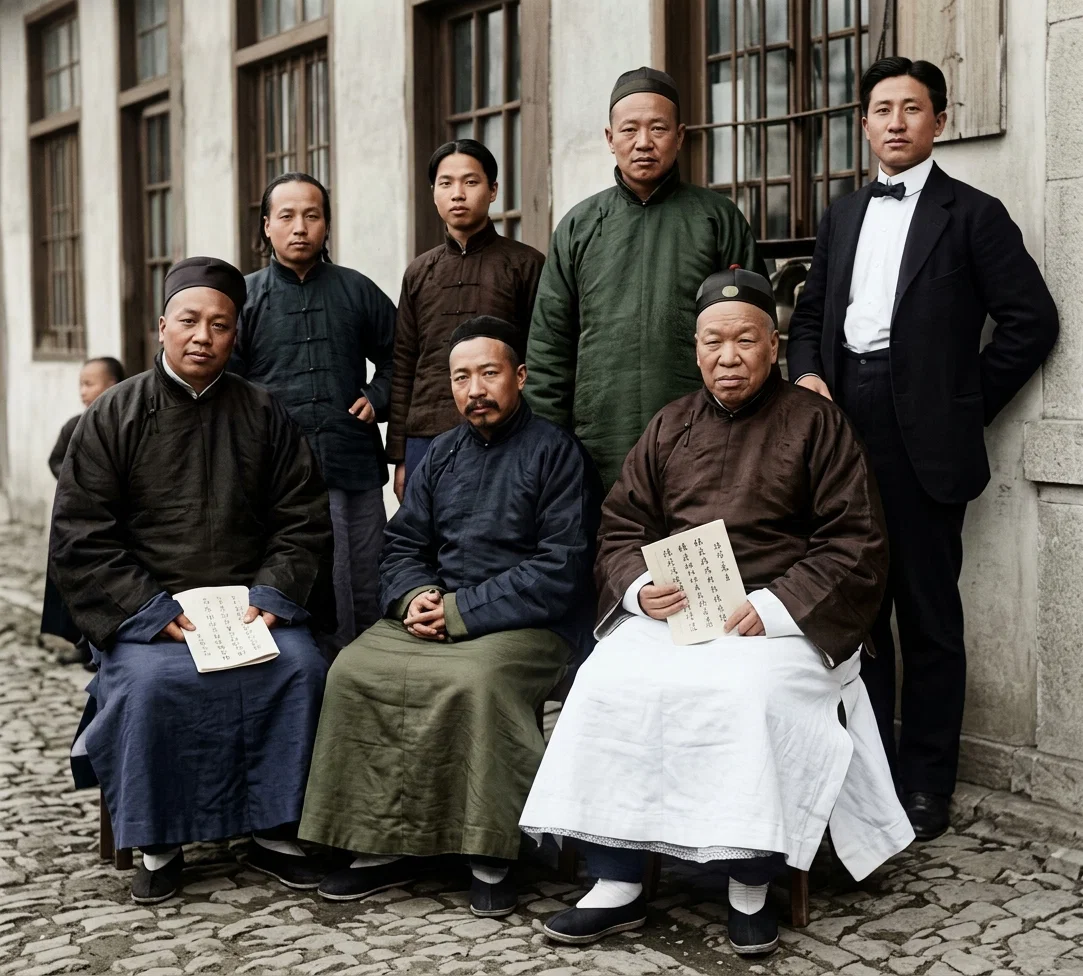
AND THESE FROM THE LAND OF SINIM
The attendance at the Sabbath afternoon service had improved much just prior to my coming, and it increased during my stay until the meeting-room was filled, and every chair and bench was occupied by attentive listeners. A good many of both men and women were Singke-Chinese (born in China), and so not very well acquainted with the Malay. I enjoyed great freedom in presenting the vital, spiritual truths of the gospel, and a good interest was shown by those who were able to follow me. A deep impression seems to have been made, which we trust will result in creating a greater hungering and thirsting after righteousness. We have good reason to believe that this was the case with at least two Baba-Chinese, a young man of about thirty and his wife. The husband used to attend our services while we were in Padang about six years ago. He has attended Brother Bernard Judge's services and studied the truth with him for a long time, and he did not miss a meeting during my visit, when he could possibly get there. Whenever I spoke, I was much cheered by the bright, intelligent expression of this man's face. He seemed to drink in every word eagerly. The truth found its mark, and the Holy Spirit sent it home to his heart, as we knew when, after two private interviews, he decided to step out and confess Christ in baptism. Sister Tena Judge had labored faithfully with the wife, who, while timid and fearful at first, finally found courage to take her stand with her husband, and decided to be baptized with him.
So it came about that on the afternoon of my last Sabbath there, December 10, a little company took carriages, and following up the left bank of the10river, went two miles into the country. Crossing the river on the big iron railway bridge, which has a good foot-path on one side, we were in the midst of a beautiful tropical scene. I there baptized these two precious souls.
The railway from Padang to Emma-haven, the seaport, passes near by. Just as we were beginning our service on the river-bank, a passenger-train passed by, and as there was a halting-place at the other end of the bridge, it provided, for a few minutes, a curious audience of interested spectators, who had probably never before seen a Christian baptism. It seemed a pity that the train could not delay for a time, and witness the conclusion of what was to us a joyful and happy scene. God grant that many such scenes may be witnessed in Sumatra before the Lord comes.
Java, East Indies.
The Panjab
By S. A. Wellman
S. A. WELLMAN
Among the unworked portions of the North India Mission, is the province of the Panjab. The eastern portion has had some work. An Indian brother has been singing and preaching throughout the state of Patiala. Though no one has accepted the truth, he is well thought of, even in the palace of the raja.
In Ambala several are inquiring after the truth, having been brought to a partial knowledge of its claims through the work of our canvassing brother, P. C. Poley. In Patiala City, a doctor has become interested through the same instrumentality, and at Lahore, the capital of the province, another man, prominent in the Indian Christian community, also a doctor with a good practice, has been influenced by the truth. Interests have been awakened in other places; and should it be possible to place a worker in this section at once, the results bid fair to be excellent. The Panjab people are among the most intelligent of India. . . .
The Panjab has a Mohammedan population of twelve millions, two thirds of its entire population. We have done but little for the people of this faith, and it is high time that we were putting forth an effort in behalf of the Moslems, who constitute over one fourth of the population of the Indian empire. They are a hard people to reach, but not more so than some others, in proportion to their privileges and the education they have received.
The Panjab is not our only unentered territory. The Sindi country, with three and one-half millions, occupying the valley of the lower Indus, is without workers. Karachi, the second port of India's west coast, is its chief city. Here a European brother in government employ faithfully lived the truth for some time. Last year he died, but his life and example have been felt. Some of our recent Sabbath-keepers on the west coast obtained much of their first knowledge of the truth from this brother; but with his death this whole territory has been left without one representative of the third angel's message.
Between the Sindi country and the United Provinces, lies the Rajputana agency. Here live ten million of the survivors of the ancient rajputs, the warriors of India. The country is mostly desert, but here and there are fertile portions, and several large cities are scattered about the agency. These ten million souls have no representative of the truth. How long must they wait?
To the south, in the Central Provinces, are millions of Hindi- and Hindustani-speaking people. These are good subjects for labor. Other missions have had excellent success throughout this region, and there is every reason to hope that we could do as well, had we the workers for the openings.
As we look out upon these unentered provinces, and see the density of the darkness and the millions that are yet to be warned, we should grow faint of heart at the prospect were it not for the promise of divine assistance. Here in the Hindustani portion of the field is as large a population as that of the United States, and half as many more that speak kindred tongues, yet in the North India Conference there are only two English-speaking men and three lady workers; and they are confining their efforts to the United Provinces. Daily we are praying that the Lord of the harvest will send forth laborers into his harvest. As we pray and work, we are hoping that with the blessing of God this help may not be long delayed.
Lucknow, India.
Nagasaki, Japan
By Walter L. Foster
WALTER L. FOSTER
My heart goes out in sympathy to the unwarned millions of Japan. Sinful and lost they are; but the Lord has something for them, and it is the same thing that brought hope into our own lives. If the future of the message in Japan can be judged by the past, the living preacher will never get the people warned in this generation—not even one half nor one third of them. But there is a quicker, less expensive way. Let the people read the message. A good, well-equipped printing-plant and a hundred well-trained canvassers could do a mighty work in helping to carry the last gospel message to this people.
In such a country as Japan, not many can get from reading enough to make them Seventh-day Adventists. But the honest ones—those who want the message—can be found in this way; and what they learn from reading will make the rest of the work for them very much easier.
Some insist that we can never sell literature in Japan. If it is the right kind, we know literature can be sold. The present facilities for publishing are so small that hardly enough suitable literature for more than three or four good canvassers can be prepared. The special Owari now being published is not perfect by any means, but it is much better than anything else yet on the market. A fair opportunity is afforded to demonstrate what can be done. Mrs. Foster and another lady worker have been selling the last special for some time. Recently the sales of Mrs. Foster alone have been amounting to more than one hundred papers a day. One day she sold one hundred twenty papers. That would make a profit in United States money of $1.50. This is not theory, but actual experience; and by improving the paper a little, and giving the canvasser a good training, he might often sell many more papers than this.
I believe the book work will also have its day. There are many young people who will be glad to do such work if they can get the literature, and if some one will teach them how to sell it. Japan needs another tent and a printing-plant.
A Missionary Party "on Trek"
By R. C. Porter
R. C. PORTER
(From a personal letter) *
ELDER W. S. Hyatt, Dr. Geo. Thomason, and I, with our wives, Willis and Rosa Hyatt, and Brethren Burton, Moko, and Faba, are making a trip through the Tymnie Valley, in Kafirland [Eastern Cape Colony], where Brethren Burton and Moko have been doing medical missionary evangelistic work with a wagon.
At our first camp it rained all the time the two days we spent with the people. We held public meetings, and Dr. Thomason treated forty-six patients. One intelligent native government teacher decided to accept the truth.
At our second camp the children came running to meet us as we neared the place. We pitched by a beautiful row of shade-trees, and held three outdoor meetings. There were more than one hundred present at some of the meetings. We found a willingness to hear the truth, and the people took a great interest in lantern lectures on the signs of the times and the second coming of Christ. One child who was nearly dying from dysentery was treated, and began to improve at once. This became known to another mother, who came several miles to the second encampment, bringing a child suffering with a similar complaint. She reached us just as we were breaking camp, and called for the great baby doctor. She was much pleased to learn that our party would wait for her baby to receive treatment before proceeding on our journey.
In our last meeting a number requested prayers that they might be prepared for the coming of the Lord, and we closed with a revival service. Dr. Thomason gave forty-three treatments during our second two days' encampment. The people brought hens, mealies, beans, milk, threepences, and sixpences to pay the doctor's bills. As we left, they wished us many blessings, and expressed the hope that if we should not meet again on earth, we might meet in heaven.
Cape Town, South Africa.
Editorial
By Editor
THERE is one straightforward testimony for the Sabbath truth throughout the Scriptures. And in whatever part of the world one meets Sabbath-keepers, one hears the same reason for keeping the day: God himself commands it. “The seventh day is the Sabbath of the Lord thy God.”
WITH Sunday observance it is different. There is no testimony for it in Scripture; and one may hear for it all manner of reasons, confusing and contradictory. It is because there is no reason for rejecting the day that God has blessed and made holy, and no Bible foundation for the keeping of the first day.
YEARS ago a man who left us wrote a book, into which he put a number of the various arguments against the Sabbath. His book was quite a large one, and so the contradictory statements were not closely crowded together. But a certain minister in a foreign land got hold of the book, and issued a small tract in which these self-contradictory arguments were grouped together in a way that led some of his friends to say he had made a great mistake. It was too apparent that the arguments for Sunday “agreed not together.”
IN the REVIEW of November 7, 1854, Elder J. N. Andrews printed the following “creed,” illustrative of the reasons often given for rejecting the Sabbath and keeping Sunday:—
Article 1. I believe that the Sabbath has been changed to the first day of the week.
Art. 2. I believe that Sunday is the true seventh day, and that it should be observed.
Art. 3. I believe that we can not tell what day the seventh day is.
Art. 4. I believe that we are only required to keep one-seventh part of time.
Art. 5. I believe that the commandment to keep the seventh day is abolished.
Art. 6. I believe that those who keep the Sabbath of the fourth commandment will fall from grace.
Art. 7. I believe that every one should be fully persuaded in his own mind whether to keep the Sabbath or not.
CONCERNING this statement, Elder Andrews added:—
Reader, the foregoing is not a mere fancy sketch; I have met with a large number who, in course of a single conversation, have avowed their faith in all the articles of the above creed. There are plenty of such all around you. Is this your creed? If so, permit me to point you to a better one. It consists of ten articles that may be found in Exodus 20. Allow me to recommend this creed to you as infallible, it having been given by Jehovah in person, and written with his own finger on stone. You will find in its fourth article all the errors of the foregoing creed pointed out.