The Youth's Instructor, Vol. LI, No. 42

The Promises of God

The Youth's Instructor

October 20, 1903

Review and Herald Publishing Assn. · Washington, D. C. · October 20, 1903

The Promises of God

DEAR YOUTH OF THE INSTRUCTOR: Do you often think of the promises our Heavenly Father has made us? A promise of the Lord is a guarantee on his part that he will do certain things for us. Children think very much of promises made to them by earthly parents, though sometimes these promises are never carried out. But a promise made by the great Father above will never fail of being fulfilled, even to the letter. Now here are a few things that the Bible says about God’s promises:—
What is the Lord’s great promise to all who obey him?
“And this is the promise that he hath promised us, EVEN ETERNAL LIFE.” 1 John 2:25. Says Jesus: “My sheep hear my voice, and I know them, and they follow me: and I give unto them ETERNAL LIFE; and they shall never perish, neither shall any man pluck them out of my hand.” John 10:27, 28.
But how long is eternal life?—Why, it is a life that measures with the life of God. As the well-known hymn, speaking of heaven, says,—
“When we’ve been there ten thousand years, Bright shining as the sun, We’ve no less days to sing God’s praise Than when we first begun.”
What good promise has the Lord Jesus made, to induce us to come to him?
“Him that cometh to me I will in no wise cast out.” John 6:37. “No wise” means in no sense whatever. This is an unfailing promise, and an exceedingly precious one. But suppose we feel (as we justly may) that we are very sinful and unworthy, then what? To all who feel that way the Lord says, “Though your sins be as scarlet, they shall be as WHITE AS SNOW; though they be red like crimson, they shall be AS WOOL.” What could be more precious and conclusive than this?
What promise has God made concerning the kingdom?
At the last supper Jesus said, “And I appoint unto you a kingdom, as my Father hath appointed unto me.” Luke 22:29. What a precious promise is this! Here is another text: “And the kingdom and dominion, and the greatness of the kingdom under the whole heaven, shall be given to the people of the saints of the Most High.” Dan. 7:27. This is what the Lord promised Daniel over twenty-four hundred years ago, and the time for this promise to be fulfilled is now very near. Then will be realized what Jesus said at the last supper: “But I say unto you, I will not henceforth drink of this fruit of the vine, until that day when I drink it new with you in my Father’s kingdom.” Matt. 26:29. Let us all rejoice and be glad that the time is so near for the promises to be fulfilled, when the faithful will eat bread in the kingdom of God.
In view of the Lord’s promise to accept us in the Beloved, what should all of us do?
“Having therefore these promises, dearly beloved, let us cleanse ourselves from all filthiness of the flesh and spirit, perfecting holiness in the fear of God.” 2 Cor. 7:1. The expression “these promises” refers to what was just said in the last verses of the previous chapter. There the Lord says to all who will be separate from the world that he will receive them, and that they shall be the “sons and daughters of the Lord Almighty.” O, what a wonderful exaltation is this! Just think of it, to be children of the King of kings! We can not fully understand this, but we can believe it, thanks to his excellent name.
But what does the Bible say about the general character of the promises?
In 2 Cor. 1:20 we are told that “all the promises of God in him [the Lord Jesus] are yea, and in him Amen unto the glory of God.” Yea means “yes,” and amen, “so let it be.” Then all these precious assurances on God’s part are emphatically Yes, and, So let it be. Let us take God at his word, for the Scripture says, “He is faithful that promised.” Heb. 10:23. That means that he will never go contrary to what he has said; for he is literally a covenant-keeping God.
What do the Scriptures say about the preciousness and greatness of God’s promises?
Let Peter answer: “Whereby are given unto us exceeding great and precious promises: that by these we might be partakers of the divine nature.” 2 Peter 1:4. Note that the apostle speaks of the promises as “exceeding great and precious.” It may be added also that the promises are exceedingly numerous. There are in the Bible thirty-one thousand two hundred and seventy-three verses, and in no unimportant sense each verse may be taken as a promise from God. Note likewise the importance that Peter attaches to the promises. He says, “That by these ye might be partakers of the divine nature.” When we become partakers of the “divine nature,” then are we truly the sons of God, as John says. 1 John 3:2.
Concerning the preciousness of the promises, here is what the Lord himself says:—
That his children are as precious to him as the apple of his eye. Zech. 2:8.
That they are graven upon the palms of his hands. Isa. 49:16.
That the Lord will never leave them nor forsake them. Heb. 13:5.
That he will be with them always, even unto the end of the world. Matt. 28:20.
That his great desire is that his children be with him where he now is. John 17:24.
That when he comes, every one will be rewarded according to his works. Matt. 16:27.
May our Heavenly Father grant that both reader and writer may be “followers of them who through faith and patience inherit the promises.” Heb. 6:12. To help the young and the old in the great work of overcoming, the Bible everywhere states what God is always ready to do for us. Paul says, “I can do all things through Christ which strengtheneth me” (Phil. 4:13), but we should never forget that of our own selves we can do nothing. Here are a few texts that tell what God can do for us:—
He is able to make all grace abound in our hearts. 2 Cor. 9:8.
He is able to do for us exceeding abundantly above all that we ask or think. Eph. 3:20.
He is able to succor his children when they are tempted. Heb. 2:18.
He is able to help every one of his children, small and great, young and old, from falling. Jude 24.
He is able to save to the uttermost all who come to the Father in the name of Jesus. Heb. 7:25.
Is it any wonder that Paul should ask, in view of such precious assurances as these, “Who shall separate us from the love of Christ”? Let us be of that number who are really “standing on the promises of God.” G. W. AMADON.

The Watchers

I wish ’twere morning, and the night were ended, Sighed one who watched the sleepless hours away; Then joyed that some surcease his woe befriended, And brought him some faint rumor of the day.
*I wish ’twere morning, and my watch were over, The old world grieved, wayfaring through the night. O, glad the weary eyes that first discover The far-off heralds of the coming Light!*
FRANK WALCOTT HUTT.

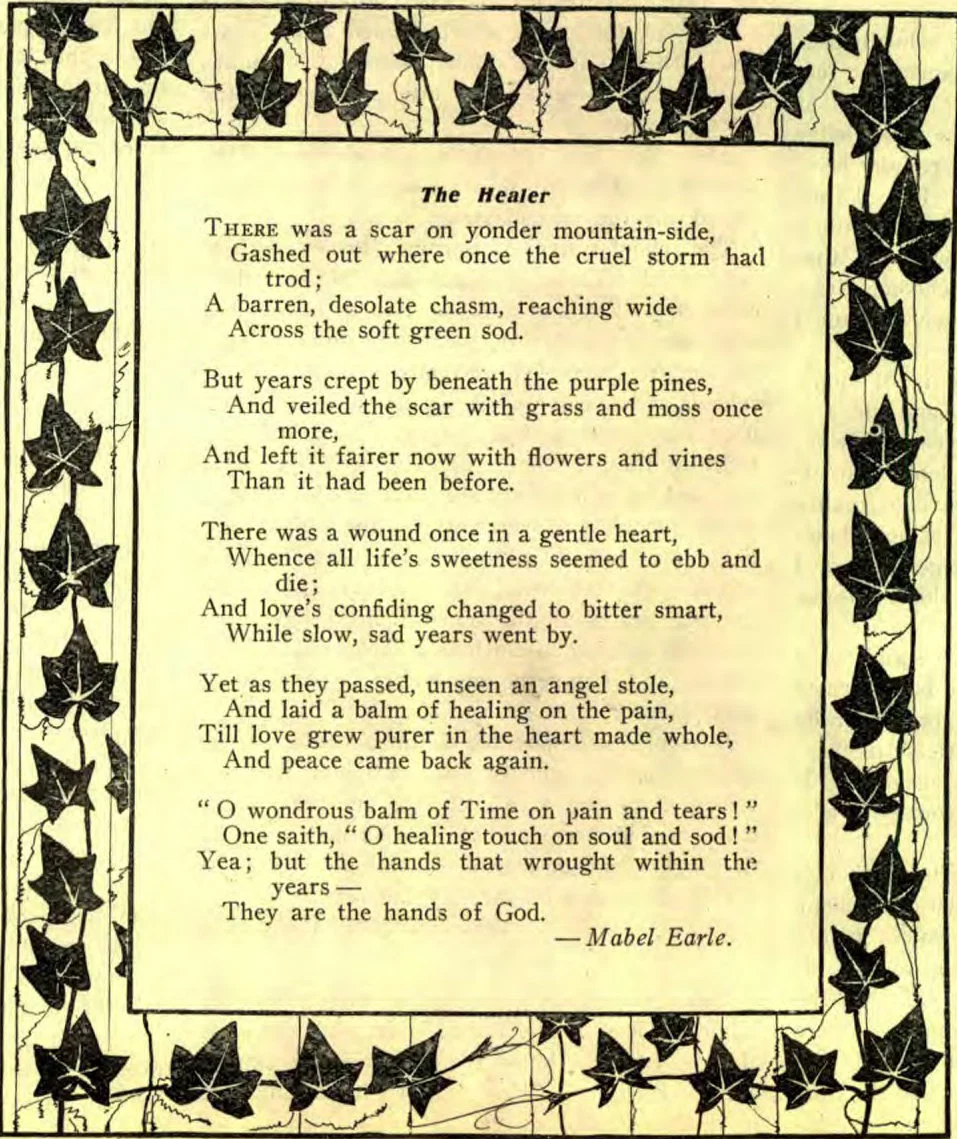
The Healer

There was a scar on yonder mountain-side, Gashed out where once the cruel storm had trod; A barren, desolate chasm, reaching wide Across the soft green sod.
But years crept by beneath the purple pines, And veiled the scar with grass and moss once more, And left it fairer now with flowers and vines Than it had been before.
There was a wound once in a gentle heart, Whence all life's sweetness seemed to ebb and die; And love's confiding changed to bitter smart, While slow, sad years went by.
Yet as they passed, unseen an angel stole, And laid a balm of healing on the pain, Till love grew purer in the heart made whole, And peace came back again.
“O wondrous balm of Time on pain and tears!” One saith, “O healing touch on soul and sod!” Yea; but the hands that wrought within the years— They are the hands of God. — Mabel Earle.

Rambles in Bermuda—V

A Bermudian School

I HAVE seen my ideal spot for a schoolhouse; for I have never looked upon the square or rectangular buildings dotting the level prairies at regular intervals, or perched on some rocky ledge among the hills, as possessing any particular loveliness of form or beauty of situation. Indeed, they are often quite the reverse of attractive, with a bare, forlorn, weather-beaten appearance that would be most depressing to the schoolchildren, were it not for their superabundance of animal spirits.
But this Bermudian schoolhouse is of stone, whitewashed within and without; and since it has a new coat of whitewash every year, it always has a clean, fresh, spick-and-span look, that effectually conceals its age. It is hard to realize that for fifty years and over this same schoolhouse has sheltered generation after generation of Bermudian children; and I may add, the same schoolmaster has taught them.
Its proximity to the water—for it stands on a little promontory that seems to have been formed expressly for its convenience—might render its location objectionable to an American mother; but I have never heard of any accident. It would be hard to find a Bermudian youngster who can not swim.
It was a warm September morning when I visited this school, in company with a friend. There may have been a buzz of voices before our approach; but we heard nothing, as our attention was fully occupied by the beauty of the scenery. As we entered the room, we were greeted with a profound silence; but the little girl peeping at us from the dunce-block, and the mischievous glance we intercepted, seemed to indicate that it was preternatural. The school was evidently under good control, however, though the schoolmaster was an old colored man, seventy-six years of age.
The children were all shades of color, and of all degrees of intelligence. The small colored children of Bermuda are very bright and interesting; but as they grow older, their faces often take on a duller look.
We were seated in front, and various classes were called forward for our inspection. Their copy-books attracted our attention at once,—they were so remarkably neat, and so free from blots. We expressed our wonder and admiration to the teacher. “Yes,” he replied, “if a blot is made in the book, out comes the leaf!”
The pupils of the higher class took a dictation exercise very quickly and correctly on their slates. Then they repeated some verses in concert, and analyzed some sentences from their readers. Last of all I gave them the name of the place from which I had come; and they followed me on their map in my journey to Bermuda, and back by way of Africa and Australia.
Before leaving, we wrote our names in a visitors’ register; and the teacher pointed with great pride to the simple signature “Louise.” Princess Louise of England had visited his school during her short stay in Bermuda.
The children rose and remained standing as we went out, preserving their decorous behavior to the last. I wondered if there would not be a reaction after so long a strain of silence.
We visited the schoolmaster later at his home; and he showed us many valuable, curious, and useful presents from various great personages, with autograph letters accompanying each.
Bermudian schools are of two sorts, private schools, and schools controlled by the board of education. The latter are sometimes called public schools; but they are not free. A fee of twelve cents a week is charged, in addition to the aid received from the government. Of the private schools, the Bermuda high school for girls and the Saltus grammar school for boys rank highest both in the grade of work done, the rate of tuition charged, and the social standing of the people who patronize them. The convent school is a Catholic institution, which opened a few years ago with two teachers and four or five pupils. It now has a very large attendance from the better classes.
The color line is as strongly drawn in the schools as elsewhere, separate schools being maintained for the two classes.
The school system of Bermuda leaves much to be desired. Those who are able to send their children to England and America to finish their education are under no particular disadvantage; but the great majority who must depend upon the schools at home for whatever training their children may receive, feel the need of a different order of things. Better appliances, better methods, and better teachers are sadly needed. Many of the schools are overcrowded; and I have seen only one school-building, the Bermuda high school, equipped with proper seats and desks. In fact, nearly all the schoolrooms I have seen resemble nothing so much as a backwoods district school; and if there be any difference, it is in the latter’s favor.
It would be impossible to introduce a system of free public schools into Bermuda with its strong class and race feelings; but the schools most needed are such as will furnish a good, thorough, common-school education at a price within the reach of the day laborer.
WINNIFRED M. PEEBLES.

The Children

O the beautiful children astray from Eden, Out on the downward path of the world! How shall we reach, and tenderly lead them To where love's banners are all unfurled,— Back, where the true hearts never harden, Where from pain is a glad release, Back to the roses in God's dear garden, Back to the lilies of endless peace.
How can we meet our Lord rejected, How can we hope for a crown of gold, If we have the little ones neglected, Nor sought to lead them back to the fold? Ah, there's an angel appointed rather, All of the children's wrongs to tell; He is their angel, before the Father, And his clear vision shall guard them well.
Keep, dear Saviour, their feet from falling, May strength to each little hand be given; And oft may the childish voices calling, Be heard by the One that rules in heaven. Guard them from sin and earth's temptations, Follow the wayward feet that roam, And at last, dear Lord, with thine own salvation, Gather the children, and lead them home.
L. D. SANTEE.

Abiding Rest in the Lord

Don’t stray hither and thither in worldly flirtation. “Rest in the Lord!” In such ceaseless abiding you will know the inexpressible experience of being “in Christ.” “All my springs are in thee.”—J. H. Jowett.

Roman History Continued

History Stories—No. II

Roman History Continued

ROMULUS was the first of the seven kings of Rome. Among these were great and noted men who did much to subdue their enemies and build up the city; but the last ones were such cruel tyrants that the Romans drove them out, and declared that they would never be ruled by another king. This promise they kept for nearly five hundred years.
They now set out to govern themselves; their laws were “of the people, by the people, and for the people.” In place of the king, there were elected by all the free men of Rome two magistrates called consuls, who were chosen for one year, and were given nearly all the powers that had been held by the monarch; but nothing could be done by one without the consent of the other.
In times of great public danger, a dictator was chosen for six months, and all the power was placed in his hands. Of the Romans it is said that they knew better how to govern themselves than any other people except the Anglo-Saxons, or English-speaking people. This is especially interesting because Rome was the first great republic.
But things did not run along very smoothly under this new rule. Many of the Latin towns that had been subject to Rome now rose in revolt, and seemed harder to conquer the second time than they were the first. War without soon brought trouble within.
Besides the slaves, there were two principal classes. The patricians were the original Romans; they were wealthy, proud, and determined to have everything their own way. The plebeians were chiefly made up of the inhabitants of captured towns, and of people who had come there to find homes. They were free to hold property, but had no part in the government. They composed the largest class, and during this time of war they fell in debt to the wealthy. The reason for this was that all were required to go to war, and pay their part of the cost. If the poor plebeian could not do this, he was sold as a slave, and in some cases even put to death. This was so unjust that they marched away from Rome in a body, and prepared to build themselves a city on a neighboring hill.
This plan, if carried out, would mean ruin to Rome, so the patricians saw clearly that the plebeians must be persuaded to give up their plans and come back. For some time they would not, but finally they consented to return. The debts of the poor were canceled, those held as slaves were set free, and two officers called “tribunes” were chosen from their own number, whose duty it was to protect them against any injustice. The number of tribunes was soon increased to ten; they were never to go more than a mile from the city, and their houses were to be open day and night, that any plebeian might flee to them for protection and justice.
This was the first great victory in their struggle for freedom. Every time they succeeded, the patricians planned to rob them of their reward. For centuries the strife continued: but they persisted until the prize was won, and they were admitted to all the rights and privileges of the Roman republic. Then its people were most loyal, its soldiers were very brave, and its power was felt throughout the world. Thus the truth that, “All men are created . . . equal,” when recognized and regarded, made the fourth kingdom “strong as iron.”
Roy F. Cottrell.

A Trip Through Egypt—IV

From Cairo to Luxor

THIS long journey is of unusual interest to the uninitiated. Leaving the central station at Cairo, the train moves in a northwesterly direction for a short distance; then, after crossing the Nile, turns to the south. Cairo soon comes into view again from across the river, the great dome and tall minarets of the mosque in the citadel standing out sharp and clear in the crisp morning air. Presently the now familiar pyramids of Gizeh appear on the opposite side, and soon those of Sakkara and Dashur follow.
The railroad follows the Nile Valley very closely, the river itself being in sight from the car window much of the time. The general scenery presents few changes, a low, brownish-yellow line of cliffs, the outlines of which in the morning and evening take on beautiful purple tints, forming the background on both sides for the entire distance. The rich fields in the foreground, dotted with small pens built of corn-stalks, in which the cattle are confined, are crossed and recrossed by small canals and ditches, which are kept full of water for irrigation by picturesque shadoofs and clumsy water-wheels, operated by oxen. Occasionally we pass a raised village of mud huts, often situated in the midst of a small grove of luxuriant date-palms. In the fields we see the “fellahs,” or agricultural class, working with oxen and wooden plows, or reaping with no less primitive tools. Wheat, corn, sugar-cane, and cotton are the principal crops; but many kinds of small vegetables are raised, also oranges, dates, and figs.
The Egyptian railway service, although slow, is reliable. The second-class accommodation is not luxurious, but, like the English, quite good enough for ordinary persons, and withal very cheap,—about one cent a mile for long distances. The neat and often elegant stone station buildings in even the smallest towns, attract the admiring notice of the traveler, particularly if he has ever had the experience of sitting seven hours in one of the many derailed “cabooses” that disgrace the cognomen of “depot” in some parts of western Kansas and Nebraska, and even, occasionally, in less uncivilized districts. The worst discomforts of Egyptian traveling are heat and dust. If the windows are closed, the temperature in the car soon rises to one hundred and fifteen degrees Fahrenheit, or thereabouts, and the clouds of dust that enter at the tiniest crevice are as bad as the heat. In the summer it is best to travel in the night, when it is always cool. The intolerable thirst resulting from these conditions is the most aggravating symptom. The quality of the water offered for sale at the stations is not even guaranteed, yet few travelers can resist the temptation to partake of it, in spite of the personal risk, sometime before the end of the sixteen-hour journey. The writer tried the plan of eating oranges, and consumed fifteen during his first trip to Luxor, with some relief, but developed such an aversion for them he was unable to eat another for some days after.
Early in the afternoon the train stops at Assiut, the metropolis of Upper Egypt. There is a fine bridge over the Nile here, also a large barrage, or dam. This barrage forms a large reservoir, which, in connection with a similar and larger structure at Assuan, supplies the water for an immense system of artificial irrigation, and also enables the government to regulate the annual inundation, which is not always reliable in its movements.
Soon after leaving Assiut, the hills begin to assume that strange purplish violet and sometimes deep-blue color peculiar to the landscapes of Upper Egypt, Nubia, and the Sudan; and the sun sets amid a wonderful display of beautiful yet weird and almost unearthly tints. As the darkness draws on, the traveler settles back in his seat as comfortably as possible, and passes the time in taking short naps between the stations until midnight, when the train finally reaches Luxor. Here, after encountering an unusually importunate charge of donkey boys and hotel agents, he reaches his destination, and, after a thorough bath, retires, falling asleep with a suddenness that cuts off all further reflections.
GLEN WAKEHAM.

Traveling in India

UNCONSCIOUSLY the English government has made traveling in India very convenient for carrying the third angel’s message. From the Himalayas on the north, to Madras in Southern India and Bombay on the west, there is a well-equipped system of railways. Probably there is no place in the world where people travel more than in India. Because of the climate, government offices change with the seasons. In the cooler months, from November to March, the government moves its office from the cold of winter, as found in the Himalaya Mountains, to the temperate atmosphere of the plains; but when the hot season begins, officials, clerks, and accountants, with their families, move their work back to the hill stations.
ON THE NILE NEAR KENEH
Twenty-three hours’ ride by rail from the burning heat of Calcutta brings one to the bracing air of the snow-capped Himalayas, which are generally regarded as one of the three greatest wonders of the world. An ascent of seven thousand feet on a toy railway to Darjeeling, the summer home of the lieutenant-governor, is made through ever-changing views. One moment the little engine is tugging through dense forest jungles, where may be found wild elephants, leopards, deer, and numerous smaller animals, and farther on immense tea plantations burst upon the view.
While these gardens are beautiful to look at, it is sad to see the soil of the Himalayas given almost wholly to the cultivation of this herb. The natives of India, usually so slow to adopt foreign customs, are rapidly taking to tea-drinking; and the herb is sold at such a low price that the poorest of the poor can have it. In the bazaars of Darjeeling it is not an uncommon sight to see the women sitting on the ground surrounded by their stores of fruits and vegetables, and a teapot beside them, though a few years ago, we are told, such a sight was never witnessed.
At the present time, during the month of June, several of our workers are seeking rest and change in this beautiful resort, where people from all over India are gathered. Here we find the government employee, the student, and the mother with her children, who are pale and sickly from the unhealthful climate where they have been living. The pleasure-lover is also here, and last but not least the missionary, gladdened by the change from the heat and enervating atmosphere of the plains to the bracing air of these mountains. Thus is offered a wonderful opportunity of getting some of our literature before all these different classes, and many of them will return to their homes subscribers to our Oriental Watchman and English Good Health.
The native hill people are merry-hearted, industrious, and interesting. The women are the burden-bearers, and carry immense loads on their backs. It is not an uncommon sight to see a native woman with a basket of coal or a bundle of wood on her back, and a little child hardly able to walk clinging to her skirts, while at the same time she is knitting stockings or some warm clothing, as she is trudging up and down the hills.
There are thousands of these honest-hearted people scattered throughout these mountains, and yet there is not a soul who can speak their language and give them the special message for this time. As we see their smiling faces and faithful work, we can not but feel that some one will be raised up to work for them.
Simla, the summer home of the viceroy and his officials, is a two-days’ trip from Calcutta, and is represented by two of our workers, who are finding their way into many of the best homes there. We rejoice to know that God is already giving them souls for their hire.
While our company in northern India are enjoying the change of climate and work, two of our young women workers are in the hills of Southern India, meeting the people who are seeking the benefits those resorts afford. They have been canvassing from place to place, taking large cities and small stations, and sometimes going as far as twelve miles to see an isolated family. The Lord has wonderfully blessed them, and has gone before them.
In connection with her railway system India has a convenient thing for the traveler, the dak bungalow, a house built near the station, well furnished, at the disposal of those who can either provide their own food or pay the man in charge a small sum for cooking it. This is a wonderful convenience, and these sisters in Chillong and Southern India have found these bungalows a great blessing; for wherever they have gone, they have found a home ready for them. Many times, too, the people have opened their own homes to them; and the promise of the Scriptures has truly been fulfilled in their case, for they have found fathers and mothers wherever they have gone. Three years ago one of these young workers was a society girl, and enjoying only the pleasures of this life. The other young woman is sent out here by the sisters of Kansas and Texas. I will quote a few words from one of their last letters: “We put each other through a regular examination every day, in points of Bible truth. This helps fix various points in our mind. We set each other questions to answer; no matter how often we study these things, they are inexhaustible: we shall never be able to dig down to the bottom of God’s word, shall we? How thankful I am that God has enabled me to see these things.”
India needs hundreds of young people who are willing to consecrate their life’s service to the salvation of the millions who are in darkness. It means self-denial now, but in the kingdom of heaven “they that be wise shall shine as the brightness of the firmament; and they that turn many to righteousness as the stars forever and ever.”
MRS J. L. SHAW.
Calcutta, India.

Soul Stability

Once, when a student of botany, I planted a handful of peas in a box of sand. I thoroughly wet the sand, and kept it moist. The weather was cold, and I placed the box near the heating stove, or sometimes in the warm sunshine in the window, and kept the temperature as nearly even as I could. Under these favoring conditions the life in the little seeds began to stir; and as day after day I dug the seeds up, pea by pea, I found the germ expanding, growing, reaching upward, until at last a number reached their tiny green hands above the surface, and plant life was begun.
For a few days they flourished, and vigorously climbed toward the light. By digging down, I could find their numerous rootlets running everywhere, searching for nourishment among the flinty grains of sand. And the fat little balls I had planted, in which there was stored so much food for the plants, were shriveling and disappearing, all but the hard envelope, the hull. Before they had grown too big to permit it, I removed two or three from the sand-box, transplanting them to a box containing richer soil, but one I left where it had begun to grow.
A number of days passed, and the pea-plant in the sand-box began to fail in its vigorous growth. I poured on more water, and gave it all the sunshine there was, and I did just as much for it as I had done in the beginning,—more, I stirred the loose soil about its roots, and found that there were no worms destroying them. But the plant did not look so well, and finally it began to wither and die, until at last it was perished.
Then I dumped the sand out of the box, outdoors, and let it fall away. Behold! what a mass of roots, packed and interwoven, the mute evidence of the little plant’s groping and determined searching for food! There was none left where its life began, only the dead hull still clinging around the root-stalk. There in the darkness they had run hither and thither, seeking for life. I could not see them while I was watching the death of the plant above; the plant did not show its secret struggles, and I let it die.
But the plants which I had transplanted were sturdily climbing the nearest supports, and making strong, bright-looking plants, with promise of flowering and fruitage. I knew their rootlets down below were finding food, and I watched them with pleasure as they climbed, knowing I had furnished them intelligently the new conditions and the nourishment their growth demanded.
There are boys and girls in whom, under favorable conditions, when the warmth of the Spirit’s awakening power is turned upon them, the divine life is placed and stirred to action. They acknowledge their Saviour, and are led to speak of their glad knowledge of the new and beautiful way.
The days go on, and a Sabbath comes when in social meeting their voices are not heard. We see their growth is failing. Perhaps a stirring appeal will bring them spasmodically to their feet. The water is being poured on. But again they drop back, and we wonder over their lack of stability. We talk with them and urge them, coddle and press them, but we see their Christian life withering and dying, dying down to the ground. What a pitiful sight it would be if we could catch a glimpse of the secret life, with the unspoken longings, the vague gropings for life, which our eyes never see. They are starving for food, and the conditions which told so favorably at first no longer have effect.
We can not depend upon the possible enthusiasm of a social meeting to sustain the Christian life, we can not look to the personal magnetism of a teacher or a religious leader to place the youth upon a firm foundation; we must give them solid food. That food is gospel truth, the definite truths of the third angel’s message. It must be a systematic furnishing, day after day a giving of the virile truths of the sanctuary work, the coming of Christ, the Sabbath, and every point of our faith. This is the work of the parent in the home, the teacher in the school, the elder in the church. It must be intelligently and attractively presented, else it will be like the sand, which the rootlets can not assimilate.
But if morning and evening the home should give the precious instruction, and day after day the school should add to it and question about it, and week by week the young people’s meeting should talk it, and the church service echo it, who can not see that we should have a strong and heroic Young Guard to beat back the enemy’s lines? This is the work which is imperatively demanded by the present situation, and if we everywhere will take it up and do it, and trust no more in an indefinite and presumptuous faith that all will be well with the flock which the Lord hath given us, then shall we see our sons and our daughters growing up as trees planted by the rivers of water, and the Lord will seal the work by a revival which will be the latter rain.
A. W. Spaulding.

THE WEEKLY STUDY

The Elements of a Great Reformation

Separation From the World

SCRIPTURE STUDY:—
In the world, but not of the world. John 17: 9-20.
Separation from the world means separation from sin. John 17: 15; Eph. 4: 17-32; 5: 1-11.
There is danger that these sins will be found in the church; for Paul's words are addressed to the “faithful in Christ Jesus.” Eph. 1: 1.
The second angel's message is a call for separation from the sins of the world and the church. Rev. 14: 8; 18: 4; 2 Cor. 6: 14-18.
The blessed result. Titus 2: 11-14; Rev. 14: 12.
PARALLEL READING:—
“Luther's Separation from Rome.” (“Great Controversy,” Chapter Seven).

To the Leader

Let the keynote of this lesson, separation from sin, ring out with the force which its importance demands.
The lesson may be conducted in two parts:—
1. A Bible study, as outlined, for from twenty to thirty minutes.
2. A brief presentation of the narrative of Luther's separation from Rome.
Chapter Seven in “Great Controversy” is quite long, and of course no attempt should be made to read it, or a large portion of it, in public; but by a little careful preparation, some one can be prepared to tell the story, reading only such selections as may be most to the point. From fifteen to twenty minutes should be enough time for this exercise.
Arrange for one of the members, at the close of the study, to read or recite the beautiful poem by Whittier, “The Hermit of the Thebaird,” published on page 6 of the INSTRUCTOR.
This will afford a favorable opportunity for impressing the important truth that the Christian is called to live a life of purity amid the corruptions of the world. We can not do our work in seclusion. We must be in the world in order to labor for its salvation; but we must not be partakers of its sins.

Notes

Luther's experience in separating from the Roman Church forms one of the most thrilling chapters in the history of the great Reformation. In the seclusion of his stone cell at Erfurth he heard the voice of God calling him away from his superstitious errors; and there his soul was strengthened for a great life-long battle.
Later he found a copy of the Bible chained to the wall in the monastery; and from it he learned that “the just shall live by faith;” that the sinner must go to God for pardon; and that the Lord Jesus Christ is man's only Intercessor. These great truths burned within his soul, and finally led him to a separation from the Roman Church, a step which at first he had not dreamed of taking.
The time had fully come for a mighty work to be accomplished; the midnight of the Dark Ages had passed; the Morning Star of the Reformation had arisen; the first gray streaks of the coming morning had flashed across the sky. Already the influence of Wycliffe's books had begun to be felt; the noble work of Huss and Jerome had stirred the hearts of many honest adherents of the Catholic Church; and Germany was beginning to awake.
The time had come for a leader, a man for the hour, who could stand without terror before the strongest organization the world had ever seen, a man whose fear of God would be so true and genuine as to take away all fear of man, even the fear of the great voice from the Vatican.
All was now ready. God takes ages to prepare his work; but when the hour is come, accomplishes it by the feeblest instruments. To do great things by small means is the law of God. This law, which appears in every department of nature, is found also in history. God took the reformers of the church where he had taken the apostles. He selected them from that humble class, which, without containing the meanest of the people, is scarcely the length of citizenship. Everything must manifest to the world that the work is not of man but of God.—D'Aubigne.
A man was required as a leader for a mighty work; and the Lord chose a humble monk, the son of a poor miner, and placed within his heart a conviction of sin, and then revealed to him the great remedy for sin; and supported by this corner-stone of the Christian faith, Luther did the work for which he was called. The great step of his life was that early step, when, under deep conviction, he decided to separate from the sins of the world and accept the great salvation. His separation from Rome was incidental to this, and only the natural result of it.
What a program is thus laid out before us who are facing the world's last great reformation! The time has come for the work to be done; all things are now ready; and God's great and mighty work will be accomplished by men who, like Luther, will separate from sin, throw their all into the work of the gospel, fearing nothing but God.
Continue reading: — M. E. Atkinson