The Youth's Instructor, Vol. LI, No. 42

The Promises of God
Earlier text: The Promises of God

— M. E. Atkinson

LORD, I have shut my door— Shut out life's busy cares and fretting noise; Here in this silence they intrude no more; Speak thou, and heavenly joys Shall fill my heart with music sweet and calm— A holy psalm.
And I have shut my door On earthly passion, all its yearning love, Its tender friendships, all the priceless store Of human ties. Above All these my heart aspires. O Heart Divine, Stoop thou to mine!
Lord, I have shut the door! Come thou and visit me. I am alone! Come, as when doors were shut, thou cam'st of yore, And visitest thine own. My Lord! I kneel with reverent love and fear, For thou art here!

— M. E. Atkinson

Chick-a-dee-dee

The sky was all gray, and the earth was all brown, The frost-withered leaves came fluttering down, And fluttering down ’mong the grasses and weeds The chickadees came for their breakfast of seeds; And out on the air so chilly and drear They sent a blithe song full of jolly good cheer, As they glided like shadows, here, there, to and fro,— “Chick-a-dee-dee, it’s going to snow.”
“O chick-a-dee-dees! you are cute little chaps In your pearl-colored vests and your black velvet caps. But tell me, I pray, I am anxious to know How you know—don’t you know?—that it’s going to snow?”
They twittered and chattered, “Chick-chick-a-dee-dee, Chick-chick-a-dee-dee! just wait and you’ll see.”
“You small fluffy prophets with beady-black eyes, How came you to be so remarkably wise? Can you read all the signals the weather man sends,— Are you fellows and Old Probability friends?”
Then from the dark clouds bending low o’er the world, With slow, zigzag motion the fleecy flakes whirled, And the birds wheeled away through the fast-falling snow, Singing, “Chick-a-dee-dee-dee! I told you so.”
— Selected.

“A Pound of Cure”

Jeffy stopped whistling to scowl; the two things somehow didn’t fit each other. You either had to stop whistling or go without scowling, and you couldn’t do that very well when you were in a dreadful hurry, and couldn’t find your cap and jacket. So Jeffy stopped whistling a minute.
“Where could I have put my jacket this time?” he scolded. “I never saw such slippery old things as jackets an’ hats, anyway!”
That made the second pair of them Jeffy had lost since morning. The first time it wasn’t so bad, for there had been his best coat and cap to fall back upon. Of course he had gone upstairs after those when he hadn’t been able to find the every-day ones. But this time—what was he going to do this time? The best ones were lost, too!
“I’ve got to find ’em!” he said. “I can’t stay home from Terry Lowe’s circus. Mother! Aunt Louie! Mildred!” he raised his voice to a shout for help. “Can’t somebody tell me where my jacket is? I can’t find ’em anywhere.”
But no help came. Nobody answered. Jeffy’s losing his things was such a very old story, indeed.
“Oh, dear!” Then suddenly the scowl vanished, and the merry whistle came back, for Jeffy remembered the old last-year’s jacket, up in the store closet. It would be tight, and the sleeves would be too short, but it would do. One isn’t critical at a back-yard circus.
After dinner Jeffy heard his special “call” on the telephone. Uncle Geof was calling him. He came back from the front hall in a whirl of excitement. Goody! oh, goody! Uncle Geof had invited him to go riding in his automobile with him; he was to call in about fifteen minutes.
“Goody!” shouted Jeffy. “How about that, mother? Isn’t Uncle Geof a dear? But I can’t wear my last year’s coat, of course,—why, that’s gone, too! They’re all gone, every single one of ’em! O mother, don’t you know where some of my jackets and caps are? I’ve got to find one before Uncle Geof comes!”
“Why, yes, I know where they all are,” smiled mother, pleasantly. “They’re in the pound.”
“In the—what?” cried Jeffy. His eyes widened with astonishment.
“The pound. Haven’t you ever heard of a pound, dear? It’s a place where caps and jackets that little boys leave lying round in the wrong places are all put away; that’s what my pound is, anyway. In olden times pounds were public enclosures where all stray animals were driven and kept until their owners claimed them, and, Jeffy, the owners had to pay something to get them out, you know. That was the way they were taught to keep their property where it belonged. I have an idea that the man who had to pay very many times to get his stray sheep or cows or oxen out of the pound concluded after a while that it would be better to go home, and mend his fences, and keep the animals at home. And perhaps,”—mother looked out of the window thoughtfully,—“perhaps the little boy who has to redeem his caps and jackets very many times from his mother’s pound will conclude by and by”—
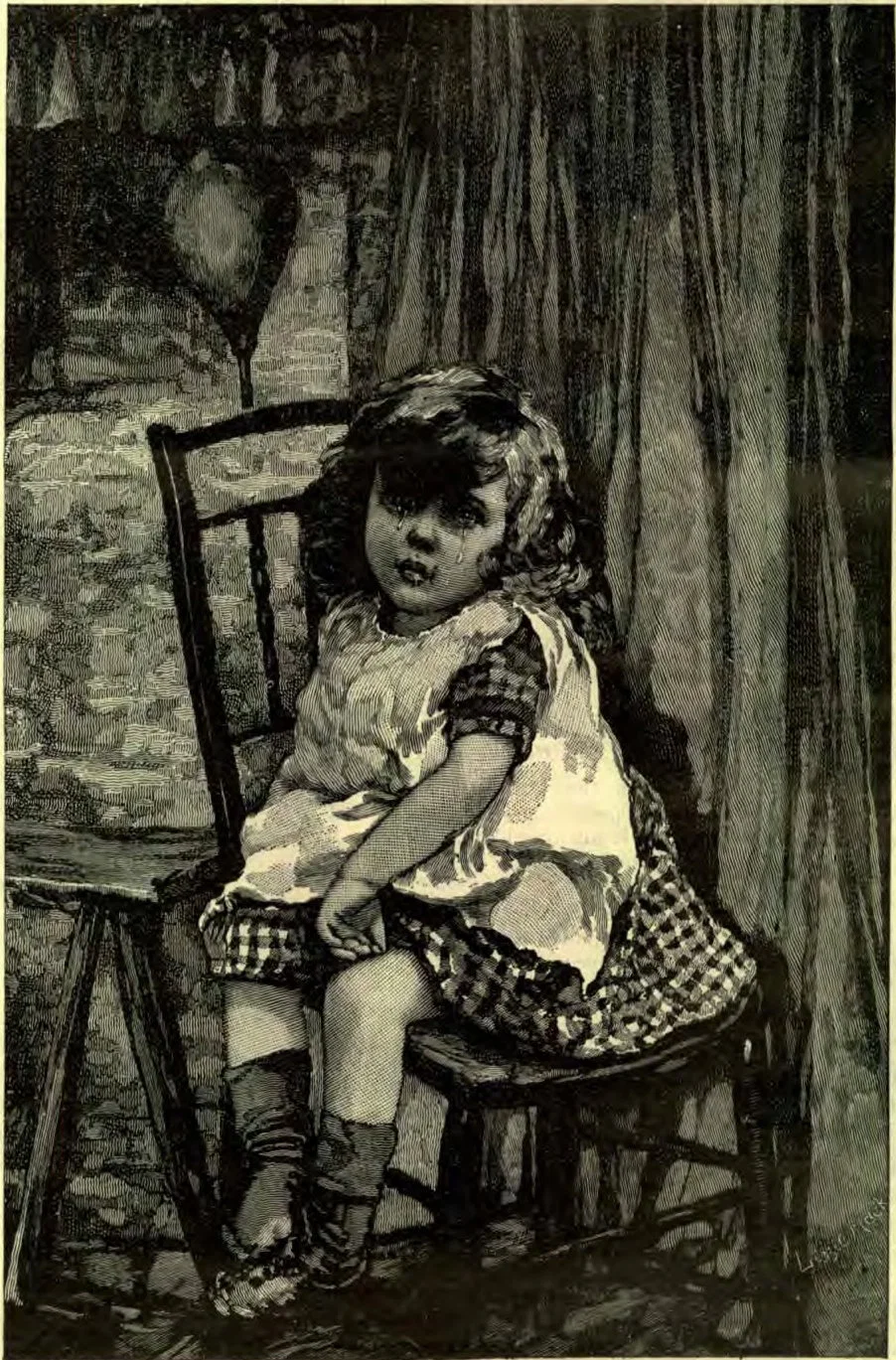
AN OCTOBER SHOWER
AN OCTOBER SHOWER
“Yes’s—yes’m,” stammered red-faced Jeffy, “p’rhaps he’ll hang ’em up in the hall closet. But, mother”—
“But, Jeffy!”
“I hope it—doesn’t cost so very much to get things out o’ pounds, because—because”—
“Because, Jeffy?”
“I haven’t got much of any spending-money left. I—I’m ’fraid I haven’t got any. I spent the last of it yesterday.”
There was an embarrassing little silence. Jeffy watched mother’s face with anxious eyes, and listened for Uncle Geof with both his anxious ears. He knew he could never go riding bareheaded and without a jacket—not in a beautiful new automobile! And his spending-money was all eaten up.
“Oh, I wish folks had never thought to pound things!” he groaned, inside, “or else I wish I’d thought to hang ’em up.”
There was certainly a sound out of the window: no, that was old Tim Hoovey’s push-cart. But Uncle Geof might come any minute.
“If—you’d lend me some money, mother, ’vance it, you know”—hesitatingly.
Mother crossed the room, and took him right into her two arms.
“Dear, I can’t. It’s a rule, you know. And I’m afraid it’s a pound rule not to let anything go until it is lawfully redeemed. I’m sorry, Jeffy”—
“Yes’m, so’m I.” But Jeffy straightened up and looked as if he were trying to smile. It wasn’t quite a success, but mother was satisfied. She smiled, too, though as sure as you live she had to try as hard as Jeffy! What he wanted to do was to cry. It was terribly hard, oh, terribly, keeping a pound.
“You tell him—you tell Uncle Geof I can’t go to-day ’cause I’ve got to earn some money,” Jeffy said, steadily. “I’m going out in the back yard, and pile that wood up.” And he strode away, whistling a shaky little tune. Mother looked after him mournfully.
“I feel as if I’d pounded him!” she told Aunt Louie a minute later, as she stood by the window looking out.
Aunt Louie rocked slowly back and forth in a chair.
“Well, you have, the poor little man!” she smiled; “but he’s good for it. Wait and see if it doesn’t teach him to hang his things up, dear. Just wait and see.”
And mother waited and saw.—Annie Hamilton Donell.

Short Horizons Make Life Easier

“SHORT horizons make life easier, and give us one of the blessed secrets of brave, true, holy living.”

Perseverance — II

THERE is, perhaps, no greater mistake that a young man can make than to suppose that in order to succeed, he must be endowed by nature with some special talent. Some doubtless are; but, undeveloped and unused, it will be of little value. What counts most is to develop the talents we do possess with indomitable perseverance, and in spite of obstacles hammer out success. Seeming defeat can many times be turned into a great victory.
“Thus at the flaming forge of life, Our future must be wrought; Thus on its sounding anvil shaped Each burning deed and thought.”
We often hear it said that “where there’s a will, there’s a way.” By unceasing effort we many times may force an opening in a hitherto impregnable barrier. Many who have succeeded have been surrounded with the most unfavorable circumstances. Environment, early training, lack of education, were against them. Time and again they failed, but they tried again.
Sir Isaac Newton was the son of a poor man, as was also the distinguished astronomer Adams, who discovered the planet Neptune. Shakespeare was of humble rank; his father was a butcher, and he himself in early life was a wool-comber. He was, however, a close student. Sir Richard Arkwright, the inventor of the spinning-jenny and the founder of cotton manufacture in England, was a barber. Abraham Lincoln was a rail-splitter early in life, poor in this world’s goods, awkward and uncouth. But his ungainly frame held a noble heart and an indomitable purpose.
One writer has said: “Do not be frightened because your idiosyncrasies stick out, and provoke criticism; it is only by these that you can be identified. If you are knock-kneed and hump-backed; if you are squint-eyed, and look two ways at once,—so much the better; you can’t be confounded with the commonplace, stereotyped bipeds who make up that ‘numerous piece of monstrosity,’ the public.”
No greater preacher ever trod the earth than the great apostle Paul. He endured the most incessant toil, and suffered shipwreck, stoning, whipping, and other abuse. Yet he speaks of his infirmities, and says that he was “in bodily presence weak.” God helped his servant, and he will help you. John Milton, author of “Paradise Lost,” was blind, and an invalid early in life. Daniel Webster tells us there was one thing he could not do when a boy, and that was to “declaim before the school.” The burning eloquence of this distinguished man was the result of hard, persevering work. George Stephenson, the engineer, when addressing young men, said, “Do as I have done—persevere.”
It has required much persevering research to decipher the cuneiform inscriptions on the ancient monuments of Nineveh and Babylon. This kind of writing has been lost to the world since the days of the Macedonian conquest of Persia. But much has been accomplished; and by the light thus shed on the buried history of Babylon, the authenticity of the Sacred Word is confirmed. No student of ancient or modern language knew anything about the mysterious hieroglyphics; but a naval cadet named Rawlinson, by comparing the known with the unknown in the language, was able to form a sort of alphabet; a clerk of an East India house, named Norris, who has made the inscriptions a study, assisted; and a lawyer’s clerk named Layard, by travel, extensive research, and patient digging, unearthed a vast amount of these historic treasures for the museum.
The same perseverance should be shown in the work of perfecting a Christian life, and proclaiming the gospel message to all the earth. If it is commendable in worldly matters, how much more in divine things? What marvelous light would dawn on our pathway if we would persevere in like manner in the study of the Bible! Shall we not do so? “The soul of the sluggard desireth, and hath nothing: but the soul of the diligent shall be made fat.” G. B. THOMPSON.

The Hermit of The Thebaird

ALONE, the Thebaird hermit leaned At noontime o’er the Sacred Word. Was it an angel or a fiend Whose voice he heard?
It broke the desert’s hush of awe, A human utterance sweet and mild; And, looking up, the hermit saw A little child.
A child, with wonder-widened eyes, O’erawed and troubled by the sight Of hot, red sands, and brazen skies, An anchorite.
“What dost thou here, poor man? No shade Of cool, green downs, nor grass, nor well, Nor corn, nor vines.” The hermit said: “With God I dwell.
“Alone with him in this great calm, I live not by the outward sense; My Nile is love, my sheltering palm His providence.”
The child gazed round him. “Does God live Here only?—where the desert’s rim Is green with corn, at morn and eve, We pray to him.
“My brother tills beside the Nile His little field: beneath the leaves My sisters sit and spin the while My mother weaves.
“And when the millet’s ripe heads fall, And all the bean-field hangs in pod, My mother smiles, and says that all Are gifts from God. ”
“And when to share our evening meal, She calls the stranger at the door, She says God fills the hands that deal Food to the poor.”
Adown the hermit’s wasted cheeks Glistened the flow of human tears: “Dear Lord!” he said, “thy angel speaks, Thy servant hears.”
Within his arms the child he took, And thought of home and life with men; And all his pilgrim feet forsook Returned again;
The palmy shadows cool and long, The eyes that smiled through lavish locks, Home’s cradle-hymn and harvest-song, And bleat of flocks.
“O child!” he said, “thou teachest me There is no place where God is not; That love will make, where’er it be, A holy spot.”
He rose from off the desert sand, And, leaning on his staff of thorn, Went, with the young child, hand in hand, Like night with morn.
They crossed the desert’s burning line, And heard the palm-tree’s rustling fan, The Nile-bird’s cry, the low of kine, And voice of man.
Unquestioning, his childish guide He followed as the small hand led To where a woman, gentle-eyed, Her distaff fed.
She rose, she clasped her truant boy, She thanked the stranger with her eyes. The hermit gazed in doubt and joy And dumb surprise.
And lo!—with sudden warmth and light A tender memory thrilled his frame; New-born, the world-lost anchorite A man became.
“O sister of El Zara’s race, Behold me!—had we not one mother?” She gazed into the stranger’s face;— “Thou art my brother?”
“O kin of blood!—Thy life of use And patient trust is more than mine; And wiser than the gray recluse This child of thine.
“For, taught of him whom God hath sent, That toil is praise, and love is prayer, I come, life’s cares and pains content With thee to share.”
Even as his foot the threshold crossed, The hermit’s better life began; Its holiest saint the Thebaird lost, And found a man!
—Whittier.

A Forest Parasite

WHERE the new railway cuts through the wooded districts of east central Cuba, the traveler gets a view of the fierce struggle going on in the tropical forests. Vines and clinging parasites weave flowering festoons and graceful tracery over boughs and branches, while all the time apparently watching only for the hold that is to strangle the life out of the trees.
A fellow-traveler pointed out the most deadly forest parasite, peculiar to Cuba, called the “cupey.” In the ride through the country I had abundant opportunity to watch its work. The seed is carried by bird or wind into the fork of a tree, high up among the branches. There it grows, putting out shoots, and sending down roots that creep round and round the trunk, and finally into the earth beneath. Then, as its roots grow and send out feelers uniting root to root, it tightens its grip upon the body of the tree. Day by day, and year by year, the parasite grows larger and presses tighter, until the tree is literally strangled. There is a look almost uncanny about it. The expiring tree stretches out its leafless limbs, like spectral hands reaching forth for help. You may see scores of large trees dead in the embrace of the parasite, which covers the bare, white form with green and flowering creepers.
But when the tree decays, as it surely does in the moist, hot climate, the “cupey” generally has not sufficient independent hold on life to maintain itself, and it also eventually falls, involved in the very ruin it had brought upon another. W. A. SPICER.

Nothing Ventured, Nothing Won

OFTEN, when we start to go somewhere, and are deferred by unfavorable weather indications, we find that we made a mistake in not taking the risk and going on. The day clears up unexpectedly, and our fear of getting wet has robbed us of a pleasure.
It is the same in all life. If one waits until all the conditions are just right for his venture, he will never launch out. As the preacher says: “He that observeth the wind shall not sow, and he that regardeth the clouds shall not reap.” And the writer of the Proverbs observes, with a fine scorn: “The slothful man saith, There is a lion without; I shall be slain in the streets.”
There are risks that it is right to run. You may lose much; but if you have a man’s heart in you, you probably will gain much. There is a wholesome note in the old English lines of Montrose:—
“He either fears his fate too much, Or his deserts are small, That dares to put it to the touch, To gain or lose it all.”
—The Watchman.

INTERMEDIATE LESSON

V — Saul Rejected

(October 31)
LESSON SCRIPTURE: 1 Sam. 13:5-14, and chapter 15.
MEMORY VERSE: “To obey is better than sacrifice, and to harken than the fat of rams.” 1 Sam. 15:22.
When Saul was appointed king over Israel, the prophet Samuel said to him: “Thou shalt go down before me to Gilgal; and, behold, I will come down unto thee, to offer burnt offerings, and to sacrifice sacrifices of peace offerings: seven days shalt thou tarry till I come to thee, and show thee what thou shalt do.”
Saul waited impatiently for the coming of Samuel. The people became discouraged. Some hid themselves in caves and thickets; others went away over Jordan, into the land of Gilead; while those who stayed with Saul were in fear and trembling.
When the seven days passed, and Samuel did not come at once, Saul did not wait longer, as God had told him to, that he might learn what he was to do. He tried to get back the people’s confidence in him by an act of disobedience to God. The Lord had commanded that only the priests were to offer sacrifices for the people; but Saul took upon himself the work of a priest, in order to keep the people with him. It may be that God was testing the people also, letting the faint-hearted go away, that through the few faithful and courageous ones he could give Israel a great victory over the Philistines. If Saul had waited for the Lord, God certainly would have worked for him.
As soon as the sacrifice was offered, Samuel came. He was much troubled when he learned what Saul had done. He told him that if he had kept God’s commandments, his kingdom would have been established; but now the Lord had chosen another man to rule over his people.
Yet God did not leave Saul. He sent the prophet to him once again with a message. Another command was given, to prove whether he would go in the Lord’s way, and obey his voice. You remember that when Israel was in the wilderness, Amalek came and fought with them. It was during this battle that Moses stood on the hill with the rod of God in his hand until Israel prevailed. At that time God had declared, and told Moses to write in a book, that he would utterly put out the remembrance of Amalek from under heaven. And now the message came to Saul: “Go and smite Amalek, and utterly destroy all they have.”
But Saul, instead of obeying God’s command, spared Agag the king of Amalek, and took him captive, to add to the glory of his victory. This was the custom among the nations. And he and the people also spared all the best of the sheep and cattle, destroying only what was not good. God told Samuel that Saul had again disobeyed his voice, and Samuel, who loved Saul dearly, prayed for him all night.
In the morning Saul met him with the words: “I have performed the commandment of the Lord.” Samuel answered, “What meaneth then this bleating of the sheep in mine ears, and the lowing of the oxen which I hear?” Saul put all the blame on the people, and excused them by saying that they had saved them to offer as a sacrifice to God. Samuel then told Saul what God had said about him. When he was little in his own sight, he had been made head over all the tribes of Israel; but when the Lord sent him on an errand, he had disobeyed his voice and taken the spoil for himself. Saul repeated the excuse that the animals were for sacrifice, but Samuel said: “Hath the Lord as great delight in burnt offerings and sacrifices, as in obeying the voice of the Lord? Behold, to obey is better than sacrifice, and to harken than the fat of rams.” “Because thou hast rejected the word of the Lord, he hath also rejected thee from being king.”
Saul did not see the greatness of his sin, and repent; and he did not want the people to know that God had given the kingdom to another, because they would then all rebel against him. When the prophet turned to leave him, he caught hold of his mantle, but it rent in his hand. And Samuel said, “The Lord hath rent the kingdom of Israel from thee this day, and hath given it to a neighbor of thine, that is better than thou.” God says: “Them that honor me, I will honor, and they that despise me shall be lightly esteemed.” Saul prayed Samuel not to leave him then, but to honor him before the people, so Samuel turned and went with him. Agag, whom Saul had spared, was slain by Samuel in obedience to the word of God. After this, Samuel came no more to see Saul, for God had no more messages for him.

Questions

1. At the time of Saul’s anointing, where did Samuel promise to meet him? For what purpose was Samuel coming? How long was Saul to wait for him?
2. What did Saul do, because Samuel did not come directly the set time had passed? Tell why it was wrong for him to do this. Why was Saul in such haste to offer the sacrifice?
3. When Samuel came, what did he say to Saul? Why would not Saul’s kingdom continue longer?
4. What did God afterward command Saul to do? What had God sworn about Amalek? Ex. 17:14-16. Why were the Amalekites to be blotted out?
5. In what did Saul disobey God? Why did he spare Agag? What only did they destroy?
6. How did Samuel learn of Saul’s disobedience? How did he feel about it, and what did he do?
7. What did Saul declare that he had done? What question did Samuel ask? How did Saul excuse himself and the people?
8. What did Samuel answer to Saul’s excuses? Does the Lord desire our sacrifices? What is the thing he wants? When only are our gifts pleasing to him?
9. How had Saul treated the word of the Lord? What had God therefore done?
10. Upon whom did Saul then throw the blame of his sin? What was he afraid of losing? What did he ask Samuel to do to prevent this?
11. What happened when Samuel turned from Saul? Of what was the rending of Samuel’s mantle a sign?
12. What did Samuel do to prevent the people rebelling against Saul? What did the prophet say to Agag? What was then done to him?

V — Israel’s Captivity

  • (October 31)*
MEMORY VERSE: “Nevertheless he regarded their affliction, when he heard their cry: . . . he made them also to be pitied of all those that carried them captives.” Ps. 106:44, 46.

Questions

1. What did the Lord tell Abraham would befall his seed before all the promises he had made would be fulfilled? Gen. 15:13.
2. What was to take place after four hundred years? Verse 14.
3. Did the Israelites go out of Egypt at the time to fulfil this promise? Ex. 12:41; note .
4. After the children of Israel entered the land of Canaan, how long did they serve the Lord? Judges 2:7.
5. What did they do after Joshua’s death? Verses 11-13.
6. What was the experience of Israel when the protecting hand of the Lord was withdrawn? Verses 14, 15. See also Leviticus 26 and Deuteronomy 28 for the word of the Lord concerning this very thing.
7. Even though they had forsaken the Lord, what means did he provide to help them? Verse 16.
8. How did they regard the judges? Verses 17, 19.
9. How long were they ruled by judges, and who was the last one? Acts 13:20.
10. Near the close of Samuel’s life what did the people demand? 1 Sam. 8:4, 5.
11. In their demand for a king whom were they rejecting? Verse 7.
12. In his compassion how did the Lord still seek to bring them back to him? 2 Chron. 36:15.
13. How did they treat these messengers? Verse 16.
14. How far did they go in this course? Last part, same verse.
15. When the Lord could no longer work for them in this way, what did he permit to come upon them? Verses 17-20.
16. Had they been warned that this thing would befall them? Jer. 25:11.
17. Even in his wrath what promise did the Lord make showing that he had not forsaken his people Israel? Jer. 29:10.

Notes

Cultivating Companionship With Christ

As we must spend time in cultivating our earthly friendships if we are to have their blessings, so we must spend time in cultivating the companionship of Christ.—Henry Drummond.

Let Jesus Open Every Door of Service

“LET Jesus open each day of service, each opportunity of ministry, each door into another soul, each new chamber of life and knowledge and opportunity; and remember that he who sets before us open doors is he who knows that we have but little strength.”

October Fruits

We all agree that October is the month of ripeness, of fruits; but as to what a fruit really is, we are not equally positive.
Once when I was talking to some young folks in the schoolroom about autumn outdoor interests, I asked this question: “Who will tell me what fruit is?” A few hands were raised. One boy seemed especially eager to reply, so I asked him to give his definition. Promptly came the reply, “Things that grow on trees and bushes, and are good to eat.” I confess I joined with teacher and pupils, and even the boy, too, in the laugh that followed, not so much at the wording of the definition as at the enthusiastic manner in which it was given.
The more I have recalled that boy and his definition, the more I have appreciated both. From his point of view and just what he had in mind, his definition was concise, complete, and most certainly very expressive.
But perhaps some of you young people, of a critical turn of mind, will maintain that the boy’s definition was neither complete nor correct: that there are fruits that do not grow on trees or bushes, and that all fruits are not good to eat.
Well, if you will insist on taking a view of fruits wider than that which the boy had in mind, you probably will make it difficult for us to insist that the definition was just right. But we will get even with you. If you keep thinking and thinking of fruits that the boy did not have in mind, you will make it the more difficult for yourself to tell just what a fruit is. The more you advance from that boy’s point of view, the more you know about plants and their products, the greater will be the difficulty.
Professor Coulter, a very learned botanist, says: “The term ‘fruit’ is a very indefinite one, so far as the structures it includes are concerned.” He mentions as fruits such plant products as seeds of clematis, dandelion, wild carrot, burdock, nutmeg, maple seeds, etc. Not all of these are “good to eat!”
Professor Bergen tells us: “It is not easy to make a short and simple definition of what botanists mean by the term fruit. It has very little to do with the popular use of the word. Botanically speaking, the bur, beggar’s-ticks, the three-cornered grain of buckwheat, or such true grains as wheat and oats, are as much fruits as is an apple or a peach.”
Then as to the edible parts. Do we eat the seeds or the parts around the seeds? Perhaps our boy, thinking only of the apple or pear, would at once claim the thing around the seeds. You, thinking a little wider, of the nuts, would say the seeds, and not the thing (bur or husks) around them.
Then, perhaps, some thoughtful girl might say, “There is one fruit that I like of which I eat neither the seeds nor the thing around it, but the thing that holds up the seeds.” You see, she is thinking of the strawberry, of which the edible part is what the botanist would call “an enlarged pulpy receptacle,” on the surface of which are the tiny seeds—the real fruit.
Then some one, trying to surpass all the rest, tries, conundrum-like, to make us guess a fruit of which “we eat not the seed, nor the thing around it, nor what holds it up.” The wild grape seems to fit that definition, for the juice is the only part that tempts us.
In this broad view of the word fruit—so extensive, as we have seen, that the botanist has difficulty in defining it—what a variety there is in uses, sizes, forms, and color! This variety, with the variegated colors of the foliage, in its ripeness and in its tintings by Jack Frost is, I suppose, what suggested to the Rev. Henry Ward Beecher the name “the picture month” for October.
Perhaps that boy, in his impulsiveness, defined better than he was aware of. Is not the fruitage of the year, to the naturalist, the things on the trees and other plant life that are good to “eat,” with our mental as well as with our physical appetite? Certainly all is highly and deliciously seasoned with the October sunshine. — St. Nicholas.
Continue reading: Filling in the Chinks