CHILDREN generally love stories. This is all right; for they can learn much from stories if they are only good and true. The Bible is full of stories, and many of them are so interesting that they never become old. There is the story of Joseph and his brethren, and of David and Goliath, of Daniel in the lion's den, and many others. Jesus told many stories, as the story of the good Samaritan, the story about the lost sheep, and the rich man and the poor beggar, etc. In every one of these stories the Lord means to teach us some good lesson.
But the most interesting stories in the whole Bible, or anywhere else, are those about the angels. Suppose we look them up, and see what we can find about them. I am sure it will be very instructive, as well as entertaining; for many very wonderful things are told about them. We will first inquire who these angels are. They are persons who live in heaven, the same as people live on the earth. We do not know just where heaven is, but it is up above the earth, where the Lord lives, and where Jesus is. We know that the angels live there, because the Bible often tells about their coming down from heaven, and going back into heaven, and tells what they do up there.
When Jesus was born, the Bible says that the angels went back into heaven (Luke 2:15) after they had announced the birth of Jesus. And so Gabriel, another angel, said that he stood in the presence of God. Luke 1:19. Now these angels are real persons, just as real as men are. They can talk and sing just as men do; they have hands and feet and faces, they talk together, and have important business which they attend to. These angels seem to be very lovely and beautiful beings. When the holy women saw them at the sepulcher of Jesus, they were clothed in white garments, and their countenances were very bright. This is the way they are described at other times, also.
How many of these angels are there? One hundred? a thousand? Well, I think there are a great many of them; more than we could count. The women saw two at the grave of Christ. Luke 24:4. At the birth of Jesus, the shepherds saw "a multitude" of angels praising God. Luke 2:13. There might have been a thousand of them. When the Lord showed John all about heaven and what was going on there, he showed him the angels, all worshiping God, and singing beautiful songs. He says that there were "ten thousand times ten thousand, and thousands of thousands." Rev. 5:11. Then there are thousands of them, you see. Yes, ten thousand; in fact John says, "ten thousand times ten thousand." How many would that be? More than little children can reckon up, I fear. Ask your father to figure it out for you. It would be (100,000,000) one hundred million. Think of all the people you have ever seen at a church, at the fair, or any large gathering, of all the big cities you have ever seen; put these all together, and the angels would number more than these. In fact, I think there are more angels in heaven than there are people upon this earth, all put together.
What are all these angels doing? They are not idle, for good people are always doing something useful. We read about their singing in heaven, about their worshiping God, and such things, and probably they do many other things of which we are not told. We know that they take a great interest in good people on earth. We are sure of this, because they often come to the earth to visit such people. And then Jesus says that they are deeply interested in the salvation of the people. Luke 15:10. He knew, because he had lived in heaven, and was well acquainted with the angels.
How long have these angels lived there? Well, we know that they existed before this earth was made; for the Bible says that when God made the earth "all the sons of God shouted for joy." Job. 38:7. This refers to the angels. So we see that they lived before men did; and then when the Lord drove Adam and Eve out of Eden, he sent angels to guard the tree of life. Gen. 3:24. So the angels are older than men.
We should remember that angels are not men, nor are men angels. Men were created on this earth to live here, but the angels were created in heaven to live there. But I am sorry to say that some of these angels who lived in heaven became bad, and disobeyed God, and had to be turned out of heaven, for so Peter says: "God spared not the angels that sinned, but cast them down to hell." 2 Pet 2:4. And John tells us all about it. He says: "There was war in heaven." Then he goes on to tell how the good angels fought with the bad angels, and the wicked angels were cast out of heaven. Then they came to the earth and joined with wicked men in disobeying God and doing wrong. We will tell more about these in the future.
D. M. CANRIGHT.
CHILDREN
By Longfellow
Come to me, O ye children!
For I hear you at your play,
And the questions that have vexed me
Have vanished quite away;
Ye open the eastern windows,
That look towards the sun,
Where thoughts are singing swallows,
And the brooks of morning run.
In your hearts are the birds and the sunshine,
In your thoughts the brooklet's flow,
But in mine is the wind of Autumn
And the first fall of the snow.
Ah! what would the world be to us
If the children were no more?
We should dread the desert behind us
Worse than the dark before.
What the leaves are to the forest,
With light and air for food,
Ere their sweet and tender juices
Have been hardened into wood,—
That to the world are children:
Through them it feels the glow
Of a brighter and sunnier climate
Than reaches the trunks below.
Come to me, O ye children!
And whisper in my ear
What the birds and the winds are singing
In your sunny atmosphere.
For what are all our contrivings
And the wisdom of our books,
When compared with your caresses
And the gladness of your looks?
Ye are better than all the ballads
That ever were sung or said;
For ye are living poems,
And all the rest are dead.
—Longfellow.
The Mosque of the Pigeons.
By E. B. G.
Many years ago, in a country far across the sea, lived a man who was named Mohammed. He was born in the city of Mecca, in Arabia, and for the first thirty-five years of his life, he lived very much as other men did. After awhile he claimed to have visions from God, in which he said he was shown the true way for men to live. At first no one would believe what he said, but finally some of his own family and friends came to think him a prophet. He went from place to place teaching his new doctrines, and telling the people he was a prophet from God. Many scoffed at him, but others believed in him, and the number of his followers grew very large, until there finally came to be more Mohammedans than Christians in the world. Mohammed wrote out the things which he claimed were shown him in vision. This book was called the Koran, and is the Bible of the Mohammedans.
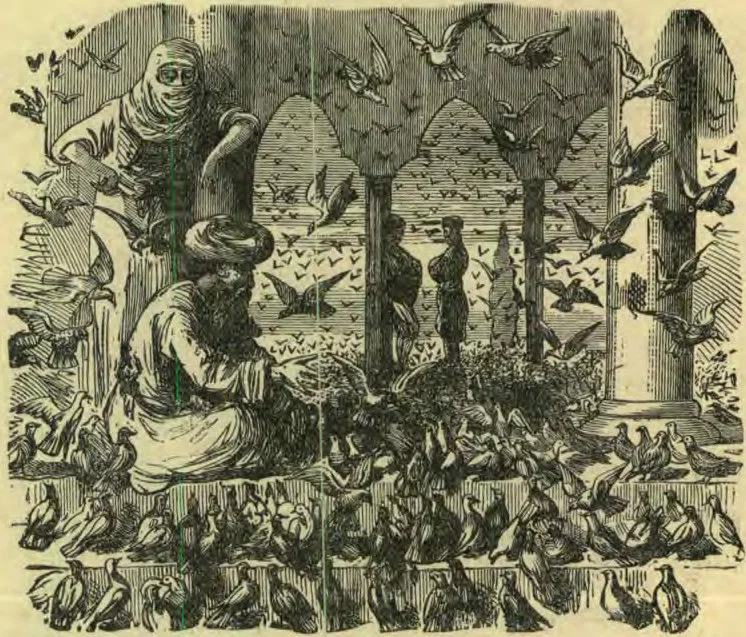
Mohammed and his followers built many mosques, or places of worship; indeed, some of the grandest buildings in the world are Mohammedan mosques. But you will wonder what all this has to do with the birds in the picture. Well, you shall hear now about the “Mosque of the Pigeons.” It seems that a pigeon was once the means of saving Mohammed’s life, and so ever after that, it was regarded by the Mohammedans as a sacred bird. A mosque was finally built for these birds in Constantinople, and here great numbers of them are still reared. It is a part of the inside of this mosque which is shown in the picture. Many good Mohammedans are foolish enough to think they are serving God by giving their whole time to the care of these pigeons. How thankful we ought to be that we know a better way to serve God! E. B. G.
Better Budget
We come now to the children’s feast,—the Budget; where the little ones have their talks with each other, and become acquainted, which must be the reason they like this department so well.
Dot McCormick, of Lapeer Co., Mich., says: “I am a little girl nine years old. I read the stories in the Instructor, and think they are all nice. Mamma and I have kept the Sabbath more than a year. We went to the Michigan camp-meeting, and had such a good time I did not want to come home. I went to the Sabbath-school, and liked it very much. I have saved up my pennies for a Christmas offering, and I want my money to go to foreign missions. I send my love to all, and want to meet you in the new earth.”
Dot’s money was received, and was placed with some sent by others, in the Foreign Mission Fund. Does our responsibility end when we have made the donation?—No! we must ask God every day to bless it, and make it do a great deal of good, just as he made the five loaves and two fishes feed all those people.
Maud G. Gallup sends a letter from Dane Co., Wis. She says: “I am a little girl twelve years old. My mamma died when I was three years old, and I live with my grandparents now. I go to Sabbath-school, and study my lessons in Book No. 5. I love to read the Instructor very much. I visited in the country last summer, at the home of a Sabbath-keeper, and the man of the house took us out on Lake Wingre, which lies at the end of his lot. We went way across to some springs, and came back just as the sun was setting, and it was very pleasant. I want to be a good girl, so I may be saved when the Lord comes.”
Have you begun the new year, Maud, by trying to keep your life-record clean? The Lord cannot save you unless you do your part, by trying to overcome every evil way.
Nellie Parmele, of McLean Co., Ill., says: “I am nearly six years old. I get the Instructor every Sabbath, and like to hear the Budget read. I give my papers to my little friends. My mamma has poor health, so I help her all I can. I sweep, wash dishes, carry in coal; and I have a little new pail to carry water from the well, and I also help care for my little two-year-old brother. I have just sold my chickens to get missionary money. I love to take part in family worship. My papa writes my letter for me.”
The hymn says our actions will show how much we love the Saviour. Nellie seems to be trying to show her love by doing her little duties faithfully. This is right.
Bertha E. Barker writes a letter from Chicago. She says: “I am eleven years old. I like to read the Instructor very much. I have been reading the children’s letters, and thought I would write too. I am in Book No. 6, at Sabbath-school, and recite my lessons to mamma Friday evenings. After I have read my papers, I send them to my cousins in England. I have a little sister eight months old, and I like to take care of her. I am trying to keep God’s commandments.”
If you will notice, Bertha, as your sister grows older, she will try to do as she sees you do; so if you want her to have nice, pretty ways, you must always set a pretty example, you know.