"I think she's just as mean as she can be. I hate her, and always did."
Elenore Dupont was the tallest of quite a large group of girls gathered on the doorstep of her father's costly country residence. She was a handsome but proud-looking girl of seventeen years. Early deprived of the guidance of a fond mother, and left to the care of a busy, indulgent father, she had grown to be a haughty, imperious girl, whose proud manners and imperative way had secured for her the title of "Lady Elenore" among the scholars of the select school of which she was a member.
"Oh no, Elenore, you don't mean that! You hate Miss Holland!" exclaimed pretty Susie Grey, the pet and peacemaker of the whole school.
"Yes, I do mean just that, Midget," interrupted Elenore. "I do hate her, and there's no denying it. Even you had to take it to-day."
"Yes," answered Susie, "but I deserved it, for I was careless with my rhetoric."
"Well, it was mean of her to keep me after school to write an essay. She knows I can't do it, and I won't," said Elenore, wrathfully.
"Why, Elenore, you can write real good essays when you want to!" exclaimed Minnie Hale.
"Well, if I only wrote when I wanted to," retorted Elenore angrily, "the productions of my pen would grow small and beautifully less with each passing term; but," she added, "I am going to have my revenge on Miss Holland."
"How!" "When!" "Where!" eagerly cried the girls; for Lady Elenore's revenges were by no means pleasant things to encounter.
"You know," began the young lady, coolly, "that Miss Holland is exceedingly cowardly in the dark," and she paused a moment while the girls answered, "Yes, oh yes, we do."
"Then you know," continued Elenore, "that she goes every evening after dark to the post-office for her mail. It is but a short distance, but there is a cross street between, and I propose that we girls hide in there and jump out at her as she passes by," and Elenore looked about the group to see the effect of her words.
"O Elenore! it will frighten her dreadfully," cried timid Lula Estabrook, as Elenore stopped.
"That is what I want, of course," retorted Elenore, pettishly.
"Oh, won't it be fun, though!" chorused several of the more thoughtless girls.
Pretty Susie Grey had been standing a little to one side, with alternate flushing and paling cheeks during this animated conversation; but at this point she could no longer contain her growing indignation.
"Girls, I am ashamed of you," she cried, "and I think"—
"Well, Midget," said Elenore, calling her by her pet name, as she saw Susie's eyes filled with tears as she turned away. "I suppose that you think we are a wicked set, and I presume we are; but Susie, darling, if you don't like my revenge, you must tell me what we can do, for to do something I am determined."
"O Elenore! may I, really?" exclaimed Susie, lifting her tearful face, over which a bright smile now shone, making, as the girls said, a perfect rainbow in her eyes.
Susie Grey was a lovely girl, but her chief charm did not consist in her soft, blue eyes, the delicate complexion, or the profusion of sunny curls. These were only the outward adornments; but hers was the ornament of a meek and Christian spirit, for Susie Grey loved Christ, and was never so happy as when doing him a service.
No one ever thought of being angry with Susie Grey, and now, as she lifted her sunny face, all the girls crowded eagerly around to hear "Susie's revenge."
"I am afraid you won't like my plan, but I will tell you, any way."
"And I will grant it to half my kingdom," interrupted Lady Elenore, loftily.
"I don't intend to intrude upon your domains as far as that," laughed Susie, "but this is my plan. You all know how perfectly shabby Miss Holland's dress is."
"Yes," cried Lula Estabrook, shrugging her shoulders; "it looks as if it had come out of the ark."
"Well, girls, she wears the same one Sundays and week-days too," continued Susie. "Next Wednesday is her birthday. I know, for I told her it was my own, and she said, 'O Susie! our birthdays come together.' Now, girls, I propose that we all club together and get her a handsome black cashmere. They are very reasonable now. And then we can leave it on her desk at night, and perhaps see her when she opens it. Oh, won't it be nice!" and Susie's eyes glowed with excitement.
"O you little saint!" exclaimed Elenore, "who would have thought of that but you?"
But Susie had her own way, and the next morning the dress was bought, trimmings and all, and with joyous hearts the girls walked homeward, planning how best to surprise Miss Holland. It was strange how changed they felt toward her now that they wished to please her.
On the morning of her birthday Miss Holland woke weary and dispirited.
"Must I go to those girls again!" she sighed. "Were it not for Elenore I might manage them. Hers is the ruling spirit, and I can do nothing with her."
And so she wearily commenced her toilet. Going to her closet for her old alpaca dress she started back, exclaiming, as her eyes rested on a beautiful black cashmere, "What in the world is this? How came it here?" and with trembling hands drew it forth, admiring much the dainty garment, with its delicate, filmy lace in sleeves and neck.
"What can it mean?" pondered Miss Holland. "O, maybe this will explain!" and she drew forth from the pocket a little note and read:—
Dear Miss Holland—Many returns of your birthday. Please come and spend it at Mrs. Grey's with your NAUGHTY GIRLS.
Tears came into her eyes as she read the little note. "Yes, I will go," she said; and a few hours later found her at Mrs. Grey's.
Such a sight! There were her delinquent pupils, every one as merry as butterflies.
"O Miss Holland! Here you are! I am so glad!"
"But why weren't you at school, Susie?" asked Miss Holland; "and you, and you, and you," she continued, trying to look grave, and making a total failure.
"Now don't scold, Miss Holland," cried Lula Estabrook, "we only wanted to surprise you."
"And was this beautiful dress part of it?" asked Miss Holland.
Lula hesitated, but Kate Bartlett said, in a low tone, which, however, did not escape Miss Holland's ear, "No, that was Elenore's revenge."
She had to make an explanation then, and afterwards a happy, happy afternoon and evening were spent together, the girls declaring that they did not know Miss Holland was so pleasant, and each understanding the other better than ever before.
Nor did the girls forget that it was Susie's birthday, and she was made the recipient of a beautiful token on which was engrossed the words which she had evidently taken as her motto in life: "It is more blessed to give than to receive."—Selected.
HOW "WHISKEY BILL" WAS MADE A NEW MAN.
"Where is Whiskey Bill, who used to drive that old white horse in front of a twenty-five cent express wagon?" repeated the man, in tones of surprise.
"Yes."
"Well, now, it's a curious case," he slowly continued. "We all thought he'd gone to the dogs for sure, for he was drinking a quart of whiskey a day; but a few months ago he braced right up, stopped drinking, and now I hear he's in good business, and saving money. It beats all, for the last time I saw him he seemed underground."
When you go home at night and find that all is well with your own flesh and blood, do you go to sleep reasoning that the rest of the world must take care of itself? Do you ever shut your eyes and call up the hundreds of faces you have met during the day, and wonder if the paleness of death will cover any of them before the morrow? When you have once been attracted to a face, even if it be a stranger's, do you let it drop from memory with your dreams, or do you call it up again and again as night comes down, and hope it may lose none of its brightness in the whirling mists of time?
So Whiskey Bill was hunted up. An inquiry here and there finally traced him to a little brown cottage on a by-street. He sat on the step in the twilight, a burly, broad-shouldered man of fifty, and in the house three or four children gathered around the lamp to look over a picture-book.
"Yes, they used to call me 'Whiskey Bill' down town," he replied, as he moved aside to make room. "But it is weeks since I heard the name. No wonder they think me dead, for I've not set eyes on the old crowd for months, and I don't want to for months to come."
"They tell me that you have quit drinking. One could see that by your face."
"I hope so; I haven't touched a drop since February. Before that I was half drunk, day in and day out, and more of a brute than a man. I don't mind saying that my wife's death set me to thinking, but I didn't stop my liquor. God forgive me, but I was drunk when she died, half drunk at the grave, and I meant to go on a regular spree that night. It was low down, sir, but I was no better than a brute then."
"And so you left your motherless children at home, and went out and got drunk?"
"No, I said I meant to, but I didn't. The poor things were crying all day, and after coming home from the burial I thought to get'em tucked away in bed before I went out. Drunk or sober, I never struck one of'em a blow, and they never ran from me when I staggered home. There's four of'em in there, and the youngest isn't quite four years yet. I got the older ones in bed all right, and then came little Ned. He had cried himself to sleep, and he called for his mother as soon as I woke him. Until that night, I had never had that boy on my knee, to say nothing of putting him to bed; and you can guess these big fingers made slow work with the hooks and buttons. Every minute he kept saying, mother didn't do that way, and mother done this way, and the big children were hiding their heads under the quilts to drown their sobs. When I had his clothes off and his night-gown on, I was ashamed and put him down; and when the oldest saw tears in my eyes, and jumped out of bed to put her arms around my neck, I dropped the name of Whiskey Bill right then and forever."
"And little Ned?"
"Mebbe I'd have weakened but for him," replied the father, as he wiped his eyes. "After I got the child's night-gown on, what did he do but kneel right down beside me, and wait for me to say the Lord's prayer to him! Why, sir, you might have knocked me down with a feather. There I was, mother and father to him, and I couldn't say four words of that prayer, to save my life. He waited and waited for me to begin, as his mother always had, and the big children were waiting; and when I took him in my arms and kissed him, I called upon Heaven to witness that my life should change from that hour. And so it did, sir, and I've been trying hard to lead a191sober, honest life. God helping me, no one shall call me 'Whiskey Bill' ever again."
The four children, little Ned in his night-gown, came out for a good-night kiss, and the boy cuddled in his father's arms for a moment and said:—
"Good-night, pa—good-night, everybody in the world—good night, ma, up in heaven—and don't put out the light till we get to sleep."—Washington Monthly.
The Home Circle.
By Benjamin J. Taylor
THE ISLE OF LONG AGO.
OH, a wonderful stream is the River of Time,
As it flows through the realms of tears,
With a faultless rhythm and a musical rhyme,
And a broader sweep and a surge sublime,
As it blends with the Ocean of Years.
How the winters are drifting like flakes of snow,
And the summers like buds between,
And the year in the sheaf—so they come and they go,
On the river's breast, with its ebb and flow,
As they glide in the shadow and sheen.
There's a magical isle up the River of Time,
Where the softest of airs are playing;
There's a cloudless sky and a tropical clime,
And a voice as sweet as a vesper chime,
The June with the roses are staying.
And the name of this isle is the Long Ago,
And we bury our treasures there;
There are brows of beauty and bosoms of snow—
They are heaps of dust—but we loved them so—
There are trinkets and tresses of hair.
There are fragments of song that nobody sings,
And a part of an infant's prayer;
There's a harp unswept and a lute without strings,
There are broken vows and pieces of rings,
And the garments that she use to wear.
There are hands that are waved when the fairy shore
By the mirage is lifted in air;
And we sometimes hear, through the turbulent roar,
Sweet voices we heard in the days gone before,
When the wind down the river is fair.
Oh, remembered for aye be the blessed isle,
All the day of our life till night;
And when evening comes, with its beautiful smile,
And our eyes are closing in slumber awhile,
May that "Greenwood" of soul be in sight.
Ben. J. Taylor—in The Baptist.
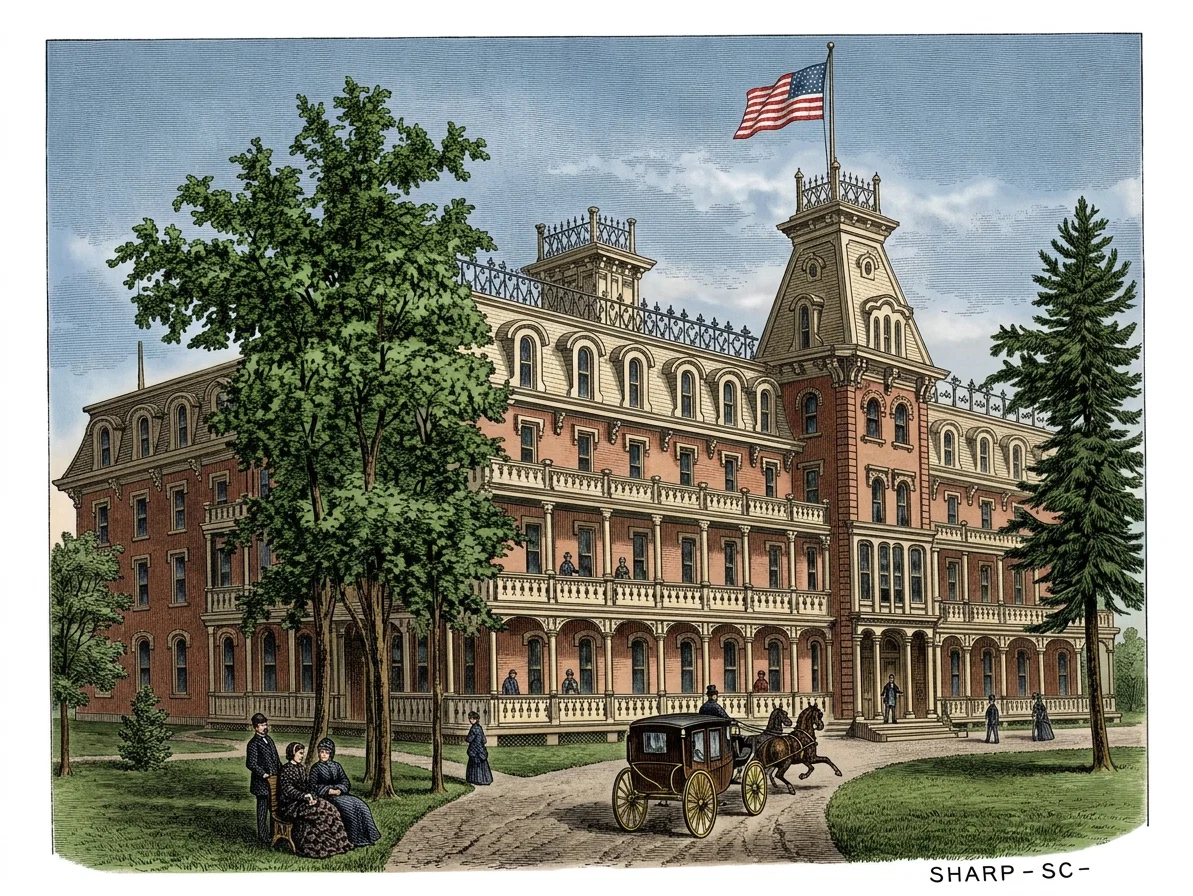
Battle Creek Sanitarium.
By John Harvey Kellogg
Institution Founded 1866......4000 Patients Successfully Treated.
THIS INSTITUTION, for completeness of appointment, and extent of facilities, is unrivalled in this country. Its splendid arrangements for HEATING AND VENTILATION, together with special appliances for regulating the humidity of the atmosphere, makes this Institution UNEQUALED AS A WINTER RESORT FOR CHRONIC INVALIDS.
Even persons suffering with pulmonary difficulties do much better here than in Florida.
All known useful remedies for disease are employed, including Turkish, Russian, Vapor, Electro-Thermal, Electro-Vapor, all kinds of Water Baths, Sun Baths, Swedish Movements, Electricity, etc., etc.
Terms very reasonable. J. H. KELLOGG, M. D., Medical Superintendent.
Address for Circulars:—SANITARIUM, Battle Creek, Mich.
NEWS ITEMS.
-Russia sends a threatening note to Turkey.
-The distress in Ireland is said to be increasing.
-Forest fires in New Jersey have been extensive and very destructive of late.
-It is said that full twenty thousand Russian prisoners are on the way to exile.
-Twenty-five deaths of children, from dyphtheria, are reported in Susanville, Cal.
-April 15 three Chinamen were cremated in a burning wash-house in San Francisco.
-The horrible crimes reported in the daily papers are literally "too numerous to mention."
-The Board of Education in Chicago, voted not to lease buildings or land where liquor is sold.
-Dr. Glenn, of Colusa Co., Cal., has more wheat sown this year than usual—over 50,000 acres.
-The suit of the United States against Gov. Tilden for his income tax has been postponed until November next.
-Representative Jews have asked the United States government to request better treatment of Jews by Russia.
-The fierce zeal of the Ultramontanes in Germany is likely to hinder the settlement of differences with the Vatican.
-A conflict of jurisdiction has arisen in Constantinople between the American consul and the Turkish authorities.
-An engine and baggage car went through a bridge near Sheridan, Kansas, April 13. The hands escaped by jumping.
-Rev. Dr. Osgood, one of the most celebrated ministers of New York, died in that city, of congestion of the lungs, on the 14th.
-Heavy frosts in the section of Augusta, Georgia, April 13, killed fruits and vegetables. The damage is reported to be extensive.
-Two thousand Swedes left Bremen this Spring for the United States. One thousand emigrants left Christiana, Norway, April 4.
-Dr. T. L. Cuyler delivered his twentieth anniversary sermon as the pastor of Lafayette Avenue church, Brooklyn, on Sunday, April 11.
-A strike by the Columbia River fishermen at Astoria will, it is thought, close the canning establishments, the proprietors refusing to make the advance.
-It is reported that the king of Burmah is dead. The massacre of people for sacrifice has been denied, but the London Times thinks the report is true.
-One of the greatest surprises in the late election in Great Britain is that Parwell's candidate in Cork County, for whose election great efforts were made, was defeated.
-A U. S. revenue cutter is to be dispatched to the Arctic seas to relieve the Jeannette and whaling vessels which are supposed to be in distress by reason of the severity of the winter.
-It is said that the Democratic members of the Senate Committee on Rules have agreed on a plan for counting the electoral votes, which is substantially the same as that one offered by Senator Morton.
-Pres. Mc Cosh of Princeton College, writing to the Princeton Alumni of San Francisco, says: We have had the courage to put down hazing, secret societies, and other evils which still remain in many colleges.
-Cadet Whittaker, (slightly) colored, has been made the subject of malicious abuse at West Point. If such things are not stopped or adequately punished, we hope Congress will withhold appropriations for the Academy there.
-An explosion of firedamp occurred recently in a colliery at Anderlues, Belgium. The number of lives lost is unknown, but twenty corpses have already been recovered. There were 150 persons in the pit at the time of the disaster.
-The storm in California continued over the 15th. On that day two snow slides occurred on the railroad near Emigrant Gap—one 75 feet long and 10 feet deep, the other 50 feet long, 14 feet deep. The storm was very heavy in many places.
-Mrs. Elizabeth Thompson, the philanthropist, compares the relative cost of rum and tobacco, religion and education, in the United States as follows: The first named cost yearly $667,638,502; religion, $47,636,450; and education, $95,406,727.
-A paper says: "In England the young gentlemen speak of their father as 'governor,' 'pater' 'the overseer,' etc. In America they say 'dad,' 'the boss,' or 'the old man.' In heathen countries they say 'father,' but they are far behind the age."
-A Russian Corps of Observation will shortly be stationed in Turkestan, on the Chinese frontier, under command of colonel Harapatkin, who was Chief of General Skobeloff's Staff during the Turkish war. Ten or fifteen vessels will go to Chinese waters, instead of five, as at first announced.
-Secretary Evarts has telegraphed to Mr. Swift, of California, to repair to Washington to receive instructions as Commissioner to China. It is reported that the Commission will be instructed to tarry in California and observe for themselves the effect of the Chinese on American society and labor.
-Judge Freelon, of the Superior Court of San Francisco has confirmed the decision of the Police Court in the case of Denis Kearney, whereat all lovers of law and order and decency rejoice. He has been "put where he will do the most good," and after breaking stone on the road six months will have, though unwillingly, earned the title of a workingman.
-The California Legislature, which has just adjourned, probably had a larger "hoodlum" element in it than any other like body that ever assembled. The "sand lot" influence was strong enough to prevent wise and speedy legislation. After almost constant quarreling they had a pleasant time in adjourning. People throughout the State are likewise happy over that event.
-Report from Chicago, April 18: Storm signals have been flying at all the Lake stations for nearly two weeks, but until within three days there have been few disasters to shipping. Now, however, there are almost hourly reports of vessels ashore, dismantled, or disabled by loss of seamen. Three losses of life were reported to-night for the first time. The wind has been very high all day, and amounts to a gale to-night.
-Forest fires continue to do damage in New Jersey, also in Virginia. A dispatch from Petersburg says: The forest fires which have been raging in this vicinity the past week have become uncontrollable. The flames are plainly visible here. Barns and stables in large numbers have been destroyed. In many instances farmers have lost all their crops. Horses, farming implements, and a number of cabins have been burned, the occupants barely escaping with their lives. The destruction of cordwood timber is immense. And the same report comes from other localities in that State.
GOOD HEALTH, FOR 1880.
By Editor
THIS POPULAR JOURNAL enters upon its fifteenth volume with the most flattering prospects not only of a continuance of the prosperity which has attended it in the past, but also of a great increase of patronage, although it already enjoys
THE LARGEST CIRCULATION OF ANY HEALTH JOURNAL IN AMERICA.
The interest of the journal for 1880 will be greatly increased by a series of practical articles from the well-known pens of
ELDER AND MRS. WHITE.
Whose contributions in the past have done so much to increase the popularity and the usefulness of the journal.
A SPLENDID PREMIUM BOOK
Is offered to new subscribers. Address, for specimen copy:—
GOOD HEALTH PUBLISHING CO., Battle Creek, Mich.
Or:—SIGNS OF THE TIMES, Oakland, Cal.
OBITUARY.
By Alonzo T. Jones
DIED at his residence on Pataha Prairie, W. T., on Sunday April 4, 1880, Bro. Eli Thornton, aged 43 years. Bro. Thornton embraced present truth in 1878, under the preaching of Elders Van Horn and Raymond. He was thrown from a horse the evening after the Sabbath, April 3, was taken up, and remained unconscious until his death on Sunday morning. He leaves a wife and five children to mourn his loss, as also the whole Pataha church. Yet we sorrow not as those who have no hope. May the Father of the fatherless, and the Judge of the widow look upon these. ALONZO T. JONES.