The Youth’s Instructor, Vol. 30, No. 49.

THE MOSQUE OF ST. SOPHIA

The Youth’s Instructor

Dec 6, 1882

S. D. A. Publishing Association · Battle Creek, Mich. · Dec 6, 1882

THE MOSQUE OF ST. SOPHIA.

CONSTANTINOPLE, as every school-boy knows, is the capital of the Turkish Empire, and is situated on the Bosporus, a strait of water joining the Black Sea and the Sea of Marmora, while at the same time it separates the two great continents, Europe and Asia. This wonderful old city has a most beautiful situation. Like ancient Rome, it is built on seven hills, and gives a fine view of the Bosporus, the Black Sea, and the Sea of Marmora. To the traveler sailing up the Bosporus, the city appears in all its glory, especially if the morning sun strikes its hundreds of domes and minarets rising out of the groves of dark green cypresses, where the Turks bury their dead. But if one wishes to retain his first pleasant impressions of Constantinople, he would do well not to land at all, but rather drift slowly up and down the Bosporus, beholding and admiring afar off, and then sail away just as the last light of day gilds the domes and minarets with its parting splendor.
Probably in no city in the world are extravagance and luxury so strangely blended with wretchedness and squalor as in Constantinople. “Here gold appears by the side of rags, and the most wretched poverty crouches under the walls of splendid palaces.” Thus the city may be described as mean or magnificent, and either be true, according as we look at one extreme or the other. The streets are mostly “narrow, dark, and dirty, and are overhung with miserable houses, while from little shops turbaned figures peer out upon you, and women, closely veiled, glide swiftly by. The pavement is of the rudest kind, of rough, sharp stones, between which one sinks in the mud.”
These Turks have a great deal of money and many treasures, but they have strange ideas of the use to which they are to be put. There are few really fine buildings in the city, except mosques and the palaces of the sultan; but these, especially in the inside, are costly and extravagant almost beyond description. The treasure-room in the Seraglio, a deserted palace of the sultan, is said to be the richest in the world. In the center stands a Persian throne which is covered with rubies, pearls, emeralds, and diamonds; there are toilet-tables covered to the feet with diamonds; old armor thickly set with precious stones; saddle-cloth and stirrups stiff with diamonds and emeralds; and robes embroidered with pearls. Nothing seems so cheap as wealth lavished in this manner; and those who have visited the place say that although they are at first dazzled by the sight, after a time these heaps of gems become as common in their eyes as pebbles in the street; and they come away with a hearty contempt for earthly treasure.
There are many mosques in Constantinople, but that of St. Sophia is the most important as well as the most interesting. This was first built in the fourth century, by Constantine the Great, the first Christian emperor of Rome, and dedicated by him as the Church of Divine Wisdom. It was twice destroyed by fire, the last time in the reign of the Emperor Justinian, some two hundred years after it was first built; but the church was immediately restored by him to more than its former splendor. The first stone was laid in the year 532. No fewer than 10,000 workmen were employed upon it under the directions of 100 master-builders; and when it was done, it had cost the emperor about 5,000,000 dollars. The principal material of the walls was brick, but the whole interior was lined with costly marbles of every variety and color; and to add to its splendors, columns and statuary were brought from the Temple of Diana, at Ephesus; from the Temple of Minerva, on the Acropolis at Athens; from Baalbec, Heliopolis, and other ancient cities. Men were sent over seas and across continents to gather treasures to enrich and beautify this great edifice. We read of doors of cedar, amber, and ivory; of hundreds of wrought golden candlesticks, and crosses each of a hundred pounds weight; of a score of books of the Evangelists, the gold covers of which weighed twenty pounds; of golden lilies and golden trumpets; of forty-two thousand chalice-cloths embroidered with pearls and jewels; and of the great altar,—for which gold was too cheap a material and so it was made a mass of the most precious and costly stones imbedded in gold and silver.
It was Justinian’s wish to pave the floor with gold, but he feared the avarice of his successors, and so laid it in variegated marbles, which run in waving lines, representing the flowing of rivers. But the wonder of the building was the central dome, one hundred seven feet across, and hanging in the air one hundred eighty feet above the pavement. It was built of pumice stone, because with the immense size of the dome, any heavier stone would have crushed in the building. When this Church of Santa Sophia was finished, and Justinian came in to view his great work, he is said to have run from the porticoes to the pulpit with outstretched arms, crying, “Solomon, I have surpassed thee!” It was then doubtless the most magnificently decorated temple that had ever stood on the earth.
It is now about four hundred twenty-five years since the Turks conquered Constantinople, and the terrible Mohammed II., mounted on horseback and sword in hand, rode through the high door of St. Sophia, and gave orders to slay the thousands who had taken refuge within those sacred walls. “Then Christian blood overflowed that marble pavement like a sea, as men and women and helpless children were trampled down beneath the heels of the cruel invaders. The first act of these usurpers was to destroy every trace of its Christian use; to take away the vessels of the sanctuary, as of old they were taken from the temple at Jerusalem; to cover up the beautiful mosaics in the ceilings and on the walls, that for so many centuries had looked down on Christian worshipers.” Wherever the sign of the cross had been carved in the marble, it was chiseled away; but the foundation of the building itself had been laid in the form of a cross, and this they could not change, except by putting on additions in such a way as to hide the original shape of the building. They also added the tall minarets on the four corners, as seen in the accompanying picture. The venerable temple is still in the hands of those who despise the name of Christ; but had the money spent by Justinian in its useless ornamentation, been devoted to spreading among his subjects a knowledge of true Christian principles, the kingdom might never have become so weakened as to be conquered by these Mohammedans, and thus the walls dedicated to the service of God have been desecrated by heathen worship.
E. S. G.

NOVEMBER

THE wild November comes at last Beneath a veil of rain; The night wind blows its folds aside— Her face is full of pain.
The latest of her race, she takes The Autumn’s vacant throne: She has but one short moon to live, And she must live alone!
A barren realm of withered fields; Bleak woods and falling leaves; The palest morns that ever dawned; The dreariest of eves.
It is no wonder that she comes, Poor month! with tears of pain; For what can one so helpless do But weep, and weep again? —Selected.

THAT AWFUL WOOD PILE.

Coming home from school one day, I found a large pile of wood before our door.
“There's work for you, Willie,” said Ned Blake, the boy who was with me. “Your father had better do as my father does—hire a man to get it in. It is too much for a boy, mother says, and it will take the whole of the afternoon. You will have no time for play. Now, Will, I would not do that, I tell you.”
This was the substance of Ned's talk as we stood before the wood pile, and the more he said, the bigger it grew. By the time he left me, I began to think myself a poorly used boy indeed.
“There is work for you, Willie,” said mother, as I sidled into the kitchen. “Did you see that beautiful wood at the gate as you came in?”
“I should think I did!” I muttered to myself, but said nothing aloud, only asking how father was. He was ill, and had been for many months, and the family funds, I knew, were becoming low.
“It is a monstrous pile,” I at length said, getting a glimpse of it from the window.
“So much the better for us, Willie,” said the mother, cheerfully. “A long winter is before us, you know.”
Dinner was soon ready, the table spread in the little kitchen, and father was helped out from an adjoining room by his two little daughters, one on each side. Father and mother sat down to our frugal meal with thankful hearts, I am sure; the girls chatted as usual, while I sat brooding over that “awful wood pile;” I am afraid that my chief dish was a dish of pouts. Father asked me several questions, but I took no part in the pleasant table talk.
“Well, my boy,” said father, after dinner, “there's that wood to be put in. No school this afternoon, so you have time enough. You had better do it the first thing.”
“It will take the whole afternoon,” I said coldly. “The boys are going a nutting.”
I was not sure of this, but anything in the way of an objection to the wood. My father said nothing. Dear, dear father! God forgive me for wounding his feelings!
“Mother,” I said, following her into the pantry, “Ned Blake's father hires a man to get his wood in. His mother thinks it is too much for a boy to do. Why does not father hire one?”
“Ah!” said my mother sadly, “the Blakes are better off than we. Your poor father”—
Tears came into her eyes; she stopped, Mary ran in where we were, and I, half ashamed of myself, escaped out of the door.
Still Ned Blake's words rankled in me, and I thought it was too bad; nor did the brisk west winds blow off the fumes of the foolish grumbling which made a coward of me. I sat down on the wood block, my hands in my pockets, and shuffled my feet among the chips in sour discontent.
“It is such a monstrous pile!” I said to myself a dozen times.
Presently out came mother. I jumped up.
“Willie,” she said cheerfully, “I would go to work earnestly. You will soon get it in.”
“It is monstrous, mother!” I said in self-pitying tone. “It will take me forever, and half kill me in the bargain.”
“‘Forever’ is a long, long while,” she said. “Come, let us look at the pile. It is big, but all you have to do is to take a stick at a time. That will not hurt you, Willie, I am sure—only one stick at a time! yet one stick at a time will make that pile vanish quicker than you think, Willie. Try it now.”
There was a kindness, yet a decision in mother's tone which were irresistible. She could put even hard things, or what we thought hard, in a very achievable light.
“Only one stick at a time!” I cried, jumping up and following her. Really the pile seemed already to lessen under this new mode of attack. “Only one stick at a time!”
That seemed easy enough. “Only one stick at a time! What was the need of a man to do that? One stick at a time! If Ned Blake could not do that, he was a poor tool.”
Ah! and a poor tool he proved to be. My mother had got my metal up, and I boldly went to work.
“Father,” said I, bolting into the house at a later hour in the afternoon, all in a glow, “please tell me what time it is.”
“Eight minutes after three,” answered he, looking at his watch.
“Whew!” I shouted, “and the pile is mastered!”
Never did I feel such a strong and joyous sense of the power of doing. Finding mother, I put my arm round her neck, and said, “Mother, I was a naughty boy, but ‘one stick at a time’ has cured me.”
I did not then know the full value of the lesson I had learned. Years of labor—successful labor—have since tested and proved its value. When the work looks insurmountable, and you seem to have no heart to take hold of it, as work many a time will, remember it is only one stick at a time, and go at it.—Selected.

SCENES IN THE LIFE OF CHRIST.

LESSON 99.—REVIEW.

1. What interest was manifested by the Greeks who came up to the Passover? John 12 : 20–22.
2. On what subject did Jesus immediately begin to talk?
3. By what figure did he represent his death and resurrection?
4. How did he thus show them that it was necessary for him to die?
5. What warning did he give against setting the affections too much upon the things of this life?
6. How must we show our desire to please our Lord?
7. What is it to follow Jesus?
8. What reward will thus be secured?
9. As Jesus thought of what he was soon to suffer, how did he give expression to his feelings? John 12 : 27.
10. How was he answered from heaven?
11. What did he say to the people about walking in the light?
12. Who is the light of the world? Verse 46.
13. How will all be judged in the last day? Verses 47, 48.
14. Did the voice from heaven convince many that Jesus was the Christ?
15. Why not?
16. What prevented some of the chief rulers from confessing their faith in Jesus?
17. On what day of the week did these things occur?
18. What did the disciples want Jesus to notice, just as he was leaving the temple that night?
19. What did Jesus say to them about those fine buildings?
20. When they had gone across the valley, and up the Mount of Olives, what questions did the disciples ask about these things?
21. How did he first caution them about being deceived?
22. What commotions did he say there would be in the world?
23. What did he speak of as the beginning of sorrows?
24. What trials did he say the people of God would pass through?
25. What effect would these trials have upon many?
26. What reward awaits those who will endure them all?
27. What did he say must be accomplished before the end would come?
28. How were they to know when the desolation of Jerusalem was nigh? Luke 21 : 20.
29. What were they to do when they should see this?
30. How great haste would then be required? Mark 13 : 15, 16.
31. What great persecution did he then talk about? Matt. 24 : 21 ; Mark 13 : 19.
32. What did he say about it?
33. What did he say about the shortening of those days of persecution?
34. What dangers did he say Christians would be subject to in the last days? Matt. 24 : 23–26.
35. To what did he compare his second coming? Verse 27.
36. What did he say should happen immediately after the tribulation of those days? Verse 29.
37. In giving these signs, what question was he answering? Verse 3.
38. When and how have these signs appeared?
39. What is next to follow?
40. How are the saints to be gathered?
41. What did Jesus admonish his disciples to do when they should see these things begin to come to pass? Luke 21 : 28.
42. What lesson did he give from the fig-tree? Matt. 24 : 32, 33.
43. What warning did Jesus give for the last generation? Luke 21 : 34.
44. What did he charge them to do? Verse 36.
45. What short parable is recorded in Mark 13 : 34?
46. What striking admonition is found in verses 35–37?
47. Relate the parable of the ten virgins. Matt. 25 : 1–13.
48. What important lesson is taught in the parable that represents the Judgment? Matt. 25 : 31–46.
49. How did Jesus foretell the definite time of his betrayal? Matt. 26 : 1, 2.
50. What important council was held at this time?
51. What did Satan prompt Judas to do? Luke 22 : 3–6.
52. What contract did he make with the chief priests?

KEEP YOUR WORD.

“WHAT is it to keep your word?” asked a teacher of her class, last Sabbath morning, after reading to them a little story touching upon that point. There was silence for a moment, and then little four-year-old Etta spoke out in her own musical way, and said, “Not to lose it!” Of course the little ones laughed, and the older ones smiled just a little. But who could have given a better answer? “Not to lose it!” It is a great thing, dear children, to be able to keep your word. If you have been guilty of doing a wrong thing, and your mother or father receives a promise from you that you will not repeat the offense, how important it is that you keep your word! By repeating the wrong, you not only lose your word, but you lose the confidence of your parents, and the respect for yourselves. You cannot recall the words you have lost, but you can resolve to make good their loss by doing the right thing in the future, and thus find comfort in the thought that you have done your duty by those who love you best. Don’t lose your word.—The Myrtle.

ROCK OF AGES

“Rock of Ages, cleft for me,” Thoughtlessly the maiden sung; Fell the words unconsciously From her girlish tongue; Sang as little children sing; Sang as sing the birds in June; Fell the words like light leaves down On the current of the tune— “Rock of Ages, cleft for me, Let me hide myself in thee.”
“Let me hide myself in thee,” Felt her soul no need to hide: Sweet the song as song could be— And she had no thought beside All the words unheedingly Fell from lips untouched by care, Dreaming not they each might be On some other lips a prayer— “Rock of Ages, cleft for me, Let me hide myself in thee.”
“Rock of Ages, cleft for me”— ’T was a woman sang them now; Sang them slow and wearily— aching brow, Rose the song as storm-tossed bird Beats with weary wing the air, Every syllable a prayer— “Rock of Ages, cleft for me, Let me hide myself in thee.”
“Rock of Ages, cleft for me”— Lips grown aged sang the hymn Trustingly and tenderly— Voice grown weak, and eyes grown dim, “Let me hide myself in thee.” Trembling though the voice and low, Ran the sweet strain peacefully, Like a river in its flow, Sung as only they can sing Who life’s thorny paths have pressed; Sung as only they can sing Who behold the promised rest— “Rock of Ages, cleft for me, Let me hide myself in thee.”
“Rock of Ages, cleft for me”— Sung above a coffin-lid; Underneath all restfully, All life’s joys and sorrows hid. Nevermore, O storm-tossed soul! Nevermore from wind or tide, Nevermore from billows’ roll Wilt thou need thyself to hide. Could those sightless, sunken eyes, Closed beneath the soft gray hair, Could those mute and stiffened lips Move again in pleading prayer, Still, aye, still the words would be, “Let me hide myself in thee.”

NEW-TESTAMENT HISTORY.

LESSON 112.—JESUS APPEARS TO HIS DISCIPLES.

While the women who had visited the sepulchre were hastening to tell the disciples that their Lord was risen, some of the watch came into the city, and told the chief priests all that had happened. “And when they were assembled with the elders, and had taken counsel, they gave large money unto the soldiers, saying, Say ye, His disciples came by night, and stole him away while we slept. And if this come to the governor’s ears, we will persuade him and secure you. So they took the money and did as they were taught, and this saying is commonly reported among the Jews until this day.”
“And, behold, two of them went that same day to a village called Emmaus, which was from Jerusalem about threescore furlongs. And they talked together of all these things which had happened. And it came to pass, that, while they communed together and reasoned, Jesus himself drew near, and went with them. But their eyes were holden that they should not know him. And he said unto them, What manner of communications are these that ye have one to another, as ye walk and are sad? And the one of them, whose name was Cleopas, answering said unto him, Art thou only a stranger in Jerusalem, and hast not known the things which are come to pass there in these days? And he said unto them, What things? And they said unto him, Concerning Jesus of Nazareth, which was a prophet mighty in deed and word before God and all the people; and how the chief priests and our rulers delivered him to be condemned to death, and have crucified him. But we trusted that it had been he which should have redeemed Israel; and besides all this, to-day is the third day since these things were done. Yea, and certain women also of our company made us astonished, which were early at the sepulchre; and when they found not his body, they came, saying, that they had also seen a vision of angels, which said that he was alive. And certain of them which were with us went to the sepulchre, and found it even so as the women has said; but him they saw not. Then he said unto them, O fools, and slow of heart to believe all that the prophets have spoken: ought not Christ to have suffered these things, and to enter into his glory? And beginning at Moses and all the prophets, he expounded unto them in all the scriptures the things concerning himself. And they drew nigh unto the village, whither they went; and he made as though he would have gone further. But they constrained him, saying, Abide with us; for it is toward evening, and the day is far spent. And he went in to tarry with them. And it came to pass, as he sat at meat with them, he took bread, and blessed it, and brake, and gave to them. And their eyes were opened, and they knew him; and he vanished out of their sight. And they said one to another, Did not our heart burn within us, while he talked with us by the way, and while he opened to us the scriptures? And they rose up the same hour, and returned to Jerusalem, and found the eleven gathered together, and them that were with them, saying, The Lord is risen indeed, and hath appeared unto Simon. And they told what things were done in the way, and how he was known of them in breaking of bread.”
Now this was on the first day of the week at evening. The disciples had gathered together for fear of the Jews, and had the doors closely shut. When the two disciples told how Jesus had appeared to them on the way to Emmaus, the other disciples could not credit what they said. While they were thus talking, Jesus appeared standing among them, and said, “Peace be unto you.” Then he reproved them for their unbelief, and hardness of heart, because they believed not them who had seen him after he was risen. The disciples were greatly terrified at the presence of Jesus, and thought it must be his spirit appearing to them. Then Jesus said, “Why are ye troubled? and why do thoughts arise in your hearts? Behold my hands and my feet, that it is I myself; handle me, and see, for a spirit hath not flesh and bones as ye see me have.” After thus speaking, he showed them his hands and his feet; but they could not yet believe, thinking that his being raised from the dead, and appearing to them in this way, was too joyful to be true. Then Jesus said, “Have ye here any meat?” And when they had brought him some boiled fish and a piece of honey-comb, he took the food and ate it.

QUESTIONS.

  1. What happened while the women who had visited the sepulchre were hastening to tell the disciples that Jesus had risen? Matt. 28:11.
  2. What did the chief priests do when they had assembled with the elders?
  3. What falsehood did they bribe the soldiers to tell?
  4. What did they promise to do in case the governor should detect the falsehood?
  5. On what journey did two of the disciples set out the morning that Jesus rose from the dead? Luke 24:13.
  6. What was their leading topic of conversation as they traveled?
  7. Who joined them as they were thus reasoning and communing together?
  8. Why did they not recognize him?
  9. What question did he ask them?
  10. How did Cleopas answer?
  11. What seeming astonishment did Jesus manifest?
  12. What response did this call forth?
  13. How had they been disappointed? Verse 21.
  14. What startling report had they heard that morning?
  15. How had the report been confirmed?
  16. What exclamation did Jesus then utter?
  17. What question did he ask? Verse 26.
  18. How did he then instruct them from the word of God?
  19. What purpose did he manifest as they drew nigh the village? Verse 28.
  20. How did they induce him to tarry with them?
  21. What took place as they were partaking of their evening meal? Verses 30, 31.
  22. What remark did they then make?
  23. What did they immediately do?
  24. What did they say to the disciples whom they found gathered together?
  25. Why had the disciples gathered themselves together?
  26. What precaution had they taken against being discovered?
  27. How did they receive the report of the disciples to whom Jesus had appeared on the way to Emmaus? Mark 16:13.
  28. What took place as they were thus talking together? Luke 24:36.
  29. How did he greet them? John 20:19.
  30. For what did he reprove them? Mark 16:14.
  31. How were the disciples affected by seeing Jesus appear so suddenly among them? Luke 24:37.
  32. What question did he ask them?
  33. How did he try to convince them that he was not a spirit? Verses 39, 40.
  34. When they were still unable to believe, what further proof did he give?

NOTE

In the narrative of the events connected with our Lord’s resurrection, it is to be borne in mind that no one of the writers has undertaken to make a complete record of all that occurred. Each has mentioned those incidents which particularly concerned his own purpose or experience. In order to combine the four narratives into one consecutive story, it is necessary to make some conjectures in regard to intervening events which may probably have occurred. Such conjectures may not, perhaps, represent what actually took place, for in some instances several different conjectures may be formed; but so long as any of these are in themselves probable—likely to have occurred—and by means of them the statements of the several Evangelists are seen to be entirely consistent, it is impossible to allege contradictions between their narratives. Some study and careful attention is required thus to exhibit the four accounts harmoniously—perhaps more than is required in any other part of the Gospels, because here such a number of important events are crowded into so short a space of time; but beyond this, there is no other difficulty, nor is there any real discrepancy in the accounts.
For the convenience of the student, the following synopsis of the events is given, as far as the points of difficulty extend.
The resurrection itself occurred at or before the earliest dawn of the first day of the week (Matt. 28:1; Mark 16:2; Luke 24:1; John 20:1, on the “at the rising of the sun” of Mark 16:2). The women coming to the sepulchre, find the stone rolled away and the body gone. They are amazed and perplexed. Mary Magdalene alone runs to tell Peter and John (John 20:2). The other women remain, enter the tomb, see the angels, and are charged by them to announce the resurrection to the disciples, and depart on their errand. Meantime Peter and John run very rapidly (verse 4) to the sepulchre. (A glance at the plan of Jerusalem shows that there were so many different gates by which persons might pass between the city and the sepulchre that they might easily have failed to meet the women on their way.) They enter the tomb, and are astonished at the orderly arrangement of the grave-clothes, and then return to the city. Mary follows to the tomb, unable quite to keep pace with them, and so falling behind. She remains standing at the entrance after they had gone; and looking in, sees the angels. Then turning about, she sees Jesus himself, and receives his charge for the disciples. This was our Lord’s first appearance after his resurrection (Mark 16:9).
To return to the women who were on their way from the sepulchre to the disciples. They went in haste, yet more slowly than Peter and John. There were many of them, and being in a state of great agitation and alarm (Mark 16:8), they appear to have become separated and to have entered the city by different gates. One party of them, in their astonishment and fear, say nothing to any one (Mark 16:8); the others run to the disciples and announced all that they had seen, viz., the vision of angels (Matt. 28:8; Luke 24:9-11).
At this time, before any report had come in of the appearance of our Lord himself, the two disciples set out for Emmaus (Luke 24:13).
Soon after, Mary Magdalene comes in, announcing that she had actually seen the risen Lord (Mark 16:10, 11; John 20:18).
While these things are happening, the first-mentioned party of the women are stopped on the way by the appearance of the Lord himself, and they also receive a charge to his disciples (Matt. 28:9, 10).—Gardner’s Harmony.

GOPHERS

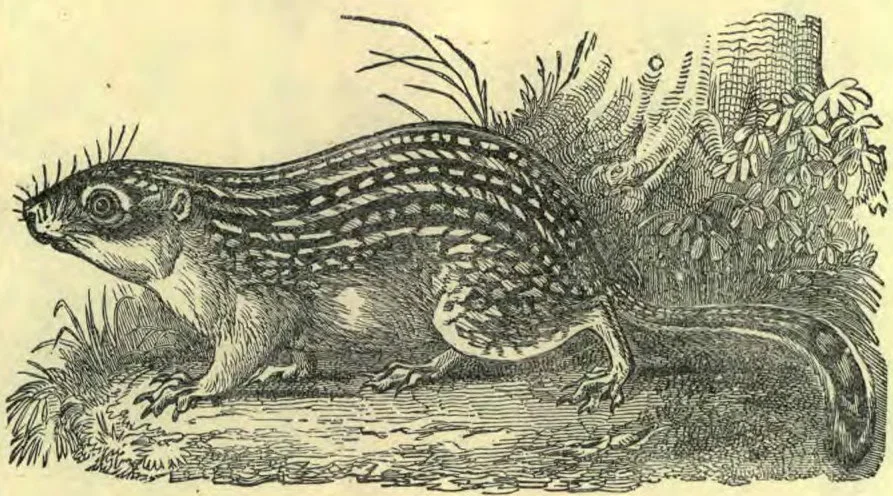
The gopher is an animal some like the squirrel, only it lives in the ground instead of in the trees. Perhaps most of you have seen the striped gopher like the one in the picture, by the road or in the field, and noticed how he will sit up like a bear, and watch you pass; but if he thinks there is any danger of being hurt, he suddenly disappears into his house under the ground.
There is also the gray gopher, whose habits are very much like those of the striped. But the pocket gopher is more peculiar than either of these. It is some larger than the others are, and nearly the color of a mouse. On each shoulder is a pocket, all nicely lined with fur, in which he carries wheat, corn, small potatoes, or whatever he finds for food. These he places there with his fore paws, and removes them by the muscular action of the pockets.
His front feet are so large and strong that they seem to be made on purpose for digging. This he can do very rapidly, and seems to enjoy it. His home differs some from that of the striped and gray gophers, because he uses the dirt which he digs out to cover the opening, or door, of his hole, so that there is nothing to be seen but a little mound of dirt.
They sometimes have a large number of these mounds, which are all connected by under-ground passages, and look like little villages. The little fellow sometimes entirely destroys fruit trees, for he not only gnaws the bark off the roots, but cuts them off with his teeth, just as the beaver cuts down trees.
We children once caught two of them, and put them in a box of sand, where we could watch them. We noticed that in digging a home they would work away furiously for a few moments, and then turn around and push the dirt out with their front paws, using them as hands. They were at first very cross, and would bite at us if we offered to touch them, but after a while they seemed to enjoy being petted as much as a kitten. We had not kept them very long before one died, and the other was so knowing as to pile the dirt against the side of the box high enough so that he could escape over the top.
Are not the small animals of God’s creation as wonderful as the large ones? M. H. S.

ALFRED’S THREE PRAYERS.

“Mamma,” said Alfred one night as he was going to bed, “I prayed three prayers, and the Lord has answered two of them; do you think he’ll answer the other?”
“I think he will, dear; but tell me about these prayers. What were they?”
“One was that he would make you well, and you’re not sick any more. Another was that he would make papa more kind; and he has been more kind lately, hasn’t he?”
“Yes, dear; now what’s the third?”
“I prayed that God would keep us children from quarreling; but he hasn’t answered that yet, for Daisy and I quarreled dreadfully to-day.”
“Ah, my son, you will have to help the Lord to answer that.”
“Help the Lord, mamma? Can’t he do everything?”
“He wont make you good, Alfred, against your will. If you choose to be a naughty boy, God will be sorry for you; but you will be naughty still. But if you earnestly wish to be a good boy, and when Satan tempts you to quarrel, if you turn right to God for strength to resist him, and then fight like a good little soldier to keep down the naughty temper, then God will give you the victory. But he won’t do the work for you.”
“Oh, I didn’t understand,” said the little boy.
“Yes, my dear,” continued mamma, “you have something to do yourself when you pray such a prayer, to help God to answer it. You must watch and pray, and fight against temptation; and if you do this, you will be able by-and-by to come and tell me that God has answered all three of your prayers.—Morning Light.

THE GOLDEN CHAIN.

It is related of Dr. Payson that once, in the progress of a revival at his church in Portland, after having repeatedly invited meetings at his house of those who wished to seek religion, he one day gave an invitation to all those young persons who did not intend to seek religion. Any one who did not know Dr. Payson would be surprised to hear that thirty or forty came. He had a very pleasant, social interview with them, saying nothing about the subject of religion until, just as they were about to leave, he closed a very few, plain and simple remarks in the following manner:—
“Suppose you should see, coming down from heaven, a very fine thread, so fine as to be almost invisible, and it should come and very gently attach itself to you. Should you, knowing that it came from God, dare to put out your hand and brush it away?”
He dwelt a few minutes upon this idea, until every one had a clear and fixed conception of it, and of the hardihood which any one would manifest who should openly break off even such a tie.
“Now,” continued he, “just such a slender, delicate thread has come from God to you, this afternoon. You do not feel, you say, any interest in religion; but by coming here this afternoon, God has fastened one little thread upon you all; it is very weak and frail, and you can, in a moment, brush it away. But you certainly will not do so. Welcome it, and it will enlarge and strengthen itself, until it becomes a golden chain to bind you forever to God.”

THE BOOK OF THANKS.

“I feel so vexed and out of temper with Ben,” cried Mark, “that I really must—”
“Do something in revenge?” inquired his cousin Celia.
“No, look over my book of thanks.”
“What’s that?” said Celia, as she saw him turning over the leaves of a small blank book, full of writing in a round text hand.
“‘March 8th: Ben lent me his hat.’”
“Here again: ‘January 4th; when I lost my shilling, Ben made it up to me kindly.’ Well,” observed the boy, turning down the leaf, “Ben is a good boy after all.”
“What do you note down in that book?” asked Celia, looking over his shoulder with some curiosity.
“All the kindnesses that are shown me; you would wonder how many there are. I find a great deal of good from marking them down. I do not forget them, as I might do if I only trusted to my memory; so I hope I am not often ungrateful; and, when I am cross and out of temper, I almost always feel good-humored again if I only look over my book.”

KEEP TRYING TO DO RIGHT.

Do not give up trying to be good after one mistake. Begin anew every morning, and see how much better you can do each day. A tree never grew to be a tree in a single night; first it was a seed, then a tender sprout, then a weak sapling, and at last a strong tree. So you will grow, if you keep trying to do right; from a fearful, helpless disciple of Jesus, you will go on till you become a brave and successful soldier in his cause. And yet he loves the little ones who try to serve him just as well as the valiant bearer of the cross who gains great victories for him; for in each case he sees the love in the heart which prompted the action. Remember how he watches your movements; so never give up!
Continue reading: LITTLE CHILDREN