According to appointment, this Conference took place at Hamburg, Germany, July 8–14, in the Seventh-day Adventist chapel at Grindelberg 15a. In addition to all the laborers and colporteurs of the German Mission Field, the assembly was composed of the following persons: From England, Elders W. W. Prescott and E. J. Waggoner; from Norway, L. Johnson, N. Clausen; from Sweden, E. Lind, E. J. Åhrén, and J. Carlsson; from Denmark, M. M. Olsen, Dr. J. C. Ottosen; from Russia, H. J. Løbsack; from Switzerland, J. Erzenberger, G. Roth; from America, Elders G. A. Irwin and A. Moon. As decided by the last General Conference, Elder O. A. Olsen took the chair as president. H. P. Holser was chosen secretary pro tem. On motion of Professor Prescott, all the members present were invited to participate in the Conference.
Lay members from the German field and the Hamburg church increased the attendance to about two hundred during the daytime and three hundred in the evening. Five meetings were held daily, three for Bible study and the mission field; and two for business and the study of the health and school questions. The leading feature of the Conference was the question as to the best manner of studying and presenting the message. No effort was made to describe how it should be done, but rather to illustrate this in the studies held. The leading theme of these studies was the gospel as revealed in nature, the Bible serving as the key. The written, living Word served as an index to the living word in nature. Much precious light was revealed; the minds of the laborers were quickened, and their hearts rejoiced. To a remarkable degree all features of the message—the nature and destiny of man, conversion, the work of the Holy Spirit, the new earth, the resurrection, the signs of the times, etc.—were seen in nature. This shed much light on how to preach the message to the heathen from the book of nature,—a book which they all can read, and with which they are already more or less familiar,—and also illustrated how we can study and preach the message when the printed Word is taken from us.
The morning Bible study was conducted by Professor Prescott, the evening study by Dr. Waggoner, and the afternoon hour was occupied by Elders Irwin and Moon, the former on the subjects of health reform and the church, and the latter on the mission field. Considerable of the time for business meetings was devoted to reports from the field. Many statistics were read, the summary of the most interesting being as follows:—
Members
Tithes
S. S. Contributions
Annual Offerings
First-day Offerings
Scandinavia
1,921
$10,444.05
$781.16
$656.13
Central Europe and Turkey
727
4,654.15
336.36
651.33
$223.50
England
750
7,442.15
434.91
378.35
Russia
995
1,811.44
222.49
192.84
30.50
Germany and Holland
1,422
9,855.21
958.00
584.22
414.52
Totals
5,815
$34,207.00
$2,732.92
$2,462.87
$668.52
Compared with the previous year, these figures show an encouraging increase in both members and finances. In fact, no year has witnessed so great an increase in numbers and contributions as the past.
The usual committees were appointed, and the following resolutions adopted:—
1. That the Conference elect an Executive Committee of five, of which the president of the European Union Conference shall be a member and chairman, to take general oversight of the work between sessions of the Conference.
2. That the funds of the Conference be composed of the revenues formerly sent to the General Conference and the Foreign Mission Board; namely, a tenth of the tithe, Sabbath-school, First-day, and annual offerings, and special donations for specific enterprises depending for support on the European Union Conference.
3. That the presidents of Conferences, superintendents of missions, and such other laborers as the Union Conference may employ be supported from the Union Conference treasury.
4. That the financial year of the Union Conference close December 31, and that the Executive Committee be authorized to provide for the annual audit of laborers’ accounts.
5. That a Norwegian laborer be sent from the Scandinavian field to labor in North Sleswick.
6. That a laborer be provided by the German field to work among the Germans in Palestine.
7. That the General Conference be requested to send John Hoffman to labor in Finland.
8. That Brother O. Johnson return from Finland to labor in Sweden.
9. That a young man be selected from Sweden by the Sweden Conference Committee to labor in Finland, under the direction of the superintendent of that field.
10. That J. H. Kraft, of Colorado, make Russia his field of labor.
11. That the requests of the British and German fields, that each be provided with a physician qualified to give instruction in practical gospel, medical, and health work, be heartily seconded; and that we approve the request of the Central European Mission for a second physician to labor in that field.
The following officers were elected:—
Union Conference Executive Committee: O. A. Olsen, H. P. Holser, W. W. Prescott, L. R. Conradi, L. Johnson. Secretary, N. Clausen, Copenhagen; Treasurer, W. T. Bartlett, London.
Educational Board for Scandinavia: O. A. Olsen, L. Johnson, J. C. Ottosen, C. C. Hansen, E. J. Åhrén, J. Hansen, M. M. Olsen, E. Lind, F. C. W. Wallenkampf.
Board of Directors of Institut Sanitaire, Basel: H. P. Holser, H. Revilly, J. Erzenberger, P. A. De Forest, J. Robert.
Superintendent of the Mediterranean and Turkish Mission Field, H. P. Holser.
Superintendent of the Russian Mission Field: H. J. Løbsack. Advisory Board: H. J. Løbsack,12L. R. Conradi, G. Tetz, Gerhardt Isaak, G. Tittel.
Superintendent of the British Mission Field: W. W. Prescott. Advisory Board: W. W. Prescott, E. J. Waggoner, W. T. Bartlett, A. Bacon, A. R. Leask.
Superintendent of the Finnish mission, L. Johnson. Board: L. Johnson, E. Lind, J. Hoffman, K. Sandberg, K. Sandelin.
It being anticipated that a Conference will be organized in Germany, the election of officers for the German field was left to this Conference. The business sessions were conducted in English, and the studies and instruction were in German, the part taken by English speakers being translated. The members present represented the English, German, French, Spanish, Danish-Norwegian, Swedish, Russian, Polish, Hungarian, Bohemian, Livonian, Esthonian, and Dutch languages.
Considerable time was devoted to the sanitarium in Skodsborg and the health question in general. The sentiment of the Conference was quite pronounced that the work of the message is one, that all branches should be carried on in unity, and that new enterprises should be begun small and allowed to grow up by natural development, thus avoiding debts. It was a remarkable feature of the Conference that no time was lost discussing points of difference; in fact, no differences appeared; thus all the time was spent to profit. All in attendance knew that the Lord was present; both instructors and learners were refreshed with precious light. All returned to their fields with the feeling that the Lord had prepared them for more efficient work. Thus in unity and blessing closed the first European Union Conference.
H. P. H.
The Price of Rendering Helpful Service to Others
By H. Clay Trumbull
THERE is no real service to others without a drain upon our vital energies. He alone who is conscious that virtue, or power, has gone out of him, is paying the price exacted of all who would render helpful service to others. A young minister said of the throng which the anniversary of a noted temperance worker drew, “What would I not give to have such a hearing for my messages!”
“If you are really willing to pay the price, you may have it,” was the answer,—“your own self, spent for others.”
It costs life to save life; and he who, in Christ’s way, is willing to give life for life, not only saves life, but gains all else.— H. Clay Trumbull.
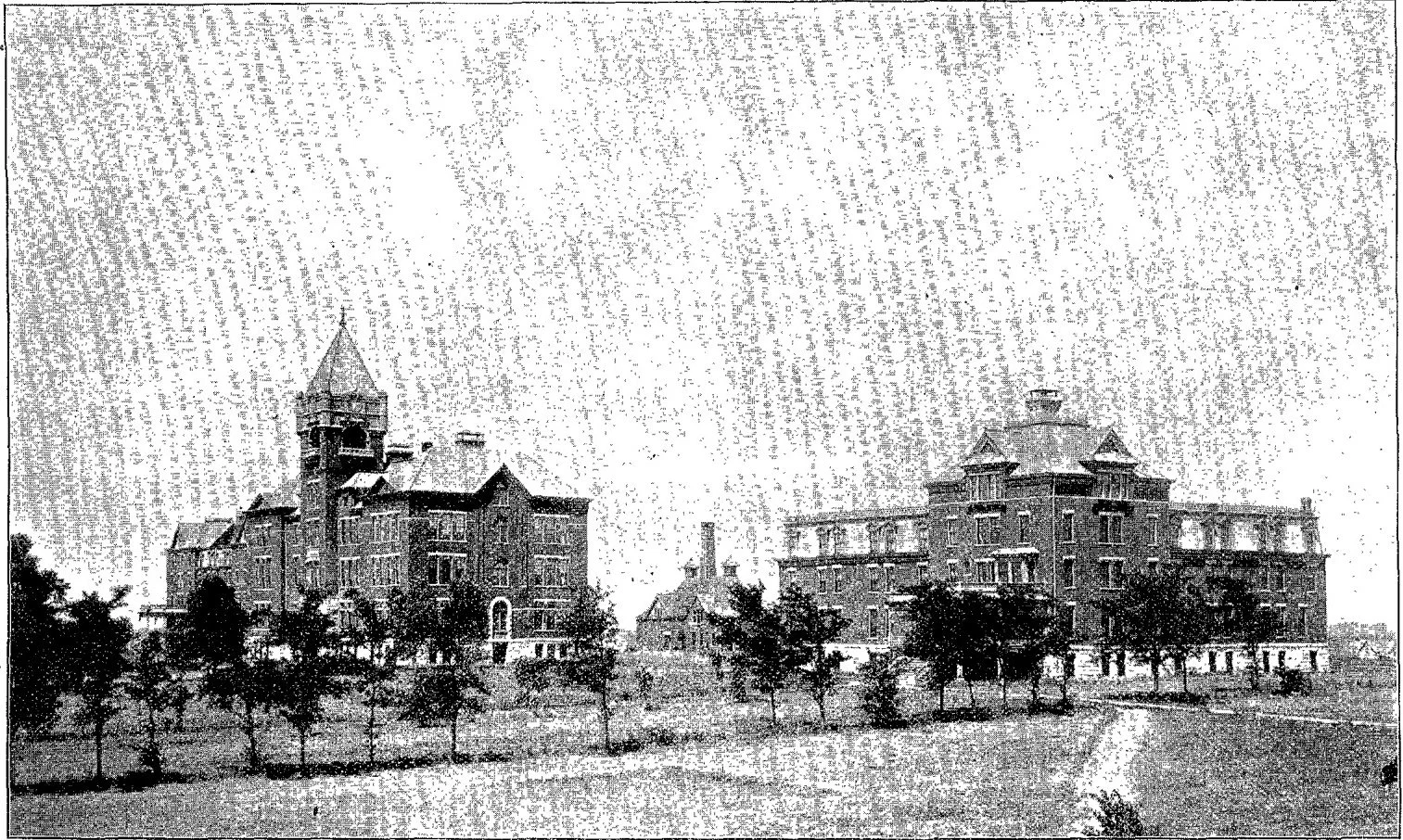
UNION COLLEGE AND LADIES’ HOME.
UNION COLLEGE.
The accompanying illustration gives a partial view of the buildings and grounds of Union College, College View, Neb. The buildings proper stand in the center of a campus overlooking the city of Lincoln, nearly five miles to the northwest. The ground is high and rolling, affording a commanding view in all directions. An electric street-car line extends from the city to the college grounds, thus making the school easy of access. The main college building —a substantial structure of brick and stone, eighty by one hundred and forty feet in size, four stories high, containing a large chapel, library, museum, gymnasium, offices, and a number of well-equipped class-rooms—occupies the central location. The home for young ladies is to the south, and that of the young men to the north, of this building. These buildings are all commodious and comfortable, heated by steam and lighted by electricity.
The Nebraska Sanitarium is situated just across the street north of the campus. This institution is under the same general management as that at Battle Creek, Mich., and is in a prosperous condition, several physicians and nurses being constantly employed. The church is south of the ladies' home, and is the second largest in the denomination, having a seating capacity for about eighteen hundred. There is also connected with the college a well-equipped bakery, where all kinds of general health foods are prepared. This not only furnishes the college tables with the choicest health foods, but is a source of considerable income, as the foods find a ready sale in surrounding States.
Union College was founded in 1891, and is now well established, and thoroughly equipped for the work it was intended to accomplish. In addition to the regular English department, there are two separate foreign departments, one for the Germans and the other for the Scandinavians, all under the same general management.
Much careful attention has been given in planning the different courses of study. To have the work all practical in its nature, and at the same time furnish the students with a thorough line of instruction, so that they may go out practical men and women, has been the object in view. The spiritual interests of the students are carefully guarded; the teachings of the Bible are sacredly followed, and its principles are made the foundation of all the work.
Besides the regular literary and scientific courses, shorter courses are arranged, which offer inviting work for those who can not remain a longer time in school. The Bible course of four years is especially planned for those fitting themselves for the ministry or any missionary or evangelistic work. This may be completed in less time, depending altogether on the student's previous preparation. The normal course of two years is planned with special reference to those who intend to teach. These courses are popular with the students, and open up a broad field of work for our young people,—a field that, heretofore, has received but little attention. The business course covers a period of one year; and while much of the work is similar to that found in the regular commercial college, the student will here have the advantages of special studies that are constantly carried on in the college. There is always a demand for consecrated business men to manage the financial interests of the denomination; and it is believed that many young men will receive much benefit from this course.
In brief, Union College offers to young men and women a thorough Christian education. This is always practical, and those who obtain the benefits of such an education must necessarily be better men and women than they otherwise could possibly be. Here our young people may study for the ministry, for teaching, for business, for missionary work of any kind. The opportunity is especially offered to those living west of the Mississippi River, and it was for the convenience of these that the college was established.
The coming year promises to be one of great importance. Special efforts will be made to fit young men and women to become laborers in the cause of God. An invitation is extended to all who are interested in the cause of education, and especially those who ought to attend Union College and receive its benefits, to write for the annual Calendar. All questions regarding the college will be cheerfully answered. Address W. T. Bland, College View, Neb.
Helping Hand Mission of San Francisco: June Report
The report of the Helping Hand Mission of San Francisco, Cal., for the month of June is just at hand, and is as follows:—
“Penny lunches served, 29,138; beds occupied, 2,269; baths given, 638; garments fumigated, 5,059; persons using free laundry, 159; garments distributed, 136; medical treatments given, 300; men furnished work, 723; Bible readings given, 63; men asking prayers, 67; men professing Christ, 20; sermons delivered, 30.”
News of the Week.
FOR WEEK ENDING AUGUST 13, 1898.
—In round numbers the estimated cost of the war up to date is $1,000,000,000.
—Captain Sigsbee, of the “Maine,” has been given command of the battle-ship “Texas.”
—The employees of the Syracuse Rapid Transit Company went on a strike, August 5. Four hundred employees are involved.
—John Carmody, of Chicago, who went to the Klondike as a newsboy, has just returned with $1,900 made by selling papers.
—Bismarck, the capital of North Dakota, was practically destroyed by fire, August 9. The loss was over half a million dollars.
—Mayor Van Wyck, New York’s famous official, recently saved three young women from drowning while bathing in the surf near the city.
—Seventy-five per cent. of the army stationed before Santiago, in command of General Shafter, has been sick from fevers and other causes.
—The revenue from the war-tax approximates $1,000,000 daily. This is greatly in excess of the expectations of the framers of the law.
—The thirty-third anniversary of the Salvation Army was celebrated at the Alexandra Palace, London. About 30,000 persons took part in the gathering.
—The men who robbed the San Francisco train at Andover, near St. Louis, Mo., a short time ago, were captured in Indian Territory, and are now awaiting trial.
—Captain Clark, commander of the “Oregon,” has been given a six-months’ leave of absence from duty on account of ill health. Captain Barker is to succeed him.
—The first newspaper printed in the language of the Kurds, of whom there are 6,000,000, has been started in Cairo by Prince Kibdad Midhad. It is called the Kurdistan.
—According to reports received, the largest wheat crop in the history of the United States is that about to be harvested. The crop is estimated at 400,000,000 bushels.
—The strike at Oshkosh, Wis., that has been on for nearly three months, was partially broken, August 3, when about 400 of the men went to work. A vigilant effort is now being made to locate the responsibility for the strike, and to punish the guilty parties.
—According to the advance proofs of the report of the government geological survey, it is learned that the output of coal in the United States during 1897 exceeded 200,000,000 tons.
—A man who lives on the North Side of Chicago evidently got conscience-stricken; for the other day he sent to the mayor a check for $400 to pay his taxes on property the assessor had missed.
—Sixty linemen employed by Chicago on the outside municipal lighting plants, went on a strike a few days ago because they were refused two days’ pay for working on the Saturday half-holiday.
—Dr. James B. Angell, former minister to Turkey, had a farewell audience with the sultan on August 5, prior to leaving for his home in Michigan. He will be succeeded by Oscar S. Straus, of New York.
—While Richmond P. Hobson, the hero of the “Merrimac,” was in Annapolis the other morning, he made a friendly call on Admiral Cervera, and exchanged courtesies with the defeated Spaniard.
—Well-defined plans for the murder of Señor Sagasta, the Spanish prime minister, have been discovered; and but for the vigilance of the authorities, they would doubtless have been carried into effect.
—There is one Christian minister for every 900 inhabitants in Great Britain, one for every 114,000 in Japan, one for 165,000 in India, one for 222,000 in Africa, and one for 457,000 in the Chinese Empire.
—A new whisky trust has been formed, with headquarters at Cincinnati, on a foundation which its promoters believe will be lasting. It will include the majority of the leading distilleries in the United States.
—A plan is on foot whereby money is to be raised by the school-children of America for the building of a battle-ship, to be called “The American Boy.” President McKinley has given his official endorsement to the scheme.
—During the departure of the president of Brazil from Lisbon for his home, August 8, two steamers that were carrying friends to bid him farewell came into collision with two small boats. Twenty persons were drowned.
—No fewer than 12,000,000 acres of land have been made fruitful in the Sahara Desert, an enterprise representing, perhaps, the most remarkable example of irrigation by means of artesian wells which can be found anywhere.
—The town of Beckwith, Cal., with a population of 500, was practically wiped out of existence, July 30, by a fire which started at the depot. Every building in the town was destroyed, except a church, a schoolhouse, and two dwellings.
—A party of naval officers visited the defenses of Santiago harbor, and report that the bombardment made by Admiral Sampson’s fleet did practically no damage whatever. Over $2,000,000 worth of ammunition was expended in the effort.
—A despatch from Yokohama, dated August 1, says: “It is reported here that Hawaii has agreed to pay Japan £40,000 sterling in settlement of the dispute which arose out of the exclusion of Japanese emigrants from the Hawaiian Islands.”
—L. D. Leonard, a wealthy farmer in Fond du Lac county, Wis., claims to have on his premises the bell used at Fort Dearborn (Chicago) for many years to assemble the garrison and give fire-alarms. It was brought from New York in 1816.
—The “Infanta Maria Teresa,” one of the Spanish war vessels sunk by the American fleet as it was leaving Santiago, has been floated, and is reported to be in good condition as to machinery and boilers. She will shortly start for Norfolk under her own steam.
—Judge Tuley, of the Illinois Circuit Court, has decided that express companies must pay that part of the war-tax which is provided for in the new revenue act by the section requiring one-cent stamps on all bills of lading. The express companies have appealed.
—On account of the selection of Secretary Day as one of the peace commissioners, it is authoritatively announced that he will at an early date retire from the office of Secretary of State, and after concluding his labors as a member of the commission, resume the practise of law.
—Recently the Canadian gold commissioner issued a proclamation declaring the Dominion Hill Creek and bench claims open for settlement by all persons holding free miners’ licenses. In less than two hours 1,100 people had reached the Bonanza Creek ferry, two miles from Dawson City, headed for the place. The trip will require six days from Dawson City, and will be attended with great hardship, but will doubtless be endured in the hope of making a “strike.”
—Mexico has 11,512 schools, of which 5,852 are supported by the state, 3,212 by cities, and 2,442 by individuals or societies. The actual attendance at these schools last year was 490,746, and the amount appropriated for the support of the public schools was about $5,500,000.
—The Congress of the Republic of Colombia has announced its intention to deposit $300,000 as security for the amount due the heirs of Signor Cerruti, the Italian subject whose claims against the government of Colombia were decided in his favor by President Cleveland as arbitrator.
—James S. Washington, a near relative in descent of George Washington, died a few days ago at Denison, Tex. He had in his possession several heirlooms from the Father of his Country. At the Centennial at Philadelphia, James Washington and his father were guests of the nation.
—Dates are as yet entirely imported, there being none grown commercially in this country. Last year the importation of dates amounted to 12,225,110 pounds, valued at $285,617. Tamarinds are in the same class, although their annual importation is comparatively insignificant, amounting to only $2,000.
—The farmers of Kansas have developed a philanthropic spirit. They now propose to give Leiter one cent on every bushel of wheat they raise in the State during the present year. The yield is said to be about 200,000,000 bushels, and this would mean $2,000,000 for Mr. Leiter, provided the plan goes through—instead of under, as young Leiter did.
—July 30, 31, an unprecedented cold wave swept over portions of Nebraska, and the thermometer went as low as 50° in the eastern, and still lower in the western, part of the State. At Kimball, near the Wyoming line, it snowed for several minutes on the morning of the 31st, the first time snow ever fell there in July. No serious damage to crops is anticipated.
—The “Second Church of Christ” (Scientist) of New York City is about to erect a church at the corner of Sixty-eighth street and Central Park, West, which, it is said, will, in architectural pretensions and in actual cost, surpass any similar place of worship in America, not excepting the new temple in Chicago, about which so much has been written. The cost will be $225,000.
—Sir Thomas Lipton recently presented to the Prince of Wales a check for $500,000, to start dining-rooms in London, at which working people may secure substantial meals for from two to eight cents. The central dining-room will accommodate 2,000 people. It is expected that from 8,000 to 10,000 dinners will be served daily. The project has received the name of the “Alexandra Trust.”
—Some time ago the report was circulated that the Brooklyn bridge over East River was in a dangerous condition, as the result of the crowding of street-cars on the structure. A thorough report on the condition of the bridge has been made, and this fear has been pronounced groundless. However, an ordinance has been passed compelling the trolley-cars to keep at least 100 feet apart while on the bridge.
—At Paris, Ill., on the 31st ult., some miscreant placed under the residence of Col. Torrence Clark, a prominent citizen of that place, a bomb consisting of nine sticks of dynamite, each weighing half a pound. The fuse attached was four feet long, and had burned almost to the powder before going out. The bomb was found by a servant while sweeping the porch in the morning. Had the charge gone off as intended, it would have wrecked every building in the neighborhood.
—A few days ago a little year-and-a-half-old girl in Schlesingerville, Wis., swallowed a hat-pin six and one-half inches long. Local doctors failed to be of service, averring that it was impossible for so small a child to swallow the hat-pin. The child was taken to Chicago to an X-ray laboratory, where, under the photographic process, the pin was located, with its glass head downward. The little one was taken to the Presbyterian hospital, where, by a simple operation, the obstruction was removed.
—August 5 six men looted the only bank at Richland, Mich., robbing it of $6,500 in greenbacks, gold, and silver; $46,000 in negotiable notes; $50 in two-cent postage-stamps; and of other valuables that had been deposited for safe-keeping. The men used dynamite to blow open the safe; and when residents of the town were attracted by the explosion, the outlaws paraded up and down the street near the bank, threatening to kill any one who interfered with their operations. After their work was finished, they left town on a hand-car. A posse is searching for them, but at this writing no trace of them had been found.530
—The big Nail Trust recently formed, that has ruled against its employees at the various points where its factories are established, has determined to entertain no proposition whatever from the labor commissioners concerning the situation. This means that the employees of the trust, over 4,000 in number, will all leave, if present reports can be relied upon. The trust is surrounding its plants with a fifteen-foot closed fence, made of inch oak plank. It is practically a barricade.
—Another trust has made its appearance. It has a capital stock of $50,000,000, and is called the Biscuit Trust. It is an Illinois corporation, with headquarters at Chicago, and will control the output of crackers and this class of breadstuffs. To indicate the earnings, it is stated by the Chicago Times-Herald that the National Biscuit Company, of that city (one member of the new trust), earned $250,000 in April, $500,000 in May, and $300,000 in both June and July.
—On the 5th inst., at Clarendon, Ark., while a prominent hardware merchant of that place was making a glass of lemonade at his home, an assassin crept up to his window, and fired a shot into his body, from the effects of which he soon died. At first there was no clue to the murderer. Bloodhounds were put on the trail, but were unable to track him. It developed at the inquest, however, that Mr. Orr’s wife had offered $200 to have her husband killed; and from this clue, warrants were issued for seven persons, five of them being negroes, and one a prominent young Jewess. The five negroes, which number included one woman, were captured and taken in custody. On the night of the 9th inst. a mob took them from the jail, and hanged them. The widow of the murdered man was also confined in jail; but before the mob came, after practically admitting her guilt, she swallowed poison, and was soon dead.
TENNESSEE RIVER CONFERENCE.
By F. D. Starr
AS THE result of labor at the mission established last February in the center of the city of Nashville, one gentleman has taken a very decided stand for the truth, and it was recently my privilege to baptize him. Others have come to a knowledge of the truth, and have gladly accepted it so far as they fully understand it. Many others have received much benefit, physically and in other ways, from instruction and benevolent services rendered at the mission and by the workers.
July 6-11 we were favored with a visit from Brother L. A. Smith, editor of the American Sentinel, and Brother D. W. Reavis, who were in attendance at the Christian Endeavor Convention. This convention furnished many items that indicate how rapidly religious thought and aspiration are being merged into national and political enthusiasm, thus preparing the way for the final conflict. Now is the time for us to be enthusiastic in the matter of circulating our truth-laden literature. Under the supervision of Brother Reavis, more than 250,000 pages of tracts were handed out to those in attendance at the convention, the brethren of the Nashville church gladly engaging in this work. These tracts will certainly do their work. I am now holding meetings near Sturgis, Ky., where a growing interest to hear the truth is manifested. A pressing call comes from a brother in a neighboring town, who has recently come into the faith, and has several neighbors about ready to take their stand.
F. D. STARR.
Special Notices.
A VALISE was left on the camp-ground at Fort Worth, Tex. The owner can secure same by proving property. Contents are marked “D. H. B.” For further information address W. L. McNeely, Keene, Tex.
THE annual meeting of the West Virginia Conference and Tract Society will be held in connection with the camp-meeting at Grafton, September 8-18. We hope to see a general attendance of the brethren and sisters. Good help has been promised for the meeting, and we expect a season of refreshing. The first meeting of the Conference will be held on Friday, September 9, at 10 A. M. All delegates should be present at the first meeting. G. B. THOMPSON, Pres.
CAMP-MEETINGS FOR 1898.
DISTRICT ONE.
Place
Date
Atlantic, Wilmington, Del.
Aug. 25 to Sept. 4
Virginia, Alexandria
" 11-22
Maine, Brunswick
" 25 to Sept. 5
Vermont, Bennington
Sept. 1-11
New York, Rochester
" 8-18
West Virginia, Grafton
" 8-18
DISTRICT TWO.
Place
Date
Cumberland Mission Field, Harriman, Tenn.
Aug. 19-28
Tennessee River Conference, Guthrie, Ky.
" 25 to Sept. 4
Florida
DISTRICT THREE.
Place
Date
Wisconsin, Appleton
Aug. 15-22
" New Richmond
Sept. 5-12
Michigan (general), Owosso
Aug. 18-28
Illinois, Forrest
" 25 to Sept. 4
Indiana, Logansport
Sept. 1-11
Southern Illinois and Indiana (union), Willow Hill, Ill.
" 22 to Oct. 2.
DISTRICT FOUR.
Place
Date
Nebraska (local), Cambridge
Sept. 1-10
" Arcadia
Oct. 6-11
" (State), York
Sept. 27 to Oct. 3
DISTRICT FIVE.
Place
Date
Colorado, Pueblo
Aug. 25 to Sept. 5
Kansas (local), Salina
" 18-28
" (general), Ottawa
Sept. 8-18
Oklahoma, Edmond
Oct. 7-17
DISTRICT SIX.
Place
Date
Utah, Salt Lake City
Aug. 25-31
THE twenty-first annual session of the New York Sabbath-school Association will be held in connection with the camp-meeting at Rochester, September 8-18. A. R. HYATT, Pres.
THE Battle Creek College desires a first-class shoemaker. We much prefer a man without family,—one who desires to take some school work. This will be an excellent opportunity for such a person; he can not only pay his own expenses through school, but he can make something besides, and also have the privilege of teaching young men a useful trade, which will be exceedingly helpful to them when they go into foreign countries as missionaries. None but Sabbath-keepers, and those who can send a recommendation from the president of their Conference or some well-known Seventh-day Adventist minister, need apply. Address E. A. Sutherland, Battle Creek, Mich.
INDIANA, NOTICE!
RATES have been secured for those who will attend the camp-meeting at Logansport. All persons buying tickets to Logansport during the first six days of September, and paying over seventy-five cents for the same, will be entitled to a certificate from the agent, where the tickets are bought, showing that full fare has been paid. Bring these certificates to me on the camp-ground, so that I may have all of them by the morning of September 7, as the special agent of the Passenger Association will be there on that day. Ask the ticket agent where you expect to get your ticket, if he has been advised of excursion rates to the Seventh-day Adventist camp-meeting at Logansport in September. If he has not, report the matter to me without delay, giving the name of the railroad, also the station. All should attend this meeting. W. A. YOUNG.
New Britton, Ind.
AN OPPORTUNITY FOR ONE HUNDRED YOUNG WOMEN.
UNION COLLEGE is now prepared to offer special inducements in the normal department to one hundred young women who have had experience in teaching, or who wish to enter that work. Before another school year opens, there should be no fewer than one hundred young women prepared to take charge of as many church schools in Iowa, Minnesota, Kansas, Nebraska, Missouri, Dakota, and Colorado. The work during the coming year will be of special importance, and no one who expects to teach in these schools can afford to miss it. This is one of the greatest opportunities ever offered for our young women, and it is earnestly hoped that a large number will arrange at once to enter this work.
Besides the special class work in the normal department, valuable instruction will be given in healthful cooking, dressmaking, physical culture, and bath-room treatment, also in the successful organization and carrying forward of church schools.
The college opens September 14; and plans to enter should be made at once. For further information address W. T. Bland, Union College, College View, Neb.
A WORLD PAPER.
Gospel of Health is reaching a continually widening circle of readers. A few days ago a subscription came from China, not long ago one from the Gold Coast. This is as it should be. The Gospel of Health, our denominational health journal, should follow the good old REVIEW into every country where there are English-speaking Seventh-day Adventists.
The missionaries who leave the home country, and go to work in some foreign clime, where the conditions are often unfavorable to health, are especially in need of the paper. It sets forth great principles, which enable those who espouse and live them out to live higher, nobler lives, and enjoy freedom from much of the sickness which is now afflicting so large a proportion of mankind. It calls upon God’s people to leave the lowlands of Sodom, and get up into the mountain.
These great principles are set forth in language so simple, and explained so clearly, that he who runs may read. Mothers here learn how to prepare healthful food for their children, and how to treat them when sick. Fathers learn what kind of food to provide. Ministers learn the kind of food that will make the best sermons. People of all classes are taught the sacredness of the body, and how it may be kept in health.
The price of the journal is forty cents a year. Subscribers in foreign countries should add 12 cents for postage.
Address Gospel of Health, Battle Creek, Mich.
PUBLICATIONS WANTED.
THE persons whose names appear below desire late, clean copies of our publications sent, post-paid, to their addresses:—
Mrs. Lou Welborn, Webster, Tex.
Ellie C. Read, Box 309, Girard, Ohio.
George E. Cole, East Enterprise, Ind., papers and tracts.
Wm. Duce, 685 W. Lake St., Chicago, Ill., REVIEW, Signs, Sentinel.
James W. Brando, Inda Ave., Philadelphia, Pa., REVIEW, Signs, Sentinel.
George McDowell, Box 481, La Plata, Mo., Signs, Sentinel, Instructor, and tracts.
J. L. Johnson, 423 Court St., Brooklyn, N. Y., publications for use in ship work, hospitals, prisons, etc.
Obituaries.
“I am the resurrection and the life.”—Jesus.
Brown.—Died at Amboy, Minn., Aug. 5, 1898, Sister E. A. Brown, aged 58 years. She sleeps in Jesus. H. F. Phelps.
Spencer.—Died at Birmingham, Ala., July 17, 1898, the infant daughter of Clarence and Eliza Spencer. M. C. Sturdevant.
Gage.—Died at Sioux Falls, S. Dak., July 22, 1898, Sister Hattie A. Gage, wife of Alanson A. Gage, aged 45 years, 2 months, 22 days. Andrew Nelson.
Travis.—Died at Otsego, Mich., July 26, 1898, Mary E. Travis, aged 73 years, 9 months, 19 days. She had been a firm believer in the truth for forty-two years. H. Nicola.
Goodrich.—Died at Waterville, Mo., July 17, 1898, of heart-disease, Sister Amanda Goodrich, wife of Elder J. B. Goodrich. She fell asleep in full triumph of faith. H. C. Basney.
Elder.—Died at Coleville, Pa., July 22, 1898, Freddie C., son of Brother and Sister Elder, aged about five years. His death was caused by injuries received from a fall. C. H. Morian.
Fish.—Died at Bancroft, Ore., July 14, 1898, of diphtheria, Earl, son of Brother J. G. and Sister Lily W. Fish, aged 9 years, 3 months. Funeral discourse given by the writer. F. S. Bunch.
Brown.—Died at Bordoville, Vt., July 27, 1898, of typhoid fever, Henry V. Brown, aged 54 years, 4 months, 18 days. Remarks at the funeral by the writer, from Heb. 9: 27, 28. H. E. Rickard.
Winslow.—Died at Harvey, Wash., July 6, 1898, Sister Lucy Winslow, wife of Brother Johan Winslow, aged 82 years, 10 months, 23 days. The funeral was held in Sparta, Wis. I. Sanborn.
Collie.—Died at Colorado Springs, Colo., July 31, 1898, of consumption, John Collie. He was converted in 1873 under the labors of Mrs. E. G. White. He died triumphant in the faith. F. G. Watson.
Pierce.—Died at South Lancaster, Mass., March 24, 1898, of pneumonia, my dear mother, Malinda B. Pierce, aged 79 years, 3 months. She had been a strong adherent to the truth for over forty years. Sadie R. Pierce.
Cochran.—Died at Provo, Utah, June 5, 1898, Mrs. Lena Cochran, aged 35 years, 5 months, 11 days. She accepted present truth a year ago, and was among the number to form the Provo church. C. M. Gardner.
Rosengrene.—Died near Provo, Utah, March 25, 1898, Brother Christian Rosengrene, aged 54 years, 13 days. He was the first Seventh-day Adventist in Utah, having accepted the truth seven years ago. C. M. Gardner.
Russell.—Died at Otsego, Mich., July 27, 1898, Sister P. P. Russell, aged 79 years, 2 months, 16 days. Sister Russell accepted the truth, and became a member of the Otsego church at the time of its organization, about forty-one years ago. H. Nicola.
McPherson.—Died at Provo, Utah, July 16, 1898, Brother David McPherson, aged 51 years, 5 months, 14 days. He was thrown from a railway car, receiving injuries from which he died a few hours afterward. He accepted the truth about a year ago. C. M. Gardner.
Martin.—Died suddenly in Madera Co., Cal., July 16, 1898, Minnie Martin, wife of Wm. Martin, aged about 22 years. She was the second daughter of Sister Gilner, of Fresno county, Cal. The cause of her death is not known. She lived a consistent Christian life. Funeral services conducted by the writer, assisted by Elder L. H. Bowen. Frank Thorp.