ONE of the most marked tendencies of this time is that of federation, and the federation movement in the churches is one of the strongest. Men ought to be able to see that the methods used are largely political. They are seeking to combine numbers for so-called moral purposes; but where in the word of God has the church ever been encouraged to put her trust in numbers? On the other hand, God gave the promise of one chasing a thousand, and two putting ten thousand to flight. Deut. 32: 30.
The promise is not given, in the Word, that large numbers would flock to the church. The Master plainly says that “strait is the gate, and narrow is the way, which leadeth unto life, and few there be that find it.” Matt. 7: 14.
Then where is there any warrant for us in accepting political methods in church work? Is there any possibility of the church’s working any real reforms in society by bringing its force of numbers to bear upon the political machinery? It is when professing Christians begin to depend upon their vast numbers that they lose sight of the necessity of the power of God and expose their weakness. The individual Christian who has the power of God in his life is a power in society wherever he may be. The church makes her most fatal mistake when she minimizes this power by believing that she can combine her vast numbers and produce reforms.
In some advertising that was done by the Federated Body of Pastors in one of our large Eastern cities, they had this statement:
“The man who stays away from the polls on election day fails in a duty to society. Good citizens call him unpatriotic, and rightly. Every man should take his stand one way or another at the polls.”
“It does not occur to most people that staying away from church is a kindred failure in duty to society. Men must vote for or against the church. It does not occur to most persons that non-attendance at religious services is really nothing more nor less than a vote against religious services—a vote to remove them from society.”
Such talk as that seems catchy. From the surface standpoint, it may seem all right, but it is lowering the great standard of Christianity. It is putting the work of the church down to the political basis. The ringing words of truth that come from the divine Word itself should make men feel that they are eternally lost unless they have the benefits of the gospel. And when their minds are stirred in this way, they will come to the church, not to be patriotic, but to be saved. It is the purpose of the gospel to save men, and not merely to make them patriotic.
Salvation through Christ is deep enough, and broad enough, to include every virtue and every duty that comes into our lives, either in the church or in the state. The standards of this time are too low, and that is the reason why we have to have so many reform movements to seek to destroy the evils that are breaking society to pieces. The evils of this time can not be overcome by any kind of political machinery. It is just as true to-day as it ever was that “there is none other name under heaven given among men, whereby we must be saved.” Acts 4: 12. Jesus Christ is the one Saviour, and His gospel must be preached in all of its power, and with all of its forceful and truthful clearness, if we may save men.
Question Corner
WE can not answer repeatedly in the same volume questions upon the same scripture. The name and address must accompany question. It is well always to enclose a stamp for reply.
4214 — Tithes on Gifts
Is it one's duty to pay tithe on gifts of money, food, clothing, etc.? R. U. H.
The law of the Bible in regard to tithing is very plain and simple. The text says we are to pay the tithe on our increase. Deut. 14: 22. The scripture in Malachi is also very plain in saying: “Will a man rob God? Yet ye have robbed Me. But ye say, Wherein have we robbed Thee? In tithes and offerings. Ye are cursed with a curse: for ye have robbed Me, even this whole nation. Bring ye all the tithes into the storehouse, that there may be meat in Mine house, and prove Me now herewith, saith the Lord of hosts, if I will not open you the windows of heaven, and pour you out a blessing, that there shall not be room enough to receive it. And I will rebuke the devourer for your sakes, and he shall not destroy the fruits of your ground; neither shall your vine cast her fruit before the time in the field, saith the Lord of hosts. And all nations shall call you blessed: for ye shall be a delightsome land, saith the Lord of hosts.” Mal. 3: 8-12. The great principles of truth in the tithing law are perfectly clear. We become confused only when we wander off into some far-away occurrence that comes only occasionally in a lifetime. We can see how individuals might receive some gifts that it would be very proper and certainly their privilege to tithe. Other things might be given to us which there would be no necessity for tithing. In fact, the gift might be something that we would not care for or appreciate at all. On the other hand, the individual who is receiving a regular support from charity, in some cases might find it a privilege and a blessing to pay his regular tithe, but such cases would have to be settled by each individual in harmony with his own conscience. When we come to regard tithe paying as a great privilege, and consider that while paying tithes we have the Lord Himself for our partner in the transaction, we have no difficulty. There could be no specific law of detail laid down. God deals in fundamental principles, and one of the greatest fundamental blessings that the individual receives from tithe paying is the breaking up of the selfishness of his own heart and the cultivating of faith in God.
Heb. 3: 14 reads, “For we are made partakers of Christ, if we hold the beginning of our confidence steadfast unto the end;” and the next verse adds, “While it is said, To-day if ye will hear His voice, harden not your hearts, as in the provocation.” There is nothing difficult about this text. It is a simple statement of the fact that we are made partakers of Christ, if we hold the beginning of our confidence true to the end. Our confidence comes through receiving and accepting the word of God. We are to hold that Word and build upon it, and the ever-present “to-day” is the time to act. God always says To-day; Satan is always saying To-morrow. God's time is always the ever-living, vibrant present. The devil's time is “the will-o'-the-wisp of to-morrow.” It is always twenty-four hours ahead of us, and nobody ever did anything to-morrow. Whatever we do must be done to-day.
4216 — Reading the Old Testament Scriptures
Should we not read the Old Testament? H. J. P.
Most certainly should we read the Old Testament Scriptures. The Master says, “Search the Scriptures; for in them ye think ye have eternal life: and they are they which testify of Me.” John 5: 39. When the Master made that statement, the only Scriptures in existence were the Old Testament writings. When He was on the way to Emmaus with two of His disciples, after His crucifixion and resurrection, He told them, “These are the words which I spake unto you, while I was yet with you, that all things must be fulfilled, which were written in the law of Moses, and in the prophets, and in the Psalms, concerning Me. Then opened He their understanding, that they might understand the Scriptures, and said unto them, Thus it is written, and thus it behooved Christ to suffer, and to rise from the dead the third day.” Luke 24: 44-46. Christ taught the Scriptures that were written by Moses, and by the prophets, and by David and the others who wrote the Psalms. This example and teaching of Christ was after His resurrection, and therefore unquestionably in the new dispensation. It is always safe to follow the example of the great Pattern.
4217 — At the End of Six Thousand Years
Will not the Lord come at the end of the six thousand years of this world's history? F. W. K.
We know of no scripture upon the subject; and in the absence of scripture, we would not be warranted in speculating upon a topic of this kind, for the Master plainly says in His word, “But of that day and hour knoweth no man, no, not the angels of heaven, but My Father only.” Matt. 24: 36. Where God's word does not speak, it may be harmless, except for the waste of time, to speculate; but the individual who would refrain from falling under the deceptions against which the word of God warns us, will not speculate where that Word has plainly spoken.
What is the power referred to in Rev. 9: 5? Are we to understand the five months to be 150 literal years? MRS. K.
The power referred to in Rev. 9: 5 is, without question, the great Mohammedan scourge that swept over Europe in the Middle Ages. The five months represent 150 literal years, as these months are prophetic, and there were thirty days to the Jewish month. We could not give the space, in this department, to a full exposition of this part of the interesting book of Revelation, but would refer all who are interested in this subject to the book “Thoughts on Daniel and the Revelation,” published at this office.
Neglecting to Preach Against Sins
THE Christian Century, published in Chicago, one of the leading Disciple papers, had some good things to say, in a recent issue, in regard to the failure of our pulpits at the present time to decry against sins. One paragraph from the article says:
“A sermon against sin is one thing; a sermon against sins is another. Sin is an abstraction; nobody commits it. But sins are concrete, personal, the kind you and I have. God does not call upon His prophet to show the people their sin; he is told to show the people their sins. He is not told to rebuke them, nor abuse them, nor denounce them, but just to show the sins of the people of God.”
There can be no question but that the Century is right in its diagnosis of the situation. There is not the ringing, clear denunciation of sin that characterizes power in presenting the gospel.
As an illustration of this, a temperance campaign was being conducted in a certain Western town. There were enough of those who ought to have stood on the side of temperance, to carry the measure against the saloons by a big majority; but the pastors of the large churches seemed very indifferent to the movement. They could not be induced to attend any of the meetings; and when it came to taking part, in either a public or a private way, their influence was so neutral that it was really cast on the wrong side. This condition called forth an investigation, and something over three hundred individuals were found to be members of these large churches who had money invested in various ways and in various places in the big wine industries of the state. These pastors would not denounce the sin of intemperance, they would not attend the public meetings and throw their influence in favor of the cause, for in so doing they would have to denounce the sin that was practised by the members of their own church.
The Bible says, “Sin is the transgression of the law.” But some of our great popular churches of this time have gone so far as to affirm openly that the ten-commandment law of the Old Testament has been abrogated; and when the claim is made that the very instrument for exposing sin has been abrogated, how is it possible to make sin appear in its exceeding sinful light? The gospel “is the power of God unto salvation.” “Thou shalt call His name Jesus: for He shall save His people from their sins.” But how can people be saved from sin when the minister is such a weakling that he lacks the courage to denounce sin? The reason why the people of this age think that they are so good and that the world is getting better and better, is that the standard of the church has kept getting lower and lower, until it is practically on a level with the world itself.
Bible Distribution in China
REGARDLESS of the unrest and civil war in China, the Bible house at Shanghai, during the first seven months of the year, issued 1,486,000 Bibles. This is an increase of 214,000 books over the issue for the corresponding months last year. Facts of this kind are truly significant. The mighty power of the Infinite is pushing forward the circulation of His word among all the nationalities of earth. This is preparing the way for its inhabitants to learn from His own book the gospel of His kingdom and the message of the soon coming Christ.
Our readings this week continue in 1 Corinthians, and include the first five chapters of 2 Corinthians. 1 Corinthians was written to correct Judaizing tendencies and some fearful sins that had crept in among some members of the church. But Paul learned from Titus, in Macedonia, probably in the year 56 A.D., that his first epistle had had the desired effect, but that there were still teachers there opposing his influence and depreciating his apostolic authority; and this called out his second epistle, in which he pours out the love of his heart for his converts. It has been said that these two epistles, more than any others, reveal to us the personality of their writer, and also the inner life of a great Christian congregation in the apostolic age.
We have a richness of reading in the Psalms this week. Psalm 90 was written by Moses. Psalm 91 is of especial comfort to God's people in the calamities of the last days.
Did the Apostles Change the Sabbath?
By W. A. Colcord
Should Sunday Observance Be Enforced by Law?—Recent Pronouncement by the Papal Delegate to the United States
BY OUR WASHINGTON CORRESPONDENT
THE Washington Times, one of the leading daily newspapers of Washington, D. C., recently announced its intention to inaugurate a campaign “in the interests of Sunday churchgoing.” In the prosecution of this proposed campaign, it purposes to publish regularly in its Saturday issues, during the next twelve months, a series of half-page articles giving “reasons why people should attend some place of worship on Sunday.”
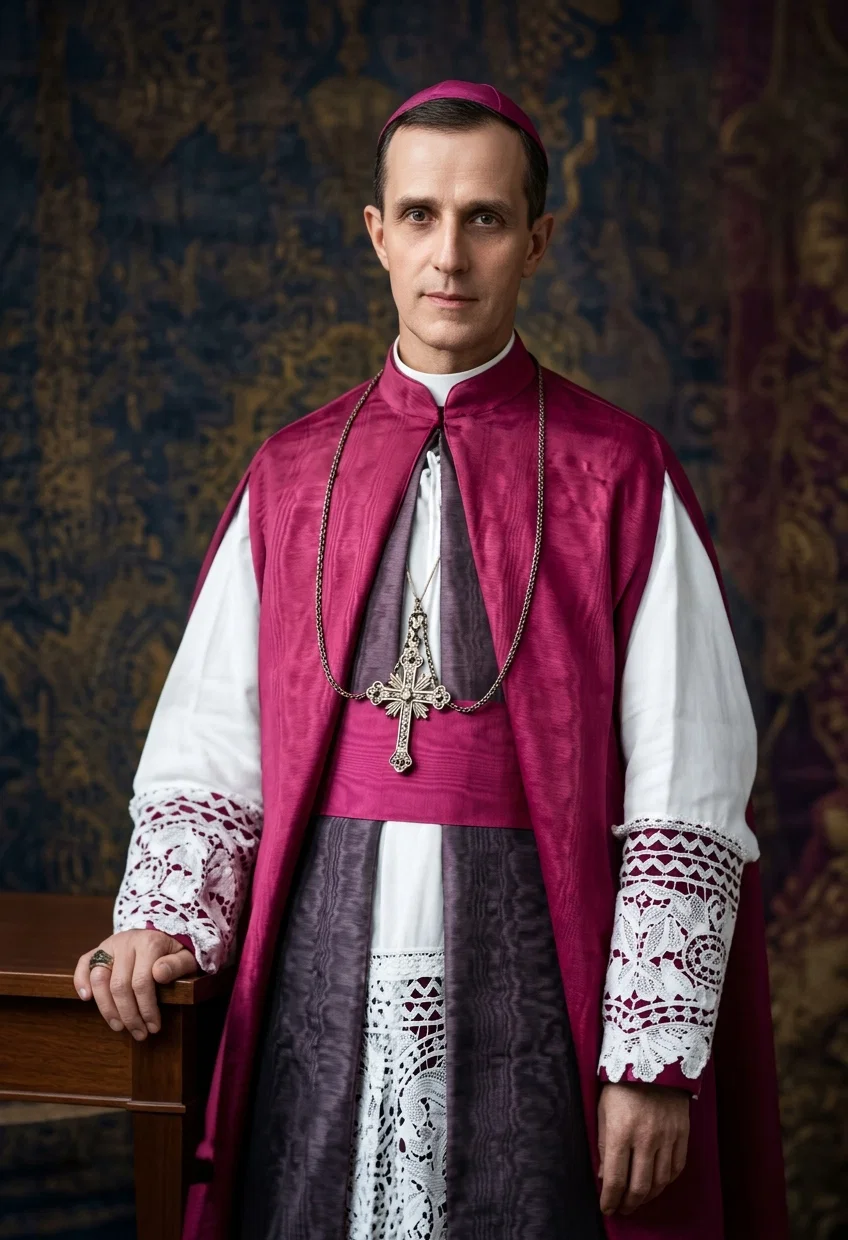
As introductory to this campaign, Archbishop Bonzano, the papal apostolic delegate to the United States, took occasion to address a special communication to the Times on the subject, in which he attempts to explain who changed the Sabbath from the seventh to the first day of the week, why the change was made, and why laws enforcing the observance of Sunday are proper and right. Coming from such a source,—the personal representative of the pope to the United States,—the statements are of special interest.
What the Papal Delegate Says
The communication referred to appeared in the Times of Saturday, October 11, 1913, under the caption, “Why Sunday Is the First Day of the Week,” and reads as follows:
“We know by the light of our reason that there is an obligation for man to adore his Creator, God Almighty. Natural law requires that every human being shall devote some part of his time to acts of divine worship, but it does not fix or determine any particular time for the fulfilment of this obligation. For the people of Israel, in the old law, there was a specified time for it, because God Himself condescended to appoint a day on which they were to discharge this duty toward their Maker. He set apart the seventh day of the week for this purpose in commemoration of the day on which He rested from the work of creation.”
“In the new law the time for fulfilment of this obligation was changed by the apostles from the Sabbath, or the seventh day of the week, to Sunday, or the first day of the week, primarily to commemorate the resurrection of Jesus Christ, who early in the morning on the first day of the week arose, glorious and triumphant, from the dead. Hence it is that, in Scripture, the first day of the week is called the ‘Lord’s day.’ Apoc. 1: 10.”
“Other reasons for this change were: Because it was on this day that the apostles received their commission, as apostles, from Jesus Christ, with the same power and authority which He, as man, has received from His Father. ‘As the Father has sent Me,’ He said to them, ‘so I send you’ (John 20: 21); and because it was on this same day that they received from Christ the power of forgiving sins. It was also on this same day of the week that the Holy Ghost came down upon the apostles, and that the faith and law of Christ was for the first time solemnly published to the world by them.”
“The manner in which Christians are bound to keep holy the first day of the week consists in their abstaining from all unnecessary servile work and in occupying themselves with some positive act of divine worship.”
“Since the law of God in this matter is, therefore, so clear, and since the determination of the time for the fulfilment of this duty has been reasonably changed from the day of Saturday to that of Sunday, it is very much to be desired that all who claim to be Christians should faithfully discharge their duty in this regard. So much, at least, is their duty of conscience.”
“From the faithful observance of Sunday the commonwealth, as well as the individual, derives much good, both of the spiritual and of the temporal nature. And hence it is that, in view of this good, society should be greatly concerned in enacting laws for the observance of Sunday, and most careful in seeing that they are put into practise.”
ARCHBISHOP BONZANO
We have reproduced this communication in full in order that the reader may see just what the special representative of the papacy to this country has to say upon the change of the Sabbath, and Sunday legislation,—two questions of prime importance to Rome. And inasmuch as the papacy just now is seeking to regain her lost supremacy in the Old World by capturing the New, and thus establishing a universal supremacy throughout the whole world, these questions are of special interest and of immense importance to all the people of this nation and of the whole world.
Let us therefore examine some of the statements made by Mr. Bonzano in his communication to the Times. First let us note what he says respecting the question as to—
Who Changed the Sabbath
According to this latest semipapal pronouncement, the time for fulfilling the duty enjoined by the divine Sabbath commandment “was changed by the apostles from the Sabbath, or the seventh day of the week, to Sunday, or the first day of the week.”
No proof is given for this assertion, but the responsibility for the act of changing the Sabbath here referred to is boldly charged to the apostles. If the statement is correct, then the apostles changed the law of God, a thing which Christ Himself said He came not to do. See Matt. 5: 17-19.
In so important a matter, the record of the alleged change should be clear, explicit, and unmistakable. What proof, we therefore ask, is there in the Scriptures that the apostles changed the Sabbath? That there is none is admitted by both Catholic and Protestant writers. Thus Cardinal Gibbons, in his work “The Faith of Our Fathers,” page 111, says:
“You may read the Bible from Genesis to Revelation, and you will not find a single line authorizing the sanctification of Sunday.”
In like manner Dr. Lyman Abbott, in the Christian Union for June 26, 1890, said:
“The current notion that Christ and His apostles authoritatively substituted the first day of the week for the seventh day is absolutely without any authority in the New Testament.”
The statement made by Mr. Bonzano, therefore, that the apostles changed the Sabbath, is without Scripture warrant, and, in the absence of such proof, must be regarded as false. The apostles made no such change.
The following from “The Convert’s Catechism of Catholic Doctrine,” by the Rev. Peter Geiermann, C. SS. R., page 50, comes much nearer the truth:
“Q. Why do we observe Sunday instead of Saturday?”
“A. We observe Sunday instead of Saturday because the Catholic Church, at the Council of Laodicea (A.D. 336), transferred the solemnity from Saturday to Sunday.”
The writer of this conveys the correct idea. The change of the Sabbath was the work of the Catholic Church rather than that of the apostles, and it was made in the centuries following apostolic times, and after all the early apostles were dead.
The Council of Laodicea, held in A.D. 364, wrongly given in the foregoing quotation as A.D. 336, in its twenty-ninth canon, enjoined the observance of Sunday as the Lord’s day, and anathematized those who should continue to observe the seventh day, the day specified in the Sabbath commandment.684This, however, was but one of a series of acts on the part of the Roman Catholic Church, beginning with that of Victor, bishop of Rome, in A.D. 196, in which the Eastern churches were excommunicated by that haughty prelate because they refused to heed his injunction to celebrate the Passover on Sunday in conformity with the practise of the churches of the West, and extending to acts of councils and decrees of popes during centuries following, by which the Sabbath was changed. The change was not the work of a day, but, like the apostasy from which it came, and of which it was and still is a part, was brought about gradually, step by step, through a long process of years.
Upon such foundation as this rests the Sunday sabbath; and with no better warrant than this for its observance, we are told by this papal apostolic delegate to the United States that “Christians are bound to keep holy the first day of the week.”
Christ was crucified on Friday, and rose from the dead on Sunday; but neither the one event nor the other made a sabbath out of the day on which it occurred. Though all the events mentioned by Mr. Bonzano, and more, may have occurred on the first day of the week, that gave no foundation for changing the Sabbath, and making a day of rest out of Sunday. When God made the seventh-day Sabbath, He Himself first rested upon the day; and then, by definite and explicit appointment, He gave it to man as the Sabbath, or day of holy rest. Gen. 2: 2, 3; Ex. 20: 8-11. But the Sunday sabbath is wanting in both respects. Christ neither rested upon that day, nor commanded His followers to do so. What He did not do, Christians are not bound to do; and what He did not teach or command, no Christian church has a right to teach or command.
Concluding his communication to the Times, Mr. Bonzano, true to Catholic doctrine and tradition, sets up—
A Defense for Sunday Legislation
Because of the good to the individual and the commonwealth accruing “from the faithful observance of Sunday,” it is alleged that “society should be greatly concerned in enacting laws for the observance of Sunday, and most careful in seeing that they are put into practise.”
Here we have the papal principle and the papal program in a nutshell—religion by law. Because religion is good, the state should enforce it! This is the logic of Rome. But no greater error was ever promulgated among men. Upon this very principle the Inquisition itself, with all its persecutions and monstrous horrors, was carried on during the Dark Ages. Because religion was a good thing, the papal ecclesiastics of those times reasoned, just as Mr. Bonzano now reasons, that it was the duty of the state to enforce it upon the people, and to proscribe, persecute, and put to death all who refused to accept the religion thus laid down and doled out with an iron hand.
Good religion is a good thing. But no religion which craves the power of the state by which it may force itself upon men irrespective of faith, conviction, and conscience, is good. By this very act it brands itself with the mark of Cain, who was a murderer.
The bane of all ages has been the union of church and state, the result of which, in the end, has invariably been religious persecution. And during the past sixteen hundred years, as history abundantly testifies, both in Europe and America, Sunday legislation has played a very prominent part in effecting and perpetuating such unions. Through this means more than any other the early church, in its apostasy, rode into power. And, as the Bonzano article here quoted shows, by this means this same apostasy aims to retain its hold upon the civil power, and wield it to its own advantage and aggrandizement.
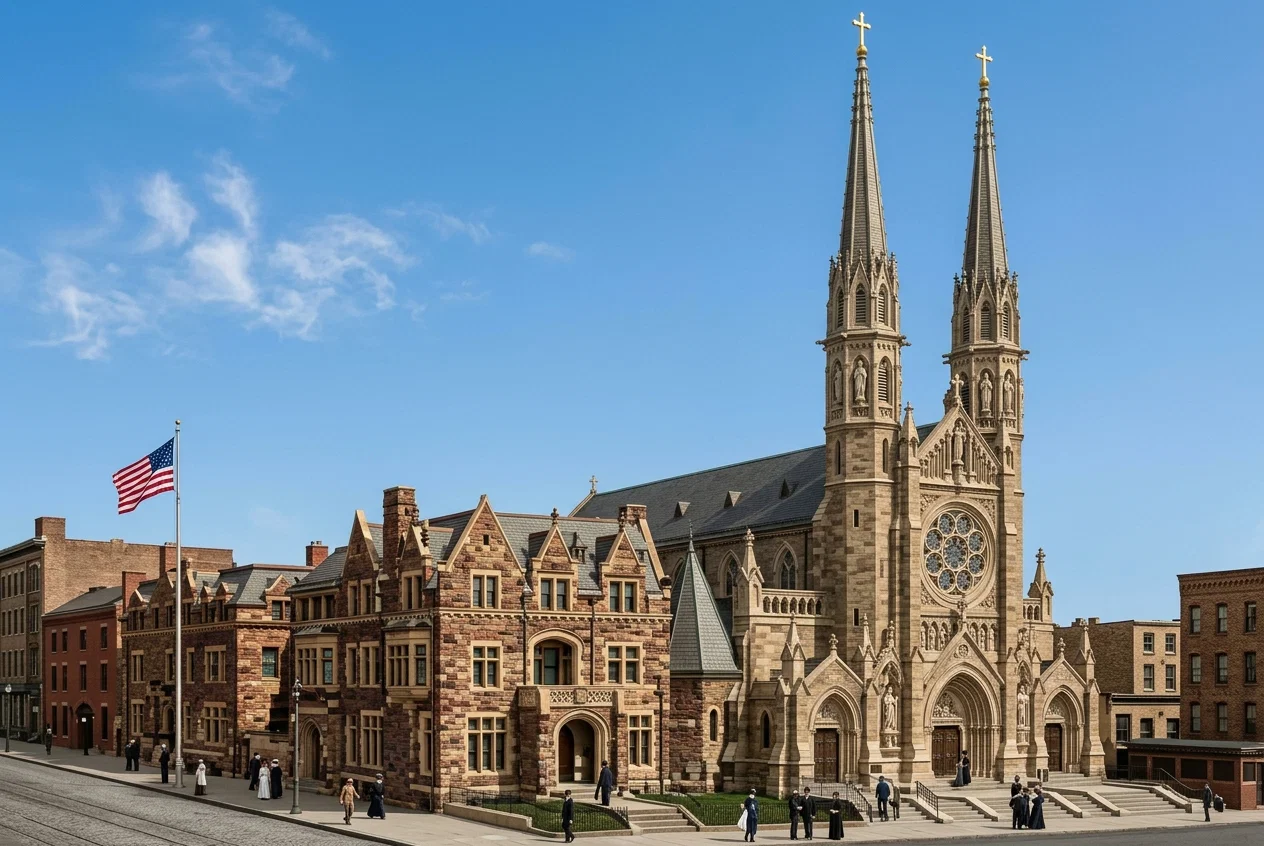
Georgetown College, in Georgetown, or West Washington, D. C. It is the oldest and largest Jesuit college in the United States. The first building was erected in 1789.
Were the people of these United States as wide-awake as they might be, and as true as they should be to the principles upon which the national government was founded, they would not only repeal every Sunday law now found upon the statute-books, but would look with suspicion upon any man or any religion which dared to advocate them in this land of far-famed freedom.
W. A. COLCORD.
The War Spirit in Europe
THE Germans were disposed at first to treat very lightly the new three-year service law of France, but the high military authorities of the German Empire are coming to regard that law with much more seriousness. They recognize that the position of Germany places her in grave danger. General von Bernhardi, speaking through a Berlin paper, says:
St. Patrick's church, rectory, and Carroll Hall, Washington, D. C. The oldest Catholic congregation in Washington. Each recent year, on Thanksgiving the representatives of all the South American republics, together with the President of the United States and his cabinet, attend mass there.
“We are not threatened only by economic misfortune, but by an economic catastrophe. This last point can not be too earnestly insisted upon. . . . Germany, in order to supply the needs of its population, is forced to rely continually upon foreign countries. . . . We fall short every year fifteen or twenty per cent in our annual supply of breadstuffs. The situation of our industries, therefore, in case of war, would be most critical. Germany is forced to import a great part of the natural products of which she has need. Our steel industry imports annually 12,000,000 tons of ore.”
“To sum up, we are in a dangerous situation, and find ourselves compelled either to augment our military power to such a degree that we would be sure of success, or to give up all hope of a great future. There is no choice in the matter. We must either be a great world power or abandon ourselves to an irremediable decadence.”
Possibly it is the dissemination of such sentiments that is changing the attitude of the German Socialists toward militarism. The German working man is coming over to the side of the kaiser in favor of a big army and a big navy. Leaders of the social democracy voted in the Reichstag for military laws that were a great source of gratification to Emperor William, and in their Socialist Congress recently held at Jena, they expressed themselves as much more favorable than formerly to a strong military program.
The war spirit is one of the significant conditions of this age. It is rampant everywhere; and notwithstanding all of the efforts that are made to promulgate “the gospel of peace,” it is increasing most rapidly. Men have made light of the prophecies which tell us that the spirit of war would characterize this age, which is to see the second coming of Christ. But if we will take a clear outlook at the facts, and give proper study to the prophecies, we will see that God knew how to announce these conditions long before they became fact in human experience.
California Presbyterians and Local Sunday Laws
The California Synod of the Presbyterian Church recently convened at Santa Rosa. It comprised representatives of all the congregations of that denomination in both California and Nevada. They voted to affiliate with the Weekly Rest Day League in a state-wide movement for a municipal Sunday closing ordinance, as expressed in the following resolution:
“Resolved, That we cooperate with other churches, under the leadership of the Weekly Rest Day League, to secure municipal Sunday closing ordinances and a general state-wide Sunday rest law, and that we approve of the appointment of Dr. G. G. Eldredge and Prof. Lorin Handley as members of the central committee of the league.”
If Sunday were the Sabbath of the Bible, it would be a very proper thing to seek to persuade men to observe the day religiously; but as the Bible has no law whatever in favor of Sunday observance, there is no divine reason for seeking to get men to observe it.
The name of the Weekly Rest Day League would seem to indicate that all it cares for is to secure one day out of the week as a day of rest for the laboring man. But our Presbyterian friends propose to make this rest day fall on Sunday; and we will find, before we are through with the proposition, that all those who are working to secure one day out of the week for rest, will unite in asking that that one day be Sunday.
In bygone days, men thought they had divine approval for Sunday observance; but a large part of the world has been educated to the point where they know that God has given no command whatever for the observance of that day, neither has either Christ or the apostles given any authority for changing the rest of the divine Sabbath from the seventh to the first day of the week. And when we come to the final analysis of this controversy, it is not a question of securing a weekly day of rest for the laboring685man, but rather it is a question of loyalty to the word of God. Will we accept what God says, or will we insist upon setting aside His word, and putting in place of it a man-made institution?
California has been a great battle-ground over this question of Sunday laws, and it would seem that the agitation is to continue with renewed activity. As this discussion goes on, as is planned, in every municipality throughout the state, there will be a great opportunity for men to become fully enlightened concerning what the Bible actually teaches upon this Sabbath question. In all the history of the past, the men who have stood squarely upon the clear teaching of God's word, even though they have been vastly in the minority, have in the end come out on the safe side, because the right side is always the safe side, for the omnipotent God is with the right, and will fully vindicate every utterance of His word.