Your ShelfYour Projects

Signs of the Times, Vol. 24, No. 15.

Guardian Angels
Earlier text: THE HORRIBLE BULLETS FOR MODERN WARFARE

Our Work and Workers.

Brother W. J. Stone reports the baptism of three persons at Miles City, Mont.
The new meeting-house at Fellsburg, Kansas, is to be dedicated on the 17th inst.
In the past fifteen months the Minneapolis English church has been increased by fifty members.
Four have decided to keep the Sabbath of the Lord at Burleigh, Maine, in connection with meetings held by Brother J. B. Goodrich.
The Michigan Conference will employ nine tent companies the present season, seven in that State and two in the province of Ontario.
Our book agents are especially favored in Texas, as persons selling books of a purely religious character are exempt from the $45 license imposed upon all other canvassers.
The local camp-meeting for Central California will be held at Visalia, May 5 to 15. The State camp-meeting will be held at St. Helena, June 2 to 12. Other particulars will be given when decided.
The new subscription book, “The Story of Redemption,” by Wm. Covert, recently issued by the Pacific Press Publishing Co., is receiving high praises from canvassers, both as to mechanism and matter. Don’t fail to get a copy. Prices, $1.00 and $1.25.
A good work has been accomplished at Wallace, N. Y., under the labors of Sister Lulu Wrightman. Brother S. M. Cobb reports to the Indicator that twenty-six are now keeping the Sabbath as a result of her work in that place. A church will be organized there in the near future.
The New Zealand Tract Society is erecting a new two-story building in the city of Wellington, for the use of the society. The upper story will also be used by the Wellington church as a temporary house of worship until needed by the tract society or it becomes too small for church purposes.
On the 6th ult. a church of thirty-one members was organized at Oak Level, Ala., fifteen being received by baptism. This result was attained by circulating the SIGNS OF THE TIMES, and following this work by a tent effort. It is becoming more and more apparent that the SIGNS is the most effective “pioneer,” when assigned to its legitimate place.
Miss Sannie M. Gallion, a Bible worker in Atchison, Kansas, writes: “The Lord is abundantly blessing the work in this city. Our small sanitarium, which was begun a year ago in one small room, has been moved into larger quarters, and the patronage is constantly increasing. Brother L. F. Hansen is at its head. A reading-room has been established also, and cottage meeting bands are having good success.”
Prof. J. C. Whatley, wife, and child arrived in San Francisco on the 3d inst., from Pitcairn Island. He came on the British ship Drummuir, having left the island February 22. He reports the inhabitants—then numbering 145—as all in good health, altho they were threatened with a short food supply, owing to drought and the destruction of many of their banana trees by a severe gale. Sister Rosa Young had safely arrived home from California before Brother Whatley left.
Another of our older ministers, Brother J. H. Cook, has been laid to rest. We have no particulars as to his death, other than that he died at Fresno, Cal., March 28, after a lingering illness. He has not been in active service for two or three years, owing to age and infirmity. Brother Cook was for some time president of Kansas Conference, and afterward, for a short time, had charge of the work in Kentucky; but, owing to the ill health of his wife, he came to California in the spring of 1888, and has since made this State his home.
From the Christian Help Mission, Omaha, Neb., we have the following encouraging report, under date of March 29:—“In our work here we do not find all the men, or even a large part of them, anxious for salvation. But now and then an honest soul takes hold of God’s promises and rejoices both his own heart and that of the laborer. Last night a gray-headed man arose as soon as an opportunity for testimonies was given, and told his story. For several weeks he had been sick, and his thoughts went out after God, so that he did not desire his old associations. One day while thus alone, a stranger came in with a paper, the SIGNS OF THE TIMES, and assured him that if he would read and believe, it would bring to him joy and peace. So the paper was read, not only once, but three or four times, one of the poems impressing him so much that he committed it to memory. Later he came to the mission, and raised his hand for prayer, and now he is happy in Jesus. God has jewels even in the mud and slime of this old earth. God bless the silent messengers that go where His servants can not go.”
A California Council.—Brother Knox, the president of California Conference, has this to say in the California Missionary: “A meeting of the boards of directors, stockholders, and all interested in the work of the Pacific Press Publishing Company, Rural Health Retreat, and the Healdsburg College, is called to convene at the Oakland church, April 21 to 26. The object of the meeting will be to study the principles that should govern the management of these institutions, to consider and counsel together concerning the important interests involved, and to seek to enlarge their fields of usefulness. It is believed that in view of the fact that the annual meetings of all these organizations is close at hand, a meeting of this nature at this time will result in much good.”
A Missionary Farm.—Brother W. S. Wedge informs us that with the assistance of Brother and Sister Teachout, of Minneapolis, he has started a missionary farm just south of the city. He expects to cultivate about sixty acres, some of which will be in garden, and the entire proceeds of the season’s work will be devoted to opening a workingmen’s home in Minneapolis. The labor will be performed by persons connected with the city missions and members of the Minneapolis church. The work was commenced in February, and plants in hot-beds are said to be doing well. Several outside parties have generously assisted in starting the work, and so far all needs have been supplied. Brother Wedge appeals especially to the brethren of Minnesota Conference to help at once in the way of supplying seeds, such as sweet and field corn, potatoes, squash and onion seed, beans, and peas. He also calls for the use of two good horses and harness, and two milch cows. Address all communications to C. M. Teachout, 4450 Second Avenue, South Minneapolis, Minn.

THE HELPING HAND AND MEDICAL MISSION.

At a recent meeting of the board of managers of the Helping Hand and Medical Mission, the chaplain made the following report of work done for the first month, ending March 27, 1898:—
No. of beds occupied one night . . . 1,149 *No. occupied by workers, and account of charity . . . 425 No. baths given . . . 499 No. garments fumigated . . . 2,100 No. persons using the laundry . . . 135 *No. free penny lunches served (including meals of the workers) . . . 5,304 No. paid penny lunches served . . . 4,461 No. garments distributed . . . 140 No. treatments given . . . 23 No. men furnished employment for one or more days . . . 600 No. Bible readings held . . . 32 No. sermons preached . . . 28 No. persons requesting prayers . . . 128 No. persons professing Christ . . . 60
For the very first month of work in the Mission, this report is certainly most encouraging, and those who have given of their means to assist in the starting of the Mission will certainly feel gratified at the results thus far. And if they could be present, and see the work as it goes on from day to day, every one would rejoice that they could, by giving of their means, have part in such a grand and noble work.
Several have responded to Brother Richards’ call in the SIGNS of March 17 for contributions of $1.00 each to pay for coupon books to be used at the discretion of the chaplain of the Mission in assisting the needy. All should specify that their donation is for coupon books, if this is their desire.
Total amount of cash donations received up to April 6, is $1,561.75. S. N. CURTISS, Secretary and Treasurer.

PERIODICALS WANTED.

CLEAN copies of any of our periodicals for missionary use. Please send post-paid to H. M. Campbell, Columbia, Boone County, Mo.
CLEAN back numbers of any of our periodicals will be used in missionary work if sent post-paid to G. S. Vreeland, 243 South Boulevard, Atlanta, Ga.

PACIFIC SABBATARIAN ASSOCIATION.

The annual meeting of the stockholders of the Pacific Sabbatarian Association, a corporation, organized and existing under and by virtue of the laws of the State of California, will be held at the office of the company, corner of Twelfth and Castro Streets, in the city of Oakland, county of Alameda, State of California, on Tuesday, the 26th day of April, A.D. 1898, at 9:30 A.M., for the purpose of electing a board of nine directors, and transacting any other business that may properly come before the meeting. By order of
Wm. Saunders, President of Pacific Sabbatarian Association.
E. A. Chapman, Secretary of Pacific Sabbatarian Association.

PACIFIC PRESS PUBLISHING COMPANY.

THE annual meeting of the stockholders of the Pacific Press Publishing Company, a corporation organized and existing under and by virtue of the laws of the State of California, will be held at the office of the company, corner of Twelfth and Castro Streets, in the city of Oakland, county of Alameda, State of California, on Monday, the 25th day of April, A.D. 1898, at 9:30 A.M., for the purpose of electing a board of seven directors, and transacting any other business that may properly come before the meeting.
By order of C. H. JONES,
President of Pacific Press Publishing Company.
S. C. STICKNEY,
Secretary of Pacific Press Publishing Company.

Iowa Workers’ Bulletin

At the present writing we have received orders for 10,842 copies of the new tract, “The Alarm of War,” and orders are still coming in every day. The demand for it has been so great that the publishers have been unable to keep up with their orders; hence there has been more or less delay in filling the orders we have received. We trust this has not been a source of discouragement to any. We are so glad to know that so many thousands of pages bearing the truth of God, have been scattered in our State. We trust that much more may yet be done with it. Some of the societies have found it necessary to increase their first order. Some are selling the tracts with good success.

Iowa Workers’ Bulletin

Nut Butter and Nut Products

NUT BUTTER easily and cheaply made by the use of our MILLS, Roasters and Blanchers. Valuable recipes free with each mill. Nuts of All Kinds, Nut Butter and Nut Products shipped to any address. Write for Circular and Price-List KNAPP BROS., 71 N. 11th St., E. Portland, Ore. General Agents for Mills in Wash., Ore., and Cal.
When you write, please mention the SIGNS OF THE TIMES.

WORKS BY G. K. OWEN.

PERILS and Possibilities (cloth binding) . . . . . . . . . . . . . . $1 00 Vocal Power (cloth binding) . . . . . . . . . . . . . . . . . . . . . . 75 Science of Memory (tagboard binding) . . . . . . . . . . . . . . . . 25 Science and Art of Bible Readings . . . . . . . . . . . . . . . . . . 20 Liberty Measured by the Golden Rule, per 100 . . . . . . . . . . . 50
Address, California Tract Society, 1059 Castro Street, Oakland, Cal.
Extracts from testimonials to “Perils and Possibilities.” No one can open the book without finding something instructive and interesting. The work is well worth the small price paid for it. Medical Missionary.
We all agree that “Perils and Possibilities” is an excellent book and worthy of a very large circulation. I. F. SEGNER & CO., Book Publishers, Burlington, Iowa.
I can heartily recommend it. N. E. WILSON, Professor in Nevada State University.
I find therein much food for thought. JOHN E. BRAY, Principal High School, Reno, Nev.
The works of G. K. Owen contain much that is useful, original, and interesting. M. R. AVERILL, Principal Virginia High School, Nevada.
I wish to commend Mr. Owen’s “Science of Memory” as a natural method. J. E. CHURCH, Professor in Nevada State University.
When you write, please mention the SIGNS OF THE TIMES.

PAUL A PRISONER IN CÆSAREA

Lesson V.—Sabbath, April 30, 1898.

PAUL A PRISONER IN CÆSAREA.

14 “And they came to the chief priests and the elders, and said, We have bound ourselves under a great curse, to taste nothing until we have killed Paul. Now therefore do ye with the council signify to the chief captain that he bring him down unto you, as though ye would judge of his case more exactly; and we, or ever he come near, are ready to slay him. But Paul’s sister’s son heard of their lying in wait, and he came and entered into the castle, and told Paul. And Paul called unto him one of the centurions, and said, Bring this young man unto the chief captain; for he hath something to tell him. So he took him, and brought him to the chief captain, and saith, Paul the prisoner called me unto him, and asked me to bring this young man unto thee, who hath something to say to thee. And the chief captain took him by the hand, and going aside asked him privately, What is that thou hast to tell me? And he said, The Jews have agreed to ask thee to bring down Paul to-morrow unto the council, as though thou wouldest inquire somewhat more exactly concerning him. Do not thou therefore yield unto them; for there lie in wait for him of them more than forty men, which have bound themselves under a curse, neither to eat nor to drink till they have slain him; and now are they ready, looking for the promise from thee. So the chief captain let the young man go, charging him, Tell no man that thou hast signified these things to me. And he called unto him two of the centurions, and said, Make ready two hundred soldiers to go as far as Cæsarea, and horsemen threescore and ten, and spearmen two hundred, at the third hour of the night; and he bade them provide beasts, that they might set Paul thereon, and bring him safe unto Felix the governor. And he wrote a letter after this form:
“Claudius Lysias unto the most excellent Governor Felix, greeting. This man was seized by the Jews, and was about to be slain of them, when I came upon them with the soldiers, and rescued him, having learned that he was a Roman. And desiring to know the cause wherefore they accused him, I brought him down unto their council; whom I found to be accused about questions of their law, but to have nothing laid to his charge worthy of death or of bonds. And when it was shown to me that there would be a plot against the man, I sent him to thee forthwith, charging his accusers also to speak against him before thee.
“So the soldiers, as it was commanded them, took Paul, and brought him by night to Antipatris. But on the morrow they left the horsemen to go with him, and returned to the castle; and they, when they came to Cæsarea, and delivered the letter to the governor, presented Paul also before him. And when he had read it, he asked of what province he was; and when he understood that he was of Cilicia, I will hear thy cause, said he, when thine accusers also are come; and he commanded him to be kept in Herod’s palace.”

QUESTIONS.

1. Tell the circumstances of Paul’s appearance before the council.
2. In what danger was Paul, and how was he encouraged?
3. Tell about the conspiracy among the Jews against Paul.
4. To whom did the conspirators make known their purpose? Verse 14.
5. What did they devise for the furtherance of their design? Verse 15.
6. Who learned of this conspiracy? What did he at once do? Verse 16.
7. How was the chief captain made acquainted with it? Verses 17-21.
8. What measures did the officer at once take for Paul’s safety? How strong an escort was provided for him? To what place was Paul to be sent? To whom? Verses 22-24.
9. What sort of letters did the captain send to the governor? Verses 25, 26.
10. How did he set forth his own connection with the matter of Paul’s seizure? Verse 27. See note.
11. What did he say as to the charge against Paul? What testimony did he give as to Paul’s innocence? Verses 28, 29.
12. What commandment did he say he had given to Paul’s accusers? Verse 30.
13. How far did the armed escort accompany Paul? When the horsemen arrived at Cæsarea with Paul, what did they do? Verses 31-33.
14. What question did the governor ask after reading the captain’s letter? Verse 34.
15. What did he say to Paul? What order did he give concerning him? Verse 35.

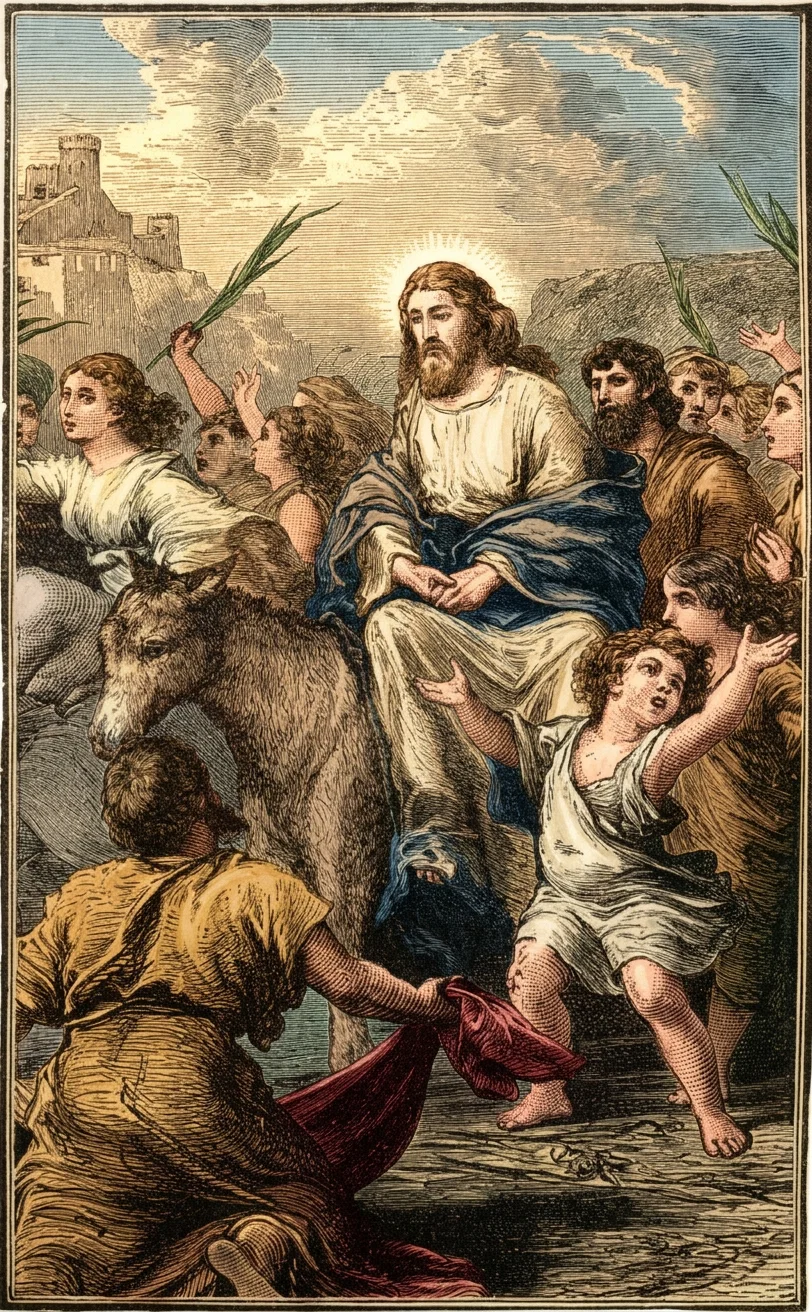
THE TRIUMPHAL ENTRY

Lesson V.—Sunday, May 1, 1898.

THE TRIUMPHAL ENTRY.

Note.—The time of the present lesson is the last week of Christ’s life upon earth. Parallel accounts of this entry into Jerusalem are found in Mark 11:1–11; Luke 19:29–44; and John 12:12–19. The record of the first cleansing of the temple will be found in John 2:13–22. The present lesson section includes the account of the triumphal entry as found in the four Gospels. Trace on the map the journeys of Jesus, and point out Bethany and the route of the triumphal procession. About five months intervene between the incidents of to-day’s lesson and those of the lesson of one week ago. The miracle of raising Lazarus was performed during this time. The teacher should make the two principal features of to-day’s lesson as vivid as possible to the members of his class, and connect it with the final glorious triumph of Christ when He enters His kingdom to reign.

Lesson Scripture, Matt. 21:6–16, R.V.

6 “And the disciples went, and did even as Jesus appointed 7 them, and brought the ass, and the colt, and put on them their 8 garments; and He sat thereon. And the most part of the multitude spread their garments in the way; and others cut branches 9 from the trees, and spread them in the way. And the multitudes that went before Him, and that followed, cried, saying, Hosanna to the Son of David; Blessed is He that cometh in the 10 name of the Lord; Hosanna in the highest. And when He was come into Jerusalem, all the city was stirred, saying, Who is 11 this? And the multitudes said, This is the Prophet, Jesus, from Nazareth of Galilee. 12 “And Jesus entered into the temple of God, and cast out all them that sold and bought in the temple, and overthrew the tables of the money-changers, and the seats of them that sold the 13 doves; and He saith unto them, It is written, My house shall be called a house of prayer; but ye make it a den of robbers! 14 And the blind and the lame came to Him in the temple; and He 15 healed them. But when the chief priests and the scribes saw the wonderful things that He did, and the children that were crying in the temple, and saying, Hosanna to the Son of David; 16 they were moved with indignation, and said unto Him, Hearest thou what these are saying? And Jesus saith unto them, Yea; did ye never read, Out of the mouth of babes and sucklings, Thou hast perfected praise?”
Golden Text: “Hosanna to the Son of David; Blessed is He that cometh in the name of the Lord.” Matt. 21:9.

SUGGESTIVE QUESTIONS.

(1) What act did the disciples perform in obedience to Christ’s command? Verses 6, 7. Note 1. (2) What was done to the colt and its mother to prepare them for the event? Verse 7. (3) When the Saviour was seated upon the colt, how did the people show their homage for Him? Verse 8. Note 2. (4) What did the multitude do as they went on toward Jerusalem? Verse 9. Note 3. (5) What effect did His entry have upon the inhabitants of Jerusalem? Verse 10. (6) What did they say? Same verse. (7) What did the multitude reply? Verse 11. (8) Where did He go when He entered the city? Verse 12. (9) What did He do there? Same verse. (10) What did He say to those whom He treated in this way? Verse 13. Note 4. (11) Who came to Him here? Verse 14. (12) What did He do for them? Same verse. Note 5. (13) Who looked on and observed what the Saviour was doing? Verse 15. (14) What did they see and hear? Same verse. (15) How did it affect them? Same verse. (16) What did they ask of Jesus? Verse 16. Note 6. (17) What reply did He make to their question?

NOTES.

1. Did even as Jesus appointed them.—The command is found in verse 2. By the account here given it is not clear whether Jesus rode upon the colt or its mother, but reference to the parallels will show that the Saviour sat upon the colt during this triumphal procession.
2. The most part of the multitude.—By a census taken in the time of Nero, it was ascertained that there were 2,700,000 Jews present at the Passover. There was probably no less a number present on this day, and, being visitors, would have abundant leisure for a procession of this kind. “It was customary in royal processions to spread decorative cloth, or carpet, upon the ground, that the feet of royalty might not be defiled, or that dust might not arise.”—Morrison.
3. Blessed is He that cometh.—The words were taken in part from Ps. 118:25, 26, a hymn which the people were accustomed to apply to the Messiah. Hosanna meant, “Save, we pray,” and was used as an expression of praise, as “Hallelujah,” or “Hail.” In comparison with this entry and the final entry of Christ into His kingdom, which this typified, how weak, how insignificant, are the triumphal processions of the kings and queens of this earth!
4. A house of prayer.—This part of the temple was the court of the Gentiles—the only part to which the Gentiles had access, the only part to which they could come to learn of the true God; and the love of money had turned it completely aside from its intended purpose. This was the second time that Jesus had cleansed the temple. The other occasion is recorded in John 2:13–22.
5. And He healed them.—What a contrast between the work which He, the One to whom all the services of the sanctuary pointed, was doing in the temple of that building, and the work which the money-loving priests had fostered and encouraged within its sacred walls!
6. Hearest thou what these are saying?—The question is asked with the idea of influencing the Saviour to rebuke those who were singing, “Hosanna to the Son of David.” The Saviour refers them to Ps. 8:2. “Thus the Old Testament expressly approved and praised just that which here took place.”—Peloubet. “The Greek word translated ‘perfected’ is in Gal. 6:1 translated ‘restore.’ It is more literally ‘restorest praise.’ True praise of God had perished from the temple; in the mouths of these children of the temple it was being restored.”—Abbott.
Christ’s Entry into Jerusalem.

CHRIST AND THE SABBATH:

Or Christ in the Old Testament and the Sabbath in the New, by Elder James White. Paper covers, fifty-six pages, sent post-paid for ten cents. Address. PACIFIC PRESS, Oakland, Cal.
Continue reading: News and Notes