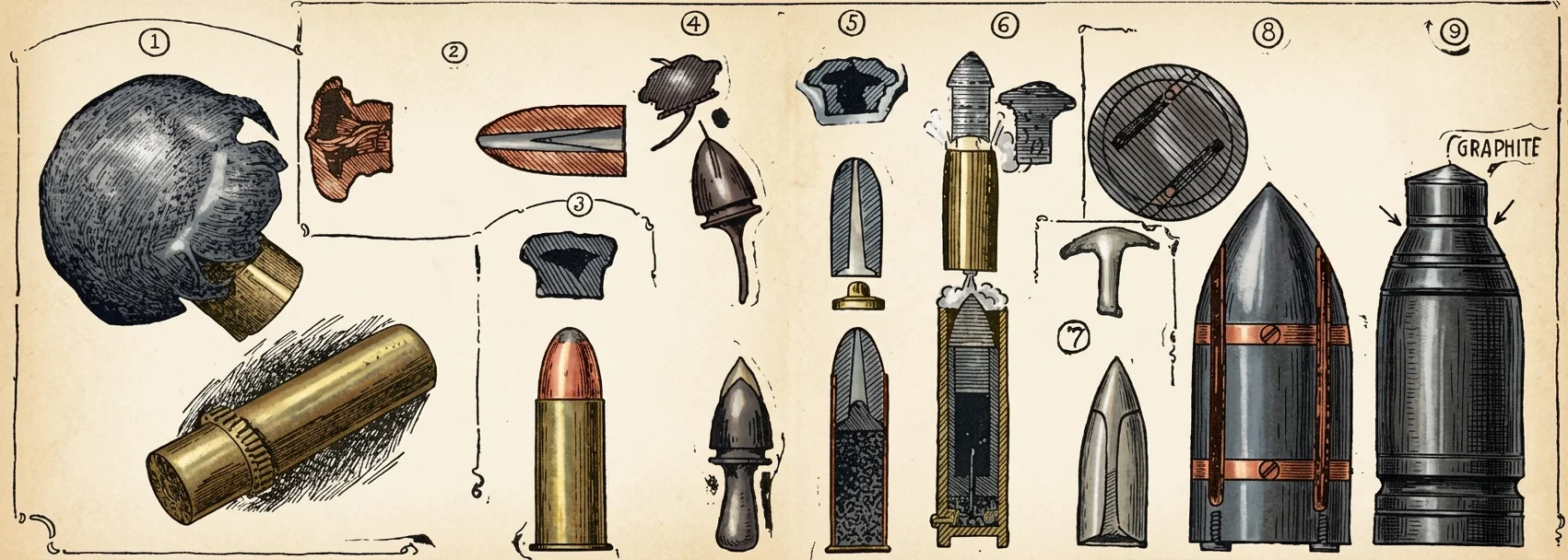
WE present herewith a cut of some of the bullets designed for use in battle. The ordinary steel bullet, while it can be fired to a great distance, is so smooth and keen that it will go clear through a man, and unless it strikes a vital part, will not stop his fighting. It will usually bore a hole right through a bone without shattering or breaking it. So some one devised the explosive bullet, that bursts when it strikes. But this was so frightfully cruel that it was forbidden by the law of nations.
SOME MODERN BULLETS.
So the “mushrooming” bullet is coming into use. Its destructiveness seems quite satisfactory to the warlike instincts, and by means of those fine balancings of opinion that ordinary minds might not be able to grasp, it is regarded as sufficiently “humane” to be used in “civilized warfare.” Nearly all of the bullets in our engraving are of the “mushroom” type, as the pictures indicate, altho we have not stated it in each case in the description.
We have just one object in presenting from week to week some of the leading facts regarding modern warfare. We have no sympathy whatever with the prevailing war spirit of the so-called “Christian nations;” for even tho some ministers preach war from the pulpit, and apologize for their course, by saying that conditions may arise under which even Christians should take up arms, nevertheless it is an eternal truth that the Lord Jesus Christ said, “Put up again thy sword into his place; for all they that take the sword shall perish with the sword.” Matt. 26: 52. Then, believing the Scripture truth that the musket and cannon are no part of the Christian’s weapons, the only object that we could possibly have in presenting these things is to call attention to such prophetic words as the following:—
“And I saw three unclean spirits like frogs come out of the mouth of the dragon, and out of the mouth of the beast, and out of the mouth of the false prophet. For they are the spirits of devils, working miracles, which go forth unto the kings of the earth and of the whole world, to gather them to the battle of that great day of God Almighty.” Rev. 16: 13, 14.
This Word of God puts it forever beyond dispute that it is the “spirits of devils,” and not the Prince of Peace, that is stirring up this fiendish spirit of war; and how solemn is the thought that the kings of the earth are thus being gathered for “the battle of that great day of God almighty”!
Do not be deceived, or misguided. This intense war spirit in our day is one among the many evidences that we are approaching the end of time. Get ready to meet the Prince of Peace, and not to join in the clashing of arms that demons are stirring up. T.
What Is the Duty of a Naval Chaplain?
By W. N. G.
Certainly the New York Christian Advocate (Methodist) does not deem it a religious duty, or it would not say of the Catholic chaplain of the lost battle-ship Maine that he was “admirably fitted for the place, as the other Roman Catholic chaplains most certainly are.” As a Protestant journal, enlightened as to what the Roman Catholic religion really is, can it truly believe the chaplain’s duty to be a religious duty, and express the opinion that “there is no reason why there should not be more Roman Catholic chaplains in the navy”? The Protestant who can publish such a sentiment to the world, with the idea that the position is a religious one, is certainly of a very compromising variety. When a leading Protestant journal, the leading organ of the largest Protestant denomination, can give place to such adulation of the Roman priesthood, it must look upon the naval chaplaincy as a mere militant position. That being the case, why should the chaplain be a priest or religious functionary at all? As true Protestantism is the very antipode of Roman Catholicism, a true Protestant would see a great many reasons why a Roman priest could not be a profitable religious teacher anywhere.
W. N. G.
Turning the Other Cheek
To the alleged plea of the administration that our government is “waiting for Spain to strike the first blow,” the San Francisco Examiner says: “The first blow was struck in Havana harbor February 15 last. It is not the duty of the nation to turn the other cheek now to the smiter.” But if this is a “Christian nation,” as declared by the U. S. Supreme Court, why should it not “turn the other cheek”? This is the instruction given to Christians by the Lord Himself. See Matt. 5: 38, 39.
HARD TIMES CONQUERED.
By Anonymous
About seventy years ago a physician with a young family springing up around him, consulting his wife, as all good husbands find it prudent to do, bought a large farm in one of our New England States, where every farmer truly earns his living by the sweat of his brow. Both felt that nowhere could their children be trained to industry and frugality so thoroughly as on a good farm.
The doctor was obliged to run in debt for this property, and he gave a mortgage on the place. The payments were to be made quarterly, and promptly, or the whole would be forfeited and revert to the original owner. In those days physicians were not likely to become millionaires, and tho Dr. Mason’s practise was large, the pay was small and not always sure. He therefore looked to the farm for the means to release him from the bondage of debt; and the children, even to the youngest, were taught to labor for, and looked forward eagerly to, the time “when we have paid for the farm!”
The creditor was the doctor’s father-in-law, through his first wife, and while the good old gentleman lived, if by any mishap or overpress of business the quarterly payment had been delayed, it would have been kindly excused. But for the ten or fifteen years that he lived after the sale of the farm, there had not been one delay in payment, tho now and then there would come a time when it was very hard to secure the needed sum in time, for even in the olden days hard times were often experienced, to the terror of our hard-working New England farmers. But, little by little, the heavy debt was diminishing, and the doctor’s family were looking forward hopefully to the year of jubilee, when they could sit under their own vine and fig tree, with none to molest and make them afraid.
At this period the father-in-law died. He had but two children, daughters. The younger, the doctor’s wife, had died childless. The elder had married a hard, close, scheming man, who lost no opportunity of remarking that he would, no doubt, soon come in possession of Dr. Mason’s farm, as the latter, with his large family, must fail by and by.
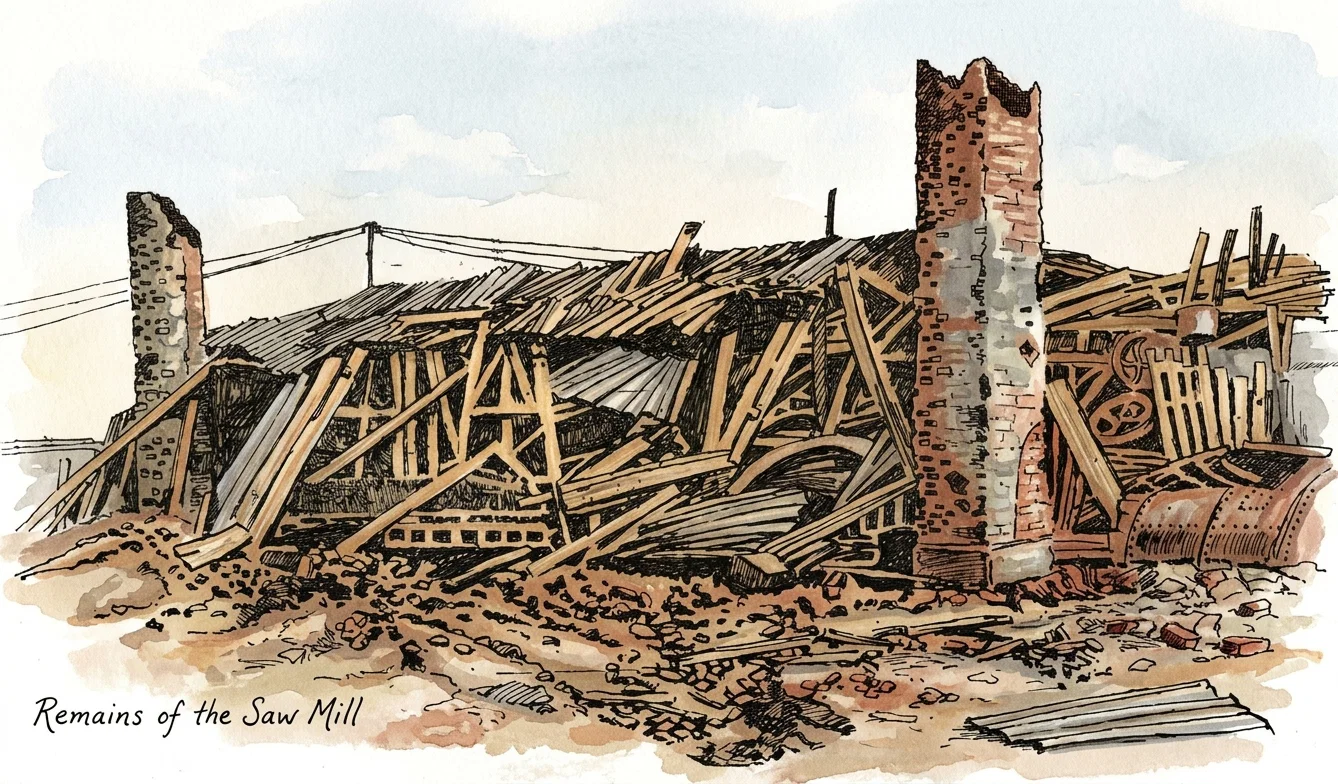
On March 30, 11:45 P.M., San Francisco and vicinity were shaken by the severest earthquake since 1868. It was notable because of the duration of the shock, which lasted from forty to forty-five seconds, but which seemed to many to extend to minutes. One or two old buildings were wrecked in San Francisco, and considerable damage was done at the Government Navy Yard, Mare Island, the wrecked sawmill being shown above. Injury to buildings is officially estimated at $342,000. That many were frightened need not be stated. Some not accustomed to pray, prayed then, but as soon as the fear was over, made light of their alarm. In some places the earth is said to have opened slightly. No lives were lost. See note on last page.
The financial troubles which the War of 1812 had caused, as all wars are sure to do, were not yet adjusted. Money was scarce, and payments very difficult. Ten children now filled the old house with merriment and gladness; but they were to be clothed and educated. Let us see how successfully they had been taught to make their high spirits and resolute wills cheerful auxiliaries in lifting the burden, which, since their grandfather’s death, was pressing so heavily upon the hearts and minds of their parents.
At the time of which we write, among other crops, rye was extensively raised. It was used for food among the farmers quite as much as wheat, and was also valuable for other purposes. When full-grown, but still in the milk, large quantities were cut to be used for “braiding.” The heads were used for “fodder;” the stalks, after being soaked in strong, hot soap-suds, were spread on the grass for the sun to whiten. When sufficiently bleached and ready for use, they were cut at each joint and the husk stripped off, and the straw thus prepared was then tied in pound bundles for sale.
Bonnets, then, meant something more than a small bit of silk or velvet with a flower or feather attached, and the “straw braid” for making them was in great demand. Boys and girls were alike taught to braid, and the long winter evenings were not spent idly. Dr. Mason raised large crops of rye, and each child, almost as soon as he could walk, was taught to braid, and was soon able to do much by it toward clothing himself. At six years of age a dollar a week was easily earned; at eight, three dollars; and in something of that proportion up to the eldest.
Does any one think that such a life, with such an object in view, was hard or cruel? Never was there a greater mistake. It was of great value to those young spirits. They had something real, that they could understand, to labor for. There was life, and courage, and true heroism in it. It was an education—with here and there, to be sure, some rough places to pass over—which was worth more to them than all the money millionaires bequeath their sons and daughters—an education which prepared them in after life to be courageous and self-helpful.
It is this kind of training that has made New England’s sons and daughters strong and self-reliant, and the lack of it which makes these hard times such a horror that we hear of many who seek death by their own hands as preferable to the struggle for better times.
In the long winter evenings, when the labor of the day was over, the children home from school, and the “chores” all finished, the candles were lighted and the evening work begun. The mother in her corner was busy making and mending for her large family. The doctor, if not with the sick, read and studied opposite her. The children gathered around the long table in the middle of the room, where lay the school-books and straw previously prepared for braiding, while the old fireplace, heaped with blazing logs of hickory, oak, and fragrant birch, made the room warm and cheerful. Here, with their books before them and fastened open to the next day’s lessons, the children with nimble fingers plaited the straw and studied at the same time. For children taught to be industrious, usually carry into the school-room the principles thus developed, and are ambitious to keep as near the head of the class as it is possible to do.
Such a family as this was well equipped to meet and conquer adversity. For several days Dr. Mason had been unusually grave and silent. All noticed it, but no remarks were made until evening, when he came to supper so unmistakably worried and despondent that his wife inquired if he were not well.
“Yes, well enough. But, Lucy, I have so far been unable to collect money for our quarterly payment. So much is due me that I had no fears but that enough would be promptly paid to save me any trouble.”
“How much is lacking?”
“Not quite a hundred dollars; but it might as well be thousands for any chance I now see of getting it in season. There is now so much sickness about that, as you know, I have had no rest, and little time to collect money. If not ready before midnight to-morrow, we are ruined. I have kept it from you as long as I dared, still hoping that those who ought to pay me would do so.”
“Have you told them how very important it is that you should have the money?”
“No; I did not wish to speak of it. Mr. H.10is watching greedily for a ‘slip,’ and we need expect no mercy at his hands. Under our hard labor and good care, this farm has risen greatly in value—too much so for him to spare us an hour, if he can once get hold of it. I am about discouraged. It is the darkest time we have seen yet. But I must be off, and will probably be kept out all night. To think there are not forty-eight hours between us and ruin! And my hands are so tied by several severe cases, that I may not find one hour to make up the little that is needed.”
For a few minutes after the doctor left, the children stood silent and sad, watching their mother. At last she said:—
“Children, we can help father through this, and save our home, if you are willing to submit to some little self-denial. No, I should have said to great self-denial. Each of you have worked diligently to buy new garments for winter. You need them and deserve them, and I should be happy and proud to see you all neat and comfortable. But to help father, are you willing to let me try to clean, mend, or make over your old clothes, and use what you have earned to help brighten this dark day? The braid you have on hand, and what is now due at the store, is all your own, or to be expended for your own clothes, and if each one of you is not perfectly willing, I don’t wish you to give it up.”
It was a beautiful sight to see those eager faces watching their mother, ready to answer the moment she had finished; for in the olden time children were taught that it was disrespectful to interrupt any one when speaking, even when, as in this case, it was difficult to keep silent. But the reply, when given, was prompt, enthusiastic, as she had confidently looked for it.
“Thanks, dear children! Now, then, hasten. First bring me all your braid, and let us see how much it will come to.”
The braid, in ten-yard rolls, was brought, and its value estimated.
“With that which is now due us at the store we have nearly sixty dollars. Well done, for all these little fingers! But now we must devise a way to make up the remainder. Your father spoke last night of a large quantity of straw, which, if cut, would bring in something. He will be away all night. If you work well, you can cut many pounds before midnight. Now, girls, help me wash the dishes, while your brothers bring, before dark, the straw we can cut to-night.”
By the time the candles were lighted, all was ready to begin.
The younger children were excused at their usual bedtime, but the others worked with their mother till the tall clock in the corner struck one. Then all retired for a few hours’ rest.
Dr. Mason returned home in season for breakfast, and his wife inquired if the eldest son could drive her over to the neighboring town to dispose of some braid for the children. He replied that he must be gone again all day, and neither son nor team could well be spared from important work at home. But a strange thing followed this implied refusal. Mrs. Mason, who never allowed her plans or wishes to interfere with her husband’s, now repeated her request, and urged it till he yielded, apparently from sheer surprise that his wife could be so persistent.
The doctor went his usual round, and the mother and her son departed on their mysterious errand. Their business accomplished, they returned well satisfied and ready for supper when the father arrived.
A deeper gloom was on his face when he entered; but no word was spoken till all were seated at the table. Then, in a slightly agitated voice, his wife inquired:—
“Have you been successful in obtaining the money?”
He shook his head, but remained silent. Each young, quivering face was turned first toward him, then, with earnest, questioning glance, to the mother.
“Do not be discouraged, dear, even at this late hour.”
“Are you wild, Lucy? There are but six hours between us and ruin. Can you talk of hope now? I have none.”
With a warning gesture to the children, she rose, stepped to her husband’s chair, and, passing her arm around his neck, said gently:—
“Yet still hope on, my husband; God will not forsake us.”
He moved impatiently from under her arm; but, as he did so, she dropped a roll into his bosom and turned toward her chair.
“Lucy! Lucy! what is this? Where did you get it?”
All was wild excitement. Each child laughed, sobbing, shouting, but one glance from that strong but gentle mother quelled the confusion, and she replied:—
“It is our children’s offering, and sufficient to make up the needed sum. I persisted in going away against your wish, because I saw no other escape. We cut the straw last night—many willing hands made quick work—I sold it, and their braid added to it, with what was already due them, completed the sum.”
Those who witnessed the scene will never forget it: Dr. Mason, with his arm around his wife, and both in tears, calling her all happy names; the children clinging about their parents, so joyful that home was saved and they had helped to save it.
“Put Charlie into the wagon, quick. If he fails me not, the six miles between here and M. will be the shortest I ever rode. I shall be home before bedtime to thank you all. I can not now. I hope we shall never come so near ruin again.”
And they never did. In two years the last dollar was paid, and then Dr. Mason resolved he would never again owe any one a cent. He kept his resolution.—Anonymous.
LABOR
By Anonymous
Labor is rest from the sorrows that greet us,
Rest from all petty vexations that meet us,
Rest from sin promptings that ever entreat us,
Rest from world sirens that lure us to ill.
Work, and pure slumbers shall wait on thy pillow;
Work, thou shalt ride over care’s coming billow;
Lie down not wearied ’neath wo’s weeping willow;
Work with a stout heart and resolute will.
Labor is life! ’tis the still water faileth;
Idleness ever despaireth, bewaileth;
Keep the watch wound, or the dark rust assaileth;
Flowers droop and die in the stillness of noon.
Labor is glory! the flying cloud lightens,
Only the waving wing changes and brightens;
Idle hearts only the dark future frightens.
Play the sweet keys, wouldst thou keep them in tune!
Labor is health! Lo, the husbandman reaping,
How through his veins goes the life-current leaping!
How his strong arm in its stalwart pride sweeping,
True as a sunbeam the swift sickle guides!
Labor is wealth,—in the sea the pearl groweth;
Rich the queen’s robe from the frail cocoon floweth;
From the small acorn the strong forest bloweth;
Temple and statue the marble block hides.
Droop not, tho shame, sin, and anguish are round thee!
Bravely fling off the cold chain that hath bound thee!
Look to the pure heaven smiling beyond thee.
Rest not content in thy darkness,—a clod.
Work for some good, be it ever so slowly;
Cherish some flower, be it ever so lowly;
Labor; all labor is noble and holy;
Let thy great deed be thy prayer to thy God.
—Anonymous.
ANCIENT RELIGIONS OF JAPAN.
By W. C. Grainger
Shintoism.
The most ancient religion of the Japanese is Shintoism, a species of ancestor worship. The notion that the spirits of their ancestors return to earth and exercise a special guardianship over the destinies of their posterity is well-nigh universal. As far as my observation has extended, this opinion prevails among those who are Buddhist, as well as the adherents of the older religion.
The Shintoists have numerous temples, but no images that are objects of worship. They repel the charge of idolatry, but it is said their temples often contain images of men of national reputation, but that no worship is performed before them.
There are two or three classes of Shinto shrines, the national, the community or district, and the household. In the first, prayer is made to the imperial ancestors, who are supposed to be the guardians of the nation. In the second, supplications are made to the spirits of local benefactors. Every household has a shrine, dedicated to its own ancestors. Prayer is offered before the shrine daily—usually in the morning and at night. When the family partake of food, a portion is placed before the shrine for the refreshment of the souls of the departed ones.
The love of country and respect for parents are very strong among all classes, and are so interwoven with their religious sentiments that it is difficult to persuade them that it is wrong to perform acts of worship to their dead friends. This is one of the greatest stumbling-blocks to their accepting Christianity. Because Christianity condemns such things, they regard it as antagonistic to true patriotism and filial duty.
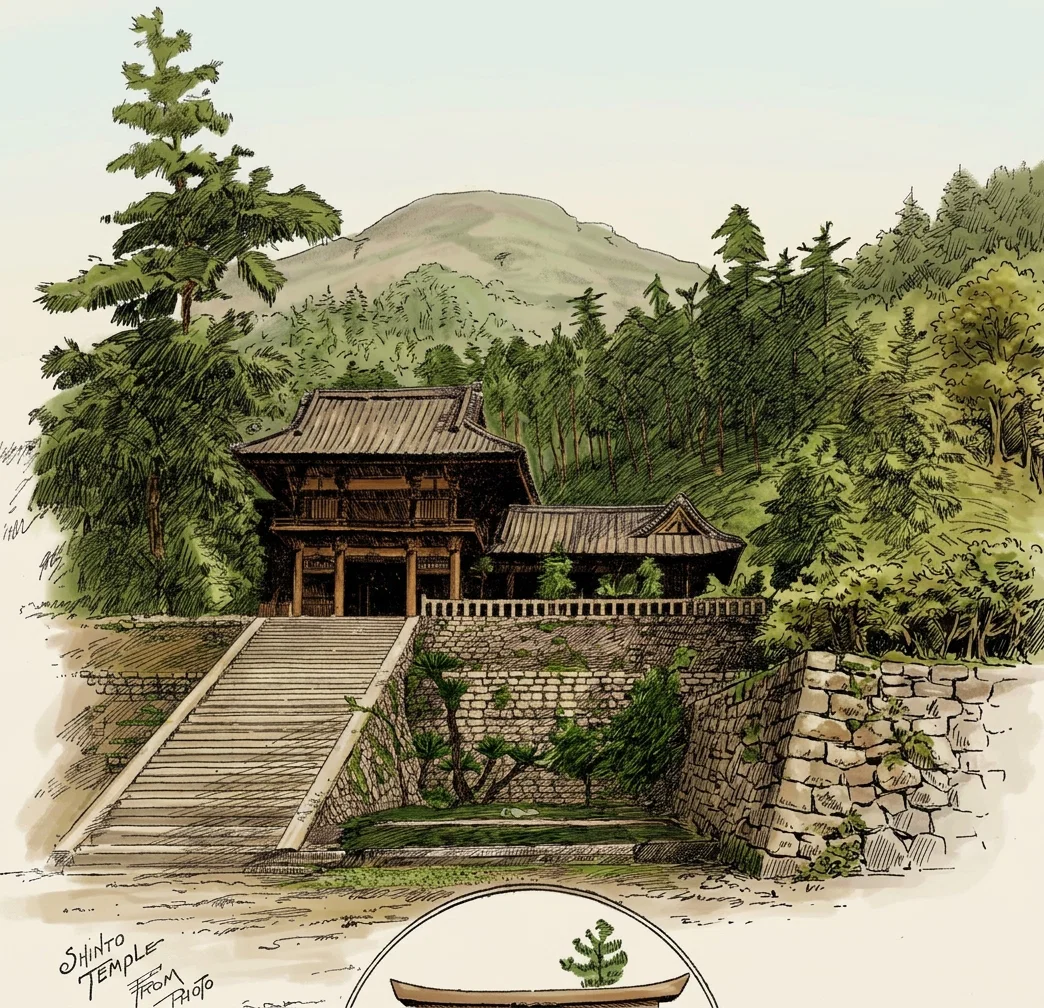
The most important piece of furniture in11a Shinto temple is a large metallic mirror, circular in shape and about two or three feet in diameter. This is a memorial of a great event in Japanese mythology. It seems that about the time the gods were planning to organize the Japanese people into a government, a certain goddess of great power and influence becoming offended, from some cause not well known, hid herself in a cave. As the projected organization could not be carried out without her aid, various means were employed to dislodge her from her hiding-place. At last the idea occurred to some wise man to place a mirror in such a position that she would come upon it unawares. This scheme was crowned with success. On beholding herself in the mirror, the goddess was so well pleased with her personal charms that she immediately became good-natured toward everybody, came from her retreat, and performed her part of the ceremony of establishing the Japanese Empire. The original mirror is supposed to be in a temple further south. The gods are the supposed ancestors of the emperor.
Entrance to SHINTO TEMPLE
The anniversary of the death of a father or mother is observed with special acts of devotion—from the emperor down to the poorest coolie. All of the family who can go, visit the grave, where they pray and make offerings of flowers and food. The emperor’s parents are buried at Kyoto, the former capital of the country. He and his family go twice a year to pray at the graves of his ancestors.
The Shinto priests are pensioners of the government, but their compensation is very small. The temples belong to the government but are in many cases in a very dilapidated condition, which would indicate that this ancient religion has not as strong a hold on the people as it formerly had.
As the people become educated, these myths will be discarded. The Shinto, like every other heathen, believes in the immortality of the soul, as the foregoing would indicate. He also believes in a kami, or great spirit, a chief of all gods, and in many grades of inferior spirits reaching down to man, but his religious devotions are paid to those who have once lived in the flesh.
Buddhism.
Buddhism was introduced from Korea and China in the sixth century of the Christian era, but in a greatly modified form. At first the opposition to it was very strong, but after it was changed so as to harmonize more with the customs and religious views of the people, the opposition ceased and it soon became popular. Its moral precepts are far superior to those of Shintoism. For this reason the more religiously inclined of the people embraced its doctrines. There is a great lack of unity among its adherents—there being no less than eight distinct sects. What their differences are I am not sufficiently informed to state.
While the moral code of the Buddhist is good, his practises are abominable. His priests are notoriously corrupt—so corrupt that the more respectable of Buddhist papers are now crying out against their abominations, and predict the speedy downfall of the whole system should not a radical reformation be begun at once.
As far as I have observed, about the only difference between Buddhism and Shintoism, aside from the moral code of the former, is that, in addition to the superstition of the latter, there has been added a system of worship which is a very gross kind of idolatry. The Buddhists have temples, shrines, and a priesthood of their own. These are to be found everywhere. While there is nothing in the outward appearance of their temples to remind one of Roman Catholicism, the interior arrangement of both and the manner of worship are strikingly similar. The priests go through posturings and genuflexions, and mutter in an unknown tongue before images of the Buddha in a way that is very much like the services of Catholicism. There are many other points of similarity. Each has its holy water, the rosary, incense, and lighted candles, and tapers—all used for the same purposes for which they are used in the Catholic Church.
Again, the organization of Buddhism is almost the exact counterpart of Catholicism. It has the same orders among the priesthood—priests, bishops, archbishops, etc. Whether they acknowledge the authority of the Grand Lama of Thibet or not, I do not know.
It has also establishments of monks and nuns—a more forbidding set of human beings one would not wish to meet.
They may be seen any day going around in their dirt and rags from door to door muttering prayers and begging for pennies or rice. Yes, I almost forgot to mention purgatory. Our Catholic friends do not hold a monopoly of that valuable institution either. Their Buddhist cousins have it and know how to use it as well as they. A man’s ability to get through quickly depends upon the willingness of his friends to pay. It is hard for the poor wretch who dies penniless or who has no friends to help him through.
The query naturally arises, Did the Catholics borrow from the Buddhists, or vice versa; or have they both a common origin? The probabilities are that they are both derived from the same system of ancient paganism.
But the wonder is that they should retain so many features of the parent religion as evidenced by these similarities.
W. C. GRAINGER.
March 14, 1898.
A LESSON FROM THE HEATHEN.
By Brooks
I HAVE read a remarkable story of Aristippus, tho but a heathen, who went of his own accord to Æschines, his enemy, and said, “Shall we never be reconciled till we become a table talk to all the country?”
And when Æschines answered he would most gladly be at peace with him, “Remember, then,” said Aristippus, “that tho I were the elder and better man, yet I sought first unto thee.”
“Thou art, indeed,” said Æschines, “a far better man than I, for I began the quarrel, and thou the reconcilement.”
My prayer shall be that this heathen may not rise in judgment against the flourishing professors of our times.—Brooks.
Principle
By Rabbi David Philipson
PRINCIPLE.—There is one thing that is higher than policy, and that is principle. Better were it for the world if the men of principle ruled in the councils of state and of nations; the men who, having determined upon the right, wish to act now—now; who, having a message, would fulfil it at the earliest possible moment and unburden their souls. Nothing is gained in the end by time-serving, by policy. You can not compromise with the wrong.—Rabbi David Philipson.
THE WORKER’S PRAYER.
By D. L. Hayward
LORD, speak to me, that I may speak
In living echoes of Thy tone;
As Thou hast sought, so let me seek
Thine erring children, lost and lone.
O, lead me, Lord, that I may lead
The wandering and the wavering feet!
O, feed me, Lord, that I may feed
Thy hungering ones with manna sweet!
O, strengthen me, that while I stand
Firm on the rock, and strong in Thee,
I may stretch out a loving hand
To wrestle with the troubled sea!
O, teach me, Lord, that I may teach
The precious things Thou dost impart,
And wing my words, that they may reach
The hidden depths of many a heart!
O, give Thine own sweet rest to me,
That I may speak with soothing power
A word in season as from Thee,
To weary ones in needful hour!
O, fill me with Thy fulness, Lord,
Until my very heart o’erflows
In kindling thought and glowing word
Thy love to tell, Thy praise to show!
O, use me, Lord—use even me,
Just as Thou wilt, and when and where,
Until Thy blessed face I see,
Thy rest, Thy joy, Thy glory share!
D. L. HAYWARD.
Walla Walla, Wash.
JOTTINGS FROM OUR HELPING HAND MISSION.
[BRETHREN B. F. RICHARDS AND G. W. REASER IN CHARGE.]
Program of the Day.
The picture directly above represents the entrance to a Buddhist temple. The structure
Our daily program is as follows: Family worship, for all of the workers in the mission, and for those who are from time to time giving themselves to the Lord; at 10:30 A.M., Bible study for all who desire to attend; at 3:00 P.M., prayer-meeting and song service; at 7:30 P.M., a Gospel service each evening in the year. In the latter meeting we pursue the plan of presenting the Gospel as the power of God unto salvation, and, while we lift up Jesus before the people, appeal to them to accept Him as their personal Saviour. As we see from two to fifteen hands lifted up each night, for divine help, it leads us to thank God that we have a part in the wonderful work of leading men to Christ. At this date (March 29) fully 150 souls have in some way expressed a desire to forsake the ways of Satan, give themselves to the Lord, and in His strength lead a new life. Some of these have had bright experiences, and are very promising cases. We confidently expect to see them, and many others who shall hear of the Saviour and His wonderful love, here in the Mission, among the redeemed before the throne of God.
After the meeting, the men take their bath, and then retire, and the Mission is left to the care of our night-watchman, and the heavenly watchers, until the workers are astir again in the morning.
Testimonies.
In our after meetings we give each convert an opportunity of publicly confessing Christ. The following testimonies were taken by a shorthand reporter on March 28, 1898:—
1. “I praise God for His love to us all. My desire in the future is to follow Him, to be guided by His words, to obey His laws and testimonies, and to walk in that straight and narrow path which my Saviour has provided for me, that I may do just as He wants me to do.”
2. “There is no doubt in my heart but what Jesus does save. I know there was a time when I was saved, and I feel to-night that the Lord has taken me back again. The time was when I gave my whole12life to God’s service. The hours of the day were spent in God’s service, and I would go to bed with thanksgiving on my lips. I would wake up in the morning, and it would be praise to my God. That was the happiest time in my life, and I feel to-night that God has taken me back, and my desire is to serve Him more and more each day, and go on.”
3. “I feel that I have never served God at all; I want to make a start.”
4. “I have tried to live a Christian life in my own strength, but I have made a complete failure of it, and I realize now that I need help, and I want to come to God for help.”
5. “I thank God that I am saved-to-night.”
6. “I can not say anything; I don’t feel like speaking. I am endeavoring to serve God.” (This man had a good experience, but it was difficult for him to speak what was in his heart.)
7. “I feel that His grace is sufficient to keep me in time of trouble.”
8. “My friends, I want to say that I took a start last August to serve the Lord, but I found that I was not close enough to the Lord. Since I have been attending these meetings off and on, I have become convinced that I never understood the Bible, altho I had learned it, I believe, from beginning to end in my boyhood days. And I have had such a longing and such a desire to receive more light, and I believe the Lord wants me to be an instrument in the world to bring others to His throne, and with the help of God I will do it.”
Here are some expressions taken at another meeting:—
“My blessed Saviour has given me strength day by day.”
“I praise the Lord for His keeping and saving power.”
“I know there is power in God to keep me from falling.”
“I praise God to-night He has been kind to me and keeps me and saves me.”
Surely it is good to know that bodies are being helped; but it is better to know that God through the Mission is building characters.