The Youth’s Instructor, Vol. 50, No. 24.

In the Hindu Sacred City

The Youth’s Instructor

Jun 12, 1902

Review and Herald Publishing Company · Battle Creek, Mich. · Jun 12, 1902

In the Hindu Sacred City
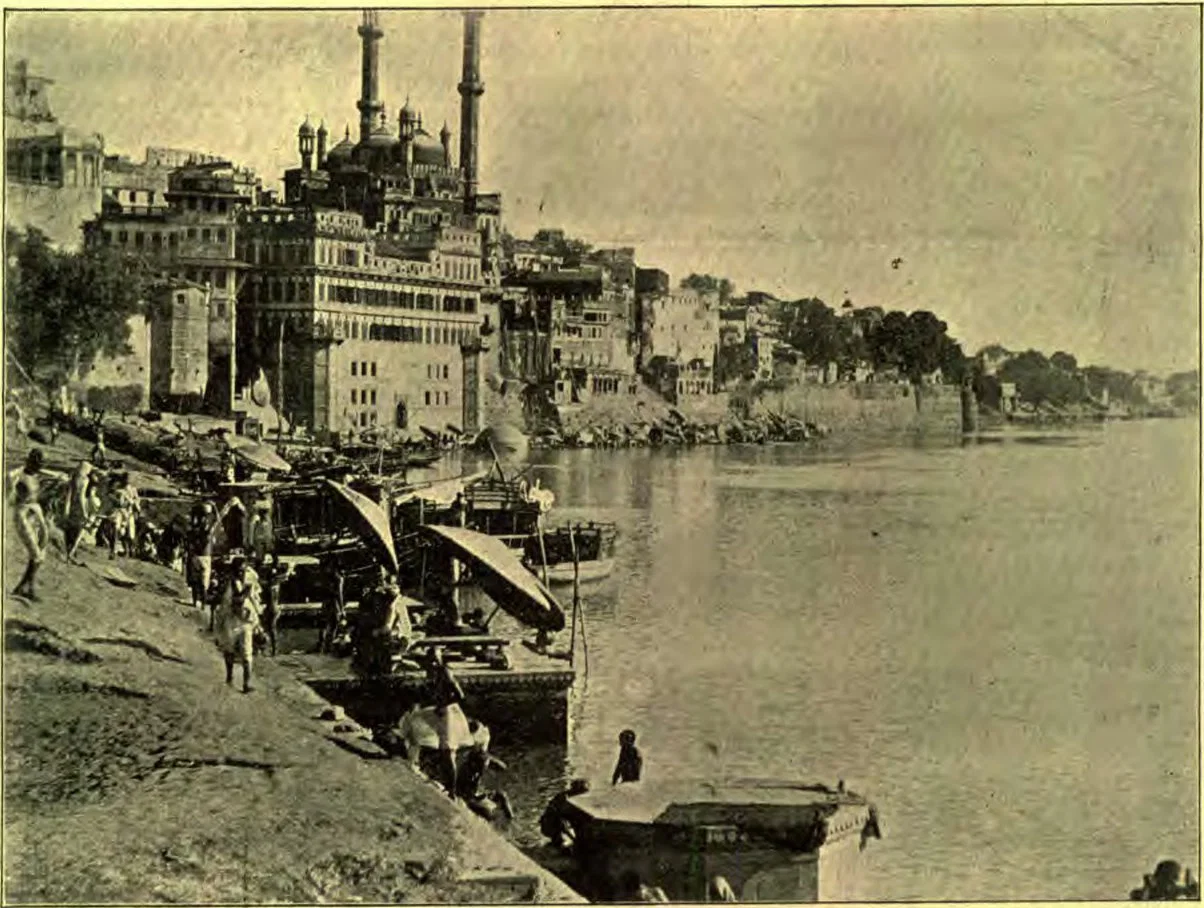
HINDUISM has many so-called sacred places, but Benares is the chief. Before ever Rome was built on the Tiber, Benares, on the Ganges, was the resort of the devout of India. Still to-day the pilgrims throng its streets and temple areas. With its resident and transient population, it is as like a human beehive as any city in the world.
Kasee, the Hindus call it,—“Kasee the Splendid.” My first view of it was from across the river, in the early morning, just as the rising sun was touching temple and tower and minaret with gold. It really is an imposing sight. I could fancy a pilgrim’s heart thrilling with ecstasy of feeling as the view burst upon his eyes,—the city toward which the hearts of his fathers have turned for thirty centuries, a very gateway to the Hindu heaven.
To me, however, it meant a very citadel of superstition and ignorance of God, the fruits of which we meet everywhere in darkened India.
High over the city rise the minarets of the Mosque of Aurungzeb, one of the Mogul conquerors of India. He tore down the chief Hindu temple of Bisheswar in order to plant his mosque above its ruins. But the Mohammedan sword could not pull down the traditions and social fabric of Hinduism; so alongside the mosque new temples sprang up and multiplied, and the idolatry of Bisheswar, “lord of all,” still fills the sacred city.
I walked with the crowd along the highway from the Kasee railway station to the temple district and the river terraces. The fascinating study in Benares, as everywhere else in the East, is the crowd, the people themselves. Many of these pilgrims come to die in Kasee; others have spent their all to make the journey in order to win deliverance from sin. One is struck with the serious and businesslike manner in which the multitudes take up the performances connected with this way of self-salvation. Poor souls! I know from having talked with some, that, in spite of all their wearisome toil, they feel still the burden of sin upon them. Of course they must. Not a soul can come up from the bathing in the Ganges, or return from making the round of the fifteen hundred temples, without being conscious of the fact that God’s law, written by nature in the heart, still speaks in order that every mouth may be stopped, and all the world become guilty before God.
The Brahman priests are everywhere in evidence. Under great umbrellas the gunga-putras—“sons of the Ganges”—earn a living by caring for the effects of the bathers, and by setting the proper mark of their god upon the foreheads of the devotees.
A VIEW IN BENARES
A VIEW IN BENARES
To my mind, the saddest sight in all this sad city is the spectacle of old age waiting for the summons into eternity. Here at almost any morning hour, among the bathers, companies of aged widows may be seen, with shaven heads, washing and worshiping in the Ganges, hoping at last to atone for the sin that is supposed to have brought the curse of widowhood upon them.
Benares is not altogether dependent upon its reputation as a shrine. Rare tapestries and silks are made in its old-time factories. In the brass market, skilled workmen produce chased and decorated brazen articles that are famous the world over. It is rather a center for publishing interests in the Hindi language. We ought erelong to have workers enough in India to allow of making some effort among the hundreds of thousands of Benares.
W. A. SPICER.

The Apostles’ Clock

PERHAPS the object that excites the most present-day interest in Prague is the Apostles’ Clock in the tower of the Council House. Once an hour an expectant throng gathers on the sidewalk opposite the Council House; and, when the moment arrives, a skeleton representing Father Time takes hold of a cord, which he pulls with his grim and bony hand, thus ringing a bell.
Then two little windows of stained glass mysteriously slide open, and life-size figures of the apostles appear. Matthew, John, and all the rest are seen first at the left-hand window. They turn squarely around, and look up and down the street. Then each passes to the second window, turns squarely around once more, looks up and down the street again, and passes on out of sight. The twelve follow in solemn silence, while skeleton Time tolls the bell. Last of all comes Peter, whereupon a cock, which is roosting over the apostles’ windows, flaps his wings, and utters a lugubrious crow. Then the windows close upon the scene, and all is still again for another hour.
For a curious story connected with this old clock that illustrates the barbarism of those bad old times, I am indebted to an old-time resident of Prague, who vouches for its substantial accuracy.
Before Columbus discovered America, this clock was built, and even then was the wonder and pride of the city. The skilled mechanic that set it going was induced to build another just like it for a rival city.
This greatly angered the Pragueites, who wanted a monopoly of apostle clocks of that sort. So what did they do but catch the inventor and builder, and put out both his eyes, so that he could never make another clock.
But this blind Samson asked to be taken once more to his loved clock, that he might feel of its curious machinery, and say a last fond farewell to his handiwork. Such a reasonable request could hardly be denied; so the clock-maker was led up into the tower, and allowed once more to touch the beloved machinery.
When he had firmly grasped it, with one tremendous wrench he tore cogs and wheels and balances apart, and in an instant it was a hopeless wreck. There was no other man in the world who could repair the damage; the blind clock-maker alone knew the secret of the mechanism; and for a hundred years it stood idle and useless, a monument to the folly and jealousy of Prague.
At length, after several generations, a clock-maker was born skillful enough to repair the damage of the blind inventor; and ever since the old clock has been in charge of this man and his descendants, who to-day have a fine jewelry and watch-makers’ shop on a corner opposite the Council House, and they alone know the secret of the mechanism of the Apostles’ Clock.—F. E. Clark, in Christian Endeavor World.

Good Conductors

It was a shoemaker’s shop, with bench, half-worn shoes, and not a few boxes. The proprietor was an old friend of mine, but so deaf that few could converse with him. Visiting the village in which he lived, I made him a call. He was happily surprised. After a chat by means of the lips, signs, and paper, he asked if I would like to hear his boy play the harp. I said that I should. A little later a lad came into the shop with a beautiful instrument. Placing his feet on the pedals, he ran his fingers over the wires, and the most melodious music responded.
Picture the scene,—the old cobbler, with leather apron, bent form, and glowing eye riveted on the musician; the boy, with his very soul making the strings vibrate beneath his touch; while the writer was perched upon the counter enraptured. When the music stopped, I turned to the old man, and asked by signs: “Did you hear it?” He shook his head, and answered: “Not a note.” Then stepping to the stove, he picked up a long black poker, and putting one end between his teeth, and placing the other on the harp, he motioned the boy to play on. How the lad played! His fingers moved as if by magic. The room was flooded with music, and pedestrians stopped in their walk on the street to listen. Every string of my heart was touched, and harp and heart were in sympathy. Suddenly the musician stopped. The old man, his face beaming with delight, looked at me. I propounded the same question: “Did you hear anything?” He laughed. “All that you heard I heard,” he answered.
What was the reason?—The poker was a conductor of sound, and by its use he received a benefit which otherwise he could not have enjoyed. Ah, I thought, few hear the music, see the smile, feel the touch, taste the sweets, of Jesus; but it is because they do not come in touch with him. Prayer, my young friends, is one conductor; God’s word is another; worship at church is another; acts of love in Christ’s name are others. Test them, and you will be well repaid. Try them, and they will put sweetness into your life, and music into your soul. By them the song of mourning will be changed to a halleluiah chorus.
WILLIAM P. PEARCE.

John Earl’s Noon Hour

JOHN EARL was employed in one of the largest cotton mills of Lowell. The work was hard, the hours long, and, worst of all, the pay small, with little or no prospect of increase. His condition was no worse than that of hundreds of others employed in the same mill, but, somehow, it seemed to disturb him more. He believed that he was capable of better things.
One noon, while eating his dinner beside the machine he operated, the thought occurred to him, Why am I wasting the noon hour each day? Each year he spent three hundred days or thereabouts in the mill, and the possibilities of those three hundred noon hours appealed to the young man. Too weary at night to turn his attention to serious study, he had about given up hope of bettering his condition.
Being naturally a good penman, and fond of mathematics, he turned his attention to figures and bookkeeping. He thought that during the ensuing five years, while his companions were idling and telling stories, he could master the subject that interested him.
The following morning, on his way to the mill, Earl purchased an arithmetic, and, when the noon hour came, having eaten his dinner, he made a beginning on the course he had marked out for himself.
Of course the men laughed when they saw him at work with his paper and pencil; that was to be expected, and Earl was not disturbed in the least. In fact, he was so engrossed with his work that he heard but few of their gibes. The only thing that seriously annoyed him was the one-o’clock whistle.
One noon the superintendent of the mill chanced to pass the young man while he was busy with his study. He noted the nature of the book, but said nothing. That afternoon, however, he referred to the incident, asking the foreman who the young man was, and what his ability as an employee.
“Oh, you mean John Earl,” said the foreman. “He’s the best workman in my room, sir, but I’m afraid he isn’t going to stay with us long.”
“Keep your eye on him,” said the superintendent; “that kind of young man is worth holding.”
Five years, the time that Earl had first allotted for the completion of his studies, had passed.
One morning the foreman stopped before Earl’s machine, and informed him that the superintendent wished to see him in the office.
“Haskell has a bone to pick with you, John,” said the foreman, striving to conceal a smile, as he noted Earl’s bewilderment. “Don’t think ill of me, John; I had to report you.”
“Report what?” demanded Earl, flushing.
“You will find out when you reach the office,” said the foreman, beating a hasty retreat among the noisy looms.
“Mr. Earl?” queried the superintendent, turning in his chair as the young man approached his desk a few minutes later. The “mister” perplexed Earl even more than the foreman’s words. Ordinarily the employees, when addressed by the heads of the departments, were spoken to in a most concise form. The “mister” was quite without precedent, but he replied in the affirmative.
“I think it was nearly five years ago that I chanced to see you one noon at work over some problems. I spoke to your foreman about it and told him to keep a sharp eye on you. We have been some time in coming to a decision in the matter, but we have finally decided that you have outlived your usefulness as an operative.”
Poor Earl crimsoned clear to the roots of his hair. He knew that he had attended to his work faithfully, and for a moment the seeming injustice of the superintendent’s remarks fairly stunned him.
The superintendent nervously stroked his beard as he noted Earl’s amazement, and then resumed: “For some time past we have been dissatisfied with the work”—John was deathly pale now, for he had had time to recall the fact that there was rent due and fuel to buy, and, strive as he would, he was unable to keep back the tears—“of our first assistant bookkeeper,” finished the superintendent, smiling for the first time; “to-day we discharged him. Are you ready, Mr. Earl, to take his place?”—Well Spring.

Sabbath Observance

I WELL remember the time when, before I had much light on present truth, I began to rest on the seventh instead of the first day of the week. To me the term “Sabbath-keeping” then meant little more than ceasing work on Saturday. The hours that were not occupied in attending and going to and from meetings were long and wearisome; and when sunset marked the close of the day, a feeling of relief came over me. I was not a Sabbath-keeper; I simply kept Saturday.
I fear that many of our young people regard the Sabbath in the same way that I did at that time. I have been in homes where children were impatient for the sunset hour to come in order that they might go out to play. The spirit of true Sabbath-keeping is lacking in such homes.
“If thou turn away thy foot from the Sabbath,” says God, “from doing thy pleasure on my holy day; and call the Sabbath a delight, the holy of the Lord, honorable, and shalt honor him, not doing thine own ways, nor finding thine own pleasure, nor speaking thine own words; then shalt thou delight thyself in the Lord.” The Lord wants us to find great delight in keeping the Sabbath. The “holy of the Lord” should be the most joyful day of the week. When, in the ordinary sense, there is to be a joyful day, special preparations are made for it. We need to plan, before the Sabbath comes, how we shall spend it, so that it may prove delightful to us and acceptable to the Lord.
It will be necessary to rise early, in order to avoid hurry and confusion in preparing breakfast and getting ready for Sabbath-school. Whatever work needs to be done should be done as noiselessly as possible. Do not wait, however, until the Sabbath comes to “study to be quiet.” Preparing for and attending Sabbath-school and meeting usually occupies the first half of the day. The remaining hours should be devoted to sacred purposes.
The Sabbath was given that we might remember the Creator,—that our minds might be directed to the true and living God. Since God is seen in the things he has made, it is especially appropriate to study him in nature on this day. During the pleasantest hours of the day take a walk into the field or forest. A previous study of such chapters as the 104th Psalm or Job 36, 37, 38, and 39, will open your eyes to many things in which God’s hand is at work. His love is seen in trees, flowers, hills, and clouds. If you are kept in the house, study his word.
Let the members of the family gather to praise the Lord in singing. Devotion in this is as pleasing to the Lord as prayer.
Suitable reading, which may have been selected during the week, and laid aside for Sabbath afternoon, may be enjoyed by the older members of the family as well as by the younger. It is a good plan to study the Sabbath-school lesson for the following Sabbath. Let the children take turns in preparing short Bible readings during the week to be studied by all on Sabbath afternoon.
While all visiting should be avoided on the Sabbath, it is well to consider the Saviour’s example in remembering the sick and suffering on that day, and that he said, “It is lawful to do good on the Sabbath day.”
At the setting of the sun, when the sacred hours are closing, let all join in hymns of praise and words of prayer, thanking the Giver of every good and perfect gift for the blessings of the day, and asking his presence and guidance during the week to come. CLARA SCHUNK.

ELIZABETH ROSSER

By Love Concealed

If all the trials of the year, The year that is begun, Should to thine eyes at once appear, Couldst say, “Thy will be done”?
If all the sorrows of thy days, The days thou still must live, Should cast their shadows o’er thy ways, Couldst thou the sight survive?
If all the pain by love concealed, The heartbreak and the loss, Were to thy gaze at once revealed, Wouldst thou accept the cross?
O soul impatient! love divine The future still doth hide; Then on thy Father’s breast recline, And in his love abide.

ELIZABETH ROSSER

Sweetness the Secret of Love

It was a beautiful spring day. As I walked down the narrow trail leading through a dark wood of brush and bramble to the banana plantation, I came to a place where the air seemed fairly drenched with fragrance. Stopping to enjoy for a moment the sweetness which was brought by every breath, there occurred the thought that a flower emitting such perfume must certainly be one of great beauty; and immediately I longed to possess it.
Casting my eyes from bush to bush, I soon discovered, almost hidden by the dark foliage of the luxuriant tangle, some little cone-shaped flowers very unlike those my imagination had pictured. But because of their fragrance I gladly gathered a handful to take home.
What a lesson this little flower teaches us—that sweetness rather than beauty wins the heart. Every one desires to be loved. But what shall I do to make people love me? you ask. Let the flower answer, Be sweet. Fragrance in the character as well as in the blossom quickly finds its way to the heart. CHAPMAN McCoy.

Facing the Orient

The age of Shanghai is perhaps more uncertain than the number of its population. Mention is made of it as early as 249 B. C.; and two thousand years ago it was the seat of an extensive cotton manufacturing industry. The walls surrounding the native city are three and one-half miles in circuit, with seven gates, and were built at the time of the Japanese invasion in the latter part of the sixteenth century. The city as it now stands is composed of two distinct parts,—the Settlement, or Concession, and the “Native City.”

The Two Cities

The Concession is the foreign city, and consists of various strips of territory adjoining the original city, ceded to the different nations by treaty; or of tracts bought of, or rented from, the central government for commercial and military purposes. These have been built up either by foreign enterprise or by native capital seeking safe investment under foreign patronage. Beautiful and substantial buildings, both public and private, have been erected. The English cathedral, begun in 1866 and completed in 1891, is said to be one of the finest specimens of modern ecclesiastical architecture outside of Europe. The principal roads leading from the Settlement are planted with trees on each side, forming fine avenues. Beautiful suburban residences line these roads.
The Chinese have no right of residence within the Concession, but during the Taiping siege of their own city, in 1860, five hundred thousand natives took refuge in the Settlements. Their residence there proving a benefit to themselves as well as to their foreign landlords and employers, they have been allowed to remain, some as “hewers of wood and drawers of water,” and not a few engaging profitably in trade. Coming from the sea, we approached the city from the side of the Concessions, and on landing were much pleased with the broad, clean streets, and generally thrifty and wholesome appearance of the city; but later, after a visit to the native city, we concluded that it was not unlike a “whited sepulcher.” The Concession has its own municipal government.
The native city includes that part within the walls, and is entirely under Chinese jurisdiction. No description can adequately convey to a European mind a picture so unlike anything in Western civilization. Heavy iron gates bar the way to objectionable visitors. There is an inner gate besides an outer gate at each entrance. These are closed at night, and closely guarded during the day. The streets are narrow, six feet being a common width; a few are wider, while others are still narrower. In the quarter which we visited, they were paved, the stones worn round and smooth with much travel. A light rain had fallen, and this made the pavement so slippery that it was almost impossible to keep our footing in the surging crowd that always fills the street. Occasionally a sedan-chair, borne on the shoulders of coolies, would be announced, and every one must draw in his elbows and keep close to his neighbor to allow it to pass. The coolies keep up an almost constant yell to clear the track. Furrows are laid in the pavement at each side of the street for general sewerage purposes.

The Home Life

The one-story buildings are packed closely together, wall touching wall; and open full front upon the pavement. The same space is used for business and domestic purposes. In other words, the people live in their shops, domestic life always giving the precedence to business. A small space in the rear suffices for cooking purposes; the wife sits anywhere to mend or make the plain garments; and the children play about the feet of the workman. Very small boys may be seen handling mechanic’s tools, or otherwise assisting in the labor of the shop.
At mealtime the center of the shop is cleared, the small round table spread with the day’s rations of rice and fish or vegetables, and the workmen eat. Afterward the women and children come in for a portion. At night a piece of matting with a blanket spread anywhere on the floor will make a native a comfortable bed. Kneading bread, roasting fowls, disciplining the children, washing clothes,—anything that is to be done,—may be done on the street. The married sons bring their wives home to live; and anything like privacy in domestic life among the common people is impossible.
Many heart-rending evidences of poverty and disease are to be seen; but on the whole the plain, substantial clothes of the common people are well made and clean; and they are cleanly in personal habits beyond what could possibly be expected. Judging from the evident luxury one witnesses in the elegant sedan-chairs borne by liveried coolies, there must be another side to life even within the walled city; but I may say that what actually goes on within these fortifications is a conundrum only half guessed by the neighbors who live nearest.

The House-Boat

Here in Shanghai one gets views of that unique feature of Chinese civilization, the houseboat. The creek between the French Concession and the wall was almost dry from prolonged drought, but its miserable, stagnant channel was lined with boats occupied as homes. An ordinary Chinese wooden boat, with a tent-like roof of matting or any other available material over the stern, furnishes a home for the whole family, including cats, poultry, and pigs. I saw one with a hen’s nest well filled with eggs on the roof.
There are no street-cars and no drays in Shanghai. Passengers and freight are drawn in jinrikishas, pushed about in two-wheeled carts or wheelbarrows, or carried by means of a bamboo pole slung over the shoulders of coolies. Man is his own beast of burden.
About five thousand jinrikishas and as many wheelbarrows operate for hire in the Concessions. These are licensed by the municipality, and each is numbered. Horses are kept for pleasure only. It is not uncommon to see a native sitting on one side of a wheelbarrow, with an immense pile of vegetables or freight on the other side, the whole trundled along by a single coolie. The burdens these men sometimes bear would be regarded as cruelty to a horse in America. We were entertained at the Seventh-day Baptist Mission, three miles from the boat landing, but the jinrikisha coolies made the distance in about twenty minutes for a price equal to five cents in United States gold for each vehicle accommodating one passenger.
Mrs. J. N. Anderson.

“I’ll Stand the Pain”

In the awful Park Avenue Tunnel collision in New York City last January, Peter Murphy, twenty-eight years of age, received injuries which resulted in the loss of his right leg, and the paralysis of his left arm and side. The New York Sun relates his part in the horrors of that cruel accident.
When the trains crashed together, Murphy’s head and shoulders were pushed through a window, and his feet and legs were caught beneath the engine which had telescoped the car. He worked one leg free, and was about to pull the other loose when the roof of the car fell on both legs.
As he hung there in fearful agony, Battalion Chief Farrell of the fire department came along. Murphy asked him to lift the timbers off his legs so that he could free himself.
“If I do that,” said Farrell, “the roof will fall on those inside. There are women there.”
“I didn’t think of that,” said Murphy. “Let it stay. I’ll stand the pain.”
Imprisoned close to the wreck of the hot locomotive, and crushed under the deadly weight of splintered wood and twisted iron, this young Irishman waited in agony half an hour, never losing consciousness, although most sufferers would have fainted from the pain, till his fellow victims were dragged from the ruins.
Every one of those terrible thirty minutes endured for their sake was like an hour of agony; but his extended torture shortened the pain of the other sufferers, and helped them to escape with a better chance of life. It was for that he waited, with the certainty of mutilation and the nearing probability of death.
It is natural to shrink from pain; it is noble to bear it in necessity; it is godlike to endure it for others. Religion has its spiritual vision and its devotional beauty; but its heavenly service is best seen wherever men do and dare and die to help their fellow men. Nothing is more characteristic of Christian law and discipline than this magnanimity of human nature. It is the heroic virtue of Him who gave Christianity its name.—Selected.

A Good Plan

Yes, it is a good plan to deny self for the advancement of the cause of God. Self-denial is the first thing the Christian must learn. Jesus said, “If any man will come after me, let him deny himself, and take up his cross daily, and follow me.” I am glad to note that a self-denying spirit is coming into the young people’s work. Many are not only taking time that they have been accustomed to use in serving self, to do work for others; but they are also saving, for missionary purposes, money that formerly they spent upon themselves.
Our young people do not have a great deal of money. What they have is largely the result of their own earnings. In many cases the amount earned is not much more than sufficient for actual needs. Notwithstanding this, there is a disposition to bind about personal wants, that something may be given for the advancement of the message that is to go to all the world in this generation.
A number of Iowa young people are saving one dollar a month for the work in mission fields. Just now they are contributing it to the one-thousand-dollar fund which is to go to France. Slowly, but steadily and surely, that money is coming in; and by and by the entire sum will have been raised, and no one will really suffer because of what he has given.
One of the largest of our young people’s organizations is planning to send out one of their number as a missionary to Egypt. Doubtless they will not only be able to send him, but to contribute largely to his support in the field.
Another cheering move is that which has been made by the young people in Oakland and San Francisco. They have established a Self-Denial Fund. This fund is made up of the money that these young people have been spending for candy, chewing-gum, ice cream, and other things more or less harmful. The money is to help in the establishment of a dispensary for the treatment of the sick and poor in San Francisco. The young people throughout California are invited to join in this grand work. Those who try this plan will be surprised, at the end of a few months, to see how much they have been able to give. Several years ago I greatly desired a certain sum of money for a special purpose, and began to save all the dimes that came into my hands, and placed them in a box, for the purpose in mind. I never was more surprised than when I discovered that I had more than the amount required. It seemed so easily saved, and in so short a time. I am sure that many may have the same experience. I wish that the saving of the money that is uselessly spent, and the devoting of it to missionary purposes, might become a prominent part of the work of each Young People’s Society. May it be so!
MRS. L. FLORA PLUMMER.

In Service for Christ

THERE can be no self-seeking in the life of him who follows the Saviour. The true Christian banishes all selfishness from his heart. How can he live for self as he thinks of Christ hanging on the cross, giving his life for the life of the world?
In your behalf Jesus died a death of shame. Are you willing to consecrate yourself to his service? to hold yourself ready to be or to do anything he may require? Are you willing to put self aside, and speak a word of warning to the companion you see yielding to Satan’s temptations? Are you willing to sacrifice some of your plans for the sake of trying to lead him in safe paths?
Many youth are in peril who might be saved if Christians would manifest toward them a loving, unselfish interest. By faithful effort they might be led to Jesus. But how many professing Christians there are who are so absorbed in self that they make no effort to help those in need of their help. Terrible will be their remorse in the day of judgment, when their mistake will be plainly revealed. The Spirit of God was striving with the straying ones, striving to lead them home. But those who should have co-operated with God were occupied with their own plans, too busy to see the opportunity that he offered them to work with him. Thus the connection between heaven and earth was broken. Those upon whom God called for help did not respond.
Remember that when you accepted Christ as your Saviour, you entered into a solemn covenant to employ your powers in his service. Into this work you are to put earnest, whole-hearted effort. Christ will not accept divided service. It is expected of a steward that he be found faithful. You are to make all temporal matters subordinate to the work the Lord has placed in your hands. He will call for a strict account of the use you have made of his gifts. The true Christian works unselfishly and untiringly for the Master. He does not seek ease or self-gratification, but holds all, even life itself, subject to God’s call. And to him are spoken the words, “He that loseth his life for my sake shall find it.”
To the indolent, those who are doing nothing for God, comes the inquiry: Why stand ye here all the day idle? Is there nothing to be done in my vineyard? Are there no souls for you to help? Have you forgotten that the judgment is coming? Work while it is called to-day; the night cometh, in which no man can work.
You are God’s light-bearer. He has placed in your hands a lamp that you are to keep trimmed and burning for him.
By all that has given us advantage over another,— be it education and refinement, nobility of character, Christian training, religious experience ,—we are in debt to those less favored; and, so far as lies in our power, we are to minister unto them. If we are strong, we are to stay up the hands of the weak. Angels of glory, that do always behold the face of the Father in heaven, make such their special charge. Angels are ever present where they are most needed, with those who have the hardest battle with self to fight, and whose surroundings are the most disagreeable. And in this ministry, Christ’s true followers will co-operate.
MRS. E. G. WHITE.

Battles between Truth and Falsehood

Lesson X — The Heart of God's Law

(June 15-21)
How to Study These Lessons.— (1) Read the lesson story; (2) try to recall or find scriptures in proof of each statement; (3) study the texts; (4) see how many missing links you can supply; (5) give the lesson to some one else. You will keep only what you give away.
It is by no chance arrangement nor arbitrary ruling that the Sabbath command is made the “seal” of God's law. It is indeed the heart of the law; and as such it is placed in the bosom of God's perfect law. Without it the rest of the law is a dead letter. From it flow the life and power of the whole law. God would have no right to govern us simply because he is older, wiser, or more powerful than others. His only right to say what we shall or shall not do lies in the fact that he is our Creator. He made us; he keeps us alive; we belong to him. So he rules by right; and the Sabbath as a memorial of creation is a “sign” of his rightful rule.

Outline

  1. Wicked priests violated God's law. Eze. 22:26.
  2. People were not taught to see God in the Sabbath; so he was profaned. Id.
  3. The heart, or “seal,” was torn from the law—a breach was made in it.
  4. Those who honor God in his Sabbath will repair this breach. Isa. 58:12, 13.
  5. The “seal” of the law will be restored in the hearts of God's people. Isa. 8:16.
  6. The Sabbath is God's “sign” of rightful rule. Eze. 20:12, 20.
  7. The Sabbath is the memorial of God's character. Read the ninety-seventh Psalm, especially the margin of verse 12.

Young People's Society Organized in Lehigh, Kansas

From Lehigh, Kansas

For a long time I have had a deep desire to help our young people, and have wondered what I could do to awaken in them a new interest in missionary work. At last I learned of the Young People's Societies that are being formed, and calling some of the young people together, we organized ourselves into a company of twenty-eight. Others were added at a later meeting. We are much interested in the reports in the INSTRUCTOR, also in the studies given therein, and hope to order a club of the paper soon. We are of good courage, and mean to go forward in the Master's service. NETTIE GAEDE.

How to Win a Person's Confidence

WHILE the art of winning people's favor and confidence is, in many instances, a natural gift, like most of the good things in life, it may be acquired by those who earnestly seek it.
The first step to be taken is to cultivate, if you do not already possess it, a uniformly cheerful disposition. A bright, smiling face will do more to incline a man's heart toward you, and to gain his ear, than all the virtues in the calendar, handicapped by a gloomy visage.
Be generous with your sympathy, and try to be at least as much interested in the joys and sorrows of others as you would wish them to be in yours.—Success.

Do You Know Her?

I HAVE a little friend who doesn't like to mend, To dust, or set the table, or even make a bed; The very thought of sweeping nearly sets her off a-weeping, And she always goes about it as if her feet were lead.
She “hates” to rock the baby, and says that some day, maybe, She'll go away and linger where they've no babies 'round To keep folks busy rocking—but really this is shocking, And she doesn't mean a word of what she says, I will be bound.
'Tis true she can not bear to even walk a square To buy a spool of cotton, or stamps for mama's mail, And it's much against her wishes that she's set to washing dishes, While to speak of darning stockings is enough to make her pale.
In fact, she wants to shirk everything resembling work, And the only thing she does enjoy, so far as I can say, Is to take her doll and book, and within some quiet nook To read of elves and fairies, and dream the hours away. — Selected.

Garbage-Box Brain Food

WHAT child is there who does not enjoy good food? It is always pleasant to gather about the table with friends. We must have food; and if we can not get the best, we have to partake of an inferior quality. I have known poor children in large cities who had to live on what they could pick out of garbage-boxes. It is sad indeed to think that anybody should have to live like that. But what would you think of a girl or a boy who, being provided with good food, carefully selected and well cooked, would turn away from it, and eat from a garbage-box, all reeking with filth and vermin? Such a course would be so unreasonable that it could result only in evil, perhaps in disease and death.
Now listen; I know of some young people who receive the INSTRUCTOR who do things almost like that, and I will tell you about it. You see the mind is a part of the body, and must be fed in order to grow and become strong and useful. It is a pleasure to feed the mind; nothing is more delightful than to study and read. Good books and papers are like the good food that we feed to our bodies, and bad ones are like the garbage-box, filled with vileness and disease. When we turn from instructive books and papers, and read trashy novels and untrue stories; our mental taste becomes poisoned and unnatural, so that we prefer the base and untrue to the true and beautiful. Our minds then become sick and dwarfed, and almost die from the effect of such poor food. In later years we can not make useful men and women in the world, because our minds are so impoverished that they can not serve us. Let us choose the very best food for our minds as well as for our bodies; then they will always be strong. LILLIAN S. CONNERLY.
Continue reading: The Treasures of a Mountain Rat