The Youth’s Instructor, Vol. L, No. 24

In the Hindu Sacred City
Earlier text: In the Hindu Sacred City

The Treasures of a Mountain Rat

THE mountain rat is an odd genius. He is considerably larger than the common rat, is gray in color, and lives in caves and holes in the rocks. He never cuts holes into houses, nor gnaws things, like our common rat; but if there is any opportunity,—and there always is in the log cabins in the mountains,—he gets into the house. He does not stay, but only enters to explore. He has a great weakness for making collections. It makes little difference of what they are composed, but his preference is for articles taken from a house, or that man has handled. Every rat has his own house. If he lives in a cave, he will have his treasure-house in some loft or deserted shack. If these are not available, he chooses a hollow log or another cave, and to it carries chips from the wood-pile, shoes from the house, hats, stockings, handkerchiefs, or any article of apparel that he can lug off, no matter what.
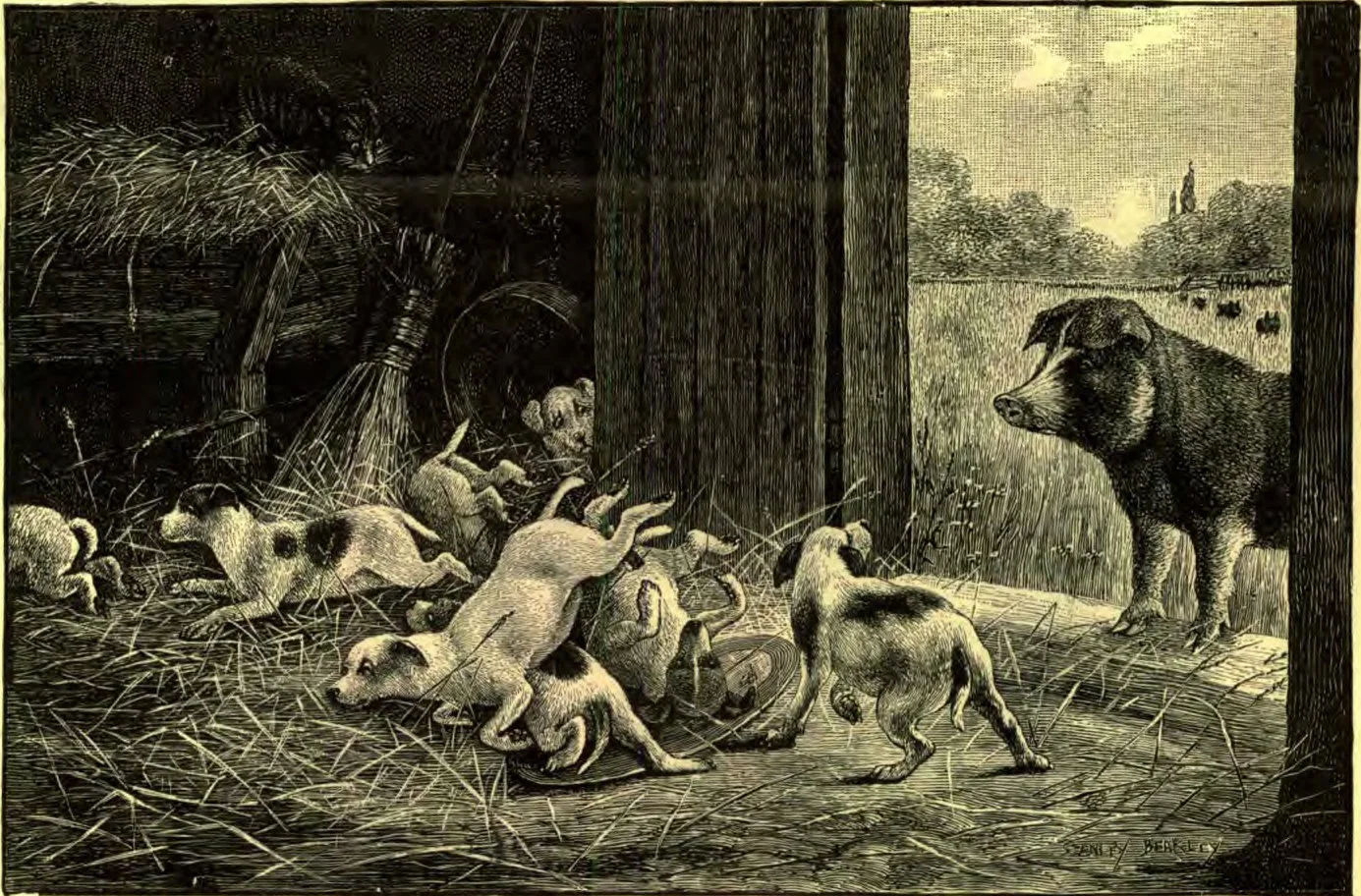
AN UNWELCOME GUEST
AN UNWELCOME GUEST
Among their favorite treasures are pieces of broken glass, broken dishes, knives, forks, spoons, cups,—anything that they can have no possible use for. These are carefully piled up into a neat pyramid, carried to a sharp point at the top. When one pile grows so large that it is inconvenient to place things upon it, he starts another. I have known these pyramids to contain chips, coffee, spices, shoes, strings of ginseng and dried pumpkin, saucers, spoons, knives, tea, paper, etc. I have two combs in the curiosity-shop of one of these rats, and I am sure that he has never combed his hair with them once.
Perhaps you wonder if the mountain rat does not use these piles of trinkets for a house. No, he simply hoards them, for the same reason that a miser hoards money, or a boy collects postage stamps. Crows and bluejays do the same thing, only their cache is harder to find, and is never so large. If this creature stores food anywhere, it is not with his collection. He does not even take his treasures down, and look them over occasionally. I have known them to be stored in a loft just over a sleeping-room, and yet the rat work so quietly that no one knew that they were there. A lady of my acquaintance lost her spoons one at a time until they were nearly all gone. Afterward she found them among the trinkets of a mountain rat in her own garret.
Mountain rats do not increase rapidly, and therefore are not very numerous.
FLOYD BRALLIAR.

The Birthday Present

It was to be a surprise. “One,” said Bessie, “that mama mustn’t even suspect. We mustn’t drop a hint—not the leastest bit of a one; mama’d guess it in no time if we did.” “What must we give—something nice—nicer’n anything she got last year,” said Harold. “Let’s—see,” pondered Bessie, slowly, her “thinking cap” making itself evident in the tiny “considering puckers” on her forehead. “Her birthday’s on Wednesday, and it’s Monday now—we’ve no time to lose.”
“Let’s get what she’d rather have than anything else—let’s!”
It was the first time Carl had spoken.
“That’s what we’re going to,” replied Harold; “why we’re thinking so long,” and it did seem long, for Harold was expecting any moment to hear Willy Ferguson’s “call whistle” at the gate, which meant one little Holman less to discuss the question of the birthday gift.
“She had a watch last year—from Switzerland,” said Carl, ruefully, for hadn’t he seen the stock of fine ones at Freeman’s—“better’n they make in Switzerland”?
“And a chafing-dish,” added Bessie, counting on her fingers, “and a chair, and a desk, and a ——”
“We can’t get any of those.” It was Harold’s turn to think. “Besides, they’d cost ——”
“We’d never thought of that,” exclaimed Bessie, in dismay, “about the money! I don’t believe we can get—I haven’t a cent!”
“Nor I!”
Ray “fished” into the pockets of his trousers—his first ones—and drew from their depths only a jack-knife handle.
“Then we can’t ——”
“But we must, Harold!” said Bessie, with all the emphasis she could command. “We must! Mama’d feel so disappointed with nothing—now we’ve planned so much!”
“And we wanted it better’n anything she’d ever had,” and Ray looked to Carl.
“And it can be—if you agree!” Carl went to the lower drawer of the bookcase, and took out his box of “Tom Thumb” stationery. “I just thought of it!”
Bessie looked up inquiringly.
“It’s something we each can give—what she’s wanted and wanted, ever so long! And what she’s asked for, too,” mysteriously.
“I—don’t—see,” said Harold, thoroughly puzzled. “We haven’t any money!”
“Don’t need any. Wait! I’ll get mine ready, and then you’ll see.”
Carl went to the table, and wrote on a page of his delicate paper:— “For Mama’s Birthday Present. I’ll give up my whistle in the house forever and ever and ever. CARL.”
They all crowded to look over Carl’s shoulder.
“Splendid!” exclaimed Bessie. “I know what I’ll give!”
“And I!” cried Harold.
Ray didn’t quite understand. Bessie whispered something to him, and all that the rest could hear was “cap.”
What excellent gifts they were!
“I promise not to read a word after it gets dusk—before the gas is lighted. BESSIE.”
“I’ll hang up all my things in their proper place when I come from play or errands—I really and truly will. HAROLD.”
“Ray will not forget to take off his cap in the sitting-room.”
Mrs. Holman smiled her sweetest mother smile when she received her gifts, two days later.
“They are the choicest presents I have ever received,” she said, happily; “for they are something we all can keep!”—Companion.

Getting the Worst

A BOY came to the door of a lady’s house, and asked if she did not wish some berries.
“Yes,” said the lady, “I will take them.” So she took the basket, and stepped into the house, the boy remaining outside, whistling to some canary birds hanging in their cages on the porch.
“Why don’t you come in, and see that I measure your berries right?” said the lady; “how do you know but I may cheat you?”
“I am not afraid,” said the boy, “for you would get the worst of it.”
“Get the worst of it?” said the lady; “what do you mean by that?”
“Why, ma’am,” said the boy, “I should only lose my berries, and you would make yourself a thief. Don’t you think that would be getting the worst of it?”
The boy was right. He who steals, or does anything wrong or mean just to gain a few pence or a few shillings, burdens himself with a sin which is worse than all the gain. The one who does a wrong to another always gets the worst of it.—Selected.

Cheap Language

To be able to speak well, to express one's thoughts in simple but pure language, is a great blessing, and marks one as a gentleman or a lady.
It might be thought, however, judging from the practice of many young persons, that to be jocular, or even coarse, is an evidence of real development. But rather than conclude that those who show such lack regard their way as right, the writer believes that as a rule they have simply fallen into a habit of being cheap in their manner of speaking.
It is easy to be cheap. To use the slang expressions common to the loafer and street Arab requires no effort. No midnight oil need be burned, no painstaking application made. All one needs to do is to open his ears, loose his tongue, and let himself go. Moreover, he who does so always finds plenty of company, and hosts of admirers.
But cheapness is no standard; it is simply a slime-pit, into which any standard may be dropped. To be cheap is to make of life a mere round of existence, purposeless, useless. Even the world regards cheapness as something to be despised and abhorred; for, sooner or later, sensible people always turn away from that which is worthless.
But how should cheap, boorish language appear to the Christian? With the prospect of entering into the presence of the King of kings; of associating with the pure, unfallen beings of heaven and other worlds; of conversing with Christ Jesus, the great Author of perfect language and address, the Christian views anything short of highest excellence as unworthy of his calling. Believing, as he does, that all knowledge and perfection gained here will be carried with him into the next world, and that “for all knowledge that we might have gained, but did not, there will be an eternal loss, even if we do not lose our souls,” he seeks to cultivate the ability to express in perfect language the thoughts given him of God. Standing face to face with the thought that God is dishonored by foolish jesting, impure speech, and the slang heard almost everywhere, he denies these things any place in his life, with all his might adopting the refining, elevating word and thought of the divine.
“Well,” says one, “I believe all that, and would like to be able to use good language; but I have had no opportunity to learn, and even now am not able to attend school.” Dear young friend, you do not absolutely need book-learning—that which is taught in school—in order to acquire a good vocabulary, and wholesome, beautiful expression. In fact, the best form of speech is not gained in the schoolroom. Rather, it is absorbed, taken in, gathered from here, there, everywhere,—this speaker, that writer, and from articles which now and then come to the attention. He who is willing and anxious to excel, to become an easy, smooth, and really correct speaker, needs to keep his eyes and ears open; and all along the way he will gain the very highest of educational advantages. He will find teachers all around him. The sermon will contain a word, the lecture a phrase, the article a sentence, which contrasts with his own imperfect form, and he stands corrected, improved.
In view of such resources, let no one say that he can not improve. Stir up your mind. Set your face like a flint. Be determined to be the very best. Begin now to weed out of your language all that is coarse and cheap. Abhor slang and senseless bywords. But withal, be a Christian. Be simple and natural. Strive to please God, and not to please and fascinate men. “Be swift to hear, slow to speak.” “God is in heaven, and thou upon earth: therefore let thy words be few,” and choice, even “like apples of gold in pictures of silver.” And forget not to pray, daily: “Let the words of my mouth . . . be acceptable in thy sight, O Lord, my strength, and my Redeemer.” C. L. TAYLOR.

The Life of an Apple Woman

In his “Investment of Influence” Dr. Hillis tells the story of a London apple woman.
Her life lay among the poorest of the poor. Her only means of living was the peddling of fruit from a basket. She was a daughter of the gutter, the offspring of the London tenement, than which there is no more sunless nor degrading birthplace in the world. Cold, and the poverty that means frequent hunger and sometimes eventual despair, were the conditions of her life. But an English author searched out her career, and as Dr. Hillis remarks, “Her story makes the story of kings and queens contemptible.”
For forty-two years this poor woman had dedicated herself to the rearing of those waifs of the street who have no knowledge of father or mother, and who are blown hither and thither, perhaps to lifelong imprisonment, perhaps to suicide, certainly to starvation and crime.
In her back room, in the cellar of one of the most lawless tenements, she had an ash-box, which was continually in use either as a cradle or a bed. There a chance visitor might at any time have found one, two, or three wee orphans, whose lot was even harder than her own.
During these long years this woman reared some twenty orphans with as much solicitude as if she had been their mother. She gave them home and bed and food and education. She felt that there was another and purer world beyond the fighting and the filth, the hunger and the crime, to which she had been accustomed, and from which she could never hope to escape; and with this feeling she taught them to look for better things, both here and hereafter. She enabled them to attend school, saw that they acquired some knowledge of useful trades, and finally, when, one after another, they grew to a more self-dependent age, she helped them off to Canada, and to the United States, and to Australia, that they might begin life for themselves.
The life-history of this poor London apple woman is an exotic blossom of the slums. With her misshapen face but exquisite smile, with her disfigured body but beautiful soul, she seemed, as she lay on her deathbed, like one over whom God’s loveliest angels bent.
She has fallen asleep, but her example of devotion remains a living essence of good in the midst of evil. It ennobles poverty. It dignifies opportunity. It illustrates Christ.—Youth’s Companion.

Abide with Us

ABIDE with us in days of youth: O, help us love Thy word of truth! 'Twill give us might and strength and power, And guard us safely hour by hour. We'll keep thy holy standard high, To thee in trouble quickly fly; Then, Lord, abide with us, we pray, And help us choose the narrow way.
Abide with us as years roll on, And help us meet, with cheerful song, The varied changes time will bring, Of good or ill, upon his wing. He swiftly flies; and naught can stay The hands that bear the books away, Wherein are kept, on pages fair, The record of the deeds done here.
Abide with us, both young and old. May we obtain the precious gold Which binds the parent and the child In sweetest union, gentle, mild. Abide with us in that dread day When sin and death shall pass away, And may we with the faithful meet, And sing together at thy feet.
PAULINA M. A. ANDERSON.

THE INTERMEDIATE LESSON

XII—The Promise of a Saviour

(June 21)
“And the Lord God said unto the serpent, . . . I will put enmity between thee and the woman, and between thy seed and her seed; it shall bruise thy head, and thou shalt bruise his heel.” Gen. 3:14, 15.
“The Word was made flesh, and dwelt among us.” John 1:14.
“As many as received him, to them gave he power to become the sons of God, even to them that believe on his name.” John 1:12.
“Forasmuch then as the children are partakers of flesh and blood, he also himself likewise took part of the same; that through death he might destroy him that had the power of death, that is, the devil.” Heb. 2:14.
(The Scripture texts are the lesson to be studied. Go over these carefully every day, until you know just what each one teaches. Then the following notes will help to a fuller understanding of the lesson. Read them carefully several times. Lastly go over all the questions, and be sure you can answer each one in the words of Scripture.)
The first promise of a Saviour that was given to man, was in the words of God to the serpent that had deceived them, and so got them into his power. It was the promise that the seed of the woman should give the serpent a crushing blow, which would destroy him, though in doing this he would himself be wounded.
This promised Seed is Jesus; for it is he who “was wounded for our transgressions,” and “bruised for our iniquities.” But by being bruised upon the cross, he has taken away all the power of Satan, and given him his death-blow.
As we have studied God’s great works of creation, we have learned that the Seed from which they all come is the word of God, and that Jesus is that Word by whom all things were made. So he is the real seed of all living things.
Every seed that is sown, and that springs up and unfolds into a beautiful plant, is a parable. It is to teach us of the true seed, Jesus, and that the whole universe is but the unfolding of the riches of his glory; for he is the beginning of the creation of God.
And now to man in his sorrow and sin came the wondrous promise that this divine seed, the Creator and Lord of all things, would humble himself, and take the form of one of his creatures, and be made in the likeness of man. The Word was to be made flesh in order to put within man again that power that made him the Son of God in the beginning. Those who receive Jesus into their hearts by believing in him have within them all the power that made the heavens and the earth, to break the chains of the serpent, and to make them again new creatures. This holy seed will unfold in the heart, and form Christ within us, to save us by his life. The divine Word, who made all things, is the power that saves them.
God said that he would put enmity between Satan and the children of men. If it were not for this, all would be the willing slaves of Satan.
Every good impulse, every desire to do right, comes from Jesus, and is a fulfilment of this promise of God to put enmity between man and the serpent. It is this that teaches the heathen who have not heard the gospel from man, to know right from wrong, to love what is good and true, and to hate evil; for Christ is “the true Light, which lighteth every man that cometh into the world.”
“I can not feel Thee touch my hand With pressure light and mild, To check me as my mother does Her little wayward child.”
“But I have felt thee in my thought, Striving with sin for me; And when my heart loves God, I know The sweetness is from thee.”
Adam and Eve soon saw the sad results of their sin. The falling leaves and fading flowers showed that death had come into the world. But in all these marks of the curse they could read the sweet story of the cross. They told of him who was bearing the curse, and whose life was stronger than death; for if it had not been, all things would have vanished.
Sin has brought death upon us, as God said that it would, but Jesus has taken its curse upon himself, and is giving us life every moment by his power that can raise the dead. Because of sin, the leaves fall from the trees, the grass withers, and the flowers fade. But the seed, the Word of God which abides forever, clothes the world again with new beauty, telling of the Saviour’s victory over death, and that he will restore all things.
The seed falls into the ground and dies, that it may spring up, and give birth to many more seeds. This also is a figure of the true seed, Jesus, who gave up his life that he might bring many sons unto glory, and clothe them again, and the earth also, with all the glory of the new creation.

Questions

  1. What did God say to the serpent after he had tempted Adam and Eve to disobey?
  2. What did he place between the serpent and the seed of the woman?
  3. What did he say the seed of the woman should do to the serpent?
  4. What would the serpent do to Him?
  5. Who is the serpent?
  6. Who is the seed of the woman?
  7. What was in the beginning, by which the worlds were made?
  8. What did the Word become?
  9. Where did he come to dwell?
  10. What power does he give to all those who receive him?
  11. Why was Jesus made flesh?
  12. What did he suffer when he became flesh?
  13. What has he done by his sufferings?
  14. Then from what are we delivered?

XII — The Building of David’s House

(June 21)
MEMORY VERSE: “The Lord hath sworn in truth unto David; he will not turn from it; of the fruit of thy body will I set upon thy throne.” Ps. 132:11.

Synopsis

David reigned in Hebron seven years, and then he took “the stronghold of Zion: the same is the city of David. . . . And David went on, and grew great, and the Lord God of hosts was with him. And Hiram king of Tyre sent messengers to David, and cedar trees, and carpenters, and masons; and they built David an house.” 2 Sam. 5:7–11.
Now David had made a vow that he would not come into the tabernacle of his house, nor go up into his bed, nor give sleep to his eyes, until he should find a place for the Lord, an habitation for the mighty God of Jacob. Ps. 132:2–5. At this time the ark of God was at Kirjath-jearim in the house of Abinadab; “lo, . . . we found it in the fields of the wood.” Verse 6. From the days of Saul it had not been inquired of (1 Chron. 13:3), but now David brings it to his own city, Zion, and sets it in the midst of the tent which he has pitched. 1 Chron. 16:1.
Sitting in his house with the prophet Nathan, he can not but compare his cedar walls with the curtains covering the ark. He plans to build a house for the Lord. But the Lord answers, No; I will build thee an house (2 Sam. 7:11); and then he swears in truth to David: “Of the fruit of thy body will I set upon thy throne. . . . For the Lord hath chosen Zion; he hath desired it for his habitation. This is my rest forever: here will I dwell.” Ps. 132:11, 13, 14.
To build a house was to bring a son into a family. Ruth 4:11. If a house continued forever, there must be a son in the family forever. When the Lord promised to establish David’s throne and David’s house forever, he renewed the promise of the seed (Gen. 3:15; 2 Sam. 7:12), and declared his purpose to give his eternal Son to David’s family. Although the promise may have had immediate reference to Solomon, yet it can only be completely fulfilled in Christ, the one who ever liveth. Heb. 7:25.
He is the seed of Abraham (Gal. 3:16), the seed of David (Rom. 1:1–3), and the son of both. Matt. 1:1. In him Israel was brought into the relation of a son (Hosea 11:1; Matt. 2:14, 15), and in him the family in heaven and earth are united. Eph. 3:14, 15.
In this way was David’s house to be built,—through the gift of Christ, the fruit of his own body, the one coming in his own flesh.

Questions

  1. Who built David a house in Zion?
  2. What kind of house was it?
  3. What vow did David make at this time?
  4. Where did he find the ark of God?
  5. How had it been neglected during Saul’s reign?
  6. What place did David prepare for it in his own city?
  7. Then what thought came to his mind?
  8. How did the Lord answer him?
  9. What psalm records his answer?
  10. What words show the Lord’s acceptance of the plan which David had selected for the ark?
  11. Anciently what did it mean to build a house?
  12. On what basis, then, could a house continue forever?
  13. In the Lord’s promise concerning a house for David, what original promise did he renew?
  14. To whom did this seed refer?
  15. What shows that the promise can be completely fulfilled only in Christ?
  16. Whose seed is he? Whose son?
  17. What did the sonship of Christ do for Israel?
  18. What does it do for the whole family of earth and heaven?
  19. How, then, did the Lord purpose to build David’s house?

Shorthand by Mail

YOUR spare time can be well improved by studying shorthand, and this may be done at small expense to you by taking a mail course at your home. We are using “The Rogers Compendium of the Graham System of Shorthand,” a method arranged especially for home study, and giving an epitome of a system of shorthand acknowledged to be the best, the briefest, and the most complete. The only presentation of Standard Phonography in which all shorthand outlines are written as first learned, thus greatly abbreviating the work on the part of the student. A complete course in thirty lessons, illustrated by facsimile notes, with key. The correction of all students’ papers given special attention by experts. Reasonable tuition rates. If interested, write for full particulars. Practicing stenographers wishing to prepare for rapid reporting work should secure the last twenty lessons.
FIRESIDE CORRESPONDENCE SCHOOL, Battle Creek, Mich.

SOLID THROUGH TRAINS OF

WIDE VESTIBULE COACHES and PULLMAN SLEEPING CARS BETWEEN Battle Creek and Chicago, Buffalo, New York, Philadelphia, Toronto, Montreal, Boston
Toronto, Montreal, Boston
For time-tables, descriptive matter, and information, apply to any representative of the company.

A Suggestion

FOUR young men from the Tuskegee Industrial Institute in Alabama sailed from New York not long ago on their way to Togo, a territory about the size of North Carolina lying on the west coast of Africa. Here they will join four others from the same school who went out last year. These young men go to connect with a cotton plantation under the direction of the German Economic Society; and they hope, by their example and teaching, to instruct the natives in better methods of agriculture. An impressive statement in regard to their enterprise is that they go to Togo to live permanently.
Any such step, that shows a desire on the part of those who take it to uplift and benefit their fellow men, must commend itself to every one. As one reads of their entering this work, the thought comes, Why should there not be many young men among Seventh-day Adventists who, charged with the most important message ever given to the world, could do a similar work? There must be among the readers of the INSTRUCTOR many who have no other wish than to work for the Master wherever he calls them to labor. But they perhaps put off the decision, thinking that now they are too young. No greater mistake could possibly be made. Now is the very time to decide; then everything can be made to count for the utmost usefulness in the days to come.
For a number of years we have had a small industrial mission colony in Matabeleland; and it is hoped soon to establish, under the direction of Brother Joseph Booth, a similar colony in Nyassaland. But the field so entered is practically unoccupied. District after district, among whose people will be found many who will shine as stars in the kingdom of our Father, has never yet been entered by missionaries.
But with the message that goes to these people telling them of Jesus, and of his soon coming, will go instruction in better methods of living. They must be taught how to cultivate their land, how to care for their bodies, as well as the common branches of education. Are there not many who will definitely decide to do this work, and then fit themselves thoroughly for it, and take it up, resolved to stay by it till the end? The blessing of God will rest upon those who make such a decision; and he will go before those who consecrate their lives to him, to be used wherever he calls in his great harvest-field.

A New Book

“BIBLE NATURE STUDIES,” by M. E. Cady, of Healdsburg College, is, as its name implies, a nature-study book. But it differs from many similar books in that it is executed in harmony with the truth that all true higher education is that which leads the student to gain a closer knowledge of God. “Bible Nature Studies” is a book for parents as well as for teachers; by its aid, parents can begin in the home the study that the teacher will carry on later in the school, thus laying a good foundation for future work. There are two hundred and sixty lessons in the book, or five a week, and these are so arranged that they may be adapted to the season of the year.
Published by the Pacific Press Pub. Co.; 512 pages; bound in dark-green cloth; price, post-paid, $1.

Get Outdoors: Finding God in Nature

GET outdoors! Some part of these beautiful days are for you. Perhaps not a large part, reckoned by minutes, but a little space, morning or noon or evening, in God’s sunshine, to let your soul breathe, will give a wonderful inspiration and uplift to the whole day. There are lessons of living, and living lessons, too, to be learned outdoors, which can never be learned inside—unless by special dispensation, not granted to those who slight God’s gifts. Get outdoors! Drop the things that occupy your mind at other times, and let God speak to you. His love and goodness are written on all the face of nature; open your eyes, and read there the message of hope, of comfort, of love, of cheer, that your own heart needs. It is there, but you will never see it unless you look.

Further News from India

MENTION was made last week of the copy of the annual Report of the American Marathi Mission sent by Miss Abbott, to whose school in Bombay a club of INSTRUCTORS is sent every week for distribution. Following this came a letter, in which she earnestly thanks again all who have helped to send this club. She says:—
“The papers come regularly; and when three numbers are received, I send them out, as three can go for the same postage as one. It would be rather difficult for me to send them every week. I must send you one letter lately received, and a bit of another. The first is from a young lady who was in the medical school in Bombay when she wrote. She has now been graduated with honor, and gone to England for further study. She is a Hindu, but belongs to the class of reformers who have broken away from the trammels of caste. She says: ‘I have been wishing to thank you for copies of the YOUTH’S INSTRUCTOR that you so kindly forward to me. It is a very good paper, and a favorite among the other lady students also.’ The second is from an official in the employ of a native rajah. He is a Hindu also, but in caste a Brahman. He writes: ‘You are long since continuing to send me the YOUTH’S INSTRUCTOR, and I have to thank you often and often. In these papers I find some interesting lessons, such as “Gospel Work in the Harrison Street Police Station,” “Parable of the Talents,” etc., etc., which make me as awaking from sleep. I do not know how I should reward your kindness toward me.’”
After speaking of her widows’ home, and the work opening before her, Miss Abbott concludes: “I am continually asked for copies. I wish the people would pay for them; but they are either afraid of their purse or their friends. . . . Again I must thank you, and through you all those who help in sending the papers out here. I am sure the Lord is using them to his own glory.”
Shall not our prayers go with the papers as they go to this distant land week by week, that they may be indeed a blessing to all into whose hands they may fall?

As Awaking from Sleep

You will notice this expression in one of the extracts quoted in Miss Abbott’s letter on this page. As the young man read of the work being carried on in Chicago, and the admonitions of another writer, he says: They “make me as awaking from sleep.” Do not the words remind you of the admonition of the apostle: “And that, knowing the time, that now it is high time to awake out of sleep”? Why?—“For now is our salvation nearer than when we believed.” Are we awake? If we are, we shall work the works of Him who has called us; for “the night is far spent, the day is at hand;” and the time is now when the “works of darkness” are to be cast aside, and all who love God are to put on the “armor of light,” even “the Lord Jesus,” and go forward to do his work.

LAYING TRACK BY MACHINERY.—

A new mechanical device for laying railroad track has recently been put into successful operation near Greenville, Pennsylvania. The machine consists of a number of cars, those in the rear containing the rails and fastenings, those in the center carrying the ties, while at the head come the boiler and machine cars. It is claimed that this device, with the aid of forty men, is capable of laying two miles of track a day.

PLOWS AND PUMPS

The Persian minister to the United States is impressed with the desirability of introducing the American plow and pump into his own country. He says: “We need the pump most. Under our earth in Persia there is plenty of water, but we have no pumps like yours. We need them to bring it to the top quickly, as you do here, to make our land fertile. We need the plow also. We have cotton, wheat, and rice; but we could produce much more if we had your plows.”

The Kaiser's Gift.

Growing out of the recent visit of Prince Henry to this country, is the offer of Emperor William to present to the United States a statue, in bronze, of Frederick the Great, to be erected in the city of Washington. The President sent a message of thanks to the German ruler in the name of the American people; and his proposition was laid before Congress in a special message. It is already suggested that the unveiling of this statue might be sufficient occasion for a visit from the emperor himself.

How the Air Is Cleansed.

Not long ago a health commissioner in Chicago decided to find out for himself if the common statement that a snow- or rain-storm cleanses the air, is founded on fact. The results of his experiments show that portions of the air of the city on a day just before a snow-storm “showed an average of 630 colonies of growing germs. The largest number was 1,050, the smallest 350. After a snow-fall equivalent to 1.28 of an inch of rain, he repeated the experiment, and found the average number of colonies to be sixty-six, ranging from nineteen to 180.”
Continue reading: Telescopic Fire Ladders