Your ShelfYour Projects

Advent Review and Sabbath Herald, Vol. 56, No. 1

THE LORD'S DAY; OR STRONG PROOF IN FAVOR OF THE SABBATH
Earlier text: THE KIND OF REVIVAL NEEDED

NEW YORK.

Norwich Corners, June 14.—We pitched our tent here June 8. Three meetings have been held, with an average attendance of one hundred, our last being the largest. We already have invitations to visit, and provisions have been furnished us.
We desire and pray that the Lord will prosper his work in our hands.
Our post-office address is Sauquoit, Oneida Co., N. Y.
T. M. LANG. J. Q. FOY.

Tent Meetings Begin at Lisbon Center, New York

Lisbon Center, St. Lawrence Co., June 11.—We have pitched our tent at the little village of Lisbon Center in the midst of a densely populated farming country, and held our first meeting last evening. One hundred were present, and gave excellent attention. We have found kind friends here, who have assisted us in preparing for the meetings. We desire the earnest prayers of the brethren that the blessing of God may attend this effort. Our post-office address will be as above until further notice. Will the church librarians of District No. 4 please notice this change, and direct all T. and D. business to Chas. C. Lewis.
M. H. BROWN. CHAS. C. LEWIS.

Maine Church Meetings and Baptisms at Hartland

Maine.

Hartland.—Our meeting here the 12th and 13th was very well attended. Norridgewock, Somerset Mills, Canaan, Burnham, Cornville, and Cambridge were represented. The social meetings were free; the Spirit of the Lord was with us. Six young converts who have recently commenced to serve the Lord under the labors of Bro. R. S. Webber, went forward in baptism and united with the church. A vigilant missionary society has been organized here, and the youth are becoming interested in this branch of the work.
Eld. R. S. Webber joins Eld. S. J. Hersum in the labor in Aroostook county, and our fifty-foot tent will run in this part of the State.
We request the prayers of the brethren and sisters for the success of the cause in Maine.
June 14. J. B. GOODRICH.

Sherman and Marystown.

From Fairview I went to Sherman, May 24, to complete the organization of the church. Four more were added to the church, three were baptized, and the proper officers were elected. By private conveyance I reached Cleburne, a distance of one hundred and twenty miles, where I spent the Sabbath, and on Sunday attended the funeral of Sister Rosa Chapman at Peoria, thirty miles farther south. Spoke also at night to the church.
Began tent-meetings at Marystown, Johnston on Friday night, June 4, with about forty hearers. Johnston is a small village in a thickly settled country, ten miles north of Cleburne. Our audiences have greatly increased, and we shall labor and hope for good. My family is with me, and Bro. T. T. Stevenson is tent-master.
June 8. R. M. KILGORE.

VERMONT

Fayston, May 20.—Met with the few Sabbath-keepers and friends here, at the house of friend Porter, and had a refreshing meeting. The Signs and other reading matter are circulated by anxious, praying ones. Their labors are crowned with some success. One sister has recently embraced the Sabbath. She met with us, and enjoyed the meetings. A good interest is manifested in the Sabbath-school.
Granville.—May 22, 23, held profitable meetings with the Granville and Warren church. The members of this small church are scattered over a mountainous region. This forbids even a majority of them from often meeting together. We were happy to meet so many at the house of Bro. Cady. The word was preached with freedom, the ordinances of the Lord’s house celebrated, and the interests of the Sabbath-school and health and temperance cause were looked after. The secretary of these organizations was present, but feeble in health. Ten subscribed for the Signs.
Bristol, May 25.—Our meeting here was a laborious one, but crowned, we trust, with good fruits. If the hope of eternal life were not sufficient to inspire courage and fortitude in the Christian warfare, the hands of some who are left here might hang down. But “a better day is coming.” Removals, trials, the infirmities of years and feebleness of health, have combined to reduce the number and weaken the strength of the church and their ability to do missionary work. One member is doing a good work in circulating the Signs. May Heaven’s blessing rest upon the little company here. And may those who have from a lack of wisdom or experience wounded the cause in any measure, share the priceless blessing flowing into the repentant heart which rectifies past wrongs.
Jericho, May 27.—Was thankful to meet a goodly number of brethren and sisters here, and learn of their purpose to still press on in the way of life. An increased interest and effort in the tract and missionary work would prove a blessing to these brethren, and would doubtless result in leading precious souls to Christ. The saints who have made a covenant with God by sacrifice will soon be gathered. Who of us will be of the number?
Wolcott, May 29.—Enjoyed freedom in speaking and laboring to help the brethren here. Deaths, removals, and other causes have greatly reduced the membership of this church; but a sufficient number remain and meet together for worship to claim the promised presence of Jesus, if union of heart and union in labor characterize them and their labors. “If we walk in the light,” says John, “as he is in the light, we have fellowship one with another, and the blood of Jesus Christ his Son cleanseth us from all sin.” A. S. Hutchins.
June 15.

IOWA CONFERENCE.

The Iowa Conference held its seventeenth annual session at Des Moines, in connection with the camp-meeting, June 3–8.
The first meeting was called June 3, at 5:30 A. M. President in the chair. Prayer was offered by Eld. J. O. Corliss.
The following churches were represented by delegate: Afton, Adel, Brighton, Bentonsport, Bonaparte, Davis City, Emmittsburg, Denison, Altamonth, Indianola, Knoxville, Logan, Lisbon, Monroe, Magnolia, Marshalltown, Nevada, Osceola, Pilot Grove, Panora, Spencer, Sigourney, Smithland, State Center, Woodburn, Waukon, Winterset, West Dayton, West Union, Mt. Pleasant, Elkhorn, Sandyville, Belvidere, Oskaloosa. Three new churches were added to the Conference; viz., Hampton, Lenox, and Douds.
After inviting Eld. Corliss and other brethren from abroad to participate in the proceedings of the Conference, the Chair, being authorized, appointed the following committees: On Nominations, H. Nicola, A. W. H. Millard, Noah Hodges; on Resolutions, J. O. Corliss, E. W. Farnsworth, C. F. Stevens; on Licenses and Credentials, J. H. Morrison, C. A. Washburn, J. T. Mitchell.
The Committee on Nominations reported as follows: President for the ensuing year, Geo. I. Butler; Secretary, Ira J. Hankins, Mt. Pleasant; Treasurer, A. R. Henry, Indianola; Executive Committee, Geo. I. Butler, J. H. Morrison, and C. A. Washburn; Camp-meeting Committee, Jacob Shively, Ellis Clark, and C. F. Stevens.
On motion, these nominees were elected, each to his respective office.
The Committee on Licenses and Credentials reported, recommending that Geo. I. Butler, J. H. Morrison, E. W. Farnsworth, C. A. Washburn, Henry Nicola, J. T. Mitchell, J. F. Hanson, J. Bartlett, L. McCoy, C. F. Stevens, and D. H. Hollenbeck receive credentials from this Conference; and that Ira J. Hankins, R. A. Hart, J. S. Hart, A. W. H. Millard, J. D. Pegg, A. G. Daniells, J. H. Durland, and L. T. Nicola be granted licenses.
On motion, these were separately granted according to the recommendation of the committee.
The Committee on Resolutions offered the following:
1. Resolved, That we express our gratitude to God for his goodness and longsuffering to us, as a Conference, in that he has sent us another timely reproof, pointing out our danger as a people; and that knowing the testimony to be true, we will try to humble our hearts before God and put away our sins.
2. Whereas, Our past experience as a people has taught us the importance of heeding the testimonies of the Spirit of God; and,
Whereas, Through a lack on the part of some to read these testimonies, doubts have arisen with regard to the instrument through whom God has seen fit to speak to us, therefore
Resolved, That we recommend to all our ministers and people to study carefully these testimonies, and we especially recommend our ministers to adopt a systematic study of them, in order to be better qualified to instruct the people in the practical duties of the Christian life.
3. Resolved, That we recommend the adoption by this Conference of a resolution passed by the General Conference in its last special session, relating to the annual election of local elders and deacons in our churches, with the accompanying appendix:— “Resolved, That the local elders and deacons in our churches should be elected annually, such election to occur in each church at a time set by each State Conference, except in churches where dissatisfaction with the incumbent has been expressed by at least a respectable minority of the church. In such cases it shall be the duty of the church clerk to notify the Conference Committee of such fact; and elections in such churches shall be deferred till proper help is provided by the committee.” And should it be found at any annual election when no such dissatisfaction has been expressed, that the present incumbent would not be re-elected, it shall be the duty of the church clerk to immediately notify the Executive Committee, and no other person should be elected till help is sent by that committee.
4. Resolved, That we as a Conference express our firm belief that God’s hand was in the establishment of our several institutions located at Battle Creek, Mich., and that it is our duty as a people to sustain them by our influence and our means; and we hereby recommend that our people throughout the Conference take stock as they are able in our College, Sanitarium, and Tabernacle.
5. Whereas, The past experience of our people in connection with the tract and missionary work has shown the necessity of thorough instruction in all its branches in order that efficient laborers may be developed, and
Whereas, Tract and Missionary Institutes have been found to be a most efficient agency by which to instruct our people, not only in that work but in many other important branches of the cause, therefore
Resolved, That this Conference recommend the holding of a Tract and Missionary Institute this fall, in camp, at such time and place as the Executive Committee may appoint; and that special effort be made to secure the services of Eld. B. L. Whitney to conduct this Institute; and we further recommend our ministers and T. and M. officers and members to attend it.
After an interesting discussion, these resolutions were separately passed by the Conference.
On motion, Henry Perry, P. E. Ferrin, and F. H. Chapman received license as colporters.
It was voted that the next camp-meeting be held in Des Moines; and that a grove-meeting be held this fall in the northwestern part of the State, the time and place being left to the Conference Committee. On motion, a tithe of the S. B. of the Iowa Conference was voted to the General Conference.
Moved and supported that the minutes of this Conference be furnished the REVIEW for publication.
GEO. I. BUTLER, Pres. IRA J. HANKINS, Sec.

TREASURER’S REPORT.

The following is the report of the Conference Treasurer for the year ending June 4, 1880:—
Amount
Total receipts, $4,762.03
Tithes to General Conference, $476.20
Loaned to tent fund, 400.00
Paid to ministers, 1,961.77
Balance on hand, 1,924.06
Total, $4,762.03
Received on tent fund:—
Subscriptions and donations, $264.74
Borrowed from S. B. fund, 400.00
Total, $664.74
Paid out to W. Armstrong, $400.00
To Conference Committee, 100.00
For printing, etc., 8.80
Balance on hand, 155.94
Total, $664.74
Indebtedness of this fund, $244.06
This report includes all claims that have been audited to date. A. R. HENRY, Treas.

Conference in Denmark.

Our first Conference was held in Hellum. The first session commenced May 30, at 8 A. M. After prayer, nine brethren were received as delegates: from Hellum, two; Tylstrup, two; Dronninglund, two; Alstrup, two; Aarhus, one. These, with two preachers,—Matteson and Brorson,—made up the members of the Conference. All brethren present were invited to partake in the deliberations. Seven churches in Denmark united to form this Conference: Hellum, with thirteen members; Alstrup, seventeen members; Tylstrup, nine; Dronninglund, fourteen; Jested, six; Nortvig, seven; Uhe, ten. The scattered brethren near Aarhus also united with the Conference. No delegates were present from Uhe and Nortvig. Letters were read from Nortvig and Ringsted, Själland. The whole number of Sabbath-keepers in Denmark was shown to be one hundred and twenty; members of churches, ninety-one.
Bro. Matteson was unanimously elected chairman, and the following resolutions were adopted:—
Resolved, That each church can send one delegate to the Conference; a church of over ten members can send two; over twenty can send three, etc. Brethren in places where there is no church can unite with the Conference, and send a delegate.
Resolved, That the chairman shall choose a committee of three to present resolutions, three to attend to licenses, and five to decide upon the distribution of means.
These committees were then chosen, and the meeting adjourned till 1 P. M.

Second Meeting.

After prayer, the treasurer’s report was read. Received, Kr. 280.55 (about $75.00); paid out, Kr. 135.31; cash on hand, Kr. 145.24.
The following resolution was passed:—
Resolved, That the church in Tylstrup be dissolved, as the members have moved away, and that those members living near Alstrup unite with the Alstrup church, and the rest with the church in Hellum.
Our position in respect to diet was discussed freely, partly for the sake of our members, and partly because our opponents try to injure us by presenting us as extremists and fanatics. The following sentiments were unanimously adopted: The New Testament teaches that it is lawful to eat all kinds of food, but all food is not edifying (Danish translation). That which is not edifying, or suitable to build us up in health and strength, is not good for us. The best food is fruit and grains, which God in the beginning created for man to eat. The next best is the meat of those animals which in the Bible are denominated clean. We recognize, also, that our Saviour did not favor pork-eating, since he allowed two thousand of these animals to be suddenly destroyed, causing an immense loss to their owners, while he on other occasions was very economical, and told his disciples to gather up the fragments of the loaves and fishes. Mark 5:13; John 6:12.
The question of systematic benevolence was considered, and the following points agreed upon: We are situated here in such a manner, many being poor, wages low, taxes to church and State very oppressive, and interest on money only 4 per cent, that paying one-tenth would be no equality at all, and in most cases an impossibility. Some are sustained by the poor fund, and some would make a greater sacrifice in paying one-twentieth of their little income than others would make in paying one-fifth of theirs. The first-named would have much less left to sustain their families (and in many cases not sufficient) after they had paid a twentieth, than the last-named after they had paid one-fifth. If the heavy taxes to the government and State church were removed, the matter would stand differently. At present the laboring classes in cities can better furnish some help, than we can in the country. Yet we will cherish a spirit of benevolence, and try to sustain the mission as we are able.
Meeting adjourned till Monday morning.

Third Meeting, May 31.

After prayer, Bro. Brorson’s report was read. He has labored forty-eight weeks, and held, on an average, four meetings a week. He has traveled principally on foot, and visited families, and scattered books. Distributed and sold about fifty thousand pages of tracts and pamphlets, baptized twelve persons, received nineteen members into the several churches, while sixteen others have commenced to keep the Sabbath and follow the Lord. (In this country the law forbids all colportering.)
The following resolutions were presented:—
Resolved, That Bro. Brorson receive license as preacher, and that Bro. Kristensen be recommended to use his gift in preaching; that churches and scattered brethren send their S. B. to the Conference treasurer at the close of each quarter; that preachers be referred to the committee, when they need means, and that the committee be empowered to give orders on the treasury.
Resolved, That this Conference expresses its heartfelt thanks to our brethren in America for the help which Bro. Matteson has been enabled to bring us, not only at these meetings, but also by his former labors in Denmark, and the more so because we are not yet able to help sustain him, on account of scarcity of means; that, on account of the great need of proclaiming the truth in Denmark when Bro. M. went to Norway, we do hereby express our joy on account of the labors of Brn. Brorson and Jorgenson, and our gratitude to our brethren in America inasmuch as they have sustained them.
Resolved, That the Conference meet again next year about the middle of June.
The following committee was chosen for the coming Conference year: J. G. Matteson, C. G. Hansen, and J. P. Madsen. The two brethren last named were also chosen for secretary and treasurer. Meeting adjourned.
C. C. HANSEN, Sec.

MICHIGAN

Smith's Creek.—We closed up the work at this place for the present, May 30. Have organized a church of twenty-five members, with a full corps of officers. Thirteen more have joined as class-members. Eleven were baptized Sabbath, May 29. A Sabbath-school of forty-four members is also in full working order, with secretary's book, class-records, contribution box, etc. Have also organized an H. and T. club of forty-nine members. A leader has been appointed, and they will have regular meetings. A large share of the members have signed the teetotal pledge.
This church now has most excellent Sabbath meetings, an interesting Sabbath-school, and a weekly prayer-meeting on Wednesday evening. They are a happy and united people.
Twenty copies of the Instructor are taken, six of the College Record, and six of the REVIEW. Every family will soon take the REVIEW, and some Good Health. About fifty dollars' worth of books were sold.
Bro. Lawrence has been a most efficient helper in these meetings. His prayers and exhortations have touched many hearts. He has now gone home. On returning to Armada from Smith's Creek I was very severely injured, and both our lives were in extreme jeopardy, by the terrible storm, which partially destroyed a barn in which we had taken shelter. Am now nearly recovered, and expect to join Bro. M. B. Miller in tent labor next week. Armada, June 11. D. H. LAMSON.
Alma.—Monday and Tuesday evenings, the 14th and 15th, we were with the few remaining members of this once large church, which was raised up some fifteen years ago. They were very anxious that a strong effort should be made with the tent to enlist new recruits, and offered to do all that we could ask or expect. After consulting with Bro. Squires and earnestly seeking the Lord for wisdom, it was decided to begin the work on the 22d.
ITHACA.—Wednesday we reached this place, and spent the remainder of the week in assisting the Secretary in the arrangement of his books on the new plan. On the Sabbath our brethren and sisters came in from Carson, Estella, and Alma. There has been a marked improvement in the Sabbath-school work, and the social meetings show that there are many here who are making progress in the divine life. Sunday we spoke on the importance of sacrificing in this cause, and all but two expressed their intention, not only to pay the Lord his tithe, but to add the one-third for the T. and M. work. Between fifty and sixty dollars' worth of books were sold, and eight subscriptions were taken for our periodicals.
Thus closed my labor among the churches in Dist. No. 7. Everywhere I have been received kindly. Quite a number have started in the new life, and connected themselves with the visible church on earth. “Spirit of Prophecy” has been placed in nearly every family, and a promise to have family readings obtained. Our book sales have amounted to not far from $400. All through this district are promising fields of labor, and the saddest thing to me is that so few of them can be filled. Bro. Squires and Reynolds have been faithful and untiring in their work.
On account of the many other burdens upon Bro. Reynolds, he has resigned his secretaryship, and Bro. L. Squires is his successor, to whom all librarians in Dist. No. 7 should address their communications.
Last evening, on my way to Battle Creek, I called at Fowler, where Bro. Wilbur has a good hearing in the tent. A. O. BURRELL.

Notes of News.

—The King of Greece has been cordially received in London.
—Dentists assert that they annually use half a ton of pure gold in filling teeth.
—The whole number of Sunday-school scholars in the world is estimated at 12,000,000.
—There is now a direct line of steamers between New York City and Palermo, Italy.
—Congress has passed the Ute bill, providing for the removal of these Indians from their present reservation to Southern Colorado.
—In the last 25 years the number of houses in Jerusalem has more than doubled. Bethlehem and Nazareth have the appearance of newly built towns.
—Philadelphia has discovered that she has five fraudulent medical colleges, which have sold 3,000 false diplomas. Some of the Faculty have been arrested.
—In a dispatch to Earl Granville, Minister Layard says that Turkish opinion is weary of European interference and reforms, and longs for a government by Mussulman laws and ideas.
—The present prospect is that crops will be excellent this year, though they are injured in localities. In New Jersey and on Long Island the army worm is causing great destruction.
—On the 14th, two boilers in a Milwaukee distillery exploded, killing one man and fatally injuring another. The building took fire, and was partially destroyed, the loss amounting to $25,000.
—The Swiss republic is making progress in the movement for the separation of church and state. After some time not yet determined, the government will grant no more subsidies for religious purposes.
—According to a statement made to Congress by the Secretary of the Treasury, the entire expense to the government of the war of the rebellion up to June 30, 1879, was $6,796,792,509.
—The Methodists are to hold an Ecumenical Conference. It is to meet in London in 1881, and is to be composed of 400 members, one-half of whom will represent the United States and Canada and their foreign work.
—There is great excitement over the discovery of wholesale forgeries by the president of the First National Bank of Brattleboro, Vt. It is thought that the forgeries will amount to not less than $250,000.
—On the 30th of May, the American schooner Ethel A. Merritt, engaged in the fruit trade, was fired upon by a Spanish man-of-war. She was only six miles from the coast of Cuba, and had shown her colors when the firing took place.
—The official statistics show that France is enjoying great business prosperity. During the first five months of the year the imports exceeded those of 1879 for the same period by more than 100,000,000 francs, and the exports by 40,000,000.
—Ireland has five newspapers whose editors read English, German, and French, and these languages are understood by the educated classes generally. It is said that no other country reads so many books in proportion to its population.
—There are oleomargarine factories in several of the leading cities of the United States, and their product is sold by a majority of the wholesale grocers and butter-dealers on its merits, for precisely what it is.
—A Robert Raikes monument is to be set up this year near the Cleopatra Needle in London, to celebrate the founding of Sunday-schools a hundred years ago. It is to be nine feet high, of bronze, and to surmount a pedestal eleven feet in height.
—In the House of Commons, Henry Richard, Liberal, has moved an address praying the Queen to direct communications to be made by the Foreign Secretary with other powers, with a view to a mutual and simultaneous reduction of European armaments.
—A dispatch from San Francisco, Cal., dated June 18, gives an account of a terrible accident at the Yellow Jacket mine. A car-load of tools fell from near the surface to the bottom, where eight men were at work. Four of them were killed and the others more or less injured.
—The first week in August there is to be held in Brussels, Belgium, an International Temperance Congress, under the patronage of King Leopold. The Congress will discuss such questions as total abstinence, the adulteration of liquors, the relation of strong drink to crime, etc.
—There are 7,000,000 soldiers in Europe, who are non-producers, and expensive consumers; 2,000,000 or 3,000,000 army horses, all eating, and not working; emperors, kings, princes, and titled persons of all kinds, who are supported in the greatest luxury out of the public revenues; and “the farmer pays for all.”
—The revision of the Bible, which is now nearly completed, will cost not far from $120,000; and yet the revisers are only paid their hotel and traveling expenses—no salary. The university presses of Oxford have become responsible for the expenses, and will sell the first edition at a high price to indemnify themselves.
—France has selected July 14 as its national holiday. This is the anniversary of the capture and destruction of the Bastile in 1789. Louis XVI. had filled this and other prisons with political offenders; and the people, aroused against his tyranny, destroyed this building, which they considered the symbol of despotism, thus signalizing their determination to enjoy a constitutional government.
—The conference of the powers to take into consideration measures to promote the execution of the provisions of the Berlin treaty, held its opening session at the German capital, June 16. The conference held little more than an opening session, as it almost immediately agreed to adjourn until engineers shall have elaborated new boundary lines of the Greek frontier, their report to be preliminary to further action.
—In many English towns the market-places and show-grounds are usually crowded on festival and market days. In these crowds are many who will not attend a gospel service, even in a tent or a barn; and evangelists have utilized these gatherings by sending to the market-places the Gospel Bible Carriage, a small omnibus, carrying several evangelists and singers, with their stock of Bibles, Testaments, and religious books and tracts.
—An exchange states that a man by the name of Lamb, a native of Canada, after experimenting 15 years, has invented a water repellant, which, applied to any kind of dress-goods, causes the water to run off as it does from a duck’s back, without affecting the colors or the ventilation. He was in part stimulated by the offer of the Goodyear Rubber Company of $100,000 for a water-repellant substance that would not affect the appearance of fabrics. He has at last succeeded, and a company has been formed. At a recent exhibition, its merits were tested on silks and velvets of delicate shades, also on flowers, feathers, gloves, etc., and the water rolled off, leaving them as bright and beautiful as ever. Ink, lemon juice, and claret were poured on some of them, but a dash of water left them as good as ever.

CHRISTIAN LIFE.

The Epistle to Diognetus, written soon after those of the apostles, gives the following delineation of the Christian life:—
The Christians are not separate from the rest of mankind by country, or by language, or by customs. They are confined to no particular cities, use no peculiarity of speech, adopt no singularity of life. Their doctrine embraces no tenet built upon the reasoning and subtility of crafty men; neither do they, like others, uphold the opinions of any man. Dwelling in the cities, whether of Greeks or barbarians, as every man's lot is cast, . . . they dwell in their own country, but as sojourners. They partake of all things as denizens; they endure all things as strangers. Every foreign land is their country; their own country is to each a foreign land. . . . They are in the flesh, but they live not after the flesh. They abide on earth, but they are citizens of Heaven. They obey the laws which are established; and in their own lives are superior to the laws. They love all men, and are persecuted by all. Men know them not, yet condemn them. Being slain they are made alive; being poor, they make many rich; deprived of all things, in all things they abound. Being dishonored, they are thereby glorified. Doing good, they are punished as evil-doers. Being punished, they rejoice. In a word, Christians are in the world what the soul is in the body. The soul is dispersed over all the members of the body; Christians, over all the cities of the world. Christians dwell in the world, but are not of the world.
—The highest point outward things can bring unto is the contentment of the mind, with which no estate can be poor, without which all estates will be miserable.—Sydney Smith.

Obituary Notices.

“Blessed are the dead which die in the Lord from henceforth.” Rev. 14:13.
SMITH.—Died of brain fever, April 25, 1880, in Lyons, Kansas, Maudie, infant daughter of Wm. and M. E. Smith, aged 7 months. Funeral sermon from Jer. 31:15-17. R. F. BARTON.
CULPEPPER.—Died in Brooks Co., Ga., June 9, 1880, after four days’ sickness, Mary Alice, only daughter of Sister Culpepper, aged 2 years and ten months. We laid her away to sleep until the Lifegiver comes. I. T. MERCHANT.
MARSHALL.—Died of consumption, April 17, 1880, in Lyons, Rice Co., Kansas, Julia F. Marshall, aged 32 years, 6 months, and 16 days. In her last days, Sister Marshall earnestly sought the Lord, and we believe she has left evidence that he accepted her. A husband and five children mourn her loss. Funeral services at the Friends’ church in Sterling, April 18. Sermon by the writer, from Job 14:14. R. F. BARTON.
SCHELLHOUS.—Died at his home in Savannah, Davis Co., Iowa, May 24, 1880, my dear father, Roswell H. Schellhous, in the eighty-fourth year of his age. The disease, from which he suffered much, and which finally proved fatal, was chronic congestion of the stomach. Six months before, my mother had gone to her rest, so I am now left alone; but I look forward to the time, now not far distant, when we shall meet where there will be no more parting, and Satan’s power over us will be at an end. I have no one to read the papers to now, as I have been accustomed to do. Father always read some in the REVIEW, until the last one before his death. He was a firm believer in most of the doctrines it teaches, and had faithfully lived them out for many years. He embraced the second-advent doctrine in 1841, and some years later that of the second and third messages. He held the truth firmly, and died in hope of a part in the first resurrection. ROXANA R. SCHELLHOUS.
MARTIN.—Died in West Ridge, N. H., May 25, 1880, Lovilla, wife of Bro. Samuel Martin, aged 60 years, 8 months, and 22 days. By her death the family have lost a loving, self-sacrificing wife and mother, the church a consistent, exemplary, burden-bearing member, while all who were acquainted with her, feel that a dear and much-valued friend has gone from them. Sister Martin has for more than thirty years been a firm believer in all the truths connected with the third angel’s message, and we have laid her away in sure and certain hope of a glorious and blessed resurrection when the Lifegiver comes. Eld. D. A. Robinson spoke at the funeral, from 1 Thess. 4:18. L. W. HASTINGS.
Ashes of roses! O perfumed life Of daughter, sister, mother, and wife. Why should we weep when our tears are vain? But they come unbidden, like summer rain.
Alas, for the earthly hopes we build! No sooner the summit the sun-rays gild, Than the light fades out, and the shadows fall, “Ashes of roses” will tell it all.
Waiting and praying, our watch we’ll keep, For Him who hath given his loved one sleep, From the grassy mound where our flowers we lay, “Beauty for ashes” will come that day.
CHRISMAN.—Died at Peoria, Hill Co., Texas, our dear sister, Rosa Chrisman, in the thirtieth year of her age. Consumption had marked her for its victim; for three years she had wrestled with her foe, and on Sabbath, May 30, 1880 she yielded to its power. At an early age she gave her heart to the Lord, and united with the Baptist church. About two years ago she embraced the truths of the third angel’s message, by reading, and with greatly increased piety and zeal she has since served the Master. At the organization of the Texas Sabbath-school Association she was elected Secretary, and with ability and energy she has magnified her office. In her death the Association has lost an efficient, devoted officer; the tract and missionary and vigilant societies an earnest, active worker; the Sabbath-school a live teacher, a sedulous student; and the church a consistent, faithful member. In her last utterances she stated that she wanted to live to labor in the Master’s cause. She leaves a large family of brothers and sisters, who deeply feel their loss. We sorrow with them, but not as those who have no hope. We laid her away to rest from her labors, with bright hope of again greeting her when the Lifegiver shall come. Words of comfort by the writer, from Rev. 14:13. R. M. KILGORE.

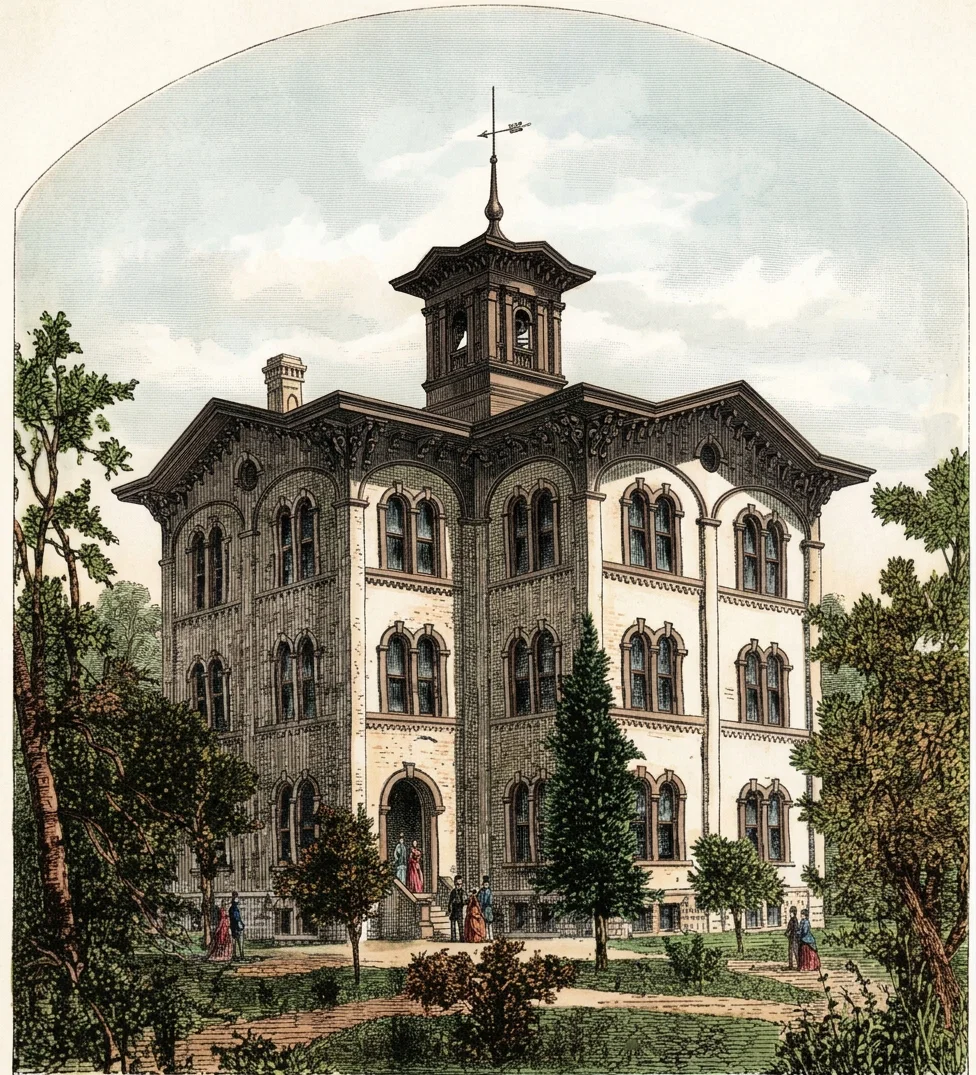
BATTLE CREEK COLLEGE.

A MODEL EDUCATIONAL INSTITUTION, COMPRISING FIVE DEPARTMENTS.

Nearly 500 Students Enrolled Annually, Coming from 32 States and Territories.

DEPARTMENTS.

I. DEPARTMENT OF THE ARTS AND SCIENCES.

This includes a Classical Course of FOUR YEARS and an English Course of three years, each with its Preparatory Course of two years.

II. NORMAL DEPARTMENT.

This includes a Teachers’ Course of FOUR YEARS, and a Model School. The course in this department includes all the branches required for a first-class certificate in any State. Professional instruction in Didactics is also given to those in this department who are expecting to teach.

III. COMMERCIAL DEPARTMENT.

This includes instruction in the following topics: Bookkeeping, Business Correspondence, Business Forms, Business Penmanship, Commercial Law, Banking, and Telegraphy. The common branches are also pursued in connection with the topics given above; also, French and German.
There are two sessions daily—afternoon and evening.
The courses in this department are of varying length, and the tuition ranges from $5.00 to $30.00.
Superior advantages for those desiring to prepare themselves for Tract and Missionary Secretaries and Librarians (Send for special circular.)

IV. DEPARTMENT OF THEOLOGY.

This department has a course of three years, which includes, besides the usual common branches, Geology and Greek.

V. DEPARTMENT OF HYGIENE.

This department has a course of one year. It is designed for those who desire to obtain accurate and scientific information on all subjects pertaining to the preservation of health, together with a fundamental knowledge of anatomy and physiology, and a practical acquaintance with the nature and ordinary treatment of common diseases.

THE FACULTY

numbers fourteen members. They are all men and women of experience and critical scholarship.
The majority of the students are young men and women of true moral worth. Their influence over the unstable is highly restrictive and salutary, making it comparatively easy to maintain the most rigid discipline.

EXPENSES.

Probably there is no other College in the United States where a thorough education can be obtained at so small an expense. A system of clubbing, which has become very popular among students, enables them to secure excellent board at $1.10 a week, exclusive of lodging, which costs 50 cents to $1.00 more. The annual expenses of each student, including all but traveling expenses and clothing, need not exceed $113.00. A full descriptive Catalogue will be sent free, upon application.
Address BATTLE CREEK COLLEGE, Battle Creek, Mich.
Continue reading: MEDICAL AND SURGICAL SANITARIUM,