THE above term is used but once in the Scriptures, namely, in 2 Peter 1:12, where the apostle expresses the wish that the people of God might be "established in the present truth." Present truth must be that which has especial reference to the present time, and which demands special present faith on the part of believers.
There are some great facts which have always been present truth. It is a truth that there is but one God, the Creator of all things, infinite in every perfection, and that to Him His creatures owe their full allegiance. And this has always been true, it always will be true.
It has been true since the creation that the only "name under heaven given among men, whereby we must be saved," is that of Christ Jesus. This was true when Abel by faith offered a better sacrifice than Cain (Heb. 11:4), and it will be true till the last soul is washed from its sins in the blood of the Lamb. Connected with this are many other facts which will ever remain present truth so long as man is on probation, facts which pertain to "this present evil world."
But there is another class of facts which are applicable only at certain times in the world's history. They were not present truth before that time, neither are they after that time. They were applicable to one day and generation; and a special exercise of faith, so to speak, is demanded of that generation, regarding that phase of truth. Or, to put it more correctly perhaps, that present truth becomes a test of the genuine faith which that generation possesses. That is, the generation or age to which that phase of truth is given, must have faith to embrace that truth; and not to do so is at the peril of their soul's salvation. Every such message of present truth bears the following characteristics:
1. It is a message of warning to prepare the world for coming judgments. "Surely the Lord God will do nothing, but He revealeth His secret unto His servants the prophets." Amos 3:7.
2. The reasons why God sends such judgments are always pointed out.
3. The warning is always given to that generation which witnesses the judgment or crisis.
4. God always intrusts it to faithful, God-fearing men.
5. It is always a message of reform. While it points out the sins, it presents the remedy for sin and the refuge from the judgments.
6. The message demands a living, active faith on the part of him who is benefited by it. To fail to have such faith is to stand condemned. To embrace the message is to show that the faith of the one who accepts it is a genuine faith, the power of which will justify and save.
7. That message always includes every truth, common and applicable to the world generally, which relates to the salvation and well-being of man. In other words, it includes the truth preached before its proclamation, and the special truth for that generation to which it is given. To illustrate: Noah preached just the same truths held by Enoch, but connected with those was the warning of the impending destruction of the earth by a flood. John the Baptist preached every practical moral truth taught by the prophets of the past, but in addition to those he proclaimed the coming of God's Messiah.
An illustration of such a message is found in the patriarch Noah's work in connection with the Deluge. When the world became utterly corrupted, God determined that He would destroy it with a flood. But involved in all this were just the principles above stated. Notice:
(a) The Lord revealed to Noah the judgment to come, and sent Noah to warn the world of the coming flood of destruction. Gen. 6:9, 13.
(b) The reason why the Lord determined to send the Flood was because of the wickedness of the world. Gen. 6:5-7.
(c) The warning was given to that generation who saw the Flood, and was proclaimed for six score years. Gen. 6:3.
(d) This message was not intrusted to the mighty men, the men of renown (Gen. 6:4), but to Noah, "a just man and perfect in his generations," and one who "walked with God." Gen. 6:9.
(e) It was a message of reform, for Noah was a "preacher of righteousness." 2 Peter 2:5. The righteousness which is by faith in Christ was presented (Heb. 11:7), and the Spirit of Christ aided in the work (1 Peter 3:18-20). The refuge presented was the ark; but the faith which laid hold of that message was faith in Christ, whose message it was.
(f) This is shown by the fact that faith in that message was a saving faith. "By faith Noah, being warned of God of things not seen as yet, moved with fear, prepared an ark to the saving of his house; by the which he condemned the world, and became heir of the righteousness which is by faith." Heb. 11:7. Noah's faith not only saved him, but condemned others who did not believe that message. The fact that Noah believed and was saved, was an evidence that any one else might have believed and been saved; for "God is no respecter of persons."
The above characteristics are manifested in every message of present truth to the world. The warning of the Flood was connected with the great message of salvation to a lost race. That present truth was not applicable a century previous to that time, nor has it been since. We may learn from it God's dealings with men respecting such messages, and may be assured that as He saved or condemned men then as they accepted or rejected His message so will He do now.
The message of John the Baptist to the Jewish nation at the first advent of Christ, bore the same characteristics. It was a message of warning of coming judgments (Matt. 3:7, 10); it pointed out their national pride, their sins against God (verses 7, 8); it was given to that generation who witnessed the destruction of the temple and the scattering of the Jews thirty-three years after; it was intrusted to one of the most faithful and humble of men (Matt. 11:11); it was a message of reform, and pointed to the Lamb of God who taketh away the sins of the world (Matt. 3:8; John 1:29-31; Acts 19:4); and John's message demanded a living, active faith. If it were accepted, well; if rejected, it was loss of eternal life. Says the Scripture, in speaking of John and his work: "And all the people that heard him, and the publicans, justified God, being baptized with the baptism of John. But the Pharisees and lawyers rejected the counsel of God against themselves, being not baptized of him." Luke 7:29, 30.
The publicans, and all who accepted of John's message, showed that God did wisely in giving it. It was a saving message; that was demonstrated, and will be to the universe in the judgment-day; for it saved those who believed in it, while, on the other hand, those who rejected that message, "rejected the counsel of God against themselves."
Those Jews reasoned that such a message was not required of Abraham or Moses or the prophets; surely God does not require it of us. But He did, and they were condemned, even as were the antediluvians. In rejecting John's message, they rejected Christ, whose message it was.
Is there a message for our day? Is this time of the ages, when "to be living is sublime," without its present truth? Do not the many fulfilled and fulfilling prophecies indicate that God has for us a message more far-reaching and important than any other ever given, even as this age is greater than any other? God has such a message, dear reader, as there is abundant evidence to show. It embraces every precious truth of the past, with the glorious truths for these days. This message the SIGNS OF THE TIMES is endeavoring, in the fear of God, to set before you in its different aspects. We ask you to weigh these evidences carefully in the light of the Word of God and in view of the coming judgment.
The Appointed Hour
THERE are no times for prayer like the appointed ones. Christ always keeps His part of the appointment; "for," says He, "where two or three are gathered together in My name, there am I in the midst of them." Matt. 18:20. There are no such assurances to prayer as to the united prayers for special objects: "Again I say unto you, That if two of you shall agree on earth as touching anything that they shall ask, it shall be done for them of My Father which is in heaven." Matt. 18:19. Note the answers to the united prayers of the disciples, recorded in Acts 1:4, 14, compared with Acts 2:1-4. See also Acts 12:5-11.
Monarchy, Revolution, and Republic in Thirty-Six Hours
By C. E. Rentfro
WHEN the tempest at the time of King Carlos's death passed away few thought that in little more than two years the kingdom of Portugal would pass away, and the Portuguese republic take its place. But recent facts have demonstrated it.
Concerning the continuance of nations, God has thus spoken:
"At what instant I shall speak concerning a nation, and concerning a kingdom, to pluck up and to break down and to destroy it; if that nation, concerning which I have spoken, turn from their evil, I will repent of the evil that I thought to do unto them. And at what instant I shall speak concerning a nation, and concerning a kingdom, to build and to plant it; if they do that which is evil in My sight, that they obey not My voice, then I will repent of the good, wherewith I said I would benefit them." Jer. 18:7-10.
It seemed for some time that the monarchy or kingdom of Portugal was tottering under the weight of national and personal sins. Noble men tried to bring about a reform, but they saw nothing could be done under that regimen. The union of church and state was a great cause of oppression and robbery of the people. The last great public holiday was the anniversary of the peninsular war, in 1810. The bishop had to be present to give his blessing. The special banner must be blessed. The "host" was elevated in the mass, and king, officers, and soldiers were obliged to give obeisance by saluting or kneeling.
This thing had to be changed. The change was effected in a short time. On Monday morning, October 3, 1910, the decision was reached that immediately the revolution must begin, or never. Plans had been made to capture the king and his officials when on their way to visit in the North. But the assassination of one of the chiefs by a traitor to the cause, brought about the beginning sooner than desired.
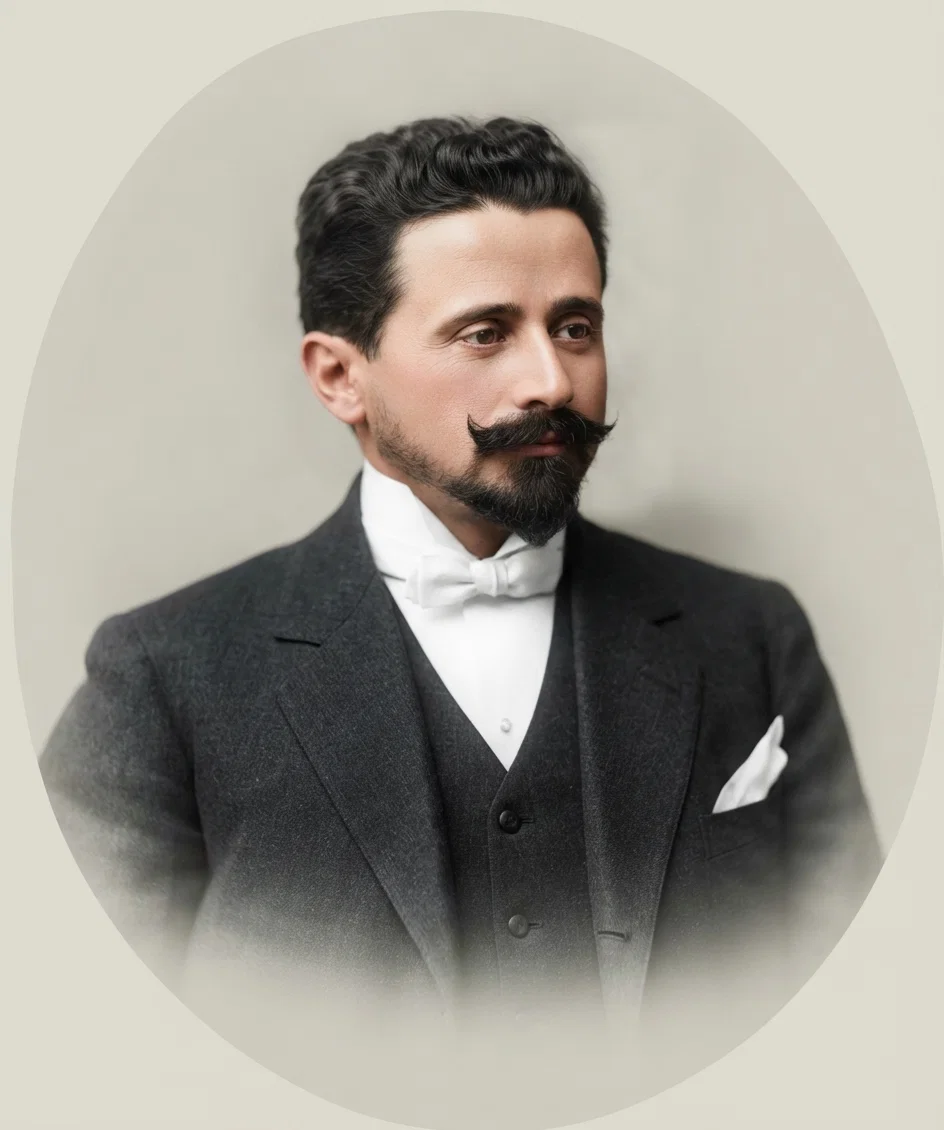
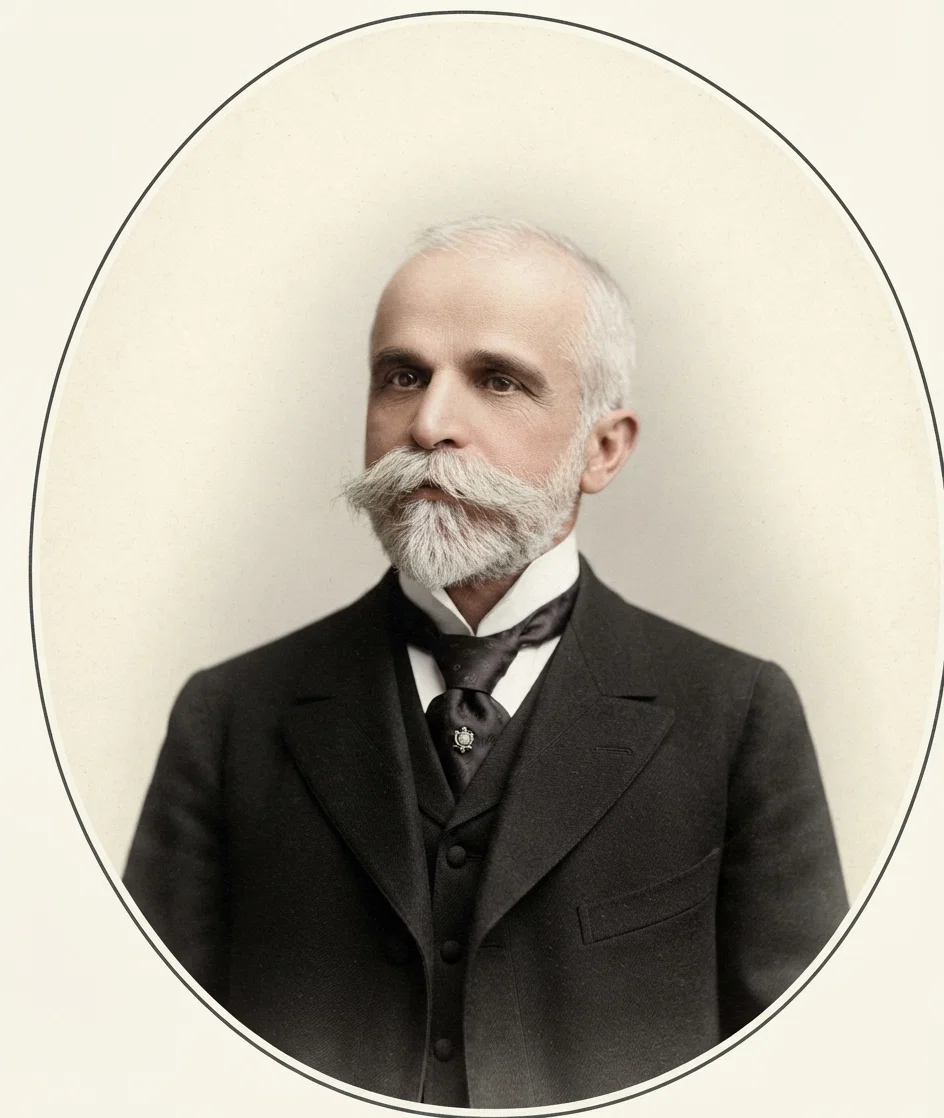
Dr. Affonso Costa, L.L.D., minister of justice of the provisionary government
A notable day in Portuguese history will be October 4, 1910. At 7 A. M. Infantry 16 and Artillery 1, and the mariners in their barracks and in three ships, all revolted. Civilians were armed by them, or armed themselves, and side by side they fought to redeem their country, against three or four regiments of infantry and one or two of cavalry faithful to their king, or monarchy. I imagine they were reluctant in fighting for something in which they had little faith.
The fighting was fierce nevertheless. We, about seven or eight miles out of Lisbon, could hear the boom of cannon. The republican forces took up prominent positions, and held them until the end. The war-ships bombarded the king's palace, from which he fled. The royal family, uniting from different points, embarked in a yacht belonging to the state, and sailed for parts as yet unknown; some say to England. [Our correspondent did not then know that the royal family found refuge at Gibraltar.—Editor.]
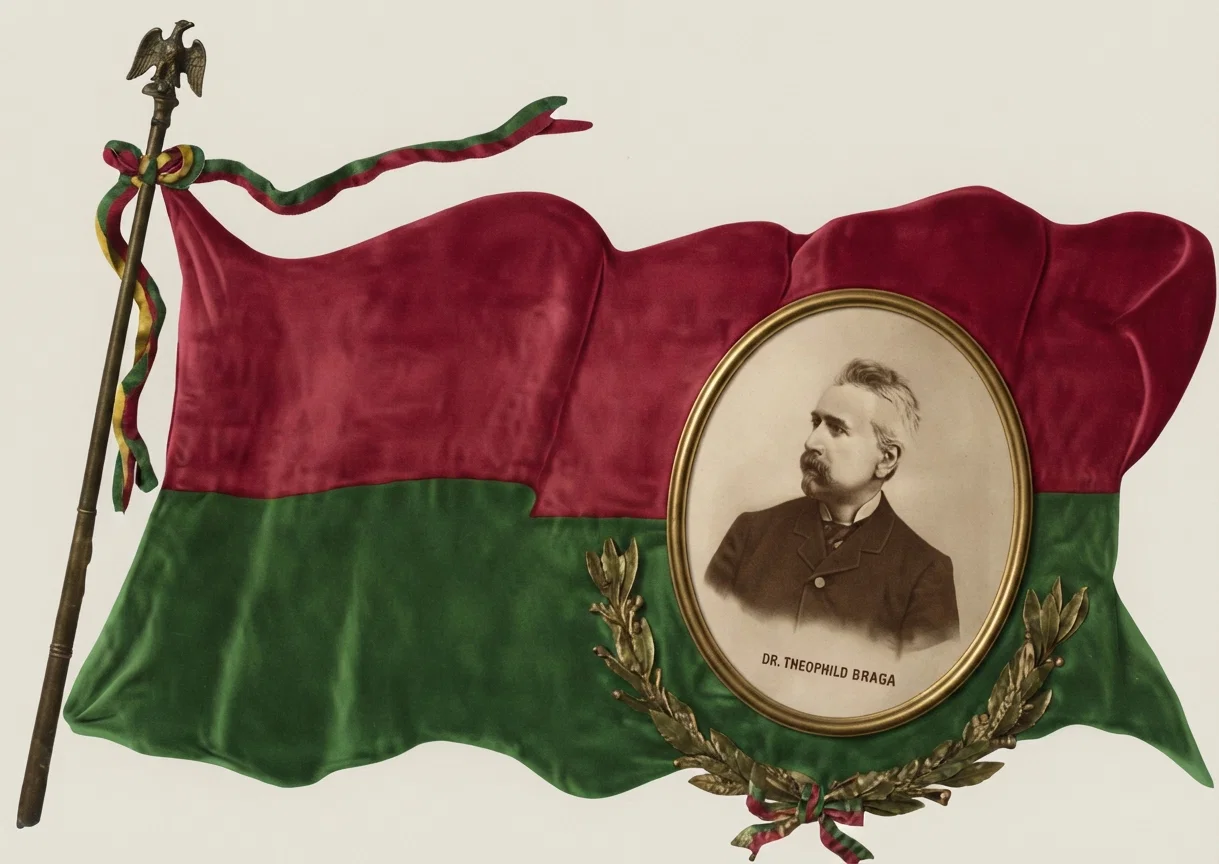
Dr. Theophild Braga, the provisional president of Portugal, and the republican flag of the new state. The upper portion is red, and lower green.
All troops were warned by ultimatum to surrender so as to avoid loss of life. By 8 A. M. on the second day, October 5, another notable date, the people went to the city courthouse, and hoisted the red and green banner of the new republic that they proclaimed. The gunboats saluted the flag with twenty-one guns, and the people almost went wild with joy.
Dr. Antonio Jose d'Almeida, minister of the interior
A provisionary government began a hard work in organizing and arranging their plans for the new regimen. The surrender of all fighting troops, the adhesion of all soldiers still in their barracks, and forts, cities, towns, officials, and civilians of all classes, was accomplished in an incredibly short space of time.
I entered the city on the first train, and could not but note the good organization of military and national affairs. The people acted as police, and protected others from thieves and personal assaults. Revenge seemed to be forgotten or laid aside. The banner floated from buildings public and private, carriages and carts, and in the hands of the people.
In the general program of the government I note the following: "Banishment of monks and nuns, autonomy of essential liberty, separation of church and state," etc. These will develop into liberty of conscience and worship. These, with public instruction, are the foundation principles of progress in the nation. From a conversation I once had with the minister of justice, I know he will as much as possible be the means of guaranteeing liberty to all who are willing to abide by the liberal laws of the nation.
God had His hand in this change; and we pray that He will help and bless these chiefs of the new republic, so that they will be willing for the forwarding of His cause in this country. C. E. RENTFRO.
Advice for Physically Strong College Women
Prof. Walter Magee, head of the department of physical culture at the University of California, and whose wife has charge of the physical well-being of the women students, advises the college women who would be strong physically to "throw away corsets, cast off high-heel shoes, wear low-cut shoes, exercise the lungs and develop the chest, walk, eat, and live properly, and take proper physical training daily."
Dr. Bernardino Machado, minister of foreign affairs
University Fire and Other News
By Editor
The famous University of Toulouse in France, founded in the thirteenth century, has been greatly injured by fire. Two thousand students helped to fight the flames, but the library of the university, one of the largest and most comprehensive in the world, was completely destroyed, also the building of the school of medicine and pharmacy. The actual loss of the buildings is estimated to be at least $1,000,000; but the loss from the destruction of rare works of art, books, medicine, antiquities, and medical instruments will be several times as great. Professors declare that many of the medical works can never be replaced.
A writer in the "Homiletic Review" for October quotes a former "first reader" of the First Church of Christ Scientist, to the effect that Christian Science is "losing ground in America, and is being replaced by the Emmanuel movement," a statement which we doubt. He further says, "To meet this [the decline] they are preparing a grand finale in the pretended ascension of Mrs. Eddy to heaven, her death being concealed till her body has disappeared, when they will declare she has ascended to heaven." We also doubt this; for as in the view of Christian Science the body is no matter, what matters the body?
Priceless Radium.—Radium is worth only the sum of $100,000 per gram. A gram is equal to less than one thirtieth of a troy ounce. There are only a few grams in existence, extracted from pitchblende by a long, slow, wearisome, expensive process, covering two years. Sir William Ramsay, the distinguished scientist, has discovered a process by which radium can be extracted from uranium in a period of three months, and uranium and the rare polonium have been found in a pitchblende in Cornwall, England. Already a radium bank has been established in London. Men are only beginning to touch the wonders of God’s creation.
The Secret Service Division of the Department of Justice is laying plans for a country-wide net to enmesh men and women engaged in "white slave" traffic. State officers and district attorneys have been asked to render aid in a simultaneous investigation to be made in the large cities, where it is thought the guiding minds of this nefarious business are to be found.
The balloon America II, which ascended from St. Louis, was located nine days after in the wilds of Northern Quebec. Its daring pilots, Allen R. Hawley and Augustus Post, when found by Canadian trappers, were alive and well, tho they had a marvelous escape from death. They made a record flight of 1,355 miles, winning the Bennet international trophy cup.
As a climax to the power movement started by the government of Ontario through the hydro-electric commission five years ago, Niagara Falls now supplies electric current and light to towns within its power zone. The scheme of transmission is said to be the largest in the world, and electric power is transmitted at the highest voltage known, 110,000 volts, which enables near-by towns to be provided with power at an ordinary rate.
Among the Guggenheims trust products are white lead, linseed oil, and zinc white. In this country the prices are, white lead, 6 cents a pound; zinc white, 5¾ cents a pound; linseed oil, 94 cents to $1.04 a gallon. In Germany they sell respectively at 3¾ cents; 4 1/3 cents; and 70 cents. The protective tariff does not favor American buyers, evidently, but the house of Guggenheims.
A translation of the book of Genesis and the Gospel of Mark has been made into the language of the Navajo Indians by the American Bible Society. This version of the Scriptures will help in the education of these Indians and in the formation of a Navajo literature. There are said to be about 25,000 Navajoes in the United States.
It is a sign of the times in Italy that one of the largest publishing houses in that country is sending out a large edition of Dr. Lea’s monumental "History of the Inquisition," which has now been translated into Italian.
The latest use of aluminum is the manufacture of slate-pencils. It is claimed that the metal will mark on slate, will not break, needs no pointing, and will last a long time. A German company is now engaged in this manufacture.
The Asiatic Exclusion League report an exodus of 3,253 Japanese from the United States during the fiscal year ending last June. Hindu laborers on the Pacific Coast are expressing their intention of returning to their home land of their own accord, complaining that they can not get employment now as easily as formerly and that the railroads are no longer anxious to employ them.
John Barry Ryan, son of Thomas F. Ryan, the New York multimillionaire, has offered the War and Navy Department one thousand military aeroplanes to be held in reserve for the service of the Government in time of need. All he asks is the support of the two departments, which was heartily given.
The Bible societies of eight different nations report the sale of 11,378,854 Bibles. More Bibles were sold last year than any other hundred books of the world combined. The Oxford Press turns out twenty thousand Bibles a week. The American Bible Society published and distributed last season 2,153,028 copies of the Bible.
Fifty passengers and sailors were drowned when the British steamship Wally was wrecked near the lighthouse at Arazolles, off Para, Brazil. A similar disaster occurred in the wreck of a steamer on Shoal Bay, nine miles from St. Johns, Newfoundland, in which nineteen men of the crew were lost.
Six gigantic search-lights will aid the batteries guarding San Francisco harbor. This pattern promises to revolutionize the methods of night defense. In the first experiments, officers on a vessel seven miles out report they could easily read fine print from the glare of the distant lights.
The following towns in Washington,—Bellingham, Mount Vernon, Port Townsend, Irondale, and Port Angeles,—are to be connected by a monorail railroad, according to articles of incorporation offered for filing with the secretary of state.
In an Eastern city recently three men devoured nine hundred and fifty-four clams at a single sitting. Gorging, gluttony! The report adds, "Cannibalism seems to be on the increase." Does this mean that the clams were human, or the eaters were clams?
Thirty thousand pounds of dynamite has been used to blow up a solid mountain of slate clay near Fleming, California. When the dust and powder cleared away a crumbling and caving mass of broken clay, covering an area of a quarter of a square mile, was exposed to view.
At a recent convention of the Protestant Episcopal Church in Cincinnati, Ohio, a special committee was appointed to call other Christian churches into a conference to decide whether all faiths shall not be amalgamated.
It is reported that seventy persons were either killed or drowned by an explosion on board the Haytian gunboat Liberte, off Port de Paix, October 26. They sailed with ninety on board.
After an illness of several weeks, David Bennett Hill, former governor of New York State and former United States senator, died recently at his home in Albany, New York.
Coinage of gold in the United States will be suspended for an indefinite period, if plans now forming in the treasury department are adopted. The object is to curtail expenses.
The United States Navy will have ten new torpedo-boat destroyers in commission by the first of next month, but some difficulty is experienced in finding crews for the ships.
The Government board of trustees of the postal savings banks has decided that the banks shall be opened on January 1 instead of December 1.
Edgar Allen Poe has been awarded a place in the Hall of Fame.
The Vatican and Portugal
By Editor
The Vatican has severed all diplomatic relations with the provisional republic of Portugal, and has recalled the papal delegate from Lisbon. That is proper; what has a religious, professedly Christian body to do with earthly powers? Christ’s ambassadors are sent to proclaim salvation and peace to sinners.
The Burdened Nations.
By Editor
Dr. David Starr Jordan recently returned from a vacation spent in some of the great cities of Europe. This, in harmony with an article in this paper last week, is what he said of his observations on the European continent:
“The nations of Europe are wofully burdened with military debts and taxation. France owes five billions, and England and Germany as much more. Democracy is coming to all of Europe. It is in the air. The great lesson is being learned there that the nation exists for the people and not the people for the nation. There were one hundred international conventions in Europe this summer, and the influence of all was for peace.”
And yet notwithstanding the efforts put forth for peace by such men as Dr. Jordan, it is war that is coming, it is war for which the nations are preparing.
The Favorite Daughter
“The Favorite Daughter.”—Before leaving this country Cardinal Vannutelli, in an interview to a Hearst syndicate reporter on October 6, printed in the San Francisco Examiner October 7, assured the people of this country that “the holy father is commencing more and more to regard your wonderful United States as the favorite daughter of the church. Catholicism has here made more wonderful strides than anywhere else in the world. Your bishops and priests and teachers have built up a magnificent church organization. Under your government of freedom and personal liberty, the church and its individuals have prospered splendidly. Your country is amazing to a stranger, but no less amazing is its Catholicism.”
But what has given Catholicism its liberty to grow in this land?—Protestant freedom. What apart from its natural resources has made the nation and government great?—Its civil and religious liberty inherent in primitive Protestantism. The sad thing now is that nominal Protestants are repudiating these principles.
Of What Politics Are You?
By Editor
Before election there were many men proud to say, "I am a Democrat," "I am a Republican," "I am a Prohibitionist," "I am a Socialist." Most of these would gladly say, "I am an American." They would claim it as a proud designation, an honored title. But there is something better, for there is coming a day when the great God will number the people, each one according to his choice. Egypt and Babylon and Philistia and Tyre and Ethiopia and Persia and Greece and Rome and England and America,—all will be remembered. It will be said of each of the citizens of each of the countries, "This one was born there." Yet his land or his city gives him no continuance of life beyond the earthly. But "of Zion it shall be said, This one and that one was born in her; and the Most High Himself will establish her. Jehovah will count, when He writeth up the peoples, This one was born there." See Ps. 87:3-6. Another prophet declares: "And the kingdom and dominion, and the greatness of the kingdom under the whole heaven, shall be given to the people of the saints of the Most High, whose kingdom is an everlasting kingdom, and all dominions shall serve and obey Him." Dan. 7:27. The politics of the editor can be well expressed in the language of an old soldier of King Emmanuel: "I am a Fifth Universal Monarchy man." That commonwealth is not made by corrupt men; the Leader in that land remakes both men and land.