The Youth’s Instructor, Vol. LIII, No. 13

Korean Sketches

The Youth’s Instructor

Mar 28, 1905

Review and Herald Publishing Assn. · Washington, D. C. · Mar 28, 1905

Korean Sketches

The People—Some Strange Customs
THE population of Korea is variously estimated at from six to ten millions, the lower figure being probably nearer the truth. As a race they have the same yellow complexion, black eyes and hair, as the other Mongolian peoples. There is no authentic record of their origin; but there is a theory that they originated from the union of a Mongolian branch with an Aryan race from western Asia. It is said that there are elements in the language that show a derivation from the languages of India; and one often sees a face decidedly Aryan in type. In size they are quite well developed, being decidedly superior to the Japanese in stature.
In temperament the people are more expressive and boisterous than their island neighbors. An angry or excited Korean scolds and shouts, when a Japanese would only mutter, or perhaps smile. A Korean gentleman is polite and cordial, yet with far less ceremony than is observed by the Japanese. You miss the profound and repeated bowing seen in Japan; yet well-bred children are carefully taught to bow low before their elders, and to guests.
Intellectually the Koreans are bright and clever, and make good students. They excel as linguists, but do not take so well to mathematics and the sciences. It is to be regretted that they have no general system of education; the only schools are of a private character. Yet this very fact makes Korea a promising field in which to conduct Christian schools for the education of the young.
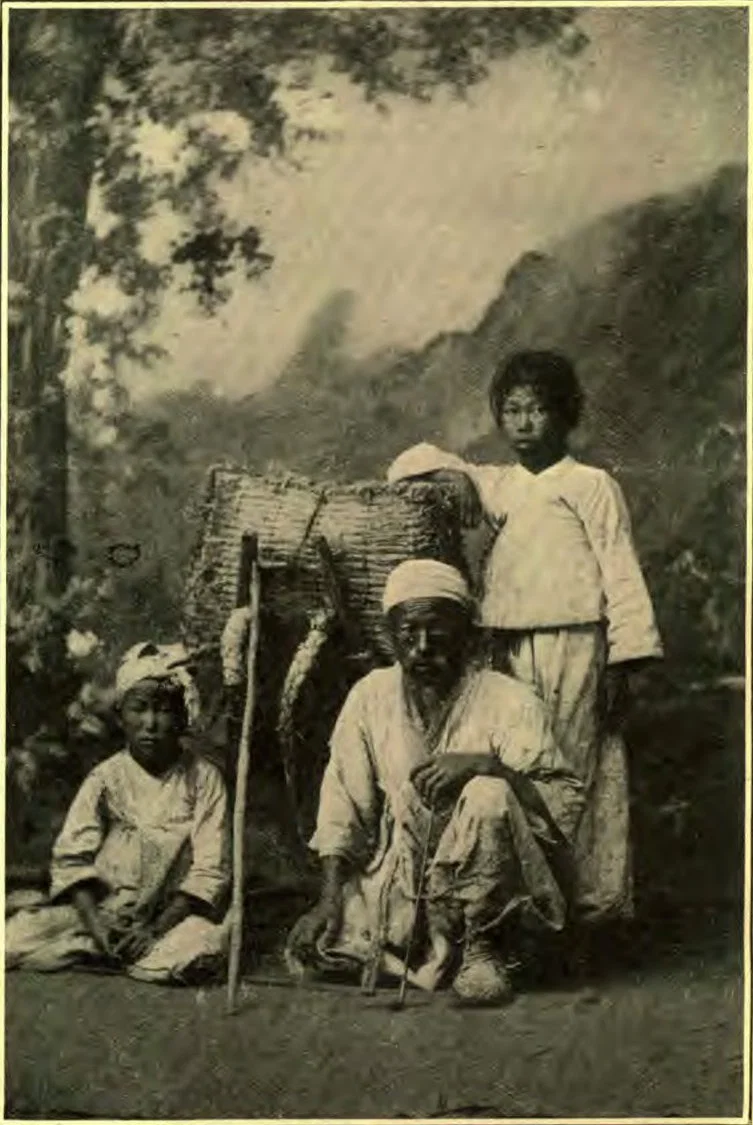
Every country has its customs that possess all the force of statute law. In Korea there are many sights and some sounds that seem strange to the foreigner. Several of the most striking ways of doing things may be worthy of notice here. In America we are accustomed to seeing the commodities of trade transported through the streets in wagons drawn by horses. In Japan it looks strange to see most of the drays and delivery wagons, or carts, drawn by men. But in Korea it looks stranger still to see everything carried upon men's backs. And here let me describe the rack or saddle which supports such a load. Two pieces of wood between three and four feet long are fastened together by several crosspieces, like a short ladder. Each of these two upright pieces has a natural branch projecting from it, these two branches project behind, and support the load. The whole is carried on the back, suspended from the shoulders by stout ropes of straw. At the ports of Korea, scores of men are seen carrying heavy loads of all sorts upon these queer saddles. Farmers carry loads from the fields in the same way. During our trips across the country, we employed a man with one of these contrivances to carry our baggage. A similar thing is used in the country districts of Japan, where wagons are scarce. It seems a hard way to make a living; but there is a heavier bondage resting upon the world than any which daily toil imposes. It is the bondage of sin.
KOREAN LABORER RESTING FROM HIS BURDEN
The work which falls to the lot of women in Korea also presents some strange ways of doing things. One of the most interesting is their manner of doing laundry work. The soiled clothes are first taken to a well or pool of water, placed upon a flat stone after being well soaked with water, and then pounded with a wooden club. After this treatment, the clothes are well rinsed in a small tub. I could not see or learn that any soap is used; but the process is certainly effective, for the clothes are made spotlessly white.
But still more curious is the method of making the clothes smooth after drying. A garment, instead of being ironed, is folded in several layers, laid upon a smooth, flat stone, and pounded with wooden clubs. Usually two women sit facing each other, with a club in each hand, and pound with alternating strokes that make quite a rhythmical rub-a-dub-dub. Sometimes the garment is wrapped around a wooden cylinder, and then beaten. In this case the roll is turned with the left hand, and beaten with the club in the right. Now, I may not have described this process accurately enough so that the reader could succeed well at it; but the women of Korea understand it well, as their smooth and even polished clothes bear witness. And there is never a garment scorched!
We may learn from the customs of other peoples that the whole sum of wisdom is not wrapped up in our ways of doing. Let us have charity and a teachable spirit; and then we shall be able to teach others the things that pertain to their eternal welfare. F. W. FIELD.

Mission Work Among the Women of China

It is one year since our little party arrived in the province of Honan, China. The past year has been spent chiefly in the study of the language, and caring for the sick. After spending several months among the Chinese, and learning some of their customs, we decided that we must scatter; for the field is large, and the laborers are few, and the time is short in which to give the third angel’s message to this great empire.
We have now four mission stations in the province of Honan. Miss Ericksen and myself have our station in Sin-tsai Hsien. We have a dispensary, and a portion of each day is devoted to caring for the numerous sick people who come to us for help. The Lord has certainly blessed the treatments given, and many have been restored to health and strength.
At the present time, we are caring for one little child who is paralyzed on one side, and has been in this condition two months. His mother walked many li on her poor, crippled, little feet to bring him to us. Wonderful results followed the few treatments given, and soon we hope to see the child restored. Last week a man came complaining of great pain in his side; we found he had a large growth on his side, which had been there for thirty years. After one week’s treatment he declared himself well; he thought it was wonderful, for he had been treated for years by the Chinese doctors.
Some time ago a child was brought to us, ill with pneumonia. We treated her, and she soon recovered. Since then mother and child have attended our Sabbath meetings regularly. We find that the medical work opens the hearts of the people to the gospel, and this is what we are working for, not that we may get the praise, but that they may know that God is working through us; and that all praise is due him.
Our Chinese teacher, who is one of Brother Piliquist’s converts, holds meetings three times each Sabbath. The meetings are well attended, and we are praying that God’s Spirit may convert many hearts to his truth for this time.
Our work is largely among the women and girls. Surely this is one of the most important features of mission work, to reach the mothers of growing families; but here in China it is the mothers-in-law we aim to reach; for they have entire control not only over their daughters-in-law, but also their children as well. Each week we hold two or three meetings with the women at their homes; they know when to expect us, and we usually find a large number of their friends and neighbors waiting for us. There are very few Chinese women who can read, and so it is no easy task to explain the Bible to them. We must take a very little at a time, and repeat it many times, to make sure they fully understand. We encourage them to visit us in our home; and when they come, we teach them hymns.
Some can learn one in a short time, by repeating it over after us. Some of the mothers bring their children, so they can learn also; for they say the little ones remember better than they, and can help them to sing the hymn after they get home.
Several boys also come to learn to sing the hymns. They are able to read a little, so in the evenings the boys and women meet at one of their homes to sing together. The boys are a real help to us; for they aid the women to learn more quickly than we could. Many have expressed a desire to learn to read, and we help them the best we can, and encourage the sons who can read a little to help their mothers and sisters. The Chinese women have few interests. Being unable to read and scarcely ever going out, it is no wonder they become more and more ignorant and superstitious.
We are anxious to see them interested in the gospel, and we are praying that many may become faithful and earnest workers in the Master’s service. CHARLOTTE SIMPSON.

The Blind Hymn-writer, Fanny Crosby

A Thrilling Announcement

(Concluded)
WHEN fifteen years old, Fanny Crosby received the good news that arrangements had been made for her to attend the school for the blind in New York City. Her eagerness for an education led her to adjust herself quickly to her new life, and though for a time she was a bit homesick, she never allowed her feelings to prevent a proper improvement of opportunities. The first obstacle that she had to meet and bravely conquer by earnest effort was arithmetic. Her regard for that study she expressed in rather strong terms,—
“I loathe, abhor, it makes me sick To hear the word ‘arithmetic.’”
However, she determined to master its intricacies, though secretly she wished every assault she made upon the study would give it a twinge of pain. English, history, and the natural sciences she enjoyed exceedingly. The lessons were given in the form of lectures and readings, and the pupils grasped eagerly every word. They, like other students, were favored with examination days, when they were called to return what had been given them by the teachers. Miss Crosby made rapid progress in her studies, and afterward taught a number of years in the same school.

Advice from the Superintendent

From time to time during even the early part of her school life she composed little poems that pleased both pupils and teachers. In so young a girl this doubtless produced a feeling of self-gratulation. But the good superintendent knew a quick remedy for any feelings of superiority that might come to young poets; so he called Miss Fanny to his office, and prescribed very heroic treatment for an aspiring schoolgirl. He said, “Fanny, your attempts at poetry have brought you into prominence here in the school, and a great deal of flattery has resulted. Shun a flatterer, Fanny, as you would a snake! As yet you know very little about poetry, or, in fact, anything else—compared with what there is to be known. Store your mind with useful knowledge, and think more of what you should be than of how you can appear. The favor and praise of the world is a very fragile thing upon which to depend. Seek the approval of God, and of your own conscience. Remember that the very air you breathe, the food you eat, and all the ability or talent you may develop come from God. Remember that you are always in his presence: and who has any right to be vain for a moment when standing before the great Creator of all things?”
These words were “like bombshells in the camp of her self-congratulatory thoughts,” she said; but, despite the hot tears that came to her eyes, and the pain and mortification she felt, Fanny stepped around behind the superintendent’s chair, put her arms around his neck, kissed his forehead, and thanked him sincerely for his kind words. But “the poetic sprite,” she says, “was ever tugging away at my heart-strings, even though I had been forbidden to write for three months.”

Visit to the Capital

In order to awaken general interest in the work of the school for the blind, the superintendent or some of the teachers would take a number of the pupils and visit the leading cities during the summer vacation. Miss Crosby went on several of these trips. On one tour they went from New York to Buffalo, stopping at many places on the way, then on to Chicago. In January, 1844, she was chosen to be one of a party to visit Washington. They were asked to appear before a joint session of the two houses of Congress, and she was to deliver a poetical address. She is the first lady ever granted the privilege of addressing Congress. John Quincy Adams, James Buchanan, Andrew Johnson, Hannibal Hamblin, Stephen A. Douglass, Rufus Choate, Jefferson Davis,—these, and many others whose names are familiar to the world, were among her auditors. Later on she made a second visit to the capital.
Miss Crosby has very pleasant reminiscences to relate concerning persons of renown who visited the blind school. She personally met William Cullen Bryant; Henry Clay; General Winfield Scott, of Mexico fame; and President Polk, who, with his cabinet, made two visits to the Institution. Jenny Lind visited them, and sang her sweetest songs for her appreciative but blind audience.

Miss Crosby and Grover Cleveland

Prof. William Cleveland in 1853 was head teacher in the school. He was called home to attend the funeral of his father. On his return he brought with him his younger brother, a youth of sixteen, to be clerk in the office. Professor Cleveland said to Miss Crosby that Grover had taken their father’s death very hard, and he would like her to go down to the office at times and talk with him. One day the young man copied down for her a poem that she recited from memory. The superintendent, who had been newly installed in office, happened in, and gave a very severe rebuke to Miss Crosby, who was then a teacher in the school. She was both wounded and bewildered; but young Mr. Cleveland came to the rescue. He said, “We are entirely within our rights, Fanny, and the superintendent had no business to interrupt or reproach us. To-morrow, at this time, come down here with another poem; I will copy it for you; he will step into the office again, as he generally does at this time; he will doubtless repeat his lecture; and then, if I were you, I would give him a few paragraphs of plain prose.”
The advice was acted upon, and the results were as anticipated. When the superintendent began administering his second reproof, Miss Crosby, in mildly spoken, but effective, prose, reminded the gentleman that her poems had been used largely for the benefit of the school, and that the reciting of them had helped to increase the attendance of the school, and that she thought it proper, if any of the employees of the Institution were willing to copy her poems, that they should do so, providing they did not neglect other duties. The justice of Miss Crosby’s claim was acknowledged; at least no further interference was attempted by the superintendent.

A Marvelous Memory

“Memory, when cultivated,” says Miss Crosby, “grows a wonderful treasure-house of ripened grain.” She further adds “that recollecting is not entirely a lost art, although we live in rushing days of memorandum tablets and carefully kept journals and ledgers. The books of the mind are just as real and tangible as those of the desk and the library shelves, if we only use them enough to keep their binding flexible, and their pages free from dust.”
Miss Crosby claims that if she were given a little while in which to do it, she could reproduce from memory, alone, hundreds, if not thousands, of her hymns. She does not write her stanzas as she composes them, but keeps the entire hymn in her mind for a few days, that she may “prune and trim it through the eyes of her memory.”
Sometimes she wrote her hymns according to order, as it were. W. H. Doane, a musical composer, one day came hurriedly to Miss Crosby and said, “Fanny, I have just forty minutes to catch the cars for Cincinnati; during that time you must write me a hymn.” He hummed the melody to which he wanted the words written. In fifteen minutes she gave him the words of the hymn “Safe in the arms of Jesus.” At another time a friend asked her to provide words for a tune that she had composed. The words of “Blessed assurance, Jesus is mine!” were produced. She wrote words for many of Mr. William Bradbury’s compositions.

Mission Work

Miss Crosby for many years has been much interested in mission work. She even now frequently speaks to large audiences in behalf of such work, or engages directly in the services of missions. One evening at a meeting in which Miss Crosby was assisting, a young man arose at the close of the song “Rescue the perishing,” and said that he was led to Jesus by that hymn. Then he told of his wanderings, and how he had wasted his time and money in drink; and how, while passing along the street one night without a cent in his pocket, ragged, cold, and hungry, he heard some voices singing:—
“Rescue the perishing, Care for the dying, Snatch them in pity From sin and the grave.”
He followed the voices until he came to a building where there was a mission meeting. He went in, and listened to the words of that hymn. “I was just ready to perish that night,” he said; “but that song by the grace of God saved me.” The young man then expressed a strong desire to meet the writer of the hymn, and tell her what it had done for his soul. As Miss Crosby was present, there was, after the service, an interesting meeting of the poet and the reclaimed man.
Miss Crosby is now living with a sister in Bridgeport, Connecticut. The money that is received from her autobiography written in 1903, she wishes to use in extending her labor of love for the betterment of earth’s perishing millions.
More than eighty years of joyous, helpful living is the record of our blind poet, Fanny Crosby.

Germs as Friends and Enemies

In general, it may be said that our business is to act as scavengers, to turn all organic matter — matter from plants and animals — back to a condition where the plants can use it again. Most of us are engaged in the common processes of decay. Others living in the ground are engaged in making ammonia, one of the plant foods. In the work of producing decay some of us get into mischief, causing all kinds of unpleasant smells, but perhaps this is not so bad after all, for it compels people to be clean, and thus avoid disease.
Some of us — shall I say it? — are murderers. We get into the throats or stomachs of little babies (or older people), and soon there is a fever, choking, and spasms; and then there is a family of sad, very sad people who follow the little fellow to the graveyard.
The people know how to protect their loved ones from cows, and dogs, and the larger dangers, but we are so small that we get into the place where we can cause mischief without any one's knowing it.
Sometimes we live in the mouth of a person without making him sick. Then when he kisses some one else, some of us germs get into the other mouth, and perhaps the other person dies — from a kiss! A customary place for us to be passed around is at school, in coughing, loud laughing, and in other ways.
Some of us make bright colors,— lemon yellow, orange, red, purple, blue, brown, snow white.
One germ, quite harmless, has innocently caused some very curious stories to get started. What would you think, if you left some fresh bread in your cupboard, to find it covered in the morning with a moist, dark-red, shiny covering, looking like clotted blood? This germ I am telling about grows very rapidly, and in one or two nights will cover over a surface of bread, or perhaps some other substance, with this red paint, and you may imagine that the poor, ignorant people who knew nothing of germs, would naturally suppose it was the blood of Jesus. But few such outbreaks have occurred since more is known about germs, and the microscope readily shows that the red was due to germs, and not to blood.
So you see we are constantly changing organic matter. We produce various substances, some comparatively harmless, such as vinegar, others, like alcohol, more harmful. We are the cause of many odors, most of them unpleasant, and of many flavors. We produce colors, and even light and heat. We are workers, never standing idle for a moment when our environment is favorable.

What We Do

You have been going down the road sometime, perhaps, when suddenly your nose detected an unpleasant odor, and you said, “There is something dead around here; I can smell it.” What you smelled was not the dead animal, but a gas produced by some of us germs. A piece of meat cooked so as to kill all the germs, and then canned so that no germs get in the can, will, if opened twenty years from the time of canning, smell the same as when first canned. But if it is allowed to remain a few days after the can is opened, it will have a very foul odor.
An egg, after it has stood for a few weeks, or even days, in warm weather becomes “spoiled.” The germs penetrate through the shell, which is porous for the admission of air, and they live on the egg mixture, producing substances which are not only unpleasant to the smell, but also
has its intestinal canal entirely free from germs.
One investigator, by great care, was able to keep part of a litter of newly born animals entirely free from germs for eight days.
They were kept in a glass case, and were supplied germ-free air and germ-free food. Such constant watching was required that it was decided to end the experiment after eight days. The sterile animals were at that time in better condition than the remainder of the litter which went through the ordinary treatment. They were killed, and found to be entirely free from germs.
Another fact is that, although germs are being constantly swallowed with the food, the upper part of the digestive passage,— the stomach and small intestine,— where most of the digestion is carried on, contains fewer germs than the large intestine, where comparatively little digestive work is going on.
It is supposed that if the food and mouth were entirely sterile (free from germs) it would not be long before the upper part of the intestinal tract would be entirely sterile. Many persons show an absence of all bacteria in the stomach at the end of an hour's digestion.
It is probable that the germs are not present as an aid to digestion, but that they grow because they find the favorable conditions of proper temperature, moisture, and abundant food. There is no doubt they often do harm. Very many of the symptoms which come under the head of dyspepsia are the result of poisons or irritating substances caused by the presence of germs.
The summer complaint of infants, dysentery, cholera, typhoid fever, and other diseases are the direct result of germs in the intestinal canal.
MIKE ROSE.

A Sick Man's Blessings

“AND we know that all things work together for good to them that love God, to them who are the called according to his purpose.” Rom. 8:28.
It seems to me I ought to write a few lines to our younger brethren who understand the English language; and I believe it will do every one good. I was compelled to remain in bed for several days because of an operation made necessary by overlifting. As my mind was clear enough to read, I obtained several old books on the beginning of the advent message. Among them were sketches of the lives of William Miller, James White, Mrs. White, and Joseph Bates. I improved the time reading those books with joyful interest. I could see there the consecration, earnestness, self-denial, and love the pioneer workers in the Lord's last three messages of mercy to the world manifested by their lives, their works, and their deeds. Many times it was difficult to keep back the tears, as I read the words of warning and consolation the messengers of the Lord directed to sinners, and to the believers in hours of trial and affliction.
The reading of such books has, on one who is young and inexperienced in the work of the Lord, an untold influence for good. He learns what consecration and sacrifice mean. He takes hold and grasps the message right from its beginning, and sees the hand of God guiding his faithful servants through perils and difficulties, and leading them to precious truth and clear understanding of his good-will.
“Call to remembrance the former days, in which, after ye were illuminated, ye endured a great fight of afflictions. . . . Cast not away therefore your confidence, which hath great recompense of reward. For ye have need of patience, that, after ye have done the will of God, ye might receive the promise. For yet a little while, and he that shall come will come, and will not tarry. Now the just shall live by faith: but if any man draw back, my soul shall have no pleasure in him. But we are not of them who draw back unto perdition; but of them that believe to the saving of the soul.” Heb. 10: 32-38.
When one reads these biographies, and Bible instances about the experience of the people whom God called to proclaim his messages to the world, faith grows stronger, confidence increases, and the prophetic word, which is surer than sight (2 Peter 1: 19), gives a hope that is worth more than all this world can offer.
I would recommend all our younger brethren to study closely the relations of the rise and progress of the last three messages, that they may be able to give a clear account and reason of the work God has done for this people, especially now when Satan tries to remove our confidence in the foundation of our faith.
E. W. THOMANN.
Valparaiso, Chili.

Germs and Digestion

injurious if eaten. If the egg is dipped into “water glass,” or some other substance which will render it impervious to air, it may be preserved a long time, the same as canned fruit, but then it would not hatch, as no air could get to it.
I might go on to give you many familiar instances of the action of germs,—the souring of milk, the turning of cider or wine to vinegar, the decay of fruit, the rotting of wood,—but you will think of them yourself.
One germ or one kind of germ does not do all this work. Some germs produce one thing, some another. A germ sometimes gets into ice-cream or into cheese, and makes very poisonous products, so that the people eating these things may be very sick or lose their lives. Some germs instead of souring milk, make it putrid or rotten, so that it does not taste like ordinary sour milk, and is liable to be very harmful. Milk which sours in large cities is liable to act this way. You have noticed in the decay of fruit, there is a difference in the rapidity and in the nature of the decay, caused by the difference in the germs.
There is a great difference in the flavor of different lots of butter. This is due sometimes, partly to the feed, some foods imparting marked and unpleasant flavors to the milk and butter; but the difference in flavor is very largely due to the difference in the germs that get into the cream. Some germs falling in from the air multiply rapidly, and produce very unpleasant flavors; others produce pleasant flavors. Bacteriologists, having obtained pure cultures of germs which produce certain agreeable flavors, now distribute them to the dairymen. A pure culture is a collection of germs all of one kind. Perhaps I will tell you later how pure cultures are obtained. It requires considerable care, for a single germ of another kind, if allowed to get into the culture, may multiply, and contaminate the culture. Pure cultures of germs are also prepared to give certain flavors to wines and to cheese.
In the manufacture of vinegar, weak wine, or cider, a weak solution of sugar is allowed to trickle over shavings which have a certain kind of germ on them. These germs transform the liquid into vinegar. You may wonder how it is that other germs do not get in from the air, and produce other undesirable changes. Sometimes they do; but these particular germs thrive so well on this kind of food that they grow rapidly, and crowd other germs out. Several kinds of germs may work successively on one food. For instance, with sweet cider, the yeast plants first convert the sugar to alcohol. Later a certain germ converts the alcohol to vinegar, and later on other germs may cause the vinegar to decay. In any decaying matter there are a great variety of germs present from the air; but only those thrive well and multiply rapidly that find the food best suited for their use. These germs finally exhaust all the food that is available for their use, or else produce substances which retard their own further action; then some other kind or kinds of germs find conditions suitable for them to multiply, and they proceed to work other changes. Thus the process continues, each change reducing the matter to more simple forms, until finally it is ready again for the plants to use as food.

Germs and Digestion

The question is sometimes asked, Do germs aid in digestion? The fact that the intestinal canals of all animals swarm with germs, and that the action of some of these germs seems to be similar to the action of the digestive juices, leads some to the belief that germs are essential to digestion; that they are a decided benefit to the body economy.
But there are some facts which seem very strongly to cast doubt on this theory. For instance, every infant or young animal, when born,

Missionary Hymn: Go Preach My Gospel

“From many a river’s temple bank, Where pagans bend the knee; From continental villages, And islands of the sea, Each ship that floats upon the wave, And all the winds that blow, Ring out to us the Lord’s command— ‘Go preach my gospel, go’!”

Nebuchadnezzar's Humiliation

For many months after Nebuchadnezzar's dream in regard to his humiliation, his position was unaltered. The judgment of God lingered. The king lost confidence in the dream, and regarded it as a delusion. More proud and haughty than ever, he jested at his former fears.
About a year after the king had received the divine warning, he was walking in his palace, and thinking with pride of his power as the ruler of the greatest universal kingdom, when he exclaimed, “Is not this great Babylon, that I have built for the house of the kingdom by the might of my power, and for the honor of my majesty?”
The proud boast had scarcely left his lips when a voice from heaven announced to him that God's appointed time of judgment had come. Upon his ears fell the mandate of the Almighty: “O king Nebuchadnezzar, to thee it is spoken; The kingdom is departed from thee. And they shall drive thee from men, and thy dwelling shall be with the beasts of the field: they shall make thee to eat grass as oxen, and seven times shall pass over thee, until thou know that the Most High ruleth in the kingdom of men, and giveth it to whomsoever he will.”
In a moment Nebuchadnezzar's reason was taken away, and he was placed on a level with the beasts of the field. “He was driven from men, and did eat grass as oxen, and his body was wet with the dew of heaven, till his hairs were grown like eagles' feathers, and his nails like birds' claws.”
As the beasts have no knowledge of God, and therefore do not acknowledge his sovereignty, so Nebuchadnezzar had been unmindful of God and his mercies. Prosperity and popularity had led him to feel independent of God, and to use for his own glory the talent of reason that God had entrusted to him. Messages of warning were sent to him, but he heeded them not. The heavenly Watcher took cognizance of the king's spirit and actions, and in a moment stripped the proud boaster of all that his Creator had given him.
Nebuchadnezzar did not profit by the warnings he received. Only through severest discipline did he learn the lesson that the Lord, and not man, is ruler, and that God's kingdom endures forever. Only after passing through long years of humiliation did the king of Babylon learn that it was not his scepter, but the scepter of him whose kingdom is everlasting, that held supreme sway over the affairs of the nations.
Man may lift himself up in pride and boast of his power, but in an instant God can bring him to nothingness. It is Satan's work to lead men to glorify themselves with their entrusted talents. Every man through whom God works will have to learn that the living, ever-present, ever-acting God is supreme, and has lent him talents to use,—an intellect to originate; a heart to be the seat of his throne; affections to flow out in blessing to all with whom he shall come in contact; a conscience through which the Holy Spirit can convict him of sin, of righteousness, and of judgment.
God is infinitely holy, and he hates every species of iniquity. He is great in power, and he will punish the mightiest with the most depraved. He first gives to transgressors oft-repeated warnings. If the heart is hardened, if it refuses to heed the warnings given, and to accept the means of salvation, God will make men feel that as he has exalted and favored them; so he has to do with their casting down. When God has forsaken those whom he has highly favored, no earthly power can avail. God is long-suffering, not willing that any should perish; but his forbearance has a limit, and when the boundary is passed, there is no second probation. His wrath will go forth, and he will destroy without remedy. MRS. E. G. WHITE.

Loup City Society

THIS is a report from the Loup City Young People's Society, up to Jan. 1, 1905. We had our weekly meetings after Sabbath-school for more than a year, taking up the studies as outlined in the INSTRUCTOR, but we never organized for effectual work until Oct. 16, 1904. Since that time our Society has given away forty-five copies of the special number of the Signs, 331 papers, 1,781 pages of tracts, and one copy of “Christ's Object Lessons.”
We have also given five Bible readings, written five missionary letters, had eight missionary talks, made two missionary visits, loaned 1,200 pages of books, taken forty-five subscriptions for the Life Boat, sold 43 copies of the “Story of Joseph” and one of “Christ's Object Lesson.”
Our Society has a membership of eleven. During the last quarter we have had ten visitors, all of whom took an active part in the meetings. We try to make our meetings as interesting and instructive as possible, and it is our aim to keep pressing forward in the work of soul saving till the last note of warning has been sounded to a dying world. Thus shall we hasten the coming of our Lord and the glorious appearing of the great God and our Saviour Jesus Christ.
FLORENCE E. NIGHTINGALE, Leader, ORVILLE C. WAKENIGHT, Secretary.

MONTHLY FIELD STUDY

(April 8)
OPENING EXERCISES:—
Singing.
Scripture reading.
Prayer, in which a large number may participate.
REMARKS BY LEADER:—
The enlarging work, and what it means.
FIELD STUDY:—
Cuba an Open Field.
A Year in China.
The Plainfield Mission.
A Visit to Burma.
MINUTE REPORTS OF PROGRESS: Fiji, Latin Union, Chile, West Africa, Hayti, Mexico, Burma, Portugal, Panama, Ceylon, Basutoland, Natal, Transvaal, Jamaica, Colombia, Polynesia.
CLOSING EXERCISES.

Note

The material for the study this month will be found in the issues of the Review of February 16 and 23, and March 2 and 9. We would suggest that the program be varied to suit the different companies. Where the information is available, it would add to the interest of the meeting to bring in something concerning the early missionary work in the fields. We can well afford to study the pioneer efforts of mission lands. The facilities at our hands for work in these once difficult fields will mean far more as we become familiar with the early missionary history.
E. H.

The Legend of the Weeping Willow

A LITTLE girl with golden hair, Whose home no trees or flowers knew, Crept to a park gate, peering there At what seemed fairy-land grown true.
The gardener threw dry cuttings out, She saw on one a bud so small; She thought, “*If this will only grow Into a live tree fine and tall!*”
She took it home, and planted it In darksome area all alone; She closely watched and tended it, And soon another bud had grown.
And then she knew it had a root, And as she stood beside the pool, She dreamed of birds that came and went Amid its branches, soft and cool.
Years changed the gold-haired, winsome child Into a maiden fair and tall; The garden, now a lovely place, But her tree loveliest of them all.
A pleasant mansion reared its head Where once had been a lowly home, And many a tree its branches spread, But hers the dearest ’neath the dome.
She thought no tree cast shade so soft, In none the birds so sweetly sung, And none so fair in all the grounds That shimmering shadows fell among.
But while the tree so graceful grew, The maiden faded day by day; On cheeks where once the roses bloomed, The lily faded fast away.
Sweeter and sadder grew the light That flickered in her eyes of blue; Angels may come with dreamless sleep To old or young—to me or you.
Kind, loving friends wove fairest wreaths To grace her white and placid brow, And ’neath the branches she had loved, Dear, tender hands have placed her now.
But from that hour the stately tree, As if in grief, its head bowed low, Till boughs caressed the daisied mound O’er her who once had loved it so.
“See,” said her friends, “the tree now weeps For her who rests on dreamless pillow, And here its constant vigil keeps,”— The legend of the Weeping Willow.
MARY MARTIN MORSE.

Sunday Laws

THE people are willing and anxious for Sunday laws. It is already difficult to find those to oppose the enactment of such laws. Are all the Young People's Societies doing all they can to scatter the pages of truth, so that the people may at least intelligently take their stand on this question? A responsibility rests upon every one to whom has come the light of the third angel's message.

Mother’s Comfort

I KNOW a little girlie, With loving eyes so blue, And lips just made for smiling, And heart that’s kind and true. She wears no dainty dresses, No jewels does she own; But the greatest of all treasures Is her little self alone.
Her name is “Mother’s Comfort,” For all the livelong day Her busy little fingers Help mother’s cares away. The sunshine loves to glisten And hide in her soft hair, And dimples chase each other About her cheeks so fair.
Oh, this darling little girlie, With the diamonds in her eyes, Makes in mother’s heart a sunshine Better far than floods the skies! But the name that suits her better, And makes her glad eyes shine, Is the name of “Mother’s Comfort,” This little treasure, mine.
— Selected.
Continue reading: The True Story of Cornelius