BEFORE the middle of the last century, a family of three left their native Scotland to seek for themselves a new home in the West. They were Sandy Atherford, his wife, and only living child, Cornelius, aged thirteen. Up to middle life this father and mother had worked hard, and spent as little as possible, in the hope of saving their little home and laying by money enough to support them comfortably in their old age. But everything seemed to be against them. One after another their children sickened and died; work was scarce; crops failed, and at last, in some mysterious way, their house took fire and burned to the ground with most of their household belongings. Fortunately they saved a part of their clothing, and a small sum of money which they had laid by, and, remembering accounts which they had heard of the ease and certainty of gaining a good living in America, they sold their estate, and realized more than enough money to pay for their passage to this land of promise.
So they bade good-by to accustomed places and familiar faces, shed for the last time love’s bounty of tears over the row of little graves, and went out as did Abraham of old, not knowing whither they went. Like Abraham, too, they trusted in the guiding and protecting care of the God of heaven and earth, and fully believed that their buried children were safe in his keeping, and that one day he would give them back immortal.
They journeyed by rail to Liverpool, and there took passage on the steamer “Etruria” to New York. To save money, they traveled in the steerage. The passage across the Atlantic Ocean was not then so swift as it is now. Three or four weeks the voyage lasted, if I am rightly informed. A few days out from Queenstown, ship-fever broke out among the steerage passengers, and among the first victims were Sandy Atherford and his wife.
They were too sick, from the first, to give their son any advice as to what to do in case they should die, and indeed they probably did not realize their danger before delirium set in.
Not long did Cornelius listen to their ravings, trying to catch a sentence that had reason in it, for within two days they died. There was no one to speak a word of comfort to the poor boy — so many were sick unto death, and so great was the terror of those not as yet stricken down.
A FASCINATING TALE
His parents, however, had been Christians, and though not yet a Christian himself, Cornelius believed in the God of his father and mother, and felt a sense of his protecting power. Bible passages which they had taught him years before, rose up in his memory and strengthened him. He remembered his parents’ prayers, and was sure that God would not let him come to harm in vast, unknown America.
Under present immigration laws Cornelius would not have been allowed to land. He would have been sent back to Liverpool when the “Etruria” returned; for he had not even an acquaintance in this country, and some heartless wretch on board the ship had stolen the bag of money which his parents had saved so carefully.
The ship was kept at quarantine, off Staten Island, for two or three weeks before the passengers were allowed to land, so that the terrible fever might not be brought into the city, but at last Cornelius went ashore, with a crowd of people who took but little heed of the lonely lad.
The heart of the poor boy sank within him, as at last he stood in the streets of New York, without a place in which to spend the night, without money enough to buy more than two or three loaves of bread. And the blue-coated policeman said, “Move on!”
Cornelius did “move on” and as soon as he could find the way, he left the paved streets, the big buildings, the bewildering, hurrying, noisy crowds, and found himself once more out in the blessed country, alone in the wide world.
The wide expanse of sky, the broad green fields, the trees in which sang free and happy birds were like messages from home to the little Scottish exile. For weeks he “moved on.” Sometimes he slept in a barn or in the shelter of some haystack, sometimes in a good bed in a farmer’s attic, and everywhere he told his story. A farmer would hire him for a day or two, and pay him a little money; the farmer’s wife would need little jobs done, for which she gave him food; but he found no place where a boy of his size was wanted for steady work. Sometimes he was very hungry, but with the honest obstinacy of his race he never would take anything from the hands of charity.
So he passed out of New York State into Connecticut, through Connecticut into Massachusetts, and across the Connecticut River, some miles north of Springfield. At last, in a village on the eastern bank of the river, he applied at a large hotel for work. The landlord looked at him curiously. His clothes were the worse for wear, his shoes badly broken, but his face and hands were clean; and though small for his age, he looked strong and well. He seemed thoroughly in earnest, too, and had an honest face.
“I would have given you work early in the season,” said the man, not unkindly, “but the rush is over for the summer, and I am sending off a number of my help.”
Cornelius was turning away almost discouraged, for winter was coming on, and it would soon be impossible for him to get along as he had done, when the man called him back.
“Here, boy, they want a fellow about your size at that other hotel. They need a boy there badly, and you tell them I sent you, and I guess they’ll take you.”
Cornelius did not notice that the little group he had left were laughing, and after thanking the man for his kindness, he went hopefully down the street and up the broad front steps of the big four-story brick building, with two piazzas, one above the other, running the whole length of it, and whose top was crowned with a cupola.
The door was locked, so he rang the bell. A young lady came to the door.
“Can I see the landlord, miss?”
“The landlord! There is some mistake, I think. Did you take this for a hotel?”
“He sent me here; the man back there. He said a boy was wanted at this hotel,—wanted badly. I am older than I look to be.”
The girl wanted to laugh at the idea of a boy being wanted in a girls’ school, where all the work was done by themselves, and where the teachers, from the principal down, were all women, but she checked herself. She could not bear to hurt the feelings of the sturdy young fellow whose honest blue eyes looked into hers with an expression of such frank entreaty. She turned, and said something in a low tone to an older lady who came down the long hall just then. Cornelius, catching the words, “a cruel joke,” and seeing the indignant look on the lady’s face, turned away with a sinking heart. There must be a place somewhere in the great world for him, but would he ever find it?
“Wait, my boy,” said the lady, “till we see what can be done about this.”
Turning again, he saw that the woman’s eyes were kind as well as keen, and read in her face a true motherly interest; so he gladly obeyed.6
“I am busy just now,” she went on. “We work by the clock in this establishment. A class is now waiting. Follow this young lady to the basement, and get something to eat, and rest yourself till five o’clock, and I will see you again.”
Cornelius felt very bashful while telling his oft-repeated story to that group of lady teachers, but he did not fail to interest every one of them, and temporary arrangements were made for his stay there, till a better place could be found for him. A good suit of clothes was provided; he was to board with the steward, who lived on the grounds, and was expected to make himself generally useful.
They taught him book learning in the evenings, and he proved so useful that the temporary arrangement became a permanent one. In a very short time everybody was wondering how they had gotten along before he came. At first he did errands, attended fires, and did all sorts of little jobs about the premises. They found him always cheerful, energetic, and trustworthy, and his duties became more and more responsible, as the years went on, until, at the time I knew him, he did most of the marketing, and had charge of whatever provisions were kept in store, and was as ready for errands and little odd jobs as at first.
I remember him as a man of middle age, small in stature, with curly brown hair and twinkling blue eyes, and a smile and pleasant word and helpful hand for every one. He could make a harmless joke, as well as appreciate one, and the man who played the trick on him never found out just what to make of Cornelius. The boy thanked him so warmly, every time they met, especially if there were some one else to hear it, for getting him such a good place, that the man tried to avoid meeting him.
“Of course,” Cornelius would say, “if I had known it was a young ladies’ seminary, I should never have come here at the first, not thinking they’d be in want of a boy. It was so good of you to think of sending me.”
Then the man would slink away ashamed of his sorry joke, though to do him justice, he was not sorry that good fortune had come to the friendless stranger by means of that same joke; but he would have given considerable to know if Cornelius really knew how the case stood.
Cornelius was called by the townspeople “Mr. Atherford,” and was much respected by them, but he was always called Cornelius at the school. Not that we respected him any the less, but he seemed somehow like one of the family to those who met him daily, and we learned some wholesome lessons from his cheery face, his ready helpfulness, his unselfish Christian character.
Cornelius never became a great man nor a rich man, as the world counts greatness and wealth. He married a girl in the village, and saved enough money from his moderate wages to buy a small farm, which his boys worked; for, except through the long summer vacation, their father’s days were spent at the school building.
I believe God answered the prayers of his father and mother in providing for their orphan boy; but I am just as sure that this kind of success would not have come to him if he had not been the upright, hopeful, energetic, truthful boy that he was.
It pays in this world to be honest and unselfish, and love to God and to one’s fellow men will reap eternal reward in the life to come.—Selected.
Carrots: A Boy's Night Without a Home
“Carrots”
Thirty-eight years ago a young medical student at the London hospital opened a “ragged school” in a disused donkey stable, teaching there Sundays and the evenings of week-days. One bitter night, just as he was closing the room, a boy crept in and begged to be allowed to stay by the fire. The student told him he had better run home; for home was the place for boys.
“I haven’t got any home,” he retorted.
“But where are your friends? Where do you live?” the student asked.
“Don’t live anywhere. Got no friends,” the boy replied.
The young teacher stood appalled. Was it possible that there were children—children—homeless, friendless, shelterless, on nights like that? The boy answered quite simply; it was a common fact of life to him: “O, yes, sir, ’eaps on ’em; more’n I could count.”
Of what followed—how the two, the boy serving as guide, went down into one of the city wildernesses and found a “lay” of eleven boys sleeping in the gutters of an iron roof, with nothing to shelter them from the bitter cold; and how the sight led the young medical student to give up his cherished dream of missionary work in China, to care instead for the waifs of his own city; and how the work grew from the support of fifteen or twenty boys by himself and his friends to the establishment of the Barnardo Homes, in which over fifty-seven thousand children have been cared for, trained and loved into happy boys and girls and self-supporting men and women—all this is a story known the world over; but of the cost by which success has been won—the toil, the faith, the very life-blood spent for it—this no record can ever tell.
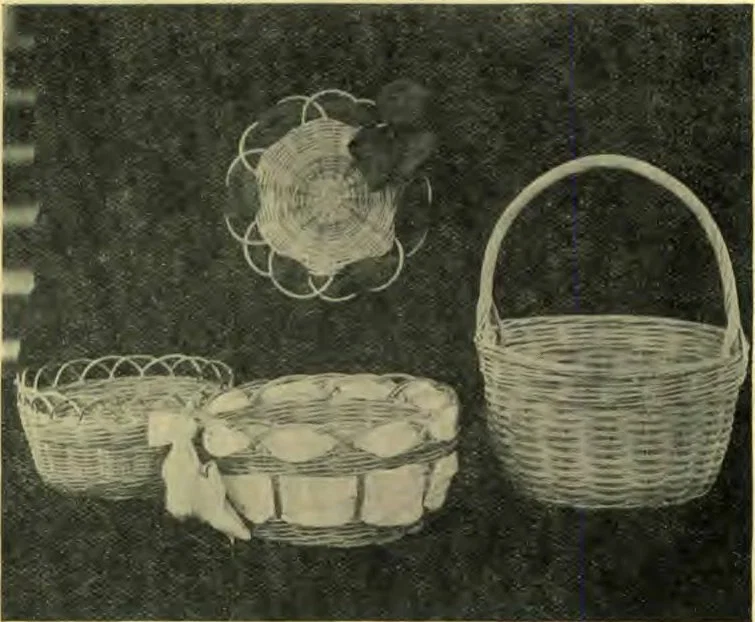
These articles were made wholly from the directions in the articles on Basket Making. The young lady had had no previous instruction in such work.
There is, for instance, the story of “Carrots.” Carrots was an awkward, most unprepossessing boy, whose red hair had won him his name. He had never known a father, and it would have been better if he had never known his mother. He was only seven when she turned him adrift, and in the four years that followed, he was newsboy, bootblack, vender of matches—anything that turned up. He rarely earned enough to buy both food and lodging, so that most of the time he “slept out” in Covent Garden Market or somewhere in the Billingsgate Market. After four years of this life he heard of the Barnardo Homes, and begged for admission. He was told that he could be admitted in a week.
A few mornings later some men, moving a large sugar cask, found two boys there. One waked at the movement, but the other did not stir or answer when he was spoken to. It was Carrots,—dead, the jury declared, from exhaustion, the result of frequent exposure and want of food.
Poor little eleven-year-old martyr! What, save the friendship of other child-outcasts like himself, had life ever given him? What place could such a pitiful little creature, ignorant, wretched, unlovely, ever have in God’s great world-purposes?
What place? The door that little Carrots’ thin hand could not open for himself! has ever since stood open for every destitute child. The ever-open door means no weak sentimentality; every case is strictly investigated, and impostors unhesitatingly turned away. But it does mean that no starving, perishing child who seeks shelter there will ever again be left uncared for even for a night. Of the little London street child, ignorant and unconscious though he was, that was true which has been true of the martyrs of all ages, as in divinest sense it was true of the Master whom some of them never knew—he saved others, himself he could not save.
A useless life? Thank God, no life is so poor, so ignorant, so helpless or hopeless, that he can not, through it, bless the world!—Selected.
March Fourth
THE inauguration of Theodore Roosevelt as president of the United States is a thing of the past. Four years of earnest work now is his. Those who have never been in Washington at the time of an inauguration can scarcely appreciate the elaborate preparations that are made for the event. The government, however, makes no provision for the inauguration, but the necessary preparations are all left to the city of Washington. Congress is considering the advisability of managing the affair itself, thus making it official, instead of a private enterprise. Such a change would not seem inappropriate.
The chairman of the national committee of the party that won in the election, names the chairman of the inaugural committee, and the chairman selects his own assistants. The question of funds is one of the first points to receive attention. This is usually settled by a half hundred or more of Washington’s patriotic citizens guaranteeing the expenses. This year the committee so ably managed the financial part of the inauguration that a surplus of several thousand dollars is on hand, to be used, doubtless, in the erection of a permanent inaugural hall in the city.
More than one hundred thousand visitors, it is claimed, were in the city at the time of the inauguration. Mr. Roosevelt’s unique, forceful, and attractive personality doubtless was responsible for so large a company of visitors. “It was Theodore Roosevelt,” says the Washington Post, “that the people came to see, rather than the president of the United States.”
Large reviewing stands had been built along the main avenue, and these, with every building on the avenue, were handsomely decorated. The city furnished a very large number of flags to be used by any who would properly display them. Not a window could be seen for miles from which some evidence of patriotism did not float. Seats in the reviewing stands were sold for sums not exceeding five dollars. The president’s stand was erected on the very spot where President Johnson and Generals Grant and Sherman reviewed the armies of the Union in 1865.
The inauguration ceremony being held out of doors, the weather conditions became a very practical and absorbing theme to all concerned. It is said that only about one out of four inauguration days is bright and sunny; one is fair, and the other two are exceedingly disagreeable days. March 4, 1905, dawned bright and fair; but the blue soon changed to gray, and from the gray blew a chilling gale. The senior senator from Tennessee, Senator Bate, died a few days after7the inauguration from a cold contracted from the winds that swept across the inaugural stand.
Vice-President Fairbanks was sworn into office in the senate-chamber before the inauguration. The President, members of the Supreme Court, diplomatic corps, and other distinguished visitors were present. Mr. Fairbanks is a man of strength in the Senate. It may be of interest to some to know that he is the owner of the Fairbanks’ scales, his father being the inventor. These have brought him great wealth. Mr. Fairbanks’ name has already been suggested as a possible candidate for the presidency in 1908. Immediately following the exercises in the Senate, the President, with Chief Justice Fuller, repaired to the stand outside. After delivering his inaugural address, the oath of office was administered by the chief justice. The exercises were brief, and at the close of them the President’s carriage started for the White House. Pennsylvania Avenue at once became the center of interest. From the stand in front of the executive mansion the President reviewed the parade. For more than three hours there marched in front of him a procession consisting of nearly forty thousand men. The parade was chiefly military, yet there were several interesting departures. Indian chiefs, a company of schoolboys from the Carlyle Indian school, cowboys from South Dakota, men dressed as Uncle Sam, and little boys and girls in the national colors, a company of citizens from the President’s county in New York, made interesting variations to the martial effect. Governors from fifteen States were present at the inauguration, some of whom led the military organizations from their States. The President’s continuous smiles well expressed his pleasure and appreciation of the day’s proceedings.
In the evening there was an elaborate display of fireworks; also the inaugural reception, which was held in the pension building. For several days before the inauguration the government employees of the Pension Office gave up their work so that the building could be cleared of desks and chairs, and then suitably decorated. Within this immense building—two hundred by four hundred feet—is a vast court with lofty roof of iron and glass. Surrounding the court are three galleries, and tiers of offices. An attractive feature of the architecture of the room is the two rows of supporting columns, three in a row. Each of the immense pillars appears to be made of one solid piece of polished marble, with gold capitals and bases. The floral decorations were both rich and artistic, and under the light of the electrical display made a picture quite satisfying. Ten thousand men and women handsomely attired completed the brilliant spectacle. The reception tickets sold for five dollars each. There were no complimentary tickets; even the President insisted on purchasing his, as the sale of the tickets is used for defraying the inaugural expenses.
MEMORY VERSE: “When they had heard the king, they departed; and, lo, the star, which they saw in the east, went before them, till it came and stood over where the young child was.” Verse 9.
“Now when Jesus was born in Bethlehem of Judea in the days of Herod the king, behold, there came wise men from the east to Jerusalem; saying, Where is he that is born King of the Jews? for we have seen his star in the east, and are come to worship him.
“When Herod the king had heard these things, he was troubled, and all Jerusalem with him. And when he had gathered all the chief priests and scribes of the people together, he demanded of them where Christ should be born. And they said unto him, In Bethlehem of Judea: for thus it is written by the prophet, And thou Bethlehem, in the land of Juda, art not the least among the princes of Juda: for out of thee shall come a Governor, that shall rule my people Israel.
“Then Herod, when he had privily called the wise men, inquired of them diligently what time the star appeared. And he sent them to Bethlehem, and said, Go and search diligently for the young child; and when ye have found him, bring me word again, that I may come and worship him also.
“When they had heard the king, they departed; and, lo, the star, which they saw in the east, went before them, till it came and stood over where the young child was. When they saw the star, they rejoiced with exceeding great joy.
“And when they were come into the house, they saw the young child with Mary his mother, and fell down, and worshiped him: and when they had opened their treasures, they presented unto him gifts; gold, and frankincense, and myrrh. And being warned of God in a dream that they should not return to Herod, they departed into their own country another way.
“And when they were departed, behold, the angel of the Lord appeareth to Joseph in a dream, saying, Arise, and take the young child and his mother, and flee into Egypt, and be thou there until I bring thee word: for Herod will seek the young child to destroy him. When he arose, he took the young child and his mother by night, and departed into Egypt: and was there until the death of Herod: that it might be fulfilled which was spoken of the Lord by the prophet, saying, Out of Egypt have I called my son.
“Then Herod, when he saw that he was mocked of the wise men, was exceeding wroth, and sent forth, and slew all the children that were in Bethlehem, and in all the coasts thereof, from two years old and under, according to the time which he had diligently inquired of the wise men. Then was fulfilled that which was spoken by Jeremy the prophet, saying, In Rama was there a voice heard, lamentation, and weeping, and great mourning, Rachel weeping for her children, and would not be comforted, because they are not.
“But when Herod was dead, behold, an angel of the Lord appeareth in a dream to Joseph in Egypt, saying, Arise, and take the young child and his mother, and go into the land of Israel: for they are dead which sought the young child’s life.
“And he arose, and took the young child and his mother, and came into the land of Israel. But when he heard that Archelaus did reign in Judea in the room of his father Herod, he was afraid to go thither: notwithstanding, being warned of God in a dream, he turned aside into the parts of Galilee: and he came and dwelt in a city called Nazareth: that it might be fulfilled which was spoken by the prophets, He shall be called a Nazarene.”
Questions
1. Near what village was Jesus born? Who came to Jerusalem seeking Jesus? What question did they ask? What did they say they had seen?
2. Why was Herod troubled when he heard these things? Whom did he call together? What did he ask these learned men? How did they answer? What prophecy did they read to him?
3. For whom did Herod then send? What did he ask them? What did he command them to do?
4. When the wise men started again on their journey, what went before them? Where did it stand still? When they had entered the place, whom did they see? What did they do when they saw Jesus? What did they give to him?
5. What warning did the wise men receive? When they had gone away, who appeared to Joseph? What was Joseph told to do? Why?
6. Where did Joseph take the child Jesus and his mother? What prophecy was fulfilled by their stay in Egypt?
7. When Herod saw that the wise men did not return to him, how did he feel? What cruel order did he give? What did he thus expect to do? What words of the prophet Jeremiah were thus fulfilled?
8. When Joseph had lived a few years in Egypt, who again appeared to him? What did the angel say? Where did Joseph then go? What warning did he receive on the way? In what city did he dwell? What word of the prophet was thus fulfilled?
9. Notice the prophecies relating to Jesus in this lesson, and tell where each is found.
II—The State of the Dead
(April 8)
MEMORY VERSE: “As for me, I will behold thy face in righteousness: I shall be satisfied, when I awake, with thy likeness.” Ps. 17:15.
Questions
1. By what was death brought into the world? Rom. 5:12.
2. When were Adam and Eve warned that transgression would bring death? What was this warning? Gen. 2:17.
3. Who disputed God’s word? What did he say? Gen. 3:1-4; note.
14. When did the psalmist expect to behold the face of his God? Ps. 17:15.
15. What comforting promise did Jesus leave with his disciples? John 14:1-3.
16. Whence will the righteous be gathered when Jesus comes? 1 Thess. 4:13-17.
Note
The Lord warned man that the penalty for sin is death. Satan plainly contradicted the word of God, by stating that man would not die, but be “as God, knowing good and evil.” The doctrine, therefore, of consciousness in death had its origin wholly from this declaration of Satan in Eden. To make good his statement, “Ye shall not surely die,” he has filled the world with the false idea of an immortal soul which survives the stroke of death, and continues to live in consciousness separate from the body.
The Letter Box
Ridgefield, Wash., Jan. 15, 1905.
Dear Editor: I enjoy reading the Youth’s Instructor very much. I do not take the paper myself, but get it at Sabbath-school.
My father and I are the only Sabbath-keepers here. I have four brothers dead, and three living. They are young men. My mother died when I was eight years old. I am thirteen years of age. Pray for me, that I may be the means of leading my brothers into the truth. I am going to church-school, and am in the fifth grade. My school-teacher’s name is Miss Ruth Watson, and my Sabbath-school teacher’s name is Mr. Wilkinson.
Esther E. Soules.
Harrison, Idaho, Jan. 15, 1905.
Dear Editor: I enjoy reading the Youth’s Instructor. I like the articles on “Good Manners” very much. We live eight miles from town. My mother is an Adventist, but my father is not. I have two brothers and two sisters.
There is no Sabbath-school near here, so we have Sabbath-school at home. We learn our lesson from the Youth’s Lesson in the Instructor. We live on Cœur d’Alene Lake, and have beautiful lake and mountain scenery. I am fourteen years old.
I hope I may meet you all in the new earth. Pray for me.
Bessie Sumner.
Briggsdale, Ohio, Jan. 21, 1905.
Dear Editor: I just love to read the nice stories in the Instructor every Sabbath afternoon. I go to Sabbath-school and church. I am a boy twelve years old. I have a sister and a brother younger than I. Their names are Lucile and George. Lucile is eleven years old, and George is seven years old. My father will not let me go to public school, and there is no church-school at Columbus, so I do not go at all. We have a nice horse; her name is Daisy. She is a great pet. My father and mother both keep the Sabbath. I would like to hear from some of the Instructor readers. I would like to have this published sure, please. My father is deacon in the church. I hope to hear from some of the readers, and to see my letter in the Instructor next Sabbath, January 28.
Theodore S. Dunham.
P. S.—I want to say something for Jesus. I want to say that I love him very much, and I know that he loves me.
Fillion, Mich., Jan. 16, 1905.
Dear Editor: I have received the Instructor weekly, and was much pleased to get it.
I have been especially interested in the reading. I have two sisters, two brothers, and a mother keeping the Sabbath. We hold our Sabbath-school at our neighbor’s house, as we are a long way from the church.
There are nine in our school, and we hope to have more. Mrs. Gooderham is my teacher, and she makes our lesson very interesting. There are six in my class.
I have been keeping the Sabbath for over four months. I am sixteen years old, and I wish to go to some of our schools in the near future. My desire is to be a nurse.
I have a father and four brothers, but they do not keep the Sabbath, and I ask all who take the Youth’s Instructor to pray for them, that they may do what God wants them to do.
I also ask them to pray for my dear ones and myself, that we may prove faithful to the end, and meet one another in the world made new.
I am sorry to say I shall not want the Youth’s Instructor any longer, as I am going in the Bible Class; but hope to get some one else who will be interested to get it.
Louise Crampton.
I am glad Miss Louise is thinking of attending one of our training-schools. They offer many opportunities to our young people. The nurses’ work is a good work, and I am glad she has chosen it for her life-work. But allow me to whisper one word: I can’t see, Miss Louise, how you can get along without the Instructor. It is a paper meant for all our young people. It helps to keep them in touch with the work and with one another. I know men and women with gray hair, intelligent men and women, who enjoy the Instructor, and claim to receive benefit from reading it. Seventy-five cents is a small sum for a paper filled every week with good articles. A single article often is worth many times the subscription price of the paper.
We must all remember to pray for Esther in her work of holding up the light of truth in her life. I think Miss Bessie is favored in having a home near both the water and the mountains. If she reads aright and remembers all the lessons God has written for her in her picturesque surroundings, she will have the purity and strength of a beautiful young womanhood.
Master Theodore can learn much without books, if he keeps his eyes and ears wide open. And he can learn much from books, without being in school, if he really thinks it is worth while. I am sorry that letters can not appear more promptly in the Letter Box corner. But all must remember that there are scores of little people who enjoy writing; so each one must gracefully take his place in the line, and “meekly wait, and murmur not,” until his turn comes.
Unveiling of Miss Willard’s Statue
STATUARY HALL in the Capitol at Washington, D. C., is dedicated to the States, each one being requested to send statues of two of its most gifted men. There are at present in the hall thirty-four life-size figures; but not until Feb. 7, 1905, was a statue of a lady offered by any State. On that day Illinois unveiled the statue of Frances E. Willard. The affection and regard in which the memory of Miss Willard is held by the people of Illinois, and the honor conferred upon her by the placing of her statue in the Capitol, will be better appreciated if one stops to think of the illustrious names that Illinois passed over by choosing Miss Willard as the one to be honored. Lincoln, Douglas, Trumbull, Yates, Baker, Browning, Grant, John A. Logan, and many others worthily challenged recognition.
At the time of unveiling the statue, hundreds of school children in procession covered it with flowers, and many women paid their tribute by the silent tear. Exercises were held in both houses of Congress. Senators and representatives by thrilling speeches paid a high tribute to the character and work of Miss Willard as student, teacher, woman, orator, organizer, and philanthropist; in all of which capacities she served the world as president of the Woman’s Christian Temperance Union.
Senator Dolliver said: “I think the highest point in the public career of the late Senator Hanna was that last speech of his before a meeting of laboring men and capitalists belonging to the Civic Federation in New York. He there laid down the proposition, based on a long experience as a laborer and an employer, and on an intimate acquaintance with the leaders of political thought in all parties, that the rights of labor and the rights of capital can never be established on a lasting basis of justice except as both bow in loyal obedience to the law of Christ. Frances E. Willard had, for twenty years before her death, taught that doctrine, not only in its application to the labor question, but to all the complex social problems of these times.”
The individual surrender of the heart to the law or will of Christ is the only solution to the gigantic evils that are filling the world with fear and terrible perplexity. We need now, more than ever before, many voices to proclaim with even greater power than Miss Willard’s that “law of Christ” throughout the earth. Would that all Christians would earnestly espouse this cause.
Worth Remembering
“FOLLOW the path of duty, and leave results with God.”
THE teaching of nature is as varied and infinite as it is constant.
“IF a man’s vocation brings him happiness, he has won a fortune by it.”
MANNERS are not gloves to be put on and off at will.—Margaret E. Sangster.
“ONE secret of successful labor is being found in the right place at the right time.”