Your ShelfYour Projects

The Youth’s Instructor, Vol. 43, No. 5.

THE GREAT WALL OF CHINA

The Youth’s Instructor

Jan 31, 1895

S. D. A. Publishing Association · Battle Creek, Mich. · Jan 31, 1895

THE GREAT WALL OF CHINA.
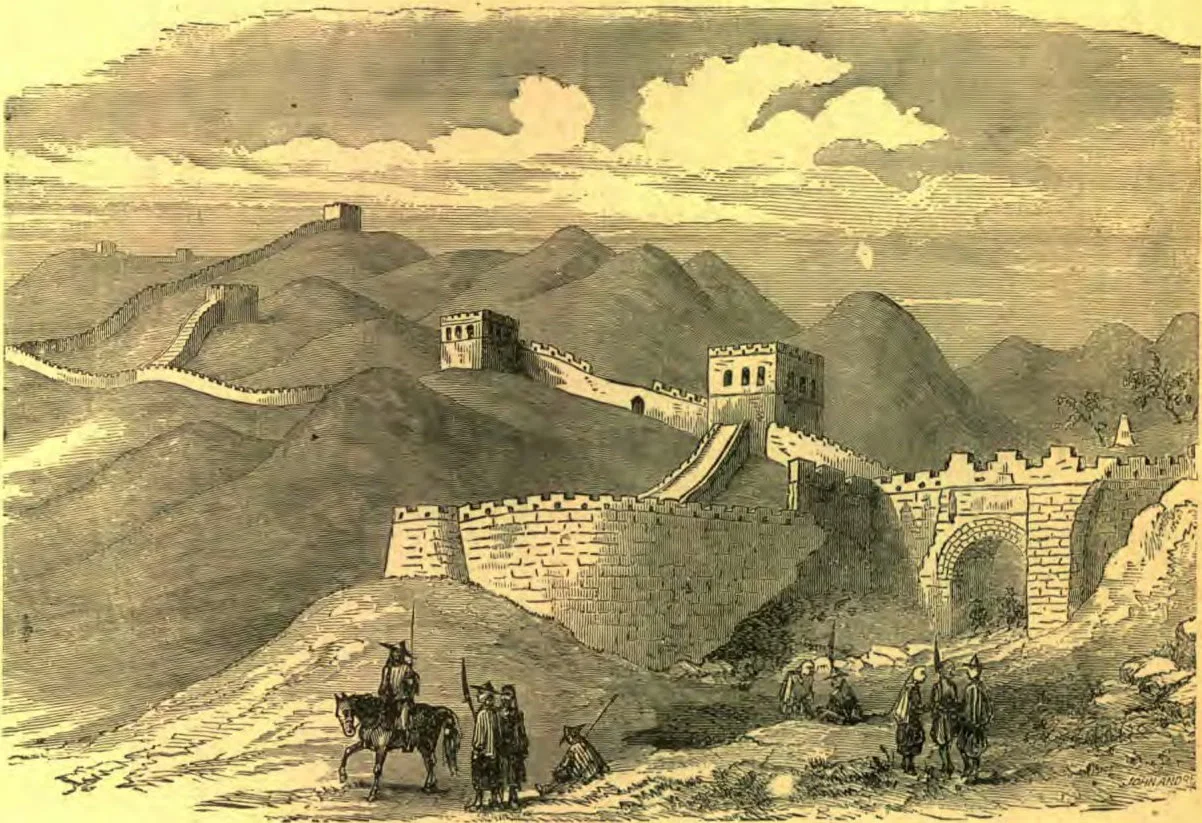
WHILE the present experiences of China in its war with Japan place its people in a not at all enviable light before the world, it is due to them to recognize their natural love of peace as well as their habits of perseverance and industry, which have characterized them from of old, and led them to rear vast structures for the generations that should come after, manifesting a persistency and patience that might well challenge the admiration of all the rest of the world. One of these monuments is the great wall of China, built within an almost incredibly short space of time, by Chi-Hoangti, the first emperor of the Tsin dynasty, about 220 B. C., now over twenty-one centuries ago, as a protection against the Tartar (more correctly Tatar) tribes, or the Hiungnu ancestors of the Mongolians,—at that time China's most terrible enemies. For Mongolia was not originally a part of the Chinese empire, as it is to-day; and so this great wall was stretched along the boundary line of the two countries from the Gulf of Liaotung, north of Tin-yu at the northern extremity of the Yellow Sea, over mountains and across valleys and plains, away to the river Thola at the extreme northwest border of China, a straight distance of nearly thirteen hundred miles. The actual length of the wall was no doubt at least two thousand miles, counting various sinuosities and the double and triple walls in some places,—as, for instance, north of the provinces of Pechili and Shansi.
THE GREAT WALL OF CHINA.
Every foot of the foundation of this immense structure was of solid granite, the sides brick, and the interior filled with earth. Including the parapet, or breastworks, its average height, as well as its mean width, was over twenty feet, the base being about twenty-five, and the top averaging fifteen feet in breadth. Others give the average height at thirty feet, no doubt counting in the height of the bastions, or towers, which were found at intervals of about one hundred yards, rising from twenty-five to fifty feet above the ground, being forty feet square at the base and thirty feet square at the summit. Between these towers along the top of the wall were breastworks on both sides, so that the defending forces could pass from one tower to another without being exposed to an enemy from either side. In some few places the wall is built up against a precipice, having a descent of one thousand feet or more. Small streams are arched over; on larger ones the wall runs to the water's edge, the end being crowned by a tower, and then begins again with a tower on the other side. Scattered all along the top of the wall were sentinels within communicating distance of one another, so that no enemies could approach without having their arrival signaled all along the frontier. Every gate in the wall had its garrison, and every mountain-pass through which the wall was built had its military camp. In the vicinity of the wall towns were built and agriculture developed, all along the line, in order to supply the needs of the soldiery at the shortest notice.
When we consider the fact that this wall must, with the dimensions as above given, have contained over one hundred and sixty million cubic meters of solid masonry, we may gain some slight conception of the enormous amount of labor put forth in its erection. Several hundred thousand men are believed to have perished while at work in its construction, so that it cost as much in human lives and treasures as a great war, but may nevertheless justly be regarded as the greatest work ever wrought by human hands, the Grand Canal of China and the Pyramids of Egypt not excepted.
And no doubt to ancient China the wall, in spite of all it cost, was worth more by far than ever it took to rear it, since the hordes of Mongolians must have found in it an insurmountable barrier for a great many centuries, thus putting an effective stop to their marauding expeditions in the direction of China; and should the theory be true, which is at least quite probable, that the Huns and the Hiungnu Tartars have the same origin, it will account for their appearance in the west, after their way in Asia had been thus effectually barred.
The end of the great value of this wall was destined to come, however, when Jengis Khan, that is, “the greatest chief” (1164-1227 A. D.), the great conqueror of Asia,—whose path is said to have been strewn with at least five million dead,—forced his way into China through this mighty rampart (1210 A. D.), took Pekin (1215 A. D.), and in a few years gained possession of the northern provinces. From this time on the wall ceased forever to be of any strategic value. For long stretches it has now almost wholly disappeared. Millions of tons of material have been torn from it, and deported for other purposes; and what may still be seen of it is mere patchwork compared with the original structure. And yet the time had been when it was a crime punishable with death to so much as scratch it with a pin; but those days will never come again.
In closing, we would again remind the thoughtful reader that this wall was evidently built in the interests of peace; and surely a nation which can rear such a stupendous work as that to avoid the horrors of war and protect their people from barbarian assaults, is deserving of respect. A people so diligent, industrious, and frugal as the Chinese have again and again shown themselves to be, deserve better treatment than they have received even from those who consider themselves their betters, and style themselves Christians,—no to mention their pagan neighbors at all.
A. K.

THE WALK OF TIME.

By sound we never Know his walk, Nor do we ever Hear him talk. He is patient as the humblest slave, And silent as the seaman's grave Beneath the wave!
We see his footprints In the light; We know his shadow By the night. O wonderful is Father Time, With his stately walk, through zone and clime, O'er the sands of Time!
At his step the days Grow warm or cold, Yea, we ourselves Are growing old! We may think to change the law of Time, But still he walks, firm and sublime— Old Father Time.
MRS. HULDA WARD.

ARMENIA

The Armenians are an ancient Christian people occupying chiefly a plateau and mountain country to the eastward of Asia Minor, about five hundred miles square. For many centuries they have maintained their faith, through wars and persecutions, against Mussulman or pagan nations all around them. They have an ancient language, with an alphabet of its own, to which they have also clung tenaciously.
Their country is now divided between Russia, Turkey, and Persia. By far the greater number of the Armenians—who are estimated all together to number between four and five million—live in the Turkish dominions; a million or more are under the sway of the Russian czar.
Three Armenian provinces, including the fortress of Kars, were taken by Russia from Turkey in the war of 1877–78. The Russian Armenians have been considerably favored by the government, and also considerably “Russianized.” Yet they are permitted to practise their own form of religion without hindrance.
The Armenians whose troubles are now attracting attention are the Turkish Armenians. They have long been oppressed by Turkish rulers, and plundered by their wild Kurdish and Circassian neighbors, who are nominal Mussulmans, and are encouraged by the Turks.
When the European powers intervened in behalf of Turkey against Russia in 1878, England entered into a special agreement with Turkey, under which England guaranteed to the Turks their possessions in Asia, and Turkey promised to introduce governmental reforms in Armenia, and to protect the Armenians against the plundering Kurds and Circassians.
It is asserted by the Armenians that the Turks have never kept these promises, but on the contrary, have been more oppressive than ever, and have winked at repeated Kurdish outrages. It is certain that the Turkish government has greatly restricted the privileges of the Armenian patriarch in Constantinople, has prohibited the printing of the Armenian ritual, and has colonized Mussulman settlers in Armenia against the protest of the Armenians.
A revolutionary party, fostered by Turkish misrule, has grown up among the Armenians. Its nucleus is a secret patriotic society which is alleged to have destructive and even revolutionary purposes. Moreover, the members of a large party of the Turkish Armenians look to Russia as their deliverer.
Others among them fear that their annexation to Russia would extinguish the spirit of nationality which they have kept alive so many centuries, and merge them hopelessly in the great Russian nation. They demand political autonomy under Turkish suzerainty.
Recently there have been collisions and bloodshed between Turkish troops and the Armenians. Very conflicting accounts have been given of these troubles. The Armenians complain of wanton massacres of their people. The Turkish authorities, on the other hand, declare that all the Armenian blood shed has been that of insurgents with arms in their hands.
The United States government has undertaken, through one of its consuls in Turkey, to investigate these reports. At the same time, the leading European powers are conducting a joint inquiry, with the concurrence of the Turkish government. Our government intervenes chiefly because many Armenians who have become American citizens have been imprisoned on returning to Turkey, but also because there has been violent interference with some of the schools which American missionaries have established among the Armenians.
The Armenians are an emigrating people. They are scattered through Europe, and several thousands of them are established in the United States. They are industrious and enterprising, and everywhere succeed in attracting attention to their nationality.—Youth’s Companion.

JAPANESE TROOPS.

REAR-ADMIRAL BELKNAP, of our navy, now in retirement, says:— “There is not one incident of personal prowess or of individual valor in the annals of England, that may not be matched by a similar deed of courage and heroism in the annals of Japan. The great sea-fight of Dem-No-Ura was as significant as and more hotly contested than the battle of Trafalgar. No British force has ever met on the field of battle an Oriental race at all the equal of the Japanese in martial character and intrepid spirit. Her army to-day is the equal of the British army in organization and equipment; superior to it in homogeneity, mobility, and discipline. She has seen this long while the British squeeze upon the throat of China, and the brutal means used to accomplish it, and she does not mean that such fate shall overtake her, if stout hearts and strong arms can prevent it. No British minister will hereafter attempt to enact the meddling and menacing part of a Parkes at Tokio, nor will any British fleet bombard with impunity a second Tengoshima. The sun does not shine on a more determined or intrepid race than that of Japan. The martial spirit of Japan antedates that of Britain; and hereafter, whether on land or sea, the arch-robber of the universe will find all she cares to meet if she comes into hostile contact with the forces of Dai Nippon.”

Prehistoric Mound-Builder Village Found at Itasca Lake

In the Annual Report of J. V. Brower, commissioner of the Itasca state park, Minn., filed Dec. 5, 1894, he makes public a very interesting prehistoric find in these words:—
“On October 27 last I discovered and located on the shores of Itasca Lake the unmistakable remains and relics of a lost village of prehistoric mound-builders. Stone and copper implements, and a curious and miscellaneous collection of broken pottery, were taken from the mound. It would appear that this lost village was nearly a half mile in length, and the fact that the deposit of relics is found below the present surface of the earth several inches, seems to justify the belief that this extinct race of men discovered and resided at Itasca Lake many centuries ago.”

A REMARKABLE MIRAGE.

The people of Port Huron in this state witnessed a remarkable mirage on December 25, showing the Canadian bank of the St. Clair River for about thirteen miles, and both banks from Marysville to what is known as Mc Gregor’s Point, a mile below the Oakland House. At 7:30 o’clock in the morning, on looking to the south, Port Huron people could see Sarnia reflected in the clouds, and even the ferryboats as they crossed the river. The frame houses stood out boldly, making an exceedingly pretty panorama. Following along to the west, Stag Island appeared, and from there to a point a mile below the Oakland House both banks of the St. Clair River were visible. St. Clair City was so plainly outlined upon the sky that even the smoke could be seen ascending from the tops of several smoke-stacks. The mirage was visible for more than an hour.

WORK OF THE LIFE-SAVING STATIONS.

The record of the government life-saving service for the past year has been exceedingly gratifying. The number of disasters has been greater than in any previous year in the history of the present system. Superintendent Kimball, of the Service, states that three hundred and eighty vessels in distress have received help. The total number of passengers on these vessels was four thousand and fifty-four, of whom three thousand nine hundred and ninety-three have been saved, and but sixty-one of whom have been lost. The shipwrecked persons to receive shelter at the various stations along the coast number six hundred and fifty-eight, and some eighty-three lives have been saved among those who have fallen from wharves or bridges. The value of the vessels and cargoes in distress is estimated at ten million dollars, and of this amount seven million six hundred and eighty-eight thousand dollars have been saved. The cost of maintaining the system for the year has been one million two hundred and fifty thousand dollars, and the work has been considerably improved and extended.
— Scientific American.

CANAL TRACTION IN EUROPE.

In a paper on boat traction on canals, presented to the Paris Academie des Sciences, M. Maurice Levy states that the cable system has given excellent results in an experimental installation tried on a three-mile length of canal in the suburbs of Paris. A somewhat similar plant, erected by the German government on the Oder and Spree canal, has been less successful. The winding engines should, M. Levy states, be placed twenty-five miles apart where the traffic is one million tons per annum; for two million tons, they should be placed at about twenty miles apart; for three million tons, at about sixteen and a half miles apart; and for four million tons, at about fourteen miles apart. The system is not economical for a traffic smaller than one million two hundred thousand tons per annum. The first cost of the system is about eight thousand dollars a mile.

Lichens and Their Endurance of Cold

LICHENS endure greater cold than any other plant.

THE SUBMARINE DETECTOR.

This instrument and its use are thus described in the London Electrical Review:—
“The apparatus is based on the principle of Professor Hughes’s induction balance, and it consists simply of an electrical arrangement contained in a small mahogany box, which is carried on board the searching vessel, and a sinker, which is trailed along the bottom. The sinker also contains an electrical arrangement, and is connected with that in the box by a light electrical cable of any required length. The apparatus includes a small battery and an automatic contact breaker, which opens and closes the battery circuit at short intervals. The battery circuit includes two primary coils, one in the box and the other in the sinker. Each primary coil has its secondary coil, and both the primaries and secondaries are respectively connected up by conductors, which are inclosed in the suspending cable. In the searching vessel there is a telephone, which is included in the secondary circuit.
“The apparatus is adjusted so that under ordinary circumstances there is silence in the telephone. When, however, the sinker approaches a mass of metal, the balance is upset, and sounds become audible in the telephone, while these are reduced in intensity as the sinker recedes from the metallic object. Three hundred-feet of electrical cable were employed with the detector in searching for the “Rusalka,” and the depths searched varied from fifteen to fifty fathoms. The search was continued for several weeks, and the exact position of the foundered vessel was at length placed beyond all question, as every time the searching steamer passed over a given spot the electric indicator of the detector sounded loudly, thus affording evidence that a large mass of metal was submerged below. After the vessel had been located, the divers descended and examined her, the result of their examination being, so far as is at present known, that she had foundered through serious damage to her stern.”

INTERESTING RUINS OF CLIFF-DWELLERS.

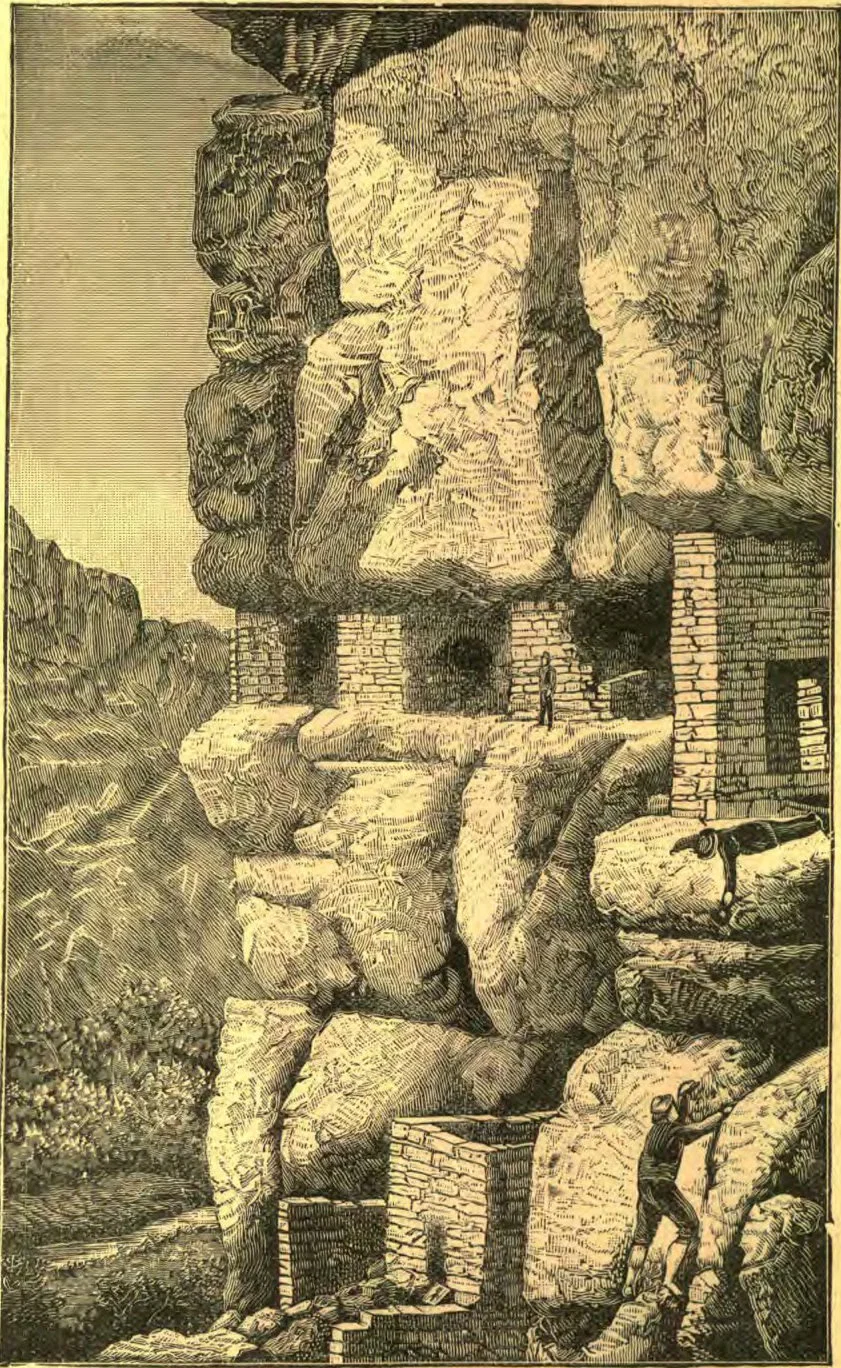
RUINS OF THE CLIFF-DWELLERS IN ARIZONA.
A LATE issue of a leading scientific paper tells of the ruins of a very interesting city of cliff-dwellers which have recently been discovered among the Bradshaw Mountains of Arizona. The place is situated high up on the terraced bank of Willow Canyon, and is estimated to comprise two hundred and sixty buildings in a fair state of preservation. Like most of the cities of these strange people, it stands in an almost inaccessible position. A series of narrow steps cut in the rock in the side of the canyon probably provided means of ascent and descent. Only a few of the buildings have been explored, and these were found to contain large quantities of pottery. The most interesting discovery, however, was of a number of crude agricultural instruments. This is the first proof of any value that the cliff-dwellers cultivated the soil. The canyon in front of the ruins of the city is one half a mile in width, and gives evidence of having been cultivated at some remote period. A man’s skeleton, four feet eight inches in length, was also discovered. An exploring party is fitting out to make a thorough investigation of the ruins.

HOW A TORTOISE WHIPPED RATS.

The following unique story is told by the Philadelphia Press, and serves well to illustrate innate instincts in animals placed there by the Creator for their protection against aggressors:—
“A tortoise which was a most unique attraction some years ago at Parkersburg, W. Va., has returned after nearly three years’ absence. It is about six inches in length, and almost a perfect elipse in shape. Not many months ago the tortoise was picked up up-town, and was identified by a series of dates—the last one, 1891—carved into its shell. The tortoise has since then proved a real attraction in that locality.
“The tortoise was presented to a local merchant four or five years ago by some one who picked it up in the forest. His new owner set him down in the yard in the rear of the store, and he was forgotten until some days after his arrival, when one of the clerks heard a shrill squealing in the yard, and looking through the window, saw a strange sight. A big rat had attacked the tortoise, and was biting and scratching at him, but with all his attempts the rat failed to make any indentation whatever in the armor of his enemy. The unique sight soon attracted the clerks and customers, until even standing room was difficult to obtain.
“The big rat climbed all over the tortoise, and tried all points of vantage, but his sharp teeth merely slipped from the smooth shell. While all this was going on, the tortoise lay with feet closely gripped to the ground, while his head had been drawn in out of sight. Presently, in climbing over his antagonist, the rat stood with his hind feet in front of the place where the tortoise’s head was accustomed to be, and it was there yet; for in a second the head and neck shot out, and the horny mandibles closed with a snap on the rat’s hind legs. When the rat felt the grip, it twisted about with a squeak of pain and rage, and tried its best to get at its enemy’s head; but the shrewd tortoise had withdrawn not only its head, but the rat’s hind leg, between the upper and the under shells out of its enemy’s reach. Fight and struggle as it would, the rat failed to move the tortoise in the least. It then turned and tried to break loose; but that too was ineffectual for a minute, when it broke away, but with one leg as cleanly amputated as if cut with a knife. The rat bled to death.
“After this battle almost every day a similar one occurred. Sometimes the rats attacked the scaly gladiator in pairs, but the result was always the same—a leg amputation, a tail abbreviated, a disk of skin and flesh cleanly cleft, or an almost severed neck ended the battle. The tortoise never paid any attention to the spectators, and the rats, after getting fairly excited, paid all of their attention to their enemy. This sort of thing continued for months, until at last it appeared as if the rats had given up the war, as they entirely disappeared from that locality.”

THE DEAD SEA OF AMERICA.

The dead sea of America, or Medical Lake, as it is called, because of its medicinal qualities, is situated on the great Columbian plateau, in southern Washington. It measures a mile in length, and from a half to three quarters of a mile in width, and has a maximum depth of sixty feet. It stands at an altitude of twenty-three hundred feet above the level of the sea. The chemical composition of this lake is nearly identical with that of the Dead Sea of Palestine, and like its eastern counterpart, it is almost devoid of life, and no plant has yet been found growing near its edges.—Scientific American.

THE BASIS OF TRUE EDUCATION.

TRUE education is a grand science; for it is founded on the fear of the Lord, which is the beginning of wisdom. Christ is the greatest Teacher this world ever knew, and it is not the pleasure of the Lord Jesus that the subjects of his kingdom, for whom he died, shall be educated in such a way that they will be led to place the wisdom of men in the forefront, and delegate to the wisdom of God, as revealed in his holy word, a place in the rear. True education is that which will train children and youth for the life that now is, and in reference to that which is to come; for an inheritance in that better country, even in an heavenly. They are to be trained for the country for which patriarchs and prophets looked. “These all died in faith, not having received the promises, but having seen them afar off, and were persuaded of them, and embraced them, and confessed that they were strangers and pilgrims on the earth. For they that say such things declare plainly that they seek a country. And truly, if they had been mindful of that country from whence they came out, they might have had opportunity to have returned. But now they desire a better country, that is, an heavenly: wherefore God is not ashamed to be called their God, for he hath prepared for them a city.”
The general method of educating the youth does not meet the standard of true education. Infidel sentiments are interwoven in the matter placed in school books, and the oracles of God are placed in a questionable or even an objectionable light. Thus the minds of the youth become familiar with Satan’s suggestions, and the doubts once entertained become to those who entertain them, assured facts, and scientific research is made misleading on account of the way its discoveries are interpreted and perverted. Men take it upon themselves to rein up the word of God before a finite tribunal, and sentence is pronounced upon the inspiration of God according to finite measurement, and the truth of God is made to appear as a thing uncertain before the records of science. These false educators exalt nature above nature’s God, and above the Author of all true science. At the very time when teachers should have been firm and unwavering in their testimony, at the very time when it should have been made manifest that their souls were riveted to the eternal Rock, when they should have been able to inspire faith in those who were doubting, they made admission of their own uncertainty as to whether the word of God or the discoveries of science, falsely so called, were true. Those who were truly conscientious have been made to waver in their faith because of the hesitation of those who were professed expositors of the Bible when they dealt with the living oracles. Satan has taken advantage of the uncertainty of the mind, and through unseen agencies, he has crowded in his sophistries, and has caused men to become befogged in the mists of skepticism.
Learned men have given lectures in which have been mingled truth and error; but they have unbalanced the minds of those who leaned toward error instead of toward truth. The nicely-woven sophistries of the so-called wise men have a charm for a certain class of students; but the impression that these lectures leave upon the mind is that the God of nature is restricted by his own laws. The immutability of nature has been largely dwelt upon, and skeptical theories have been readily adopted by those whose minds chose the atmosphere of doubt, because they were not in harmony with God’s holy law, the foundation of his government in heaven and earth. Their natural tendency to evil made it easy for them to choose false paths, and to doubt the reliability of both the Old and the New Testament’s records and history. Poisoned with error themselves, they have watched every opportunity to sow the seeds of doubt in other minds. Nature is exalted above the God of nature, and the simplicity of faith is destroyed; for the foundation of faith is made to appear uncertain. Befogged in skepticism, the minds of those who doubt are left to beat on the rocks of infidelity.
MRS. E. G. WHITE.

REFUSED OR ACCEPTED?

IN TWO PARTS.—PART I.

“Go thy way for this time; when I have a convenient season, I will call for thee.” Acts 24: 25.
These words were spoken over eighteen hundred years ago, by a man of high standing in this world,—one whom the people called great. He had heard from the lips of the man of God wondrous truths; and he was eager to hear more. As Paul rehearsed to him the history of the fall of man through disobedience, which must end in eternal death, unless a remedy could be found; as he told how God, for his great love to man, had provided a Saviour, even his only begotten Son, to die in man’s stead, so that, though man should die as a consequence of sin, he might live again; and as he proclaimed that the Saviour had indeed come to this earth, and died, and arisen again, and was even then in heaven preparing places for all who would trust in him for salvation, Felix trembled, and answered: “Go thy way for this time; when I have a convenient season, I will call for thee.”
Can the readers of this paper tell me if that “convenient season” ever came; and if so, was it improved? Did Felix ever call for Paul again, that he might hear more about Jesus?—Ah no! To be sure, “he sent for him the oftener,” the sacred record says (Acts 24: 26), but it was in the selfish hope simply “that money should have been given him of Paul.” God’s blessed Spirit had knocked at the door of Felix’s heart once, and had he yielded to its gentle pleadings, he might have become one of those who will be saved from the “second death.”
While reading this text, this morning, my heart went out after those who, like Felix, are saying to the Spirit’s call, “Go thy way for this time.” My dear young friends, let me say to you, If you only realized what you are doing when in your heart you say these words, it seems to me you would be more cautious.
The Holy Spirit is a gift from God to his children. When Jesus was about to leave this world, he told his disciples that when he went back to heaven, his Father would send the Comforter, which is the Holy Spirit, to be with them always. Jesus could not stay here. He had a work to do in heaven; and the Father knew that his children could not live a holy life in this wicked world, without help from above; so he sent the Comforter, to be with them and guide in the right way.
But you may say, “What is that to me? I am not a child of God.” Dear youth, it is everything to you. Life or death hangs upon your heeding or disregarding this heavenly messenger; for Jesus said this Comforter would “reprove the world of sin, and of righteousness, and of judgment.” Wherefore when you are reproved of your sins, it is the work of the Holy Spirit. He is showing you your wrongs, that you may put them from you, accept Christ, and be pardoned. Do not spurn his call. Ask Jesus to help you to overcome. Leave all your sins with him, and he will give you a heart full of love instead; and you will then delight to do his will, because you love him.
Did you ever have a friend so dear that nothing could tempt you to displease him? Well, this is just the kind of love God wants to implant in your heart, and expects it from you. He has styled himself a “jealous God.” He wants your undivided love; and when you give him this, he will give you a heart that will take in all the world; that is, you will love every one, and your own dear ones with a purer love. This is a great mystery to the unconverted, but to the heart which has yielded all to God, and accepted Christ as its Saviour, it is a grand and precious truth. The great desire of your heart will then be to know and do the will of him whom you love, and to have others taste the joy that springs up in your heart. Then the Bible will be precious to you, and as you read, every word will be full of meaning, because you are a child of God, and his Spirit is leading you into all truth, as Jesus declared it would do. All this comes from listening, and heeding, the Spirit’s call.
May you decide from this moment never to disregard the gentle pleadings of the Spirit of God, and you will have help from above to carry out your decision. JULIA LOOMIS.

THE BEAUTIFUL STORY.

I HAVE heard a beautiful story, It causes me joy and delight; The Lord will soon come in his glory, Surrounded by angels of light.
There are crowns, and white robes to be given, And a home in the earth made new; And that is the beautiful story, And best of it all, it is true.
He comes to bring joy to his people, The ones that are faithful and true; He tells them to watch and be ready. Can this be said truly of you?
He comes to bring life to the sleeping; He'll bid them come forth from the tomb. There'll be no more sorrow and weeping When we are with Jesus at home.
MRS. A. L. FORBES.

GOOD MAXIMS FROM THE KEYSTONE.

A WELL-KNOWN banker says he owes his success to observing the good advice of an older friend, who told him to keep good company or none. Never be idle. Cultivate your mind. Make few promises. Live up to your engagements. Keep your own secrets. When you speak to a person, look him in the face. If any one speaks ill of you, let your life be so that no one will believe him. Live within your income. Small and steady gains bring the kind of riches that do not take wings and fly away. Earn money before you spend it. Never run into debt unless you see a sure way to get out of it. Never borrow if you can possibly avoid it. Do not marry until you are able to support a wife. Never speak evil of any one. Be just before you are generous. Save when you are young, and enjoy your savings when you are old.

Imitating Christ Rather Than Fashion

IMITATING a fashion plate is one thing, and imitating Christ is another.

God's Love Made Visible in Christ's Life

The life of Christ was God's love made visible.

LESSON 7.—THE SANCTUARY IN HEAVEN.

(February 16, 1895.)
MEMORY VERSES.— Heb. 8: 1, 2.
We have now finished our study of the earthly sanctuary. That sanctuary and its service are a great object lesson to teach us in regard to Christ and his service in the true tabernacle. Let us briefly review what we have learned about the earthly sanctuary. Supply texts to answer the following questions—from memory if you can, but supply them anyway:—
1. When and by whom was the worldly sanctuary built?
2. Of what materials was it made?
3. Into how many apartments was it divided, and what were they called?
4. What articles of furniture were made for each apartment?
5. Who were chosen to minister in the sanctuary?
6. How long did the ministration continue in the holy place without change?
7. When was the round of service concluded, and by what ceremony?
8. What was that day called?
9. When did the service of the worldly sanctuary become unavailing?
10. When was the temple destroyed?
SUGGESTIONS FOR STUDY.—1. There are so many texts in this lesson that they may be somewhat confusing to the learner unless we can classify them. Let us try. There seem to be four well-defined topics. We give them with their references. See if they appear the same to you: (a) The earthly sanctuary a pattern of the heavenly. Heb. 9: 6-12, 23, 24; Rev. 4: 5; 8: 1, 3; 11: 19; (b) The service of the earthly a type of the service of the heavenly. Heb. 4: 14, 15; 8: 1-5; (c) The priesthood of Christ. Heb. 5: 10, 11; 6: 20; 7: 1-3, 11-19, 23-28; (d) Superiority of Christ’s ministry. Heb. 7: 23-28; 9: 8-14, 25-28; 10: 1-4, 10-14. 2. Read carefully the references under the first topic, noting those expressions that you think prove the statement. Just imagine that you are trying to show some one that the earthly sanctuary is a type of the heavenly. 3. Take up the other topics in the same way, and get them all well in mind. 4. Read “Patriarchs and Prophets,” subscription edition, page 356, second paragraph, to the end of the chapter; or popular edition, page 335, second paragraph, to the end of the chapter. It will help you much in understanding the nature of Christ’s ministry.

THE EARTHLY SERVICE A PATTERN OF THE HEAVENLY.

1. Where is the Lord’s sanctuary located? Ps. 102: 19.
2. What sanctuary was a figure, or pattern, of it? Heb. 9: 8, 9, 23.
3. In what respect does the one in heaven differ from the worldly sanctuary? Verse 11.
4. What articles of furniture have been seen in the heavenly temple? Rev. 4: 5; 8: 3; 11: 19.
5. In what apartments of the earthly sanctuary were these articles kept?
6. What is said in regard to the holy places made with hands? Heb. 9: 24.

THE SERVICE OF THE EARTHLY TYPICAL OF THE SERVICE OF THE HEAVENLY.

7. Of what was the service of the Levitical priesthood an example? Heb. 8: 4, 5.
8. In how many apartments did the priests then minister?
9. Then what must we conclude concerning the ministration in the heavenly temple?
10. Who is the Minister of that sanctuary? Heb. 8: 1, 2; 4: 14.
11. What is said of his experience and character? Heb. 4: 15; 5: 7-9.

THE PRIESTHOOD OF CHRIST.

12. To what order of priesthood does he belong? Heb. 5: 10; 6: 20.
13. Who was Melchisedec? Heb. 7: 1, 2. (See note .)
14. What is said of his genealogy? Verse 3.
15. In what respect was Christ like Melchisedec? Verses 3, 15-17, 24.
16. Why could he not belong to the Levitical priesthood? Verses 13, 14.
17. Why was it necessary that he should belong to another line of priesthood? Verses 11, 19.

THE SUPERIORITY OF CHRIST’S MINISTRY.

18. Why did the service of the Levitical priesthood make nothing perfect? Heb. 9: 8-10; 10: 1-4, 11.
19. Wherein does Christ differ from the priests in the former dispensation? Heb. 7: 23-28. (See note .)
20. What is said of the blood which he offers? Heb. 9: 11-14.
21. What is said of the efficacy of his sacrifice and priestly service? Heb. 7: 27; 9: 25, 26, 28; 10: 10-14. (See note .)

NOTES.

JOHN 4:14.

As wells of water in the soul, That living waters pour. Is love of Christ to sinful heart— Renewing, cleansing every part— A well-spring gushing o’er.
Such is the love of Christ to us— A living, springing well— A joy uprising in the soul— A quiet peace beyond control, That all our fears dispel.
We slake our thirst at this sweet fount; And Christ to all will give The living water of his love, Distilling sweetly from above, Who come to him, and live.
MRS. P. ALDERMAN.

Seeking Christ With All Your Heart

EVEN though you have failed at everything else, seek Christ with all your heart, and you will succeed.

Applying Scripture to Daily Life

WE cannot get any more out of the Bible than we are willing to appropriate in our daily life.

DO YOU GIVE AS MUCH?

A BEAUTIFUL story of Christian self-sacrifice comes from the Orient:—
A missionary in Persia says that there is a woman there who wanted to give some money toward buying Bibles. She is very poor. Her husband is dead, and she has two little children and her sick mother to take care of. You may be sure there is no money in that house for candy or toys,—hardly enough for the plainest food and clothes. What do you think she did? She cut off her beautiful hair and sold it, and brought the money to the missionary. “I had nothing else to give,” she said.—Selected.
Continue reading: SOME SCRIPTURE RULES FOR LIVING