Your ShelfYour Projects

The Youth’s Instructor, Vol. 43, No. 5.

THE GREAT WALL OF CHINA
Earlier text: THE GREAT WALL OF CHINA

SOME SCRIPTURE RULES FOR LIVING.

“HONOR thy father and thy mother.” Ex. 20 : 12.
“Thou shalt not curse [abuse] the deaf, nor put a stumbling-block before the blind.” Lev. 19 : 14.
“Do no unrighteousness in judgment.” Lev. 19 : 15.
“Thou shalt rise up before the hoary head, and honor the face of the old man.” Lev. 19 : 32.
“Withhold not good from them to whom it is due, when it is in the power of thine hand to do it.” Prov. 3 : 27.
“Hear instruction, and be wise, and refuse it not.” Prov. 8 : 33.
“Rejoice not when thine enemy falleth, and let not thine heart be glad when he stumbleth.” Prov. 24 : 17.
“Set not out thy glory, . . . and stand not in the place of great men.” Prov. 25 : 6 (margin).
“Debate thy cause with thy neighbor himself, and discover not the secret of another.” Prov. 25 : 9 (margin).
“Eat so much as is sufficient for thee.” Prov. 25 : 16.
“Withdraw thy foot from thy neighbor’s house; lest he be weary of thee, and so hate thee.” Prov. 25 : 17.
“Boast not thyself of to-morrow.” Prov. 27 : 1.
“Let another man praise thee, and not thine own mouth; a stranger, and not thine own lips.” Prov. 27 : 2.
“Thine own friend, and thy father’s friend, forsake not.” Prov. 27 : 10.
“Plead the cause of the poor and needy.” Prov. 31 : 9.
“Whatsoever thy hand findeth to do, do it with thy might.” Eccl. 9 : 10.
“Judge not.” Matt. 7 : 1.
“Give to every man that asketh of thee; and of him that taketh away thy goods ask them not again.” Luke 6 : 30.
“Be kindly affectioned one to another in the love of the brethren; in honor preferring one another.” Rom. 12 : 10 (margin).
“Not slothful in business.” Rom. 12 : 11.
“Be not wise in your own conceits.” Rom. 12 : 16.
“Whether therefore ye eat, or drink, or whatsoever ye do, do all to the glory of God.” 1 Cor. 10 : 31.
“Let all your things be done with charity [love].” 1 Cor. 16 : 14.
“Let your speech be alway with grace, seasoned with salt.” Col. 4 : 6.
“Be not forgetful to entertain strangers.” Heb. 13 : 2.
“Be content with such things as ye have.” Heb. 13 : 5.
“Keep yourselves in the love of God, looking for the mercy of our Lord Jesus Christ unto eternal life.” Jude 21.

THE CORK IN THE BOTTLE.

“Rob,” called his mother from the bedroom, where she was finishing her dressing for church, “have you studied your Sabbath-school lesson this morning?”
“Bother! no!” Rob answered in an impatient tone, scarcely glancing up from the book in which he was very much interested.
“Why, Rob!” said his mother, with some astonishment. “I thought you told me you didn’t know anything about it, and I expected you would spend the hour trying to learn something.”
“I have tried, mother, as hard as ever I could, but I can’t get a bit of it into my head. Some way or other, it is so dry and stuffy that I can’t get interested in it.”
His mother at that moment came out of the bedroom, and took a glance at the situation. In an instant she saw what was the matter. Going to her room, she came back holding in her hand an empty bottle with the cork driven tightly into its mouth. She walked over to Rob, and handed it to him, saying:—
“I wish you would please take this to the kitchen sink, and fill it for me.”
Rob arose, and left his book quite reluctantly. He went to the kitchen, slamming the door behind him in a way which indicated either that he was very careless or in a very bad humor. After a little while he came back, as he entered the room exclaiming, in a tone which showed that he was out of sorts:—
“Mother, how do you suppose I am going to get water into this bottle, with the neck corked up tightly?”
“I didn’t suppose you could, Rob,” was the quiet reply.
“Then why in the world did you tell me to do it?” he demanded, half indignantly and half in wonder.
“Just to show you,” said she, “how impossible it was, and that you might understand another matter about which I heard you complaining a moment ago.”
“What was that?” asked Rob, dropping his eyes as though he half suspected.
“Why,” said his mother, “don’t you remember about the Sabbath-school lesson? You said you couldn’t get it into your head, and you threw the blame for it on the lesson, declaring that it was so dry and stuffy. But don’t you see it was simply another case of trying to pour something into a bottle while the mouth was corked?”
“Corked? What do you mean, mama?” asked Rob, now very much interested. “What corked me up?”
For answer his mother simply pointed her finger to the book which he had been reading.
“I don’t care,” half whimpered Rob. “Uncle Jack said it was a good book for a boy to read.”
“Possibly there is nothing wrong in it,” said his mother, “if you would read it at the right time; but when you use it on Sabbath morning as a cork to stop up your mind, so that the Sabbath-school lesson, which is God’s message to you, can’t get in, I think it is a clear case of a book out of place.”
Rob thought the matter over, and evidently came to the same conclusion as his mother; for presently he walked deliberately to the bookcase, and put the book in its place upon the shelf. Then, picking his Sabbath-school quarterly out from under the pile of papers and magazines on the library table, he sat himself down in his chair with a resolute look upon his face, saying to himself: “There, now the cork’s out. See if you can’t go in.”
And the bright, interested face with which he came home from Sabbath-school a couple of hours later, repeating to his mother some of the things he had learned, and some of the explanations the teacher had given, proved that attempting to fill the bottle with the cork out was an entirely different thing from attempting to fill it with the cork in.—J. F. Cowan, in Sunday-School Times.

AN ANSWERED PRAYER.

Thomas West and Ella, his wife, after many changes, and perhaps the average amount of ups and downs, had at last settled in a secluded New England town, where they owned a humble home and a small garden spot.
They were God-fearing people, and faithfully paid a tithe of their small income into the Lord’s treasury. They carried no insurance on their home, because they thought it showed want of faith to ask the Lord to preserve them from fire, and then to take out an insurance policy, thus admitting that God might not regard their prayer, after all.
The section of country was well wooded. The farmers chopped and teamed in winter, and after the early summer’s work was well under way, they would clear up the wood-lots.
Several times had Ben Hardy invited the neighbors to come to help him “burn brush”; but the weather proving unfavorable, the work had again and again been deferred. At last, one sultry morning in August, a dozen men met and started the fire; at night only a few smoldering stumps remained. The next morning there seemed no indication of an outbreak, and Ben harnessed the horse, and drove to the store, two miles away.
After the early morning had passed, a breeze sprang up, and toward noon Mrs. Hardy, flushed and breathless from running, burst into Mrs. West’s kitchen, exclaiming, “Where’s your man? Ben’s fire has broken out again, and got away from him, and there isn’t a man about here to help him fight it. The tops of the tall pines are all ablaze, and what shall we do?”
Thomas West was also away, having gone to the city that morning; but a messenger was dispatched, and soon the church-bell rang loud and clear, to alarm the townsmen, and call them out to “fight the fire.”
Mrs. West snatched her sun-bonnet, and took a narrow path which led through the garden and orchard, and up the hill. There had been no rain for weeks. Everything was dry, the grass was crisp, the leaves shriveled, and besides all that, a strong wind was now blowing from the fire toward the irregular line of houses which formed the only street of the small village.
Ella West took all this in at a glance, and as the alarm-bell echoed among the hills, she knew that before the scattered inhabitants could reach the scene of the fire, it might be too late,—the peaceful hamlet would be wiped out. Her Thomas would return at night, and find their home in ashes—they had no insurance, and no means with which to rebuild. These thoughts passed with lightning rapidity through her mind. Then she remembered the great Creator, who overrules all things, and as she passed swiftly along, she cried aloud: “O God, thou hast promised to hear the prayer of those who fear and obey thee. Thou hast promised to rebuke the devourer for their sake. O, spare our homes from the flames. Spare this thine ancient church which has stood for generations, and from which prayer and praise have ascended to thee! O, show mercy in our behalf, and send thine angel who has charge over fire!”
These broken petitions were uttered repeatedly with sobs and cries, till she stood on the brow of the hill at the edge of the pine woods which extended to Ben Hardy’s lot, and then turned toward home. As she crossed the narrow run, and entered the garden gate, peace came. She knew God had answered her humble prayer, which no human ear had heard, or heart imagined, and she thanked him in fulness of joy. She soon learned that the fire was under control.
Weeks after, when passing the blackened hillside, some one remarked: “I don’t see what ever stopped Ben Hardy’s fire. The men did not seem to be doing anything.” Mrs. West replied, in a reverent tone, “God knows,” but did not feel free to repeat her own experience at that time, lest she should do more harm than good by it; but in her own heart she felt the peaceful and blessed assurance that “the secret of the Lord is with them that fear him; and he will show them his covenant.”

STAR TIME.

'Tis star time, 'tis star time, And time to go to bed: Late eyes are sleepy eyes, And tire the little head.
Far, far the tiny feet Have wandered through the day, Chasing the butterflies, And learning games to play.
Much, much the little eyes Discovered on the road, Watching the men at work, And riding on the load.
Star time, it's star time, And time to go to bed: Now I'll smooth the pillows Beneath the sleepy head.
— New York Independent.

THE RAIN AND THE DEW.

“Thou hast fallen,” said the Dewdrop To a sister drop of rain; “But wilt thou, wedded with the dust, In banishment remain?”
“Nay, Dewdrop, but anon with thee— The lowlier born than I— Uplifted shall I seek again My native home, the sky.”
— John B. Tubb.

PRESERVE YOUR BRAINS.

Among the many interesting reminiscences of Lincoln brought out at the celebration of the last anniversary of his birthday, the following is of special interest to temperance workers. Captain Fitch narrates that soon after the Lincoln-Douglas campaign, in 1859, Mr. Lincoln was invited to Kansas, where he delivered a speech at Leavenworth. In the evening a reception was given in his honor. Wine was, of course, included in the refreshments; but while almost if not quite every one else partook of it, Mr. Lincoln did not touch it. The next morning at his departure Mr. Lincoln bade each one of his friends good-by; and when he came to Captain Fitch, then a young man of twenty-two, he took the young man’s hand in both his, and looking down into his eyes with a sad, kindly look, said: “My young friend, do not put an enemy in your mouth to steal away your brains.”

Longfellow’s Wayside Inn.

“Paul Revere’s Ride,” “King Robert of Sicily,” the “Legend Beautiful,”—what household words these are! What schoolboy or girl does not know them?
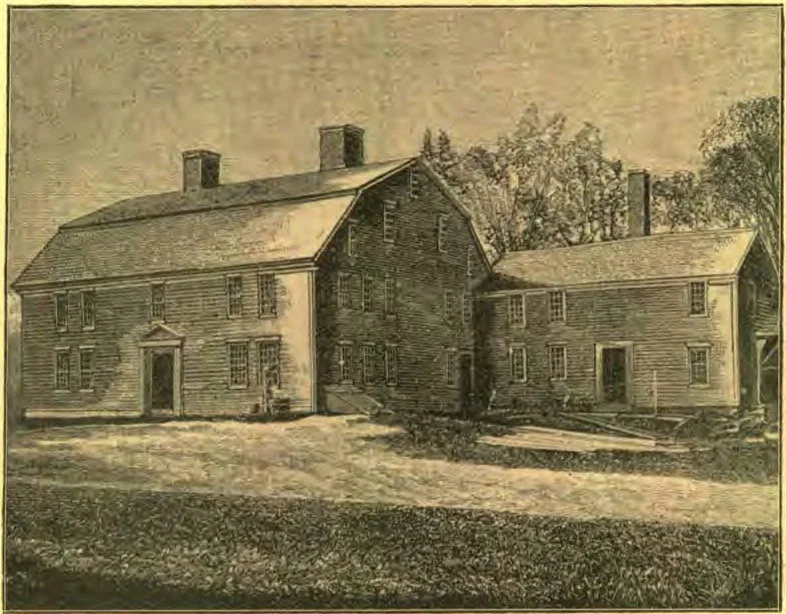
But how many school boys and girls know that the old tavern described by Longfellow in his Prelude to these and the rest of the charming tales,—the Wayside Inn in Sudbury,—is still in existence, only about twenty miles from Boston, and may be visited by any of them who care to make the pilgrimage?
It is a most interesting place, not only on account of its Longfellow associations, but on the strength of its real old colonial self. Houses that date back over two hundred years are not so common in New England as in Old.
The ancient hostelry had never been in the hands of any other family than the Howes from its first building till about the time of our Civil war. In Revolutionary days the reigning Howe was Colonel Ezekiel, of the Continental army. You shall hear a bit of a story in which he figures later, if you like. In Longfellow’s time it was Squire Lyman Howe who was the landlord, and who tells in the “Tales” the story of Paul Revere’s ride. Now the old name belongs with the place no more. The Howe arms hang framed in the parlor indeed, and the custodian, whose grandmother was a servant in the tavern in old times, will tell you stories in which the name figures, but that is all.
But the gambrel roof and dull pink of the old walls still rise as hospitably out of the surrounding green sea of meadows as if the old race of landlords were there to welcome the wayfarer. Great trees throw their shadows over the inn. Across the road at the foot of a hill crowned by a tangle of woods stands the great barn where the breezes blew through the wide doors, and “the wattled cocks” strutted to and fro. How quiet it all is in the June sunshine, as the white clouds drift through the blue overhead, and their shadows slip silently over the grass! Where have they gone, the “panting teams” and their crowd of noisy drivers, the travelers, the tramps, that used to make the busy life of the Wayside Inn? This was the country road between Boston and Worcester in the old days, and important enough before steam and the iron roads came to change everything.
THE OLD HOWE TAVERN.
Within are—
“Stairways worn and crazy doors, And creaking and uneven floors, And chimneys huge and tiled and tall,”
as Longfellow describes them. Across the hall from the foot of the stairway to the wall runs a three-barred wooden gate, to keep the teamsters’ dogs from the back of the house.
On the left is the parlor described as where the tales were told. It is wainscoted, and a great wooden beam crosses the ceiling. There is an open Franklin that may have held the “fire of wood,” before which the musician stood, the fair-haired, blue-eyed Norwegian, Ole Bull; there is a copy of the landlord’s coat-of-arms upon the wall, but the sword that hung over it, borne by his grandsire— “Down there at Concord in the fight,” is gone; there are the windowpanes bearing Major Molineaux’s rhymes scratched upon them, but they are no longer in the windows; they hang framed over the chimney-piece. But where are the old spinet, the somber clock, “fair Princess Mary’s pictured face”?—scattered, gone, with the merry party Longfellow described so lovingly.
In the dining-room at the rear, Washington once lunched. In the state chamber up-stairs, papered with ancient bluebells of Scotland, and so low-studded that you may touch the ceiling with your hand, Lafayette once slept.
A special little stairway leads out from the bar-room into the upper hall, entering it by the side of a door leading into the bar-room chamber. This is the largest of all the sleeping-rooms, and suggests state guests far more than the Lafayette room; but it seems that it was by no means so distinguished. Its walls were lined with beds, placed around it in a hollow square, to be occupied by those same teamsters whose dogs were shut out by the gate. The teamsters mounted to their chamber from the bar by their own little secluded stairway, and thus teamsters and dogs alike were kept in their proper places.
Up-stairs in the great old garret, you may see a rough ladder leading to a small loft still higher up. “Room No. 10” it was politely called in the days when it was littered with straw, and tramps were allowed to find a night’s lodging there instead of in the barn.
Just to the right of this ladder an open door shows the rough boards of a small, unfinished room. One window gives it daylight, and the only furniture it contains is a sort of bunk or berth on stilts, scarcely long enough for a child, and a short, stout ladder by its side to use in mounting it. A forlorn little square pillow in the berth suggests that it might have been slept in once.
And so indeed it had been. When the slaves of Massachusetts were liberated during the Revolutionary war, there was a poor old deformed slave belonging to the Howes of that day, probably to Colonel Ezekiel, who received his freedom among the others. It was quite worthless to him, however. “Portsmouth Azimuth”—if that was his name, “Ponto,” at any rate, by abbreviation—knew he was too old and useless to earn his living elsewhere; so he told the colonel he would be obliged to keep his old slave for the rest of his days. “You’ve eaten the meat,” he said; “now you must pick the bone.”
And the colonel consented. Ponto lived at the Wayside Inn until death came and took him away. The berth on stilts, the ladder, and the quaint story you have just heard, are the memorials he has left behind him.—The Wellspring.

A NEW USE OF COMPRESSED AIR.

“A novel use of compressed air,” says a standard authority, “has recently been made by some western railroads. Jets of air discharged from flexible hose are made to do the work of brooms, whisks, and cloths in removing dust and cinders in passenger-cars. The hose may readily be carried to any part of a car, and is used in the same manner as an ordinary hose carrying water. The new application has many advantages. In many cases passenger-cars on reaching the terminals are allowed to stand only a few minutes before being again filled with passengers, and it is impossible in this time to clean or even dust them thoroughly. This work is usually done by women, who hastily brush off the upholstered parts and wipe the woodwork. A stream of air will effectively remove all dust and dry dirt from cloth, and even from glass and wood, and it has the additional advantage of reaching cracks and crevices which otherwise would not be touched. The stream of air is especially effective, it is said, in clearing the cars of flies.”

A FAITH THAT WILL NOT LET GO.

A SHORT time ago a ship's captain told the following in a prayer-meeting, as a fact which he himself had witnessed a few years previous to that time: “While sailing past the island of Cuba,” so he said, “suddenly the cry, ‘A man overboard!’ rang through the ship from bow to stern. As it was impossible in that instant to turn the ship about, or bring it to a stand-still, I seized a rope, and threw it abaft the stern of the ship, at the same time shouting to the man that he should hold on to it for dear life. The sailor seized the rope just as the stern of the vessel swept past him. I immediately took a second rope, and making a sling on one end of it, tied it to the first rope, and let them out toward the wrestling sailor, telling him at the same time to draw it over his shoulders, and fasten it under his arms, after which I calculated to have the men haul him on board without trouble. He was saved; but he had held so tightly to the rope that it required several hours for his hands to relax enough to even only let go of his hold. Indeed, he had seized the rope with such vehemence that the smaller strands of it had cut the flesh of his hands to the very bones.”
Does it not seem as if God had let down a rope from heaven above for every sinner on the earth, and that each strand of this rope is a precious promise from the Almighty? Let us then be as diligent as possible to make these promises our own, by laying hold of them as though they were our very life; for indeed our eternal welfare depends upon how we appropriate them to ourselves. We must not allow any power, either of earth or hell, to shake our trust and hope in these saving promises of God.

GROWTH OF INDUSTRIAL LIFE.

I.—THE FIRST STAGE.

The questions which at the present time are most earnestly discussed are those concerning the rights and duties of different classes of society, and particularly the rights and duties of the laboring class. To the correct understanding of those questions the history of labor must be of much help. Industrial history is only in its childhood, yet many interesting facts concerning the rights and duties of the laboring class, and its relation to other classes of society, in past centuries, have been gathered, chiefly from old musty accounts, deeds, and records, compiled hundreds of years ago for other uses. From some of the more important pages of industrial history I shall try to glean a few of these facts.
To understand a country or a locality well, it must be compared with other countries or localities. A man who has never traveled is likely to pass over, as matters of course, things with which he comes daily in contact, so that he scarcely knows that they exist; only when he misses them in other places does he come to realize that they are features of the country in which he lives. But if he wishes to find out what is wrapped up in the customs of his country, he must study history, and see out of what they grew.
To find the beginning of our industrial history we must go back to a time when every one lived directly at the expense of nature. We can find in the history of every people a time when nearly every one hunted, fished, or tilled the soil, and each one made for himself almost everything he needed to clothe and shelter him. Men who had special skill in making certain things sometimes traded their commodities with men who were more skilful than they in some other art, but no one thought of living by such skill.
In our history we find such a state of things in England, at the time when William the Norman parceled the estates of the Saxons among his lords. The people were gathered in little villages, all about which were tilled fields and pasture lands. The estate upon which the villagers lived and worked was called a manor. The manor was the property of a baron who received it, or inherited it from ancestors who had received it, by grant from the king. His tenants were allowed to use parcels of its soil as a return for service which they were bound to furnish.
Their idea of ownership in land was not like ours. We consider that a man’s land is his own, and that he may do what he pleases with it, so long as he does not endanger the health or peace of the neighborhood. We never think of dictating by law or custom that a man shall raise beans and not potatoes, that he shall not sell his land, or that he shall not plow in the fall. But every one, in those times, seemed to feel that the land was not property in the way that money and horses and furniture are property. The land of the manor was owned by the nation, or by the community. The idea is expressed in the reply of Lord Angus to Marmion,—
“My castles are my king’s alone From turret to foundation stone: But the hand of Douglas is his own;”
yet the king could not have expelled Lord Angus from his castles unless he was proved guilty of treason. Nor could a baron turn his humblest tenant out of doors.
There was no laboring class at this period in the history of society. There were three grand classes only,—the nobles, the people, and the clergy. The nobles had the military and political power in their hands; the clergy held in their possession the mysterious power of learning; the people were all alike producers, and every man was employer and employed, laborer and capitalist. How well the people were governed, how well they were protected, how well their souls were cared for, makes no difference here, for we are trying to find out what their industrial life was.
One thing they had which we lack. They had a settled position in the life of the neighborhood which they could neither change nor lose. They were not ambitious to rise above their station in life, for such an idea never came to them. Therefore they were happy where they were. They could not fall below their station, for they had no competition with their neighbors, and their right to be where they were had never been questioned. They had not learned to want much, and their few wants were certain to be filled.
When people had nothing to buy or sell, money was almost unknown, and merchants were traveling peddlers and traders. Here again the people were not concerned, since most of the commodities were such as the aristocracy alone had use for,—laces, jewelry, spices, and perfumes, with other accompaniments of luxury not produced in England. Such trade could hardly be called commerce. It was insignificant in amount, and both the goods and the traders were foreign.
How merchants and craftsmen arose, and how the importance of manufactures and commerce increased; how factories sprang up, and labor questions began to shake law-making bodies, we shall see as we trace from the Norman times the history of the people who make the wealth of the rich.
C. B. MORRILL.

The Road to Heaven

THE road to heaven is paved with God’s promises.

The Wrong of Misjudging Others

We cannot do any man a greater wrong than to misjudge him.

Simple Pleasures That Cost Nothing

THE things which do most to make us happy do not cost money.

Being Useful in Youth Leads to Happy Old Age

THE first step toward being happy in old age is to be useful in youth.

Civility Toward the Devil and Freedom From Bigotry

You need not be civil to the devil in order to show that you are no bigot.

Make a Child Happy for God

WHEN you can’t find anything else to do for God, try to make a child happy.

Taking Up the Cross

If you undertake to pick up the cross with one hand, you will find it very heavy.

The Hollowness of Religion Reduced to Notions

Boil down the religion of some people, and you will find nothing in it but a few notions.

Religion Should Pervade Every Part of Life

As the blood goes to every part of the body or the sap to every part of the tree, so a man's religion should go to every part of his life.

Our Influence Is Felt Whether We Know It or Not

God’s eye is ever upon us. So are the eyes of men when we are among them. Our not knowing that we are exercising an influence on those around us, does not make that influence less real.

The Rest That Remains for God's People

JOSHUA did not give Israel the true rest in the land of Canaan. He did not bring them into God’s rest; yet God has promised his people that they shall enter into his rest. “There remaineth therefore a rest for the people of God.” Heb. 4: 8, 9. This rest remains. It has not yet come; but Jesus will bring God’s Israel into the eternal rest in the heavenly country on the new earth. Do you desire to follow him? Then step into the ranks of the people of God. Accept his truth, and walk in it. Then Jesus will give you a heavenly mansion when he comes in his glory with all the holy angels.

Guilty of All: The Weight of One Sin

“Whosoever shall keep the whole law, and yet offend in one point, he is guilty of all.” James 2:10.—Many find this text altogether too rigid for their practice. But just fancy that on yonder tower a roofer is suspended, sitting on a board held by a chain of ten links which is securely fastened above him. All at once one of the links of this chain breaks and—will he not just as surely fall into the depths below as if five or nine links, or the whole chain, had broken?—Most assuredly. Was he any more secure because only one link broke?—Not at all. If even only one link gives way, he must inevitably fall to the ground, and be killed. So one sin is enough to doom a soul to eternal death.

The Meek Shall Inherit the Earth

“BLESSED are the meek: for they shall inherit the earth.” Matt. 5: 5. The meek do not inherit the earth in this life. Some of them may obtain a small portion of the land, but they have to work hard for it. Very few obtain it by inheritance; and when death comes, they must leave it all behind. Not so with the glorious promise of the meek. They shall obtain an immortal inheritance in the new earth.

Growing Up Into Christ in All Things
“Grow up into him in all things.” Eph. 4: 15.—How sad it would be if in the growth of the child only one part of his body would develop, but all the other parts and members be stunted; if, for instance, the head only would grow, and all the rest of the body remain as puny as it was at birth; or, vice versa, if the whole body should grow but the head remain as small as when brought into the world, who would enjoy such a malgrowth as that?
And yet there are many Christians whose religious growth, at least, is just like that. They are onesided; they direct their attention to some one or at best but a few points of Christian growth, to the neglect of all the rest. But the true Christian develops his Christianity symmetrically, in every direction, that he “may grow up into him [Christ] in all things;” and whoever does not do so as a follower of Jesus, will cause as much sadness, and even more, to the dear Saviour, as a child will cause to its parents when they see it growing up in a onesided way, developing in some parts, but stunted in others. Pray God daily and fervently that you “may grow up into him in all things, which is the head, even Christ.”

You have reached the end of this edition.

The Youth’s Instructor · Jan 31, 1895