“Why, what is the matter, Laura?” asked Mrs. Porter. Her daughter had come from school an hour before, passed through the sitting-room and up-stairs, and her mother had not seen her since. Now, on entering Laura’s room, she found her lying face downward on the bed, sobbing as if her heart would break. Kneeling beside her, and pillowing the brown head on her shoulder, Mrs. Porter smoothed the tangled locks lovingly. The comforting mother-touch seemed to subdue the tumult within, before a word was spoken.
At length, between heavy sobs, Laura’s troubles were poured into her mother’s sympathizing ear.
“Why couldn’t I have been beautiful, mother? Or at least passably good looking? No one loves beauty more than I! I do so admire a pink-and-white complexion, bright eyes, white teeth, glossy locks,— and, mother, I haven’t a single one of them! I’m freckled and green-eyed and shock-headed, and my teeth are crooked, and —” but here she sat up, and brushed the “shock” of hair away from her flushed, excited face. Her mother could not repress a smile at this formidable array of disadvantages; but she knew, nevertheless, that her fourteen-year-old, and unmistakably plain, daughter’s trouble was very real to her; and that to the sensitive, beauty-loving soul just awaking within, her child’s plain face was a sore trial.
“But how is it that you are feeling so much worse about it to-night than usual?” asked her mother.
“Why, I overheard Lottie Brown, the new girl, ask Alice Reed who that homely girl was, who sat just in front of her. That girl was I, mother, and they called me the homeliest girl in school!” and Laura’s sobs broke out afresh.
“I know, dear child,” said her mother, soothingly, “that it is natural for young girls to look much at the outward appearance. When you are older, you will be better able to estimate things at their true value. Beauty is a gift of God, and not to be despised. But our loving Father may have bestowed upon you gifts that many prettier girls do not have. Do the best with what he has given you, darling, and it will all come out right.” So saying, Mrs. Porter kissed her daughter, and left the room.
There was no school the next day; and as Laura was helping her mother arrange the rooms, the latter said: “Now we need bouquets for the parlor. Bring me some flowers, daughter. Perhaps those lovely poppies at the end of the garden would be best.”
Laura looked at her mother in surprise. “Why, mama!” she exclaimed, “I never knew that poppies were favorites of yours. Let me get roses, instead.”
For answer her mother drew her to the window. “Look! what could be more beautiful than those poppies? Some are a deep, rich red, and others are red, pink, and creamy white, beautifully mingled. Really, the roses look faded in comparison.”
“Yes, but the roses are fragrant, and poppies are not. Roses would fill the room with their sweet odor.”
“Oh! then beauty is not everything!”
Afterward, as they arranged the flowers, most of which were roses, Mrs. Porter told Laura how a moral and spiritual influence emanates from every one, surrounding him like an atmosphere. If one is pure and good, this atmosphere may be compared to the fragrance of the rose. It attracts all who enter its circle. After a long silence the daughter said, “I think that is a very beautiful idea, mama; I am going to remember it, and try to be like the rose.”
“God grant it! Now let us hasten; for I expect Aunt Eunice here to dinner.”
“Oh, I am so glad! Dear auntie! No one comes here whose visits I enjoy as much as hers.”
“And yet she has a very plain face—perhaps even more so than your own.”
“Oh, I can’t agree with you at all, mama! I think she is beautiful—and here she comes this minute!” and Laura flew to meet her favorite aunt.
Later in the day, as she sat by her side, enjoying the confidential talk so dear to them both, Laura was forced to admit that her aunt’s features were irregular, her mouth rather large, and her eyes the very same color as her own. The charm of Aunt Eunice’s face lay chiefly in the smile that played about her lips, and the look of goodness and intelligence that beamed from her eyes.
“Aunt Eunice isn’t pretty,” Laura acknowledged to her mother that night; “but if I thought I could ever look as sweet as she, it would be a great comfort to me.”
“Then begin now to strive to attain to the sweetness of character that is the source of those sweet looks. Cultivate all the graces of mind and heart; for the older one grows, the more the soul shines through the face. Get your Bible, dear, and let us see how the Lord regards mere beauty. Turn to Prov. 31:30.”
Laura did as requested, and read, “Favor is deceitful and beauty is vain; but a woman that feareth the Lord, she shall be praised.”
“Do you remember what praise Solomon gives the King’s daughter?”
“Yes, mama; he says she is ‘all glorious within; I think that must be what Aunt Eunice is.”
“Yes, and it is what your Heavenly Father wishes you to become.”
VIOLA E. SMITH.
THE MUSIC OF THE SEA
By P. T. Forsyth
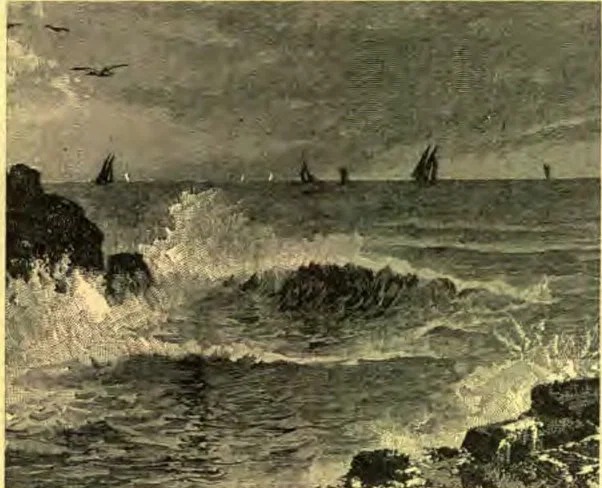
Some people call the world God’s great cathedral. One of its organs is the sea. Oh, it is a great organ, the sea! It can play as sweet and soft as a flute. But it can also roar and thunder to terrify the bravest.
The sounds are many that make the music of the sea. It may seem to you one great sound, but it is made up of many. As you lie by the sea on a breezy day, you see the little white waves out there like sheep in a green field, or like cloudlets in the sky. Each one of them is making a little whisper as it runs along and breaks; and the sum of all their whispers must be something considerable, like the singing of a forest of little birds.
There is the sound of every wave that tumbles on the shingle or the sand, the rush of it as it runs along the beach, the hiss of it as it draws back. And there is the rattle of the pebbles one upon another, which it carries back with it. Then there is the little clash as it meets another upcoming wave, and the pebbles are driven up again. Then there must be the sound of the tidal wave as it rises for hours, and then sinks for hours away. Streams are flowing with their own sound into the sea, or falling over cliffs with a trickle, or a splash, or a thud.
And the winds are piping in many keys; and the sea-birds are shrieking with wild sounds, which, perhaps, you do not separately hear; but they all make up the one mysterious voice and music of the sea — a voice as rich, and a music as unfathomable, as the great ocean deeps themselves.—P. T. Forsyth.
NOTABLE EVENTS ON FRIDAY
Moscow burned on Friday.
The Mayflower landed on Friday.
America was discovered on Friday.
Lincoln was assassinated on Friday.
The Bastile was destroyed on Friday.
King Charles was beheaded on Friday.
Queen Victoria was married on Friday.
Napoleon Bonaparte was born on Friday.
Julius Cæsar was assassinated on Friday.
The battle of Bunker Hill was fought on Friday.
Joan of Arc was burned at the stake on Friday.
The Battle of Waterloo was fought on Friday.
The Declaration of Independence was signed on Friday.— Selected.
THE GIRL WHO SMILES
THE wind was east, and the chimney smoked,
And the old brown house seemed dreary;
For nobody smiled, and nobody joked,
The young folks grumbled, the old folks croaked,
They had come home chilled and weary.
Then opened the door, and a girl came in;
Oh, she was homely — very!
Her nose was pug, and her cheek was thin,
There wasn't a dimple from brow to chin,
But her smile was bright and cheery.
She spoke not a word of the cold and damp,
Nor yet of the gloom about her;
But she mended the fire, and lighted the lamp,
And she put on the place a different stamp
From that it had had without her.
Her dress, which was something in sober brown,
And with dampness nearly dripping,
She changed for a bright, warm, crimson gown,
And she looked so gay when she so came down,
They forgot that the air was nipping.
They forgot that the house was a dull old place,
And smoky from base to rafter,
And gloom departed from every face,
As they felt the charm of her mirthful grace
And the cheer of her happy laughter.
Oh, give me the girl who will smile and sing,
And make all glad together!
To be plain or fair is a lesser thing;
But a kind, unselfish heart can bring
Good cheer in the darkest weather.
1. Of what does Paul assure his brethren? Gal. 1:11.
2. How did he receive the gospel? Had any man taught it to him? V. 12.
3. What had the brethren heard of him? In what religion was he then living? What had he done in times past? What had been the effect upon the church? V. 13.
4. In what connection is Paul first mentioned in the Scriptures? Acts 7:58-60; 8:1. How is his work against the church described in Acts 8:3? Where is he next mentioned? What did he do? Acts 9:1, 2.
5. What was his standing among his brethren during this time? What religion did he then profess? Of what was he so zealous? Gal. 1:14. What does this show concerning his religion? Note 1.
6. Who had called Paul to his life work? From what time was he thus called? V. 15. Who are called of God? Rev. 22:17. Do all who are called of God respond to the call? Matt. 22:14; Luke 14:16-24; note 2.
7. What did it please God to do for Paul? Why did he do this? What course did Paul pursue? Gal. 1:16.
8. Where and to whom does Paul say he did not go? Where did he go? To what place did he return? V. 17; note 3.
9. On what occasion did God reveal his Son to Paul? Acts 9:3-5. Where was the Son revealed, that Paul might preach him to others? Gal. 1:16; note 4.
NOTES
1. Paul says that he formerly lived “in the Jews’ religion.” In this, he says, “I was exceedingly zealous of the traditions of my fathers.” This shows plainly what the Jews’ religion consisted in at that time. And the fact that it led Paul to persecute to prison and to death the followers of Jesus, shows that the religion he held was not the true religion. It was the kind of religion that has always led to persecution. Saul, the persecutor, was zealous and conscientious in persecuting the church. “He believed it to be his duty to strive with his utmost power to exterminate the alarming doctrine that Jesus was the Prince of life; and with conscientious zeal he had become a persevering persecutor of the church.”—“Life Sketches.” Yet when convicted and converted by the power of Christ, he confessed his sin, and became an earnest worker for the Lord. We should learn from this not to condemn those who may oppose truth. Rather let us pray for them, that the Holy Spirit may bring conviction to their minds, and lead them to see and accept the light, and become Christians indeed.
2. The call of God is to every one. But it is left to each one to heed the call, or to ignore it. John the Baptist was called, from his birth, to do a special work for the Lord; and he was faithful in the work given him. So also was Jeremiah. Read Jer. 1:5. Samson was to be a Nazarite unto God from his birth. Read Judges 13:1-5. But of him we read: “God’s promise that through Samson he would begin to deliver Israel out of the hand of the Philistines, was fulfilled; but how dark and terrible the record of that life which might have been a praise to God and a glory to the nation! Had Samson been true to his divine calling, the purpose of God could have been accomplished in his honor and exaltation. But he yielded to temptation, and proved untrue to his trust, and his mission was fulfilled in defeat, bondage, and death!”—“Patriarchs and Prophets.” Are you heeding God’s call to you?
3. In these verses Paul is defending his apostleship. He received as direct a call as did any of the twelve chosen disciples. And when called, he did not confer with men about the matter, but placed himself under the Lord’s instruction.
4. Christ must be revealed in the person who would present him to others. The gospel is not a mere theory: every one who carries it to others must be an illustration of its power. One very concise, inspired definition of the gospel is, “Christ in you, the hope of glory.” Col. 1:27.
CLOUDS
By J. Edgar Ross
THERE are very few outdoor scenes that, when photographed, are not beautified by having a few clouds to break the monotony of the sky. A great expanse of clear, white sky has spoiled many an otherwise excellent landscape picture. Of course you can not always get appropriate clouds to occupy the desired position; and even when you do, it is not always possible to get them in the negative.
When the picture includes moving objects, thus demanding a rapid exposure, the securing of any clouds that may be in the sky is quite out of the question. The reason is not that clouds require a long exposure; for just the reverse is true. The violet rays so predominate in the sky that when the negative has been sufficiently exposed for the landscape, the sky has been so overtimed that it is made of universal blackness in the negative. It will then print perfectly white.
If the subject will admit of an exposure of two or three seconds, and there are appropriate clouds in the sky, the photograph may be taken through a color-screen or a ray-filter. This will exclude some of the violet rays, and thus equalize the exposure.
Under the most favorable circumstances, the sky will often be more dense than the landscape. When the contrast is not too marked, a little dodging in the printing will usually obviate this difficulty. The least dense portions of the negative will print most rapidly; and when they are fully printed, they must be protected until the denser parts are printed also. This may be accomplished by holding any opaque object over the part to be protected, moving it slightly every few seconds, to avoid a distinct line between the protected and exposed parts. If the protecting mask is held about half an inch from the back of the negative, and the printing is combined in the shade or under tissue-paper, it will not be necessary to move the mask, as the light will be so diffused that no line will appear. This is what is called “vignetting.”
When there are no clouds in the sky, they may be printed in from another negative, without great difficulty. The first thing necessary is to get a negative with clouds suitable for the landscape, and so lighted that they will not look as if they were taken at a different time of day than the rest of the picture. It is well to take a number of cloud-negatives that are differently lighted. Do not devote too many plates to heavy storm-clouds. They are interesting in themselves, but there are few landscapes into which they can be appropriately introduced. Light, fleecy, scattered clouds will be far more serviceable for double printing.
Do not print a favorite sky into too many pictures, as this will give your work a sameness that will be anything but pleasing. If the sky in your landscape prints white, a print may be made from it without masking. Take a piece of brown wrapping-paper about the size of your printing-frame, and cut through it along the sky-line of the negative. If the picture is of a level country, with no trees nor buildings extending above the horizon, this will be simply a straight cut. Under any circumstances it will not be difficult, as it will not be necessary exactly to follow the sky-line. Adjust this mask on the face of the printing-frame so that all but the sky of your landscape negative is covered, and fasten it in position with two tacks at each end. Unless you print in the shade, the remainder of the printing-frame must be covered with white tissue-paper.
The cloud-negative may now be placed in the frame, and the sky printed into your landscape. The mask will protect that part of the paper that has already been printed, while the tissue will admit sufficient light to print the clouds on the white sky.
If the sky of your landscape negative prints too dark for this, it may be necessary to mask it while printing the landscape, just as you mask the landscape while printing the sky.
J. EDGAR ROSS.
RELIGION MERELY AS SELF-DENIAL
By Henry Ward Beecher
If I should say of a garden, “It is a place fenced in,” what idea would you have of its clusters of roses, and pyramids of honeysuckles, and beds of odorous flowers, and rows of blossoming shrubs and fruit-bearing trees? If I should say of a cathedral, “It is built of stone, cold stone,” what idea would you have223of its wondrous carvings, its gorgeous openings for door and window, its evanescing spire? If you regard religion merely as self-denial, you stop at the fence, and see nothing of the beauty of the garden; you think only of the stone, and not of the marvelous beauty into which it is fashioned — Henry Ward Beecher.
THINGS TO AVOID
In an educational journal we find a list of fifteen things that the well-bred boy and girl will avoid. The list is worth repeating; therefore it is given here:—
Loud and boisterous laughing.
Reading when others are talking.
Reading aloud in company without being asked.
Talking when others are reading.
Leaving a church before public worship is closed.
Whispering or laughing in church.
Gazing rudely at strangers.
Leaving a stranger without a seat.
A want of respect and reverence for seniors.
Correcting older persons, especially parents.
Receiving a present without an expression of gratitude.
Laughing at the mistakes of others.
Talking before others have finished speaking.
Answering questions that have been put to others.
Not listening to what one is saying in company — unless you desire to show open contempt for the speaker. A well-bred person will not make an observation while another of the company is addressing himself to it.
WE WILL DISPOSE OF 300 Nut Butter Mills, AND 300 “Guides for Nut Cookery.”
The Mill is our latest improved, light-running, adjustable, ball-bearing machine. A good mill is required for making fine Sterilized Nut Butter. We furnish the recipe.
The “Guide for Nut Cookery” tells you how to prepare wholesome foods in the most simple, healthful, hygienic, and palatable manner, giving over 900 recipes. It contains frontispiece; table of contents, tables of food properties and values, menus for those who can not eat fruit, menus for those who can not eat vegetables, chapter on the composition of foods; also copious general index of subjects.
451 pages, substantially bound in oilcloth; regular price, $1.25. Regular price of the Nut Butter Mill, $5.00. Regular price for both, $6.25.
Our Special Price for the Mill and Book,
$3.00
Do not Delay. Order at Once.
Send for our new catalogue and special discount sheet on nuts. We have something new in other mills that will interest you. A postal card bearing your name and address will bring you full particulars. Address— LAMBERT NUT FOOD CO., BATTLE CREEK, MICH.
Ticket Agent, Battle Creek.
A Bonanza for Live Agents!
MEN OR WOMEN
The Magic Pocket Vaporizer
Is one of the best-selling articles on the market to-day. Compact and effective, it appeals at once to the man or woman suffering from catarrhal affections.
Energetic agents throughout the country are making good wages by its sale.
It will be to your advantage to read every word of the following unsolicited letter from one of our salesmen:—
1101 LINCOLN AVE., SAGINAW, W. S., MICH., Feb. 6, 1900.
Modern Medicine Co., Battle Creek, Mich.
GENTLEMEN: I have canvassed the greater part of the time for more than thirty years, keeping my eyes open all the time for the best-selling books and other articles that might come upon the market, but do not hesitate to say your Magic Pocket Vaporizer is the best thing I have ever found to pick up money with. It is a real money catcher, as you will see by the following. On arriving in my territory, I went directly to work. At sundown that day I had sold four and taken five orders; the second day I put in about eight hours, and had fourteen in orders and sales. I can usually average eleven orders out of fifteen exhibitions, or a profit of from four to six dollars a day. I have succeeded in putting thirteen Vaporizers in one home, receiving $12.50 for them; eight Vaporizers in another family; five to a Baptist minister; three to another family. Yours truly, H. S. MERCHANT.
Write at once to the MODERN MEDICINE COMPANY, 105 Washington Ave., Battle Creek, Mich., for terms and territory.
To Reach BATTLE CREEK
FROM
CHICAGO, BUFFALO, DETROIT, OR TOLEDO,
Purchase Tickets Reading over the MICHIGAN CENTRAL
“The Niagara Falls Route.”
A First-class Line for First-class Travel between Chicago and New York and Boston. Elegantly equipped through trains pass Battle Creek in each direction daily.
R. N. R. WHEELER, Ticket Agent, Battle Creek.
O. W. RUGGLES, Gen'l P. and T. Agt., Chicago, Ill.
TAKE THE Canadian Pacific Railway
for . . . CHATHAM, LONDON, WOODSTOCK, PORTLAND, OTTAWA, GALT, TORONTO, and MONTREAL, QUEBEC, BOSTON,
All points in New England, the Maritime Provinces, Great Britain, and the Continent.
Illustrated literature, time-tables, and full particulars, upon application to—
J. FRANCIS LEE, GEN. AGENT.
Passenger Dept. 228 SOUTH CLARK ST., CHICAGO
Branch: 76 Ottawa St., Grand Rapids, Mich.
Offices: Room D, Chamber of Commerce, Cincinnati, Ohio.
315 Chestnut St., St. Louis, Mo.
Cincinnati Northern Railroad Co.
TIME TABLE NO. 3.
IN EFFECT SEPT. 24, 1899.
Trains Pass Battle Creek, as follows:
WEST-BOUND.
No. 21, Mail and Express ................. 6.58 P. M.
No. 23, Accommodation .................... 2.07 P. M.
No. 27, Local Freight ..................... 8.25 A. M.
EAST-BOUND.
No. 22, Mail and Express ................. 8.25 A. M.
No. 24, Accommodation .................... 1.45 P. M.
No. 28, Local Freight ..................... 5.30 P. M.
Direct connections are made at Toledo with all roads diverging. Close connections for Detroit and Cincinnati.
J. L. READE, Ticket Agt., Battle Creek.
E. R. SMITH, City Pass. Agt., 6 West Main St.
E. W. Meddaugh and Henry B. Joy, Receivers.
CHICAGO & GRAND TRUNK R'Y.
By A. S. Parker
Trains arrive and leave Battle Creek.
WEST-BOUND FROM BATTLE CREEK.
No. 9, Mail and Express, to Chicago — 12.15 P. M.
No. 1, Chicago Express, to Chicago — 9.00 A. M.
No. 3, Lehigh Valley Express, to Chicago — 3.40 P. M.
No. 5, Pacific Express, to Chicago, with sleeper — 1.10 A. M.
No. 75, Mixed, to South Bend — 8.20 A. M.
Nos. 9 and 75, daily, except Sunday. Nos. 1, 3, and 5, daily.
EAST-BOUND FROM BATTLE CREEK.
No. 8, Mail and Express, to Pt. Huron, East, and Detroit — 3.45 P. M.
No. 4, Lehigh Express, to Port Huron, and East — 8.27 P. M.
No. 6, Atlantic Express, to Port Huron, East, and Detroit — 2.25 A. M.
No. 2, Leh. Exp., to Saginaw, Bay City, Pt. Huron, and East — 6.50 A. M.
No. 74, Mixed, to Durand (starts at Nichols) — 7.15 A. M.
Nos. 8 and 74, daily, except Sunday. Nos. 2, 4, 6, and 8, daily.