“Papa,” cried Floyd, running breathlessly up to his father, who sat reading on the cool veranda at Hillsdale Farm, “O papa! there's a poor little wild hen down at the edge of the creek meadow, and I guess she's got a lot of little peep chickens, and I'm sure they'll starve to death! She's a little bit of a speckled, plump hen, with almost no neck; and one wing is broken, I'm sure, for she tried so hard to fly, and didn't get on at all. And I think she has tiny peep chickens, because Cousin John said ’most a month ago, when we first came to grandpapa's, that she had a nest somewhere in the swale beyond the meadow.”
“Oh, ho!” said papa, laying aside his book, with a very sober face, but with a funny twinkle in his eye. “So John told you about her! Did he say she was a partridge?”
“No, that wasn't the word; it's shorter than that. Why, you know, papa, she's the little hen that keeps saying, ‘Bob White! Bob White!’ almost every afternoon and evening.”
“Yes, I know now,” said papa, smiling. “Her name is Mrs. Quail. But it's her mate, my boy, that says ‘Bob White!’ She has been too busy lately hatching her chicks to say anything. But who can have been cruel enough to break her wing? Let us see.”
They walked briskly across the sweet-smelling meadow grass until almost in the shade of the wooded strip beyond. Then they went more slowly and cautiously till Floyd pointed out the spot where he had seen timid Mrs. Quail. She was not there, but as they walked forward into the woods very softly, and speaking in whispers, she suddenly darted from a clump of ferns almost beneath their feet.
With a whir she shot a few feet into the air, and wheeled to the left; but before going a rod she fell to the ground with one wing outstretched, and fluttered along, crying, as if in great pain.
“O papa!” Floyd exclaimed, almost in tears, “don't let's scare her any more! See how it hurts the poor thing!”
“Very well,” said papa, “let us go this other way, to the right, and look carefully under every leaf and beside all the stones. Maybe we can find some of her chicks.”
They moved slowly away; but instead of hurrying off in the opposite direction, as she had started, the mother quail came nearer, tried to fly a second time, and again fell with a broken wing—only it was the right one this time, instead of the left, which had been outstretched before. Her actions seemed to say: “If you want to catch anybody, catch me. I'm wounded, and can't get away.”
But the two intruders kept right on searching, and all at once the father whispered: “Quick, my boy, come here just as quietly as you can!”
Floyd crawled swiftly to his side, and peeped under his arm. There were three grayish-brown stones in a row—at least the two outside ones334were stones, but on looking close it could be seen that the round ball cuddled between them had a downy surface with mottled lines set close together. And right in the center were two bright eyes that no one ever saw in a stone. It was a baby quail, not more than two or three days old, but sharper at playing hide-and-seek than a boy or girl of a thousand times that age.
Papa and Floyd watched it for five minutes, but the little chap did not stir a feather. All this time the anxious mother kept calling and fluttering about only a few yards away. Her wing was not broken, as Floyd's papa had known from the first; it simply was a pretty trick that many wild, feathered mothers employ to lure enemies away from their young.
After a little time Floyd whispered “Good-by” to the chick, and the two went quietly away, sure that as soon as they were gone, the wildwood family would be speedily reunited.—Roe L. Hendrick, in Youth’s Companion.
THREE LITTLE SERVANTS
I HAVE a little servant, With a single eye; She always does my bidding Very faithfully; But she eats me no meat, And she drinks me no drink— A very clever servant, as you may well think.
Another little servant On my finger sits; She the one-eyed little servant Very neatly fits. But she eats me no meat, And she drinks me no drink— A very clever servant, as you well may think.
Now one more little servant, Through the single eye, Does both the other's bidding Very faithfully; But she eats me no meat, And she drinks me no drink— A very clever servant, as you well may think.
A needle and a thimble And a spool of thread, Without the fingers nimble And the knowing head,— They would never make out, If they tried a day, To sew a square of patchwork as you well may say.
—Selected.
THE WILD ANIMAL CATCHER
THE United States government hires a man to catch wild animals to be put in museums and public parks. His name is Thomas Elwood Hoefer. He is called “Billy” by all his friends. This man is a great hunter, and has had many thrilling and narrow escapes.
For more than twenty years he has made his headquarters at the northern edge of Yellowstone Park. He has captured several hundred animals, including bears, elk, deer, foxes, antelopes, squirrels, and numbers of birds.
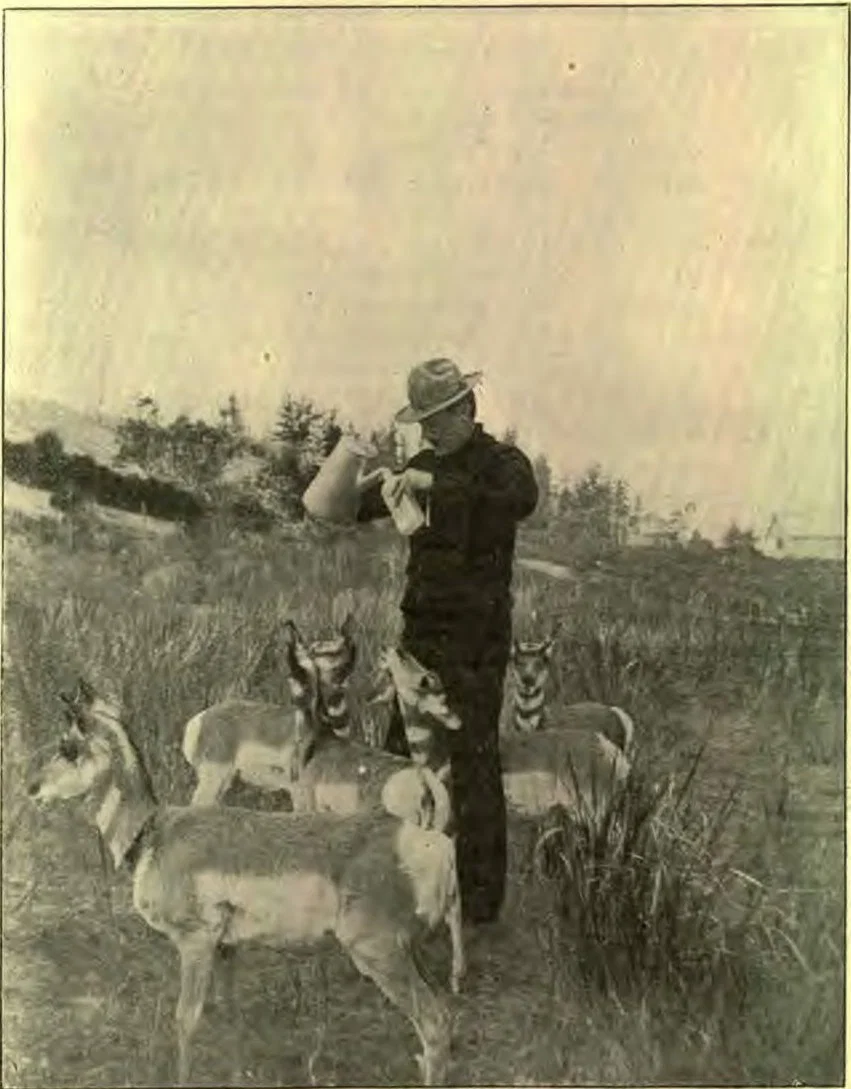
In the picture you see Billy surrounded by his four-footed friends begging for some breakfast. I will tell you about them.
One morning in April he was riding down the mountainside when he came to a sudden turn in the bridle-path.
Not far from the edge of the wood he thought he saw an antelope. Using his field-glass he could tell by its actions that it was a doe.
He got off his horse, and crept up as near as possible to the spot where he thought the young should be. Then the mother antelope gave the alarm to the little ones, who instantly dropped to the ground, and the tall grass hid them for a few minutes. The mother, being badly frightened, bounded into the forest. Billy found three baby antelopes too young to walk. They stared at him with their big brown eyes in a most helpless way. Billy put one little antelope into one saddle-bag, with only his head sticking out, the second he treated in the same way, and the third he put across the saddle; then he rode slowly to his tent.
That night he fed the young antelopes with milk from a bottle, just like human babies. After a few days’ feeding, the little creatures became very trustful, and learned to believe in Billy, who cared for them faithfully. When the baby antelopes got hungry at night they would cry pitifully; and Billy would get up, and warm the milk to feed his pets. At breakfast-time they seemed to know what was in store for them; for they would crowd about Billy like impatient children, pawing at his legs to let him know how hungry they were.
When the weather grew a little warmer, Billy put his pets in an inclosure out-of-doors. As he always gave them their food himself, they soon became friendly. When they heard his whistle, they would instantly jump to their feet.
WAITING FOR BREAKFAST
One chilly night in May there was a terrific storm in the mountains. Billy brought the three little antelopes into his own tent. The wind blew, the lightning flashed, and crash after crash of thunder echoed through the mountains. Billy could not sleep. It must have been after midnight when he thought he heard a strange noise. It sounded more like a howl than anything else. He listened again; this time the sound was nearer and stronger. Hark! he listened once more; now he knew it. It was a pack of hungry wolves scouring the country for something to eat. What if they should travel his way, and kill his antelopes, after all his tender care! Billy loves animals, and rarely kills one unless in self-defense, but he has no use for wolves.
A short distance from Billy’s tent there was a cave with a small opening. He quickly seized his lantern and gun, hustled the baby antelopes into the cave, and then got in himself, barring the entrance with a huge stone, still leaving a peephole for emergency. Nearer and nearer came the wild howling. Billy ventured to look out; at first he could see nothing, but by and by a flash of lightning showed from ten to fifteen wolves howling and wrangling among themselves. Two were fighting in front of the cave. Billy shot one; and the others, surprised, made for the mountains as fast as they could. Their howls grew fainter and fainter.
At dawn the rain had ceased, and Billy cautiously looked out once more. All was quiet. He ran back to the tent, heated some milk, and brought it to the antelopes, who were loudly clamoring for their breakfast.
After several months the baby antelopes learned to eat solid food, and in due time were shipped to Washington.
BREADFRUIT
By W. S. Chapman
Most of the Instructor readers are familiar with the story of the mutiny of the “Bounty,”—how in 1787 this vessel, under command of Lieutenant Bligh, was sent from England to Tahiti, there to load with breadfruit plants to be carried to the West Indies; and how a mutiny broke out, and the commander and his crew were cast adrift in a small boat, while the mutineers returned to Tahiti, a few afterward settling on the lonely island of Pitcairn.
Lieutenant Bligh had been sent on this expedition at the recommendation of Captains Campier and Cook, who, years previously, had called the attention of the English government to the value of this fruit, and the desirability of introducing its culture into the West Indies.
The fruit has nothing about it, either in taste or form, that resembles bread, but acquires its name from the fact that it forms the staple food substance, hence the bread, of the inhabitants of the tropical islands.
The tree is fair-sized, with large, glossy foliage, the male flowers growing in spikes, and the female in a dense head, the carpels of which consolidate, and form the fruit, which, in size and shape, generally resembles a melon. There are several varieties, some of which are not eaten, but whose large seeds are highly esteemed as food. The edible fruit seldom matures seed. There being many varieties, some are constantly ripening fruit, so that the fruit is present on the trees nearly all the year round.
In the South Sea Islands, a common practice is to roast the fruit in the coals, afterward scooping out the contents with a spoon. The fruit is picked just before ripening, when it is filled with starchy material, which, when cooked in this manner, resembles potato prepared with milk. It is frequently eaten with milk, butter, or syrup, making a toothsome mush, or pudding. In the Pacific Islands the fruit is stored in pits to ferment, when it forms a substance resembling new cheese, and having a very offensive odor. This disappears, however, when the fruit is baked under hot stones.
The common method of preserving breadfruit is to cut it into thin slices, which are dried in the sun, and afterward reduced to a flour, from which bread, biscuit, and puddings are made; or the slices are baked, and eaten without grinding. W. S. CHAPMAN.
HEALING THE PARALYTIC
By W. S. Sadler
(Concluded)
Who Can Forgive Sins?—The Pharisees said, “Why doth this man thus speak blasphemies? who can forgive sins but God only?” This is an instance of the kind of reasoning that starts out right, but ends wrong. Their first inference—that no one but God could forgive sins—was right. But it did not necessarily follow that because Jesus had forgiven sins, therefore he was a blasphemer; for he was God,—Immanuel; God with us; God dwelling in human flesh. “But that ye may know that the Son of man hath power upon earth to forgive sins (he said unto the sick of the palsy), I say unto thee, Arise, and take up thy couch, and go into thine house.” Luke 5:24. The Son of man had power on earth to forgive sins, and so to-day it is the same Jesus that is on earth in every man, who has power to forgive the sinner, and free him from the bondage of his sin.
Arise, Take up Thy Couch.—The man was commanded to take up his bed and walk. To receive power to do this was the very thing for which he had come to Christ. He received the power in obeying the Master’s command. In making the attempt to obey, the necessary strength was supplied. A great object-lesson is here of the disaster of continually waiting for the gift of the335Spirit, or for any other blessing that man needs, and God is willing to bestow. Heaven often asks of us the apparently impossible. It would seem that God sometimes bids us do that which we are unable to perform; and so it was in the healing of the paralytic. He was told to rise up and walk. And yet this was the very thing he was unable to do. It was his willingness to obey the Master’s word that empowered him to do the thing commanded; and so with the soul dead in trespasses and sins: the one who is suffering from spiritual paralysis, the one who has sinned against light, the one who has stifled the conscience, may be asked to “arise and shine;” and it is according to the willingness with which he yields obedience that the necessary strength is supplied; for it is written, “If there be first a willing mind, it is accepted.”
Go into Thine House. And Immediately He Rose Up.—The Saviour did not send the man, after he had been healed, to some great audience to tell of the miracle that had been wrought upon him. He directed the man to go home; and in obedience to the Master’s instructions, he went. The greatest evidences of conversion and a real change of life are to be found in the home and the home life of the Christian. One who is not a Christian at home can not expect to be one away from home. The great evidence that the paralytic had been forgiven, and that he actually appreciated his forgiveness, is found in his unquestioning and immediate obedience; for no sooner had the Master said, “Arise, and take up thy couch, and go into thine house,” than we find the man on his feet starting toward home.
An evidence of the spiritual healing of the paralytic is found in his implicit obedience. He carried out the Master’s instructions to the letter. He did not wait until the day of miracles and wonders was over before going home; neither did he tarry to occupy much time in thanking the Master, or to tell the multitude of the wonders which had been wrought in his case. He went home at once, carrying his bed, as the Master had directed. The people said, “We never saw it on this fashion.” Truly the work of Jesus was to bring new ways of doing and thinking, and so conversion marks the time when men and women begin to do things according to the new fashion. Thinking, eating, dressing, and acting will then be done according to the fashion of true principle and the glory of God, instead of according to this world’s fashion, which results in the defilement of body, soul, and spirit.
W. S. SADLER.
MY MISSION
By S. O. James
I want to be a watchman,
And with the watchmen stand,
And sound the note of warning
O’er all this troubled land.
I want to tell the story
How Jesus died to save,
And with the Father’s glory
Came from the cruel grave.
Let me repeat the promise
That he will come again,
And hear the joyful echo
O’er every hill and plain.
I want to tell my brother
That Christ is very near;
How like a loving mother,
He quiets all my fear.
And O, if they’ll believe me,
And join the holy throng,
The watch will soon be ended;
’Twill not be very long.
We shall the earth inherit
When Jesus comes to reign,
Receive the Holy Spirit,
And shout the glad refrain.
S. O. JAMES.
THE HOLY SEED
By Edith E. Adams
God says to each one of us, dear children, “Though your sins be as scarlet, they shall be as white as snow.” And he tells us what it is that is to make this wonderful change. “Ye are clean through the word which I have spoken unto you.” That word, which drops gently upon our hearts like the snow and the rain to cleanse us, is also the seed, which will take beautiful form in the pure, snowy blossoms of holiness that it brings forth.
To every one of you, dear children, God is saying, “If thou wilt hearken unto me, there shall no strange god be in thee, neither shalt thou worship any strange god.” In these words he shows us that all we have to do is to listen to his voice when he says, “Thou shalt have no other gods before me,” and then he will keep away every strange plant out of his garden, and root out all the weeds of sin, and everything that he has not planted himself. These things will all fade away, just as the fig-tree withered at the word of Christ.
The great ugly weed of self tries to fill up all the space in the garden, and it has such showy blossoms that we are sometimes deceived into thinking it is a very fine plant. But O, when we see “the Chiefest among ten thousand, the One altogether lovely,” all our love for self will disappear, and this ugly weed will shrink and wither away as we say, “Not I, but Christ.” And in its place the sweet, pure worship of the one true God with all the heart and mind and soul and strength will fill the garden with “the beauty of holiness” for the pleasure of the King, and to show forth his praises. EDITH E. ADAMS.
Giant Smoke Column from Bayonne Oil Tank Fire
In July of last year, during the burning of the oil tanks at Bayonne, N. J., an immense umbrella-shaped column of smoke rose straight up in the air to the surprising height of 13,411 feet,— more than two miles and a half. The phenomenon was observed for two days. After one explosion the flames shot up three thousand feet into the air, and their heat was felt nearly two miles away. Little wind was stirring at the time; and except at the top of the smoke column, where soft white clouds formed, the sky was cloudless.
Woodpeckers Use Poke Berries to Lure Borers
WOODPECKERS feed largely on worms that burrow into trees. Sometimes these borers make a gallery three or four feet long in a single season; so in order to get at his prey, the bird must make a number of incisions in the wood. While on a natural history exploration in the Maine woods, Prof. E. T. Clarke noticed one family of woodpeckers that adopted a practical labor-saving device in obtaining their favorite food. Having opened up a gallery made by a borer, the birds brought the berries of the Indian poke, “the rankest plant that grows in the Maine woods,” and dropped them one by one into the orifice. The odor from these berries is detested by all animal life, and to escape it, the grubs would come to the surface, where the intelligent woodpeckers were waiting for them.
WHEELS THAT MOVE NOTHING
One of the common attractions at the summer resorts is a miniature locomotive in a glass case, which stands motionless on a tiny track. When a penny is dropped into the slot, all at once the little wheels begin to move. Faster and faster they fly, as if trying to make a record for speed. But when the piston-rod ceases to work, and the wheels are still again, the little engine has not moved an inch, nor done a bit of work. The activity is all spectacular; the wheels go around, and nothing more.
There are some young people who remind us of this little engine. They are always busy. Sometimes we have heard them complain that “hardly have time to breathe,” and really there seems some ground for this complaint. But with all their hurry they never accomplish very much. One year finds them about where they were the year before. They do not carry an ounce of the world’s burden, nor lift an ounce of the world’s grief.
Revolving drive-wheels that drive nothing mean wasted power. And so with a life that is all the time busy without accomplishing anything, which spends its energy making the wheels spin around.—Young People’s Weekly.
Raising and Drying the Coco Plant
THE raising of the coco plant is a delicate operation. The young plants have to be sheltered by larger trees, as they can not stand the direct rays of the sun. A cucumber-like pod growing on the trunk and the large branches contains the seeds, the coco-beans of commerce. Besides the care of raising, the process of drying requires painstaking attention.
In interpreting the parable of the sower, Christ says, “The seed is the word of God;” but this same thought is found in other portions of the Scriptures that are not parabolic. In Isaiah 55 is found the same comparison: As the seed fulfills its purpose in the earth under the influence of rain and sunshine, so God’s word will grow and multiply, and accomplish the thing whereunto it is sent.
SELECTED NOTES ON THE LESSON
1. “The sower of the seed represents those who labor in Christ’s stead. The seed is said to ‘spring and grow up, he knoweth not how,’ and this is not true of the Son of God. Christ does not sleep over his charge, but watches it day and night. He is not ignorant of how the seed grows.”—“Christ’s Object Lessons, page 63.”
2. “The question may be asked, How can he get wisdom that holdeth the plow, and driveth the oxen?—By seeking her as silver, and searching for her as for hid treasures. ‘For his God doth instruct him to discretion, and doth teach him.’”—“Special Testimony on Education, page 103.”
3. “There is wisdom for him who holds the plow, and plants and sows the seed. The earth has its concealed treasures, and the Lord would have thousands and tens of thousands working upon the soil who are crowded into the cities to watch for a chance to earn a trifle. . . . Fathers and mothers who possess a piece of land and a comfortable house are kings and queens.”—Id., pages 104, 105.
4. “Study in agricultural lines should be the A, B, and C of the education given in our schools. This is the very first work that should be entered upon. . . . The school farm is to be regarded as a lesson-book in nature, from which the teachers may draw object-lessons. . . . The Lord would have the grounds about the school dedicated to him as his own schoolroom. . . . So when the students employ their time and strength in agricultural work, in heaven it is said of them, Ye are laborers together with God. 1 Cor. 3: 9.”—“Testimonies for the Church, Vol. VI, pages 179–187.”
PRAYING CONSTANTLY
But can we pray constantly? Will it not divert us from our work?—No, it will not. Praying constantly means two things. It means having, in all that we do and say, the prayerful spirit, the sense of God’s nearness to us and ours to him, so that we feel his presence, and act as in his presence. This will help, and not hinder, our work. When we are expecting soon to see dear ones, we are not incapacitated by our expectancy. We work the more eagerly and intensely, but with a light and joyous heart. It is so in Jesus’ service. We can live in the prayer-consciousness of his presence whatever our work or pleasure. Whatever can not be done in this prayer sense of Christ, we may be sure, is an unallowable thing.
Secondly, unceasing prayer means constant actual turning from our task to speak to God. And we can and must do that. We can not live a whole day through on one single word to God at the day’s beginning. We could not work with a friend all day on such terms. Much less can we do so with God. Once and again and again during the day, we must turn definitely to him for friendship, for counsel, for strength.—S. S. Times.
Lady Agents Wanted for Health Garments
By W. S. Dann
LADY agents do splendidly selling my Health Garments. I have some new articles. Big sellers. No trash. I pay charges. Address W. S. Dann, 1916 Cuming St., Omaha, Neb.
A Baby’s First Wardrobe
By Mrs. F. M. Kellogg
Is the most trying proposition a young mother can meet. Often everything she makes is wrong. For 30 cents in stamps you can get twenty-two guaranteed patterns drawn on anatomical and hygienic lines, with full instructions for making. Also an illustrated booklet on care of the body—_free_. All in plain envelope. Everything essential to know. For information on garments for other ages, send stamp.
_MRS. F. M. KELLOGG,_
_207 Hubbard St., - - Battle Creek, Mich._
GRAND TRUNK RY. SYSTEM.
By W. C. Cunliffe
Taking Effect June 2, 1901.
Trains leave Battle Creek.
WEST-BOUND.
No. 9, Mail and Express, to Chicago 12.15 P. M.
No. 7, Limited Express, to Chicago 7.00 A. M.
No. 1, Chicago Express, to Chicago 9.23 A. M.
No. 3, Lehigh Valley Express, to Chicago 3.50 P. M.
No. 5, International Express 2.17 A. M.
No. 75, Mixed, to South Bend 7.30 A. M.
Nos. 9 and 75, daily, except Sunday.
Nos. 1, 3, 5, and 7, daily.
EAST-BOUND.
No. 10, Mail and Express, East and Detroit 3.45 P. M.
No. 8, Limited Express, East and Detroit 4.50 P. M.
No. 4, Lehigh Express, East and Canada 8.22 P. M.
No. 6, Atlantic Express, East and Detroit 2.10 A. M.
No. 2, Express, East and Detroit 7.00 A. M.
No. 74, Mixed (starts from Nichols yard) 7.15 A. M.
Nos. 10 and 74, daily, except Sunday.
Nos. 4, 6, 8, and 2, daily.
W. C. CUNLIFFE, Agent, BATTLE CREEK.
SENT FREE
By E. J. Worst
Read Special Offer Below.
THE CO-RO-NA MEDICATOR.
A natural evolution from E. J. Worst’s famous Catarrh Inhaler that has won a world-wide reputation. It is made of Nickel, and will last a lifetime; is so compact it may easily be carried in a vest pocket or reticule.
CATARRH.
Don’t take medicine into the stomach to kill germs of Catarrh in the head. If you will only stop and think for a moment, you will certainly realize that the germs of disease were carried into your head by air, and that air is the only agency that will carry a medication to the diseased passages capable of destroying such germs. Catarrh, Colds, Pains and Roaring in the Head, Bronchitis, Sore Throat, Headache, Partial Deafness, La Grippe, and all diseases of the air passages yield as if by magic to treatment with the Co-ro-na Medicator. Science and common sense can offer no improvement upon this little pocket physician. It is simple in construction, and may be used anywhere and at any time. It is the only positive cure for the diseases named. I make it easy to prove this beyond all question by the following remarkable
SPECIAL OFFER.
For a short time, I will mail free to any reader naming this paper one of my new Scientific Co-ro-na Medicator(s), complete, with medicine for one year. If it gives satisfaction, send me $1.00; if not, return it after three days’ trial. Could any proposition be fairer?
E. J. WORST, 112 Elmore Block, Ashland, O.
NOT SOLD BY DRUGGISTS. AGENTS WANTED.
EMMANUEL MISSIONARY COLLEGE
The first annual calendar of the new Emmanuel Missionary College has reached our desk. It is fully illustrated with views of the new college farm, and of the buildings where the school will be carried on during the present year. The reasons for the existence of the new school are briefly stated, and several pages are devoted to a description of the new site, and the causes leading to its selection. The relation of this college to other departments of the work, the general plan, and information to those who desire to attend are also considered, with schedules of studies for the different departments. Little space is given to setting forth rules and regulations, it being assumed that those who enter this school will be those who are preparing to teach and govern others, and must therefore learn to govern themselves.
To all who are interested in a further examination of this calendar, it will be sent, free, on receipt of a postal card bearing such request. Address E. A. Sutherland, Berrien Springs, Mich.
THE MISSION OF A PICTURE
The story is told of a beautiful but poor Bohemian girl who posed for a German artist. In his studio one day she noticed an unfinished picture of the crucifixion, and moved by curiosity she inquired “who that wicked man was,” and what he had done to deserve so cruel a death.
The artist was not a Christian, and it was rather unwillingly that he answered the girl’s questions, after the first, when he explained that the Sufferer on the cross was not a wicked man,—that he had done nothing to deserve so cruel and dreadful a death,—but that he was “good above all good men in the world.” At last one day the girl, feeling the artist’s lack of real love for the subject of his picture, said, simply, “I should think you would love him if he died for you.”
Then she went away, but her words remained to trouble the mind of her employer, who found no rest till he obtained the peace that comes from confession, acceptance, and forgiveness.
In due time, under the influence of the new love that filled his heart, the artist finished his picture, and it was hung in the Düsseldorf gallery, with these words beneath it: “I did this for thee: what hast thou done for me?” And hither came one day the poor gypsy girl, to gaze and to wonder. As she stood weeping before the picture, touched yet only half comprehending, the artist found her; now he could answer her eager questions as one to whom the sacrifice portrayed in the picture had brought salvation; and gently he pointed her to the Man of Calvary as indeed the Saviour of the world—her Saviour if she would believe.
She did believe; and when, a few months later, the artist was called to her dying bed, she told him of her confidence and happiness that she should one day see Him whose pictured face she had so often gazed upon.
We can never measure all the good that a single pure, uplifting influence may exert in the world; but occasionally a glimpse is given for our encouragement.
Years after the incidents already recorded had taken place, the picture which had had so strange a history spoke its silent message to another soul. “A frivolous young nobleman looked upon it, and the study of it and the rebuking pathos of its inscription so moved and influenced him that he consecrated himself to the service of God. The young man was Count Zinzendorf, the founder of the Moravian Church.”
It is a remarkable story, and one that should cause every Christian heart to feel a thrill of joy that God can so gloriously use the weak things of the world in his greatest work—the saving of souls. First the chance word of the ignorant peasant girl, pressed home by the Holy Spirit; then the hands of the artist guided and inspired by heavenly love as he laid the colors on the canvas; next the finished picture speaking its wonderful message to poor and rich, low and high alike; and afterward, through the influence of one of these, countless souls brought to a knowledge of the Saviour’s love, and hundreds of the bravest, most self-sacrificing missionaries the world has ever seen carrying the light of the gospel into heathen lands.
When we reflect on the small beginning of this great wave of influence, should it not lead us to pray again, as we have often prayed before,—
“Take my life, and let it be
Consecrated, Lord, to thee,”
that whatever we do,—whether we speak, or sing, or pray, or sweep a room, or do some humble daily task,—all our works may be “wrought in Him,” and so done to his glory?
ANOTHER DOLLAR
By Editor
For the India Mission Fund is received this week from Brother Brice Morrow, of Lead Hill, Neb. We still lack about ten dollars of the amount necessary to continue the subscription to this club of papers for India another year. Who will send in a small contribution to bring this fund up to the required place, and make it possible to send our youth’s paper into other destitute and needy fields?