Your ShelfYour Projects

Review and Herald, Vol. 81, No. 31.

The Greatest of These is Love
Earlier text: Why Russia Clings to Manchuria

The East Caribbean Conference

GEORGE F. ENOCH
The East Caribbean Conference of Seventh-day Adventists was organized in the early spring of 1903. Its territory comprises the islands that fringe the eastern end of the Caribbean Sea, and the Guianas of South America, with Venezuela as a mission field. The second annual session was appointed to be held the latter part of last year, but an epidemic of smallpox, with consequent quarantine regulations, made it impossible to hold the meeting at that time. The first week of June the hindrances were largely removed, and the delegates came from all the field to Bridgetown, Barbados, with the exception of most of the British Guiana brethren, the quarantine being reimposed the same day they went to buy their tickets. Their absence was a disappointment to all.
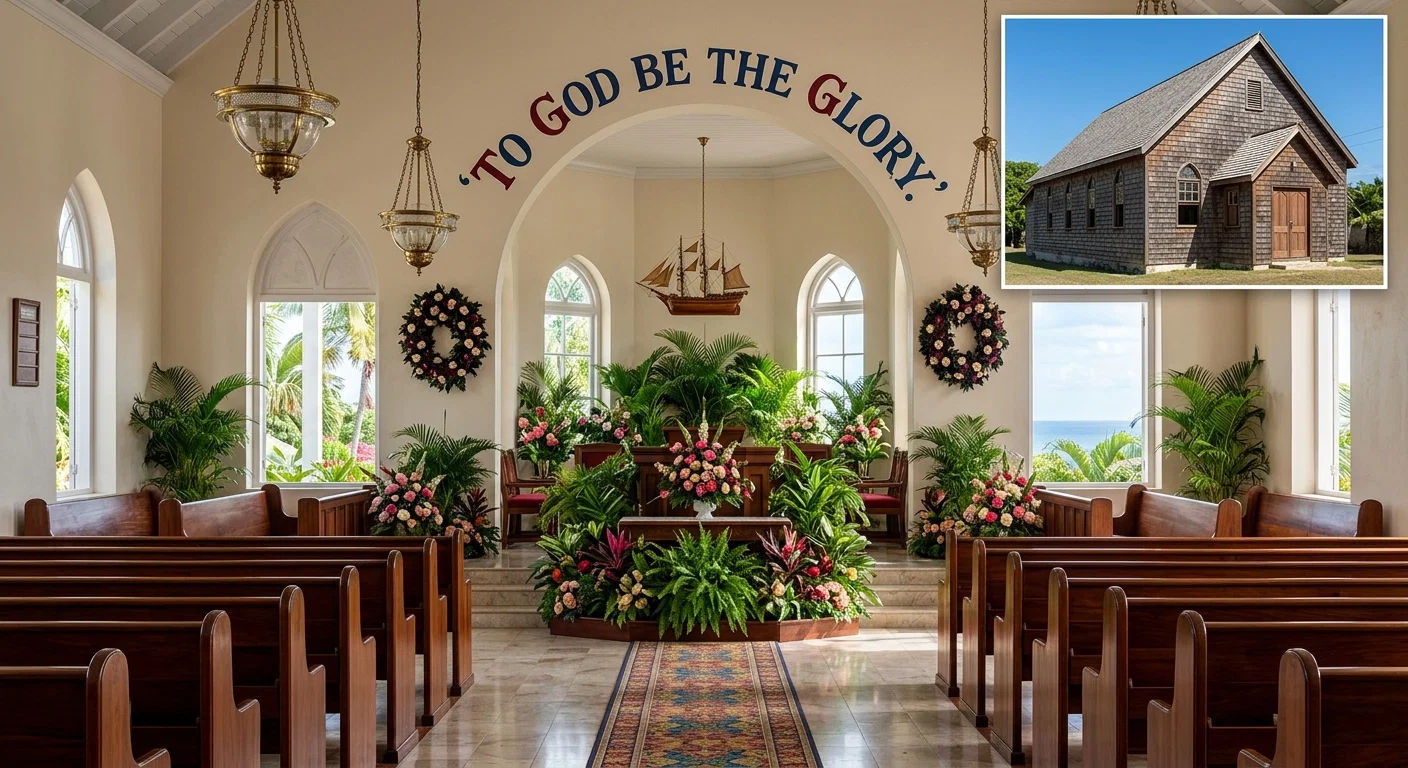
OUR CHURCH IN BARBADOS
The program for the fortnight was a very busy one. At 6 A. M. was held the daily Bible study; at 10:30 A. M., the convention work, at which time such subjects as the Seed-sowing Campaign, the Sabbath-school Work, and the Educational Work were considered; at 11:30 was held the regular conference sessions, and at 7 P. M. the public preaching services at Wilhelmina Hall.
The reports of the progress of the cause in the different fields were most cheering and encouraging. One hundred and thirty-nine persons were reported as having been baptized, and others were keeping the Sabbath, and in every field there were open doors and a most encouraging interest to hear the message; in fact, the soil seems to be prepared for us to go forth and sow the good seed of the kingdom.
Thirty-three believers were reported from the island of Tobago, which is practically a new field. Elder W. G. Kneeland brought a good report from Grenada, an island which we entered with the living preacher last March. Ten are already keeping the Sabbath, and there is a wide-spread interest to hear the third angel’s message. Faithful canvassers have been for years sowing the seed, and the living preacher is able to reap a quick harvest. Both will share in the harvest home. Elder W. A. Sweany had come from a successful tent effort in Antigua, and Brother Brown two successful tent efforts in Demerara.
Three church buildings were erected in the conference during the year,—one in Port of Spain, Trinidad; one in Kitty, British Guiana; and one in Tortola, Virgin Islands. In addition to the church buildings in smaller places, we now have neat, substantial church buildings in the three large cities of our conference, Port of Spain, Bridgetown, and Georgetown. For this we praise the Lord, as it will help us much in the years to come. In each of these three cities there is now pressing need of at least one trained Bible worker, who can give her whole time to the house-to-house work. Mrs. M. H. Honeywell, of Minnesota, has been doing self-supporting Bible work in the city of Bridgetown for three years. The Lord has abundantly blessed her labors, and souls have been added to the church.
Doors are standing wide open in these cities, inviting us to enter. Who will come? Are there not three strong conferences at home that can each send and support one Bible worker in each of these three cities?
“Work is abundant, the promise is great, Few are the reapers, in sadness they wait; Patiently toiling, yet daily they cry, Pray ye that our Lord and Master, reapers supply.”
Plans were laid for aggressive work for the year to come. There was a general belief that the time had come to push our literature out into the hands of the people as never before. It was decided to thoroughly organize tract and missionary societies throughout our conference. From these we hope to inaugurate such a seed-sowing campaign that every loyal believer in the message will have a place. The Caribbean Watchman and the Good Health will be the central figures of this campaign; some small books, tracts, and leaflets will also be provided for the tract society workers.
It was also decided to issue a series of twenty-six Bible readings, similar to the Family Bible Teacher, but adapted to the needs of our field. To facilitate this work, and also to help in keeping the Watchman where we would like to see it, it was decided to raise a fund to buy a small press, type, and office supplies sufficient to print our tracts and leaflets and set up the Watchman, sending it out to have the press work done. This will cost about eight hundred and fifty dollars. Four hundred and fifty dollars was raised at the conference, and we are now carrying the appeal for help to our people.
In view of the fact that Barbados is somewhat better as a distributing center, it was decided to remove the conference headquarters from Port of Spain to Bridgetown, Barbados. The headquarters of the Watchman and of the publishing work will remain in Port of Spain.
The East Caribbean Conference desires to be in line with the world-wide forward movement. Although owing to the scarcity of laborers, the committees on nominations and distribution of laborers were sorely puzzled to know how to perform their work, yet provision was made to enter the French and Spanish portion of our field, and for the publication of literature in the Negro-English, or talkee-talkee, of Dutch Guiana, and the Hindi language. We must enlarge our borders, lengthen our cords, and strengthen our stakes.

Meetings in the Wilhelmina Hall

The greatest blessing of all the conference was received in the public services held at night at the Wilhelmina Hall, the largest opera-house in the island. The English opera companies have to pay about thirty dollars a night for this hall, but the Lord opened the way for us to secure it for six dollars a night, by taking it for the fortnight.
The meetings were well advertised; and from the first night, the hall was crowded, some nights scores being unable to gain an entrance. The Spirit of the Lord strove mightily in the city, and night after night hundreds of intelligent interested hearers listened to the word. The Lord baptized the speakers with power, and the Spirit carried the word home to the hearts of the hearers. Behind the speakers on the stage we had a choir of about twenty singers, accompanied by an orchestra, and the good old advent hymns were rendered with a spirit and power that will long be remembered by those present. As such topics as Christ’s second coming, the signs of the times, the twenty-three hundred days, the judgment, spiritualism, and practical subjects were taken up, light shone from the Word, and souls rejoiced in the truth. Each night a collection was taken up. These collections were sufficient to pay all the expenses of the hall for the fortnight.
The officers elected for the coming year were as follows: President, A. J. Haysmer; Secretary and Treasurer, George F. Enoch; Sabbath-school Secretary, Mrs. A. J. Haysmer; Conference Committee, A. J. Haysmer, D. E. Wellman, George F. Enoch, D. C. Babcock, W. G. Kneeland, W. A. Sweany, and Philip Giddings; Editor Caribbean Watchman, George F. Enoch; Business Manager of Caribbean Watchman, S. A. Wellman; Editorial Contributor, W. G. Kneeland, with the request that Jamaica appoint another.
The address of the conference office and the president of the conference is now Bridgetown, Barbados.
On the last Sabbath of the conference, just after sunrise, ten precious souls were buried with their Lord in baptism, in the blue waters of the Caribbean Sea. Later in the day the regular quarterly meeting service was held. The Lord drew very near, and the souls of all present were watered with showers of blessing.
On Monday, June 20, the delegates left for their different fields, full of faith and courage to press the battle during the coming year. When we consider the scattered condition of our field, the isolation of our workers, and the heavy responsibilities resting on each one, we are led to exclaim, Who is sufficient for these things? We at once turn our face toward the Stronghold, and are thankful for the promise, “I will never leave thee, nor forsake thee.” The laborers of this conference, each one toiling under a heavy burden in a trying climate, desire an interest in the prayers of God’s people.
Bridgetown, Barbados.

A Glimpse of Barcelona

FRANK AND WALTER BOND
In the minds of those familiar with Spain's history, it is natural that dark, foreboding pictures should arise. There is no expression in our language more indicative of all kinds of cruelty than “Spanish Inquisition.” Many thousands who accepted the doctrines of the Reformation suffered martyrdom at the hands of that, the cruellest of all institutions of the Dark Ages. The greatest of all reformations is now going to the world. He who is the central figure in this great movement, bids us as a people, “Go ye into all the world, and preach the gospel to every creature,” and assures us, “Lo, I am with you alway, even unto the end of the world.” In this injunction every country, and every part of every country, is included. No matter how severe may have been the persecutions inflicted upon God's people in these dark lands in past ages, when the Lord by his Spirit impresses his servants with the importance of sacrificing home, loved ones, etc., and going to these fields, it certainly is time to think seriously of going. We may ever rest assured that the Holy Spirit will not impress us to do a thing unless that thing is in harmony with the mind of God.
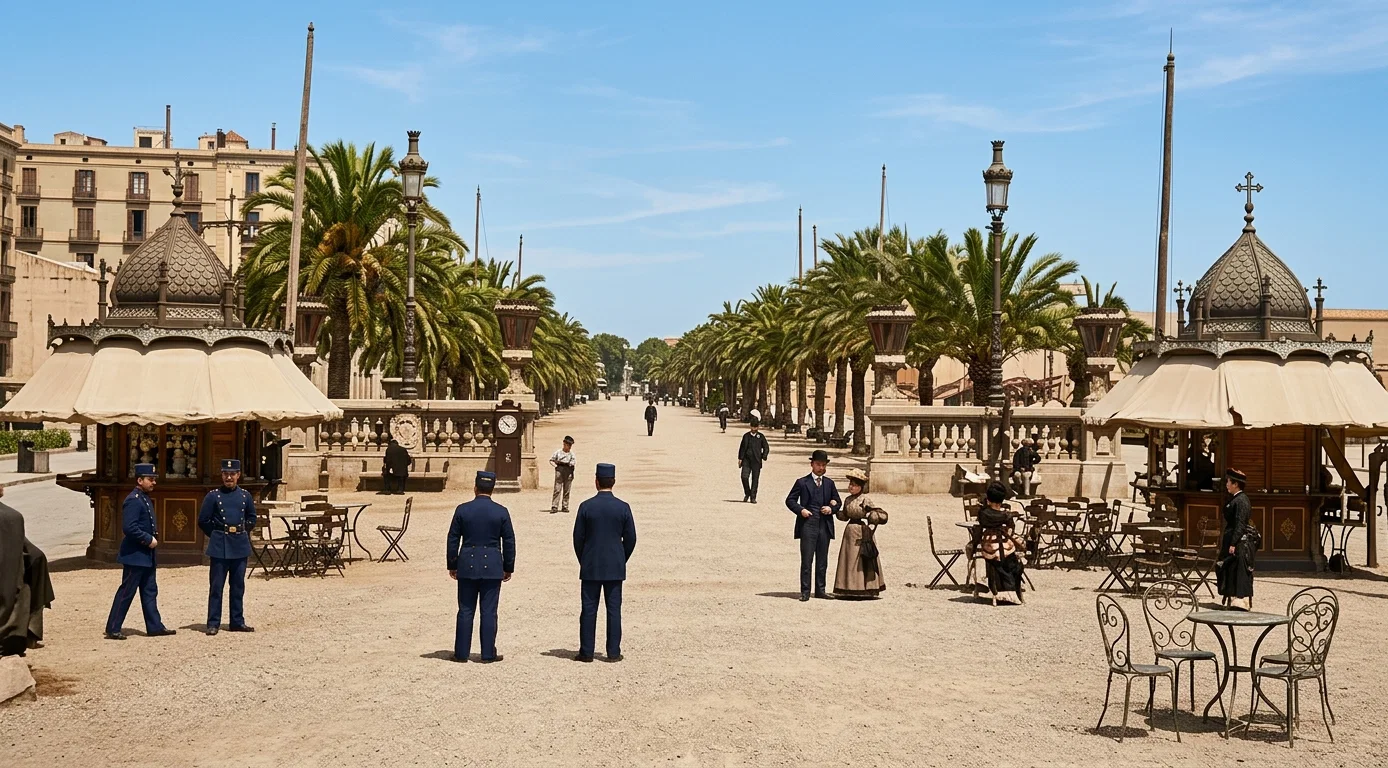
PASEO OF BARCELONA
PASEO OF BARCELONA
How blessed it is to be in a position where one can appreciate the verification of that promise, “Lo, I am with you alway, even unto the end of the world,” the constant companionship of Christ.
Spain is a beautiful country, a land of sunshine and flowers. With the exception of Switzerland, it is doubtless the most mountainous country in the world. To the traveler there is not that monotony of scenery found in some lands. The scene is continually changing, mountains, valleys, hills, and plains all come in their turn in quick succession.
Most of Spain's inhabitants live in the cities and towns. The country districts are very sparsely settled.
As a general rule, Spanish architecture is antique in appearance, and the cities are compactly built. Narrow streets are characteristic of the country. Nearly every town, however, of a few thousand inhabitants, has its paseo, or rambla. This is usually a broad street, in the center of which is a walk for pedestrians, and on either side are one or two rows of beautiful shade trees.
Barcelona has one of the most interesting parks we have ever seen. It is not so large as some, but is unusually original in its construction. It also has an interesting collection of animals from various parts of the world.
This certainly is a productive country, although it has been under cultivation for hundreds, yes, thousands, of years. True, the country is far behind the times in many respects. The benefits that may be derived from the plow, the cultivator, the mowing-machine, the reaper, the harvester, and the thrashing outfits of more modern lands are here unknown. The swarthy paisano may be seen harvesting his grain with the old-time hand sickle or scythe, and thrashing it with a flail, or treading it out with oxen on a summer's thrashing-floor.
Great ignorance prevails. This, of course, is due to the fact that Rome has had her dominating, soul-destroying influence over this country from the very first. Almost all are baptized into the Catholic Church; but a large majority have lost confidence in her, and have turned to infidelity and atheism. We have recently published a few thousand copies of two tracts, and the last few days have been experimenting, to see how these would sell. We have realized a marked degree of success. God has blessed the effort, enabling us each to sell from one hundred to one hundred and twenty tracts in five or six hours. A young lady, sixteen years of age, who has accepted the truth, has taken up this work, and is also meeting with excellent success, one day selling ninety-five in a few hours.
Thus far we have been able to meet only a few people in a small province of this great country. There are yet many millions who have never heard of this last-day message. The people in their homes are, as a rule, very hospitable, and the canvasser is generally well received. Are there not many strong, consecrated young people who should take up canvassing in this needy field? This country has an excellent climate, and its fruits are noted the world over, but its inhabitants are perishing having no hope, and without God in the world.
We pray that erelong many laborers shall enter this languishing field, to help carry the everlasting gospel to its people.
Barcelona, Spain.

British and Foreign Bible Society

THE British and Foreign Bible Society supports nearly seven hundred Bible women.

First Baptismal Service in Spain

ON June 29 the first baptismal service was held in Spain. Professor Wilkinson performed the rite, and three precious souls followed their Lord into the watery grave.

British Guiana

GEORGETOWN.—The Lord is blessing the work in this city. I think the interest is the best now of any time since I have been in the colony. Within the past five weeks I have baptized eleven, and our church is full each Sunday night. I think it will not be long until one of the stores in the city will be closed on the Sabbath, and the proprietor obeying God.
The minister of whom I wrote some time ago is coming closer to the truth. We are now studying the seal of God, and at the end of each study he expresses his thankfulness.
The school is growing in interest. All are well, and of good courage.
D. S. BABCOCK.

Trinidad

WE have just returned home from our good conference in Barbados, which was an important event in the history of the message in the West Indies. Public services were held in the opera-house (the largest hall on the island) each evening and Sunday afternoon during the conference, which lasted a fortnight. The house was packed to the doors at every service, and the deepest interest and attention was manifested, as the message was presented in the power of the Spirit, by the various conference laborers. The very best class of people attended in large numbers. Ten were baptized, and as many more made a start. Hundreds are interested and deeply stirred, many being under conviction and almost persuaded. The study, devotional, and business sessions were held in our own church, during the day.
Doubtless the proceedings will be fully reported by others, so I will only say that, despite the vast extent and difficult nature of our field, and our meager force of laborers, we were enabled to lay plans to hold the ground already occupied, and also open up the work among the Dutch, French, Spanish, and aboriginal peoples within our borders. Plans were also laid for strengthening and enlarging the educational and publishing work.
The work here in Arima is encouraging. About twelve began to obey the message during the tent-meetings, which we closed in order to attend the conference. These seem to be faithful, and are growing in grace. The interest is still good. We are continuing the work in a hall until such time as we shall be able to build a house of worship, which is an absolute necessity to the permanent establishment of the work in this field.
We have thus far been alone, save for the help of a native canvasser, who cared for the tent. When we think of tent companies in the States, with from six to twelve workers, we feel that the force is not evenly divided. We also have eight churches and companies to visit and care for. However, we are of good courage, and with God's help, will hold the advance line, and continue to push it forward till complete victory is achieved. But we do need help, both men and means.
Could all our people but see, and feel, and realize the world's need as do those in the regions beyond, they would arouse and give, send and go, and soon the work would be done. We need and solicit your prayers.
W. A. SWEANY, MRS. FANNIE SWEANY.

New South Wales, Australia

Ten months has nearly passed since we landed in Sydney, New South Wales, and eight months since we took up the work here in this great field; and after six months of tent work, and one camp-meeting having been held, I will send a brief report of our work to the REVIEW.
Before noticing our work, however, it might be of interest to the readers of the REVIEW to speak of this country and people. Australia has a vast area of very nearly as many square miles as the United States of America, and has many natural advantages, which fact is not generally understood by our American friends. The great seaports and beautiful harbors are also advantageous to this country. It has several great cities and thousands of smaller ones. The large cities, like Sydney and Melbourne, numbering over half a million each, are great commercial centers. There is no better country for farming and grazing purposes than this. I have been nearly three hundred miles back from the coast, and find that all kinds of grain, fruits, and vegetables are grown in great abundance, also that sheep, cattle, and horses are raised in great numbers. The wheat crop this year averaged about fifty bushels an acre, and other grain accordingly.
The country has great resources: coal, iron, copper, tin, gold, silver, and other metals are here in abundance.
The people are very kind, and nearly as varied in caste and rank as in America. The native Australian black man, like the American Indian, has become nearly extinct.
We commenced work in the field last October. After purchasing two new field tents, one thirty by fifty feet and the other a forty-foot circle, we put three tents in the field, one about one hundred and fifty miles up the north coast from Sydney, and the other two on the western line of railway, one hundred and sixty, and one hundred and ninety miles inland from Sydney. These tents were kept in the field for six months, after which we held our camp-meeting one hundred and fifty miles from Sydney. Each tent made two efforts, and then the camp-meeting was followed up with regular tent work, and each effort has been successful. Since Oct. 1, 1903, to this date, June 6, over one hundred have accepted the truth for this time in New South Wales, and we are still laboring on, praying that others may be gathered in. The Lord has also greatly blessed us in a financial way, as we have paid off over £300 of our indebtedness, and have paid all current expenses.
For the last year the country has been blessed with plenty of rain, and the future prospect of the country seems very encouraging. For all these mercies and blessings we thank and praise the Lord.
We have had great opposition in our work in this field the past season; but nothing can be done against the truth. It, of course, has triumphed.
S. M. COBB.

British Central Africa

PLAINFIELD MISSION STATION, CHOLO.—The work is still moving on, and I am sure with some degree of success; I feel confident that the Lord is blessing the seed sown in his name. There are many signs that the word preached is taking effect for good, as the people are becoming diligent students of the Bible.
The eight o'clock prayer-meetings are of interest, also the Sabbath preaching services, and the Sabbath-school, in which all take part. The day-school is in good condition, with an enrolment of about thirty-five or forty pupils, fifteen of whom live at the station, and quite a good many come from the villages. In the different parts of the work we are doing what we can, asking our dear Saviour each day for more wisdom and strength to do the work in his name. At the Sabbath morning services, when a text of Scripture is mentioned, those who are so fortunate as to have a Bible will turn and read it with great earnestness, which is encouraging to the worker.
The mission crops are promising. The chimanga I think will yield abundantly. The cotton is still very tender, but promises a good harvest. The rainy season is over, and we are having the hot sunshine again. I am now busy with all the workmen, cutting away the high grass from around the station, which if left standing until the terrible forest fires, is destructive to the mission buildings.
There are many wild beasts here. The lions come quite near the mission. Their dreadful roaring strikes terror to the heart. A leopard came into the yard of the schoolboys in the daytime. There are many snakes. A large boa-constrictor swallowed a goat belonging to one of the native boys, and they let the snake lie until the third day, when it was helpless, then they killed it. First of all they called in their friends to take part in a sort of festival, after which they divided the dead goat, and sold it among themselves. They gave me the skin of the snake, which is sixteen feet in length. These people are a little reluctant about killing this kind of snake, as heretofore they worshiped it as one of their gods. But since many of them are learning concerning the true God, they are turning their minds away from it.
We desire an interest in the prayers of God's children, in behalf of this people. We are all well, and of good courage in the work of Him who said, “Go . . . and teach all nations, . . . and, lo, I am with you alway.” We desire to remain faithful in the giving of the message to perishing souls.
THOMAS H. BRANCH.

F. W. FIELD

Japan

Tokyo.—Lately Dr. Kawasaki was called to report for military service. But again the Lord was gracious, and our brother was excused. One of our young men was to have had his examination two days ago, at Wakamatsu. We have been praying for him, but have had no word from there yet.
The Kobe brethren have had some exceedingly interesting experiences of late with several Korean Christians. Dr. Lockwood will report how two of them have accepted the truth, been baptized, and received into the Kobe church. The story reads like one from the Acts. Just a day or two ago a card from Brother Kuniya reported the latest development in the case. While one went on to Hawaii, the other returned to Korea. But on the boat he met another Korean Christian returning from Hawaii, and at once proceeded to impart to this one his newfound truth. The result was that before they got past the shores of Japan, this last-mentioned one wrote back to Brother Kuniya, expressing his acceptance of the truth as far as he understood it, and his desire to return and study more as soon as possible. Surely the Lord is going before us into Korea.

F. W. FIELD

Caucasia

TIFLIS.—We are always glad to receive the REVIEW AND HERALD. We have already had three copies here. We await its weekly visits more than those of a dear friend. We are glad it is coming without the government's displeasure marks on it.
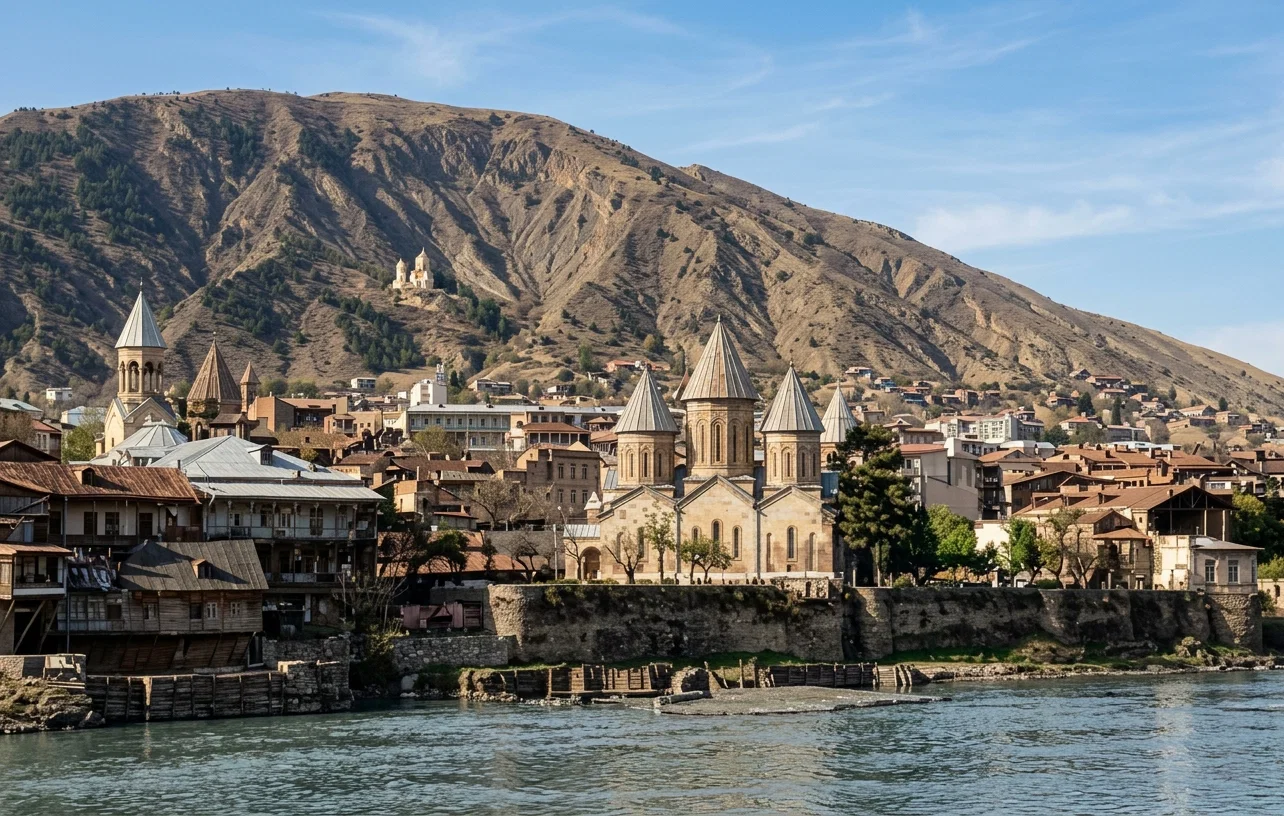
TIFLIS
TIFLIS
We have seen God's guiding hand and protecting care in every step we have taken from the first day of our arrival. He brought to us a man who assisted us in every way that a stranger would need assistance in a strange and wicked city. He neglected his own work in order to make us comfortable, and would not receive a penny for his services. We could not have hired a person for ten dollars a day who would work so faithfully.
The Lord has also blessed us in finding a room. Our landlord is a German, and is much interested in our work. Through this family we are becoming acquainted with many other Germans. There are several thousands of them in this city. I believe they would be a good support to our work, if we had a place where we could give treatments. Here every one must have his work sanctioned and permission granted, before he has the right to do business. This is especially so with doctors, lawyers, and preachers. Legally I can not obtain permission to practise until I am able to speak the Russian language, and pass examination at St. Petersburg. This of course will take some time.
From the information we have, we believe we can secure permission to open treatment rooms; in fact, there are already many such places; but of course they are not doing such work as we intend to do. Once established, the people will learn the virtue of the treatments. The sooner we open such a place, the better, both for the cause and for the people.
Tiflis is a city of nearly two hundred thousand inhabitants. It is the center of, and the most important place in, the Caucasus. It was formerly the capital of the Georgians, a people once famous for their beauty; but the increasing sins of the last days have deprived them of that gift which was common to all in the beginning. From the natural aspects of the country, one would expect to find a people not only most beautiful, but also strong and healthy. I expected to find many a centenarian, but I find the contrary. People here die very early. There are few who live to be over sixty years of age, and most of the people die before the age of fifty—from the lack of a knowledge of the principles of life. There are three evils practised by nearly all: tea-drinking—ten to thirty cups daily; smoking, indulged to great excess; and in addition to the great amount of poisons taken into the body, they live in great numbers in one room, tightly closed, in winter. A family of six or seven, cooking, eating, and sleeping in one room, is not an uncommon thing. Of course this is partly due to high rents; but the exclusion of the fresh air is simply due to ignorance.
Our souls are stirred to do something to help this people. Their physical needs are great. We must also think of their spiritual needs. Medical missionary work, we are told, is the entering wedge. There is no better place to apply it than this city,—and this is only a small part of the field. There are twelve million people, of whom we have not even thought. How few are the ways by which we can work! and how few the workers! We can not hire halls in which to preach, we can not hold tent-meetings, we can not canvass; we are barred on every side. Shall we not take hold and enter where we see an opening? We are glad to report that some of our neighbors have given up their tea.
Our Father knows this place, and he also knows our ability. In order to fit up a treatment room, even on a small scale, several hundred dollars will be necessary. Most of the people here are well to do. We feel quite sure that when the work is once started, it can soon be made self-supporting. But to open treatment rooms on a small scale several hundred dollars will be needed. This is not like many fields, where the truth may be spread in different ways. Here we have to do what we can do. Pray for the Caucasian field.
VAHON PAMPAIAN.

California Conference and Camp-Meeting

THE thirty-third session of the California Conference, and the eighth session of the California Conference Association of the Seventh-day Adventists, a corporation, convened at Bushrod Park, Oakland, Cal., June 1, 1904, at 9 A. M., and continued till June 12, inclusive, according to notice duly given in the Signs of the Times and the Pacific Union Recorder.
Besides the delegates at large, there were present to represent the churches one hundred and twenty-seven delegates, Elder W. A. Spicer, of Washington, D. C., secretary of the Mission Board; Elder W. B. White, president of the Pacific Union Conference, and others, were also present.
The report of the secretary of the conference showed fifty-one organized churches, with a membership of 3,663, besides several companies and many isolated Sabbath-keepers. The report also showed that for the nine months ending Dec. 31, 1903, nearly twenty thousand dollars has been paid by this conference in tithes and offerings to support the work of God in fields outside our own territory, and that about an equal sum has been expended in the home field.
Prof. J. S. Osborne, superintendent of church-schools, presented an interesting report of the work in that department, the particulars of which will appear later.
Mrs. Carrie R. King, secretary of the Sabbath-school and young people's work, presented a brief and encouraging report of the work in those departments.
Reports were given from the workers in the field, showing a need of more laborers, especially in house-to-house Bible work.
Important reports were also presented from Healdsburg College, Pacific Press Publishing Company, the Sanitarium and Health Food Company.
Two new churches were received into the conference, viz., the German Seventh-day Adventist church at Lodi, with twelve members, and the church at Hughson, with twenty-five members.
The following officers were duly elected: President, A. S. Kellogg; Secretary, J. S. Osborne; Treasurer, Pacific Press Publishing Company; Executive Committee, A. S. Kellogg, W. T. Knox, T. J. Evans, H. H. Hall, M. E. Cady, D. T. Fero, B. F. Richards, J. W. Bagby, C. E. Leland; missionary secretary, A. J. Bourdeau; superintendent of young people's work, B. F. Richards; superintendent church-schools, E. D. Sharpe; State canvassing agent, S. C. Osborne; secretary Sabbath-school and young people's work, Carrie R. King.
The office of vice-president was abolished. Directors of the California Conference Association: C. H. Jones, A. S. Kellogg, R. P. Gray, E. E. Parlin, G. W. Mills, M. H. Brown, L. M. Bowen.
The recommendations of the committee on credentials and licenses were adopted, as follows:—
For credentials: J. W. Bagby, A. Brorsen, M. H. Brown, M. E. Cady, J. O. Corliss, D. T. Fero, C. M. Gardner, J. S. Harmon, E. J. Hibbard, B. L. Howe, M. C. Israel, A. S. Kellogg, W. T. Knox, C. E. Leland, J. N. Loughborough, C. N. Martin, N. C. McClure, Isaac Morrison, A. J. Osborne, J. D. Rice, B. F. Richards, G. W. Rine, A. Schlotthauer, E. D. Sharpe, H. A. St. John, C. L. Taylor, M. C. Wilcox.
For ministerial license: J. W. Beardslee, A. J. Bourdeau, A. L. Lingle, H. G. Lucas, M. H. St. John.
For missionary license: A. C. Bainbridge, H. E. Brighouse, T. J. Evans, Carrie R. King, Mary Lamie, J. S. Osborne, Mrs. E. E. Parlin, Phoebe Press, Cora A. Rice, Mrs. A. Speedie, W. L. Sims.—Pacific Union Recorder.

The Seventh-day Adventist Matabele Mission School

At the present time we have about fifty boys and girls in this school, and it is expected that many more will wish to come in a short time, but we do not see how we can take many more. We think that fifty should be about our limit. At this season of the year, when the crops are gathered, and the boys have nothing to do, they naturally wish to come to the school, as they can get their food and clothes. Of course this is the season when we have the least work for them to do, and what we do have amounts to but little, as it brings little or no returns.
That you may have an idea of the work of the school, I will give you our program of work each day, and the classes:—
Rising at daylight. The boys work till breakfast time. Breakfast at seven o’clock. One hour is given before they are to begin work. School from eight to ten. This is the beginners in English and Zulu. Mrs. Hyatt and the native teachers have this part of the school. From eight to ten the more advanced boys are in the field working. At 10:15 the bell rings for the boys to come in, the school to close. At 10:30 those who have been in school go to work. At 10:30 school opens; 10:30-10:45 opening services; 10:45-11:15 Bible study on points of present truth; 10:45-11:15 geography class, by Mrs. Hyatt; 11:15-11:40 reading class in English New Testament, by W. S. Hyatt; 11:15-11:40 reading class in English New Testament, by Mrs. W. S. Hyatt; 11:40-12 A arithmetic, studying division, etc., by W. S. Hyatt; 11:40-12 B arithmetic, studying subtraction, etc., by Mrs. W. S. Hyatt; 12-12:30 penmanship—we use copy-books; 12:30-12:55 advanced class in reading,—book, “Christ Our Saviour,”—by W. S. Hyatt; 12:30-12:55 Zulu Bible, third-year class, by Brother Sturdevant; 12:55-1:20 Bible history and geography, by W. S. Hyatt; 1:20-1:40 language class—an English class in conversation. Flowers or some other objects are chosen as a subject about which to talk. The students learn very fast, and enjoy this class. At two o’clock everybody is ready, I assure you, for dinner.
At three o’clock all go to work gathering mealies, shelling, drying, and storing them; digging monkey-nuts and drying them; grinding food; drawing water; looking after the store; caring for the stock; pulling teeth; caring for the sick, etc., etc. How do you think Brother Sturdevant did all this or looked after it all before we came to assist him? I do not wonder that he was sick.
At six o’clock the bell rings for closing work, and at six forty-five we have evening worship. I should have mentioned that worship is also held at seven in the morning.
From seven to eight forty-five the children study the next day’s lessons,—Zulu, thirty-five minutes; slates, thirty-five minutes; English, thirty minutes.
The retiring hour is eight forty-five. Lights are out at nine. We draw a sigh of relief when they are in their huts, and the work is finished; for it is a busy day, yes, and a long one. We have tried to lift some of the burden off Brother Sturdevant’s shoulders, and let him rest. I feel that he deserves it, after bearing the load that he has. It is not a small thing to guide and direct the work of fifty of these children, and make it accomplish something for the mission.
I am thankful for this experience. It is just what I have desired to have, as I wanted to get some real experience in this kind of work. If I am to act as a counselor to the brethren, I must know the nature of the work by coming in contact with it.
W. S. HYATT.
Continue reading: Central Union Conference Summer School