How many there are who live in a turmoil of anxiety in reference to their temporal affairs! They know nothing of relying upon God for their temporal necessities as a little child relies upon its affectionate and thoughtful father. But this is the faith that God requires, and the only faith that he can recognize as such. For, “except ye be converted, and become as little children, ye shall not enter into the kingdom of heaven.” Matt. 18:3.
To these care-laden souls Jesus Christ is little more than a historical figure. They believe that he once lived on the earth; and, in a cold sort of way, believe that he is the Saviour of the world. They expect him to forgive them their sins; but as for trusting him for their food and clothing, well—that would be “absurd”! They are “too practical” for that. “God,” they say, “helps those who help themselves.” How very much truer it is that God helps those who cannot help themselves! Dwelling in a cold intellectualism of belief, they know nothing of the warm atmosphere of “trust.”
The One who wishes us to cast all our care upon him (1 Peter 5:7), thus admonishes us in the beautiful sermon on the mount (R. V.): “Be not therefore anxious, saying, ‘What shall we eat? Or, What shall we drink? Or, Wherewithal shall we be clothed? For after all these things do the Gentiles seek; for your Heavenly Father knoweth that ye have need of all these things. But seek ye first his kingdom, and his righteousness; and all these things shall be added unto you.’”
With his hand upon the lever of circumstances, our loving Father in heaven, without whose notice not even a sparrow falls to the ground, is waiting, aye, longing, for us to put away our distrust, and thus allow him to anticipate our every necessary requirement.
Reader, why not step upon this “higher plane”?
What the Bible Has to Say to the Mother
By M. L. Dickinson
“How gentle God’s commands! How kind his precepts are!”
Not long ago an intelligent young mother said: “Motherhood seems, indeed, the crown and glory of my life, but why do people congratulate me as if wifehood and motherhood were the end and aim of existence? I thought God made me to be a good woman. I mean to be a good wife and mother in passing.”
Throughout the Bible we find recognition of this divine purpose to bring the mother-soul to the “full stature of a perfect womanhood,” uplifting the whole nature as the surest way of ennobling any part.
We can never begin to gather from its sacred teachings the direct messages for any class without finding how little the Bible specializes. Running all through its pages there is a broad stream of general instruction applicable to all human beings alike. Here and there may be traced little rivulets of precepts for a particular class, usually the untutored or subordinate. To these belong such commands as: “Children, obey your parents;” “Honor thy father and thy mother;” “Servants, obey in all things your masters.” But the mother’s need is a broader and deeper need, and for her flows the whole wide stream of suggestive teaching—the water courses of the Bible which ought to make the woman-soul, and so the mother-soul, like “a tree planted by the rivers,” of which it is said: “His leaf also shall not wither; and whatsoever he doeth shall prosper.” As we study this more general teaching, we say not only, “How gentle God’s commands! How kind his precepts are!” but how wise, how strong, how mighty to pull down womanish weakness of character, but powerful to upbuild, until women—like Jacob, who became a prince of God— shall also have a new name given, and become princesses in the household of the King.
Every mother who approaches the Bible lovingly, claiming its unmeasured treasure as a part of her inheritance, though she may find its direct words to mothers few, will find that all its riches belong to her womanhood; and that its principles, if not its precepts, may become the spiritual food on which the mother-life exists.
But in the search for specific texts we are impressed with the overwhelming indications of the high value set on motherly character and motherly service to the child and the home. She is not urged and commanded to rise to her high calling, but it seems to be taken for granted that she will do so. And that the mothers of the Bible met this expectation is shown by abundant passages calling upon others to exalt and honor her. Thus in the example of her life, and the esteem to which her life entitled her, the mothers of our time may find most practical and valuable teaching.
The Mother in the Old Testament
The references in the Old Testament imply full recognition of the mother, not only as parent and as participant with the father in the care and rearing of the children, but they everywhere demand for her the love and honor due to her unparalleled devotion.
For the noblest women of their race, without regard to the character of the service which won for them distinction, the chosen people of God had no better name than “mother.” With the name and fame of the great lawgiver and leader of his people through the wilderness, runs always the story of the mother who saved him for his great career through days and nights of watching by the hidden cradle in the rushes of the Nile. For Deborah, to whose voice as prophet the leaders of armies listened; who went up with the hosts to battle because the captains of the hosts refused to go without her; who sat under her palm tree judging the children of Israel, they found no name so great as “mother in Israel.” Adam’s name for the woman God had given him was, “the mother of all living.”
For the aged wife of Abraham, the friend of God, what distinction like that of “mother of nations;” and what sweeter testimony to her hold on the life of Isaac than we have in the simple story of the new love which came to him with Rebecca, which lifted from his heart the shadow from that gloomy cave in Hebron, and confronted him “after his mother’s death.”
One does not forget the glory and power of God or the honor of Elijah as shown in the healing of the son of the woman who had shared her cruse of oil, but we must remember, too, that here God through his prophets shows his own tender sympathy with the mother-heart. We find ourselves watching breathlessly, while the flush creeps through the pallor, and the light of life12comes into the dulled eyes, and the white lips quiver as the child’s soul comes back to him. We see the look on the prophet’s face as he lays the boy in his mother’s arms; we hear his voice, “See, thy son liveth,” and her answer, as she takes him back: “Now by this I know that . . . the word of the Lord in thy mouth is truth.” God’s love, comprehending the mother’s anguish, and answering the cry of the mother-love, was the surest, swiftest way to win the answer of that mother-heart to the yearning heart of God. That poet told it when he wrote:—
“O great Heart of God! whose loving
Cannot hindered be, nor crossed,
Will not weary—will not even
In our death itself be lost.
Love of God! of such great loving
Only mothers know the cost,
Cost of Love, that all grief sharing,
Gave itself to save the lost.”
The greatness of the mother-love and its likeness to the love of God are revealed by David when his tender submission voices itself as in the one hundred and thirty-first Psalm: “Lord, my heart is not haughty nor mine eyes lofty. . . . Surely I have behaved and quieted myself, as a child that is weaned of his mother: my soul is even as a weaned child.”
How high a value he placed on mourning for a mother is shown when he measures his goodness to his enemies in their affliction, by saying (Ps. 35: 13, 14): “When they were sick, my clothing was sackcloth: I humbled my soul with fasting. . . . I bowed down heavily, as one that mourneth for his mother.”
And the quick recognition of the kinship of the spirit of motherhood and the spirit of God is shown in the almost universal transference to our own lives as individuals of that utterance of the prophet concerning Jerusalem in the sixty-sixth chapter of Isaiah, when he says: “As one whom his mother comforteth, so will I comfort you.” So sorely has the individual heart needed this comfort, that it has claimed and taken and rejoiced in it, regardless of the fact that the word was for Jerusalem, and we were asked to “rejoice . . . with Jerusalem, and be glad with her.”
In Prov. 23: 22 sons are urged, “Despise not thy mother when she is old,” and all evil things are attributed to a generation that “doth not bless their mother;” and the highest reward of the good woman is, as we see elsewhere, that “her children rise up, and call her blessed.”
The Mother in the New Testament
Coming down to the New Testament, we find abundant evidence of the appreciation and exultation of motherhood. St. Paul recognizes it when, speaking of the unfeigned faith which he finds in Timothy, he reminds him that it dwelt first in his grandmother Lois, and in his mother Eunice. In another epistle he urges: “Entreat . . . the elder women as mothers.”
All these examples and precepts which in one way or another seek to stimulate the heart’s honor and devotion for the mother, by their very loving loyalty influence the mother to be worthy of all by her own recognition of her high destiny and her profound responsibility to God.
Leaving this line of human illustration, there remains only to call attention to Christ’s evident ideal of the rank of the mother in the kingdom he established. There are not many sentences, but they are pregnant with meaning. The obedience of his boyhood, the evident surprise that his mother’s heart should not have known intuitively what was passing in his heart in Jerusalem when he asked, “Wist ye not that I must be about my Father’s business?”—the gentle question surely might have been: “I thought, of course, my mother would have understood,”—the tender committal of her to his beloved John at the last,—these seem human, tender, personal. This was Mary’s son providing for his mother—a great example for every mother and every son.
But the broader message, “Whosoever shall do the will of my Father which is in heaven, the same is my brother, and sister, and mother,” was for his kingdom for all time, for all the world, opening the door for all manhood and womanhood to live for him in divinest companionship of sisterhood and brotherhood. And for all motherhood he made a way to share the blessedness of Mary the mother of Jesus. She who, down through all the ages, lives to do the will of his Father; she who trains her own children to the Christ-life; she who mothers any one of the little ones of whom he said, “Inasmuch as ye have done it unto one of the least of these my brethren, ye have done it unto me,” she might enter, nay, even unto this day she does enter, into the promise given at the cross. Surely, if all other pages of the Bible were barren of a message to mothers, this last and sweetest is enough.—M. L. Dickinson, in Pittsburg Christian Advocate.
Teach the Children Unselfishness
As a necessary part of a child’s education, a writer recommends paying him for some work well and faithfully performed, and guiding him in the wise expenditure of the money thus earned.
“When the child has the money in his hand, it is the mother’s part to guide him in its disposal. It is here that the foundation is laid for the habits of a lifetime.
“Teach him first to think of others, and to put aside something, if only a penny, for those who are poorer than himself. When he has accumulated enough to be of use, let him buy a few flowers or a little fruit for a sick child or an old person, and give it himself, to show him practically the value of sympathy. Try to instill into his mind the fact that money is a trust, not to be expended solely for self; that a part is due to those who need, and that he must share it with them if he is a faithful steward.”—Selected.
The Unknown Future
It is not always best to try to know everything. God mercifully hides the difficulties that the future contains for us, in order that our spirits may not be alarmed nor downcast by them. He would not have us needlessly disturbed by the long contemplation of them; he knows that he will remove them, or help us through them when the time comes, and so he says: “Sufficient unto the day is the evil thereof.”
“I know not what awaits me;
God kindly veils mine eyes;
And o’er each step of my onward way
He makes new scenes to rise;
And every joy he sends me comes
A sweet and glad surprise.
“One step I see before me;
’Tis all I need to see:
The light of heaven more brightly
shines
When earth’s illusions flee;
And sweetly through the silence comes
His loving, ‘Follow me.’
“So on I go—not knowing,
I would not if I might;
I’d rather walk in the dark with God
Than go alone in the light;
I’d rather walk by faith with him
Than go alone by sight.”
—Selected.
Diligent in Business, Seeking the Lord
In the shop, in the market, in the kitchen, in the study, in the street, and in the solitude, when we are thinking and toiling and striving ever, still to have our face set toward God, is blessed but difficult. Still, though difficult to unite, the two things are not incompatible. The world spins round, on its own axis in four and twenty hours, but that does not interfere with its annual revolution round its central sun. And it is possible for a man to be “diligent in business,” and yet in it all to be “seeking the Lord.” Nay, it is not possible for a man to be rightly “diligent in business” unless in it he is “seeking the Lord.”—A. Maclaren.
Hindrances Are Helps
HINDRANCES are helps in the life we live and in the paths we tread. It is because of God's love for us that he denies us so many things we ask him for, and that he gives us so many things we pray him to spare us from. This, we may all see, has been the case in our own experience, as we look back on the years that are gone. What have been God's ways with us, in contrast with our petitions to God, ought to assure us of God's wisdom and love, and our lack of knowledge even where we thought we knew our greatest needs. Yet we have a right and a duty to make our desires known to God daily, and to rest all with him, according to his wisdom and love.—Selected.
Life’s Burden and Recompense
LIFE is a burden, bear it;
Life is a duty, dare it;
Life is a thorn crown, wear it.
Though it break your heart in twain,
Though the burden crush you down,
Close your lips and hide your pain:
First the cross, and then the crown.
— British Weekly.
Our Recent Trip Through Chile
By J. W. Westphal
J. W. WESTPHAL
In company with Elder A. R. Ogden, I left Valparaiso, February 28, for a trip through the south of Chile. The following day we spent with the church at Santiago. This church has a membership of about thirty. The Lord is blessing them, and adding some to their numbers. Two desired baptism. A church school was planned for, and has since been begun.
ON THE SANTIAGO AND VALPARAISO RAILWAY
The next day we went to Rancagua, where three were awaiting baptism. No sooner had we reached the place than the provincial judge sent word that we might have the use of his hall, if our place of meeting was not large enough. Those who were baptized were the fruits of the labors of lay brethren. There are ten in this city keeping the Sabbath.
Our next visit was to Rengo, where one family is endeavoring to hold up the light. The husband and father is secretary of the Register of Deeds, and also publishes a small paper. At Chillan, our next stopping place, there is one lone sister endeavoring to walk in the light. Her sister is the church-school teacher in Santiago.
Our next stop was at Los Angeles, where Brother F. W. Bishop, one of the pioneer canvassers to Chile, lives. Our visit with him was much enjoyed. His relation of early experiences was refreshing. He desires to be in the work again, but circumstances have hitherto hindered. We expect that he will be able to get out soon.
We had a general meeting appointed at Perquenco for the following Sabbath. There are German, French, and native brethren living in the vicinity, one family having received present truth through Elder D. T. Bourdeau’s labors in France many years ago. One day was spent on horseback, riding about forty miles, to visit some brethren. Four days sufficed to get over its effects. The rain on Sabbath affected the attendance some. The Lord was with us, and blessed us. The German brethren especially were thankful to hear the truth in their own tongue. These have taken only the first steps in the truth, and greatly need more instruction. There ought to be a German minister there for a while, as well as in other German settlements near there. A little labor would result in the organization of a church.
Near this place a brother offers us the gift of about fifty acres of land, providing we will use it for the location of a school.
On Sunday one brother was baptized. Owing to a misunderstanding, his wife and daughter were not present to be baptized also. We learned of others farther south desiring baptism. Elder Ketring had baptized five in that part of Chile just before, and he will baptize these soon.
This trip was down the fertile central valley. Its width varies from one to fifteen or twenty miles, and its length is four or five hundred miles. The snow-capped Andes are always in sight in the east, and the Coast Cordilleras on the west. Santiago, with its 250,000 inhabitants, is situated near the northern end, and along the line of railroad there are many cities of from five thousand to forty thousand inhabitants. This valley is a large field, and bids fair to be a fruitful one.
Owing to poor boat connections, our next Sabbath, March 15, was spent at Valparaiso. It was the last day of the week of prayer, and the Lord blessed us in seeking him. The annual offering for the company was about eighty-five dollars in United States gold.
On the evening after the Sabbath we started by boat to the north of Chile. While in the harbor at Coquimbo the next day, a brother came on board to see us. He had kept the Sabbath for a few months, as the result of Brother Davis’s canvassing work. On our return his son met us, and gave us his subscription for Señales.
The next day we reached Caldera, whence we went inland to Copiapo. Here we found ten brethren and sisters walking in the light as far as they had learned it. These, too, are the result of Brother Davis’s work while canvassing. We enjoyed some good meetings with them. They greatly need further help and instruction. Others seemed to be interested. The enemy sees his craft in danger here, and is working hard to pull up the good seed. On our return to Caldera we found our boat belated, and we had to wait four days. Brother E. Thomann, who was with us on both our trips, and was our interpreter with the Spanish-speaking people, sold over one hundred and sixty Señales, and secured over forty paid subscriptions, while waiting.
We desired to stop a few days at Chañaral; but, owing to a delay in boats, we could not do so. There are several at that place also keeping the Sabbath, and they are much in need of further help. Both there and at Copiapo prolonged help should be given at once. But the question which confronts us is, Where are the laborers to do it?
Iquique ended our voyage northward. I would have been glad to go farther, and I believe that it would have been profitable, but the meeting appointed in Brazil for May would not permit it. At Iquique there is a church of about fifty members. Five were baptized during our stay. They are an intelligent company, and have a very suitable meeting place, the best I have seen in South America. Others are interested. Here we learned of some keeping the Sabbath in Bolivia, and of others in Peru. As far as we know, this is the first fruit in Bolivia, and the second in Peru. Thus the work is going on into the regions beyond.
The outlook for the work in this field is indeed bright. There is every indication that the Lord is working with great power here, and that this is the time to step into the troubled waters.
An Islander’s Prayer
A SOUTH SEA islander, at the close of a religious meeting, offered the following prayer: “O God, we are about to go to our respective homes. Let not the words we have heard be like the fine clothes we wear, soon to be taken off, and folded up in a box till another Sabbath comes round. Rather let thy truth be like the tattoo on our bodies, ineffaceable till death.”
India’s Women and Literacy
ONE hundred million of India's women can neither read nor write.
The Apostle to the Indians of British Guiana
By D. C. Babcock
D. C. BABCOCK
But little or nothing had ever been done for the aboriginal Indians of British Guiana until about the year 1843, when one John Meyer, with his faithful wife and two children, who had come from Switzerland to this colony and begun work among the black people in the year 1840, visited them, and began to work for them. He settled upon the west shore of the Demerara River, near Georgetown, and began his work among the creoles by starting a school. His efforts were quite successful, and many were truly converted to the Lord, and were taught to read and write the English language.
In visiting the Essequibo district at Taymouth Manor and other places, his attention was called to the sad condition of the aboriginal Indians of the colony. Being a man full of zeal and the Spirit of the Lord, he determined to carry the gospel of Christ to this people. His first work was to educate the youth. It is evident to one who reads the life of this man that the Lord was with him. He carried in his pocket a little pass book, in which he noted each Indian word given to him, and its meaning in English. By a determined effort on his part, he soon acquired enough of the Arawak language to be able to speak to them in their own tongue.
Learning that the Arawaks had settlements on the banks of Lake Tapicooma, he visited them, with the desire of laying before them the great plan of salvation. He found several small companies, a few of whom understood a little English, especially the chief and his sister. The chief permitted his son and another lad to return home with Meyer, in order to attend his school. Week after week he visited these companies of Indians, and soon led a number of them to accept Christ. The Lord worked mightily with him.
Ministers of other denominations, seeing that he was successful in his efforts, went among the Indians, and, as the Pharisees did concerning Christ, intimated that he was doing his work without any authority. I quote the following from “Among the Indians of British Guiana,” by Leonard Strong, referring to one of the ministers of this class:—
“The following questions were asked: ‘By whose authority does he preach? What has he yet done for you? Has he made you Christians? Are you baptized yet after all his teaching?’ and added, ‘Now, if you come to me, if you learn to repeat what I teach, you shall be baptized and made Christians; I shall then baptize your children also, and join you to your wives according to law, and you will all be good Christians.’” How sad to know that such persuasion was effected upon these poor people! Thus gradually they lost the real, living truth of Christ, and rested upon forms and ceremonies.
Becoming somewhat discouraged with his missionary effort in the Essequibo district, he decided to find other places of labor, where no one, for a time at least, could disturb him in his efforts. But Satan is ever on the track of those who are endeavoring to bring the rays of light to perishing souls; and thus the work of John Meyer was many times retarded by the great arch-deceiver. He was successful in teaching the ways of Christ to a company in the head waters of the Mahaica Creek.
Soon after this he traveled up the Demerara River, holding meetings at different places, and speaking to the natives in their own tongue. He went far above the falls, into the savannas, and there preached Christ, and thus left many who were truly converted to the Lord. The companion who accompanied him from Georgetown to the savannas soon returned, and John Meyer was left to carry out the desire of his heart—to bring the message of truth to these red men of the forest. He shortly gathered quite a company together, and after living for some time among them, decided to go through the forests, from the Demerara districts to Berbice.
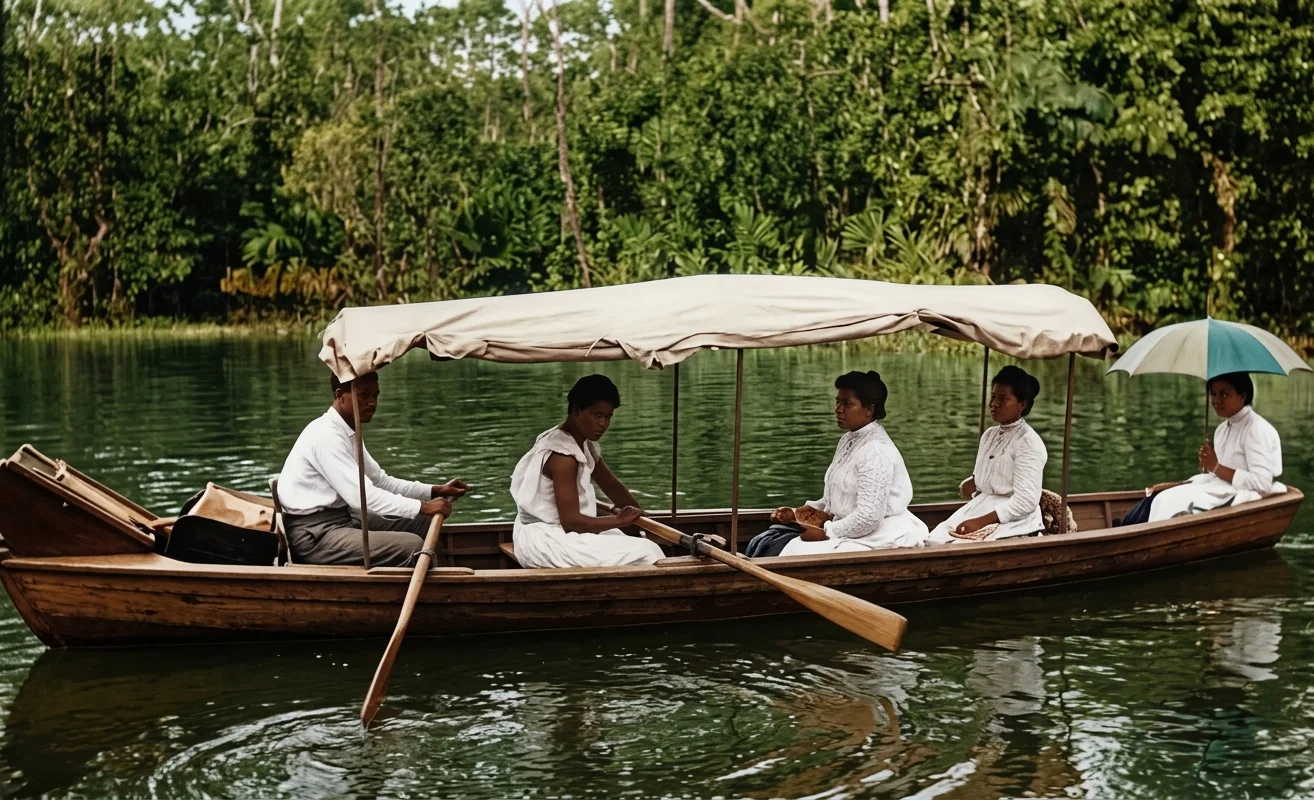
TRAVELING IN BRITISH GUIANA
The Indians accompanied him, and in three days they reached an Indian village on the Berbice River, called Kumaka, where many Indians had collected for a feast. While they remained there to take a few days’ rest after the feast was over, John Meyer made it his opportunity to preach the gospel to them. He first formed the acquaintance of the leading Indian of the village, who went among them, telling them that a white man had come with a message from the Lord. Although the Indians are a very timid people, yet it is customary for all to shake hands with a missionary. Mothers with children in their arms would take the hands of the little ones and put them into the hand of the brother, to express their thankfulness that God had sent him.
Accepting the offer of a lad who was going down the river in a batteau, he decided to return home by way of New Amsterdam. By this he was conveyed to a wood-cutting settlement, a few miles below the Kumaka village, where a white man, with many blacks and a few Indians, resided. I will again quote the words of Leonard Strong in describing a wonderful experience he had:—
“The white man showed him that if he took a batteau from thence, the river was so circuitous that, after paddling many miles, he would reach a small settlement only three miles from where he then was; he advised him therefore to walk these three miles through the forest, and there seek assistance to proceed farther down. To this Meyer agreed, and the white man, conducting him to a path which led into the wood, directed him carefully to follow it, and then left him to walk on alone. This the Indians had never done, knowing how very difficult it is for a stranger to keep the track.”
“Meyer, with his hammock and pack on his shoulders, walked on, but soon must have left the path and wandered from the right course; indeed, he acknowledged that more than once he came upon his own steps again. It is exceedingly difficult, if once you deviate from the faint break in these unfrequented forests, to recover it again, while the lofty trees so obscure the light of the sun that it is impossible to correct your course by that. He walked with little intermission the whole of that day; when the sun set, he hung up his hammock to the trees, and fell in that to sleep. At morning light he sought direction from the Lord, and pursued his journey, literally not knowing whither he went, without food or water. In the afternoon he came upon two pineapples, which he ate, as also many berries. As the shades of night closed in around him again, he swung his hammock to the trees, and commending himself to the Lord who bought him, slept till morning. At break of day he cried unto the Lord for help, and besought him not to let him die in the forest thus, if his death should discourage or stumble others and cause them to think his humble mission to the Indians had not been of him, or for his name. He then set forth again, looking to the Lord for guidance, and in the afternoon, to his great joy, lighted upon the bank of a small creek or river, where also he discovered recent traces of people, and remains of a fire.”
“Here, then, being very faint, leaves and berries his only food, he determined to remain, as, if he died here, his body was sure of being one day found, and, taking out his writing materials, he wrote down a journal of all that had happened, giving a full account of himself, with directions to whom all his papers and effects were to be conveyed. Then he hung up his hammock, and thus ended the third day, when, exceedingly happy in the Lord, though hungry and faint in body, Jesus gave his beloved sleep. The whole of the next day he lived principally on leaves, being afraid to search for berries in the wood lest he should lose his way, and his body lie concealed in the forest; for he thought it his duty to arrange if possible that his body and papers might be found, for the satisfaction of his wife and brethren. On the morning of the fifth15day he was too weak to leave his hammock or to gather leaves; persuaded that his hour was now come to die, he commended his spirit to him who had loved him and given himself for him, who had given unto him eternal life, and would raise his body at the last day; he felt that he had life in him who was risen from the dead.”
“While thus reposing his soul by faith in Jesus’ bosom, he heard the report of a gun; he listened awhile, when he heard the sound of voices on the water; raising himself in his hammock, he perceived on the creek a canoe full of Indians approaching; he then, gathering all his remaining strength, shouted and waved his hand; they came to the shore, and approached him in his hammock; he made the signs of hunger, and they brought from their canoe ready cooked fish for him to eat, from the creek also water to refresh his thirst.”
“Reviving a little, he told them his story, and how he was lost in the forest when seeking his way by the side of the river Berbice. They told him he had wandered far to the Abarry Creek, by the banks of which he then lay (this is the boundary between Demerara and Berbice counties); they then took him with all his things to their canoe, and conveyed him safely down the stream to their own village, where every attention was paid to him by their women to restore his strength, and where he remained all the next day. The following morning the Indians took him through an old canal into the Berbice River, and bringing him to a missionary station about ten miles from the town of New Amsterdam, left him with the missionary there.”
About the beginning of 1844, John Meyer moved with his family to a little village up the Berbice River by the name of Kumaka, where the Indians readily received them, and built them a home. John Meyer was a self-supporting missionary; but his arduous labors were made known to George Müller, of Bristol. He was many times assisted by this man of God. Once, when it seemed that they had eaten nearly the last morsel of bread, and starvation was about to stare them in the face, a messenger of God came to them bearing a bounty sent by George Müller. Thus he labored among these people until many of them accepted the gospel of Christ. And in after years, missionaries who have traveled through the section of country where Meyer labored find many red men who believe in the Lord and Saviour Jesus Christ.
There is a very interesting point to me in reading the record of his labors, and that is this: In the year 1844 a man, whose name is not given, went among the Indians on the savannas, far into the interior, and preached the coming of the Lord at hand. John Meyer labored against him, believing his doctrine to be fanaticism. It is evident, after reading all the connections and the manner in which this man labored, that he preached none other than the first angel’s message to these people.
Quite a number of missionary stations have been established among the Indians by the Anglicans, Methodists, and Roman Catholics. In a former article I referred to the labors of a Miss Austin, who has been very successful in teaching these people. She established the mission at Airy Hall more than forty years ago; and I find a large number of Indians scattered here and there who have been trained and taught in many respects the ways of the Lord by this woman. These people I find in most cases to be a straightforward, honest people. The Lord has surely blessed the labors of this sister; and I believe that in the kingdom of God we shall see the results of the efforts that she put forth.
We have only begun our work among this class of people, but the way is opening for us to establish missions among them; for quite often I find those keeping the Sabbath of whom I never had heard before.
May God help us to bring the precious rays of light to these benighted souls.
Mission Notes
If every missionary in India could reach forty thousand souls, more than two hundred million would still be left without Christian teaching.
Memorial Mission to New Guinea
The London Missionary Society has decided that their memorial to the missionaries, James Chalmers and Oliver Tomkins, who were recently murdered in New Guinea, should take the form of a special fund of $12,500, to support for five years a missionary to labor among the cannibal tribes who committed the massacre.
Wild Animals in the Indian Mountains
A MISSIONARY and his wife camping in the mountains of India wrote of the similarity between their location and the zoological garden, only in the mountains the animals were roaming about free instead of being confined in cages, which, he said, “has its drawbacks.” Among the animals that had either visited the camp or been seen in the neighborhood were tigers, monkeys, panthers, jackals, and a bear, besides many smaller creatures.
Biscuit Tins Protect Luganda Bibles
The empty two-pound biscuit tin, which is carelessly thrown to one side in England, becomes in tropical Africa an article of considerable value. The people of Uganda use it to preserve their books from the attacks of insects. In this manner many a Bible has been carried about in safety. Taking note of this, the British and Foreign Bible Society has made its latest version in the Luganda language of a shape to fit a biscuit tin. A thousand copies of the new Luganda Bible have been printed.
The Work at Home and Abroad Are One
The work at home and the work abroad are one. There are not two commissions. The same Spirit inspires, and the same Spirit sustains.
Fijian Bible Studies Published
A book of Bible studies in the Fijian language has been published by the Avondale Press.
Growth of Medical Missionaries
The number of medical missionaries in foreign service, which twelve years ago was 125, has steadily increased, until last year it stood at 295, and to-day it reaches 312. Of these, 115 are at work in India, and 106 in China. Presbyterian missions show the largest proportion of medical workers among their foreign agents.
The Cobwebbed Foreign Mission Fund
AN artist was asked to paint a picture of a decaying church. To the astonishment of many, instead of putting on the canvas an old, tottering ruin, he painted a stately edifice of modern grandeur. Back of the open portals could be seen the richly covered pulpit, the magnificent organ, and the beautiful, stained glass windows. Just inside of the grand entrance, guarded on either side by a pillar of the church in spotless apparel and glittering jewelry, was an “offering plate” of goodly workmanship, for the offerings of the fashionable worshippers. Directly above the “offering plate” there hung a very simply painted square box, bearing the legend, “Collection for Foreign Missions.” But right over the slot through which contributions ought to have gone, he had painted a huge cobweb.
An African Woman and the Bible
THERE is certainly some inspiration in the following incident told of an African woman who came into possession by some means of an English Bible. She and her people had heard a little of the gospel, and knew something of what the book was, and the woman was filled with delight in its ownership. But it was written in a strange tongue, and those who could interpret it were far away. Still, something must be done with so rare a treasure. After consultation, a day was set, notice was given, and at the appointed hour the Bible was laid on the stump of a tree in an open space. Then the natives began to assemble, took their places in a circle about the spot, and after waiting for a time in reverent silence, quietly dispersed.
Spanish New Testament Missionary Work
Nearly two years ago it was suggested to Mr. Lyman Stewart, of Los Angeles, that the publication of the New Testament in Spanish, marked so as to arrest the attention of Roman Catholics, and without comment, would be specially serviceable as a missionary adjunct in Spanish-speaking countries.
Many weeks and months were spent in the preparation of this volume, and proofs were submitted to missionaries in Catholic countries for suggestions. Since the work has been completed, shipments of the Testament have been made to various points in Spain, Cuba, Porto Rico, Venezuela, Colombia, Paraguay, Uruguay, Chile, Argentine Republic, Peru, Ecuador, all five of the Central American states, Mexico, the Philippines, besides many Spanish-speaking centers in the United States. This work has been undertaken, not for profit, but as a ministry of love.