Your ShelfYour Projects

Review and Herald, Vol. 57, No. 2.

THE MIND OF CHRIST
Earlier text: THE WORK IN ENGLAND

Our Tract Societies.

BY ELD. S. N. HASKELL.
The original organization of our T. and M. societies had a twofold object; first, to give each individual member an opportunity of engaging in the work of warning every nation, kindred, tongue, and people, of the approaching Judgment; second, it was designed that these societies should systematically act as agents for our institutions, through the medium of personal labor by the officers with individuals. It was thought that by this means a complete co-operation between all of our people and our several institutions could be effected, and that thus the latter would be built up and supported.
The efficiency of the system adopted was manifested in overcoming some serious difficulties, which, with our rapidly increasing numbers, we had begun to experience. In establishing the advance-pay system on our periodicals, hundreds of families were visited, and many of them found to be worthy poor. Others were found who could pay for their periodicals at some future time. These persons, with many others since that time, have received our periodicals, some of them at the expense of the various tract societies.
This was as it should be, for the Publishing Association could not know whom to trust, and, more than this, it was not consistent that it should bear the burden of furnishing periodicals to the poor, even had it been known who were worthy of such assistance.
At first, for a number of years, the societies used tracts principally in missionary labor, which were given away. When it was decided to send the Review and the Health Reformer for three months, on trial, to friends, the response from our brethren was such that an edition of ten thousand copies of the Voice of Truth was soon printed for this purpose. Not that caution was used in sending out these papers that should have been exercised, but the effort showed the strength of our system, and the willingness on the part of our brethren to co-operate in the work. A mistake was also unwittingly made in becoming liable to a postal law forbidding the sending of papers to those who had not subscribed for them. Also in a few cases persons received two or three papers for some time, which they did not read. Yet, notwithstanding all this, these moves accomplished good in enlightening many respecting our views. A brother, the president of one of our Conferences, has repeatedly said that the money paid for the Voice of Truth was one of the best investments ever made in his State. However, the defects which became apparent in this plan of operation led to the formation of our V. M. societies, and the present method of remailing the Signs, by which only three numbers are sent before corresponding with the one receiving them. If no response is received, then other names are tried. This plan has thus far proved successful, and we feel to recommend it to all.
As our ministers and others called for publications, our tract societies began to keep larger supplies of publications on hand, and to furnish them at Office prices to those who purchased them to sell again. Thus the tract societies bore the expense of freightage from the Office; but by special arrangements, this was after a time made up to some of the societies. Next, it was recommended that our ministers should act as agents for these societies, and give them the profits arising from their sales of books, etc. To this plan there can certainly be no objection, if the ministers choose to do so; but it would be going too far to make it compulsory upon them, unless they should in most cases receive more pay for their labors.
It was seen, also, that unless there were those who could and would visit individuals at their homes and secure pledges for the different enterprises, great inequality would exist, as, at our general meetings, when the wants of the cause are presented, many would not be present. Hence the tract societies have taken responsibilities in this matter.
Through all this experience, we have been learning the most successful methods of carrying forward the work of God. It has often been said, “A strong pull, a long pull, and a pull all together,” is what is needed; and there never was a time when this was more true than now. Shall we go back?—Never! Onward, is our motto, in the strength and love of Christ.
It would be too much to say that in these untried advance steps the best plan has always at first been adopted. Like every other branch of this cause, and like the cause itself, perfection is before us. As a people, we are aiming at this point; and, by the grace of God, we expect that a little way in the future we shall see the time when, like an army of well-trained soldiers in one broad phalanx, we can present to the world and the powers of darkness an unbroken front. God is leading in this work. Soon the blood-stained banner of Prince Immanuel will wave triumphant over a fallen world. Laying aside those methods which experience has proved not the best, we should, with courage, press on to final victory.

An Apportionment.

At the late General Conference, the following resolutions were adopted:—
Resolved, “That this Conference recommend that our brethren raise sufficient means to send one thousand copies of the Signs of the Times to England.”
Resolved, “That the General Conference Committee, with Eld. James White, apportion to each State the sum proper for it to raise for this object, in proportion to its tithes.”
This matter has been prayerfully considered, and much thought given to it, not because it was difficult to make the apportionment, but on account of the inequality which would exist if it were made on the basis of the tithes paid in each Conference as reported to the General Conference. Some of the Conferences least able financially pay the largest amount of tithes in proportion to their membership. However, we have apportioned the cost of one thousand copies of the Signs as suggested by the General Conference, and we have ordered that number sent to Eld. Loughborough for distribution in England. If this apportionment is satisfactory to each State society, let the President immediately notify the Signs Office to charge to that society its quota. If not satisfactory, correspond immediately with the General Conference Committee, at Battle Creek, Mich.
In this apportionment we have omitted some of the poorer Conferences, and have charged at the rate of $1.75 per copy, as this includes the necessary expense of postage to England.
We give below the amount of s. b. paid by each Conference, and the amount given on an average by each individual member, as this is the basis on which this apportionment has been made. GEN. CONF. COM.

Apportionment.

Conference No. copies Cost
Michigan 184 $322.00
California 112 196.00
Iowa 94 164.50
Wisconsin 78 136.50
Minnesota 74 129.50
Ohio 67 117.25
New England 54 94.50
New York 54 94.50
Illinois 48 84.00
Kansas 46 80.50
Indiana 30 52.50
Pennsylvania 30 52.50
Nebraska 28 49.00
Texas 26 45.50
Vermont 26 45.50
Missouri 23 40.25
Maine 18 31.50
Dakota 8 14.00
Total 1000 $1750.00
The following is the average amount of tithes paid last year by each member in the several Conferences, also the total amount:—
Conference Per member Total
California $7.02 $7163.83
New England 7.57 3500.00
Texas 6.80 1700.00
Nebraska 6.04 1800.00
Ohio 5.50 4302.98
New York 5.13 3449.80
Iowa 5.01 6024.03
Missouri 4.65 1540.85
Pennsylvania 4.65 1952.33
Wisconsin 4.59 5087.25
Vermont 4.28 1680.86
Illinois 4.10 3116.76
Minnesota 3.80 4833.95
Kansas 3.70 3018.82
Indiana 3.68 1924.50
Maine 3.62 1218.74
Michigan 3.62 11838.35
Dakota 2.62 511.86
Tennessee 2.46 133.00
Kentucky 1.95 156.63
Province of Quebec 1.41 186.40

Texas T. and M. Society.

The Texas Tract and Missionary Society held its third annual session in connection with the camp-meeting at Dallas, Texas, Nov. 11-24. The first meeting convened Nov. 14, 1880. Called to order by the President. The opening prayer was offered by Eld. B. L. Whitney. Reading of minutes waived.
After remarks by Eld. Whitney upon the importance of the missionary work, it was voted that the President appoint the usual committees. The following were then announced: On Nominations, A. H. King, J. F. Bahler, and Wm. Kerr; on Resolutions, B. L. Whitney, D. Carpenter, and A. W. Jenson.
Adjourned to call of Chair.
SECOND MEETING, Nov. 23, 4 P. M.—After the opening exercises, interesting and instructive remarks were made by Elds. Whitney and Butler concerning the best plan for defraying the general expenses of the tract society.
Voted, That the President be requested to procure and keep on hand in the repository a good supply of stationery, such as he may think necessary to supply our tract societies.
The Committee on Nominations presented the following-named persons as officers of the society for the coming year: For President, R. M. Kilgore; Vice-president, J. F. Bahler; Secretary, Kittie McKisick. Directors: Dist. No. 1, L. H. Huguley; No. 2, H. C. Chrisman; No. 3, J. F. Bahler.
The Committee on Resolutions presented the following:—
Whereas, Our State affords a most excellent and promising field for missionary labor, only a small portion of which has as yet been occupied; and
Whereas, The scarcity of ministerial help in our Conference should, in view of the great field before us, stir us all to activity in our efforts to advance the work in our midst; therefore,
Resolved, That we urge all our brethren and sisters throughout the State, to take a personal interest in the tract and missionary work, that they may thereby become efficient agents in helping to carry forward the precious cause of present truth, which God has intrusted to us.
Resolved, That we earnestly invite all our brethren and sisters to become members of the tract society.
Resolved, That we heartily indorse the action of the General Tract and Missionary Society, with reference to regular quarterly donations from all the members; and we earnestly recommend the plan to each member of this society, requesting that liberal donations be made each quarter for the support of this important branch of the work in our State.
On motion, adjourned. R. M. Kilgore, Pres. Kittie McKisick, Sec.

Notes of News.

—Dec. 31, there was a fire at Rock Island, Ill.; loss, $200,000.
—Cambridge, Mass., celebrated its 250th anniversary on the 28th inst.
—There was a fire in Jackson, Mich., Dec., 31, which resulted in a loss of $65,000.
—During the year 1880, the losses by fire in the city of Chicago aggregated $1,164,159.
—The American Board of Foreign Missions propose to establish a mission at Bagdad.
—The pope has addressed a letter to the Irish bishops, urging them to do nothing contrary to law.
—Professor Merriman says that Manhattan Island is sinking at the rate of three inches a century.
—Jan. 4, a tenement house in New York burned down, and 10 persons perished in the flames.
—Gas-light has recently been introduced into Santa Fé, New Mexico, the oldest city in the country.
—The experiment of lighting the Hoosac tunnel by the new electric light has been successfully tried.
—Two African tribes of Sierra Leone are at war, and horrible barbarities are practiced on both sides.
—Eighty persons have been killed by floods in Cyprus, and immense damage has been done to property.
—The powers are urging Turkey and Greece to accept arbitration; but neither of them seems willing to do so.
—Another anti-Jewish riot is reported in dispatches from Berlin. Jews were treated with personal violence.
—Jan. 6, eighteen persons were drowned by the wreck of the ship Indian Chief, near the entrance of the Thames River.
—Dr. Chapin (Universalist), one of America’s most celebrated pulpit orators, died in New York, Sunday night, Dec. 26.
—Mr. Jay Gould now has 10,000 miles of railroad under his control,—a ninth part of the entire railroad mileage in the country.
—Many of the Jews residing in Germany are preparing to leave that country, on account of the hostile attitude of the government.
—In South Africa, fortune still seems to favor the Boers. The British camp at Potchefstroom has been surrendered to them.
—The value of the game shipped from the West to Europe is now about $3,000,000 a year, and the business is rapidly increasing.
—The public debt is now, according to a December statement, $2,099,885,096. Since June 30, it has been decreased $42,990,559.
—An English steamer collided with a Spanish steamer near Cape Roca, Jan. 6. It is believed that 45 persons lost their lives by this accident.
—In the Russian province of Sartoff, 750,000 peasants are said to be starving, and in Samara, more than a million are suffering absolute want.
—The cod-fisheries on the Pacific coast are so productive that San Francisco, which has hitherto imported its supply, expects soon to be exporting its surplus.
—The police force of London numbers 12,000 men; and there are in that city no less than 15,000 professional thieves who are known to the authorities as such.
—Mr. Moody’s sermons have been translated into Arabic. Protestant missionaries in Syria read extracts from them every Sunday evening to their converts.
—Dec. 10, the steamer Isabel, bound up the Magdalena River, South America, burst her boiler. The steamer was blown to atoms, and 32 lives were lost.
—Several persons lost their lives by a fire-damp explosion that occurred in a coal pit at St. Etienne, France, on the 27th inst. Eleven bodies have been recovered.
—Michaeloff, a Russian nobleman and a prominent Nihilist, has been arrested. He was concerned in the attempt to blow up the Winter Palace nearly a year ago.
—Since 1870, the consumption of beer in the United States has more than doubled. In 1870, it was 6,574,000 barrels; in 1880, tax was paid on 13,347,000 barrels.
—Edison is still working hard and hopefully on the electric light. He estimates that the cost of lighting the city of New York by his method will be about $2,000,000.
—M. Blanqui, the noted Communist, died in Paris, Jan. 1, at the age of 70 years. His funeral took place Jan. 5, 30,000 persons following the remains to the cemetery.
—It is believed that the number of copies of the Bible in circulation has increased from 5,000,000 at the commencement of the present century, to 148,000,000 copies at the present time.
—Anderwert, President-elect of the Swiss republic, recently committed suicide. The autopsy showed that he was suffering from hypertrophy of the heart, and incipient softening of the brain.
—Dec. 4, a fight occurred between a part of the Chilian naval forces stationed near Lima, and a Peruvian boat on guard duty, aided by the harbor batteries. The Chilians withdrew to repair a damaged boat.
—The British Parliament met Jan. 6. Parnell, Dillon and Sullivan, although on trial before the Queen’s Bench, left for London to attend the opening session. Riots, with loss of life, are reported from Ireland.
—Of the 15 Indian girls at Mr. Moody’s seminary in Northfield, Mass., eight are succeeding well in the study of music. Most of the girls propose to take the four-years’ course, to prepare themselves to teach their people.
—The manager of the Alliance (Chicago) attempted to publish his paper on Sunday, and the enterprise cost him his entire editorial staff, and many of his most valued contributors. He has now decided to publish on Monday.
—The Roman Catholics of Ireland have, during the last eight years, expended $5,300,000 on churches; $16,000,000 on convents; and $1,500,000 on colleges. In view of these facts, an exchange exclaims, “Poor Ireland!”
—The Duke of Bavaria, brother of the Empress Elizabeth, is one of the most active young doctors in attendance on the hospitals of the Austrian capital. He has fairly earned his diploma, and is a regular attendant at the lectures of Professor Arlt.
—During the last 13 years, the national debt has been reduced $725,000,000, or nearly one-third. A parallel instance has not been known in the financial history of the world. England, with her vast wealth, was 65 years in paying less than $500,000,000 of her debt.
—A Swiss workman has constructed a clock which indicates the day of the week and month, the signs of the zodiac, the phases of the moon, and the hour of sunrise and sunset. It strikes the quarters, and at every hour plays one of eight tunes. The pendulum is a barometer.
—Heavy snow-storms are reported throughout the Southern States during the last week of the old year; no such weather has been known in that section for 20 years, and business has been generally suspended to allow the people to enjoy the novelty of sleigh-rides and snow-ball battles.
—An international sanitary conference has been held at Washington, composed of representatives of the countries likely to be visited by cholera or yellow fever. Its object was to adopt an international system of notification of the actual sanitary condition of ports or places under the jurisdiction of the several powers, and of vessels sailing therefrom.
—Several times within a few years past, there have been reports that smoke columns and similar indications of volcanic activity have been seen on Mount Baker, Washington Territory. A dispatch from that Territory, dated Dec. 12, states that the mountain was then in a state of eruption, and that a sharp shock of earthquake was felt the evening before.
—The Turkish Minister of foreign affairs has officially announced that hereafter no Moslem shall be allowed to leave his religion and become a Christian, under penalty of death; that no one shall be allowed to teach doctrines subversive of Islam; and that any foreigner engaged in such teaching may be arrested and imprisoned without consulting the foreign consuls or ambassadors.
—The British bark Fontabelle sailed from Falmouth, Jamaica, for London, Dec. 13, with 35 persons on board. On the 17th, a sudden hurricane struck the ship, and in ten minutes she was an almost helpless wreck. After protracted and terrible suffering, and nearly all on board had been swept into the angry sea, the survivors, four in number, were rescued, and taken back to Jamaica. Six sailors from the British bark Dundee, were drowned by the capsizing of the boat sent to the assistance of the wreck. Thus by this accident 37 persons found a watery grave.

Obituary Notices.

“Blessed are the dead which die in the Lord from henceforth.” Rev. 14:13.
ALBEE.—Died of diphtheria, in Poy Sippi, Wis., Nov. 24, 1880, Royal E., son of Perry and Ursula Albee, aged 5 years, 5 months, and 7 days. E. U. ALBEE.
  • [Signs of the Times please copy.]
EASTMAN.—Our youngest daughter, May M. Eastman, died of diphtheria, in Mitchellville, Polk Co., Iowa, Dec. 19, 1880, aged 14 years, 5 months, and 5 days. She was kind and affectionate, and was greatly loved. We expect to meet her in that glorious land where partings will be no more. R. R. AND M. J. EASTMAN.
BURCH.—Our daughter, Eva Winnie Parker, died near Nashville, Mo., Dec. 10, 1880, aged 13 years, 7 months, and 16 days. She died of an abscess on the brain caused by a blow inflicted by her teacher with a book, nearly five years ago. She suffered intensely, but was very patient. Funeral discourse by J. C. Alexander, Disciple. E. L. AND E. BURCH.
ROWE.—Died of membranous croup, in Townsend, Sandusky Co., Ohio, Dec. 11, 1880, little Guy, son of Arthur and Eva Rowe, aged 3 years, 11 months, and 25 days. The father, who has never made a profession of religion, now says he must meet his little boy in Heaven. Funeral services in the Methodist meeting-house. Words of comfort by the writer, from Luke 19: 10. E. H. GATES.
COOLIDGE.—Died of diphtheria, in Poy Sippi, Wis., Dec. 14, 1880, Laura May Coolidge, in the twelfth year of her age. Also of the same disease, Dec. 18, Edith U. Coolidge, in the fourteenth year of her age. These sisters united with the Seventh-day Adventist church a little more than a year ago, and died in bright hope of meeting Jesus on the morning of the first resurrection. E. U. ALBEE.
(Signs please copy.)
BAKER.—Died at Raymond, Potter Co., Pa., Dec. 4, 1880, Caroline, wife of Joshua Baker, aged 63 years, 8 months, and 6 days. At the age of twelve years, Sister Baker united with the Presbyterian church, of which she remained a consistent member until about twenty years ago, when Brn. Ingraham and Hutchins held meetings in Ulysses. She said she “would step when the body did,” and as the different advance moves have been made, she has verified this statement. The church has experienced a loss, and her husband and children a sad bereavement. Funeral discourse by the writer, from 2 Cor. 4: 18. D. T. FERO.
JOHNSON.—Died of apoplexy, at the residence of his mother-in-law, in Henry Co., Ind., Dec. 3, 1880, Jesse B. Johnson, in the thirty-ninth year of his age. Himself and wife embraced present truth through the influence of reading matter furnished them by the writer. They were members of the Greensborough church, and were baptized by Eld. Wm. Covert a few months ago. A large circle of relatives and friends mourn their loss, but they have hope in their sorrow. JAMES A. HAMILTON.
WALTER.—Died in Watson, Allegan Co., Mich., Dec. 24, of acute bronchitis, the infant son of Conrad and Adelia E. Walter, aged about four months. Bro. and Sr. Walter have reared a large family of children, and this is the first one whom they have been called upon to bury. How precious under these circumstances is the hope of those who believe that Christ will save these little ones at his coming, and that that event is near at hand. It furnishes another cord to draw them toward the better land. Remarks were made on the occasion by the writer. W. H. LITTLEJOHN.
WILLIAMSON.—Died in Westboro, Mass., Dec. 2, 1880, Ella B., wife of E. C. Williamson and youngest daughter of A. W. and C. H. Low, of Somerset Mills, Me., aged 29 years and 5 months. She embraced the truth last February, when her father was dangerously sick. In accordance with the request of Christian friends, his life was spared; and Sister W. testified that she had since tried to observe the Lord’s Sabbath and live a Christian life. She was highly esteemed, and leaves a large circle of friends. She was brought to Somerset Mills, Me., where the funeral services were held Dec. 4. Remarks by the writer, from Job 19: 25. May the afflicted family enjoy a glorious reunion in the kingdom of God. J. B. GOODRICH.

Be Willing to Do Good in Your Own Way

—Be willing to do good in your own way. David would not undertake to slay the giant in Saul’s armor; he had not proved it. You may not be able to give a Bible-reading or conduct a prayer-meeting, and perhaps you cannot even take a class in Sabbath-school. Don’t fret. A well-made loaf of bread, a basket of clothes neatly mended, may be a means of grace.
“Who sweeps a room as for Thy laws, Makes that and the action fine.”
God does not demand impossibilities. It is often one’s first duty to keep well, bright, and rested, for others’ sakes. We need none of us be disturbed if we cannot wield another’s weapons; but our own must not rust.—Christian at Work.

Obstacles to Christianity in Japan, According to Isabella Bird

—Miss Isabella L. Bird, who has recently published a work on Japan, founded on travels in the interior of that country, says that in her opinion there are three great obstacles to the spread of Christianity among Japanese people. The first is its insistence upon a morality of life which is distasteful to the Japanese mind; the second, that it founds itself upon a promise of eternal life, and eternal life is precisely what the oriental mind does not contemplate as desirable, its ideal of happiness being rest in unconsciousness; the third, that the Japanese students who are educated by their government in Europe and America assure their countrymen, “that no one of any intelligence or position now believes in Christianity, and that it is an exploded system, only propped up by the clergy and the uneducated classes.”

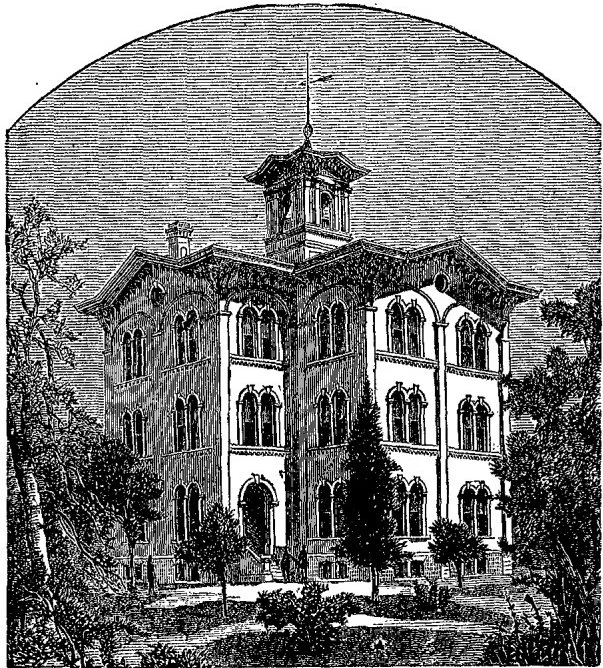
BATTLE CREEK COLLEGE.

A MODEL EDUCATIONAL INSTITUTION, COMPRISING FIVE DEPARTMENTS.

Nearly 500 Students Enrolled Annually, Coming from 32 States and Territories.

DEPARTMENTS.

I. DEPARTMENT OF THE ARTS AND SCIENCES.

This includes a Classical Course of FOUR YEARS and an English Course of three years, each with its Preparatory Course of two years.

II. NORMAL DEPARTMENT.

This includes a Teachers’ Course of FOUR YEARS, and a Model School. The course in this department includes all the branches required for a first-class certificate in any State. Professional instruction in Didactics is also given to those in this department who are expecting to teach.

III. COMMERCIAL DEPARTMENT.

This includes instruction in the following topics: Bookkeeping, Business Correspondence, Business Forms, Business Penmanship, Commercial Law, Banking, and Telegraphy. The common branches are also pursued in connection with the topics given above; also, French and German.
There are two sessions daily—afternoon and evening.
The courses in this department are of varying length, and the tuition ranges from $5.00 to $30.00.
Superior advantages for those desiring to prepare themselves for Tract and Missionary Secretaries and Librarians. (Send for special circular.)

IV. DEPARTMENT OF THEOLOGY.

This department has a course of three years, which includes, besides the usual common branches, Geology and Greek.

V. DEPARTMENT OF HYGIENE.

This department has a course of one year. It is designed for those who desire to obtain accurate and scientific information on all subjects pertaining to the preservation of health, together with a fundamental knowledge of anatomy and physiology, and a practical acquaintance with the nature and ordinary treatment of common diseases.

THE FACULTY

numbers fourteen members. They are all men and women of experience and critical scholarship.
The majority of the students are young men and women of true moral worth. Their influence over the unstable is highly restrictive and salutary, making it comparatively easy to maintain the most rigid discipline.

EXPENSES.

Probably there is no other College in the United States where a thorough education can be obtained at so small an expense. A system of clubbing, which has become very popular among students, enables them to secure excellent board at $1.10 a week, exclusive of lodging, which costs 50 cents to $1.00 more. The annual expenses of each student, including all but traveling expenses and clothing, need not exceed $113.00. A full descriptive Catalogue will be sent free, upon application.
Address BATTLE CREEK COLLEGE, Battle Creek, Mich.

REVIEW AND HERALD PUBLISHING HOUSE.

BOOK AND JOB PRINTING, BOOK BINDING, Electrotyping, Stereotyping, Paper Ruling, Blank Book Manufacturing, Etc.
The largest and best equipped printing office in the State. Orders by mail promptly attended to.
Address REVIEW AND HERALD, Battle Creek, Mich.

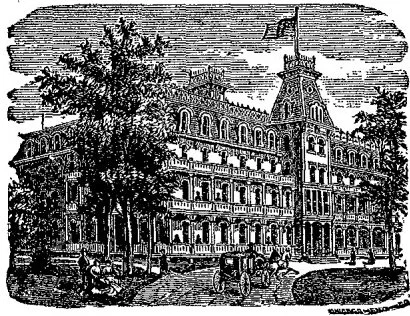
MEDICAL AND SURGICAL SANITARIUM,

Battle Creek, Michigan.
This institution, beautifully located in one of the most healthful cities of Michigan, is everywhere recognized as the

GREAT SANITARIUM OF THE WEST.

More than 4,000 patients successfully treated. The erection of new buildings and the addition of all the most approved remedial appliances known to the profession, have made it The Most Complete Institution of the Kind in America. All modern hotel conveniences furnished. Terms very reasonable.
J. H. KELLOGG, M. D., Medical Superintendent.
Address, SANITARIUM, Battle Creek, Mich.

THE SIGNS OF THE TIMES.

PUBLISHED WEEKLY AT OAKLAND, CAL., FOR THE
MISSIONARY SOCIETY OF SEVENTH-DAY ADVENTISTS.
TWELVE-PAGE EDITION.—A live Religious Family Paper, containing, in addition to the great variety of original articles, which make it a desirable prophetic journal, Departments devoted to Temperance, The Home Circle, News, The Missionary Work, and the Sabbath-school. Price per Year, $2.00
In clubs of ten or more copies to one address, to be used for missionary work, each 1.50
EIGHT-PAGE EDITION.—Condensed from the above. Per Year, 1.25
In clubs of ten or more, each 1.00
Address SIGNS OF THE TIMES, Oakland, Cal.,
—OR—
REVIEW AND HERALD, Battle Creek, Mich.
ELDER J. N. LOUGHBOROUGH, Ravenswood, Shirley Road, Southampton, England.
MISS ELIZA THAYER, Secretary N. E. Tract Society, So. Lancaster, Mass.
WM. LEAVITT, Salem, Oregon.
Continue reading: GOOD HEALTH