AFTER the time of Malachi, there is, strictly speaking, no such thing as a religious history of the Jews. God had closed His revelation, His voice was stilled, He spoke no more by prophets. The people had got entirely beyond the hearing of His voice. They were already political in their religion; and it was not long before their religion itself became political, so that henceforth their history is simply political, tending steadily more and more to that dreadful hour in which they openly renounced every principle of religion, and openly proclaimed themselves political solely—in their savage exclamation, that awful night, to Pilate and to the universe, "We have no king but Cæsar."
Nevertheless, God bore with them until that hour, and even beyond. He still abode with them, in spite of their sad misrepresentation of Him, in spite of their loading Him with constant reproach, in spite of their putting Him to an open shame. For the sake of His promise to their fathers from ancient time, that from them the Deliverer should come, He remained through all their unfaithfulness the Faithful One. Yet their history from Malachi onward is but a part, rather an incident, of the general history of empire in the East. And in this general history of empire, God continued to reveal Himself to fulfil His Word, and to shape all things to the accomplishment of His eternal purpose.
God had revealed Himself to Nebuchadnezzar, and had been accepted by him as the one true God and the everlasting King. And Nebuchadnezzar proclaimed Him as such to all peoples, nations, and languages. God revealed Himself to Darius the Mede, and was also accepted and proclaimed by him to all peoples, nations, and languages. God next revealed Himself to Cyrus, and by him likewise God was accepted and proclaimed to all nations as "the God." As we have seen, the influence of Cyrus for this God and for His worship in the earth, continued to shape the course of his successors, Cambyses, Darius, Xerxes, and Artaxerxes.
We have seen that in the days of Cyrus the angel Gabriel abode at the Persian court; and he said that he would continue there till the time of the coming of the prince of Grecia, of which the angel had already spoken to Daniel. Dan. 8:21; 10:20. And the Persian court was becoming worse and worse, and more and more unbearable. We have seen that Darius Nothus came to the throne by the murder of his predecessor, who had obtained the same throne by the murder of his predecessor. This Darius was succeeded by his son Artaxerxes without murder on his part, but not without his brother’s attempting to murder him. Artaxerxes was succeeded by his son Ochus, "the most cruel and wicked of all the princes of his race, as his actions soon evinced. In a very short time the palace and the whole empire were filled with his murders." He was poisoned by one of his ministers, Bagoas by name, who also slew all the king’s sons but the youngest, whom he made king; but whom in two years he murdered. Bagoas then placed upon the throne Darius Codomannus. Him also he shortly attempted to poison; but was detected, and was required to drink his own prepared poisoned drink to prove his innocence. In such a desperately corrupt place as the court of Persia had now become, the angel could no longer stay. Corruption had reached its height. Gabriel left the horrible place, lo! the prince of Grecia came, and the Persian empire sank.
Alexander, "the prince of Grecia," in his siege of Tyre, had demanded assistance from the Jews. The Jews pleaded that they were lawful subjects of the Persian king who was yet reigning; that all that they were, as a nation, they owed, under God, to the favor of the Persian kings; and that therefore they could not consent to oppose the Persian king. This made Alexander very angry, and he declared against the Jews and Jerusalem vengeance in destruction and desolation. He started toward Jerusalem to execute his wrath. The people were greatly troubled. The high priest proclaimed a fast, and that supplications be made to God. God accepted their appeal, and instructed the high priest in a dream to go forth with his assistant priests, arrayed in their priestly garments, and all the other people clothed in white, to meet the coming king, as he should approach the city.
The procession extended a long distance outside the city. When Alexander "saw the multitude at a distance, in white garments, while the priests stood clothed in fine linen, and the high priest in purple and scarlet clothing, with his miter on his head, having the golden plate whereon the name of God was engraved, he approached by himself and adored that name, and first saluted the high priest. The Jews also did all together with one voice salute Alexander, and encompassed him about. Whereupon the king of Syria and the rest were surprised at what Alexander had done, and supposed him disordered in his mind.
"However, Parmenio alone went up to him and asked him how it came to pass that when all others adored him, he should adore the high priest of the Jews? To whom he replied, 'I did not adore him, but that God who hath honored him with His high priesthood. I saw this very person in a dream, in this very habit, when I was at Dios in Macedonia; who, when I was considering with myself how I might obtain the dominion of Asia, exhorted me to make no delay, but hardly to pass over the sea thither, for that He would conduct my army, and would give me the dominion over the Persians; whence it is that having seen no other in that habit, and now seeing this person in it, and remembering that vision, and the exhortation which I had in my dream, I believe that I bring this army under the Divine conduct, and shall therewith conquer Darius, and destroy the power of the Persians, and that all things will succeed according to what is in my mind.'"
Alexander then placed the high priest at his right hand, and walked at the head of the procession, that was now joined by his army, into the city, and up to the temple, where "he offered sacrifice to God according to the high priest's direction." There also the high priest read to him, from the book of Daniel, the prophecy concerning him; and Alexander acknowledged that he was the one referred to in the prophecy. O that Alexander had yielded himself to this call from God, as did Cyrus to his!
When Alexander's career had ended, and his dominion was broken up, the Jews submitted to whatever king happened to hold Palestine as part of his dominion, tho it happened that for the most part they fell under the power of the kings of Syria—the Seleucidæ. One of these, Seleucus Philopator, sent his chief officer to rob the temple at Jerusalem of its treasures. The priests and people of the whole city threw themselves down before God, imploring Him to defend His holy house. As the officer had entered the temple court, and was about to break open the treasury, "the Spirit of the Almighty revealed Himself by the most sensible marks; insomuch that all those who had dared to obey Heliodorus were struck down by a divine power, and seized with a terror which bereaved them of all their faculties. For there appeared to them a horse richly caparisoned, which, rushing at once upon Heliodorus, struck him several times with his forefeet. The man who sat on this horse had a terrible aspect, and his arms seemed of gold. At the same time there were seen two young men, whose beauty dazzled the eye, and who, standing on each side of Heliodorus, scourged him incessantly, and in the most violent manner. . . . By the same power he was cast to the ground speechless."
That was the last time, however, that the temple was so protected and defended, tho it was more than once entered and robbed by heathen. A few years afterward king Antiochus Epiphanes captured the city by storm, and gave it up to plunder and slaughter for three days, in which about eighty thousand were slain, forty thousand were made prisoners, and forty thousand were sold as slaves. The king himself entered the temple, and even into the most holy place, and robbed the temple of its golden furniture and all the treasure therein. But before all this, there had gone out of Israel "wicked men who persuaded many, saying, Let us go and make a covenant with the heathen that are round about us; for since we departed from them we have had much sorrow. So this device pleased them well. Then certain of the people were so forward herein that they went to the king, who gave them licenses to do after the ordinances of the heathen; whereupon they built a place of exercise at Jerusalem according to the customs of the heathen." And the sack, slaughter, slavery, and the robbery of the temple were their reward.
Next Antiochus Epiphanes issued an edict, commanding that all the people of his dominion should be of one and the same heathen religion, and all recognize only heathen laws; and this under penalty of death. This, of course, was aimed directly at the Jews. Many of them obeyed the edict of the king, and persecuted those of their own people who would not obey it. The king also filled Jerusalem with idol altars, upon which he sacrificed abominable things; he also put to death those who would circumcise their children, or who refused to eat swines' flesh and other abominable things.5
Driven to desperation by these horrible things practised upon his people, a certain Mattathias, a ruler and a great and honorable man in the city of Modin, revolted, and with his five sons fled to the mountains. They were joined by all who rejected the king's decree. Not long afterward Mattathias died; but before his death he solemnly enjoined upon his sons that they stand true to the laws of Israel, and to fight against the king. He commanded them to let his son Judas be their captain.
This Judas was surnamed Maccabeus. Thus arose the Maccabean wars, and what is called "the Maccabean Revival." The origin of this Maccabean Revival was religious, but it shortly became political. The Maccabees were wonderfully successful in their wars; but firmly to fix forever their power and standing, they sought an alliance with the Romans, B.C. 161. And that their motive in this was absolutely political is clear from their own record of it, which runs as follows:—
"Now Judas had heard of the fame of the Romans, that they were mighty and valiant men; and such as would lovingly accept all that joined themselves unto them, and make a league of amity with all that came unto them; and that they were men of great valor. It was told him also of their wars and noble acts which they had done among the Galatians [the Gauls], and how they had conquered them, and brought them under tribute; and what they had done in the country of Spain, for the winning of the mines of the silver and gold which is there; and that by their policy and patience they had conquered all the place, tho it were very far from them; and the kings also that came against them from the uttermost part of the earth, till they had discomfited them; and given them a great overthrow, so that the rest did give them tribute every year."
"Beside this, how they had discomfited in battle Philip and Perseus king of the Citims [Macedonians], with others that lifted up themselves against them, and had overcome them; how also Antiochus [Magnus], the great king of Asia, that came against them in battle, having a hundred and twenty elephants, with horsemen, and chariots, and a very great army, was discomfited by them; and how they took him alive, and covenanted that he and such as reigned after him should pay a great tribute, and give hostages, and that which was agreed upon, and the country of India, and Media, and Lydia, and of the goodliest countries, which they took of him, and gave to king Eumenes."
"Moreover how the Grecians had determined to come and destroy them; and that they, having knowledge thereof, sent against them a certain captain, and fighting with them slew many of them, and carried away captives their wives and their children, and spoiled them, and took possession of their lands, and pulled down their strong-holds, and brought them to be their servants unto this day."
"It was told him besides, how they destroyed and brought under their dominion all other kingdoms and isles that at any time resisted them; but with their friends and such as relied upon them they kept amity; and that they had conquered kingdoms both far and nigh, insomuch as all that heard of their name were afraid of them; also that whom they would help to a kingdom, those reign; and whom again they would, they displace; finally, that they were greatly exalted; yet for all this none of them wore a crown, or was clothed in purple, to be magnified thereby."
"Moreover, how they had made for themselves a senate-house, wherein three hundred and twenty men sat in council daily, consulting alway for the people, to the end they may be well-ordered and that they committed their government to one man every year, who ruled over all their country, and that all were obedient to that one, and that there was neither envy nor emulation among them."
"In consideration of these things, Judas chose Eupolemus the son of John, the son of Accos; and Jason the son of Eleazer; and sent them to Rome to make a league of amity and confederacy with them, and to entreat them that they would take the yoke from them; for they saw that the kingdom of the Grecians [Alexander's successors] did oppress Israel with servitude. They went therefore to Rome, which was a very great journey, and came into the senate, where they spake and said:—"
"Judas Maccabeus with his brethren, and the people of the Jews, hath sent us unto you, to make a confederacy and peace with you, and that we might be registered your confederates and friends."
"So that matter pleased the Romans well. And this is the copy of the epistle which the senate wrote back again in tables of brass, and sent to Jerusalem, that there they might have by them a memorial of peace and confederacy:—"
"Good success be to the Romans, and to the people of the Jews, by sea and by land forever; the sword also and enemy be far from them. If there come first any war upon the Romans or any of their confederates throughout all their dominion, the people of the Jews shall help them, as the time shall be appointed, with all their heart; neither shall they give anything unto them that make war upon them, or aid them with victuals, weapons, money, or ships, as it hath seemed good unto the Romans; but they shall keep their covenants without taking anything therefor."
"In the same manner also, if war come first upon the nation of the Jews, the Romans shall help them with all their heart, according as the time shall be appointed them; neither shall victuals be given to them that take part against them, or weapons, or money, or ships, as it hath seemed good to the Romans; but they shall keep their covenants, and that without deceit."
"According to these articles did the Romans make a covenant with the people of the Jews. Howbeit if hereafter the one party or the other shall think meet to add or diminish anything, they may do it at their pleasure, and whatsoever they shall add or take away shall be ratified. And as touching the evils that Demetrius doeth to the Jews, we have written unto him, saying, Wherefore hast thou made thy yoke heavy upon our friends and confederates the Jews? If therefore they complain any more against thee, we will do them justice, and fight with thee by sea and by land." 1 Maccabees 8.
Thus was solicited and obtained, by the Jews, that connection with the Romans which brought the utter ruin of the Jewish nation, and the desolation of their land, by the power of the Romans.
[The next and last article of this vitally instructive series is entitled "The Scepter Departs from Judah."]
RESTORATION from BABYLON BY ALONZO TREVIER JONES
CHALK TALKS.
By J. Grantell
A Word Behind Thee.
LONG, long ago, our loving Father in heaven began saying to those who were living on the earth, "Follow Me." He tried to teach all men just how they might follow; but few understood, and very many did not try to understand. Later He sent His Son, Jesus, to lead the way. How rich and sweet His voice must have been in the ears of troubled, anxious men, as He said, "Come; follow Me."
But even when Jesus could be seen with human eyes, only a small part of the people would follow Him. After awhile He went back to heaven; but He loved us so much that He would not leave us without a guide, so He sent the Comforter, the Holy Spirit, to lead us into all truth.
This Guide is everywhere in the world, spending all His time in showing the path; and if we listen to Him always, we shall never lose our way.
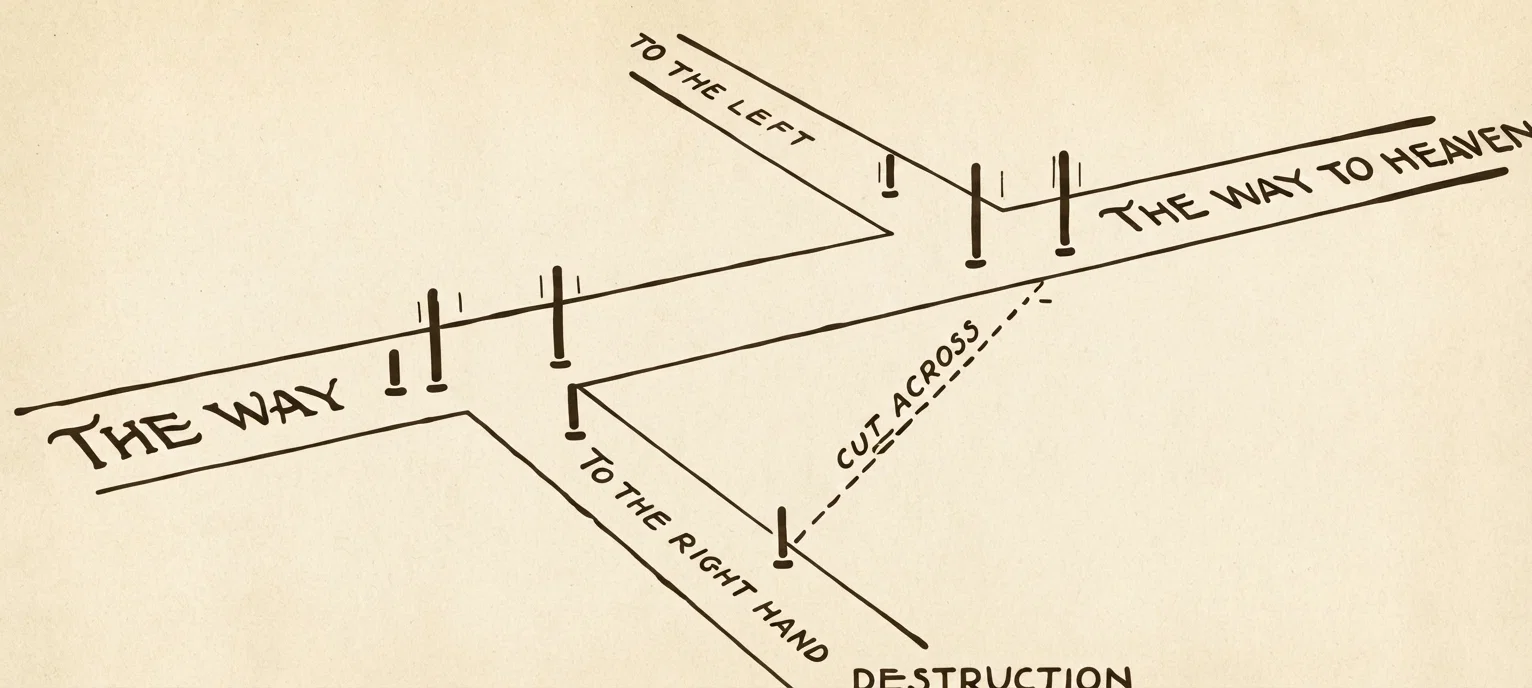
Now did you ever hear this Guide's voice? I am sure you have. May be you heard, but did not know who it was. Let us read in Isaiah 30: 21 what the Guide says: "And thine ears shall hear a word behind thee, saying, This is the way, walk ye in it, when ye turn to the right hand, and when ye turn to the left."
Now we will let this tall mark represent the Guide, and the short mark represents you and me. We walk along the way until by and by I see some other path I wish to walk in, and so I turn to the right hand. But my Guide did not lead me there; He never goes out of the way. We become separated a little; but it is not because He went away from me, but because I left Him. Now if I turn to the right hand, where will the Guide be? If the Guide should speak to me, from what direction would the voice come?—From "behind" me, to be sure. And what does the Word say?—"This is the way, walk ye in it." But suppose I go right on in my way until I get almost to destruction, could I not cut across and catch the Guide?—No, indeed; I must go right back just the way I came, to the very place I failed to follow, and humbly, meekly follow on.
And if I should turn "to the left," it would be just the same. The word would come from behind me, saying, "This is the way."
Now do you not see that the only safe way for us, the only way by which we can ever reach heaven, is to listen to the Word? Satan makes the "right-hand" road and the "left" hand road look very beautiful to us sometimes; and they are broad ways, and many are going in thereat, because the other way is narrow, and it is easy to get out of the road when we do not follow the Guide.
But the blessedness of following Him, the Word, Jesus, the Holy Spirit! Do you sometimes think He has forgotten all about you? Just listen for "the word behind thee," and if thou shalt hear it, know that He has not forgotten thee.
PAINT THE SKY FIRST.
An artist of rare skill,
And genius manifold,
Did not outline his picture till,
In tints of blue and gold,
Upon the canvas, lifted high,
He spread the colors of the sky.
And when the sky was done,
He painted all below
To match in every hue and tone,
Until it seemed as tho
The very shadows were in love
With colors copied from above.
But when the work begun
Was finished, 'twas so fine
They did not think of sky or sun,
But only how divine
The landscape was; how cool and sweet
The spot where lights and shadows meet!
Yes, let the sky come first;
This is the lesson taught.
That lifetime is, alas, the worst
Whose skies are latest wrought!
For, finished with the greatest care,
Something is always lacking there.
God first and earth the last,
What better rule than this
If thou dost wish the work thou hast
To be a masterpiece,
Whose smallest touches, lightly given
On earth and seas, are toned to heaven?
O, hast thou painted well
Thy picture's glorious sky?
Hast not? And longest to excel?
Then lift to heaven thine eye,
And let thy work its colors wear—
Paint not the ground till skies are there.
—Selected.
The True Nature of Religion
By Roswell D. Hitchcock
MERE belief would make religion a mere theology. Mere emotion would make it a mere excitement. The true, divine idea of it is a life begotten of grace in the depths of the soul, subduing to Christ all the powers of the soul, and incarnating itself in a patient, steady, sturdy service. In short, it is doing the will of the Father which entitles us to a solid assurance of our redemption by the Son.—Roswell D. Hitchcock.
The Bird and the Bending Branch
By M. de Gasparin
Be thou like the bird perched upon some frail thing; altho he feels the branch bending beneath him, yet he loudly sings, knowing full well that he has wings.—M. de Gasparin.
THE CAUSE AND THE CURE.
THE most fearful disease in this world is sin. In fact, it is the root of all diseases, mental and physical. Thus the prophet puts the matter: "The heart is deceitful above all things, and it is desperately sick; who can know it?" Jer. 17:9, R.V. It is sick with the sickness of sin, a disease incurable; for "sin, when it is finished, bringeth forth death." James 1:15. Men have sought the cure, panaceas without number have asserted their efficacy, but the sickness continues as of old, with its sad fruit of death.
The words of the prophet are easily applicable to the whole world: "Ah sinful nation, a people laden with iniquity, a seed of evil-doers, children that deal corruptly; they have forsaken the Lord, they have despised the Holy One of Israel, they are estranged and gone backward. Why will ye be still stricken, that ye revolt more and more? The whole head is sick, and the whole heart faint. From the sole of the foot even unto the head there is no soundness in it; but wounds, and bruises, and festering sores; they have not been closed, neither bound up, neither mollified with oil." Isa. 1:4-6. And all are involved in it by nature. "All have sinned, and come short of the glory of God." Rom. 3:23. "Through one man sin entered into the world, and death through sin; and so death passed unto all men." Rom. 5:12.
All are partakers of the dread disease of the leprosy of sin. Favorable environments, careful treatment, frugal diet, may for awhile keep back the visible outbreaks of leprosy; but if the disease is in the blood, it will sooner or later come to light, and awfully sad—the living death is incurable. The victim may soon succumb as the disease attacks the vital parts, or he may drag on for years, a living death, the fearful malady eating its way through flesh and bone and limb to the life-centers, and the victim dies.
What a vivid picture it is of sin—the leprosy of the race! But how much more man dreads the leprosy than he does the sin! How much more the man who has not the leprosy dreads the fearful disease than, generally speaking, those who have had it for some time! The leprosy in its worst forms destroys sensibility. So also does sin. It is deceitful, benumbing, intoxicating, bringing its numerous victims who yield to its influence continually more and more under its nerve-destroying, body-polluting, heart-narcotizing, soul-damning power.
The Great Physician sends out His heralds, giving them warning of their danger. He has connected with the dread disease itself the merciful messenger pain, and the characteristic symptoms of the monster. He does all this that men may fear the disease which works out such fearful results, and so strike at the root of all instead of endeavoring to still the voice of pain and to cure the symptoms.
But man's efforts avail nothing. The great leprous world goes on unheeded. The panaceas, the remedies, of man are despairingly ineffective. He has discovered in himself and of himself no balm, no remedy, no cure. Its poison is like the crimson and scarlet dye, no chemical can eradicate it. Like the force of gravitation, man knows no power not based upon that principle to counterbalance it. Everything that rises by his wisdom and power, rises, to put it in plain words, because something else is heavier, and for a little time forces it up.
"Where is the remedy?" you ask. It is with the Great Physician who made the diagnosis. He does not reveal our condition to tantalize or torment us. With "Him is the fountain of life" and healing, because "with the Lord there is mercy, and with Him is plenteous redemption." "Who is a God like unto Thee, that pardoneth iniquity, and passeth by the transgression?" "If we confess our sins, He is faithful and just to forgive us our sins, and to cleanse us from all unrighteousness."
Who does not want permanent healing? Then go to the root of the matter. Give up the sin, the cause of all disease, and go to the Only One, the Great Physician, for healing. He declares that if we will do this, "tho your sins be as scarlet, they shall be as white as snow; tho they be red like crimson, they shall be as wool." God wants to heal you, why not let Him do it?
"THINGS WANTING."
Under the above heading the Rev. W. E. Glenville, Ph.D., declares that the three following things are wanting to-day:—
"A clear-cut conception and conviction of sinfulness."
"A clear-cut conviction of our need of conscious individual turning to God."
"On the part of professing Christians a more thorough, earnest, and diligent imitation of Christ, the daily 'practise of the presence of God.'"
And all these are sadly wanting. What are the causes?
For the first Dr. Glenville mentions "science" and its teaching of "heredity," by which much of sin is excused; and "the more pleasurable view of life." He thus continues:—
We put respectability first, and character is but little thought of, and respectability often stands merely for a well-filled pocketbook, a well-furnished house, the elements of a general education, a well-polished exterior, an occasional conventional patronage of the worship of God; and we give little heed to the old-fashioned talk of Jesus Christ, who described such a life as like a whited sepulcher, well cleaned and painted white on the outside, but corrupt and stenchful within. And so in the literature of our day, in the magazines, the papers, the works of fiction, in the society gossip of the day, and in the popular amusements of the times, the old idea of simpleness is pooh-poohed, and the word sin itself is seldom heard. All of which, in the writer's judgment, is a most pitiful infatuation; an infatuation as real as the infatuation of any unhappy patient in the lunatic asylum. . . . The most casual observation and experience should teach us that this light and airy and sportive attitude toward sinfulness is continually working out, all around us, the most grievous and wretched results. Young people, whose sense of sinfulness has never been stirred by faithful and dutiful parents, enter life with the idea that it does not matter how we live, what habits we allow, as long as we keep ourselves out of the reach of the arm of the criminal law, get all the money we can, and have as good an all-round time as it is possible to cram and crowd into the twenty-four hours of the day. That is their philosophy of life.
They have never been seriously taught to love and reverence the Sabbath day and the worship of their God. They have never been taught, by family worship, the influence and importance of private personal prayer. In fact, the influence of the home and society has been largely the other way. And so, as they go forth into life, we see them, one after another, entangling themselves in evil habits, stupefying and stultifying the brain, confusing and confounding the voice of conscience, embarking their forces of virtue, knowledge, and strength in downright practical heathenism, living without God and without hope in the world, and in some cases reaching the conclusion that life is not worth living. True! such a life is not worth living; this kind of life we were never created to live, and this kind of life is the logical and inevitable outcome of making a mock of sin.
1. Of course the primary cause of all this lies in the tendencies of the carnal heart. But one reason why this fearful condition exists among professed Christians, is that the very means that the Spirit of God would use to quicken conscience is not preached. The Word tells us: "By the law is the knowledge of sin;" that "sin is not imputed when there is no law;" that "where no law is there is no transgression;" that "sin is the transgression of the law;" and that "I had not known sin, but by the law." How, then, can there be definite, deep, true conviction of sin where the law is not preached? When God's means are ignored, what effectual means has man to put in its stead? By what other power can the sinner—in the church or out—see his attitude toward God's law (Rom. 8:7), and that by the law the carnal mind must be and is condemned to death? There is mighty need of preaching the first seven chapters of Romans; yes, to 8:12.
But here "science, falsely so-called," has, through the higher criticism, taken from us the law preached by the prophets, the Master, and the apostles. It is relegated to the past as a part of an ancient Hebrew code, albeit declared by Inspiration to be unchangeable and eternal. Again, how many ministers are there who are afraid to use the law to point out sin, for fear that some one will ask a question about the troublesome Fourth Commandment, which enjoins the day that Jesus and prophet and apostle kept. O, for the courage of conviction on the part of preacher, and the courage to do and dare and follow Christ when he finds that through erroneous early teaching, conscientious wrong example, and pagan tradition, his feet have been set in wrong paths.
2. The second thing would not be "wanting" if the causes of the first were removed, if God's law were pressed home upon the individual conscience. There is coming in the idea of "Christian" nations, and "Christian Socialism," through which comes the idea that men are saved en masse. It is a delusion and a snare. The individual man must be born again. The individual soul must believe.
3. Yes, it is wanting. But the lack of imitation means the lack of life. All true outward forms of Christianity are growths from the inward life, fruits of the tree, outward expressions of an inward faith. We witness to what we know. If we do not know Christ as the Life, how can we bear life witness to Him? "If any man have not the Spirit of Christ, he is none of His."
The great remedy is the preaching of the Gospel of God, the Word of God, without doubt, without partiality, as God has given it. This means that the law shall have its proper place; the prophecies shall have their proper place; God's present reforming truth shall have its proper place, in His everlasting Gospel. Then, and not till then, will the church of Jesus Christ arise, "fair as the moon, clear as the sun, and terrible as an army with banners."
"BY GRACE YE ARE SAVED."
By G.
GRACE is defined as "unmerited love and favor." Then the sinner's being saved by grace shows that he had no just claim to being saved. There was no law in his favor; for the law of God justifies only those who obey it perfectly (Rom. 2:13), and the sinner had violated it. Being a sinner, the only thing due to him was death. "The wages of sin is death." Ch. 6:23. There is no way to earn grace, for any consideration that is earned is not grace. So the grace of God, by which the sinner is saved, must be a gift, and the antithesis of the foregoing quotation is, "But the gift of God is eternal life through Jesus Christ our Lord."
The sinner having no claim to life at all, the love of God, which is the well-spring of His grace, has the unrestricted right to impose a condition of salvation by grace. So we read, "By grace are ye saved through faith; and that [the grace] not of yourselves; it is the gift of God; not of works, lest any man should boast." Eph. 2:8, 9. That faith is the condition of grace, is shown by the well-known scripture: "God so loved the world, that He gave His only-begotten Son, that whosoever believeth in Him should not perish, but have everlasting life." John 3:16.
Peter says, "We believe that through the grace of the Lord Jesus Christ we shall be saved," Acts 15:11. The benediction of the New Testament epistles is the grace of God. "The grace of the Lord Jesus Christ be with you all." Rom. 16:24; 1 Cor. 16:23. "The grace of the Lord Jesus Christ, and the love of God, and the communion of the Holy Ghost, be with you all." 2 Cor. 13:14. The epistle to the Galatians begins and ends with the benediction of grace. "Grace be to you and peace from God the Father, and from our Lord Jesus Christ, who gave Himself for our sins." Now note especially the purpose! "That He might deliver us from this present evil world, according to the will of God and our Father." Ch. 1:3, 4. "Brethren, the grace of our Lord Jesus Christ be with your spirit." Ch. 6:18.
The same is true of the epistle to the Ephesians (1:2; 6:24); of the letter to the Philippians (1:2; 4:23); of the two epistles to the Thessalonians, and of the letters to Timothy, Titus, and Philemon. Hebrews closes with, "Grace be with you all." 1 Peter closes with, "Peace be with you all that are in Christ Jesus." 2 Peter has "Grace and peace be multiplied unto you through the knowledge of God, and of Jesus our Lord" (1:2), and closes with the injunction, "Grow in grace, and in the knowledge of our Lord and Saviour Jesus Christ."
Thus we have it emphasized that salvation is a free, unmerited gift of God. "While we were yet sinners, Christ died for us." Rom. 5:8. As "all7have sinned" (3:23), the grace of God offers salvation to all (Titus 2:11). To this Peter adds that God "is long-suffering to us-ward, not willing that any should perish, but that all shall come to repentance." When one is offered anything free, and he will not take it, who is to blame if he suffer the loss of the proffered favor?
Christ is now on the "throne of grace," and invites all who stand in need of His favor to "come boldly" "that we may obtain mercy, and find grace to help in time of need." Heb. 4:16. Every human being stands in need of that divine help which we do not deserve, to which we have no merit to set up as a claim, and no means with which to buy. Then why should we not all face the situation squarely, lay aside all pride and all doubt, acknowledge our poverty, and thankfully accept the salvation from sin which the love and grace of God so freely offers? God is not a respecter of persons or of nationalities; the free gift of His grace is for every one who will accept it. "The Spirit and the bride say, Come. And let Him that heareth say, Come. And let him that is athirst come. And whosoever will, let him take the water of life freely." Rev. 22:17. This is the last invitation recorded in the Book; and its last verse is the benediction, "The grace of our Lord Jesus Christ be with you all. Amen." G.