The Youth’s Instructor, Vol. 30, No. 38.

THE CAT FAMILY

The Youth’s Instructor

Sep 20, 1882

S. D. A. Publishing Association · Battle Creek, Mich. · Sep 20, 1882

THE CAT FAMILY.
ANIMALS, like plants, are divided into families, and the different members of these families are known by different names. So the “cat family” includes a large number of animals that are classed together on account of certain similarities in form and habits. As members of this family, may be mentioned the lion, tiger, panther, leopard, jaguar, cougar, and many others. At first thought we would think that these animals were anything but alike in form. But a scientific study of their bodies shows that they are all constructed on very nearly the same plan. They are the most ferocious of the animal kingdom, and every part of their body is admirably fitted for capturing and devouring other animals. The whole family usually keep themselves hid in the day-time, prowling around in the night in search of prey. They are all noted cowards, though greatly to be feared on account of their treacherous mode of warfare. Stealthily following up their prey, or lying in wait for it either in ambush by the side of the path, or high up on the branch of some tree, they suddenly spring down upon their victim with lightning rapidity. They generally fasten themselves upon the back of their prey, and with their teeth and claws fairly tear the flesh off of their bones before killing them. Some of this family, however, either break the back of their prey, or inflict some other wound that will cause death, and then drag the dead body to their den, where they can devour it at their leisure.
The whole family are noted for their great strength. A lion can easily drag off the dead body of an ox or horse, and a single blow from the paw of a Bengal tiger has been known to crush a man’s skull. Their jaws, too, are very powerful, and the largest animals find it impossible to shake them off when once their teeth have obtained a hold. Their tongue is covered with minute horny teeth which enable them to remove every particle of flesh from a bone. These can be felt to some extent on the tongue of the household cat. The fur of these animals is very free from any oily substance, so that it is easily injured by water. On this account they are very shy of water, and never enter it if it is possible to avoid it.
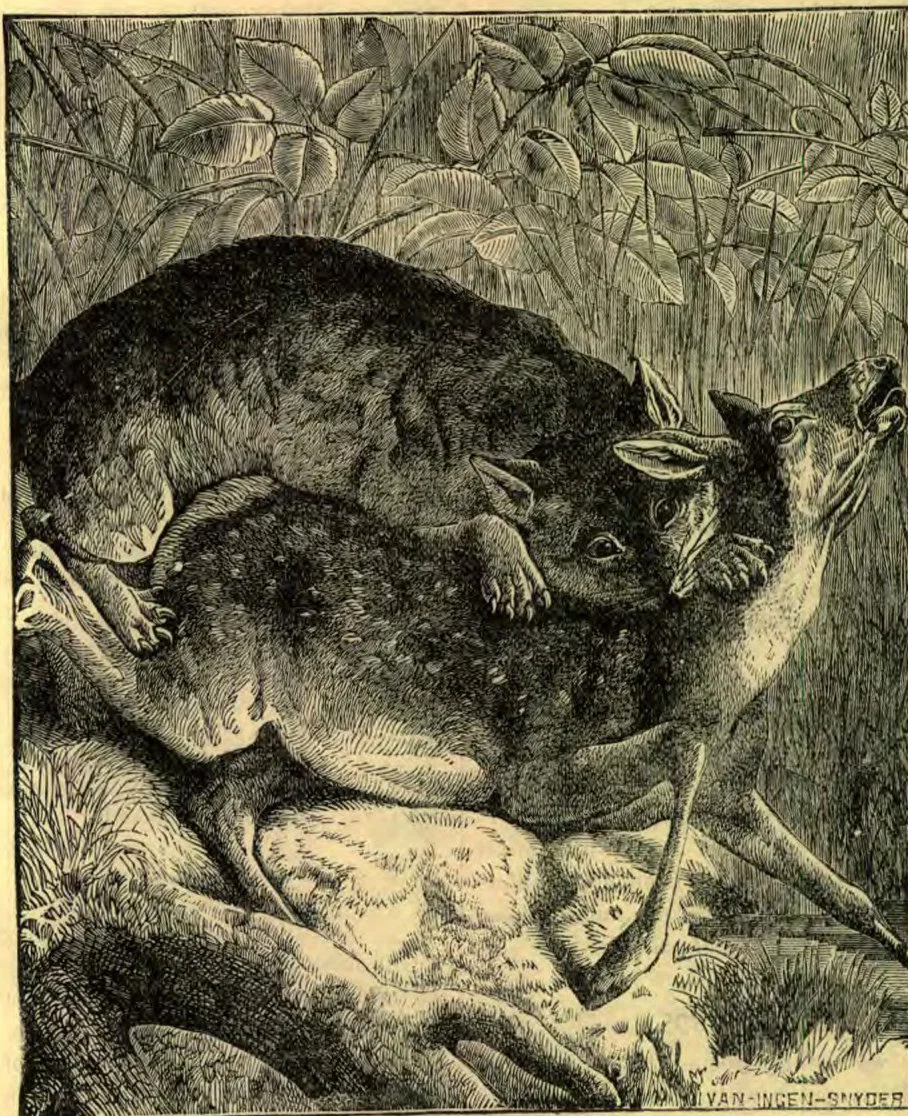
The picture represents a member of this family called the wild cat, and its manner of capturing its prey. This species is found mostly in Europe, in dense woods and rugged country. It is the only wild animal remaining in the British Isles that is at all dangerous to the inhabitants. Wild cats proper are not to be found in America; but the Bay Lynx so much resembles the wild cat of Europe, that it is by many called by the same name. It will very seldom, however, attack man or large animals. But in a few instances it has been known to attack men and even kill them.
After hearing so much about the fierceness and cruelty of these animals, you may be unprepared to believe that Tabby herself belongs to so disreputable a family. But it is so, as may be seen by her nightly hunts for game, her delight in capturing birds, rats, mice, and insects. Yet we all think a great deal of pussy, both as a pet and for the good she does us in ridding our houses of rats and mice. Her relatives, too, claim our admiration for their beauty of form, and grace of motion. And who knows but that they in their place serve man as well as many which we call “domestic animals!” C. H. G.

Peace in the Way of Religion

THAT may be right which is not pleasant, and that pleasant which is not right; but Christ's religion is both. There is not only peace in the end of religion, but peace in the way; and all may enjoy it in their daily lives.

MY BEAUTIFUL MAIDEN.

BEAUTIFUL feet my maiden had— My maiden bright and fair; They led her where the weak and sad, With nothing to make them strong and glad, Sat in their still despair
Beautiful music was in her voice As she whispered words of love; She bade them look up—look up and rejoice, For the poor in spirit were Jesus’ choice In his home prepared above.
Beautiful were my maiden’s hands, For busy as busiest bee Were they kept obeying the Lord’s commands, And their deeds of love were like the sands Beside the restless sea.
They carried food to the suffering poor, The cup of cold water gave; Like an angel of love, from door to door My maiden served from her varied store, The perishing ones to save;
For a beautiful spirit was hers within; She had made the Lord her choice; And the heart, made new and free from sin, Washed by Jesus from every stain, Moved hands and feet and voice.
—Helen E. Brown.

GENTLE WORDS.

UPON the wall of the room in which an Association of Dairymen recently held their annual meeting, was hung this motto,—
“Talk to your cow as you would to a lady.”
It was a wise and kind man who wrote that motto. He had learned the worth of gentle words, and without doubt his horses and cattle are all gentle. So true it is that even dumb animals share the spirit of their master.
Some one has suggested that boys who have to do with horses and cows should hang over the stable and cow-shed these Hebrew proverbs:—
“A soft answer turneth away wrath, but grievous words stir up anger.”
“By long forbearing is a prince persuaded, and a soft tongue breaketh the bone.”
Last summer we were walking about the pleasant grounds of a country house, when from the barn, not far distant, we heard an angry voice, and a sound as of an animal kicking. The lady looked distressed, and said,— “I am afraid our boy is in trouble again with the cow. He will not treat her kindly, and we shall have to send him away, for we think too much of our pretty Alderney to have her ruined.”
And so a boy who was sadly in need of a good home and kind friends, such as he might have had here, was in danger of losing his place because he would not remember that dumb animals have feeling, and should be treated accordingly.
Believe us, boys, and girls too, the “soft answer,” and “soft tongue,” have a wonderful charm. You will try what they can do, will you not?—Selected.

FACES

Our faces are pictures of our minds. Whatever we think about makes an impression on our face. If something gives us pleasure, others may know of our feelings by the expression of our face. Pleasant thoughts and feelings are shown in every feature. Even the youngest of you can tell pretty well whether those around you are feeling good-natured and pleasant, or whether something does not please them, and they feel fretful. Sometimes, however, we see those whose expression does not betray their feelings; they always look just so, whether they are merry, sad, or indifferent. Now this variety of looks or expressions, as we have called them, may all be produced by the same face. If you were asked how you laughed, or changed your expression, you might think you simply did, and that was all. It may seem easy to do this, yet it is really wonderful.
Not every thing, which at first thought seems simple and easy to do, is simple and easy to perform. Every movement, as running or walking, seems easy, yet when we stop and think, it is most wonderful, for no man can make a machine to operate as wonderfully as our bodies are made to act.
Why cannot dolls or other images be made to change their looks? It is because they are made by man. None but God can make such beings as we. Our frames are bone; and to beautify and enable us to move in different direction, muscles are attached to the bones. To the form and general use of these muscles do we owe our looks. These muscles are composed of very fine strings, or fibers, so fine that some are only one four hundredth of an inch in diameter: that is, it would require four hundred laid side by side to make an inch in width. The more delicately anything is made, the more easily it is affected, and if these tiny strings are often used to form unpleasant faces, it will not be long before the general expression will be one of discontent and fretfulness. Take, for example, a pretty-faced rubber doll, and pull her face one way and another, and see the different faces she will show you. When you cease pulling, the rubber contracts, and dolly will present the same smiling face; yet she cannot long endure this treatment; for if it is continued, her face will soon present a net-work of unsightly cracks and wrinkles. Our faces suffer similar effects from continued unpleasant feelings; so if you would have pleasant, pretty faces, which every boy and girl would wish to have, you must entertain pleasant thoughts and feelings.—Young Pilgrim.

“A PROFOUND SECRET.”

“Can you keep a secret, Daisy?” asked Nell Clay of her younger sister.
“Yes, indeed!” replied Daisy, trying to look dignified.
Nell bent down and whispered something in Daisy’s ear, to which Daisy clapped her hands, and cried, “O goody!”
“Remember, it’s a profound secret,” said sister Nell.
Daisy ran off to school, feeling very important, and overtook Conny Travers on the way.
“O Conny,” she said, “I know something awful nice!”
“What is it?” asked Conny, opening her eyes very wide.
“Oh, I mustn’t tell,” said Daisy, screwing up her lips. “Sister Nell told me this morning. It’s a profound secret.”
“Oh, my!” said Conny. “Can’t you tell just me!”
“Nell wouldn’t like it.”
“She wouldn’t mind me,” pleaded Conny.
“Won’t you never, never, NEVER tell?” whispered Daisy.
“Never, ’s long as I live!”
“Honest and true?”
“Truer’n steel!” declared Conny.
“Well, Sarah Bell’s father is going to give her a piano for her birthday to-morrow, but they wouldn’t have her know it for anything, until she comes home and finds it in the parlor.”
“How splendid!” exclaimed Conny.
“It’s a profound secret,” said Daisy.
A few days later, Mrs. Bell called upon Mrs. Clay.
“I suppose Sarah was surprised and delighted about the piano,” said the latter.
“She was delighted enough,” was the reply, “but she wasn’t a bit surprised. She heard it at school.”
“That Conny Travers must have told,” said Daisy, indignantly, after Mrs. Bell had gone home.
“But who told Conny?” asked sister Nell.
“I did, but I didn’t s’pose she’d be mean enough to tell.”
“And I didn’t think you would,” replied Nell.
“Well, children,” said Mrs. Clay, “it’s an old saying that ‘if you can’t keep your own secret, nobody else will keep it for you.’ If you remember this, it will save a great deal of trouble.”
“There’s an older sentence that I like much better,” said sweet Aunt Peace from her window. “‘Set a watch, O Lord, before my mouth; keep the door of my lips.’”—The Myrtle.

ABOUT BEING OBLIGING.

A PERSON may be selfish and unselfish at the same time. Ethel is very fond of making presents. If Edith admires a book or pencil of hers, it is at her service. She delights to surprise her school-mates with little gifts, and often Mattie finds a bunch of violets on her desk, or an orange is added to Sadie’s luncheon. Ethel is full of kind thoughts, and is as generous as possible with things that cost her nothing. Still I do not regard her as unselfish.
She is not the least bit obliging. If she is seated in her little rocker by the window, and mamma or auntie come in ever so tired, it does not occur to Ethel to offer her chair, that either of the ladies may rest. Indeed, if you hint it to her, she shakes her head, and says,—
“There are plenty of chairs in the room; why should I give up mine?”
Not long since, Cousin Polly and little Agnes Lee arrived unexpectedly, and as there were other guests, mamma was compelled to ask Ethel to give up her room, and sleep for the night with her younger sister. Ethel was so vexed that she pouted and sulked in Cousin Polly’s face, would take no notice of the child, and finally cried herself to sleep.
No one ever dreams of asking Ethel to run on an errand, to mend a ripped glove, or to do the slightest thing which will put her out of her usual way. They know that she is not obliging, and the very school-mates who accept her flowers and oranges, are much more fond of Mary Ann, a plain little body, who never has anything to give away, but who is always greeting everybody with kind looks and words.—Harper’s Young People.

The Knight's Shield: Look on Both Sides

Two horsemen met near the statue of a knight with a shield. One side of the shield was of gold, the other of silver. One said the shield was gold; the other that it was silver. They got angry about it, and fought till both were badly hurt. An old priest came along and told them they should have looked on both sides of the shield. We should always look on both sides of the question.

Keeping Private Matters to Yourself

IF THERE is anything among your private affairs which you are desirous of having unknown, be your own confidant, exclusive of all others; then, and then only, is it safe.

THE SILENT SEARCHERS.

When the darkness of night has fallen, And the birds are fast asleep, An army of silent searchers From the dusky shadows creep; And over the quiet meadows, Or amid the waving trees, They wander about with their tiny lamps That flash in the evening breeze.
And this army of silent searchers, Each with his flickering light, Wanders about till the morning Has driven away the night. What treasures they may be seeking No man upon earth can know; Perhaps 'tis the home of the fairies, Who lived in the long ago.
For an ancient legend tells us That once, when the fairy king Had summoned his merry minstrels At the royal feast to sing, The moon, high over the tree-tops, With the stars, refused to shine, And an army with tiny torches Was called from the oak and pine.
And when, by the imps of darkness, The fairies were chased away, The army began its searching At the close of a dreary day; Through all the years that have followed, The seekers have searched the night, Piercing the gloom of the hours With the flash of their magic light.
Would you see the magical army? Then come to the porch with me! Yonder among the hedges, And near to the maple tree, Over the fields of clover, And down in the river-damp, The fire-flies search till the morning, Each with his flickering lamp.
—Henry Ripley Dorr.

SCENES IN THE LIFE OF CHRIST.

LESSON 87.—PARABLES SETTING FORTH THE WICKED COURSE OF THE JEWS.

It seems that it must have been on the Sabbath-day that Mary anointed Jesus at Bethany. He knew that this was to be his last Sabbath on earth; and as he was spending it at this quiet little village, the disciples that dwelt there came together, so that they might all enjoy his company.
On Sunday he rode into Jerusalem amid the shouts and praises of the multitude. On Monday he drove out the money-changers from the temple. It was early in the morning of this day that he cursed the fig-tree, while passing from Bethany over to Jerusalem. On Tuesday morning the disciples noticed that the fig-tree was withered and dying. During the day our Lord put to silence the Jews, who questioned his authority, and he also spoke several parables setting forth their wicked course.
He first represented the Jews and the Gentiles by two sons, one of whom, on being asked by his father to go and work in his father's vineyard, said he would not; but afterward he repented, and went. The other, on being invited, said, “I go, sir;” but went not. This last son represented the Jews, who made great professions of godliness, but were still hard-hearted and selfish. The first represented the Gentiles who would yet believe in Christ, and obey him.
He then spake a parable, saying, “A certain man planted a vineyard, and set an hedge about it, and digged a place for a winefat, and built a tower, and let it out to husbandmen, and went into a far country.” When the season for ripe grapes had come, he sent a servant to ask the husbandmen for a proper share of the fruit of the vineyard; but they caught him, and beat him, and sent him away empty. Then the owner of the vineyard sent another servant on the same errand, but the husbandmen cast stones at him, and wounded him in the head, and sent him away bruised and bleeding. “And he sent another; and him they killed; and many others; beating some, and killing some. Having yet therefore one son, his well-loved, he sent him also last unto them, saying, They will reverence my son. But those husbandmen said among themselves, This is the heir; come, let us kill him, and the inheritance shall be ours. And they took him, and killed him, and cast him out of the vineyard. What shall therefore the lord of the vineyard do? He will come and destroy the husbandmen, and will give the vineyard unto others.” “And when they heard it, they said, God forbid.”
Then Jesus looking steadily upon them, said, “What is this, then, that is written? The stone which the builders rejected, the same is become the head of the corner.” “This is the Lord’s doing, and it is marvelous in our eyes. Therefore I say unto you, The kingdom of God shall be taken from you, and shall be given to a nation bringing forth the fruits thereof.”
The Jews knew that this parable applied to them; for they had acted just like the wicked husbandmen. They had beaten and misused the prophets of God, and some of them they had slain. They were now plotting to take the life of Jesus, God’s dear Son. They would have laid hands on him at once, but they feared the multitude, who regarded him as a prophet.
We are shocked at the hard-heartedness and cruelty of the Jews, but if we are not careful, we shall be found cherishing the same spirit in our own hearts. We must remember the words of our Saviour, when he said, “Inasmuch as ye have done it unto one of the least of these, my brethren, ye have done it unto me.”

QUESTIONS.

1. On what day of the week was Jesus anointed by Mary at Bethany?
2. What was there remarkable about this Sabbath day?
3. Why did the disciples that dwelt in this quiet little village come together on that day and eat at one table?
4. What did Jesus do the next day?
5. What did he do on Monday?
6. When did he curse the fig-tree?
7. When did the disciples notice that it was withered?
8. What did Jesus do on Tuesday?
9. In what way did Jesus first represent the Jews and the Gentiles? Matt. 21 : 28-32.
10. How did the last of these sons represent the Jews?
11. How were the Gentiles like the first son?
12. In the next parable, what was done by a certain noble-man? Mark 12 : 1.
13. On what errand did he send his servant, when the season for ripe grapes had come?
14. What did the wicked husbandmen do to this servant?
15. How did they afterward treat another servant sent on the same errand?
16. What course did they continue to pursue, as he sent servant after servant to ask for what was his just due?
17. What did the Lord of the vineyard finally conclude to do?
18. How did he reason in regard to this step?
19. What did the husbandmen say among themselves?
20. How did they treat the son of their master?
21. After relating the parable, what question did Jesus ask?
22. How did he answer the question?
23. What did the Jews say when they heard this? Luke 20 : 16.
24. What did Jesus then say as he looked steadily upon them? Verse 17.
25. Who is meant by the stone that the builders rejected?
26. How has Jesus become the head of the corner?
27. What remark did Jesus make with reference to these things?
28. Who are meant by the wicked husbandmen?
29. What did Jesus say should be done to them? Matt. 21 : 43.
30. How did the Jews know that this parable applied to them?
31. What had they done that was like the course pursued by the wicked husbandmen?
32. What were they now plotting to do?
33. What prevented their laying hands on him at once?
34. How are we made to feel by reading of these things?
35. For what must we have a care?
36. What words of our Lord should we remember?
Continue reading: NEW-TESTAMENT HISTORY