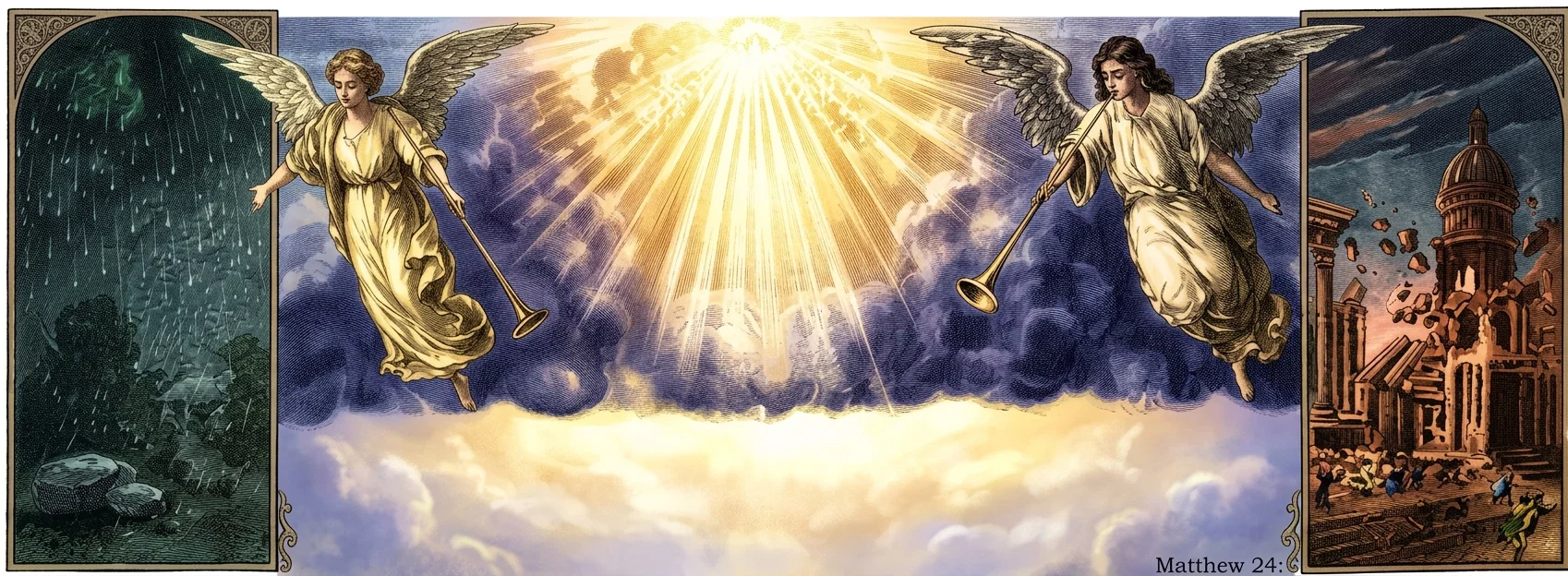
Christ Presents Signs by Which We May Know It—Sun, Moon, and Stars Testify—Warned Against Delusions—False Christs and False Prophets
By A. S. BOOTH
The Lord has seen fit to point out the last generation that will live on the earth before His second coming. The Bible speaks of two special generations—the one that lived at the time of Christ’s first advent, and the one that will be living when He comes the second time. The twenty-third chapter of Matthew has especially to do with warnings and admonitions to the generation living at the time of the first advent; and the twenty-fourth chapter, to the one that will live in the last days.
BLINDLY MAKE THE SAME MISTAKE
The mistakes of that former generation are liable to be repeated by the last generation. One of those mistakes the Master emphasized, saying: “Woe unto you, scribes and Pharisees, hypocrites! because ye build the tombs of the prophets, and garnish the sepulchers of the righteous, and say, If we had been in the days of our fathers, we would not have been partakers with them in the blood of the prophets.” Matt. 23:29, 30.
Ah, yes! They would say: “If we had lived in the days of Noah, we would not have questioned the word of God. If we had lived in the days of Lot, we would have been the first to obey the voice of God.” However, they made a more fearful mistake in rejecting their Lord and Master.
We are more responsible than any other people that have lived on the earth. All the mistakes made in the past, by those who have rejected the counsel of God, are before us; and the Bible is clear in pointing out the truth as it is in Christ Jesus. We need not take the words of any man. God has spoken. Let us not say, “Surely we would have believed Noah, Lot, and Jesus,” and then reject the Lord God of heaven by refusing to listen to the admonition of His Son Jesus Christ concerning the days in which we live.
WHAT SHALL BE THE SIGN?
As Jesus and His disciples viewed the temple, said the Master: “See ye not all these things? verily I say unto you, There shall not be left here one stone upon another, that shall not be thrown down.” Matt. 24:2.
The disciples naturally associated the destruction of Jerusalem and of the temple with the end of the world. Therefore, as He sat upon the Mount of Olives, His disciples came to Him, and inquired, “Tell us, when shall these things be? and what shall be the sign of Thy coming, and of the end of the world?”
BEWARE OF DECEIVERS
The Lord did not disappoint them by saying: “It does not matter relative to My second coming. Just pray, study your Bibles, and attend church when it is convenient, and all will be well.” Ah, no! But He answered: “Take heed that no man deceive you. For many shall come in My name, saying, I am Christ; and shall deceive many. And ye646shall hear of wars and rumors of wars: see that ye be not troubled; for all these things must come to pass, but the end is not yet. For nation shall rise against nation, and kingdom against kingdom: and there shall be famines, and pestilences, and earthquakes, in divers places. All these are the beginning of sorrows. Then shall they deliver you up to be afflicted, and shall kill you: and ye shall be hated of all nations for My name’s sake. And then shall many be offended, and shall betray one another, and shall hate one another. And many false prophets shall arise, and shall deceive many. And because iniquity shall abound, the love of many shall wax cold. But he that shall endure unto the end, the same shall be saved. And this gospel of the kingdom shall be preached in all the world for a witness unto all nations; and then shall the end come.” Matt. 24:4–14.
In these few words, the Lord carries us from His first advent down to His second. He then makes emphatic that just before the end, there would go forth to the world a message calling attention to the consummation of all things. The mere fact that just such a message is now going to the world, preached in practically all countries of the earth, is evidence enough, to the thinking mind, that these things should be diligently considered.
THE FIRST GREAT LANDMARK
From verses fifteen to twenty-one of this chapter, special emphasis is laid on the destruction of the city of Jerusalem. That event would mark the first great epoch between the first advent and the second.
Following the destruction of Jerusalem, the Master tells of the Dark Ages, when the Old World was practically drenched with the blood of martyrs. Those days began in 538 A. D., and continued till 1798 A. D., 1,260 years of fearful persecution.
FALSE CHRISTS AND FALSE PROPHETS
At the close of those days, many false Christs and false prophets were to arise, and deceive, if it were possible, the very elect. As the end gradually approaches, Satan musters his hosts of evil to do all in his power to deceive the inhabitants of the earth.
Though all the prophets and apostles have foretold remarkable signs that would occur to usher in the day of God, yet it was left for the Lord to give the most definite. He placed His signs in the heavens. There were to be signs in the sun, the moon, and the stars. Seven times in the Bible are these signs spoken of, yet many even of the professed people of God are as ignorant of these things as if the Lord had never spoken a word.
SIGNS IN SUN, MOON, AND STARS
Continuing, the Lord said: “Immediately after the tribulation of those days shall the sun be darkened, and the moon shall not give her light, and the stars shall fall from heaven, and the powers of the heavens shall be shaken: and then shall appear the sign of the Son of man in heaven: and then shall all the tribes of the earth mourn, and they shall see the Son of man coming in the clouds of heaven with power and great glory.” Matt. 24:29, 30.
The sun was darkened May 19, 1780. That was a supernatural darkness. It was not an eclipse, for the moon was full. It was not owing to the thickness of the atmosphere, for stars could be seen around the disk of the sun. Science bows the knee, and admits that it cannot explain.
One writer says of the remarkable darkening of that day, “The dark day of May 19, 1780, was one of those wonderful phenomena of nature which will always be read with interest, but which philosophy is at a loss to explain.”
And we inquire, If the darkening of the sun May 19, 1780, was not the fulfillment of the sign in the sun, spoken of in so many places in the Bible, then how could the Lord ever darken the sun in such a way as to fulfill His word?
THE GREATEST METEORIC SHOWER
November 13, 1833, the stars fell from heaven, just as the Lord said they would, “even as a fig tree casteth her untimely figs, when she is shaken of a mighty wind.” Rev. 6:13. The meteoric shower of 1833 was the greatest that the world has ever witnessed. Argo computes that at one time there were visible above the horizon at Boston over 240,000 fireballs. Many testimonials might be given; but let it suffice to ask, If the falling of the stars in 1833 was not the fulfillment of the words of the Saviour, then pray tell, how could the stars fall so as to fulfill the prediction of such an event, many times made in the Bible?
It is in the conclusions and admonitions of this twenty-fourth chapter of Matthew that the Lord points out the last generation in a very definite way. We are now living in that generation. In the next issue of the SIGNS, the writer will consider the special thoughts emphasized by the Lord, in the twenty-fourth chapter of Matthew, that point out this generation.
Surely we are living in the time of the end. Soon the opening heavens will reveal the Lord coming with power and glory. Dear reader, are you ready for that great event? There is just one thing that will separate the individual from his God in that day, and that is unconfessed sin. Just one class of sins can be forgiven by the Lord, and that is those which are confessed. May God help us to put away every evil thing, that we may stand before Him, in that day, not having spot or wrinkle or any such thing.
Unnoticed, but Most Useful
By A. C. Gilbert
By A. C. GILBERT
A PERSON may be of humble parentage, possessing little wealth or education, and filling only a small place in the world's mighty progress. Yet he need not despair. It often occurs that the things that are unseen or obscure, are giving the most valuable help.
If the rudder of the ship were placed inside the hull, so that it could be seen, it would lose its value. If it were attached, by mistake, to the topmost deck, or joined to some towering mast, in order to be conspicuous, its usefulness would be destroyed. But contentedly occupying its intended position, at the rear, far beneath the surface, it becomes one of the most valuable portions of the ship. Silently and unnoticed, it does its appointed work, while the vessel pushes its way across the sea, carrying its load of human lives.
The truest Christian is the most valuable factor in God's sovereign plan of salvation — most valuable, not because he has the most talents, the strongest personality, the largest number of acquired abilities, but because he has most of Christ dwelling in his heart. He may be the humblest in the eyes of the world, occupying some inconspicuous position; but he has allowed the Most High, who inhabits eternity, to dwell in his soul, and therefore he is called the greatest in the kingdom of heaven.
Goes Down to Get Higher
By C. L. Taylor
OVER and over again, the mountain climber finds that what he regarded as the summit is only one of the lesser peaks. Beyond him lie great stretches and greater heights.
To gain the higher altitudes, he must first go down into some yawning gulf, and thus apparently lose ground. But the descent into the chasm is as much and truly a part of the great climb upward as is the ascent to the crest of the lesser peak.
Just so it is in climbing the mountains of life. “Almost there,” we often say. But a little later, we are obliged to pass down into the very abyss of trouble and distress and disappointment; and as the dark and the damp shut us in, we are tempted to doubt, and maybe come to believe that we are retrograding.
Not so. The sorrow and the adversity are as much a part of the heavenly journey as are the joy and the prosperity. “The valley of the shadow of death” is but a slight depression in the great mountain of providence.
Keep on! The weeping is only for a moment. Just beyond are the heights of everlasting day. The valley experience will help you to reach them. C. L. TAYLOR.
JESUS WILL COME
By L. D. Santee
By L. D. SANTEE
There is help for the tried and the lonely,
For the ties that on earth have been riven,
For the poor broken hearts, that can only
Find resting and comfort in heaven.
All the signs in the heavens are but tokens.
They are harbingers telling of home,
When the arch of the sky shall be broken,
And Jesus will come.
My heart with love’s melody quivers.
There’s a home and a crown over there,
In the land where the sweep of life’s river
Shall banish each shadow of care—
The home of the jasper-walled city,
Where lives no transgression or stain;
Where Christ, in His infinite pity,
Gives joy without pain.
My way may be strewn with earth’s losses,
And dangers around me may stand,
And my burdens be heavy with crosses;
Still, I’ll follow the Savior’s command.
The friends I have trusted may grieve me,
And my journey may lead ’neath the rod.
Take all of earth’s roses, but leave me
The smiles of my God.
There is healing, though life’s sorrow lingers;
There is rest, though life’s sorrows are long;
For the harps touched by angelic fingers,
Breathe only a gladness in song;
For soon will be past every sorrow,
Where joy thrills the soul with delight,
Where life has no gloomy to-morrow,
And day has no night.
SPIRITUALISM
By Walter E. Gillis
Its Origin and Its Place in History—Bible Defines It, and Specifies the Christian’s Attitude to It
By WALTER E. GILLIS
This is the first of several articles by Mr. Gillis on the subject of spiritualism. He has resided for a number of years in China, and next week his article will deal with the heathen world as the seat of the greatest power of spiritualism, and will tell of the fruits of the doctrine as seen in its ancient citadels. EDITOR.
SINCE the morning of time, when the divine command was given to man to multiply and subdue the earth, truth and error have been in mortal conflict. Two principles have been contending, the one to build up, the other to destroy; the one to unmask, the other to conceal and deceive.
AN ATMOSPHERE OF MYSTERY
An atmosphere of mystery has permeated the conflict, for the battlefield has been the hearts of men. History has only recorded the overt acts, the culminations of thoughts inspired and nurtured by one or the other of the contending spiritual forces.
These forces commonly alluded to as good and evil, first met in conflict on the spiritual plane; and good, conquering there, now contends for complete victory on the material plane, so that the universe of God may be forever freed from the possibility of the transgression of its laws, none of which are arbitrary, all of which are necessary factors of the whole.
The tenets of truth are positive and clear-cut. They are tersely contained in the ten words of God, His law, the epitome of perfect character, and must be wrought into the life of all who shall triumph with the truth. The careful student will see that a community of interest pervades all these commandments; that to observe them implicitly, requires the elimination of self-interest and the enthronement of love. This is the positive, the affirmative side.
SELF-EXALTATION
Opposing are the multitude of conflicting theories and extravagant glorifications that have littered the shores of time with human wreckage. The principle that pervades all these false theories is that of self-exaltation. The devotee is made to believe that he is his own savior; that in him lies dormant the power for emancipation from the evils that he is conscious are engulfing him. Fatal delusion! But it flatters—therein is its fascinating power.
But how came the condition here outlined to exist? The Bible is the only positive source of information. The story is a simple one.
BUT ONE CONDITION IMPOSED
The parents of the race were created with perfect mental and moral power, and placed under ideal conditions for the development of character. The only condition imposed was that of strict adherence to the principles of love. As a test of the genuineness of the character developing, a tree in the midst of their garden home was reserved as evidence of the sovereignty of the Creator. As freewill agents, they could partake of its fruit if they so desired, but they were plainly told that to eat of it would result in death—annihilation.
All went well until Lucifer, who, because of his rebellious envy, had been removed from his office in the heavenly courts (Ezekiel 28 and Isaiah 14), succeeded in causing the beautiful flying serpent to repose on one of the branches of the forbidden tree and eat of617the fruit at a time when Eve could see him. Eve was greatly surprised, and drew near to see what would result.
THE FIRST SPIRITISTIC SEANCE
She experienced much greater surprise, however, when she heard the serpent begin to speak; and no doubt she thought that the eating of the fruit had caused the miracle. She did not realize that the serpent was but the medium of the hidden foe. This was the first spiritistic séance, and it resulted in Eve’s being convinced that to eat of the fruit would not cause death. In other words, she was deceived into believing that man is naturally immortal; that when their Creator told them they were subject to death in case of transgression, He spoke an untruth.
Eve, however, had failed to reason. She had not understood that death was inherently the portion of those who collided with law; that perpetual life could only exist where perfect harmony prevailed. She had put the result in place of the spring from which it emanated. The eating of the fruit was but the signing of the covenant with death, the confirmation of the decision of the heart to disbelieve God’s word and transgress His law. Death is the result of the transgression of God’s law. Rom. 6: 23 compared with 1 John 3: 4. The overt acts witness to the transgression.
IT BORE FRUIT IN MURDER
The harvest of sin was speedily manifested. The first-born son, through envy, slew his brother. Here was a sublime catastrophe, unknown before in the annals of eternity. The perfection of physical beauty, animate with the vitality of youth at its fountain, to be laid dumb and motionless, no more to greet with responsive love the endearments of the family hearth! How speedily had the transgressed word matured its fruit! But the maturing of the curse confirmed the faith of the bereaved ones in the stability of the promise, “The seed of the woman shall bruise the serpent’s head.”
TURNED DEATH TO HIS ADVANTAGE
The archdeceiver speedily turned the pall of death to his advantage. He had said, “Ye shall not surely die.” This awful calamity must be interpreted.
The intricate ramifications of spirit worship permeating the whole fabric of human record, and found deep-rooted in all the forms of worship now current on the earth, proclaim what that interpretation was. We have it succinctly stated as a tenet of the great Church of Rome, by Cardinal Gibbons, in “Faith of Our Fathers”: “For what is death?—A mere separation of body and soul. The body indeed dies, but the soul lives and moves and has its being.” It continues after death as before, to think, to remember, to love.”
The same doctrine obtains in all those churches springing from her fold, although at times couched in more modest terms.
The interpretation having been made away back in the beginning, a ritual quickly followed. The initiated will readily recognize the salient features in the séance granted to King Saul of Israel by the witch of Endor.
THE KING CONSULTED THE MEDIUM
The king had, by his self-will, caused the Lord to forsake him. In the days of his humble obedience, the prophet of the Lord had granted him counsel and advice. But Samuel the prophet was now dead, and the armies of the aliens were invading the kingdom. Saul had so long persisted in his stubbornness, that the Lord would no longer grant him succor. The distressed king now turned his attention to the source of knowledge which the prophet had declared to be on a par with the conduct that caused the Lord’s anger to burn against him. 1 Sam. 15: 23. He resorts to the witch of Endor.
He disguises himself successfully, and a séance is granted him by one of the proscribed class—one who had escaped his zeal of better days. 1 Sam. 28: 3, 9.
Now note: Saul asks that the dead prophet Samuel, a servant of God, one who had refused to see or counsel him after his repeated disobedience, be called forth. And the supposed Samuel, when he comes into the presence of the witch, warns her of her danger, and who her inquirer is—warns her, one whom in lifetime he abhorred.
The startled medium cries out in alarm, but is reassured by the king, who asks what she has seen. She describes a form like that of the dead prophet, and then the recorded conversation takes place.
It is worthy of note that the pseudo Samuel is not so accurate as the living prophet, although the dead are credited with a larger vision than the living. He said, “To-morrow shalt thou and thy sons be with me.” At least twice that time elapsed before the doomed man fell on the field of battle.
It is the old story, oft repeated in every clime and age. Forevermore, from the day when Eve listened to the wiles of the enemy of God in the garden, until the present day, when long practice has added cunning to cunning, the sons of men have yielded to the enchantments of the prince of the power of the air.
But throughout the years, the transgressors have been confronted by the forbiddings of the Scriptures. The absurdities involved have been proclaimed in the sublime language of the prophets:
“Shall I give my first-born for my transgression , the fruit of my body for the sin of my soul! He hath showed thee, O man, what is good; and what doth the Lord require of thee, but to do justly, and to love mercy, and to walk humbly with thy God?” Micah 6: 7, 8.
“And when they shall say unto you, Seek unto them that have familiar spirits, and unto wizards that peep, and that mutter: should not a people seek unto their God? [How absurd] for the living to [seek knowledge of] the dead? To the law and to the testimony: if they speak not according to this word, it is because there is no light in them.” Isa. 8: 19, 20.
“He that overcometh shall inherit all things; and I will be his God, and he shall be My son. But the fearful, and unbelieving, and the abominable, and murderers, and whoremongers, and sorcerers, and idolaters, and all liars, shall have their part in the lake which burneth with fire and brimstone: which is the second death.” Rev. 21: 7, 8.
What must we conclude, then, that spiritualism is?—It is the manifestation, on this earth, of the enmity that found expression in heaven when Lucifer rebelled against God’s law. It must, in final analysis, be found wherever God’s law is not revered. In its native form, it is found in the audience chambers of the clairvoyant and medium; diluted, it insinuates itself into the churches, lodges, and mystic cults of all the earth. It weaves garlands for the brow of death, the greatest enemy of mankind; and through the yawning portals of the tomb marches interminably the army of its deceived devotees—marching to perdition.
The Lord’s Day
By W. Mayhew Healey
Can It Be Sunday?—What Day Is Blessed? Can the Seventh Be the First?
By W. MAYHEW HEALEY
MANY of the addresses and papers at the International Lord’s Day Congress in Oakland, California, made very frequent reference to the first day of the week, Sunday, calling it “the Lord’s day,” and asserting that it should be observed in honor of Christ’s resurrection; that when God instituted the Sabbath in Eden, He blessed it as an institution of rest on one day following any six working days.
The seventh day was the day set apart as the memorial of creation until Christ rose from the dead, but they claimed that then the first day of the week was selected in honor of the resurrection, to be called “the Lord’s day,” taking the place of the seventh-day Sabbath, and therefore enforced by the same commandment.
THE SEVENTH CANNOT BE FIRST
The above position is unscriptural and unreasonable. By no common sense rule of language can we construe the commandment which reads, “the seventh day,” into meaning the first day.
When the Lord blessed the Sabbath in Eden, He did not bless the rest separately648from the day. The blessing was on the day, and not on the rest. “And God blessed the seventh day, and sanctified it; because that in it He had rested from all His work which God created and made.” Gen. 2:3.
THE BLESSING ON THE DAY
God placed the blessing on the seventh day, for the reason that He had rested on that particular day. The blessing cannot be transferred to any other day; because the reason that called it forth, God’s rest, cannot be changed to any other day. Man may take his rest upon any day he chooses, but he cannot have the blessing of God upon any day except the one on which the Lord placed it.
When the Israelites were in the wilderness, God sent them a double portion of manna on the sixth day, and it kept, over the seventh day; but when they tried to keep manna over on any other day, it spoiled. If the commandment permits a change of day, there is no reason why such change could not have been made in the time of Moses, as well as in the days of the apostles. But God recognized no such right. He confined the blessing to the seventh day.
The seventh day was the memorial of creation finished. If the first day of the week is set apart in honor of the resurrection, there should be two distinct days kept, for entirely different reasons. Keeping another day, for another reason, should not affect the observance or law of the seventh-day Sabbath. The celebration of the fourth of July has no effect on the observance of Christmas, because the days are different, and the reasons are different. If the first day is to be observed, the seventh-day Sabbath should not be affected by it.
FACTS CANNOT BE CHANGED
The seventh day was the “Lord’s day” of rest at the beginning. The rest being a matter of the past, and the blessing already bestowed, no future event could possibly change these facts. No one can change his birthday, as it is an event of the past. He may be mistaken about the day, or he may lie about it, but the fact is unchanged. The death and resurrection of Christ did not change one fact or reason that had made the seventh day the “Lord’s day” of rest. When John said, “I was in the Spirit on the Lord’s day,” it must have been on the seventh day, as that is the only day the Lord ever called His.
WORK IN ONE WEEK, REST IN THE NEXT
The Sabbath, as all agreed, is a weekly institution, always preceded by six working days. While this is true of the Sabbath, it is not true of the first day of the week. Six days, or even one day, cannot possibly come before the first day of the same week. If a person gets any labor days before the first day of any week, they must be days that belong to the preceding week; and this destroys the claim that the first day is a weekly institution, as the working days are in one week, and the rest day is in another.
To avoid this difficulty, and if possible, make the first-day institution fit into the law for the seventh day, some called the first day of the week, Sunday, the seventh day. But this destroys their reason for observing it as the resurrection day; because Christ rose on the first day of the week, although He never commanded any one to rest on that day. If Sunday is to be called the seventh day of the week, the reckoning must begin with Monday as the first day; and if the first day is to keep in memory the resurrection of Christ, the change in numbering should have been made immediately after that event.
NO CHANGE AT THE CROSS
Christ was crucified on Friday, and remained in the tomb over the seventh-day Sabbath, and the disciples kept that day “according to the commandment.” Luke 23:56. Here the inspired Word informs us that there was no transfer of the rest to another day at that time, as they rested on the seventh day, and on the first day went about business as usual.
To begin the new week on Monday, the first day of the first week would necessarily have to be dropped entirely from the count and from the calendar. It was not counted as a rest day, and could not begin the week, if there was to be a change, as that would bring the Sabbath just where it had always been.
To call Monday the first day of the week, when God has made it the second day, is to deny His authority, and contradict His word. A like condition existed early in the history of the world, when Eve told the serpent that God had said they should not eat of the forbidden fruit, lest they die. The serpent contradicted what the Lord had said, and replied, “Ye shall not surely die.”
To adopt any day as God’s commanded rest day, other than the one He gave, is to contradict Him. It would be a counterfeit at the start, and time would not change its nature. Counterfeit money is not made genuine by being long in circulation, nor because many have been deceived into accepting it.
The Origin and End of Evil
“There is none good but one, that is, God.” Matt. 19: 17.
“And there was war in heaven: Michael and His angels fought against the dragon. And the great dragon was cast out, that old serpent, called the devil, and Satan, which deceiveth the whole world: he was cast out into the earth, and his angels were cast out with him.” Rev. 12: 7, 9.
“What do ye imagine against the Lord? He will make an utter end: affliction shall not rise up the second time.” Nahum 1: 9.
The Scripture declares:
“For the living know that they shall die: but the dead know not anything, neither have they any more a reward; for the memory of them is forgotten. Also their love, and their hatred, and their envy, is now perished; neither have they any more a portion forever in anything that is done under the sun.”
“Whatsoever thy hand findeth to do, do it with thy might; for there is no work, nor device, nor knowledge, nor wisdom, in the grave, whither thou goest.” Eccl. 9: 5, 6, 10.
The Two Natures
By George B. Starr
War to the Death—No Mimic Conflict Is the Battle of Life
By GEORGE B. STARR
We all start in life with one nature—the human nature. “The first man is of the earth, earthy.” He loves earthly things, earthly pleasures. The world’s ways, even its sins, are not repulsive. Its songs, its foods, its revelry, its gayety, its music and mirth, its abandon, its pride, its idolatry, its self-love, its ease, its freedom from burdens, its large plans for further happiness in matchmaking and money getting and bank credits, its home making, with every pleasure for self serving—all these fill the mind and heart of the first man.
His leisure moments even are spent in daydreaming, and reading descriptive stories of the realization of these things. All his natural powers are kept at high tension, and his imagination is stayed upon the highest keys of what the world calls pleasures. But even in early life, the majority meet angel visitants from another and a better world. Whispers of a higher life—a purer, sweeter, dearer life, an everlasting life—are heard. The gospel of a new birth and a new nature is heard from human lips that have experienced it; and hope is awakened that there is really something better, nobler, higher, more enduring, than the brief earth life, with its transient, exhausting, unsatisfying, sinful pleasure. In many instances, the heart is won, the will captivated, and yielded to Christ, the Author of the new nature and the new life. The Spirit of God works mightily; and a new heart and a new man—a new nature—is really created.
THE NEW MAN FROM HEAVEN
“The first man is of the earth, earthy: the second man is the Lord from heaven. As is the earthy, such are they also that are earthy: and as is the heavenly, such are they also that are heavenly.” 1 Cor. 15:47, 48.
When Christ is accepted, then begins the real battle of life—the old nature struggling for its very existence, for recognition, demanding attention, pleading for indulgence in earth pleasures; and the new nature battling against it, crucifying and denying it. The life struggle is then on, and the question is to be decided as to which shall triumph, the old man or the new, the old nature or the new.
PERPLEXED OVER THE CONFLICT
This very conflict has been a cause of perplexity to many earnest and sincere Christians. They are sure that they have been converted—born again; and if so, they inquire, why this deadly conflict? Why these temptations and struggles? But this condition is the very ground for hope and comfort. The fact that there is a struggle, is proof that there has been a new birth. When there is but one nature, there is no battle. The one will, the one nature, has its way fully, unopposed. But when the new nature takes command, and gives orders for the subjection, crucifixion, and utter overthrow of the old nature, war is declared, and war to the death is to be maintained until one of the two natures triumphs forever.
“But,” says one, “I thought that when the new man was created, then the old man, with his lusts and deeds, was immediately and forever put away.” If that is correct, then what is the meaning of such expressions as these?
“Knowing this, that our old man is crucified with Him, that the body of sin might be destroyed, that henceforth we should not serve sin.” Rom. 6:6.
“I am crucified with Christ: nevertheless I live; yet not I, but Christ liveth in me: and649the life which I now live in the flesh I live by the faith of the Son of God, who loved me, and gave Himself for me.” Gal. 2:20.
“Always bearing about in the body the dying of the Lord Jesus, that the life also of Jesus might be made manifest in our body. For we which live are alway delivered unto death for Jesus’ sake, that the life also of Jesus might be made manifest in our mortal [natural] flesh.” 2 Cor. 4:10, 11.
“I protest by your rejoicing which I have in Christ Jesus our Lord, I die daily.” 1 Cor. 15:31.
The old man, the first man, the earthly man, dies daily—a slow death of crucifixion—put to death by the new man. He is kept under, conquered, but never converted. God never promised to convert the old man, but He has promised to destroy him forever. We are to consent to his destruction, and to cooperate with God and heavenly agencies in his final extinction.
ALWAYS TRIUMPHANT
You ask, “Can a man be happy as a Christian, with this continuous battle on?”—Surely, and the happiest he has ever been; for he now enjoys the high emotions and triumphant joys of a conqueror—the man who wins every battle.
“Now thanks be unto God, which always causeth us to triumph in Christ, and maketh manifest the savor of His knowledge by us in every place.” 2 Cor. 2:14.
The transformation also is to be complete. We are to look and act and be as actually like the new and the divine as we were actually like the first man Adam—our common progenitor; for it is written, “As we have borne the image of the earthy, we shall also bear the image of the heavenly.” 1 Cor. 15:49.
“AS”—let us write it in capitals upon our hearts, and work it into our hopes. “AS” in every particular we have been sinful and weak and failing and defeated, “SO” we shall be holy and powerful and victoriously obedient and happy, as was the last Adam, our triumphant Lord Jesus Christ. “We shall be like Him.”
Consistency and Selfish Policy
By W. H. S.
“CONSISTENCY is a jewel,” but no consistently selfish policy can be consistently successful. W. H. S.