The Youth’s Instructor, Vol. 31, No. 15.

HERALDS OF SPRING

The Youth’s Instructor

Apr 11, 1883

S. D. A. Publishing Association · Battle Creek, Mich. · Apr 11, 1883

HERALDS OF SPRING

Written for the INSTRUCTOR.

HERALDS OF SPRING.

At the close of the long dreary winter, with what delight is heard the twitter of the first robin swinging in the tree-top. Perhaps it is days or even weeks before another song is heard, and then he comes, bringing with him a host of his relatives and friends. Now we know that the reign of the winter king is over, though he at times disputes the milder sway of the south wind by sending little flurries of snow and chilling blasts. Yet the warm breath of the spring will finally drive the stormy old man in his tattered robes back to his home among the icebergs.
Not alone by the return of the feathered tribe is spring heralded. The buds of the maple swell and burst into bloom. The flowers are so small that many never notice them; yet when viewed under the microscope, they are as beautiful as a rose. The beech trees and the oaks begin to put forth tiny buds, and the bare scraggy forest dons a dress of the most delicate pink, yellow, and green.
The little flowers, that have lain all winter under their blanket of leaves, waiting for the south wind to wake them from their sleep, open their drowsy eyes. Let us take a short ramble among the forest trees to see what spring has brought us.
There, down close by the roots of the trees, as if clinging to them for protection, blossoms the little blue liverleaf, the first among early spring flowers. You may know it by its three-lobed leaves that have kept green all winter. Near by, sheltered by friendly bushes, nod the pale anemones to their delicate cousins, the wind-flowers. They look so much alike that they might almost be taken for the same plant, yet a close examination shows a difference in the finely cut leaves. The anemone generally bears but one flower, while the wind-flower has a cluster of blossoms, and so delicate are they that a rough touch is sufficient to scatter the snow-white petals.
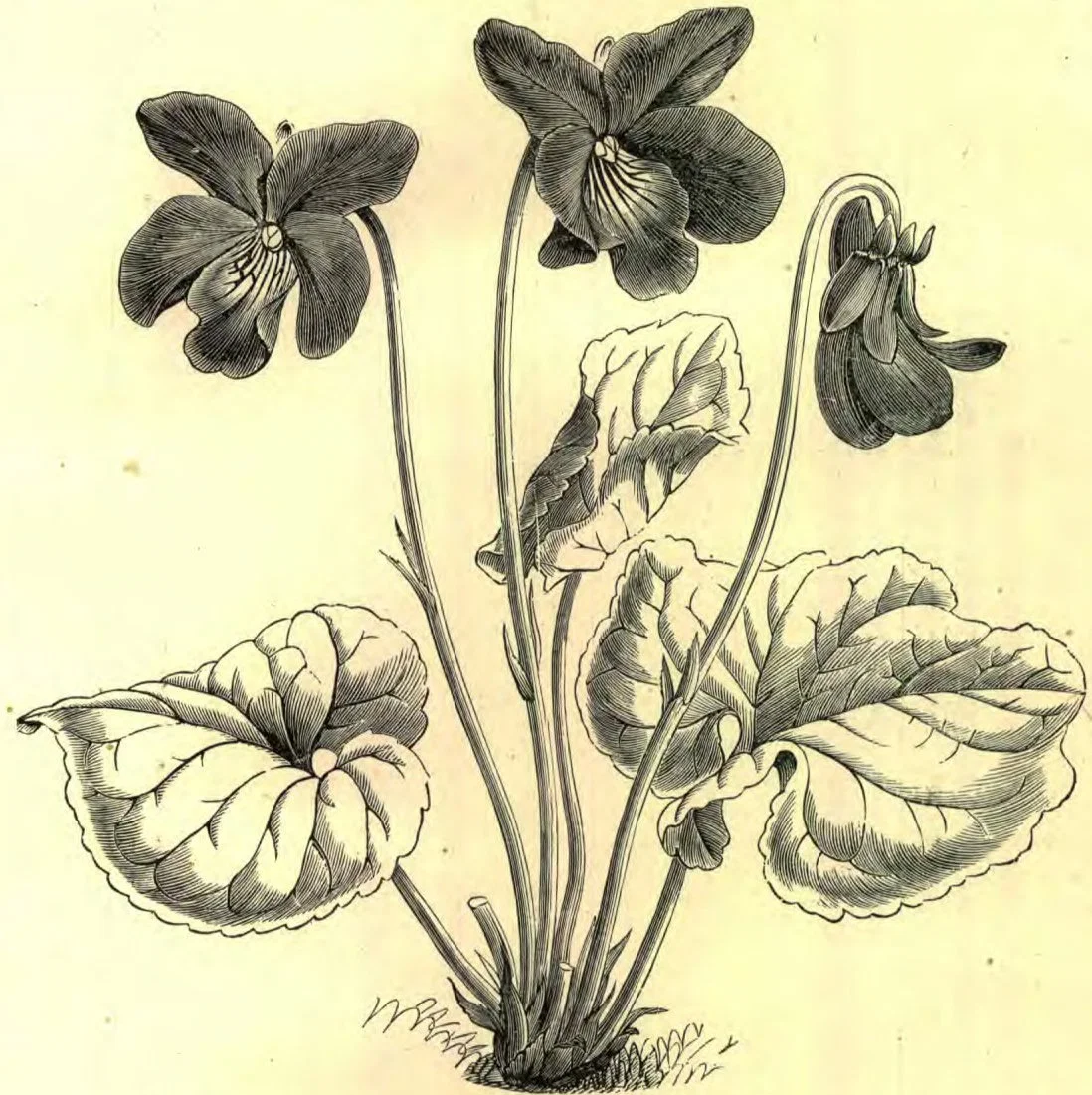
By the brook-side grows the water-cress, and the cross-shaped flowers of the crinkleroot. Farther on, the violets, with their almost human faces, peep out from sheltering green leaves. Here we find several kinds, growing side by side like brothers and sisters,—yellow, white, and blue,—most of them with rolling green leaves, and a few light blue ones with the green leaves slashed up, looking not unlike birds’ claws. In the picture on this page is a good representation of the common blue violet. Here is a large bunch, and we’ll
“Pluck the violets blue,— Ah, pluck not a few! Knowest thou what good thoughts from heaven the violet instills?”
The spice-bush fills the air with its fragrant odor. The bloodroot, growing near the old stone, opens its dainty white blossoms and broad leaves in the warm sunshine. On digging up a plant, the running rootstock seems almost as hard as a bone, while the juices drop from the wounded part red as blood, thus giving this curious plant its name.
Very beautiful after the winter snow is this resurrection of the flowers, yet how many people pass heedlessly by all these tokens of a Father’s tender care! May we learn to find the hidden lessons in the flowers, “sermons in stones, and good in everything” that God has made.
“Not useless are ye, flowers, though made for pleasure, Blooming o’er hill and dale, by day and night; On every side your sanction bids us treasure Harmless delight!”
“Your voiceless lips, O flowers! are living preachers; Each cup a pulpit, and each leaf a book, Supplying to the fancy numerous teachers, In loneliest nook.”
W. E. L.

Cultivating Kindness in Youth

CULTIVATE kindness while young; then when you become old, it will be an easy matter for you to treat others kindly.

TO THE COMING FLOWERS.

Awake, dear sleepers, from your wintry tombs; The sun has turned the point of Capricorn, And ’gins to pluck from winter’s wings the plumes Of darkness, and to wind his silver horn For your return. Come to your homes, forlorn In absence of your odors and your faces; Like Rachel weeps for you the reaved morn, As often as she views your empty places, Erewhile the daily scene of her and your embraces.
Come, pensile snow-drop, like the earliest star That twinkles on the brow of dusky night; Come, like the child that peeps from door ajar, With pallid cheek, upon a wasteful sight; And shouldst thou rise when all around is white, The more thou’lt demonstrate the power of God To shield the weak against the arms of might, To strengthen feeble shoulders for their load, And sinking hearts ’mid ills they could not full forebode.
Come, crocus cup, the cup where early bees Sip the first nectar of the liberal year, Come and illume our green, as similes Light up the poet’s song. And O ye dear Spring violets, come near, come breathing near; You too, fair primroses, in darksome woods Shine forth, like heaven’s constellations clear; And come, ye daisies, throng in multitudes, And whiten hills and meadows with your saintly hoods.
—Selected.

WHOSE WAS IT?

A CROWD of school-boys chatted very fast as they half ran, half walked the planked side-walks of a Pennsylvania city street. Just as they turned a corner, several started; for in the path near by glistened a silver half-dollar. Three boys saw it at once, and each claimed it as his own. Loud words followed, a few fists were clenched, but Peter McCarthey held the money in his strong palm, and would not even show it to the rest. Peter was very fleet of foot, so he made good use of his limbs in trying to get beyond the reach of his pursuers. But run as he would, some one seemed to keep pace with him at every step, and so in despair he bounded into the open school-room door, threw his cap toward its nail, and took his seat before school-time. Once in, he could not retreat, for the principal sat at her desk, and her rules were never to be broken. The boys all entered—half the school; perhaps—all who were near, at least, to watch the lad who meant to keep the whole. Several hands were immediately raised. “Please, Peter McCarthey has found a big piece of money,” said one. “Please, three of us found it at once, but he got it first.” “Please, and he won’t share it with us at all.” “Yes, ma’am, and he wont treat, nor nothing.”
The teacher closed the register, placed it in her drawer, and called the lads to the recitation seats. Peter came with a flushed, excited face, while some of the rest looked daggers at him slyly. “Do you think some one threw the money away?” she asked. Every one smiled. “I suppose it really belongs to some one person, and that that person, whoever it may prove to be, has lost it, and feels sad about it. I should be sorry if it proved to belong to some poor child who had been sent of an errand for his mother.” Peter and several others wiped their eyes. “We might get a lot of cherries, and treat,” said one. “Yes, or peanuts, or candies,” said another. “We might try to find the owner,” said a third. Just then the school-bell rang. “Which would be the nearest right?” asked the teacher. “The last,” said Peter, as he placed the money on the teacher’s desk. “Perhaps I shall not find an owner in school,” she said; “in that case it will have to be decided hereafter.”
Just as the moment for opening the school came, the bell at the desk waited, the pupils folded their hands, one hundred and twenty or thirty pairs of them, while the teacher held up the shining silver. No one in her room claimed it. She opened the primary department door. The teacher sat on the platform trying to comfort a little girl of seven years who was sobbing violently. All she could make out of her broken words were these: “All—she’d—got—Benny—sick—medicine.”
“Well,” said Miss Whitman, “did you wish to go for medicine now?” But the child only screamed the louder, “Can’t! O dear! O dear!”
“I’ve something to tell you,” said the lady who entered. “All look at me. I wish that little girl who is crying to look at what I hold up, and tell me if she knows whose half-dollar this is?”
The child gave a loud exclamation of delight, and rushed up to the lady to snatch it from her hand.
“Not yet,” she said gently; “come with me.”
She led the sobbing, broken-hearted little child to the desk in her room, wiped the fevered brow, and asked if the boys who found a half-dollar lying in the street would keep this child’s little brother from the medicine she was to take to him after school.
“No, indeed!” they responded.
“Boys,” said she, “do you know this child? she is a stranger to me.”
Many hands were raised.
“She is Mrs. Maloney’s girl, Bridget,” said one.
“Her mother washes for a living,” said another.
“Her father’s dead, and there’s four children besides her, younger,” said a third.
“Will you treat with cherries and peanuts, boys?” she asked. But only one response came; it was Peter McCarthey who spoke.
“Will you please forgive us,” he said, “for just thinking so selfish as it was, and give Bridget the money?”
And so the little red face was lifted and kissed, and the money placed in the child’s hand; and she faltered out, “Thank you, lady; I’m sure it’s bound to make Benny well again,” and passed into her room.
From every action of our lives there is a result. Nothing comes by chance. The loss to little Bridget resulted in a lesson that can never be forgotten by those school-boys. It will be remembered also by many more in the impression it has left upon the understanding. If we heed the lessons that are daily before us, then shall we grow in moral worth, and be better prepared to meet the temptations that surround us, by contact with the world. Every lesson in honesty is pointing us toward God and heaven.—Auntie Dee.

OUR GREAT HELPERS.

Unlike the organs of seeing and hearing, those of smelling and tasting have no remarkable machinery. No one can tell why the nose and mouth can smell and taste an orange any sooner than the hand. God has simply placed a power in those parts to perceive the fragrance and flavors which he has put into flowers, fruits, etc. Though so simple, yet how much pleasure these senses give us. Plants might have lived and borne their fruit just as well without any beauty in their flowers or any sweet scent; these things, then, must have been made as they are for some purpose. It is necessary that we eat to sustain life, but it is not necessary that we should have good things to eat, as hunger would lead us to take food. One kind of food would have been sufficient to keep us alive, but only see the great variety of grains, fruits, and vegetables God has made, and then given us the power to enjoy them.
Of all our senses, that of smell has been called the most refined. It is certainly very useful. It sits as guard over everything that approaches the mouth, and gives us warning when offensive things are about to enter it. It also tells us of decaying and hurtful surroundings when we could usually learn it in no other way.
Fragrance was mingled with all the Jewish worship. It is the emblem of prayer, and has been called the thanksgiving of nature for the sunshine and rain. When it comes to us, it should waken an echo of thanks in our hearts to the great and good Being “who giveth us richly all things to enjoy.” While he adorned the torrid zone with more beautiful flowers than the temperate, he gave us the sweetest ones. Many of those of the richest fragrance and brightest colors carpet high mountains. The costly spikenard with which Mary anointed Jesus, was obtained from a curious plant growing on the high mountains of India. We are told that on the Peak of Tenerife, high above the clouds, and found nowhere else on the earth, grows a strange shrub called Retama. In the spring, like an earnest prayer sent up from earth’s altar or a sweet blessing descending from on high, it bursts out into a wealth of milk-white blossoms, which perfume all the air. The peasants below take their bee-hives up to it, and there the bees fill them with perfumed and costly honey. The fragrant-leaved Rhododendron, on the Himalayas, grows higher than any other shrub, scenting far around.
In small quantities, such as we would get from beds of sweet-smelling flowers around our dwellings, fragrance is purifying and health-giving; but in large quantities it is said to be poisonous.
The senses of touch and weight, with the four we have been considering, make out the list of the great helpers of our bodies. As our hands are our chief ministers, so in the finger-tips, just where we need it most, the sense of touch is greatest. We should, however, find it very unpleasant, were it as acute in all parts of our bodies.
Can we not say with those of old, “He hath done all things well”? “I will praise thee, for I am fearfully and wonderfully made”?
M. E. STEWARD.

THE STORY OF THE IVY.

THERE is a pretty German legend told of the Ivy, how a single leaf fell from the wreath of an angel. It clung in terror to the moss it fell on, and although the snow came and covered it, it could not fade and die because it had once been part of an immortal crown.
When spring came, it began to creep along the ground, and inquire of the worms and bugs it met the way to heaven. They did not understand its words, and the Ivy sadly moved on to a very large stone, thinking she might catch a cloud from it, but could not; she was days and weeks going from the stone to a fence, hoping all the while to get nearer her home, but the top of the fence seemed no nearer the cloud than the top of the stone did, and she dropped down on the other side, asking the honeysuckles and climbing roses and morning glories, “How can I reach my home in heaven?”
A tall oak tree was close by. Trembling with hope, she reached it, and clung to its rough bark, for anything so tall must surely reach the sky, she thought. When almost too tired to hold on any longer, she heard the rustle of the leaves. They spoke tender words, such as she could feel and understand, and she told them she was on her way to heaven, and asked them to help her. They told her to rest often, and then try again to reach where they were, and stay with them, because she could never really reach the clouds while rooted on the earth. So then she agreed to stay with the Oak, who comforted her, although she still must climb. When the leaves of the great Oak fled away in the next winter, the Ivy folded itself around the bare limbs of the tree which had encouraged her to climb higher, saying, “You were loving, and held me up when I was homesick and tired, and now I will try to keep you warm.”
It is said that when the Ivy sometimes starts upward, and seems restlessly reaching again after the clouds, the tree only needs to rustle her leaves softly to make her remember that her home is now on earth and to be content; and so we have the beautiful dark Ivy with us always, forever green, and the angel smiles on it for being so patient in its home on earth, and because it would still climb higher toward its heavenly home.
Does not the Ivy teach beautiful lessons?—Little Gem.

Bad Habits Are the Thistles of the Heart

BAD habits are the thistles of the heart, and every indulgence of them is a seed from which will spring a new crop of weeds. A few years ago a little boy told his first falsehood. It was a little, solitary thistle-seed, and no eye but God’s saw him as he planted it in the mellow soil of his heart. But it sprung up—oh, how quickly!—and in a little time another and another seed dropped from it to the ground, each in its turn bearing more seeds and more thistles, and now his heart is overgrown with this bad habit.—Selected.

LESSON 130.—PETER AND JOHN HEAL THE LAME MAN AT THE GATE OF THE TEMPLE.

One day Peter and John went up into the temple at the ninth hour, which was the hour of prayer. As they were coming in at that gate of the temple, called Beautiful, they were accosted by a lame man, who was brought and laid there every day, that he might receive gifts from the people who passed in and out through the gate. When he asked alms of these two disciples, they fixed their eyes steadily upon him, and Peter said, “Look on us.” As the man looked up, expecting to receive something, Peter said, “Silver and gold have I none; but such as I have, give I thee: in the name of Jesus Christ of Nazareth rise up and walk.” Then Peter took him by the right hand and lifted him up, and immediately his feet and ankles became strong. Leaping up, he stood, and walked with them into the temple, leaping, and praising God. As the people saw him, they knew that it was the same man who had been lame from his birth, and who had for so long a time sat for alms at the Beautiful gate of the temple. As soon as the news of this astonishing miracle had spread among those who had come to the temple for worship, they gathered about the disciples, and the man who had been healed, greatly wondering at what had happened.
When Peter saw this, he said to the assembled people, “Ye men of Israel, why marvel ye at this? or why look ye so earnestly on us, as though by our own power or holiness we had made this man to walk? The God of Abraham, and of Isaac, and of Jacob, the God of our fathers, hath glorified his Son Jesus, whom ye delivered up, and denied him in the presence of Pilate, when he was determined to let him go. But ye denied the Holy One and the Just, and desired a murderer to be granted unto you; and killed the Prince of life, whom God hath raised from the dead; whereof we are witnesses. And his name through faith in his name hath made this man strong, whom ye see and know: yea, the faith which is by him hath given this man this perfect soundness in the presence of you all. And now, brethren, I wot that through ignorance ye did it, as did also your rulers. But those things, which God before had showed by the mouth of all his prophets, that Christ should suffer, he hath so fulfilled.”
“Repent ye therefore, and be converted, that your sins may be blotted out, when the times of refreshing shall come from the presence of the Lord; and he shall send Jesus Christ, which before was preached unto you; whom the heaven must receive until the times of restitution of all things, which God hath spoken by the mouth of all his holy prophets since the world began.”
“For Moses truly said unto the fathers, A prophet shall the Lord your God raise up unto you of your brethren, like unto me; him shall ye hear in all things whatsoever he shall say unto you. And it shall come to pass, that every soul, which will not hear that prophet, shall be destroyed from among the people. Yea, and all the prophets from Samuel and those that follow after, as many as have spoken, have likewise foretold of these days. Ye are the children of the prophets, and of the covenant which God made with our fathers, saying unto Abraham, And in thy seed shall all the kindreds of the earth be blessed. Unto you first God, having raised up his Son Jesus, sent him to bless you, in turning away every one of you from his iniquities.”
While the apostles were thus speaking to the people, the priests, and the captain of the temple, and the Sadducees came upon them, being much offended because they taught the people, and preached that through Jesus the dead were to be raised. So they laid hands upon the apostles, and put them in prison until the next day. But this could not prevent the effect of their words; for about five thousand men, from what they there saw and heard, believed on Jesus as the Son of God, and the Saviour of mankind.

QUESTIONS

  1. On what occasion were Peter and John accosted by a man who had been a cripple from his birth? Acts 3:1.
  2. How did this man come to be at the gate called Beautiful?
  3. How was the attention of the disciples drawn toward him?
  4. What did Peter at first say to the man?
  5. What expectation did this awaken?
  6. How did Peter then address him?
  7. Describe the miracle that then took place.
  8. How did the poor man manifest his joy at being healed?
  9. How was he recognized by the people?
  10. What did this cause them to do?
  11. What advantage did Peter take of these circumstances? Verse 12.
  12. What question did he ask them?
  13. How did he disclaim any credit for what had been done for the lame man?
  14. To whose power did he attribute the miracle?
  15. What cutting rebuke did he bring upon the Jews?
  16. How did he describe the manner in which the miracle had been wrought? Verse 16.
  17. How did Peter accuse the Jews for their cruel conduct? Verses 17, 18.
  18. What earnest exhortation did he then give them? Verse 19.
  19. When did he say their sins should be blotted out?
  20. What event is to be closely connected with the refreshing here spoken of? Verse 20.
  21. How long must the heavens retain the King of Glory before he will be sent to earth?
  22. To what promise did Peter call their attention? Verse 22.
  23. What doom is threatened upon all who will not hear that Prophet? Verse 23.
  24. What reference did Peter make to the prophecies concerning Christ?
  25. What encouraging words did he then speak to them? Verse 25.
  26. Where is this promise found?
  27. What preference did he give the Jews? Verse 26.
  28. Who came upon the apostles as they were thus speaking? Acts 4.
  29. Why were the priests so offended at the apostles?
  30. What did they do to them?
  31. What was it beyond their power to do?
  32. What was the result of Peter’s sermon on this occasion?

NOTES

Ver. 1. At the hour of prayer, the ninth hour. The Jews reckoned their time from six o’clock in the morning. This brought the ninth hour at three o’clock in the afternoon. There were two fixed hours for sacrifice and prayer,—one at nine A. M., and the other at three P. M. Exod. 29:38–41. These, with the noon hour, were observed as seasons of prayer by the devout Jews, even when absent from Jerusalem and the temple. The ninth hour was the favorite time for the Jews to go up to the temple, as the busiest part of the day was then over.
Ver. 2. Laid daily at the gate of the temple. The ancients had no almshouses or hospitals. The poor, the maimed, and the sick, who had no means of support, would seek some conspicuous public resort, where they might attract the notice, and obtain the assistance, of the rich. Sometimes, like blind Bartimeus, they sat by the side of a public highway; sometimes they were laid by their friends, as Lazarus in the parable, at the gate of a wealthy man.—Pierce. Called Beautiful. This was not one of the gates leading through the outermost wall of the temple, but an inner gate, separating some two of the courts, just which two being a disputed question. It is safe, however, to describe it as composed of two brazen doors, overlaid with plates of gold, and so massive that the combined strength of twenty men was required to open and shut them.
Ver. 17. I wot (know) that through (Rev. Ver., in) ignorance ye did it. Peter does not mean to teach that they were innocent in having put Jesus to death, or he would not in another verse call upon them to repent. But he meant to encourage them by showing that since their sin was one of ignorance, it was not unpardonable. Some of the rulers and of the people did no doubt act contrary to their own convictions, and did it because they were jealous of Christ’s influence with the people, and because they were cut by his sharp rebukes of their sins. Yet it is probable that the mass of the people were not fixed in their belief in Christ as the Saviour. If they had been, their sin in urging his death would have been unpardonable. But they did sin in not accepting his life, teachings, and miracles, as evidences of his divinity.
Ver. 19. Times of refreshing. This refers to the special outpouring of the Spirit of God, which is promised to his waiting people just before the second coming of Christ. It is often referred to in the Scriptures as the “latter rain.” Hosea 6:3; Zech. 10:1; Joel 2:23.
Ver. 21. Whom the heaven must receive. The idea is that Christ must remain in heaven until the restoration of all things. This was to correct the notion that he was to be bodily present throughout the history of his church on earth, as the Jews had expected.—Revision Commentary. Until the times of restitution. Better, restoration of all things, i. e., at Christ’s second coming. But this phrase, “the restoration of all things,” is used in two senses in the New Testament. First, it is said (Matt. 17:11; Mark 9:12) that Elias must “first come and restore all things.” There it signifies the beginning of Christ’s kingdom. As Christ’s death was for all men’s redemption, the restoration of all things may be said to have begun then. In the present verse the words have reference to the time when the course of that restoration shall be completed.—Cambridge Bible. The full significance of the word is renewal or restoration of primeval purity, order, happiness: setting right the present wild disorder and confusion; good will then triumph over evil, truth over falsehood.—Schaff.
Ver. 22. For Moses truly said. The authority of Moses among the Jews was absolute and final. It was of great importance, therefore, to show not only that they were not departing from his law, but that he had actually foretold these very things. The object of the passage is not to prove that the heavens must receive him, but that he was truly the Messiah. Unto the fathers. To their ancestors, or the founders of the nation.—Barnes.
Ver. 23. Every soul. Every person, or individual. Soul is often put for the whole man by the Hebrews. Acts 7:14; Josh. 10:28.—Ibid.
Ver. 25. Ye are the children of the prophets. Greek, “Ye are the sons of the prophets.” The meaning is, not that they were literally the descendants of the prophets, but that they were their disciples, pupils, followers. They professed to follow the prophets as their teachers and guides. Teachers among the Jews were often spoken of under the appellation of fathers, and disciples as sons. And of the covenant. Ye are the sons of the covenant; that is, you are of the posterity of Abraham, with whom the covenant was made. The word sons was often thus used to denote those to whom any favor appertained, whether by inheritance or in any other way. Thus Matt. 8:12, “the children [sons] of the kingdom.” John 17:12, “the sons of perdition.”—Ibid.
Ver. 26. Having raised up his Son. Not from the dead, but more properly having caused to appear.
Chap. 4:1. The captain of the temple. The captain of the temple (see Luke 22:4) was the head of the band of Levite sentinels, whose duty it was to keep guard over the sacred precincts. He, as an inspector, made his round by night, visited all the gates, and roused the slumberers. His presence implied that the quiet order of the temple was supposed to be endangered.—Plumptre. The Sadducees were a sect, or school, among the Jews, who derived their name from Sadoc, their founder. They stoutly denied the resurrection from the dead, and everything which seemed to teach the doctrine of the future life was especially hateful to them.
Ver. 3. Put them in hold. Placed them in custody, not for punishment, but for safe-keeping, until the matter should be investigated by the authorities, and a decision arrived at. The Revised Edition has, “put them in ward.”—Vincent. It was against the law of the Jews to pronounce a judicial sentence after night-fall.
For additional Notes see Review for April 10.

Letter Budget.

WELTHA I. MOORE sends a very neatly written letter from Charlotte, Mich. She says: “I am thirteen years old. I have six brothers and four sisters. I go to school, and have missed only one day this winter. My oldest brother and sister are teaching; my youngest brother goes to school with me. Our baby sister is three, and is full of mischief. We have three new-milch cows, and one little lamb a month old. My oldest brother is going to be a minister before a great while. He belongs to the seventh-day church, but the rest of us keep Sunday. We like the INSTRUCTOR very much. Pray for me that I may be a good girl.”
ALBERT W. MORRIS writes from Clearville, Bedford Co., Penn.: “I am twelve years old. I have had the hip disease for seven years, and have not walked any for over three years. I suffer a great deal all the time. I have had twelve or thirteen different doctors to see me, and have had all done for me that could be done. I cannot go to school, and the boys and girls may wonder how I spend my time. I have learned to read, and I do a great deal of reading. Then I get many nice letters and papers sent to me, so I have to write to all I can. I have pieced five bed quilts, and can do all kinds of knitting. We live in the country. I have a comfortable home, and kind parents who take good care of me. I have one brother and three sisters, all older than myself. Will you not all pray for the poor cripple boy?”
Here is one from HART HALL, Birnamwood, Wis. He says: “I am seven years old. I have five sisters and one brother. I give away tracts on the cars, and I also go to the lumber camp with tracts and papers. My brother goes with me sometimes.”
We have other letters from EVA V. WEBBER, of Colfax, Mich., and LILLIAN B. HESS and LETTIE C. JONES, of Columbus, Nebraska. These little girls all keep the Sabbath, and go to Sabbath-school. They send their love to the INSTRUCTOR family.

A STORMY DAY.

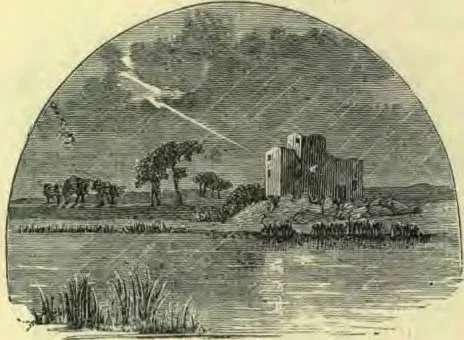
Hark, how the rain is pouring! Hark, how the north winds blow! Think of the poor, poor children Who have nowhere to go, But crouch in sheltered corners To keep from wind and rain.
Do you thank God, dear little ones, That you know not such pain? Then think of them with pity, And try what you can do To make the poor, poor children Both warm and happy too.
—Mary E. Gellie.

AN OLD STORY.

BLUE-EYED, rosy-cheeked, dark-haired boy. His work lay all day among the hills and valleys where his father's sheep wandered. His business was to watch them; to see that no wolf came and stole away one of the young lambs; to see that none of the flock strayed away; to bring them all safely home at night.
On this day the boy would have liked to be at home. There was company in his father's house, a white-haired old minister; and David the shepherd-boy would have liked well to hear him talk. However, he did not expect to have a chance; he was the youngest of the family, and of course it was foolish to expect that the old minister would care to see him, or that his father would allow him to leave the sheep.
Meantime his brothers were very busy and eager, getting ready to see the grand old minister. He had asked to see every one of them. The truth was, he had come to their father's house on a very important errand. He was to choose from the sons one to fill a high office. I suppose the old father and the brothers did not know what to think when they heard they were all called for.
“What do you think he wants of us?” they said to one another while they made ready. David's oldest brother was a tall, handsome man, and I think it very likely he expected to please the old minister. “He cannot help seeing that I am much finer looking than any of the rest,” I suppose he told himself; and then he went to thinking that if there should be any vacant office, and the minister had been sent to select one to fill it, he stood a better chance of being chosen than any of the others. To tell you the truth, the old minister thought that very thing, wise as he was, the moment he looked at the tall, handsome man. “Ah!” he said to himself, “I think this must be the very one.”
But he was something better than a wise man, he was truly good, so good that he listened always for the voice of God in his heart, and at that moment God spoke to him.
“No,” he said, “look not on his countenance, nor on the height of his stature, because I have refused him; for the Lord seeth not as man seeth; for man looketh on the outward appearance, but the Lord looketh on the heart.”
So the tall, finely-formed man passed on, and the next oldest came in and was introduced and stepped back, for the minister, following the voice in his heart, knew that he was not the one. In this way the brothers passed, one by one, and at last the minister asked,—
“Are here all your children?”
“Why,” said the father, “my youngest boy isn't here; he is away on the hillside taking care of the sheep.”
“Send for him,” said the minister; “we will wait for him.”
Then what a hurrying across the fields there was! I don't know which brother went, but perhaps it was Eliab, the tall, handsome one. I think he may have been a little bit vexed with the way things were going. I can fancy he spoke rather crossly.
“David,” he may have said, “David, hurry up, father has sent for you; the minister wants to see you; he has all the family there waiting, and will not sit down to eat until you come.”
Then I think David was very much surprised, and said,—
“Why! what can he want of me, do you suppose?”
Then it may be that Eliab answered sharply,—
“How do I know? He wants you, and my father said you were to come as soon as possible, and that is enough.”
So I fancy I can see them hurrying over the fields, and I think David waited only to wash his rosy cheeks, and brush his dark hair, then he went in, eager, happy boy that he was, to see the minister whom he had wanted so much to know.
Do you know that the moment the white-haired old minister saw him, the voice of God told him that here was the one chosen for the high office? Do you know that the shepherd boy was really called from watching the flocks to be king over a great nation?
I think it more than likely that you have heard this story before, and that in fact you know a good deal about David. But I am never tired of thinking over all the wonderful little steps that he took to the throne.—The Pansy.

LITTLE CANVASSERS.

Hundreds of the readers of the INSTRUCTOR should be engaged in securing subscribers for the paper. Among the many reasons why, are the three following very important ones:—
1. By extending the circulation of the INSTRUCTOR, you are doing great good to the new subscribers thus obtained, as the paper will be a blessing wherever it goes.
2. By enlarging the list of subscribers to the paper you will help the publishers to still further improve it, and thus increase its value to all.
3. And, most important of all, by a training in this canvassing work, you will be learning to work in a field of great usefulness, one which is fast becoming an important branch of our beloved cause.
Let the children commence to canvass for their own paper, and they will thus learn how to do the work, and be prepared for good service in other departments of the canvassing field, as the work develops before us.
The premium offered with the INSTRUCTOR is an attractive one, and will be the means of introducing the paper into many families, where it may prove a blessing to its readers. Notice the offer, as made below, and help the children to enter the canvassing field. Encourage them in their efforts, and try to keep them from growing weary in well doing, as in due time they will reap if they faint not. PUBLISHERS.
Continue reading: GOOD BOOKS