INTRODUCTION.—The preceding lesson closed with the subject of the heinous sin of the Israelites in worshiping the golden calf. For this, God purposed to destroy them, but spared them at the earnest intercession of Moses, except those who had been most active in causing the people to sin, who were punished with death. The people being brought back to their allegiance, Moses proceeds to carry out the instructions given him in Mt. Sinai with reference to the tabernacle, by directing them, at the command of God, to bring free-will offerings of their possessions for use in its construction.
Questions, with Scripture Texts, and Notes.
1. While Moses was in the mount, what did God tell him to say to the children of Israel?
“And the Lord spake unto Moses, saying, Speak unto the children of Israel, that they bring me an offering: of every man that giveth it willingly with his heart ye shall take my offering.” Ex. 25:1, 2.
2. Of what was their offering to consist?
“And this is the offering which ye shall take of them; gold, and silver, and brass, and blue, and purple, and scarlet, and fine linen, and goats’ hair, and rams’ skins dyed red, and badgers’ skins, and shittim wood, oil for the light, spices for anointing oil, and for sweet incense, onyx stones, and stones to be set in the ephod, and in the breastplate.” Verses 3–7.
On verse 4 of this reference, Dr. Bush gives the following: “Blue, purple, and scarlet. These are merely the names of certain colors, while no mention is made of the thing or things colored. But as we find from the apostle (Heb. 9:19,) that scarlet wool was employed in the sprinkling of blood, the probability is, that wool of these colors is intended, which was afterward fabricated by the women into the curtains of the tabernacle; for however difficult it may be to conceive that they should have had in the wilderness the implements necessary to such a process, the following passage (Ex. 35:26) puts it beyond doubt: ‘And all the women whose spirit stirred them up spun goat’s hair.’ Thus the Hebrew doctors: ‘The blue spoken of in any place was wool dyed like the body of heaven; the scarlet, wool dyed in scarlet, etc.’”
“Fine linen, denoting the fabric made from the plant of that name which grew in Egypt and Palestine. . . . It was either a species of soft, delicate, and downy cotton, or a superior kind of flax, from which garments were made of the most pure and exquisite white. . . . They were, in fact, the garments of kings and nobles. In Gen. 41:42, we see that Joseph was clothed in one of them. . . . So likewise David appeared in a similar robe on a day of solemnity. 1 Chron. 15:27.”
Badger skins. The Revised Version renders the original Hebrew word “seal skins,” or (margin) “porpoise skins,”—a much better translation, since the badger is an inhabitant of cold countries, and, so far as there is any evidence to show, never existed in Palestine, Arabia, or Egypt.
“Shittim wood. Though not certainly known, it is supposed, with great probability, to be the Acacia, or species of thorn that still grows in great abundance in the deserts of Arabia; the wood of which, according to Jerome, is extremely light, solid, strong, and smooth, qualities rarely found together in any one wood. The tree is of the size of a large mulberry tree, large enough, says the Father above mentioned, to furnish very long planks.”—Bush.
3. What were these offerings for?
“And let them make me a sanctuary; that I may dwell among them.” Verse 8.
4. Who only were to bring an offering?
“Speak unto the children of Israel, that they bring me an offering: of every man that giveth it willingly with his heart ye shall take my offering.” Verse 2.
“Take ye from among you an offering unto the Lord: whosoever is of a willing heart, let him bring it, an offering of the Lord; gold, and silver, and brass.” “And they came, every one whose heart stirred him up, and every one whom his spirit made willing, and they brought the Lord’s offering to the work of the tabernacle of the congregation, and for all his service, and for the holy garments.” Ex. 35:5, 21.
5. What sort of things did they bring?
“And they came, both men and women, as many as were willing-hearted, and brought bracelets, and ear-rings, and rings, and tablets, all jewels of gold: and every man that offered, offered an offering of gold unto the Lord. And every man with whom was found blue, and purple, and scarlet, and fine linen, and goats’ hair, and red skins of rams, and badgers’ skins, brought them. Every one that did offer an offering of silver and brass brought the Lord’s offering: and every man with whom was found shittim wood for any work of the service, brought it.” Ex. 35:22–24.
6. How did they come to have so many valuable things?
“And the children of Israel did according to the word of Moses; and they borrowed of the Egyptians jewels of silver, and jewels of gold, and raiment: and the Lord gave the people favor in the sight of the Egyptians, so that they lent unto them such things as they required. And they spoiled the Egyptians.” Ex. 12:35, 36.
7. What did the women do?
“And all the women that were wise-hearted did spin with their hands, and brought that which they had spun, both of blue, and of purple, and of scarlet, and of fine linen. And all the women whose heart stirred them up in wisdom spun goats’ hair.” Ex. 35:25, 26.
8. What kind of service was all this?
“The children of Israel brought a willing offering unto the Lord, every man and woman, whose heart made them willing to bring for all manner of work, which the Lord had commanded to be made by the hand of Moses.” Verse 29.
9. How are we exhorted to give?
“Every man according as he purposeth in his heart, so let him give; not grudgingly, or of necessity: for God loveth a cheerful giver.” 2 Cor. 9:7.
10. What kind of giver does God love?—Id.
11. Cite another instance where the people offered willingly to the cause of God.
“Then the chief of the fathers and princes of the tribes of Israel, and the captains of thousands and of hundreds, with the rulers of the king’s work, offered willingly, and gave for the service of the house of God of gold five thousand talents and ten thousand drams, and of silver ten thousand talents, and of brass eighteen thousand talents, and one hundred thousand talents of iron. And they with whom precious stones were found gave them to the treasure of the house of the Lord, by the hand of Jehiel the Gershonite.” 1 Chron. 29:6–8.
12. How was it that the people were enabled to give so willingly?
“Then the people rejoiced, for that they offered willingly, because with perfect heart they offered willingly to the Lord: and David the king also rejoiced with great joy.” Verse 9.
13. Is there danger of coming to poverty through generous giving to the cause of God?
“There is that scattereth, and yet increaseth; and there is that withholdeth more than is meet, but it tendeth to poverty. The liberal soul shall be made fat: and he that watereth shall be watered also himself.” Prov. 11:24, 25.
There can be no doubt but that many who bewail their (in most cases imaginary) inability to assist in the cause of God, owe their pecuniary embarrassment to the fact that they are not willing to make a sacrifice, and206help with what they have. For a noted Biblical example of this, see Haggai 1:1–12.
14. What is God able to do?
“And God is able to make all grace abound toward you; that ye, always having all sufficiency in all things, may abound to every good work.” “Being enriched in everything to all bountifulness, which causeth through us thanksgiving to God.” 2 Cor. 9:8, 11.
15. How is this?
“The earth is the Lord’s, and the fulness thereof; the world, and they that dwell therein.” Ps. 24:1.
“For every beast of the forest is mine, and the cattle upon a thousand hills. I know all the fowls of the mountains: and the wild beasts of the field are mine. If I were hungry, I would not tell thee: for the world is mine, and the fulness thereof.” Ps. 50:10–12.
“The silver is mine, and the gold is mine, saith the Lord of hosts.” Hag. 2:8.
16. Then when people make offerings to God, whose property do they give?
“But who am I, and what is my people, that we should be able to offer so willingly after this sort? for all things come of thee, and of thine own have we given thee. For we are strangers before thee, and sojourners, as were all our fathers: our days on the earth are as a shadow, and there is none abiding. O Lord our God, all this store that we have prepared to build thee an house for thine holy name cometh of thine hand, and is all thine own.” 1 Chron. 29:14–16.
17. What was the result when the people gave with a willing heart?
“And all the wise men, that wrought all the work of the sanctuary, came every man from his work which they made; and they spake unto Moses, saying, The people bring much more than enough for the service of the work, which the Lord commanded to make.” Ex. 36:4, 5.
18. What proclamation had to be made?
“And Moses gave commandment, and they caused it to be proclaimed throughout the camp, saying, Let neither man nor woman make any more work for the offering of the sanctuary. So the people were restrained from bringing. For the stuff they had was sufficient for all the work to make it, and too much.” Verses 6, 7.
What a contrast this presents to modern giving! Who ever heard of a similar instance among any other people? Here there was nothing like a fair, or an oyster supper, or a strawberry festival, by which people now coax unwilling dimes from the pockets of worldlings and professors alike, for the benefit of the church; we do not read that Moses went around to remind the people of their duty, and urge them to help the good work along; but “the children of Israel brought a willing offering.” We are forced to the conclusion that when people need urging, even to make a pledge to help on in the cause, and then need continual reminders of their obligation, there must be a great lack of that cheerful readiness to give, that is so pleasing to God.
19. How many have known of such an instance in the history of the cause?
20. Is there in this record any lesson for us?
In his second epistle to the Corinthians, the apostle Paul makes the grace of Christ the grand spring of all Christian giving. Giving that is prompted by anything else is not Christian giving. As an incentive for them to give liberally, the apostle said: “For ye know the grace of our Lord Jesus Christ, that, though he was rich, yet for your sakes he became poor, that ye through his poverty, might be rich.” 2 Cor. 8:9. The plan of salvation begins and ends in a gift. “God so loved the world that he gave his only begotten Son, that whosoever believeth in him should not perish, but have everlasting life.” John 3:16. Christ “gave himself for us, that he might redeem us from all iniquity, and purify unto himself a peculiar people, zealous of good works.” Titus 2:14. And when the work of redemption shall have been completed, the saints will share a glorious immortality as the free gift of God, through Jesus Christ our Lord. This consideration should incite to prompt and cheerful giving. Indeed, it will lead to such giving on the part of every soul who feels the worth of the Saviour’s love. Surely it is a slight thing to give the temporal riches which come from God in the first place, and belong to him, when he so freely gives to us eternal riches. “The riches of his grace” is an expression often used by the apostle Paul. But the grace of God is a gift, and consists wholly in giving; we are exhorted to be “good stewards of the manifold grace of God.” 1 Peter 4:10. The spirit of willingness to give is a grace, and a manifestation of the grace of God. See 2 Cor. 8:4–7. A converted church must be a liberal church. A revival that does not increase the contributions of a church, is not the right kind of revival; for those who, like the brethren in Macedonia, first give themselves to the Lord, will, like them, abound in liberality, even in deep poverty. (See 2 Cor. 8:1–5.) This is further proved by the experience of the people in the time of Hezekiah. See 2 Chron. 30 and 31, comparing especially chapters 30:18–20 and 31:4–11.
WORK AMONG THE GERMANS.
By H. Shultz
In company with Eld. Conradi, I visited Culbertson, Neb. A spirit of selfishness had crept into the church, and had, to a certain extent, destroyed the peace of some. Oh, that we might learn the lesson taught by our Saviour, in honor to prefer one another. From this place we went to Hillsboro, Kan., where we remained several days, preaching both here and at Lehigh to large congregations. Quite an interest was manifested. One was added to the church at Lehigh. After visiting the school at Hillsboro, where quite a number desired to enter the canvassing field as soon as the school should close, we separated, Eld. Conradi going to Olney, in the western part of the State, and I to Tampa, in the northern part.
I was joined at this place by Bro. Loeppke. We had some good meetings with the church here. We then went to Herrington to visit a few families of Sabbath-keepers. They had circulated an appointment for us, and at the first meeting the house was full. We continued meetings over Sabbath and Sunday. After the sermon Sunday forenoon, twenty-five signed the covenant to keep all the commandments of God and the faith of Jesus, and after the evening discourse, seven more names were added. Being obliged to leave on Monday to fill other appointments, I left Brn. Loeppke and Meyer to follow up the interest. I expect quite a number more will take hold of the truth in this place.
The work is onward, and may the time soon come when every soul shall have heard the sound of the third angel’s message. H. SHULTZ. March 19.
TO OUR BRETHREN IN OHIO.
By R. A. Underwood
HAVE you seen the Year Book for 1889? If not, send to L. T. Dysert, 1103 Case Ave., Cleveland, Ohio, for it at once. The book contains 208 pages, with many new illustrations and statistics concerning general points of information. The small price of fifteen cents per copy does not cover the first cost of the book. It contains a general directory of all our State Conferences and all the organizations of our people, and an account of the working of the cause during the past year. It contains the proceedings of the last General Conference and the various organizations which held their meetings at that time. It also contains cuts representing the most important institutions among us, and a brief sketch of their rise and progress, showing marked prosperity up to the present time. It has the Constitutions of our various organizations, and a table telling the exact time that each Sabbath begins and ends during the year 1889. It contains tables showing the population of the most important cities in the United States, and the population of the various nations of the world, also the comparative numerical strength of the various religions of the world. In fact, it is the most creditable Year Book ever published by us as a people.
All S. D. Adventists ought to have a copy of this book for their own use, and should also place copies of it in the hands of their neighbors. It is a good missionary document. It has many important items bearing on the union of church and state. Let each church in the State send in an order at once. A canvass should be made among all our brethren. Each family should have a copy, also some to supply their interested neighbors, editors, and others in their community. Make your order large, or you will need to send the second time, for I know you will be delighted with the book. R. A. UNDERWOOD.
News of the Week.
FOR WEEK ENDING MARCH 23.
DOMESTIC.
—A negro exodus from North Carolina to Arkansas is about to take place.
—Justice Stanley Matthews of the United States Supreme Court, died Friday forenoon.
—The public schools at East Tawas, Mich., were closed Tuesday, owing to the prevalence of scarlet fever in that city.
—Smith Bros.' mill, salt block, and docks near Bay City, Mich., with 2,000,000 feet of lumber, were burned Tuesday afternoon. The total loss is about $120,000.
—It is reported that a salt trust is being formed at East Saginaw, Mich., C. F. Burger representing the Eastern manufacturers. The capital is to be $25,000,000.
—The boiler in Whitney & Tuttle's saw-mill, at Pound, Wis., exploded Monday morning, completely wrecking the building, and killing two men. Four others were badly injured.
—Contracts for the construction of new war-vessels, embodying the latest approved ideas of high speed and heavy armament, will be let within a few months by the Secretary of War.
—The Oklahoma, Ind. Ter., “boomers” are again in trouble with the military authorities, and it is rumored that fire-arms have been brought into use by the contestants, and that serious trouble is imminent.
—The furniture store of Comstock & Avery, at Peoria, Ill., was destroyed by fire Monday, causing an estimated loss of $250,000; insurance not known. Several employees narrowly escaped with their lives.
—The Paradise Club of Anglers, of New York, have just decided to purchase 70,000 acres of forest and fifty trout lakes in various parts of the country. This will make the largest fish and game preserve in the world.
—A check for $26,000 was on Monday paid to the Commissioners of the District of Columbia to be invested, and the interest devoted to relieving the wants of the poor of Washington. The money was received from the inauguration, over and above all expenses.
—It is reported from Scranton, Pa., that Charles Nier ran a needle into his foot a week ago, for which the doctors searched in vain. Thursday afternoon he was taken to the plant of the Suburban Electric Railway, and his foot held near one of the dynamos. In fifteen minutes, as reported, the needle was drawn out.
—Judge Guthrie, of Kansas, in instructing the newly impaneled Grand Jury, stated that it was an actual fact that, owing to the prohibitory law of the State, there were boys in Kansas ten and twelve years old who had never even seen a saloon. He said the labors of the State's courts had manifestly decreased since liquor-selling was made a crime.
—On Wednesday, March 13, representatives of the State organizations of the W. C. T. U., the I. O. G. T., the R. T. of T., and the S. of T. met at Lansing, Mich., and decided to unite in securing petitions to the present legislature asking for the passage of a prohibition law, commending House bill No. 303 introduced by Hon. Henry Watson, which is an out and out prohibition bill, framed after the Kansas and Iowa laws. Albert Dodge, of Fowlerville, Mich., Grand Secretary of the I. O. G. T., was chosen Secretary, and charged with the work of distributing and collecting the petitions. Already several thousand have been sent out, and any who have not received one, and who are willing to circulate the same, are requested to write him for blank petitions.
FOREIGN.
—Lord Tennyson is slowly recovering from a dangerous illness.
—The Duc d'Aumale has been recalled from banishment by the new French ministry.
—The Ministry of New South Wales has been defeated on the question of protection, and in consequence has resigned.
—By the collision of an express train with a freight near Rimonski Station, Can., Tuesday, an engineer, two firemen, and a conductor were killed. None of the express-train passengers were hurt.
—It is reported that by the sinking of the Spanish steamer “Remus,” near the Philippine Islands, Jan. 30, forty-two lives were lost. The steamer had on board 169 people, 127 of whom were saved.
—Floods, said to be the greatest known in the present generation, have been prevailing in the west of England. Railway traffic has been suspended, bridges have been swept away, and lives lost by drowning.
—A severe scare was recently given the “boodlers” in Canada by the introduction of a bill into the Dominion parliament providing for the extradition of this class of criminals between Canada and the United States. A large sum of money was raised by them to defeat the bill.
—The London Times's case came to an end on Wednesday, March 13, and the defense of Parnell and his friends will begin in two weeks. Mr. Henry Campbell, M. P., the private secretary of Mr. Parnell, has brought suit for libel against the London Times. The case has been set for a hearing, and the trial will probably take place in May. This suit is the first of a series of suits to be brought against the Times.
—Three hundred miles an hour is the proposed speed for the electric postal railroad of the future. It is a compromise between the pneumatic tube and the ordinary railroad. It carries a miniature train of two cars solely for mails and light parcels, without any attendance. An experimental line has been erected at Laurel, twenty miles from Baltimore, Md.; and if it succeeds, it is stated that similar roads will be laid between Baltimore and Washington, and elsewhere.
RELIGIOUS.
—Philadelphia is said to be experiencing the greatest religious revival in its history since 1857.
—The twenty-eighth international convention of the Young Men's Christian Associations of North America is to be held in Philadelphia, May 8–12.
—President Harrison and every member of his Cabinet, except Secretaries Proctor and Rusk, are Presbyterians, according to the New York World.
—Reports from the spring conferences of the Methodist Church show that they are generally indorsing the movement in favor of the establishment of deaconess's homes, also the American Sabbath Union.
—Archbishop Walsh, of Dublin, has sent a telegram to Cardinal Rampolla, Papal Secretary of State, instancing the case of Pigott and his suicide at Madrid as evidence that the Parnellites have been misrepresented at the Vatican.
—A Methodist Episcopal university is to be founded in Utah. A committee, of which Bishop Warren is the head, has decided to locate in Ogden, this being the only town in the Territory of any consequence, except Park City, free from the Mormon dictation.
—In answer to the charge that the head of the Southern Confederacy meditated a union of church and state, Jefferson Davis recently wrote a denial to Rev. J. W. Jones, of Atlanta, affirming that the Cabinet was always composed of diverse religious element.
—The Galena (Ill.) Gazette reports a very successful (from a financial point of view) church fair under the auspices of St. Mary's (Catholic) church, at which about half the participants were Protestants. Contests for the determination of the most popular young lady and gentleman, the supper, grand raffle, wheel of fortune, etc., netted the church a very “handsome” sum.
—The Methodist Episcopal Church has twelve theological schools: The Boston School of Theology, Boston, Mass.; Drew Theological Seminary, Madison, N. J.; Garrett Biblical Institute, Evanston, Ill.; Centenary Biblical Institute, Baltimore, Md.; Maclay College of Theology, San Fernando, Cal.; Gammon School of Theology, Atlanta, Ga.; Swedish Theological Seminary, Evanston, Ill., and five others located in foreign countries.
Appointments: Quarterly Meetings and Visits
Appointments.
“And he said unto them, Go ye into all the world, and preach the gospel to every creature.”—Mark 16:15.
The quarterly meeting for Dist. No. 9, Iowa, will be held at Fonda, April 13, 14. We hope to see all the friends of the cause in the district present at this meeting. W. B. Everhart, Director.
The quarterly meeting for Dist. No. 6, Kan., will be held with the Wamega church, April 14, 15. Bro. C. W. Beimer will take charge of the meeting. It is necessary that all the officers be present. E. M. Gwin, Director.
A quarterly meeting will be held in Dist. No. 3, Province of Quebec, at the school-house in Bro. Richard’s neighborhood, Fitch Bay, P. Q., April 6, 7. Hope to meet all the brethren and sisters of this district at the meeting. R. S. Owen.
The quarterly meeting for Dist. No. 10, Ia., will be held in Boone, April 13, 14. We hope all absent members of the tract society will fill out their blank reports, and send them in before the meeting begins. A minister is expected. There will be opportunity for baptism. S. M. Holly, Director.
I will be at Cleveland, Ohio, Sabbath, March 30. I hope to see a good representation of the church present. Our dear brother and sister, J. F. Boettcher and wife, will start for Europe to labor in the German field about April 1. It is expected that they will be present at this meeting. We shall be glad to see the brethren from Bedford, Peninsula, and from other churches surrounding Cleveland present. R. A. Underwood.207
Quarterly meeting will be held with the church at Hastings, Mich., April 6. Hope all the members as far as possible, will be present. We invite the friends from surrounding churches to attend. L. G. Moore, Elder.
Coldwater, Mich., April 5-7. This will be the time for the church quarterly meeting. The ordinances will be celebrated. We hope every member of the church will endeavor to be present. M. J. Burnham.
Nothing preventing, I will attend the quarterly meeting at Little Prairie, Wis., April 6, 7. We desire that all friends of the cause living near should make arrangements to attend. Meetings will begin Friday evening. A. J. Breed.
The quarterly meeting for the Bradford, Pa., church will be held at Tarport, in the opera house, March 30, 31. The East Otto church will meet in Ellicottville, N. Y., April 6, 7. Let all attend who can consistently; those that cannot should report by letter. D. A. Ball.
I design holding church quarterly meetings in Kansas, as follows:—
Dennis, Labette Co., April 12-14
Emporia, April 19-21
I trust the brethren will prepare for these meetings both in temporal and spiritual matters. Please notify all isolated members. C. McReynolds.
Quarterly meeting for Dist. No. 11, Kan., will be held at Centerville, April 13, 14. We desire to have a full report of T. and M. work from each church, and that all official members shall be present, and as many others as possible. The time has fully come for a revival of this branch of the work. Plans for carrying on the work will be considered. Meetings will begin Friday evening, and close Sunday night. Rufus Baker, Director.
Providence permitting, I will meet with the following churches in Iowa:—
Sigourney, April 4-9
Osceola, April 11-16
Fontanelle, April 18-23
Elkhorn, April 25-30
The Sabbath-school and temperance work will receive special attention at these meetings, and we hope the Sabbath-schools near the places above mentioned will be well represented at the meetings. Meetings will begin at each place on Thursday evening; Sabbath-school teachers’ meeting on Friday evening, at 7:30. We hope that all interested in these important branches of the work will make an extra effort, if necessary, to attend the meetings. Come prepared to ask and answer questions pertaining to the Sabbath-school and the health and temperance work; and thus by your co-operation make these meetings a blessing to all. W. H. Wakeham, Pres. Iowa S. S. Ass’n.
Church quarterly meetings in New York for April, as follows:—
Roosevelt, March 30, 31
Rome, April 6, 7
Williamstown, April 6, 7
Newburgh, April 6, 7
Syracuse, April 13, 14
Pierrepont, April 13, 14
Silver Hill, April 17-21
Brookfield, April 20, 21
Newfane, April 19-22
The following ministers are expected at the places designated:—
Roosevelt, Elds. Lane and Brown.
Rome, Eld. S. H. Lane.
Newburgh, Eld. H. E. Robinson.
Williamstown, Eld. M. H. Brown.
Syracuse, Elds. Lane and Place.
Newfane, Eld. Lane.
Pierrepont and Silver Hill, Eld. M. H. Brown.
Brookfield, Eld. A. E. Place.
M. H. Brown, Pres.
Travelers' Guide.
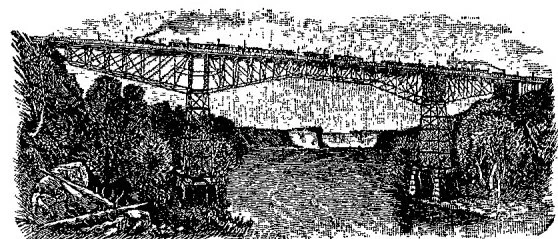
MICHIGAN CENTRAL NEW CANTILEVER BRIDGE, NIAGARA FALLS.
MICHIGAN CENTRAL
“The Niagara Falls Route.”
EAST.
Mail.
Day Express.
N. Y. Express.
Atlantic Express.
Night Express.
Kal. Accom’n.
Local Pass’gr.
STATIONS.
Chicago
am 5.00
am 9.00
pm 3.10
pm 10.10
pm 9.10
pm 4.40
Michigan City
7.23
11.03
4.54
12.23
11.27
6.57
Niles
8.37
pm 12.10
5.49
1.50
am 12.55
8.20
Kalamazoo
10.20
1.40
6.58
3.35
2.27
pm 10.00
pm 5.30
Battle Creek
11.15
2.18
7.33
4.25
3.15
7.55
6.25
Jackson
pm 1.20
4.15
8.49
6.15
4.45
9.35
8.20
Ann Arbor
2.43
5.37
9.41
7.50
6.00
10.40
Detroit
4.10
6.45
10.45
9.20
7.30
11.50
Buffalo
am 3.35
am 6.15
pm 4.55
pm 8.05
Rochester
6.50
9.15
8.00
11.45
Syracuse
9.00
11.35
10.15
am 2.15
New York
pm 7.00
8.50
7.20
11.15
Boston
10.00
10.00
9.35
pm 2.50
WEST.
Mail.
Day Express.
Chicago Express.
Pacific Express.
Evening Express.
Kal. Accom’n.
Local Pass’gr.
STATIONS.
Boston
am 8.30
pm 3.00
pm 9.15
New York
10.30
6.00
11.30
Syracuse
pm 7.40
am 2.10
am 9.05
Rochester
7.55
4.20
11.30
Buffalo
am 2.15
6.15
pm 1.30
Detroit
am 7.30
9.10
pm 1.20
pm 1.05
pm 3.00
pm 4.00
Ann Arbor
8.53
10.40
2.24
11.35
9.15
5.45
Jackson
10.13
11.45
3.27
12.54
10.55
7.10
am 6.25
Battle Creek
pm 12.09
pm 1.16
4.38
2.15
am 12.27
8.5?
7.55
Kalamazoo
12.50
1.55
5.15
3.07
1.20
pm 4.45
8.40
Niles
2.27
3.20
6.27
4.32
3.07
6.40
Michigan City
3.48
4.35
7.32
5.43
4.32
8.03
Chicago
6.10
6.40
9.30
7.45
7.00
10.20
O. W. RUGGLES,
General Pass. & Ticket Agent, Chicago.
O. E. JONES,
Ticket Agent, Battle Creek.