The Youth’s Instructor, Vol. 27, No. 13.

From Sea to Sea: Mining in Nevada

The Youth’s Instructor

Mar 26, 1879

S. D. A. Publishing Association · Battle Creek, Mich. · Mar 26, 1879

From Sea to Sea: Mining in Nevada

FROM SEA TO SEA.—NO. 4.
As we closed our last, we had halted at Reno, Nevada. From this place a branch railroad has been constructed around the mountain by the way of Carson City, the capital of the State, to Virginia City,—a distance of about sixty miles.
Virginia is in the very heart of the mining sections of Nevada; but as our train does not stop here long enough to permit us to visit it, we must content ourselves with making a few inquiries.
There are some good gold mines in Nevada, but the silver mines are so rich that the State has obtained the far-famed title of “The Silver State.”
Much of the Nevada mining is done several hundred feet below the surface of the ground. A large hole like a broad well is dug to a depth of twelve, fifteen, and in some cases more than twenty hundred feet. This is called a shaft. From this central shaft, at various depths, tunnels are run in every direction. The workmen and material are passed up and down the shaft by means of a heavy windlass worked by steam. The rocks forming the top and sides of the tunnels are kept in place by frames made of heavy timbers. The workmen, by the aid of lights fastened to the front of their caps, find their way around in these dark caverns, and dig up the precious gold and silver ore. This is then raised to the surface, and passed to the quartz mill, where it goes through the process described in a former article.
Sometimes the water comes into the mines with such force, and in such large quantities, that the workmen are obliged suddenly to flee to the surface of the ground. Although heavy pumps, worked by powerful steam engines, are kept busy pumping the water out of the mines, the workmen have, in some instances, been overtaken by the water and drowned.
However much we may prize these materials after they are made into money, I do not think any of our readers would esteem these deep, damp mines a very desirable place to tarry in long. No wonder these metals are so highly prized, when it is such a task to obtain them; yet how sad it is to think that so many of the human family shou’d place them as an idol between themselves and their Maker!
As we see men bringing large quantities of gold and silver to the surface, we are forcibly reminded of the psalmist’s declaration, “The earth is full of Thy riches.” It is full of God’s riches, not only on the surface, but beneath the surface. If men find so much by going down a few hundred feet, who knows but a million times more may be buried still farther down? This we do know, that when the earth is renewed by the fires of the day of God, these metals will be much more abundant than now. In describing that state, the Lord has said, “For brass, I will bring gold; and for iron, I will bring silver,” showing that silver and gold will be as plentiful then as iron and brass are now.
Another sad reflection in regard to these mines is occasioned by the sorrow and misery which have been caused by some who controlled them. They divided their mining “stock,” or property, into shares worth about thirty dollars each. They then employed men to examine these mines, and to publish reports of the immense layers of almost solid silver they saw. Suddenly these mining shares increased in value, in one case selling as high as eight or nine hundred dollars per share.
People mortgaged their homes to get money to invest in these mines of wealth. But soon these shares began very rapidly to diminish in value, and, as a gentleman from Reno stated to me, they can hardly be given away now. He further stated that the town of Reno was nearly ruined by this stock speculation, and as the result of the deception practiced upon them, many were even suffering for the necessities of life.
But our train is ready to move. Our course for the next thirty-five miles down the Truckee River to Wadsworth gives us our first sight at sage brush and desert sand, of which we shall see hundreds of miles as we bear on our way over the plains toward the Rocky Mountains.
To look at this desert land, where it seldom rains, one would think nothing could grow here; but for several miles back, on either side of the Truckee River, wherever its waters can be used for irrigation, we see beautiful gardens, flourishing fields of grain, and luxuriant orchards. The limit of vegetation is only the limit of the supply of water for irrigation. But here we come to Wadsworth, where we shall make another halt, as we have a relay of engines, and our train is thoroughly examined.
J. N. LOUGHBOROUGH.

TALITHA CUMI.

BY ROBERT MORRIS, LL.D.,
Secretary of the American Holy Land Exploration.
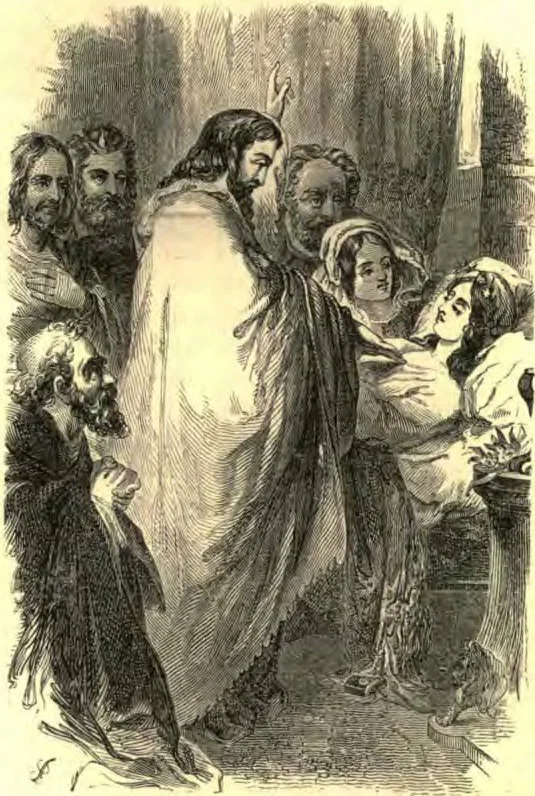
[The story of Jesus and the little daughter of Jairus; as they told it to me at the Sea of Galilee, in 1868.]
By the sea her memory dwelleth, Maiden, well-beloved and fair, And each loving mother telleth How she lay dying there; How she lay, that sweet one, dying! Only child—there was no more— While the oriental crying Swelled the murmurs of the shore: So they tell it by the sea Of the placid Galilee.
How the weeping father hastened, Christ, a present help, to meet; And with awful sorrow chastened, Fell imploring at his feet: Master—oh, my little daughter— Only child—about to die— While the dashing of the water Mocked at his despairing cry: So they tell it by the sea Of the storm-tossed Galilee.
How the Lord, no tarry making, Through the thronged and narrow street, Hastened to a wondrous waking, Such as every saint shall meet. Mattered not though servant coming Said the little one was dead; And the breakers hoarsely booming All the mournful message spread: So they tell it by the sea Of the dirge-like Galilee.
How He found the stricken dwelling, How he clasped the clay-cold hand,— Needless is the further telling, Death obeyed his Lord's command. While those waters roll, the story Of the maiden will remain, Promise of the greater glory When the Christ shall come again: So they think along the sea Of this much-loved Galilee.

Oil on the Troubled Waters

A quantity of oil in the proportion of half a gallon to an acre, poured out on the side of a lake from which the wind blows, will spread itself over the whole surface, and still the waves raised by a tempestuous wind. What a beautiful illustration of those who are peace-makers in families. They pour “oil on the troubled waters.”

LITTLE SCOTCH GRANITE.

DID you ever have a bit of cloth that you thought clean until some time it happened to be laid close by a new piece, and then you saw it was soiled? In a similar way people discover facts about themselves sometimes, as Burt and Johnnie Lee did when their Scotch cousin came to live with them. They were “pretty good boys,” and would have been very angry if anybody had called them deceitful. Well, when their cousin came they were delighted. He was little, but very bright and full of fun. He could tell curious things about his home in Scotland and his voyage across the ocean. He was as far advanced in his studies as they were, and the first day he went to school they thought him remarkably good. He wasted no time in play when he should have been studying, and he recited finely. At night, before the close of school, the teacher called a roll, and the boys began to answer, “Ten.”
When Willie understood that he was to say “ten” if he had not whispered during the day, he replied, “I have whispered.”
“More than once?” asked the teacher.
“Yes, sir,” answered Willie.
“As many as ten times?”
“Maybe I have,” faltered Willie.
“Then I shall mark you ‘zero,’” said the teacher, sternly, “and that is a great disgrace.”
“Why, I did not see you whisper once,” said Johnnie that night after school.
“Well, I did,” said Willie. “I saw others doing it, and so I asked to borrow a book; then I lent a slate pencil, and asked a boy for a knife, and did several such things. I supposed it was allowed.”
“Oh, we all do that,” said Burt, reddening. “There isn’t any sense in the old rule, and nobody could keep it; nobody does.”
“I will, or else I will say, ‘I have n’t,’” said Willie. “Do you suppose I would tell ten lies in one heap?”
“Oh, we don’t call them lies,” muttered Johnnie. “There would n’t be a credit among us at night if we were so strict.”
“What of that if you told the truth?” laughed Willie, bravely.
In a short time the boys all saw how it was with him. He studied very hard, played with all his might in playtime, but according to his own account he lost more credits than any of the rest. After some weeks the boys answered, “Nine” and “Eight” oftener than they used to; yet the school-room seemed to have grown much quieter. Sometimes, when Willie Grant’s mark was even lower than usual, the teacher would smile peculiarly, but said no more of “disgrace.” Willie never preached at them or told tales; but somehow it made the boys ashamed of themselves, just the seeing that this sturdy, blue-eyed Scotch boy must tell the truth. It was putting the clean cloth by the half-soiled one, you see; and they felt like cheats and “story-tellers.” They talked him over and loved him, if they did nickname him “Scotch Granite,” he was so firm about a promise.
“Well, at the end of the term Willie’s name was very low down in the credit-list. When it was read, he had hard work not to cry, for he was very sensitive, and he had tried hard to be perfect. But the very last thing that day was a speech by the teacher, who told of once seeing a man muffled up in a cloak. He was passing him without a look, when he was told the man was General —, the great hero. “The signs of his rank were hidden, but the hero was there just the same,” said the teacher. “And now, boys, you will see what I mean when I tell you that I want to give a little gold medal to the most faithful boy—the one really the most conscientiously ‘perfect in his department’ among you. Who shall have it?”
“Little Scotch Granite!” shouted forty boys at once; for the child whose name was so “low” on the credit-list had made truth noble in their eyes.—S. S. Visitor.

GIVE

Give, as God hath given thee, With a bounty full and free. If he hath with liberal hand Given wealth to thy command, From the fullness of thy store Give thy needy brother more. If the lot his love doth give Is by earnest toil to live; If with nerve and sinew strong Thou dost labor hard and long,— Then, e'en from thy slender store, Give, and God shall give thee more.

THE BOYHOOD OF JESUS.

It is a fact of great interest, to the children especially, that Jesus was once a child; that he enjoyed the pleasures, engaged in the duties, and felt the sorrows, of childhood. And he knows how to sympathize with the children now, even as when, a child, he rambled with his little brothers over the hills of Nazareth, or patiently labored beside his father in the carpenter’s shop. The following, from Farrar’s Life of Christ, gives an interesting description of the surroundings and early life of our Saviour. M. A. D.]
His outward life was the life of all those of his age and station, and place of birth. He lived as lived the other children of peasant parents in that quiet town, and in a great measure as they live now. He who has seen the children of Nazareth in their red caftans and bright tunics of silk or cloth, girded with a many-colored sash, and sometimes covered with a loose outer jacket of white or blue,—he who has watched their games, and heard their ringing laughter as they wander about the hills of their little native vale, or play in bands on the hillside beside their sweet and abundant fountains, may perhaps form some conception of how Jesus looked and played when he too was a child.
And the traveler who has followed any of these children, as I have done, to their simple homes, and seen the scanty furniture, the plain, but sweet and wholesome food, the uneventful, happy, patriarchal life, may form a vivid conception of the manner in which Jesus lived. Nothing can be plainer than those houses, with the doves sunning themselves on the white roofs, and the vines wreathing about them. The mats, or carpets, are laid loose along the walls; shoes and sandals are taken off at the threshold; from the center hangs a lamp, which forms the only ornament of the room; in some recess in the wall is placed the wooden chest, painted with bright colors, which contains the books or other possessions of the family; on a ledge that runs round the wall, within easy reach, are neatly rolled up the gay-colored quilts which serve as beds, and on the same ledge are ranged the earthen vessels for daily use; near the door stand the large common water-jars of red clay, with a few twigs and green leaves—often of aromatic shrub—thrust into their orifices to keep the water cool.
At meal-time a painted wooden stool is placed in the center of the apartment, a large tray is put upon it, and in the middle of the tray stands the dish of rice or meat, or libban, or stewed fruits, from which all help themselves in common. Both before and after the meal the servant, or the youngest member of the family, pours water over the hands from a brazen ewer into a brazen bowl. So quiet, so simple, so humble, so uneventful, was the outward life of the family of Nazareth.

DUTIES OF THE SUPERINTENDENT.

The Superintendent’s first work will be to classify the school. Although it is a work requiring judgment and care, the classification should be promptly and quietly made, with the understanding that, when necessary, scholars will be transferred from one class to another till they have found their proper place.

CLASSIFYING THE SCHOOL.

Most schools are naturally divided into four divisions,—adults, or grown-up people; youth, or young people from fifteen to twenty; children, or boys and girls from ten to fifteen; and little ones, or those under ten years of age. The little ones may be called the 1st, or Infant Division; the children, the 2d, or Children’s Division; the young people, the 3d, or Youth’s Division; and the adults, the 4th, or Senior Division.
When convenient, it will be best to arrange those in each of these periods of life in classes by themselves; but if there be too few of either kind to make an interesting class, they may be placed with those considerably older, or with those considerably younger than themselves.
In large schools it is better to have the different sexes in different classes, except in the case of little ones, who might as well be together. In small schools the classes may have to be made up with very little regard to sex.
The youth and children should be classified, as nearly as possible, according to their age and aptness for learning.
There should be in each class not less than three, nor more than ten. When teachers are plenty, it will probably be best to have about six members in each class; but if the teachers are few, the classes may have to be considerably larger. No one should be placed in a class where the lessons are too difficult for him; yet it is better to have large classes with good teachers, than small classes with poor teachers.

APPOINTMENT OF TEACHERS.

No part of the Superintendent’s work will test his judgment and discretion more than the appointment of teachers.
As in every other part of the work of God, so in the Sabbath-school work; the highest qualification is the indwelling of the Holy Spirit, bearing its fruit of faith, love, and good works.
The Sabbath-school teacher who takes hold of the work unwillingly, grudging the time and labor requisite to success, will be likely to beget the same spirit in his class. Love of God, of the truth, and of mankind, must prompt every successful worker.
The Sabbath-school teacher must love the truths which he teaches. That love must glow in his heart till it will show itself in his countenance, in his words, and in every modulation of his voice. Such a teacher carries a kind of inspiration with him.
The teacher must be earnest, active, faithful, free from sentimentalism and affectation. Persons who have all these qualifications are not easily found, but the Superintendent must use the best material at hand, and try to develop the qualities that are lacking. Those who do not know how to teach, can learn. Those who lack love, and faith, and earnestness, and activity, should be encouraged to seek God for aid in acquiring these graces.
Other things being equal, young women generally make the best teachers for children. An intelligent, godly young woman who loves the lambs of the fold because Christ died for them, and who has some tact in teaching, is a priceless blessing to a Sabbath-school. So far as their character and qualifications will allow, young people should be pressed into the Sabbath-school work. Not that the work should be left to them, but that they may bear a part of the burden, and be gaining an experience that will fit them for usefulness. As a rule, young people can be more easily molded into successful teachers than older people, whose habits in life have become fixed.

ASSIGNING LESSONS.

It is usually better for the Superintendent, after counseling with the teachers, to assign the lessons for each division; for by so doing the different classes of each division are kept together. It is important that the Superintendent should be familiar with the lessons of every division; for if he is not, he will be unable to assign lessons properly, or to conduct the general exercises profitably. G. H. BELL.

BIBLE LESSONS FOR YOUTH.

LESSON XXXIX.—THE TABERNACLE.

  1. Of what did God show Moses a pattern when he was in the mount? Read Heb. 8:1, 2, 5; 9:23.
  2. How long was Moses in the mount at this time? Ex. 24:18.
  3. What did the Lord invite the people to do? Ex. 25.
  4. What was to be done with these materials? Verse 8.
  5. How was Moses charged to build the sanctuary?
  6. Where do we find a description of it?
  7. What kind of structure was it?
  8. How large was it?
  9. Of what were the walls made?
  10. How were the boards bound together at the bottom?
  11. How at the sides?
  12. How many coverings had it?
  13. Describe the inner covering.
  14. Describe the other coverings.
  15. How was the sanctuary itself divided?
  16. How were these apartments separated?
  17. Where was the entrance to the sanctuary?
  18. How was it closed?
  19. What was this curtain called?
  20. What name was given to the curtain that separated the two apartments?
  21. How was the tabernacle surrounded?
  22. How large was the court?
  23. How was it inclosed?
  24. Describe the gate of the court?

SYNOPSIS.

When Moses was in the mount, God showed him a pattern of the heavenly sanctuary. The last words of Exodus 24, and the first of Exodus 25, are as follows:—
“And Moses went into the midst of the cloud, and gat him up into the mount; and Moses was in the mount forty days and forty nights. And the Lord spake unto Moses, saying, Speak unto the children of Israel, that they bring me an offering: of every man that giveth it willingly with his heart ye shall take my offering.”
Then follows an enumeration of the materials that were to be brought as offerings; and in verse 8 he says, “And let them build me a sanctuary that I may dwell among them.” In verse 9 Moses is charged to build the sanctuary according to the pattern given him.
The remaining verses of the chapter, and the chapters that follow, give a careful description of the tabernacle and its vessels.
It was a movable structure, thirty cubits long, ten cubits wide, and ten cubits high. By our mode of measuring, the width and height were each about eighteen feet, and the length fifty-four. The walls were made of boards of shittim wood, bound together at the bottom by sockets and tenons, and at the sides by bars of shittim wood passing through rings of gold.
It had four coverings of different material. The inner covering was of gold and purple and scarlet and fine-twined linen, wrought with figures of cherubim. These were to represent the heavenly host in the sanctuary above. Dan. 7:10; Rev. 5:11. The second covering was of cloth woven from goats’ hair; the third was made of rams’ skins, dyed red; and the fourth, or outer covering, of badgers’ skins.
The sanctuary itself was divided into two apartments, which were separated by a curtain of the same material as the inner covering. The entrance to the sanctuary was at the east end, and was closed by a curtain similar to the one that separated the two apartments. This is called the hanging of the door of the tabernacle, and is sometimes considered as the first vail. The curtain that separated the two apartments is called the second vail, and sometimes simply the vail.
The tabernacle was surrounded by an open space called the court. This court was one hundred cubits long, and fifty cubits broad, or about eleven by five and a half rods. The wall that inclosed it was five cubits high, and consisted of a curtain of fine-twined linen, supported by brass pillars. On the east end of the court, for the distance of twenty cubits, the curtain was of finer material, and curiously embroidered in the most beautiful colors. This was called the gate of the court. G. H. BELL.

LESSONS FOR CHILDREN.

LESSON XIII.—OTHNIEL AND EHUD.

AFTER the death of Joshua, the children of Israel did evil in the sight of the Lord and served other gods,—the gods of the people that were round about them. Then the Lord let their enemies prevail against them, and his chosen people were made to serve other nations; yet the Lord pitied them, and at times raised up judges who delivered them from their enemies; but when the judges died, the people went back to their old ways, and served idols again.
First among the judges was Othniel, son-in-law of Caleb; the next was Ehud, a brave man of the tribe of Benjamin. He was sent with a present to Eglon, king of Moab, who had made the children of Israel serve him eighteen years. When Ehud had given the present to the king, and started on his journey homeward, he turned back, and, coming before the king, said, “I have a secret errand unto thee, O king;” and the king said, “Keep silence,” and all that stood by him went out from him. Then Ehud said to the king, “I have a message from God unto thee,” and drew out a hidden dagger and killed the king in his own chamber.
When Ehud left the king’s chamber, he locked the door behind him, so that none might know what he had done, and then he fled to his own country, where he gathered the men of Israel, and went out against the Moabites, and subdued them.
“And after him was Shamgar the son of Anath, which slew of the Philistines six hundred men with an ox-goad.”
Then the land of Israel had rest eighty years.

QUESTIONS.

  1. What course did the children of Israel pursue after the death of Joshua?
  2. What evil did the Lord suffer to come upon them?
  3. How did he at times show his pity for them?
  4. What course did the people take after the judges died?
  5. Who was their first judge and deliverer?
  6. Who was the second?
  7. On what errand was Ehud sent?
  8. How long had Eglon, king of Moab, made the children of Israel serve him?
  9. What did Ehud do after he had given the present to the king, and had started on his journey homeward?
  10. What did he say when he came before the king the second time?
  11. What did the king say to those that stood by him?
  12. What did Ehud do when the king’s attendants all went out?
  13. How did Ehud keep the king’s attendants from finding out what had been done?
  14. What did he do when he reached his own country?
  15. What other noted worthy is mentioned?
  16. What brave act is recorded of him?
  17. How long did the land of Israel have rest at this time?

LYING

We can lie without saying a word. If a man sells me a basket of apples that has the good ones all on top, and bad ones underneath, he lies to me. He says by his acts that all the apples are as good as those I can see. I do not know that the man lies, until I empty the basket, but God knows it all the time.
A boy lies if he makes believe he has learned his lesson when he has not learned it. There are a great many modes of lying. We lie to God when we make good prayers and do bad acts, but lies are all wrong, because God has forbidden them.—Apples of Gold.

SAM'S NEW TEACHER.

We have a new dog at our house that is more kind and neat than some boys I know. Sometimes Sam runs in from play with his muddy boots, and leaves tracks all over the kitchen oil-cloth which poor tired Susan has just washed.
The dog has learned to wipe his paws on the door mat. When he sees how careless Sam is, he goes from one foot-print to the other, barking at each one, and looking up at Sam as if to say, “Why can’t you be as neat as a dog, and as careful to save hard work for a poor girl?” Doggie barks very loud, as if scolding, when Sam throws his cap, coat, and gloves on a sofa or chair; and the little fellow begins to know what the dog means, for when he hears the loud “Bow wow,” he runs and hangs up his cap.

AN AWFUL STORY.

[Not a few children, boys as well as girls, have the sad habit of prefixing the word awful to many of the commonest things they say. Such an improper way of talking is quite pointedly corrected in the following paragraph from the English Chatterbox of 1878. E. N. N.]
THERE was once an awful little girl who had an “awful” to everything. She lived in an awful house, in an awful village, which was an awful distance from every other awful place. She went to an awful school, where she had an awful teacher, who gave her awful lessons out of awful books. Every day she was so awful hungry that she ate an awful amount of food, so that she looked awful healthy. Her hat was awful small, and her feet were awful large. When she took an awful walk, she climbed awful hills; and when she got awful tired, she sat down under an awful tree to rest. In summer she was awful hot, and in winter she was awful cold. When it did n't rain, there was an awful drouth; and when the awful drouth was over, there was an awful rain. So this awful girl has come to an awful way of speaking, and if she does not get rid of this vulgar way of saying “awful” about everything, I fear she will by-and-by come to some awful end.

THE CROWN OF ENGLAND.

The crown of England is a costly “bauble,” bedazzled with jewels enough to found three or four public charities, or a half dozen ordinary colleges. There are twenty diamonds around the circle, worth $7,500 each, making $150,000; two large center diamonds, $10,000 each, making $20,000; fifty-four smaller diamonds, placed at the angle of the former, each $500; four crosses, each composed of twenty-five diamonds, $60,000; four large diamonds on the top of the crosses, $20,000; twelve diamonds contained in the fleur-de-lis, $50,000; pearls, diamonds, etc., upon the arches and crosses, $59,000; also, one hundred and forty small diamonds, $25,000; twenty-six diamonds in the upper cross, $15,500; two circles of pearls about the rim, $15,000. The cost of the stones in the crown, exclusive of the metal, is, therefore, nearly half a million of dollars.

A PRIZE CHARACTER.

A farmer who for several years took the first prize for potatoes was asked one day the reason why his potatoes were so much better than his neighbors'.
“There is no magic about it,” he said. “Thorough ploughing or digging of the soil, a careful choice of seed, a frequent stirring of the surface, and every weed pulled up,—these are the secrets of success.”
And these are the secrets of success in spiritual husbandry. The soil of the heart must be carefully prepared, the best seeds of truth planted in it; there must be frequent stirrings and quickenings, and every weed pulled out. This will make a character to be prized. Youth is a good time to prepare the heart for the good seed of the word.—Child's World.

READY FOR DUTY.

DAFFY-DOWN-DILLY came up in the cold, Through the brown mold, Although the March breezes blew keen on her face, Although the white snow lay on many a place.
Daffy-down-dilly had heard underground The sweet rushing sound Of the streams as they burst off their white winter chains— Of the whistling spring winds and the pattering rains.
“Now, then,” thought Daffy, deep down in her heart, “It’s time I should start.” So she pushed her soft leaves through the hard, frozen ground, Quite up to the surface, and then she looked round.
There was snow all about her, gray clouds overhead, The trees all looked dead; Then how do you think Daffy-down-dilly felt When the sun would not shine and the ice would not melt?
“Cold weather!” thought Daffy, still working away; “The earth’s hard to-day; There’s but a half-inch of my leaves to be seen, And two-thirds of that is more yellow than green.
“I can’t do much yet, but I’ll do what I can; It’s well I began; For unless I can manage to lift up my head, The people will think that spring herself’s dead.”
So little by little she brought her leaves out, All clustered about; And then her bright flowers began to unfold, Till Daffy stood robed in her spring green and gold.
Oh, Daffy-down-dilly, so brave and so true! I wish all were like you: So ready for duty in all sorts of weather, And showing forth courage and beauty together.

A Golden Rule for Diligent Work

WHATEVER work you have in hand, At home or at your school, Do your best with right good-will; This is a golden rule.

LETTER BUDGET.

A LITTLE boy who forgot to sign his name writes from Tapleyville, Mass.:
I have been keeping the Sabbath more than a year. I have been taking the monthly INSTRUCTOR, but now I am taking the weekly. I attend Sabbath-school every Sabbath when I am well enough. Sometimes mother thinks it is too cold for me to venture out; but I tell her it is warm enough.
I have lent my papers to many persons, who say they are very nice. I have attended many of Eld. Canright’s meetings; my mother used to attend with me, and before Eld. C. went away we decided to keep the Sabbath.
PLYMOUTH, MICH.
DEAR EDITORS: I cannot canvass much for the INSTRUCTOR now, for I attend school, and the snow has been deep; also, the scarlet fever is raging here. I have only received one subscriber for the paper. I will yet try to do all I can to circulate it. May be I can get pa and ma to sign.
Yours truly,
METTIE M. PLACE.
OXFORD MILLS, IOWA.
DEAR EDITORS: I get the INSTRUCTOR every week in the Sabbath-school at Clarence, and learn my lesson from it. I have three brothers who attend the same school. I am seven years old. I want to be a good girl, and meet you all on Mount Zion.
MAY L. FIELD.

You have reached the end of this edition.

The Youth’s Instructor · Mar 26, 1879